How I turn customer and market conversations into a month of thought leadership using Fathom, ChatGPT and Oleno
Most AI content workflows start with a blank prompt.
Someone opens ChatGPT and asks for 20 content ideas about GEO. Then they pick one and ask it to write the article. Maybe they add a brand guide, maybe they use a custom GPT, maybe they spend another hour tweaking the prompt so the draft doesn't sound like every other AI-written SaaS article.
The thing that bugs me about this workflow is that we're asking the AI to come up with the insight too.
Nobody asked the question. No customer raised the objection. Nothing changed in the product. Nobody on the team had some weird thought in a meeting that made everyone stop and think about the market differently.
We're basically asking an LLM to invent something interesting from its general understanding of the internet, then wondering why so much AI content feels generic.
I've started working in almost the opposite direction.
Companies already produce a ridiculous amount of useful source material every week. Customer calls, sales conversations, founder discussions, product meetings, support tickets, win/loss calls, competitive research, internal debates. There's usually no shortage of things worth talking about.
The problem is that most of it disappears into Fathom recordings, Slack threads, meeting notes and people's heads.
So I've been experimenting with a workflow where AI isn't really responsible for inventing the insight. Its job is to help find the useful stuff, figure out which ideas are worth developing, connect those ideas back to our positioning and GTM strategy, then help me actually execute the content.
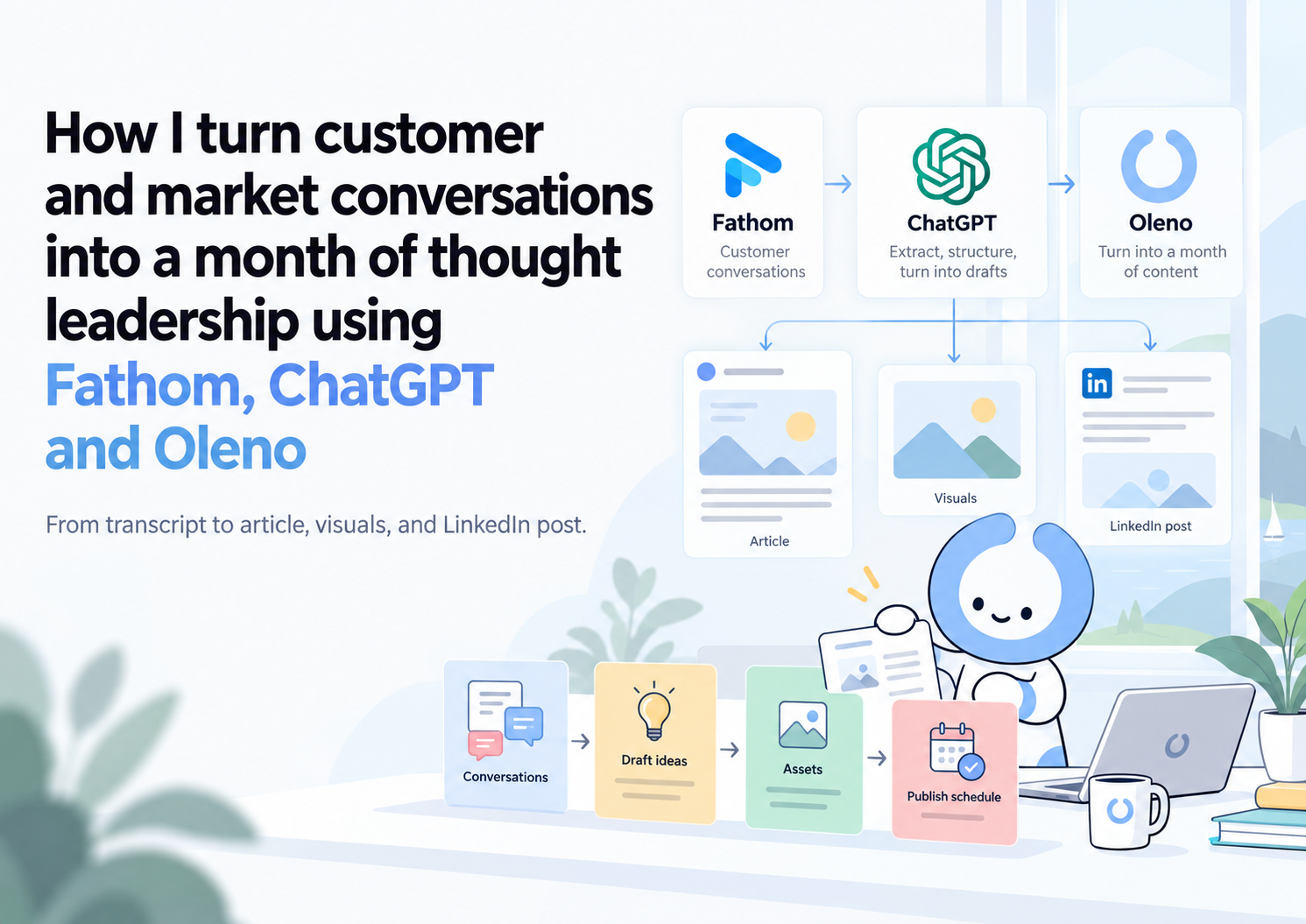
I recently ran the whole process using Fathom, ChatGPT and Oleno.
It started with one conversation that was roughly 45 minutes long. That call eventually became the foundation for a four-week thought-leadership calendar with 20 potential articles. Then I took one of those ideas all the way through research, writing, editing, visual production and a LinkedIn post.
And importantly, this wasn't some perfectly automated pipeline where I pressed a button and disappeared.
I rejected stuff. We redid parts of the workflow. I changed the input when it was producing the wrong kind of writing. I reviewed the article. I made the editorial calls.
That's actually a big part of why I think the workflow worked.
Watch the workflow on YouTube.
It started with a normal market conversation
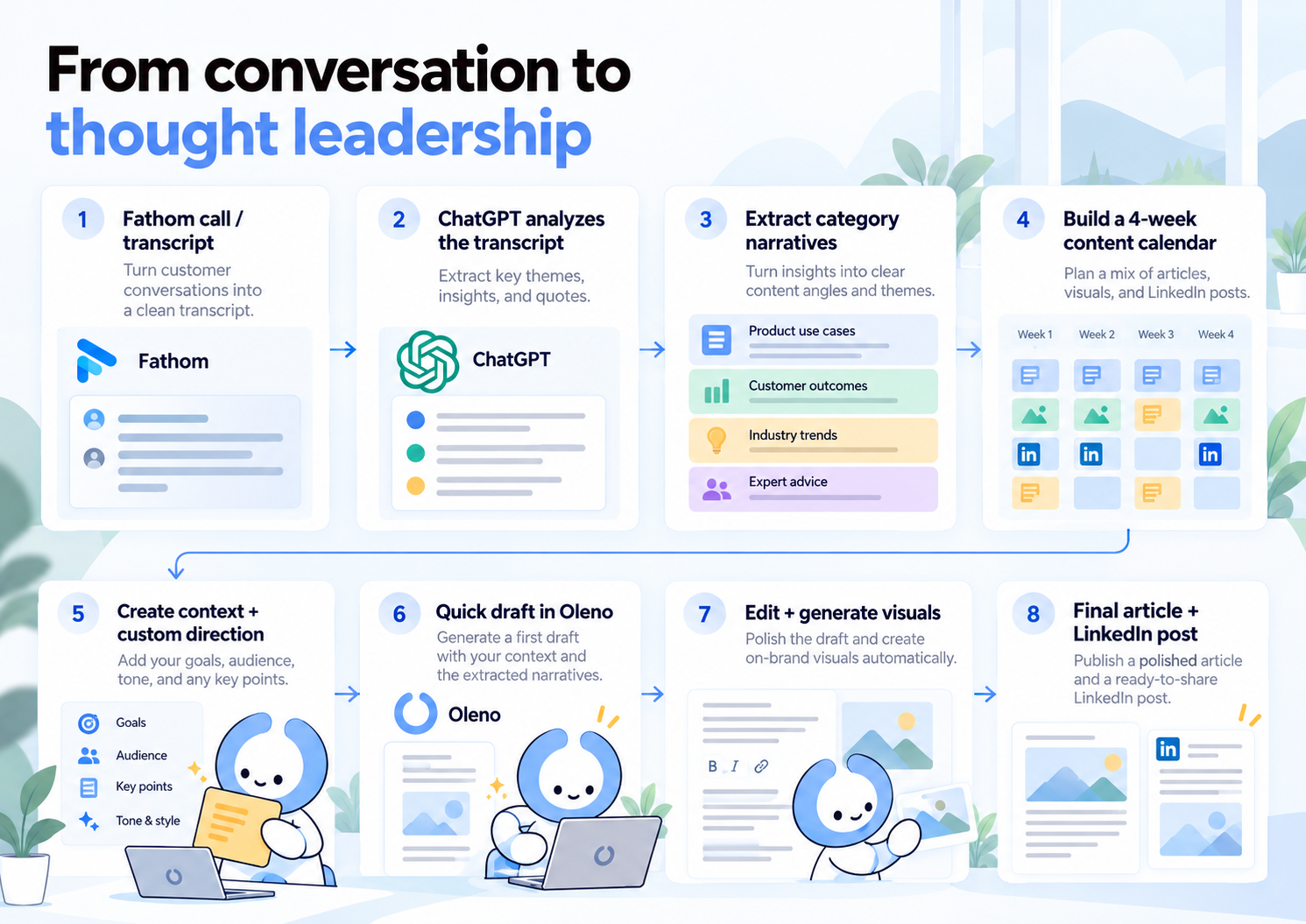
The original call was with another SaaS operator. We were talking about GEO and AI search, but it wasn't a content interview and we definitely weren't trying to brainstorm a month's worth of blog posts.
We were just trying to understand what was changing.
We started talking about how buyers find software. His market relies heavily on word of mouth, so a lot of prospects know the company exists before they start doing any serious online research. The research happens afterward when they're trying to figure out whether the company is actually good, whether it fits their use case, and whether they feel comfortable buying.
That led us into buyer enablement and product marketing. Then we started talking about AI search, how competitors can influence the language an AI uses to explain a category, whether citations actually matter, why very long-tail content suddenly becomes economical, and whether the content that's hardest to fake becomes more valuable when anyone can generate competent prose.
One thought kept setting off another one.
After the call, I had the feeling there were probably weeks of content sitting in there.
Obviously not every call deserves this treatment. Some conversations are routine. Some contain private customer information that shouldn't go anywhere near public content. Sometimes there just isn't a useful idea.
But there are also calls where somebody says something you keep thinking about an hour later.
Those are the ones I care about.
I wanted the transcript, not the Fathom summary
I asked ChatGPT to use the Fathom MCP connection and pull the call.
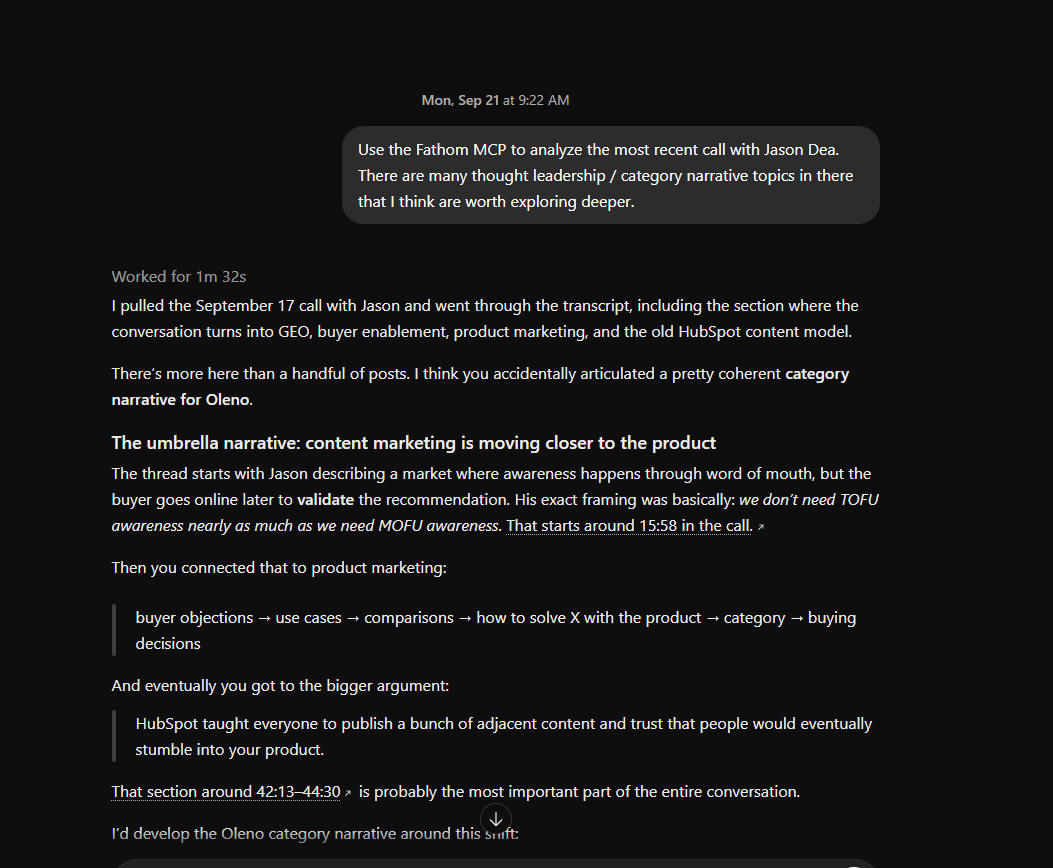
One of the most important things I did was specifically ask for the full transcript instead of relying on the meeting summary.
Fathom summaries are great at what they're supposed to do. If I need to know what happened on a call, what we decided, who owns which next step, that's exactly what I want.
But a good meeting summary throws away a lot of the stuff I care about when I'm looking for thought leadership.
I want the half-finished thought someone never came back to. I want the weird analogy that probably wouldn't make the meeting notes. I want the point where somebody makes a strong statement and then immediately qualifies it. I want to see where we disagreed, or where one topic unexpectedly turned into another.
That's usually where the good stuff is.
So instead of saying:
Summarize this call and give me the key takeaways.
The instruction was much closer to:
Read the full transcript and find the category narratives, unfinished arguments and ideas worth developing. Separate tactical observations from things we could actually build a point of view around. Flag areas that need evidence and connect the ideas back to what we're already saying about the market.
Those requests sound similar, but they're doing completely different jobs.
A summary is trying to make the conversation smaller.
I wanted ChatGPT to help me think about what else might be inside it.
You don't need MCP to do this. You can export a transcript and drop it into whatever AI workspace you use. MCP just meant I didn't have to bounce between Fathom, download the transcript and upload it again.
The more important part was changing the job I was giving the AI.
One call gave us several arguments worth pursuing
What came back wasn't particularly interesting because it had catchy article titles. It was interesting because there were several bigger arguments hiding inside the conversation.
One was product marketing is eating content marketing.
We'd been talking about how content marketing spent years getting really good at attracting people around a problem, while product marketing stayed much closer to the buying decision itself. Who is this for? What does it actually do? How is it different? What are the tradeoffs? Will it work for this specific situation?
Those are also the kinds of questions buyers are increasingly asking AI.
Another one was GEO is distributed positioning.
There's a lot of GEO advice around metadata, schema and making content easier for models to retrieve. Some of that is useful, but we kept coming back to a bigger issue: an AI doesn't understand your company from the positioning slide your marketing team approved.
It's piecing together an understanding from your site, reviews, comparison pages, customer stories, Reddit, partner pages, competitors and whatever else it can find.
That starts looking a lot more like a positioning problem than an SEO checklist.
That thought led directly into if you don't position the market, your competitors will. We were looking at AI answers where competitor content wasn't just appearing as a source. It was helping explain what the category meant and what criteria buyers should care about.
Then there was your source material becomes the moat.
If everyone can generate reasonably good prose, putting 1,500 grammatically correct words on a page isn't much of an advantage anymore. Knowing something competitors don't know is.
Customer conversations. Product expertise. Proprietary data. Sales objections. The weird stuff your company learns from doing the work every day.
And that connected to AI makes the long tail economical again.
I'm not particularly excited about using AI to make 100 generic SEO articles cheaper. I am interested in making it economical to answer hundreds of very specific buyer questions that previously weren't worth assigning to an expensive writer.
All of that came out of one conversation.
At this point we still hadn't written anything.
We turned those ideas into a month-long argument
The next temptation would have been to take all the ideas and turn them directly into posts.
I didn't want that either.
If I publish five unrelated things a week, I might have a full content calendar, but I haven't necessarily built a point of view.
So we started organizing the ideas based on how they related to each other.
Week one became about how content marketing had drifted too far away from the product. Week two moved that argument into GEO and positioning. Week three asked what becomes valuable when content itself becomes basically infinite. Week four started getting into what the operating system for content looks like when you're reacting to real market signals instead of filling slots on a calendar.
Under those larger themes we mapped out the supporting articles.
That's how the one conversation eventually turned into around 20 ideas.
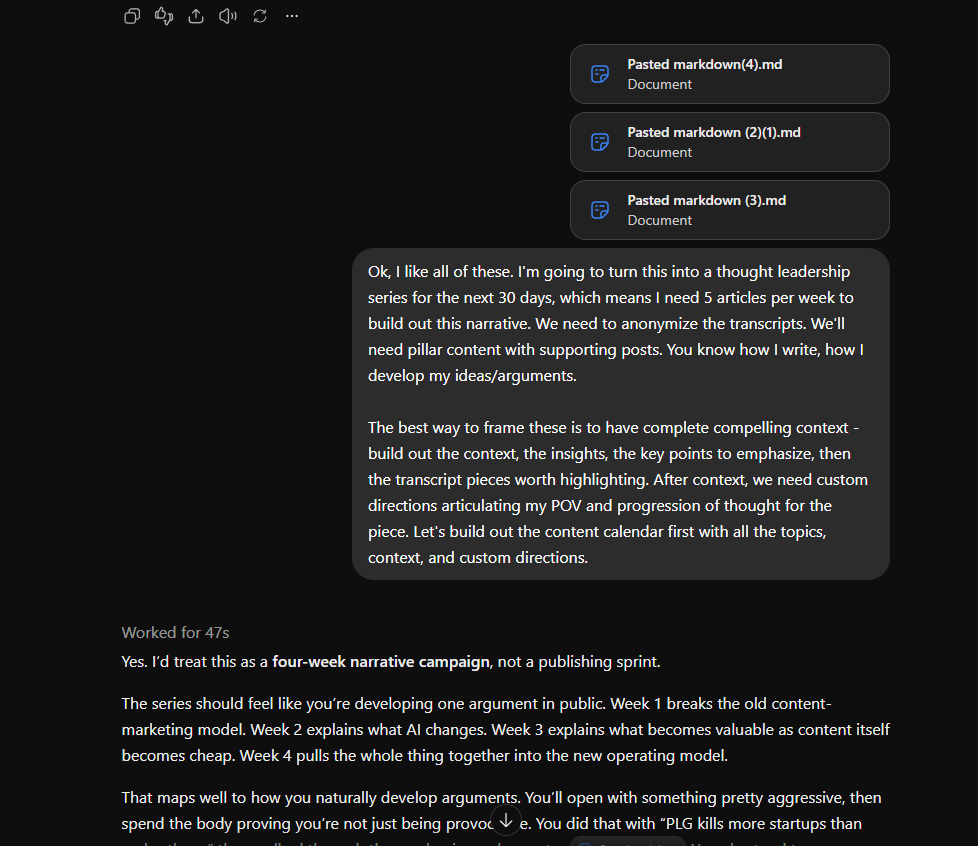
The number isn't really the point. I could have asked ChatGPT for 20 GEO topics in 30 seconds.
What mattered was that the articles belonged to the same argument.
One post establishes something that the next post can build on. A tactical idea supports the larger positioning argument. Something we observe in week one gets pushed further in week three.
It starts to feel more like developing a body of thought than filling a publishing schedule.
Then I picked one idea and went much deeper
The article I chose was AI Citations Are Becoming the New Rankings.
The initial thought was pretty simple.
Marketers are starting to treat citations as the AI-search version of Google rankings.
I understand why. Rankings were measurable. Citations are measurable. We all want something we can stick on a dashboard and track over time.
But an AI citing your website isn't necessarily the same thing as a buyer seeing your company, understanding what it does, or considering buying it.
The AI could use your article to explain the category, then recommend three competitors.
That was the argument I wanted to work through.
And this is where I think our process got a lot better, because we didn't immediately ask Oleno to "write an article about AI citations."
We first built out two separate things: the context and the custom direction.
Context and direction are doing different jobs
Our first attempt at this actually sucked.
ChatGPT created a beautiful article brief. The argument was broken into clean sections, every takeaway was neatly defined, the progression made sense, and it looked exactly like the kind of brief you'd expect an AI to produce.
I read it and thought: if the input already sounds like AI, why would I expect the writing coming out the other side to sound like me?
We'd polished all of the thinking out of it.
So we redid the context.
The second version looked much more like the way I actually think about an idea. What happened in the original conversation. Why I cared about it. Examples I might want to use. Research that seemed relevant. Things I wasn't sure about yet. Connections to positioning. Claims I didn't want to overstate. Places where I could see an argument but hadn't completely worked out the conclusion.
Some thoughts repeated. Sometimes I'd make a strong claim, then come back later and soften it. There were contradictions and unfinished parts.
That was fine.
It gave the writer the reasoning instead of just the finished answer.
For example, a normal brief might say:
Citations are not the same as consideration. Explain the difference.
Our context went much further into why I was thinking about the distinction in the first place.
Marketers are used to rankings. Citations are one of the first things in AI search that feel similarly concrete. Which means we're probably going to put them on dashboards, and then agencies will start selling citation growth, and then we'll optimize toward the number.
But what exactly does the number mean?
Maybe ChatGPT used our article to define a term but never mentioned our company. Maybe it cited us in an informational answer but left us out when someone asked which vendors they should evaluate. Maybe we showed up, but it described the company completely wrong.
Those are all very different outcomes.
That gives the writer something to work with.
The custom direction does something else.
Direction is where I tell the writer how I want the idea handled. Don't turn this into a five-step framework. Don't pretend citations are useless just because we're criticizing the metric. Don't turn every sentence into its own paragraph. Let the reasoning take some space. If there's a stronger conclusion hidden inside the source material, follow it.
I've started thinking about the distinction like this:
Context is what I know and what I'm thinking. Direction is how I want the writer to work through it.
That sounds obvious, but it changed the output quite a bit.
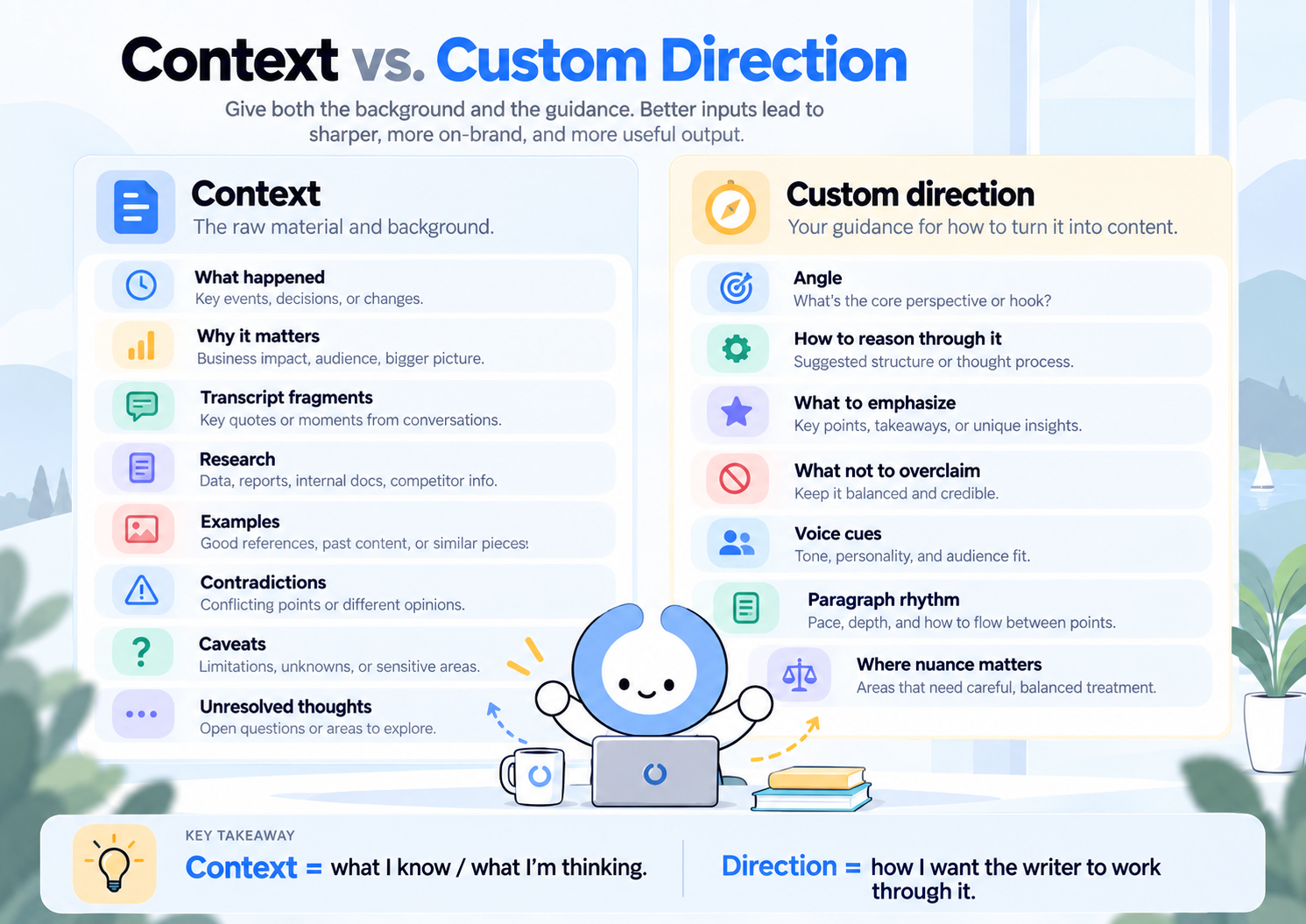
When I try to jam all of the facts, thinking, structure, tone and desired conclusion into one giant super-prompt, I usually end up over-prescribing the piece.
And then it reads like it.
ChatGPT handed the full thinking into Oleno
Once the context and direction felt right, ChatGPT called Oleno through MCP and created a Quick Draft.
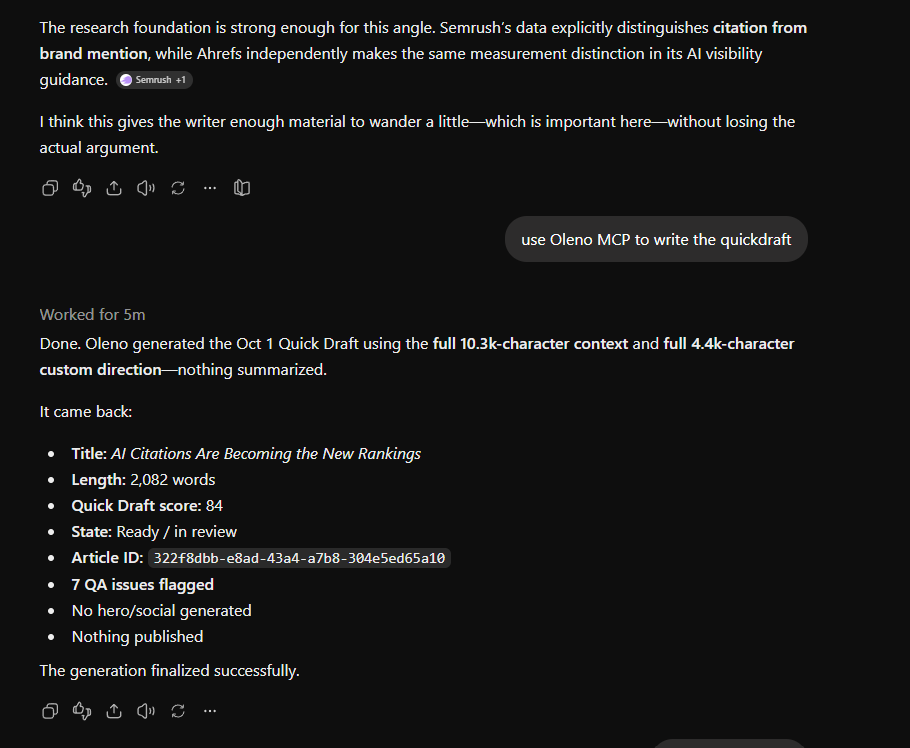
This is where the workflow started feeling meaningfully different from using three separate AI tools.
I wasn't getting text from ChatGPT, copying it into Oleno, generating another thing, copying that back, then manually trying to remember which version was current.
ChatGPT could take the context we'd just developed together and pass the full thing into the writing system.
I specifically didn't want it summarized.
We'd spent all that time preserving the messy reasoning. Compressing it right before generation would have defeated the point.
Oleno then had those inputs plus the company governance already inside the platform: our positioning, market POV, audiences, product information, use cases, writing conventions, author voice, visual identity and brand assets.
The first draft came back at a little over 2,000 words.
It was pretty good.
It also wasn't done.
I still edited the draft
I pulled the article back into ChatGPT and read it.
This pass wasn't about asking the AI whether the article was "good." I know the patterns I'm usually looking for by now.
Paragraphs that all have the same shape. Four short sentences in a row that sound dramatic but don't actually need to be separate. Neat little "this is where X becomes Y" transitions. The same idea explained three times using slightly different words. Stuff that sounds too polished for the way I actually talk.
So we cleaned it up.
The finished article ended up around 1,876 words.
I still made the calls on what stayed, what got cut, which argument needed more nuance and whether it actually sounded like something I'd publish.
This is why I don't think an "agentic" workflow needs to mean autonomous.
I want the system to do more work.
I don't particularly want it making every judgment for me.
We used the same workflow for the visuals
Once the article was in good shape, I asked ChatGPT to pull our Design Studio setup from Oleno.
That brought back the actual visual governance instead of relying on me to describe the brand again from memory. Our palette, hero-image rules, mascot reference, composition rules, even details like what different accent colours mean.
Then we looked at the article and decided what visuals would actually help explain it.
We generated the hero AI Citations Are Becoming the New Rankings, plus three inline graphics: Citation ≠ Consideration, Different Prompts Do Different Jobs, and Retrieval Is Only the First Layer.
I like this kind of visual a lot more than decorative AI art.
If a section is explaining the difference between a citation and actual buyer consideration, give me an infographic that helps someone see that distinction. If I'm comparing informational prompts with buying/comparison prompts, show the comparison.
The visual should do some of the teaching.
Then ChatGPT went back through the Oleno MCP, pushed the cleaned article into the existing draft, pulled the valid image positions for that exact revision, and placed the graphics where they made sense.
I told it I approved its placement judgment.
The first graphic went after the citation-versus-consideration argument. The prompt comparison went beside that example. The retrieval graphic went into the positioning section.
It uploaded them, added the alt text and attached everything to the current article.
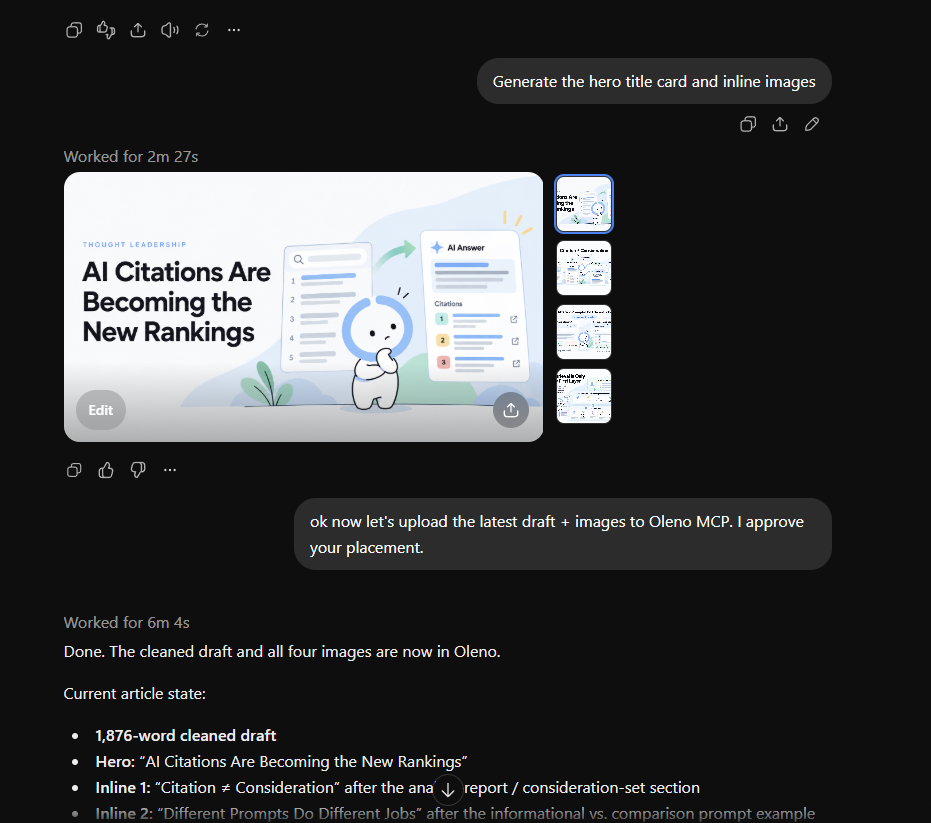
I didn't touch the CMS.
The LinkedIn post started from the finished article too
Once the article was done, we used Oleno again to create the LinkedIn version.
This sounds like a small detail, but I think it's important.
We didn't open a new prompt and say:
Write me a LinkedIn post about AI citations.
The finished article was the source.
So everything we'd already figured out about the argument came with it. The original conversation, the broader narrative, the context, the caveats, positioning, the edited article.
The first LinkedIn draft still had a few AI tells, so I cleaned those up too.
Again, the point wasn't that a machine did literally everything.
The useful part was that we weren't rebuilding the thinking from scratch every time we changed formats.
ChatGPT was doing a different job by the end
At the start of this workflow, it would be easy to describe ChatGPT as the writing tool.
By the end, that doesn't really describe what it was doing.
Fathom was capturing what actually happened in a market conversation.
Oleno was holding the company context and handling the governed production work.
ChatGPT was sitting between them. It pulled information from one system, helped me reason through it, made decisions with me, then took supported actions in another system.
That's starting to look a lot more like an operator than a copywriter.
A good marketing operator doesn't personally write every word, design every graphic, update every CMS field and manually move every artifact between tools. They figure out what matters, develop the argument, make sure the right context follows the work, bring in the right systems and review the result.
There's a meaningful amount of that work AI can help with now.
Not unattended.
But definitely not just autocomplete either.
You can do a simpler version without this exact stack
You don't need Fathom, ChatGPT and Oleno specifically to steal the useful parts of this.
A simpler version looks something like this:
- Start with a real conversation where something interesting actually happened. Get the full transcript and remove anything private that doesn't belong in public content.
- Ask AI to analyze the conversation for unfinished arguments, buyer questions, market shifts and ideas connected to your existing POV. Don't just ask for a summary.
- Group related ideas into a larger narrative before turning everything into article titles.
- Pick one piece and create a real context dump: examples, thinking, evidence, caveats, contradictions, things you're unsure about. Then write separate direction for how you want the writer to handle it.
- Generate the draft using your current positioning, product truth, audience context and writing guidance. Review the argument before obsessing about sentence-level polish.
- Create visuals where they explain something useful, then derive the social/email/etc. versions from the finished article instead of restarting from a blank prompt.
You can do every transfer manually if you want.
It's slower, but the underlying idea still works.
The important thing is keeping the chain of reasoning intact.
The interesting part is that context keeps accumulating
This is the part I keep coming back to.
Think about what normally happens after somebody says something interesting on a call.
The call becomes meeting notes. The notes become a content brief. The brief goes to a writer who wasn't on the call. An editor tries to put the point of view back in. A designer gets a headline and makes something vaguely related to it. Then somebody on social reads the final article and summarizes it again.
It's basically a long game of telephone.
Every handoff strips something out.
What I like about this workflow is that it can run in the other direction.
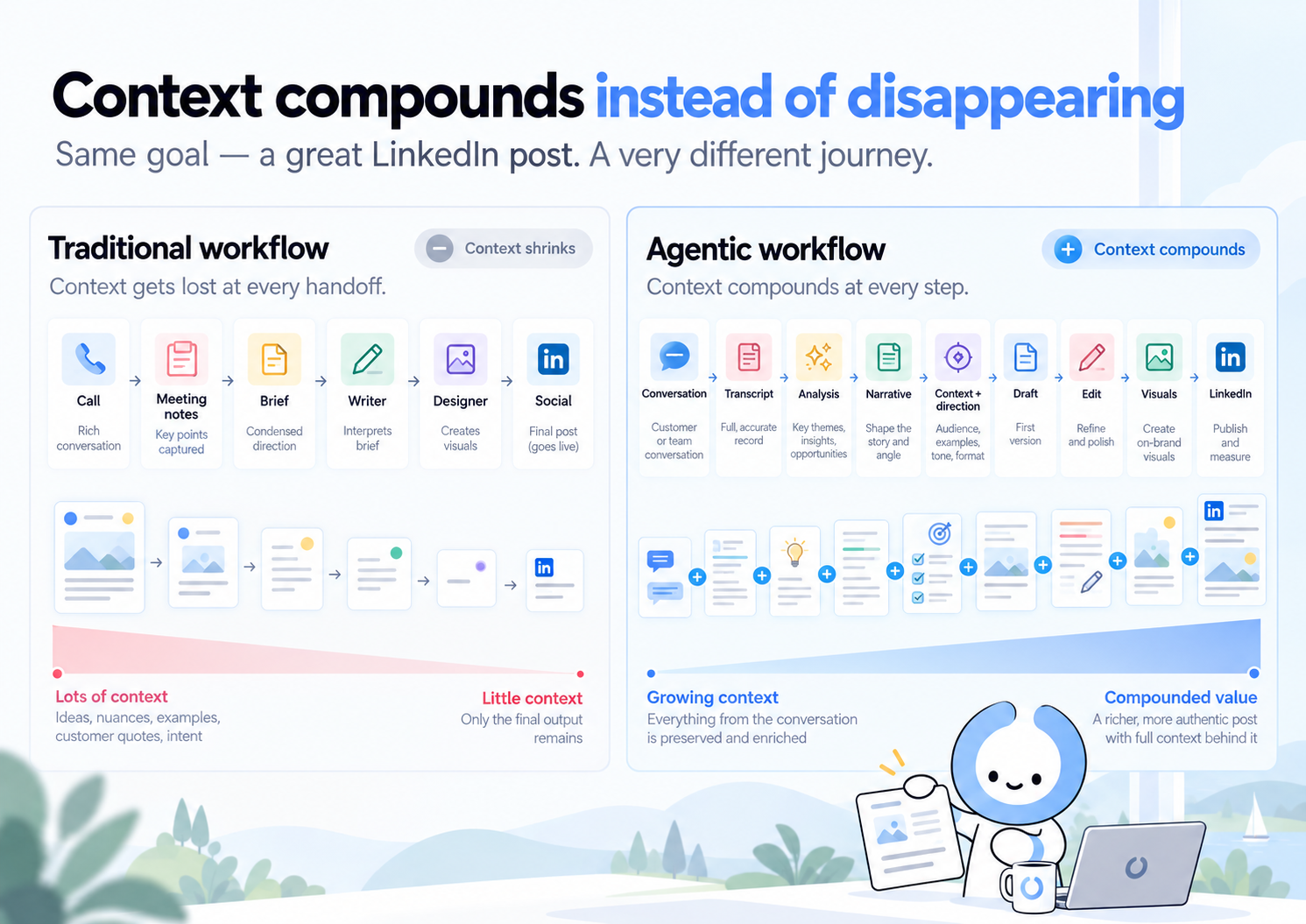
We started with the original conversation. Then added analysis. Then the larger market narrative. Then research and positioning. Then my own reasoning and caveats. Oleno added the company governance. I added editorial judgment. The visuals were based on the finished argument. The LinkedIn post came from the finished article.
The context got richer as the work moved forward instead of thinner.
That's a much more interesting use of AI to me than generating another 50 blog posts.
The goal isn't really more content.
It's taking what your company is already learning and getting more of that intelligence all the way to publication.
About Daniel Hebert
I'm the founder of Oleno, SalesMVP Lab, and yourLumira. Been working in B2B SaaS in both sales and marketing leadership for 13+ years. I specialize in building revenue engines from the ground up. Over the years, I've codified writing frameworks, which are now powering Oleno.
Frequently Asked Questions