3 Strategies to Scale Content Without Creating More Rework

3 Strategies to Scale Content Without Creating More Rework
Most strategies to scale content fall apart once more people get involved. You hire another writer, loop in PMM, add SEO review, maybe pull demand gen in too, and somehow output gets slower instead of faster. I've seen this movie before. The issue usually isn't effort. It's the rework tax that shows up when context is scattered and everybody is fixing the same draft from a different angle.
Back in 2012-2016 I ran a website called Steamfeed. At our peak, we hit 120k unique visitors a month. We got there because we had both breadth and depth at a pretty high volume. But when you scale content through lots of contributors, quality only holds if the system holds. Later, at smaller SaaS companies, I saw the opposite problem. Fewer people, less time, tons of context living in people's heads, and every article becoming a coordination headache.
So if you're a PMM or marketing leader trying to scale without adding more chaos, there are really three strategies that matter: store the right context once, run content through a repeatable system, and verify quality before anything goes live. That's the shift. And honestly, these strategies to scale content are a lot less about writing faster than they are about removing the reasons teams keep rewriting the same piece.
Key Takeaways:
- More contributors usually create more review cycles, not more finished content.
- The hidden cost of scale is frustrating rework, especially when product context lives in people's heads instead of a shared system.
- Teams can move from 4-8 articles per month to 20-40+ when topic discovery, brief creation, drafting, and publishing run through a defined pipeline.
- Brand Studio, Marketing Studio, and Product Studio let teams encode voice, positioning, and product truth once so those rules carry into every draft.
- Quality gates matter because weak or inaccurate output gets expensive after publication, not before.
Why Strategies to Scale Content Usually Break Under Team Complexity
Most strategies to scale content don't fail because the team is lazy or because writers can't write. They fail because complexity compounds. More people means more handoffs, more waiting, more interpretation, and more chances for the same article to get fixed five different ways.
More Contributors Create More Rework, Not More Output
This is the part a lot of teams underestimate. They think the bottleneck is production capacity. Usually it isn't. Usually the bottleneck is what happens after the first draft.
You get a writer creating the piece. Then PMM corrects the positioning. Then product checks the claims. Then SEO wants a structural change. Then demand gen wants stronger conversion language. Nobody is being unreasonable. That's what makes it so painful. Each person is fixing a real problem, but the total system is broken.
At PostBeyond, I could write 3-4 strong blog posts a week because I had the full context in my head and I was using a structured writing framework. As the team grew, output should've increased. It didn't. The writer had less product context than I did, so they took longer and still needed more correction. At the same time, I had less time to write because I was buried in meetings and managing the team. Sound familiar?
Let's pretend each article needs four reviewers and each person spends just 20 minutes correcting context gaps. That's 80 minutes of review time before you even count Slack messages, waiting time, or rewrites. Multiply that by 20 articles a month and you're burning more than 26 hours just on visible review time. The hidden cost is higher. That's why so many strategies to scale content look fine on a whiteboard and fall apart in real workflows.
Content Velocity Breaks When Product Context Lives in People's Heads
This is where content programs really wobble. Product truth lives with PMM. Voice lives with the founder. Category framing lives with leadership. Audience nuance lives with demand gen. So every draft starts half-blind.
That's why teams with smart people still publish generic work. The writer isn't bad. The process is asking them to guess too much. And once guessing enters the workflow, review expands to catch what should've been there from the start.
We saw a version of this at LevelJump too. We were recording videos with the CEO and turning them into written content. That was faster than starting from scratch, no question. But the content missed the structure that search needed, and we didn't have a reliable way to find the right topics. So even good ideas turned into uneven output. You can move fast and still miss the point.
Which Strategies to Scale Content Actually Hold Up Over Time
The strategies to scale content that hold up are system strategies, not hustle strategies. You don't solve this by asking people to remember more, prompt better, or review faster. You solve it by deciding what should stay fixed and what should move.
The Teams That Scale Content Reliably Separate Governance From Execution
The first strategy is simple to say and harder to implement: separate the rules from the work. Voice, positioning, product claims, audience framing, and use cases shouldn't need to be re-explained every time someone starts a draft.
When those things are explicit, content creation gets more reliable. Not perfect. Just reliable. And reliability matters more than raw draft speed once you're trying to publish at a steady cadence across a bunch of topics and formats.
This is especially true in GEO. LLMs don't just look at one article. They piece together signals across a body of work. So if your point of view shifts every week, your product definition drifts, or your audience language changes depending on who wrote the piece, you're weakening your own signal. That's the overlooked part.
Prompting Speeds Up Drafts but Makes Consistency Harder to Maintain
The second strategy is to stop confusing fast drafting with scaled execution. Prompting is useful. We use prompting too. But prompting by itself pushes too much judgment back onto humans.
Last summer, while working on a B2C app, I built a bunch of GPTs and started doing the usual routine. Prompt, copy, paste, edit, upload. Over and over. It was taking 3-4 hours a day. It felt productive at first because text was getting generated quickly. But the system around that text was still manual, which meant I was still carrying topic selection, consistency, QA, and publishing on my back.
That's where most teams get stuck. They make drafting faster, then act surprised when coordination gets worse. A prompt can create an article. It can't hold your entire operating model together. That's the gap the best strategies to scale content have to close.
Discover how governed content execution works in practice.
How Strategies to Scale Content Become Repeatable in Oleno
The move from inconsistent output to repeatable execution happens when the system stores core inputs once, helps teams prioritize what to create next, and checks output before it reaches your CMS. That's the shift Oleno is built around. It runs content operations as an ongoing system instead of a pile of prompts, briefs, and human memory.
One Governed System Replaces Scattered Briefs, Prompts, and Handoffs
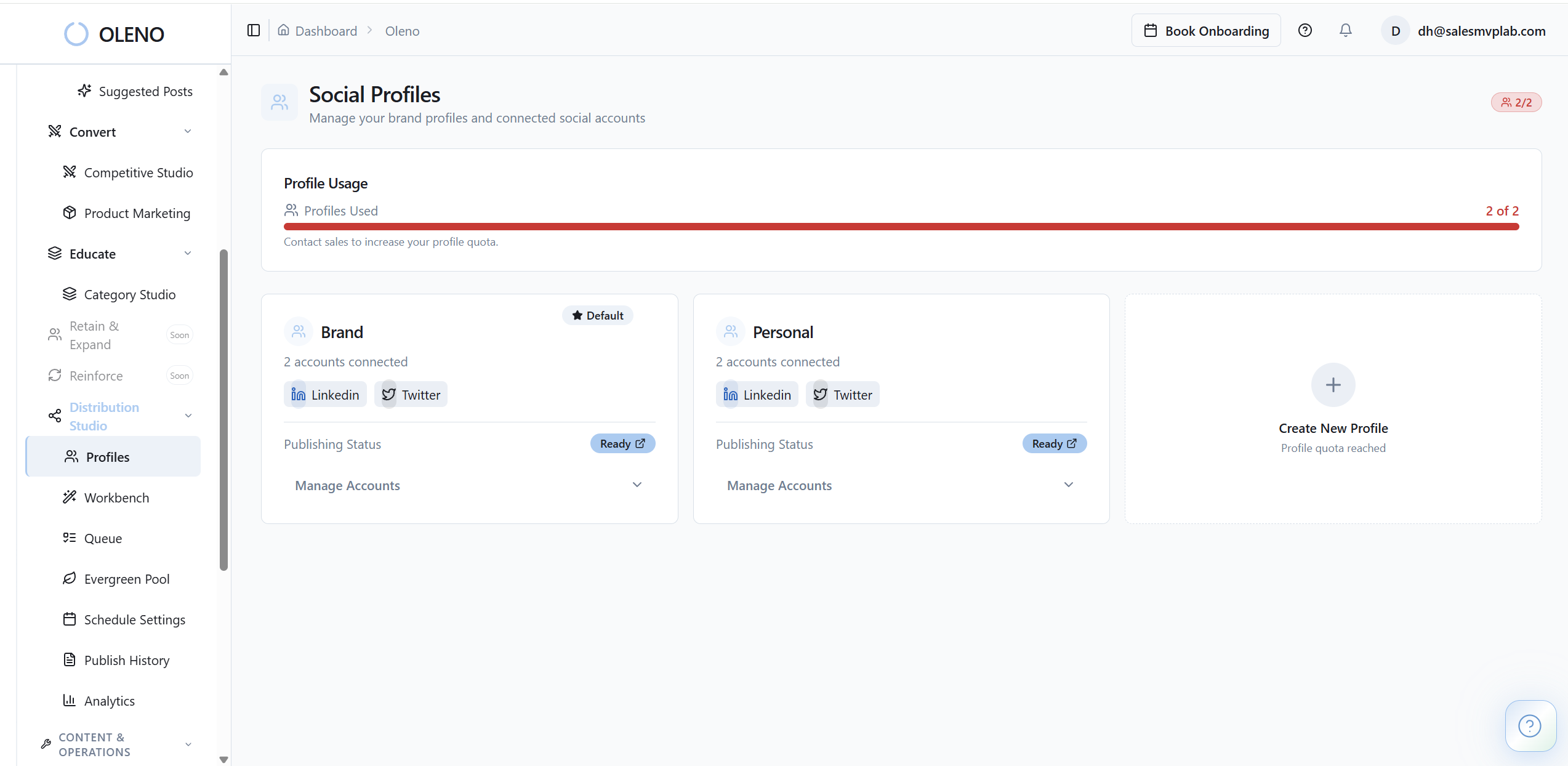
What teams actually need isn't another writing surface. They need less re-briefing, less guesswork, and fewer handoffs. Oleno starts by storing the context that usually gets lost. Brand Studio defines how the company sounds. Marketing Studio defines the category framing, key messages, and point of view. Product Studio stores approved product descriptions, claims, boundaries, pricing, use cases, and screenshots.
That matters because the team isn't re-briefing the system or the writer from scratch every time. The source context already exists. Audience & persona targeting adds another layer by framing the same topic differently depending on who you're speaking to and what they care about. So a PMM audience and a CMO audience don't get the same article wearing different clothes.
Then planning gets more operational. Programmatic SEO Studio’s Topic Universe discovers, scores, and organizes topics, while Storyboard materializes existing topic candidates into a prioritized, balanced calendar across audiences, personas, products, and use cases. You aren't manually chasing random keywords or trying to remember what gap matters next. Frankly, that's where lots of content programs quietly fail. This is one of the more practical strategies to scale content because it removes repeat setup work before drafting even starts.
Deterministic Pipelines Keep Every Article Aligned With Product Truth
Once the context is set, Oleno uses studios for the actual job types. Programmatic SEO Studio handles acquisition content. Product Marketing Studio handles feature deep dives, launches, workflow guides, and use case walkthroughs. Category Studio handles long-form thought leadership. Buyer Enablement Studio handles evaluation content.
The important part is that these aren't just blank pages with a prompt box. Each job type follows a defined blueprint, with governance and source context injected at the brief, draft, and QA stages. That's why the output can stay aligned as volume goes up.
That also reduces a lot of the PMM pain. Product truth isn't being retyped from memory. Positioning isn't getting reinvented by every contributor. And because product boundaries live in Product Studio, Oleno has a reference point for what can and can't be said.
Start building a more reliable content pipeline with Oleno.
Quality Gates Stop Weak or Inaccurate Output Before It Ships
The third strategy is verification. Without that, the first two break down. Oleno's Quality Gate evaluates output before it goes live, and that matters more than people think because weak content is expensive once it's published.
Bad articles don't just underperform. They create clean-up work. They confuse sales. They make PMM nervous. They introduce factual risk in product-led content. And they can dilute your signal across the rest of the library.
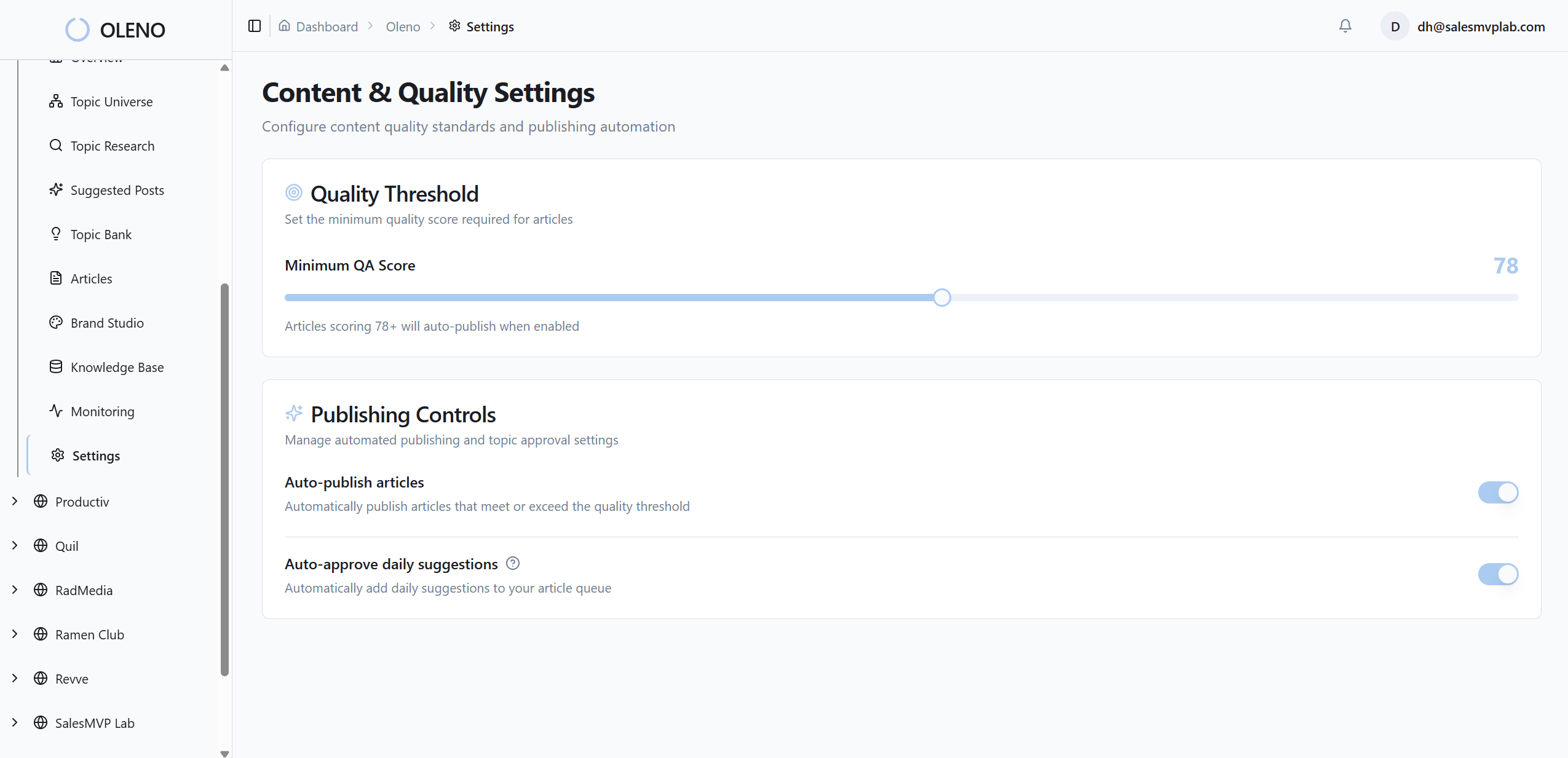
Oleno cross-checks content against the rules and source truth you've already defined. That doesn't mean marketers disappear from the process. It means they stop spending their time catching the same predictable mistakes over and over. For grounding on why consistency matters in AI-visible search, Google's documentation on creating helpful, reliable, people-first content and Ahrefs' write-up on what generative engine optimization is are both useful reads.
What Strategies to Scale Content Look Like for a PMM in Practice
This is where strategies to scale content stop being abstract. A PMM owns messaging accuracy, but usually can't personally rewrite every asset. That's the real issue. Too many assets. Too many contributors. Too much context to carry manually.
A PMM Can Scale Category Content Without Becoming the Review Bottleneck
Say you're a senior PMM at a mid-market B2B SaaS company. You're responsible for launch content, category framing, and making sure the story stays accurate across everything customer-facing. You want category definition content that sets the frame in the market. But if every article needs your full rewrite, volume dies fast.
The better setup is to encode the key ingredients once. Your enemy framing. Your three-pillar worldview. Your approved product truth. Your audience language. Your preferred terms. Your examples and stories. Oleno gives you places to store that context through Marketing Studio, Product Studio, Brand Studio, Stories Studio, and audience & persona targeting.
Then the system applies that context repeatedly across content jobs. So you're not trying to manually transfer your brain into every brief. In my experience, that's the only way PMM stops being the choke point without giving up message control.
Weekly Publishing Targets Become Manageable When the System Carries Context
This is where the output shift shows up. Oleno already has a documented use case where teams move from 4-8 articles per month to 20-40+ without adding headcount. That's a big jump. It doesn't happen because everyone suddenly writes faster. It happens because the process stops resetting from zero.
Think about the before state. Topics are being chosen ad hoc. Writers need custom briefs. PMM corrects the same messaging issues every week. SEO structure varies. Product claims get checked late. Publishing is another manual step. The whole thing feels busy, but it's fragile.
Now the after state. Topics are surfaced and prioritized through the planning workflow. The relevant studio runs the right content blueprint. Stored voice, audience context, product truth, and positioning carry into the brief and draft. Quality Gate checks the output before it reaches review. CMS publishing can happen directly from the system. That's a different operating model. And it's exactly why strategies to scale content work better when the system carries the context instead of the team carrying it in meetings.
We were surprised by how often buyers didn't really want "more AI content." They wanted fewer headaches. Big difference.
For broader context on why process consistency matters, McKinsey's research on the state of AI in 2024 is worth reading because it shows the gap between experimentation and repeatable operational use.
Where Strategies to Scale Content Still Need Human Judgment
Even strong strategies to scale content still need human judgment. The system can execute within boundaries, but it doesn't invent your market point of view for you. That's an important line.
Automation Does Not Replace Strategy, Judgment, or Market Insight
Oleno does not create your positioning out of thin air. It doesn't decide what your company should believe, which audience should matter most, or what tradeoffs your category argument should make. Marketers still have to define those things.
That matters because some teams want to skip the hard thinking. They want software to make the strategic calls for them. It won't. And honestly, it shouldn't. The value is that once your team defines voice, product truth, audience context, and narrative stance, the system can execute inside those boundaries much more reliably than a pile of disconnected tools.
There's also a practical limit here. Not every content type should be automated to the same degree. High-stakes launch content, novel category arguments, or pieces tied to a fast-moving product shift may still need tighter human involvement. That's not a flaw. That's just good judgment.
Systems Only Work When Governance Is Explicit and Maintained
Weak source inputs create weak output. That's true whether a human writes the draft or software generates it. If Product Studio is outdated, if Marketing Studio doesn't reflect the current market stance, or if brand rules are fuzzy, you're going to feel that downstream.
So yes, Oleno improves throughput and reliability. But the system still depends on explicit setup and periodic maintenance. Product changes. Positioning evolves. Audiences shift. The content system has to be updated when the truth changes.
You might be thinking that sounds like work. It is. But it's front-loaded work that saves repeated correction later. I'd take that trade every time.
Where to Start If Your Content Process Feels Heavier Every Quarter
If your content process feels heavier every quarter, don't start by adding more people or more prompts. Start by finding the breaks. That's usually where the best strategies to scale content begin.
Teams That Want More Output Need a System, Not More Prompts
If your publishing goal keeps rising but your process still depends on memory and heroic effort, you're going to keep hitting the same wall. More prompts won't fix that. Another freelancer probably won't either, at least not on its own.
A better path is to define what should stay true across every asset, decide which job types need repeatable pipelines, and put quality checks before publishing instead of after the damage is done. That's the real work behind scaling content.
The Fastest Next Step Is to Audit Where Your Content Process Breaks
Start with a simple review. Where does context get lost? Where do drafts get rewritten? Which approvals create waiting time? Which claims get corrected late? Which topics get published without fitting the bigger narrative?
Once you can see the breaks, the fix gets a lot more obvious.
Ready to transform your content process? See Oleno in action.
Conclusion
The teams that win with content at scale usually aren't the ones working the hardest. They're the ones with fewer resets, fewer rewrites, and clearer rules. That's really what the best strategies to scale content come down to. Store context once. Run work through repeatable pipelines. Verify quality before publish. Do that, and scale starts feeling a lot less chaotic.
About Daniel Hebert
I'm the founder of Oleno, SalesMVP Lab, and yourLumira. Been working in B2B SaaS in both sales and marketing leadership for 13+ years. I specialize in building revenue engines from the ground up. Over the years, I've codified writing frameworks, which are now powering Oleno.
Frequently Asked Questions