5 Habits That Enhance Content Marketing Efficiency

You shipped 40 articles last month and still had to rewrite half of them. That’s not a content problem. That’s a habits problem, and for agencies trying to enhance content across multiple client accounts, the wrong habits create hidden rework fast.
A lot of people think habits that enhance content are small editorial tweaks. Better briefs. Better prompts. Better writers. I don’t buy that. The habits that actually enhance content are operating habits. They decide whether quality compounds or falls apart the second volume goes up.
Key Takeaways:
- Habits that enhance content are usually system habits, not writing tricks
- If an agency handles 3 or more brands, isolated governance matters more than prompt quality
- The 2-Review Rule works well: if a piece needs more than 2 real review rounds, the system upstream is broken
- Content quality usually drops when strategy, product truth, and audience context live in different places
- Agencies scale faster when they build repeatable input habits before chasing output volume
- GEO raises the bar because content now has to make sense to humans, search engines, and LLMs
- The agencies that win build habits that reduce drift, not just habits that increase speed
Why Most Content Habits Break Once an Agency Scales
Strong content habits break at scale because they were never really habits. They were heroics. One strategist remembered the nuance. One editor caught the product issue. One founder rewrote the intro at 10 p.m. That works for a while. Then volume goes up, clients stack up, and the whole thing starts leaking quality.

The hidden problem is habit drift, not writer quality
Most agencies blame the writer first. Fair point, sometimes the writer is the issue. But most of the time, the writer is just the last person touching a broken chain. The real issue is what I’d call the Context Ladder. Every rung between strategy and publish creates translation loss.
You see this all the time in agencies. The client says one thing on a kickoff call. The account manager turns that into notes. The strategist turns the notes into a brief. The writer turns the brief into a draft. The editor tries to fix the voice. By then, the original intent is barely alive. That’s not a talent issue. That’s a system issue.
Back when I was running a high-volume content operation, we saw the same thing in a different form. Volume worked when there was both breadth and depth, and when contributors brought real points of view. Once context got thin, volume stopped compounding. It just created more pages.
The cost shows up before the metrics do
Content quality drops before your dashboard screams at you. That’s the annoying part. The early signals are operational. Review cycles get longer. Editors leave more comments on tone than substance. Clients start saying “this is close, but…” on every draft. And your team spends more time fixing content than creating it.
A simple red-flag checklist usually catches it:
- More than 2 review rounds on standard articles
- More than 20% of edits are voice or positioning edits
- Writers asking the same product questions every week
- Similar topics producing wildly different quality levels
- Client feedback focused on “doesn’t sound like us”
That last one matters most. It’s exhausting when every draft is almost right. You’re not dealing with failure. You’re dealing with endless near-misses, which is somehow worse.
Why agencies feel this pain faster than in-house teams
An in-house team has one brand to learn. An agency might juggle 8. Or 20. Each client has different terminology, different product truth, different competitors, different buyers, different risk tolerance. So habits that enhance content in an agency setting have to protect against cross-account contamination.
If you manage 5 or more active client brands, assume drift is happening unless you’ve built walls between them. That’s the rule. Voice drift. claim drift. positioning drift. It all sneaks in. One healthcare SaaS account starts sounding like a sales tech client. One cybersecurity draft borrows a framing from a martech client. Tiny mistakes. Expensive outcome.
So the next question is obvious: if better habits aren’t just better editing, what are they actually?
What Habits Actually Enhance Content Quality and Output
The habits that enhance content quality are upstream habits. They happen before the draft. They shape the draft. And if you get them right, editing gets lighter instead of heavier. That’s why this section matters most.
Start with the Input Integrity Rule
Good content starts with good inputs. Obvious, yes. Still ignored constantly. The Input Integrity Rule is simple: if strategy, audience, product truth, and use case are not documented in one operating system before drafting starts, expect rework.
A lot of agencies still run on scattered docs. One client voice guide in Notion. A positioning deck in Google Drive. Product notes from a kickoff in Slack. Sales call clips somewhere else. That setup guarantees drift. You may still produce decent content, but you won’t produce consistently strong content at scale.
So before writing, pressure test these 4 inputs:
- Who is the content for, specifically?
- What product truth is approved and current?
- What category or narrative angle are we pushing?
- What use case or workflow is this piece tied to?
If one of those is fuzzy, the draft will be fuzzy. Not always. But often enough that it becomes an agency tax.
Diagnose your current maturity before fixing anything
Not every agency has the same problem. Some have decent writing but weak client context. Some have strong strategy but no production discipline. Some just have too many people touching the same piece. So before changing habits, figure out what bucket you’re in.
Use this 3-stage maturity spectrum:
- Stage 1: Heroics. Quality depends on one senior person catching everything.
- Stage 2: Templates. You have briefs and workflows, but quality still varies by client and writer.
- Stage 3: Governed execution. Strategy, audience, product truth, and quality rules are encoded and reused.
If you’re in Stage 1, don’t jump straight to volume. Fix consistency first. If you’re in Stage 2, your next move is reducing interpretation gaps. If you’re in Stage 3, then push output harder.
Honestly, this surprised me more than anything else when I started looking at high-output teams. The bottleneck usually wasn’t creativity. It was reliability.
Use the 2-Review Rule to expose broken habits
Here’s a threshold that saves a lot of pain: standard content should not need more than 2 meaningful review rounds. That’s the 2-Review Rule. One round for refinement. One round for approval. If you’re routinely hitting 3 or 4, you don’t have a draft problem. You have an upstream habit problem.
Why does this work? Because review count is a lagging indicator for missing context. More rounds usually means the writer didn’t have enough audience detail, enough product grounding, or enough clarity on the actual angle. The draft becomes a place where strategy gets reconstructed. That’s expensive.
A before-and-after contrast makes it clear. Before: agency gets a topic, writer drafts from a loose brief, editor rewrites positioning, account lead softens claims, client corrects product details. After: agency starts from governed inputs, writer drafts with audience and use case constraints, editor sharpens instead of rebuilding, client approves faster. Same writer. Totally different output.
Some teams prefer a heavy editorial layer, and that’s valid if the content is very high stakes. But if every blog post gets white-glove treatment forever, your margin is quietly dying.
Build a voice bank, not just a style guide
A style guide is helpful. A voice bank is better. The difference is practical. A style guide tells writers what tone should sound like. A voice bank shows them what it actually sounds like under real conditions.
For agencies, this matters a lot. Client voice is rarely captured by adjectives. “Confident but approachable” doesn’t help much. Neither does “thoughtful but not stiff.” You need examples. Real phrases. Common sentence patterns. Terms they use. Terms they avoid. Preferred ways to explain the product. Repeated points of view. That’s the good stuff.
One pattern I’ve seen work is the 5x5 Voice Bank:
- 5 real excerpts that sound unmistakably like the client
- 5 phrases they use often
- 5 phrases they’d never say
- 5 repeated points of view
- 5 examples of how they talk about customers or pain
That gives writers and editors something they can actually execute against. It also shortens feedback loops because comments become specific. Not “make this sound more like us.” More like “this client always talks in outcomes first, then process.”
Separate persona from use case or you’ll write mush
A surprising amount of weak content comes from mixing up persona and use case. Persona is who. Use case is what they’re trying to do. When you blur those, the article gets generic fast.
An agency owner reading about habits that enhance content wants more than nice writing. They want to scale delivery across accounts without hiring 5 more people. A VP of Marketing at a client company might want tighter brand control. Same topic area. Different stakes. Different examples. Different language.
So use a simple conditional rule: if the article can swap one audience for another without changing the examples, the targeting is too broad. Tighten it. And then tie that audience to a use case. In this case, agency content scaling. That means the article should reflect account complexity, multi-brand governance, review pressure, and margin pressure. Otherwise it reads like general marketing advice.
That’s also why founder-led thought leadership often misses search intent. I’ve lived this one. You can have great ideas and still miss the structure and angle the reader actually needed.
Treat editing tax as a metric, not a feeling
A lot of teams talk about editing tax like it’s just annoying. It’s more than that. It’s measurable. And once you measure it, bad habits become a lot easier to spot.
Track three numbers for 30 days:
- Average minutes spent editing per article
- Number of factual corrections per draft
- Number of voice or positioning comments per draft
If voice comments are higher than structural edits, your governance is weak. If factual corrections happen more than once every 3 drafts, your product grounding is weak. If editing time is above 45 minutes for standard educational content, your input quality is probably weak. Not always. But usually.
This is where the slop test comes in. An experienced SEO consultant looked at Oleno output and said it passes the slop test. That phrase sticks because every content leader knows what slop looks like instantly. You don’t need a 20-point explanation. You can feel it in 3 paragraphs. That’s the standard agencies should aim for.
Midway through all this, if you want to see what governed execution looks like in practice, request a demo.
Create account isolation before chasing account growth
Agencies love adding capacity. Fewer love building isolation rules. But account isolation is one of the best habits that enhance content when you manage multiple clients.
Think of each client account like a clean kitchen station in a busy restaurant. If the ingredients start mixing, quality drops and nobody trusts the plate. Same deal here. Voice examples, product truth, messaging, stories, competitors, and use cases need their own lanes. Otherwise the team starts borrowing from memory, and memory is messy.
The practical rule is simple. If a writer can accidentally reuse terminology from one client in another client’s draft, the system isn’t isolated enough. Fix that before you add more throughput. Because scaling a messy system just makes the mess arrive faster.
How Oleno Turns Good Habits Into a Repeatable Operating System
Good habits are hard to maintain manually. That’s the part people gloss over. You can tell a team to use better briefs, track voice more closely, and keep product claims accurate. Sure. But once volume goes up, people revert. That’s human.
Why agencies use Oleno for governed client execution
Oleno turns those habits into governed execution. Instead of relying on memory and heroics, agencies can encode client voice, positioning, product truth, audience detail, and use cases once, then use that context throughout content creation. That matters a lot when you’re managing multiple brands and each one needs to sound like itself.
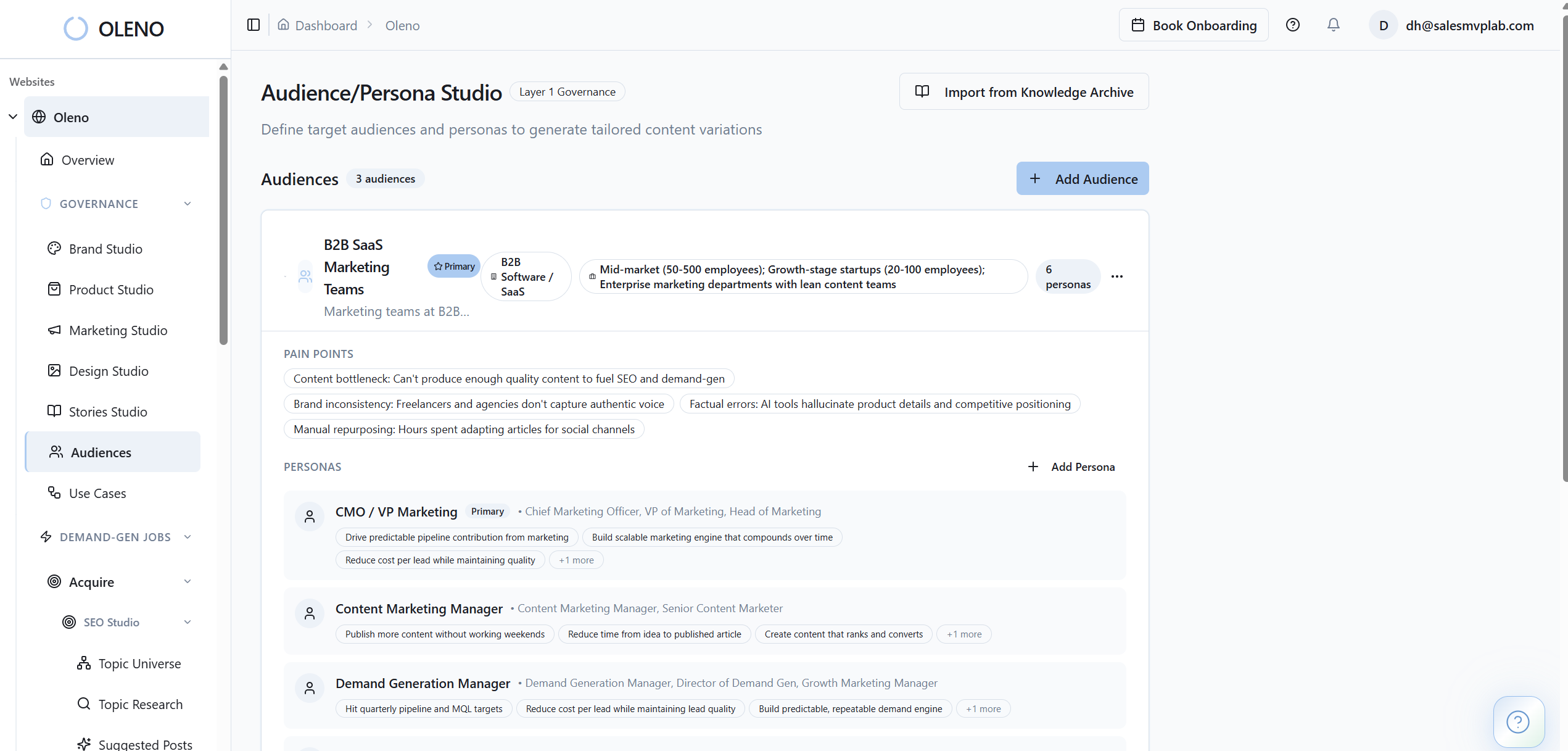
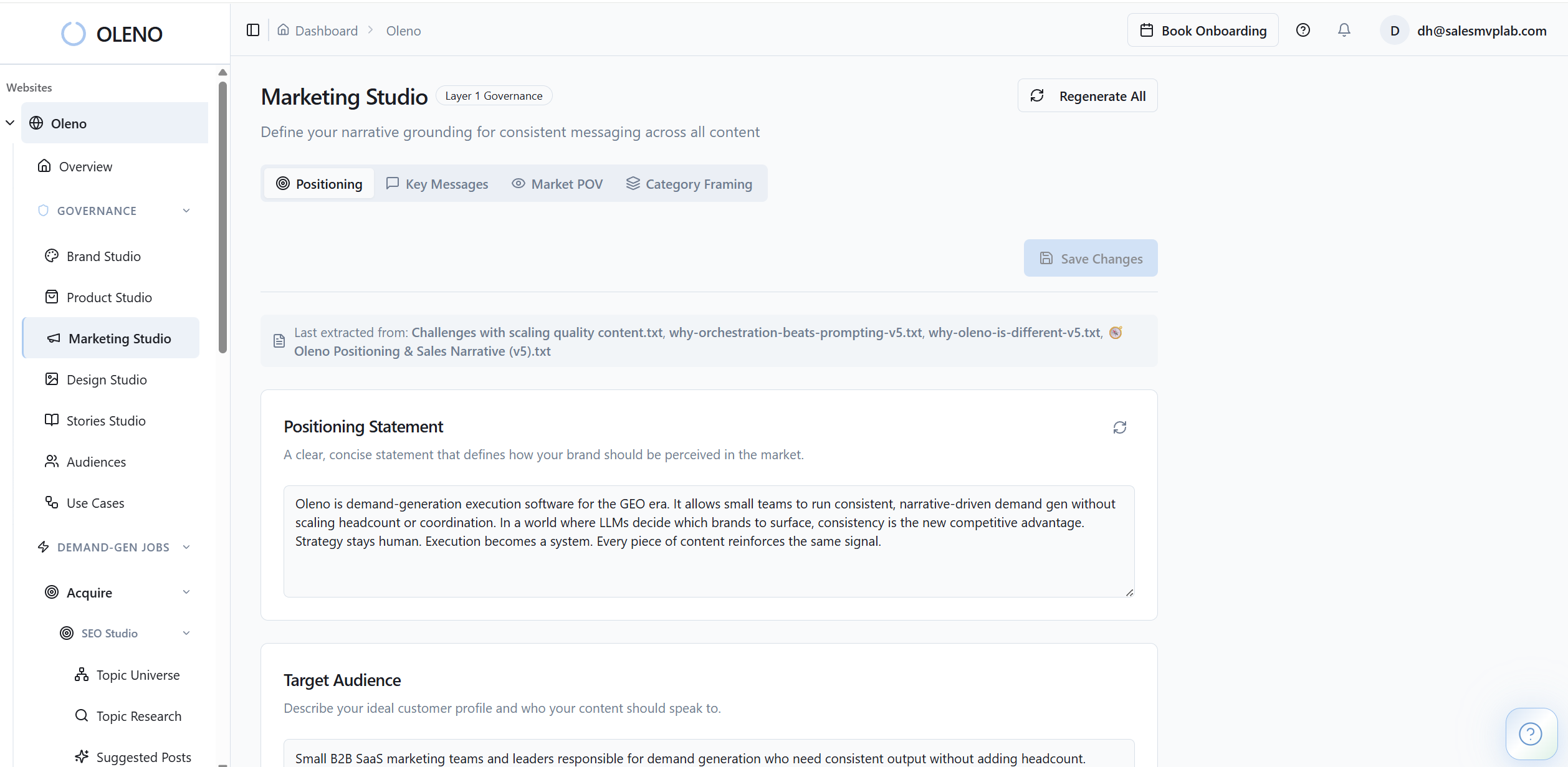
Brand Studio handles the tone, style rules, preferred terms, and examples. Marketing Studio carries the category framing and key messages so the content doesn’t drift into bland education. Product Studio keeps claims grounded in approved product truth, which is where a lot of agency review time gets burned. Audience & Persona Targeting and Use Case Studio make the same topic land differently depending on who the brand is trying to reach and what that reader is trying to accomplish.
That’s a much better operating model than sending another brief and hoping the writer “gets it.”
The slop test gets enforced before the client sees the draft
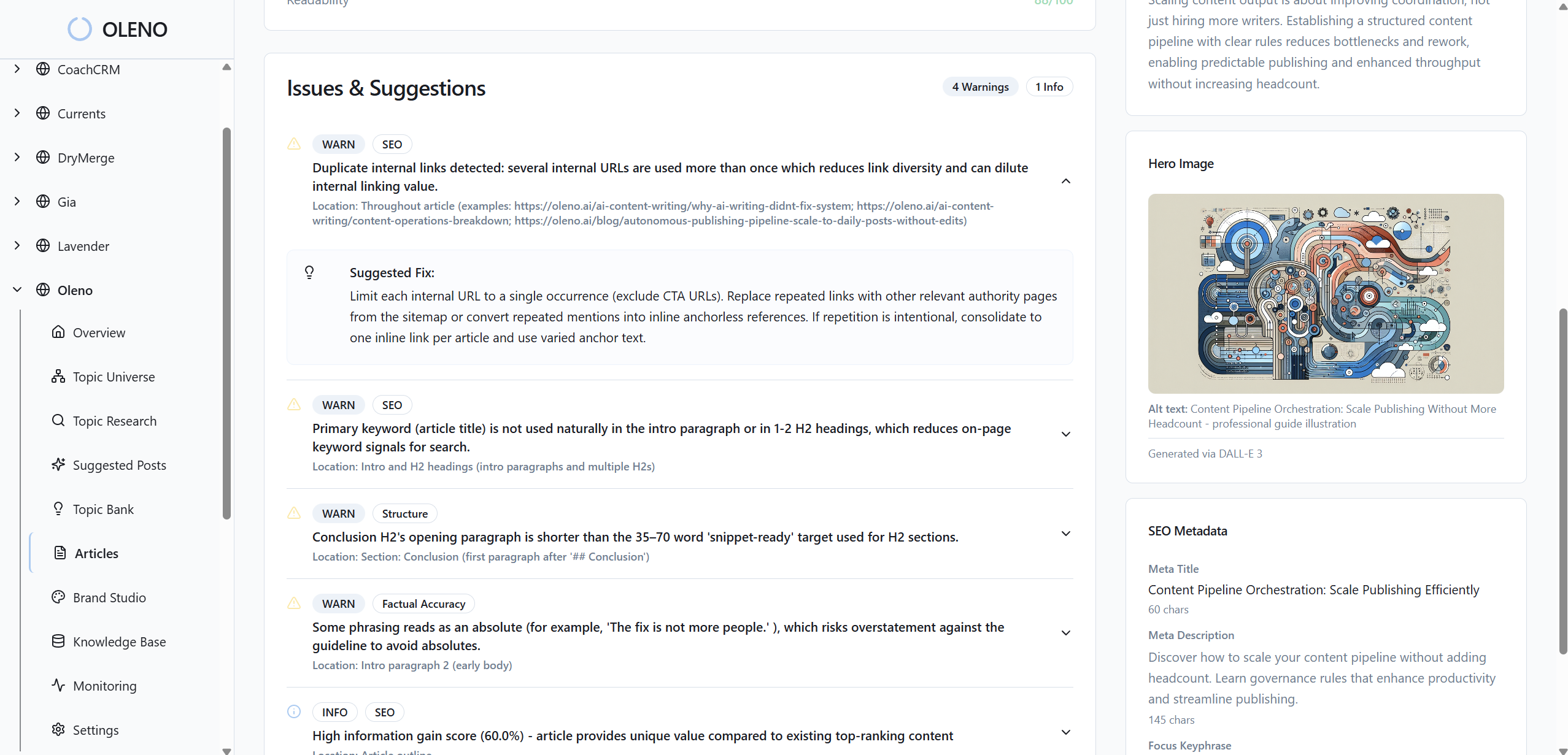
This is where the quality side matters. Oleno’s Quality Gate runs every article through 80+ automated checks for voice, structure, grounding, and quality thresholds before it reaches review. If the score is low, it attempts revision. If it still doesn’t clear the bar, it gets blocked. That matters because agencies don’t just need faster output. They need fewer embarrassing first drafts.
There’s also a practical scaling advantage here. Programmatic SEO Studio can produce acquisition content at scale, while Product Marketing Studio, Category Studio, and Buyer Enablement Studio handle different job types without forcing the team back into manual content assembly every time. The Orchestrator then runs that pipeline against quotas and cadence, so production doesn’t depend on someone babysitting the queue.
And for agencies in particular, that means you can increase delivery without proportional hiring, while keeping editors scoped to assigned websites and governance applied per website. If you want to see how that looks in a real workflow, book a demo.
The Agencies That Enhance Content Best Usually Fix Operations First
The habits that enhance content are not glamorous. They don’t start with prompts. They start with input quality, review discipline, audience clarity, use case specificity, and governance that survives scale. That’s what separates content that compounds from content that keeps getting rewritten.
If your agency is still producing good work through sheer effort, that’s fine for now. But effort doesn’t scale cleanly. Systems do. And once you see that clearly, you stop asking how to get more content out. You start asking how to make quality repeatable.
About Daniel Hebert
I'm the founder of Oleno, SalesMVP Lab, and yourLumira. Been working in B2B SaaS in both sales and marketing leadership for 13+ years. I specialize in building revenue engines from the ground up. Over the years, I've codified writing frameworks, which are now powering Oleno.
Frequently Asked Questions