5 Key Benefits of Scaling SEO Content for Businesses

8 articles a month feels productive. For most scaling SaaS teams, it’s just enough output to hide how broken the system really is.
If you’re an SEO or Growth Manager, you’ve probably felt this this week. The brief was solid, the draft was decent, then PMM changed the framing, leadership changed the angle, and now you’re on review cycle four wondering why “scaling content” keeps creating more work instead of less.
Key Takeaways:
- The key benefits of scaling only show up when quality and consistency scale with output
- Most teams don’t have a content problem, they have a context-transfer problem
- If review cycles regularly hit 3 or more rounds, your system is leaking strategy
- Scaling content without governance creates an editing tax that can wipe out the gains
- GEO changes the game: consistency across hundreds of assets matters more than isolated wins
- The best scaling systems encode strategy once, then enforce it everywhere
- For lean B2B SaaS teams, orchestration beats prompting once output passes 12-15 pieces per month
If you want to see what that kind of system looks like in practice, you can request a demo.
Why the key benefits of scaling usually get overstated
The key benefits of scaling are real, but most teams chase the visible benefit and miss the hidden cost. More output can increase coverage, speed, and reach. It can also multiply inconsistency, rework, and brand drift if the system underneath is weak.

More content does not mean more leverage
A lot of teams think scaling means publishing more. Fair point. On paper, that sounds right. More pages should mean more chances to rank, more buyer questions answered, more entry points into the funnel.
That does happen. Back when I ran a digital marketing site, we hit 120k monthly visitors largely because we built both depth and breadth. We saw traffic spikes at 500 pages, then 1,000, then 2,500, then 5,000. Most individual pages got less than 100 visits a month, but together they created a long-tail machine. That’s one of the real key benefits of scaling: compounding coverage.
But there’s a catch. That only worked because volume and quality showed up together. If you scale thin content, generic content, or off-message content, you’re not building an asset base. You’re building cleanup work.
The real bottleneck is context transfer
The symptom looks like slow production. The root cause is usually context loss between the people who know the strategy and the people producing the asset. I call this the Context Transfer Tax. Every handoff strips away nuance.
Picture a growth-stage SaaS team on a Tuesday afternoon. The SEO manager writes a brief in Docs, the PMM adds product notes in Slack, the founder leaves voice comments, and the freelance writer turns it into a draft by Friday. By Monday, three stakeholders are fixing tone, one is correcting product truth, and someone else is asking why the article sounds like every other SaaS company. That’s not a writing problem. It’s a systems problem.
And yeah, it’s draining. You start to feel like every “scaled” article comes with a second job attached to it.
The old scaling math breaks in GEO
In classic SEO, you could get away with some messiness. A decent keyword target, an okay page, some links, and you might still get traction. GEO raises the bar. Large language models don’t just look for a page. They look for consistent signals across many pages.
According to Google’s guidance on creating helpful, reliable, people-first content, consistency and original value matter more than pumping out pages that exist just to rank (Google Search Central). And if you look at how generative search products cite sources, structured, authoritative content keeps winning because it’s easier to trust and extract (Microsoft Bing guidance on generative search).
That changes the definition of the key benefits of scaling. Scale is no longer just more pages. Scale is the ability to express the same strategy, clearly and consistently, across dozens or hundreds of assets. If that sounds harder, it is. That’s why most teams stall right when they should be compounding.
What actually breaks when scaling content across a growing team
Content breaks at scale because each new contributor adds variation, and most teams don’t have a system to absorb it. The breakdown usually starts with review cycles, then spreads into messaging drift, inaccurate product claims, and uneven quality. By the time metrics slip, the operating model is already broken.
The Review Loop Threshold
If an article needs 3 or more review rounds, you don’t have a review process. You have a broken input system. That’s the Review Loop Threshold, and honestly, it’s one of the cleanest diagnostic rules I know.
When I was the only marketer at a SaaS company, I could crank out 3 to 4 solid posts a week because I had the whole context in my head. As the team grew, the writer didn’t have the product nuance, market nuance, or buyer nuance I had. Totally normal. But then I had less time to write because I was in meetings, managing people, dealing with everything else. So output dropped, quality dropped, and review effort went up at the same time. Brutal combo.
That’s why “just hire a writer” rarely fixes the problem by itself. Writers can write. But they can’t magically inherit 18 months of founder conversations, product edge cases, sales objections, and category framing through one kickoff call.
The Hidden cost of fragmented execution
Most teams underestimate the cost because they only count draft creation time. They don’t count briefing, clarification, edits, stakeholder reviews, re-alignment, CMS prep, or the Slack pings that keep the whole thing stitched together.
Try the 5-20-60 rule. If content creation takes 5 hours, and coordination plus review adds another 20% to 60% on top, you’re not running a lean system anymore. You’re funding invisible overhead. In my experience, once coordination exceeds 35% of total content effort, scaling starts to feel slower, not faster.
A team at three contributors can sometimes brute-force its way through this. A team at seven contributors usually can’t. The work starts to resemble a relay race where everyone drops the baton once.
Great rankings can still miss the business goal
One of the weirdest traps in content is getting what looks like success and still being disappointed by the business result. I’ve lived that one too. On one team, we had strong writers, strong design, solid rankings. The problem was the content sat too far away from the actual solution, so there was no clean bridge from traffic to demand.
That’s a useful concession, because SEO people aren’t wrong to chase rankings. Rankings matter. Coverage matters. Search intent matters. But if the narrative and product relevance don’t travel with the content, you end up with a nice dashboard and a weak pipeline story.
So the key benefits of scaling can’t just be “more traffic.” If your scaled system doesn’t preserve product truth, point of view, and use-case relevance, you’re scaling distribution without scaling persuasion. The next question is obvious: what should you scale instead?
How high-performing teams scale content without scaling chaos
High-performing teams scale by turning strategy into infrastructure. They don’t brief the same thinking over and over. They define the rules once, then let people and systems execute within those boundaries. That’s where the real key benefits of scaling show up: more coverage, lower rework, stronger consistency, and better buyer fit.
Start with the Strategy Persistence Model
The Strategy Persistence Model is simple. If strategy has to be re-explained for every asset, it will degrade. If strategy is stored once and reused everywhere, it compounds.
That means documenting at least four things before you try to scale past 12 to 15 pieces per month:
- brand voice and language rules
- category framing and key messages
- approved product truth and boundaries
- target audiences, personas, and use cases
Without those four, every new asset becomes a memory test. With them, each asset becomes execution. Big difference.
This is also where a lot of teams resist doing the work, because it feels slower upfront. I get it. Nobody wakes up excited to codify messaging in painful detail. But the tradeoff is clear: spend 10 hours once, or spend 2 hours per asset forever.
Diagnose where your team sits on the scaling spectrum
You need a diagnostic before you need a tool. I’d bucket teams into three stages.
Stage 1: Founder-led The founder or one marketer still carries the whole narrative. Output is decent. Scale is low. Quality is high because the context sits in one head.
Stage 2: Contributor-led Writers, PMMs, SEO, and demand gen are all contributing. Output rises a bit. Rework rises a lot. This is where most scaling SaaS teams get stuck.
Stage 3: System-led Strategy is encoded, workflows are repeatable, and contributors are working from the same operating truth. Output and consistency grow together.
Ask yourself:
- Do most articles require founder cleanup?
- Do writers regularly miss product nuance?
- Does the same messaging correction happen every week?
- Are different channels describing the company differently?
- Can you produce audience-specific variations without rewriting from scratch?
If you answered yes to 3 or more, you’re in Stage 2. Which means you don’t need more hustle. You need system leverage.
Build for audience variation early, not later
One of the key benefits of scaling is variation without starting over. That matters a lot for SEO and Growth Managers, because topical authority is rarely one-size-fits-all anymore. A Head of Content, a VP Marketing, and an agency owner can all search around the same problem and still need different framing.
A lot of teams bolt this on later. Bad idea. If you know you’re selling into multiple roles, build your audience layer early. Define the persona goals, language preferences, common objections, and what outcome each role cares about most.
Then do the Use Case Cross-Match. That’s a simple framework:
- one audience
- one persona
- one use case
- one narrative angle
If you’ve got 3 audiences, 4 personas, and 5 use cases, you don’t have 12 content ideas. You’ve got 60 meaningful intersections. That’s where scaling starts to become strategic instead of random.
Use the 70-20-10 content mix
Most teams over-index on top-of-funnel acquisition content because it’s easy to measure and easy to brief. But a more stable mix is 70-20-10:
- 70% acquisition and educational content
- 20% product-led and use-case content
- 10% evaluation and buyer enablement content
Why that split? Because pure SEO coverage without product or buyer-stage content creates the exact gap a lot of SaaS teams complain about later. You get visitors, but not enough confidence-building content for evaluation.
That said, not every company should follow that exact ratio. A team in a heavy category-creation phase may push more thought leadership. A team with strong branded demand might need more buyer enablement. Fair enough. The rule still helps: if product-led plus evaluation content drops under 20%, expect a narrative disconnect between traffic and pipeline.
Design for drift control
Scaling is really a drift problem. Voice drifts. product claims drift. audience relevance drifts. priorities drift. If you don’t build refresh and review rules into the system, your old content starts fighting your new content.
One practical rule: if a product message, pricing point, or positioning statement changed in the last 90 days, review any related high-traffic articles. Don’t wait for performance to collapse. Drift compounds quietly.
This is the part most people skip because it feels unsexy. But drift control is one of the overlooked key benefits of scaling with a system. The bigger your library gets, the more valuable refresh discipline becomes. A content library without refresh is like a sales team using last year’s deck. Technically active. Functionally off.
By this point, the pattern should be pretty clear. The key benefits of scaling don’t come from creating more content. They come from making strategy survive contact with execution.
If you want to see how a governed system handles that across SEO, product marketing, and audience variation, you can request a demo.
How Oleno turns scaling into a governed system
Oleno turns scaling into a governed system by storing your strategy once, then enforcing it across the content pipeline. That means voice, positioning, product truth, audience context, and quality rules travel with every draft. The result is not just more output. It’s more reliable output.
Governance that keeps strategy intact
The biggest thing Oleno gets right is starting with governance instead of starting with a blank prompt. Brand Studio captures how you sound. Marketing Studio captures what you want the market to understand. Product Studio keeps claims, features, and boundaries accurate.
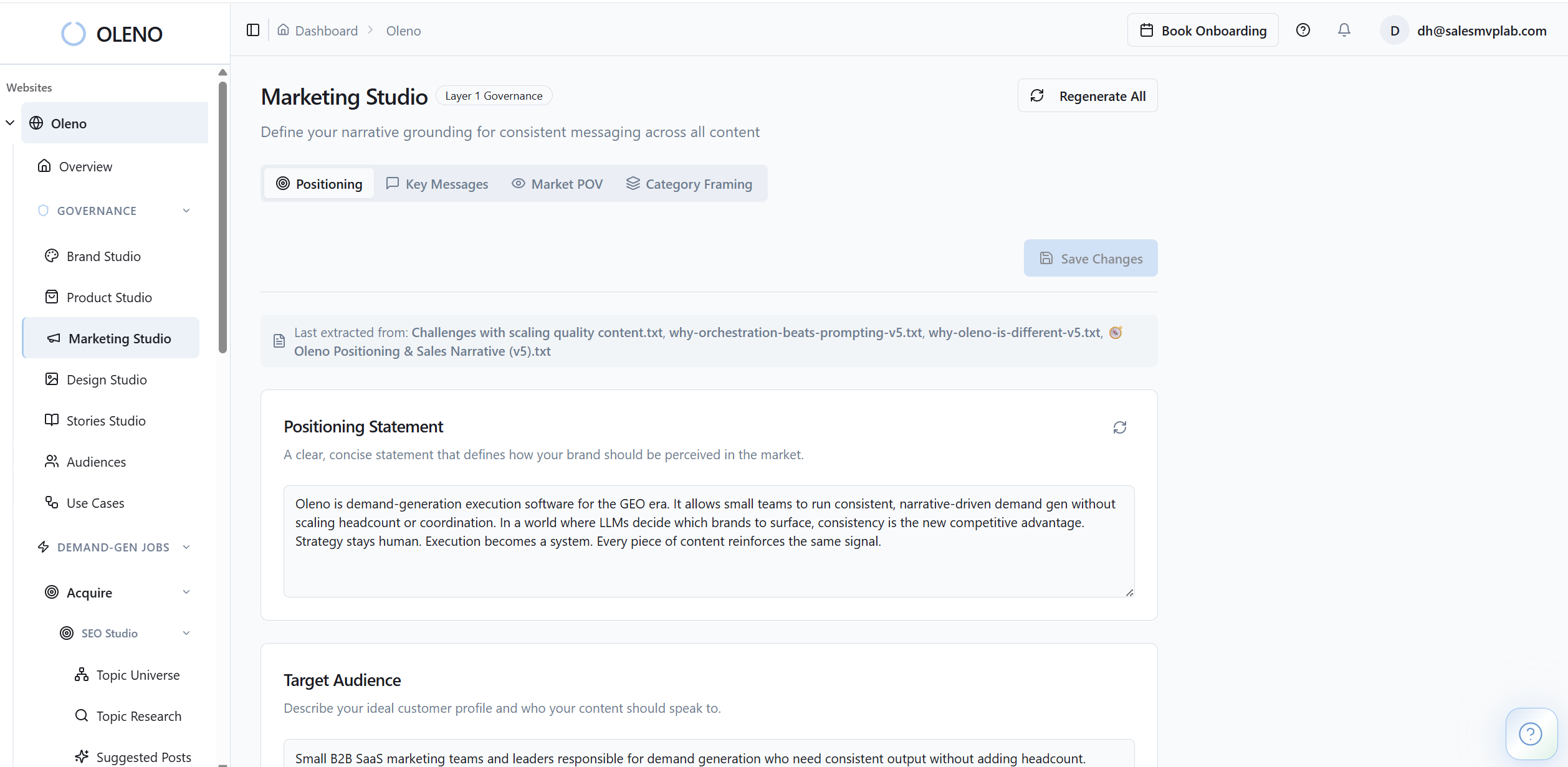
That matters because the Strategy-Execution Gap usually shows up as translation loss. The strategy lives in decks, docs, and founder brains. Then the draft shows up sounding close, but not really right. Oleno closes that gap by loading those governed inputs into the brief and draft stages, instead of asking your team to restate them from scratch every time.
Audience & Persona Targeting also matters here. For teams running multi-audience content strategy, the same topic can be framed differently for a Growth Marketing Manager than for a CMO. That’s one of the more practical key benefits of scaling with governance. You get targeted variation without rebuilding the whole asset each time.
Studios and operations that reduce the editing tax
On the execution side, Programmatic SEO Studio creates acquisition content at scale from a structured topic pipeline. Product Marketing Studio handles feature deep dives and workflow content with Product Studio grounding. Buyer Enablement Studio covers decision-stage content like FAQs, comparisons, and objection handling.
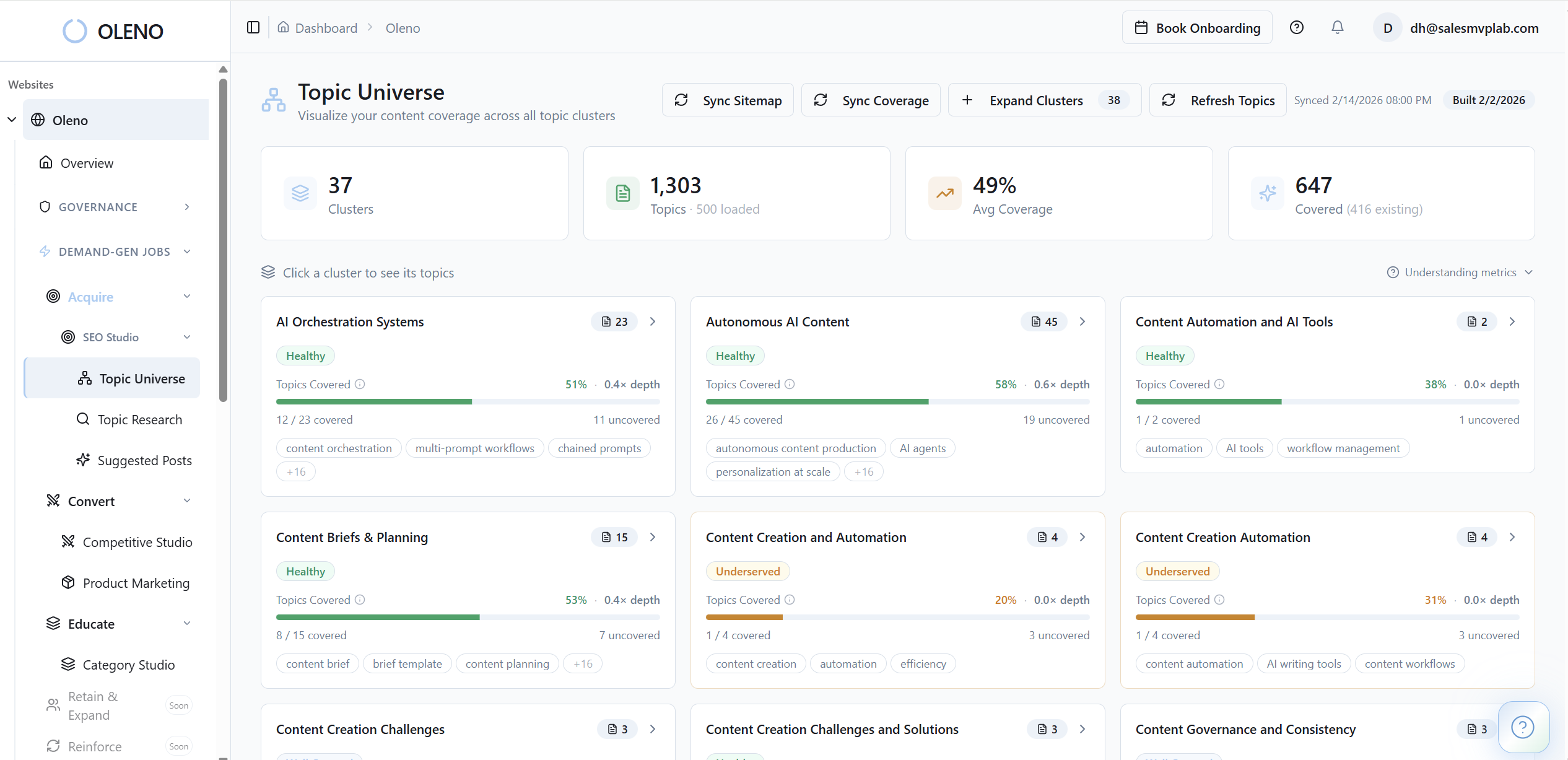
Then the operational layer takes over. The Orchestrator schedules and runs the pipeline against quotas. Quality Gate checks each article against brand voice, structure, accuracy, and quality thresholds. Content Refresh & Drift Monitoring flags when published content no longer matches current governance. The Executive Dashboard gives leadership visibility into cadence, quality trends, and coverage gaps.
That’s the part I like. It’s not pretending to be your full marketing stack. It won’t do technical SEO, paid media, attribution, or CRM workflows. It handles the content execution bottleneck really well, which is the part many lean SaaS teams keep tripping over.
A third-party SEO consultant reviewing Oleno output said it passed the slop test. That’s actually a strong signal, because anyone who runs content at scale knows how easy it is for AI output to look fine for 30 seconds and then fall apart on a second read.
What changes when the system is working
When the system is working, content stops feeling like a weekly reset. Strategy persists. Output compounds. Review gets lighter because the inputs are better, not because standards got lower.
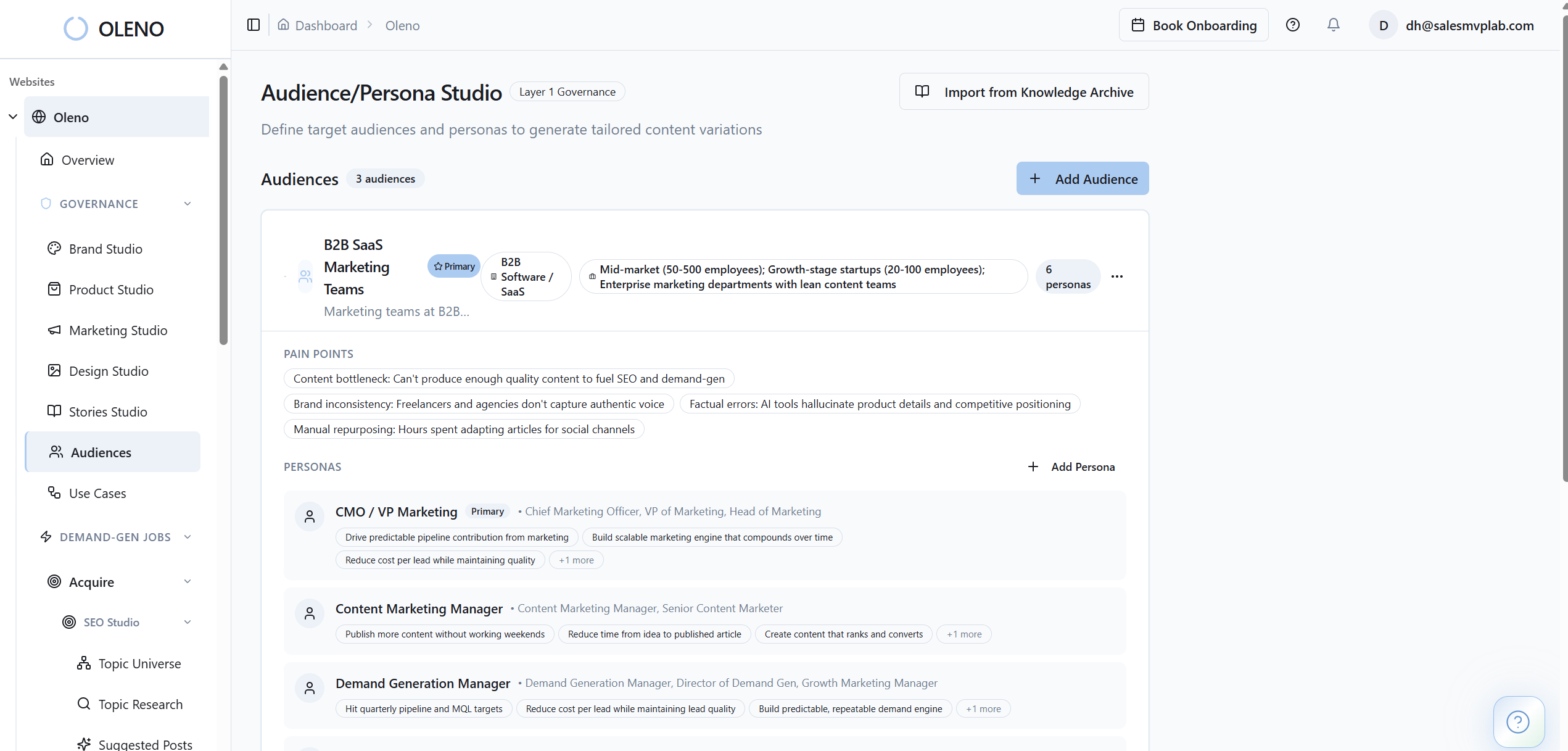
For the right team, that’s the real value. Not infinite content. Not magic. Just a way to get the output capacity of a bigger team without adding a bunch of meetings, rewrites, and coordination debt.
If you’re trying to get there, book a demo.
The real path to the key benefits of scaling
The key benefits of scaling are not more drafts, more prompts, or more people in the workflow. It’s predictable output, preserved strategy, lower review drag, stronger audience fit, and content that compounds instead of drifting.
And honestly, that’s the dividing line. Teams that scale content manually usually end up scaling inconsistency. Teams that encode the strategy first can actually scale trust.
If you’re a scaling SaaS team with real product truth, clear positioning, and a need to publish consistently across audiences, that shift matters. A lot.
About Daniel Hebert
I'm the founder of Oleno, SalesMVP Lab, and yourLumira. Been working in B2B SaaS in both sales and marketing leadership for 13+ years. I specialize in building revenue engines from the ground up. Over the years, I've codified writing frameworks, which are now powering Oleno.
Frequently Asked Questions