5-Step Content Gap Audit Using Topic Coverage & Saturation

You can ship three blog posts a week and still fall behind. I’ve seen it. At Steamfeed we scaled to 120k monthly visitors, but it wasn’t sheer volume that got us there. It was coverage. We filled clusters with depth and angles that actually added something new. Most teams never make that shift. They just publish and pray.
If you’ve been burned by thin content, or worried you’re rewriting the same ideas with new intros, you’re not imagining it. The fix isn’t harder writing. It’s a structured audit that shows you what to write next, what to skip, and where to merge. Once you see coverage and saturation, calendars stop lying to you.
Key Takeaways:
- Run a coverage-first audit to avoid redundant topics before they happen
- Label clusters underserved/healthy/well covered/saturated to prioritize clearly
- Enforce a 90-day cooldown to prevent cannibalization and force net-new angles
- Count unique claims per cluster, not just pages and tags
- Use simple heuristics to flag duplicates and consolidate quickly
- Turn the audit into a backlog with brief skeletons for predictable execution
Why More Posts Do Not Fix Your Content Problem
More posts don’t fix content performance because duplication and shallow angles dilute authority. A content gap audit maps what you have against what your buyers need and shows where coverage is missing or saturated. It replaces guesswork with rules you can apply weekly without debate.

What is a content gap audit and why does it outperform ad hoc calendars?
A content gap audit compares your current library to a clearly defined topic universe. It measures coverage depth, not just how many posts exist. When you see gaps and overlaps at the cluster level, you stop publishing side quests and start building authority. Calendars don’t do that. Audits do.
Most ad hoc calendars reward ideas that sound fresh, not coverage that compounds. We both know how that ends: reactive briefs, repetitive intros, and frustrated editors. The audit reframes the job. You map content to pillars, check saturation, and force new drafts to add distinct claims. It’s faster to avoid waste than to fix it later.
For teams who like examples, take a structured walkthrough from a trusted playbook. The principles inside a classic write-up like SEMrush’s content gap analysis guide reinforce the same move: map, measure, then act with purpose.
Why conventional inventories miss duplication
Basic inventories capture titles, publish dates, and maybe a tag. They rarely capture unique claims, intent, or last-coverage dates at the cluster level. So duplicates hide in plain sight. Two posts read different, but they say the same thing. That’s cannibalization wearing a nice shirt.
Your audit needs more than metadata. Count distinct claims per cluster and connect every page to exactly one pillar. Track last-coverage dates so you can enforce cooldowns. When duplication still slips through, it won’t be invisible. It will be flagged, labeled, and queued for consolidation. That’s the goal.
Who benefits most from a coverage-first model?
If you publish weekly and sell anything remotely complex, this approach pays off. Especially if you’re worried about rework or overlapping posts that don’t move pipeline. Coverage-first lets you stay prolific without stepping on your own toes.
I’ve been the solo marketer who could write 3–4 strong posts a week. Then the team grew and the writing slowed, quality dipped, and context got thin. That’s common. Coverage-first protects your focus, reduces the fourth revision debate, and makes the calendar honest. Shiny ideas get filtered by a system, not a whim.
Authority Lives In Coverage And Saturation, Not Keyword Lists
Authority grows when clusters deepen with unique claims, not when you chase more keywords. Coverage matrices and saturation labels turn fuzzy strategy into concrete rules. They help you say no to work that won’t compound and yes to the gaps that will.

What is a topic coverage matrix?
A topic coverage matrix lists pillars and clusters down the rows, with counts of pages and unique claims across the columns. Each page maps to one primary pillar and one cluster. Not many. This single view shows where you’re healthy, thin, or stuffed to the brim.
When you look at the matrix, trends jump out. “We have five ‘how-to’ posts in onboarding but only two concrete examples.” “We keep publishing case studies in sales ops, but zero teardown posts.” You move beyond vibes. Decisions happen faster because the gaps and overlaps are undeniable.
How saturation labels change prioritization
Saturation labels turn conversations into rules: underserved, healthy, well covered, saturated. Underserved gets net-new briefs. Healthy gets expansions or examples. Saturated gets cooldown and consolidation. No heroics required.
The best part is the compression of decision-making. Instead of re-litigating every idea, you apply labels and move. You’ll find similar guidance scattered across smart strategy primers like Brafton’s deep dive on content gap analysis, but the difference is executing it every week without fanfare.
Why cooldown windows prevent cannibalization
Cooldowns give clusters time to settle and signal. A simple 90-day window prevents “we just covered that” from becoming “we cannibalized ourselves again.” It nudges writers toward new angles or deeper claims.
Without cooldowns, intent blurs. You ship a recap and a how-to on the same feature, and the recap outranks your evergreen. Then both slide. A cooldown would have protected the how-to and scheduled the recap as narrative. It’s a small rule with outsized impact. And yes, it’s repeatable.
The Hidden Costs Of Redundant Content
Redundant content quietly taxes engineering, editing, and credibility. You lose hours consolidating later, miss opportunities in thin clusters, and train readers to expect the same article with a different intro. You feel it as fatigue. You pay it as pipeline.
Engineering hours lost to consolidation later
Let’s pretend you ship eight overlapping posts per quarter. Cleaning that up isn’t free. Consolidation, redirects, design updates, and stakeholder re-briefs burn real time. You’re looking at three hours per asset to unwind across SEO, PMM, and dev. Those hours add up, then repeat.
An audit flips the cost curve. Four to six hours up front to tag, map, and label beats weeks of cleanup later. You avoid the “we’ll merge it next sprint” backlog that never dies. And yes, fewer UTM-laden links get lost along the way. Small win. Big relief.
The opportunity cost of publishing into saturated clusters
Publishing into saturated clusters rarely moves rankings or pipeline. It splits link equity and muddies intent. Worse, it pushes meaningful work, like strengthening a thin pillar, into next month. That’s the expensive part: the decision you didn’t make.
A matrix makes the trade-off visible, and the labels lock it in. When a cluster’s saturated, you pause. When a thin cluster could power sales conversations, you write. It’s simple. It’s also how teams regain momentum without promising miracles.
The cascading impact on user trust
Readers notice redundancy. They bounce faster. They stop linking. Sales reps get picky about what they share. Trust erodes quietly until you feel it in lower reply rates and fewer referrals.
Authority comes from distinct, citable claims. Not from creative intros. Your audit should force each draft to bring a new claim, example, or use case. If it can’t, it doesn’t get scheduled. That rule saves morale too. No one enjoys debating synonyms on a third revision.
When Publishing Creates More Noise Than Authority
Noise happens when speed wins over structure. You pour effort into posts that overlap, collide, or can’t be tied to product value. An audit reframes the calendar so each piece has a job, and each cluster gets stronger over time.
What happens when a launch post cannibalizes your own ranking?
Two posts, one intent. It happens every launch week. You publish a recap and a how-to targeting the same query. The recap rides recency, outranks the evergreen, then both decay. You built your own headwind.
With cooldowns and intent tags, those posts get separated. The how-to locks search intent. The recap takes narrative intent and social distribution. Same two ideas. Different jobs. Better result.
A quick story from the trenches
At Proposify, we ranked for topics far from the product. Traffic looked great. Sales couldn’t connect it to demos. I’ve been on both sides, writing and receiving. Without a coverage lens that ties pillars to product, you spend cycles explaining why traffic didn’t convert.
This isn’t unique. The pattern shows up in teams of three and teams of thirty. You think you have a writing problem; what you have is a coordination problem. And that’s fixable with rules, not heroics.
Why your team dreads the fourth revision
Rewriting an overlapping post to “differentiate it a bit” is exhausting. Writers split hairs. Editors juggle intent. PMMs push for more product context. Nobody’s wrong. The process is wrong.
When the audit sets thresholds and cooldowns, the next draft is either net-new or it’s not on the calendar. That clarity eliminates half the revision arguments before they start. Less rework. Fewer headaches. Slightly happier humans.
For a straightforward overview of spotting gaps before they become rework, see the pattern explained in SearchAtlas’s guide to content gap analysis. The method’s not complex. The discipline is.
A 5-Step Audit That Turns Chaos Into A Backlog
A five-step audit maps your site, measures coverage and claims, labels saturation, and turns decisions into a prioritized backlog. It’s practical, not academic. The outcome is a queue of briefs you can execute without reinventing rules every week.
Step 1: Prepare your inputs
Start by exporting your XML sitemap and a flat list of pages. Pull docs, support articles, and KB content into one sheet. Add metadata you’ll actually use: page type, publish date, last updated date, search intent, and primary CTA. Clean URLs, dedupe rows, normalize tags.
Here’s why this matters. You can’t cluster if your inputs are inconsistent. And you can’t enforce cooldowns if “last updated” is missing. This is one hour of work that saves ten. For a refresher on the mechanics, tools like Shopify’s overview of content gap analysis do a good job laying out the basics.
Step 2: Build a topic coverage matrix
Group pages into pillars and clusters. One page gets one primary pillar tag. Then count two things: pages per cluster and unique claims per cluster. A unique claim is a specific assertion, example, or workflow not already covered by another page in that cluster.
Why the claim count? Because “we have five posts” isn’t the same as “we have five distinct insights.” This is where ad hoc calendars fall short. Your matrix becomes the single source of truth. You’ll see what’s thin, what’s healthy, and what’s saturated at a glance.
Step 3: Calculate saturation and priority thresholds
Define thresholds for underserved, healthy, well covered, and saturated using both page count and unique claim count. Example: underserved equals zero to one page and fewer than five distinct claims. Set a 90‑day cooldown on saturated clusters. Then apply a simple priority score: Impact × Information Gain ÷ Effort.
You don’t need fancy math. You need consistency. A basic scoring model reduces arguing and accelerates scheduling. If you like additional context, SEMrush’s explainer walks through identifying and prioritizing gaps in plain English.
Want to see how this feels in practice without rebuilding your process from scratch? You can, in a day. Want a shortcut? Try Generating 3 Free Test Articles Now.
How Oleno Turns This Audit Into A Repeatable System
The audit becomes effortless when systems enforce it. Oleno operationalizes your coverage-first model with topic mapping, information gain scoring, deterministic linking, and publishing you don’t babysit. It doesn’t promise miracles, but it does remove a lot of manual coordination.
How Oleno operationalizes coverage-first publishing
Oleno starts with Topic Universe, a strategy layer that maps pillars and clusters, tracks coverage and saturation, and enforces a 90‑day cooldown so you stop over‑publishing the same ideas. You see gaps. You see what’s saturated. You get suggestions that align to authority, not just novelty. That alone reduces duplicate work and the “merge it later” backlog.
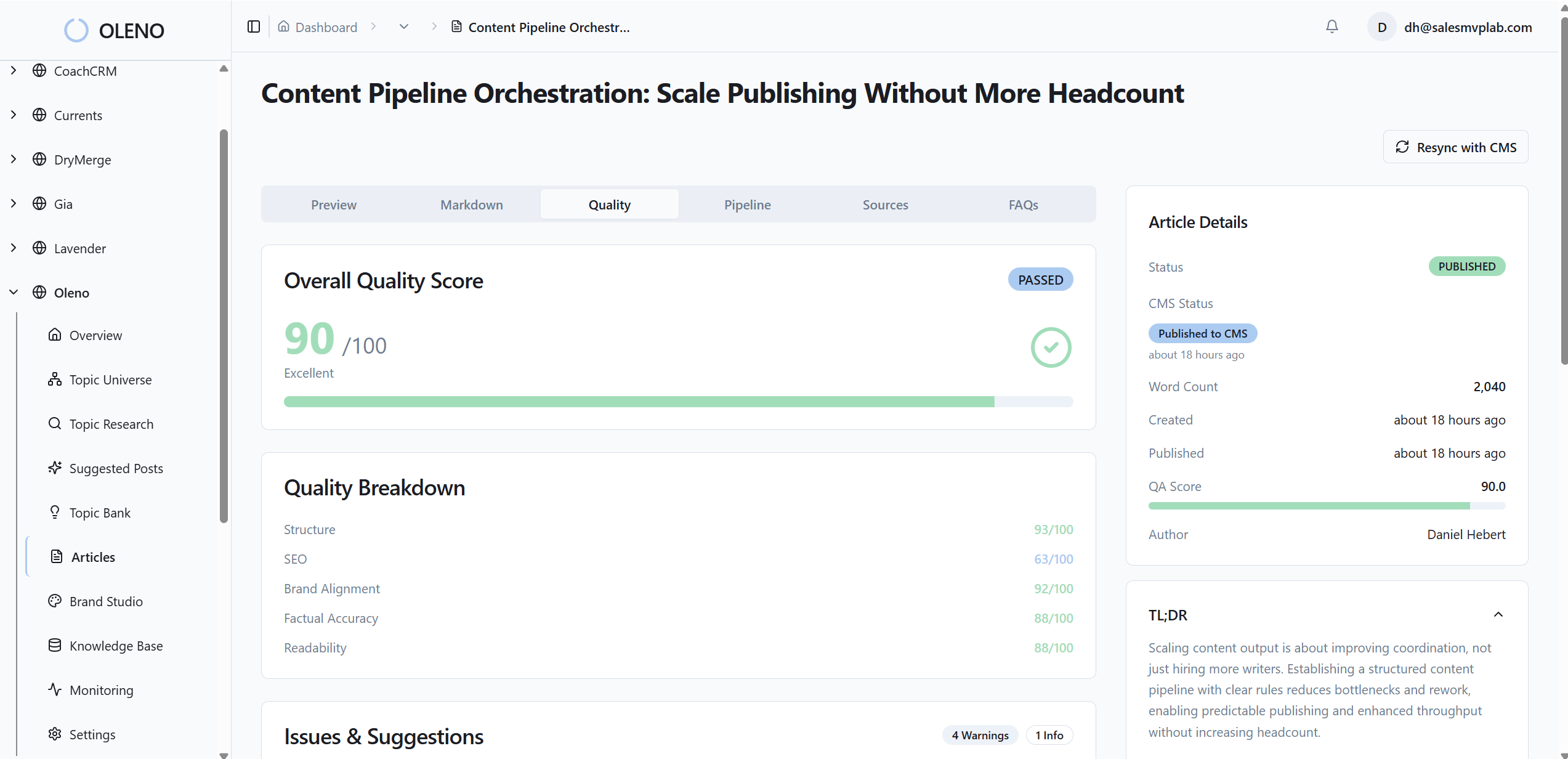
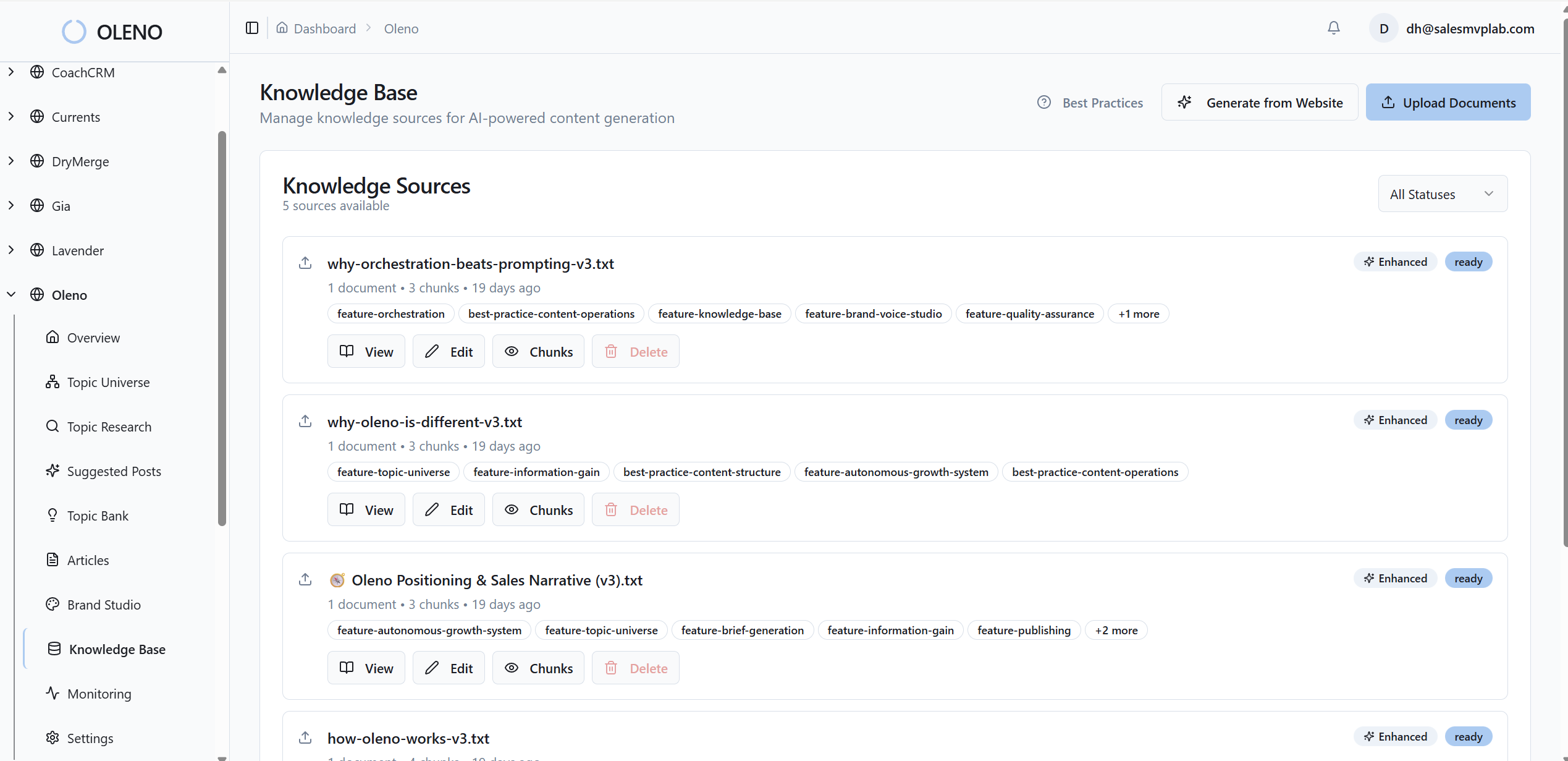
Before a word is drafted, Oleno’s Brief Generation runs competitive research and assigns an Information Gain Score. Low‑gain outlines get flagged, so shallow content never hits the calendar. During draft generation, Oleno keeps prose grounded in your KB and brand voice, and it structures sections for snippet‑readiness, those 40–60‑word openers that help both search and AI assistants parse your message. Less rework. More clarity.
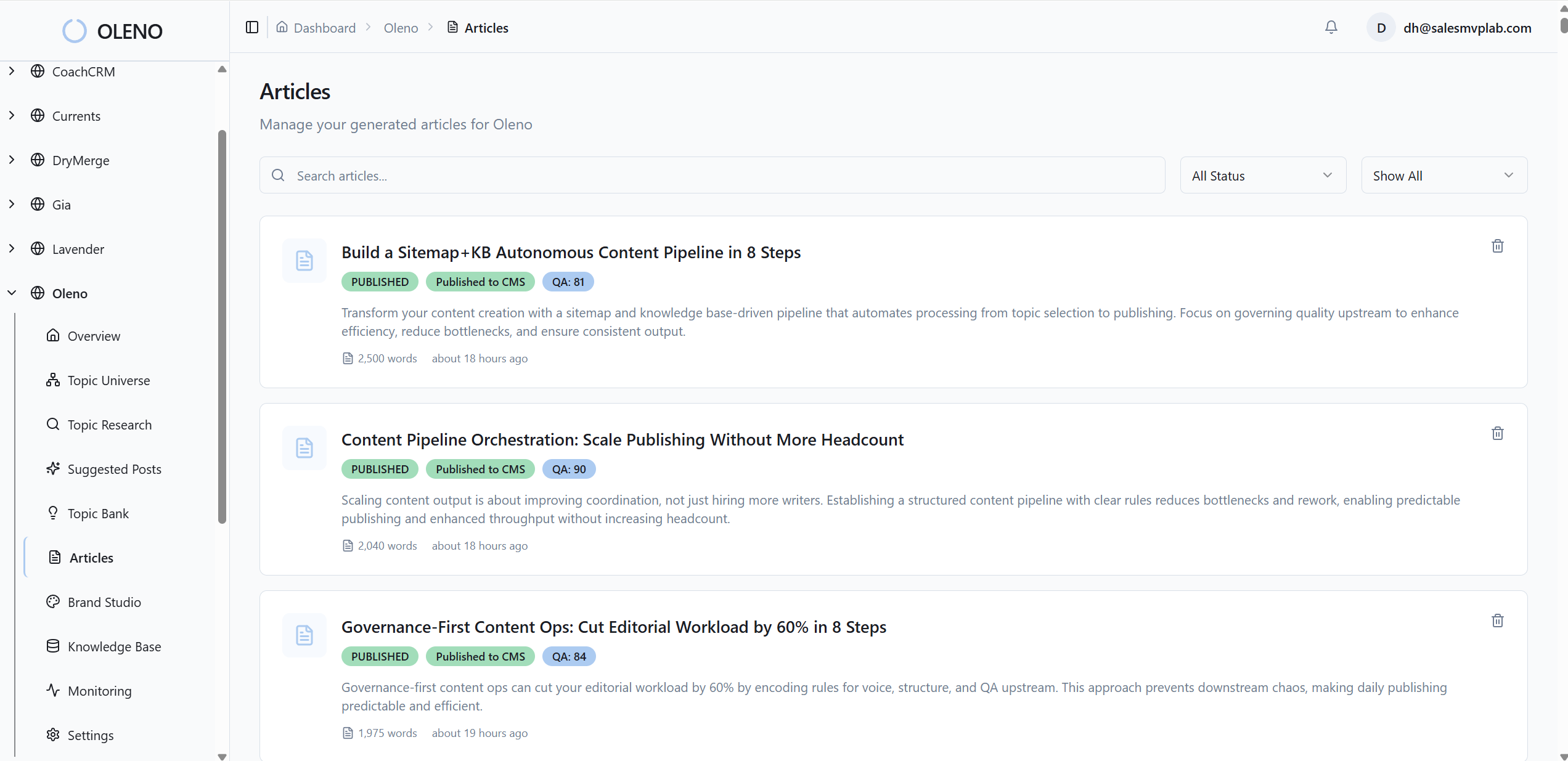
After drafting, Oleno’s deterministic systems take over accuracy. Internal links are injected only from your verified sitemap with exact‑match anchors, which keeps link equity within the right clusters instead of leaking across near‑duplicates. Schema is generated programmatically. Visual Studio inserts brand‑consistent images and relevant product screenshots in the solution areas. Finally, CMS connectors ship the article to WordPress, Webflow, or HubSpot without manual field mapping. The result ties back to the costs we surfaced earlier: fewer consolidation hours, fewer saturated-cluster posts, and fewer trust‑eroding duplicates.
If you’d rather see it than theorize about it, spin up a project and let the pipeline run end to end. You’ll get a feel for coverage labels, information gain checks, and publication without handoffs. When you’re ready to test it with your brand voice and KB, Try Oleno For Free.
Conclusion
You don’t need more posts. You need cleaner coverage, enforced saturation rules, and briefs that add distinct claims. The 5‑step audit gives you that backbone. Then a system like Oleno keeps it running every week without heroics. Less noise. More authority. A backlog you can trust. If you want to try this flow with your team, Try Oleno For Free.
About Daniel Hebert
I'm the founder of Oleno, SalesMVP Lab, and yourLumira. Been working in B2B SaaS in both sales and marketing leadership for 13+ years. I specialize in building revenue engines from the ground up. Over the years, I've codified writing frameworks, which are now powering Oleno.
Frequently Asked Questions