5-Step Microtest Framework to Validate Executive Thought Leadership

Thought leadership works when buyers repeat your ideas in their meetings without you in the room. The problem is most executive takes never make it that far. They go from idea to polished post to silence. I’ve seen this movie more than once, and the cost isn’t just a dud article, it’s lost time and conviction.
When I ran content teams, we got plenty of applause on social. Felt good. Didn’t move pipeline. At Proposify, for example, we ranked for the wrong stuff. Smart content, wrong angle, weak tie back to the product. Since then, I’ve learned to treat executive POV like a hypothesis. You test it in public, fast, before you scale it with design and PR.
Key Takeaways:
- Treat executive POV as a hypothesis to validate in 7-14 days
- Translate opinions into a thesis and three risky assumptions you can test
- Use replies, DMs, meetings, and internal adoption as real signals, not likes
- Quantify thresholds up front and add a holdout to avoid false positives
- Build a light evidence pack early so you’re never scrambling for proof
- If it passes, harden with governed claims and publish on a set cadence
Why Unvalidated Executive POVs Backfire
Unvalidated executive POVs backfire because early feedback is noisy and vanity-heavy, which misleads teams into scaling weak ideas. Social applause rarely maps to meetings or pipeline lift, so you end up polishing the wrong story. A quick microtest prevents expensive spin-up and protects executive time.

The false-confidence loop
Ship a long piece without testing and the only feedback you’ll see for days is vanity. Likes, quick “love this” comments, maybe a repost from a friendly exec. That stuff feels like signal. It isn’t. The only signals that matter early are hard to get, like replies with questions, meeting requests, or internal adoption of your angle in sales calls.
When I started running this way, it felt a bit harsh. Almost dismissive. But I’d rather offend my ego than waste a month of design cycles. A simple rule helped us cut through noise: no expansion until we see 2-3 high-friction signals. Teams stop arguing once you define signal types and thresholds with numbers, not vibes. If you want a broader take on what buyers call “real thought leadership,” the examples from the Content Marketing Institute are a good gut check.
What happens when you skip validation?
You pour 18 hours into a polished piece. Design touches every block. You brief the social team. Sales shares it twice. Prospects skim. Nothing changes. The idea might be fine, but the framing missed. Without a microtest, you don’t know which part failed, so you guess, and revise, and guess again.
I’ve made this mistake enough times to recognize the pattern. We were “discovering” post-publish, which is backwards. Publishing should be the final mile, not the test bed. A tight microtest catches the weak hook in two days, not two weeks, and points you to a stronger angle before you lock in the long-form version.
Why social applause is not evidence
Likes are cheap. They reward performance, not proof. Shareable hooks can mislead you when they don’t map to buyer intent or evaluation criteria. The signals that matter have friction built in. Replies with objections. DMs asking for details. A meeting booked. A sales leader who borrows your line for their next call.
So elevate hard signals by default and codify them into thresholds. For example, 10 percent reply-to-open on a newsletter snippet, three meeting requests from ideal profiles, or internal reuse by sales in five calls. That small shift moves the conversation away from “seems popular” to “drove real behavior.” If you want a lightweight five-step approach for senior leaders, the frame in SmartBrief’s guide is close to what we run.
Ready to cut the guesswork and validate in days, not weeks? Request a short walkthrough and we’ll show the workflow end to end. Request A Demo.
Make Opinions Testable, Not Precious
You make opinions testable by compressing the POV into a plain-language thesis and surfacing the 2-3 risky assumptions under it. Each assumption gets a microtest. This shifts debate to evidence and reduces rework. You’re not removing nuance, you’re isolating the uncertain parts you can validate quickly.

Translate POVs into theses and risky assumptions
Start by compressing the executive take into one or two sentences. If the sentence only works with flourishes, it’s not ready. Then list three claims that must be true for your buyers. If any one fails, the whole piece collapses. Now you’ve got a checklist instead of a debate.
I like to write the thesis on top of a brief and put the risky assumptions right under it. One example: “CIOs will trade feature depth for provable rollout speed.” Risky assumptions: 1) rollout speed matters more than feature count for CIOs in mid-market, 2) they trust proof that looks like time-to-first-value metrics, 3) they’ll accept a trade-off if vendor risk feels low. Each one can be tested in under a week.
Who should own validation, marketing or the exec?
Marketing runs the process, the executive brings the edge. That split matters. Ask the exec for the thesis, a couple lived examples, and what they’d stake their name on. Marketing designs the microtests, sets thresholds, and reads signals. Then you agree on the stop rule up front, so a packed calendar can’t overrule weak evidence later.
Be explicit. “We pause expansion unless we see at least three qualified replies and two meetings from ideal profiles.” Now you’re protecting the executive’s time and the team’s morale. If you want a different take on this handoff, the CEO OS framework lays out a clean owner-operator split that aligns to what we’ve seen work.
The hidden complexity behind evidence
Strong thought leadership threads lived experience with verifiable facts. That takes governed claims, citations, and micro-stories that survive scrutiny. You don’t need a research team to start. Build a small evidence pack early, even before drafting long form. A couple quotes, one customer snippet, and a small-data check from support logs goes a long way.
Honestly, this is where teams slow down. Not because it’s hard, but because it’s unclear who assembles it. Solve that once. Define where you’ll store quotes, proof points, and boundaries on claims. Then when a thesis tests well, you’re not scrambling during final review. You’re ready.
The Real Cost Of Publishing First, Learning Later
Publishing first and learning later creates a slow leak of time, money, and brand trust. You burn hours on production, drift on measurement, and invite internal rewrites after the launch. Quick microtests cut those costs by surfacing weak framing before you commit. The savings show up in fewer cycles and faster follow-through.
Let’s pretend we shipped without testing
Let’s pretend you invest 18 hours across brief, draft, edits, design, and a small paid push. At a blended $120 per hour, that’s $2,160. Sales runs two calls using the piece, no lift in meetings. Two weeks gone. The opportunity cost is the campaign you could’ve shipped, and the signal you could’ve collected by now.
Worse, you’re training your audience to ignore your essays. You’ve created a brand tax you’ll keep paying. A simple 7- to 14-day test window would’ve shown which assumption didn’t hold and given you a new angle without another full build. The difference is real pipeline time recovered.
How do false positives burn time?
A post spikes on vanity metrics. You assume it’s a hit. So you scale the wrong angle into social snippets, PR pitches, and podcast talking points. Weeks later, pipeline impact is flat and the team is confused. The problem wasn’t effort. It was signal quality.
Add a holdout by default. Keep 10-20 percent of your audience on the baseline, then compare lift. That one habit prevents the expensive echo chamber. If you want a structured approach to do this right, we wrote about holdout design elsewhere, and the broader research community has plenty of patterns that make this simple to run.
The brand tax of weak claims
A bold claim without grounding invites public skepticism and internal rewrites. Legal gets careful. Execs get defensive. Your team gets hesitant to ship. You can avoid this by building a light evidence pack and setting claim boundaries early. Quotes with permission. One chart you can stand behind. A small-data check from product or support.
That prep doesn’t slow you down. It speeds you up later. You sidestep rework, protect credibility, and you walk into expansion with fewer surprises. The best part is you can keep the pack small. Two pages, max.
Stop scaling unproven takes. Start running small, high-signal tests before you commit to the big build. If you want help setting thresholds and holdouts, we can walk you through the setup in a quick session. Request A Demo.
The Human Side, When Thought Pieces Fall Flat
When thought pieces fall flat, the human cost shows up in confidence, procrastination, and friction. Execs hesitate to contribute, teams lose conviction, and sales stops using the content. Microtests keep the loop tight, protect calendars, and restore trust that the work is worth it.
When your biggest customer asks for data
You send an op-ed to a strategic account. They ask for proof. You rummage through support logs, can’t find the stat you implied, and the follow-up drags. Confidence dips on both sides. A small, pre-built evidence pack would’ve saved the moment.
Build a simple habit. For every thesis you test, pull one micro metric, one quote, and one customer snippet into a shared place. Now when a test lands, your exec has answers in minutes, not days. Buyers remember you handled it cleanly and quickly. That matters.
The procrastination trap on exec calendars
Executives don’t avoid writing because they don’t care. They avoid slow, ambiguous tasks. Microtests make contribution lightweight. Ask for a 5-minute voice memo for the thesis and one lived example. Marketing turns that into testable hooks and a newsletter snippet. You time-box the experiment to 7-14 days, and momentum stays high.
We’ve run this cadence with very busy leaders. Once they see a tight loop, they come back with more ideas. The barrier is ambiguity, not effort. Remove it.
Why your team loses conviction
When no one can explain why a piece exists, conviction dies. Designers second-guess the visuals. Social doesn’t push as hard. Sales ignores it. Microtests fix this by creating shared stakes and clear criteria for expand, iterate, or kill. Everyone knows what you’re looking for and why.
That clarity tightens handoffs to PR and enablement. You don’t get parking-lot rewrites, because the decision rule is already set. People stop guessing. They ship.
A 5-Step Microtest Workflow You Can Run In 14 Days
A 14-day microtest workflow validates the thesis before you scale. You define a sharable thesis, design four microtests, run with thresholds, decide the path, then harden for distribution. Each step has a clear owner and simple outputs, so the process doesn’t stall when calendars get busy.
Step 1: Define a sharable thesis and top 3 risky assumptions
Write a one or two sentence thesis in plain language. Strip out flourishes until it survives a cold read. Then list three risky assumptions that must hold for your audience. If any one fails, the piece collapses. Capture one customer anecdote per assumption to ground future copy.
The outcome is a short brief you can hand to marketing to design tests and claim boundaries. Keep it on one page. If you’re struggling to compress, that’s a signal the idea needs work. You can also spark ideas by looking at how category leaders frame their POVs, but resist copying their words. You need your own spine.
Step 2: Design 4 fast microtests across channels
Build four lightweight experiments to pressure-test the thesis from different angles. Here’s a simple set: 1) LinkedIn hook variants that stress the core claim, 2) a newsletter excerpt with a clear CTA to reply if the problem fits, 3) an internal sales test with two talk tracks in five calls, 4) a small-data claim check by pulling support logs or product telemetry.
Keep setup under two hours. Document exact prompts, scripts, and what counts as success. Then break the rule once. Include one wild-card hook that feels risky. It often surfaces a better angle you didn’t see coming.
Step 3: Run for 7 to 14 days with clear thresholds
Time-box the window to avoid drift. Predefine thresholds like 10 percent reply-to-open on the snippet, three meeting requests from ICP, five qualified DMs, or corroborating customer data. Add a small holdout where possible so you can compare against baseline behavior. If signals are mixed, note which assumption is at risk.
The point isn’t perfection. It’s clarity. You’re deciding whether to expand, iterate, or kill. Quantified thresholds keep the decision clean and reduce revisiting the topic in every meeting for a month.
Step 4: Decide the path and assemble an evidence pack
If thresholds pass, pull supporting data, quotes, and two micro-stories. If not, adjust framing or kill the piece without regret. The decision rule is the win here. Build a lightweight evidence pack with links, a simple chart, and a permissions checklist. This avoids last-minute sourcing headaches later.
I like to add a small section on claim boundaries. “We can say X, we can’t say Y.” That protects your exec during interviews and keeps PR pitches safe. It also helps sales know which lines to reuse.
Step 5: Harden for long form and amplification
Translate the validated thesis into an outline with governed claims and citations. Draft with your voice rules in place. Prep an executive-ready brief for PR, social, and partner channels. Create two image concepts and three headline variants. Schedule repurposing into social and enablement once QA clears.
Now you’re compounding. The idea moves from microtests to long form to distribution without drift. If you want extra structure on extraction and packaging, the Executive Content Extraction Framework mirrors this approach nicely.
How Oleno Operationalizes Microtests For Thought Leadership
Oleno operationalizes this workflow by turning your thesis and risky assumptions into governed drafts, quick channel tests, and publish-ready assets. Governance keeps claims tight, Stories Studio gathers proof, Distribution Studio runs controlled experiments, and QA gates protect accuracy. You move faster without inviting rework or brand risk.
Governance Studios turn theses into enforceable claim rules
Governance is where you codify voice, positioning, and product truth once, so everything produced stays inside approved boundaries. You define tone and language rules, what claims are allowed, and how to phrase product value. Oleno applies these constraints across briefs, drafts, and distribution, which means fewer rewrites and safer claims during testing and expansion.
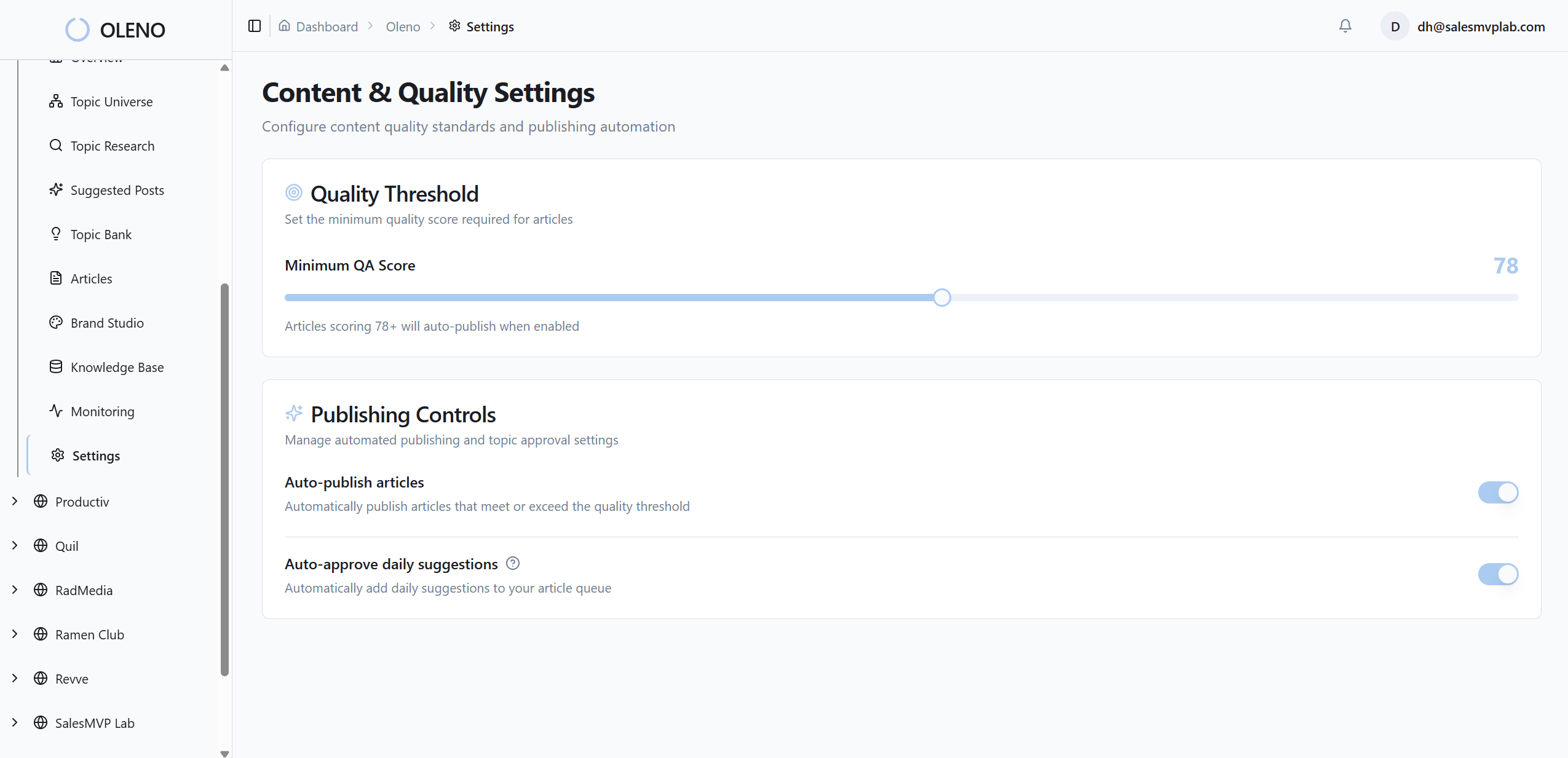
In practice, that looks like the thesis and its three risky assumptions translated into allowed statements, proof boundaries, and phrasing guidance. When a microtest hits, you scale with confidence because the guardrails are already encoded. You’re not reinventing the rules per post.
Stories Studio and Knowledge Archive assemble evidence fast
Strong thought leadership needs lived experience and verifiable facts. Oleno’s Stories Studio captures founder stories, sales anecdotes, and customer proof in one place, while the Knowledge Archive grounds drafts in your real product docs and notes. Oleno uses that context to weave credible micro-stories and citations into briefs and long-form drafts.
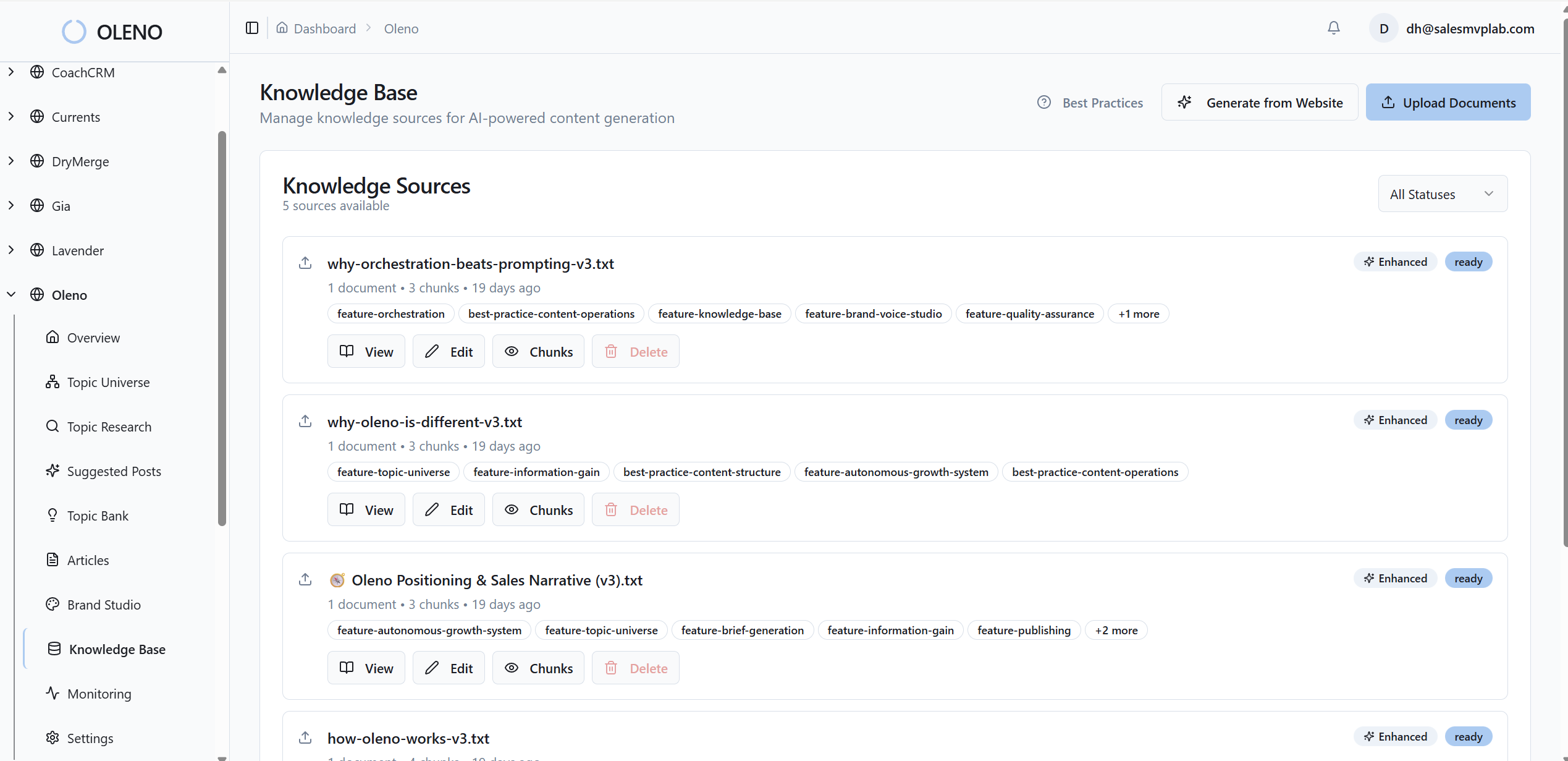
The benefit is simple, fewer last-minute scrambles for proof when a test lands. You pull a quote, a small-data check, and a chart from approved sources in minutes. Then you keep moving. This is where most teams lose a week. You won’t.
Distribution Studio generates channel tests and schedules them
Once your thesis is validated, you still need to run controlled channel experiments without turning social into a second job. Distribution Studio converts the thesis into LinkedIn hooks and newsletter snippets with AI variants. You approve in a workbench, promote to the queue, and set per-channel schedules, including an evergreen pool for top performers.
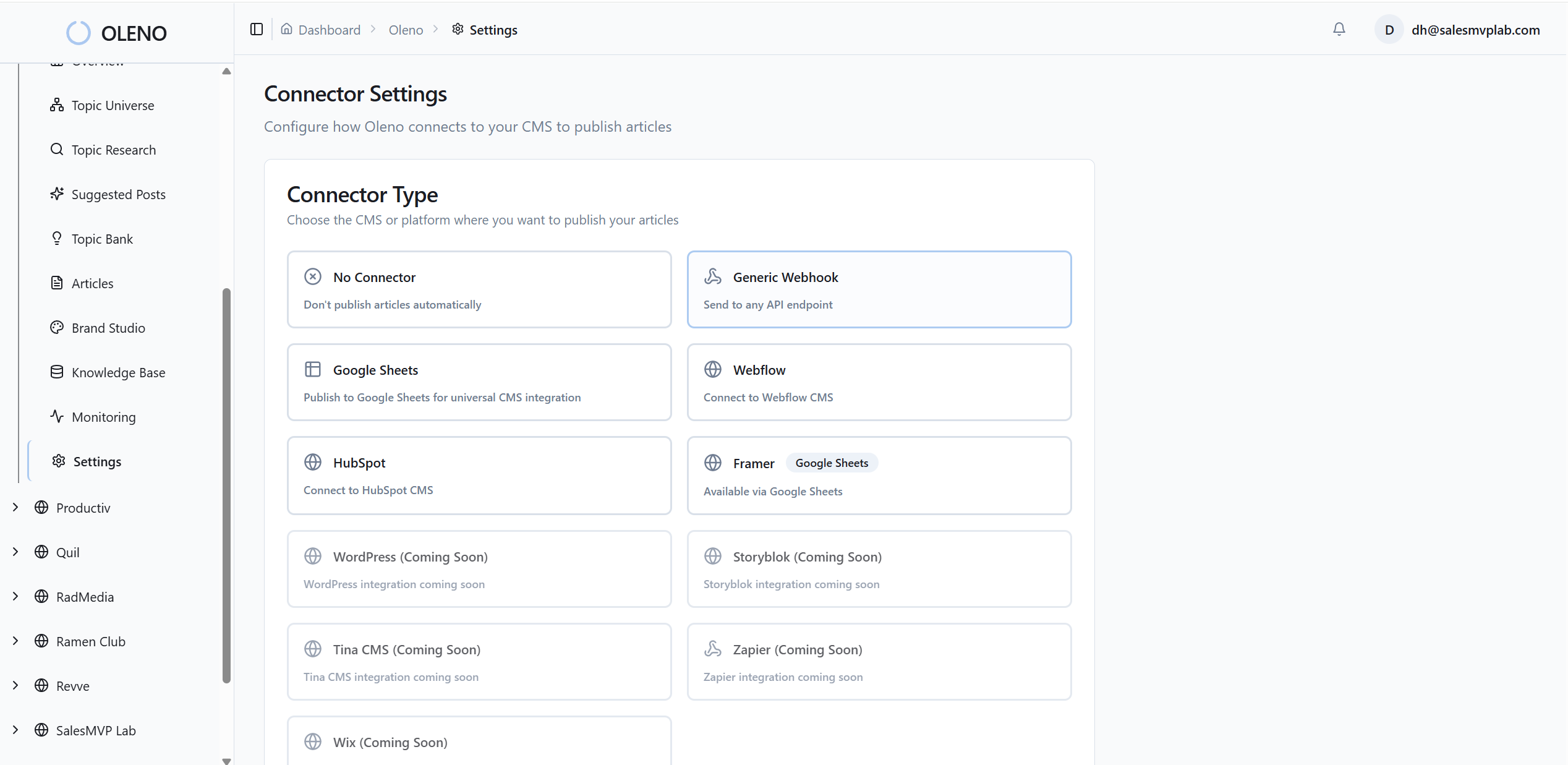
Oleno keeps distribution tied to approved content only, so nothing off-message slips out under pressure. You get repeatable tests with the right cadence, without asking your team to live in scheduling tools all day.
QA gate and publishing pipeline harden and ship
Nothing publishes until it passes Oleno’s QA checks for voice, narrative structure, clarity, grounding, and accuracy. Once it clears, push directly to your CMS, including WordPress, Webflow, HubSpot, and more. Publishing is idempotent, so you won’t create duplicates during revisions.
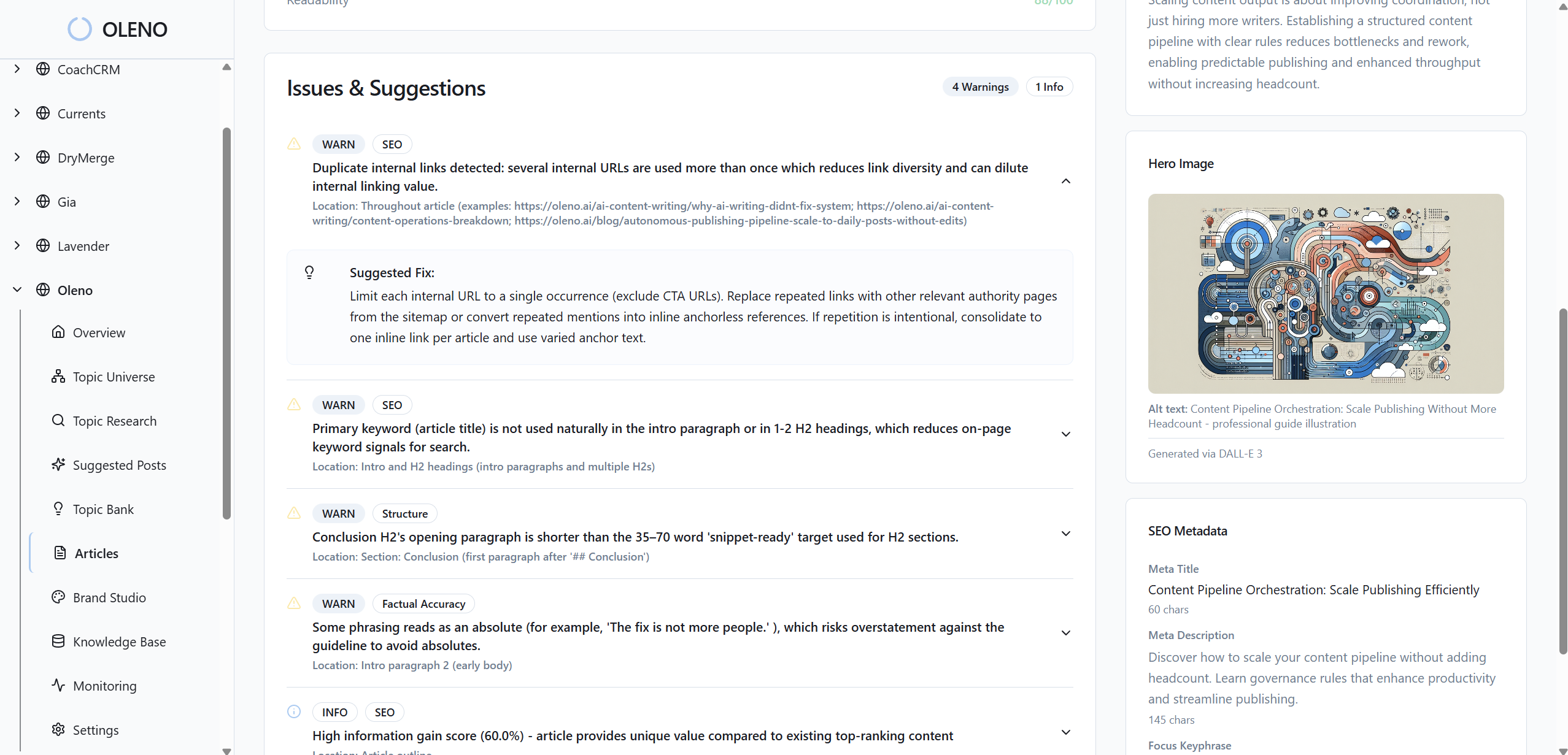
That last stretch matters. The final article reflects your microtest learnings and governed claims, which reduces public walk-backs, protects executive time, and keeps your narrative consistent as you scale. Oleno handles the execution layer. You keep the insight and the call.
3x faster from thesis to publish-ready without adding headcount. That’s what teams use Oleno for when they need more signal and less rework. If you want to see your thesis flow through governance, testing, QA, and publishing, we can show it live. Request A Demo.
Conclusion
Unvalidated executive POV is a bet. Sometimes it lands, often it burns time. A simple microtest framework turns opinions into testable theses, surfaces signal in 7-14 days, and protects your brand with governed claims. Once you’ve got a winner, let the system harden and ship it on a steady cadence. That’s how thought leadership compounds instead of resets.
About Daniel Hebert
I'm the founder of Oleno, SalesMVP Lab, and yourLumira. Been working in B2B SaaS in both sales and marketing leadership for 13+ years. I specialize in building revenue engines from the ground up. Over the years, I've codified writing frameworks, which are now powering Oleno.
Frequently Asked Questions