5 Trends in Content Strategy for Startups to Watch

84% of marketers say AI content needs editing before it can be published, according to HubSpot's 2024 State of Marketing data. If you run an agency, you probably felt that this week, when a draft looked fast on paper but still ate 45 minutes of review because the tone was off, the examples were generic, or the product details were shaky.
Content strategy trends are getting framed the wrong way. Most people talk about formats, channels, and AI tools. But the real shift is execution. The agencies that win over the next 12-24 months won't just have better ideas. They'll have tighter systems for turning strategy into output without losing the client's voice.
Key Takeaways:
- The biggest trend in content strategy is not more AI. It's more governance around AI.
- Agencies are hitting an editing wall, and the break point usually shows up around 3-5 active client accounts per content lead.
- GEO changes the standard for good content because LLMs reward consistency, clear positioning, and repeated evidence across many pieces.
- If your team is still relying on prompts, freelancer memory, and manual reviews, you're not scaling a system. You're scaling rework.
- High-output agencies separate four things: narrative, audience context, product truth, and operations cadence.
- A simple rule works: if review time is more than 30% of total production time, your content process is broken.
- The next wave of content strategy trends favors firms that can produce 20-40+ publish-ready pieces per month without adding the same amount of headcount.
- Tools matter. But without a governed process, they mostly make the mess arrive faster.
Why today's content strategy trends expose weak execution
Content strategy trends now point to one thing: execution quality is becoming more visible, and more expensive to get wrong. Search used to forgive inconsistency if you published enough. AI engines are less forgiving because they synthesize patterns across everything you've put out.

A lot of agencies still think the main problem is capacity. It isn't. The problem is that strategy gets diluted as it moves from client call, to brief, to writer, to editor, to final draft. That translation loss is where most of the damage happens.
The old volume play broke once AI flooded the market
Back in 2012-2016 I ran a digital marketing site that got to 120k monthly visitors. We saw traffic spikes at 500 pages, 1000 pages, 2500 pages, 5000 pages, then 10000 pages. So I believe in volume. Very much.
But volume only worked because we also had depth, breadth, and real points of view across contributors. That nuance matters. A huge chunk of those pages got less than 100 visits a month, but together they created long-tail authority. Volume without quality is just a bigger junk drawer.
That's one of the most misunderstood content strategy trends right now. People see AI and assume the play is simple: publish more. The real play is publish more without flattening the voice. If you can't do that, your catalog starts to look like a warehouse full of near-duplicates.
Prompting feels productive, but it pushes the hard work downstream
Prompting is useful. I use AI. Most smart teams do. So let's concede that upfront.
But prompting is optimized for moments, not systems. That's the difference. You can get a draft quickly, sure. What you don't get is reliable audience context, stable narrative framing, product boundaries, or consistent structure across 200 assets and 7 client accounts. That all gets pushed back onto humans.
A day-in-the-life version of this looks pretty familiar. Your strategist wraps a client call at 11:00. By 2:00, a writer has a draft from ChatGPT and a few old briefs. By 4:30, the account lead is rewriting the intro, fixing the CTA, stripping out invented claims, and swapping generic examples for something the client would actually say. Everyone feels busy. Nobody feels ahead.
And honestly, that's the exhausting part. You thought AI would remove the grind. Instead it often changes the shape of the grind.
The editing tax is the hidden trend nobody wants to admit
The visible trend is faster drafting. The hidden trend is slower approval.
I've seen this movie before. When I was the only marketer on a SaaS team, I could write 3-4 good posts a week because I had all the context in my head and I used a structured framework. As the team grew, output didn't get cleaner. It got noisier. The writer had less context than I did, and I had less time to fix things. So quality dropped while coordination went up.
That's the Editing Tax Ratio in action: review minutes divided by draft minutes. If that ratio goes above 0.3, meaning 30 minutes of review for every 100 minutes of drafting, you're no longer getting leverage from the system. You're financing a broken workflow. The rest of this article is really about how to bring that ratio back down.
The real shift in content strategy trends is from creation to control
The main shift in content strategy trends is not about writing faster. It's about controlling what gets written, how it sounds, what it says, and whether it still reflects the strategy six weeks later. Creation is easy now. Control is hard.
That's why so many agencies feel weirdly underwater even when output numbers look decent. They solved draft generation. They didn't solve consistency.
Strategy-execution drift is what actually breaks agency scale
Most agencies don't have a writer problem. They have a transfer problem.
Client strategy lives in kickoff decks, call notes, Slack threads, and the account lead's brain. Then a freelancer or internal writer has to reconstruct all of that from a short brief. That brief gets translated again by the editor. Then the client reviews it through the lens of everything that never made it into the document. No wonder revisions pile up.
I think of it like a relay race where every handoff shaves a little paint off the baton. By the fourth handoff, you're still holding the same object, technically. But it doesn't look like the original anymore. That's how client voice gets lost.
A lot of people defend this with a fair point: manual review is what protects quality. True. Manual review does protect quality. But if quality only exists at the final checkpoint, then your system is too late. Quality has to be upstream.
GEO rewards repeated clarity, not scattered cleverness
One of the more important content strategy trends is the rise of GEO. AI engines are now part of the audience. They don't just look at one article. They infer what your client stands for by scanning patterns across many pieces.
That changes the scoring system. In the SEO era, you could sometimes win with tactical coverage, decent optimization, and enough backlinks. In the GEO era, clear positioning, defined product language, specific audience framing, and consistent narrative matter more because LLMs are trying to decide who sounds most credible across a body of work. Google has said similar things for years through its focus on helpful, reliable, people-first content and E-E-A-T principles in Search quality guidance, even if the packaging keeps changing.
So if an agency publishes 40 posts for a client and 18 sound sharp, 11 sound generic, 6 overstate the product, and 5 drift into another market category, that inconsistency becomes the signal. Not the exception. The inconsistency is the brand.
More writers doesn't fix context gaps
Agencies often try to solve the problem with more freelancers, more editors, or more QA layers. I get the instinct. If you're overloaded, adding people feels rational.
But the status quo has real limits. Hiring another writer can help if your issue is simple capacity and the client category is straightforward. That's valid. Still, once you cross into multi-client complexity, more people usually means more interpretation layers unless you've built a system that carries context with the work.
Use the 3x3 Drift Test:
- Can a writer explain the client's category point of view in one sentence?
- Can they name the audience, pain, and buying trigger without opening the brief?
- Can they describe what the product does not do?
If the answer is no on 2 or more of those 3 questions, expect at least 2 revision rounds. Every time. That's not a talent issue. It's a system issue.
How agencies should respond to content strategy trends now
The right response to current content strategy trends is to build a governed content system, not a faster drafting line. That means encoding the inputs that matter before the work starts, then using process to preserve them through production.
This is where most advice gets too soft. "Document your voice." "Create good briefs." Fine. But what should actually exist in the system? Let's make it more concrete.
Diagnose your maturity before you add more tools
Before you buy anything, diagnose the operating model. Agencies usually fall into one of three buckets.
Bucket 1 is Prompt-Led. Drafts are created ad hoc, context lives in docs and people's heads, and quality depends on who's touching the piece that day. If you're here, expect high variance and constant review.
Bucket 2 is Template-Led. You have repeatable structures, some working briefs, and a few strong editors holding the line. This can work up to a point. Usually 2-4 core clients per lead. After that, drift starts showing up in examples, positioning, and product specifics.
Bucket 3 is Governance-Led. Voice, audience, use case, product truth, and narrative framing are defined once and attached to production every time. This is where scale starts to feel calm instead of chaotic.
The threshold I use is simple. If one account lead can oversee more than 5 active client content streams without rewriting intros and conclusions personally, you're probably operating closer to Governance-Led. If not, you're still leaning on heroics.
Separate the four layers that most agencies mash together
The strongest teams separate four layers. I call this the Context Stack.
First, narrative. What does this client believe about the market? What old way are they arguing against? What do they want prospects to understand differently?
Second, audience. Who is this for, really? Not "B2B marketers." That's too broad. Is it a CMO at a 150-person SaaS company? An agency owner serving cybersecurity clients? A head of demand gen trying to justify budget?
Third, product truth. What can be said? What can't? What claims are approved? What use cases are real? Where are the boundaries?
Fourth, operations cadence. What gets produced weekly? What gets refreshed monthly? What gets reviewed by humans? What gets blocked?
When agencies mix all four into one big brief, the brief becomes a junk drawer. When they separate them, writers can move faster because the system is carrying context for them. That's a big shift in content strategy trends right now. More teams are learning that a brief is not the strategy. It's just one expression of the strategy.
Build for client voice isolation, not just efficiency
Agencies live or die on one thing a lot of SaaS teams don't deal with as intensely: client isolation. You can't let one account's phrasing, category language, or product framing bleed into another's.
That means every client needs its own governed voice layer. Different terminology. Different enemy. Different examples. Different use cases. Different CTA style. If not, your team starts producing that weird agency output where every client sounds suspiciously similar.
We were surprised by how often this is the actual failure mode. Not bad writing. Cross-client sameness.
A practical rule: if the same intro could work for 3 client accounts with only the company name swapped out, it's too generic to publish. Another one: every draft should contain at least 2 client-specific markers in the first 250 words. That could be a category angle, product constraint, buyer pain, or market language choice.
Use throughput math that includes review, not just draft speed
Agencies love talking about throughput. Fair enough. But most throughput math is fake because it only counts draft production.
Use Net Output Rate instead: Net Output Rate = publish-ready assets per month / total team hours including briefing, review, revision, and approval
That number tells the truth. If AI increases draft speed by 60% but review time doubles, your net gain may be close to zero. Or negative.
This is where current content strategy trends get uncomfortable. Everyone wants to say they're AI-enabled. Few want to say their approval cycle got worse. But for many teams, that's exactly what happened.
For grounding on the broader AI shift, HubSpot's State of Marketing 2024 and McKinsey's The economic potential of generative AI both make the same bigger point in different ways: speed only creates value when the operating model around it changes too.
Treat refresh as part of strategy, not cleanup
One trend in content strategy that doesn't get enough attention is drift management. Content goes stale faster now because product messaging changes, categories evolve, and AI-generated material can age badly if it wasn't grounded well to begin with.
If a client changes pricing, positioning, or use-case emphasis, old content can quietly start contradicting new sales calls. That's not a small issue. That's revenue friction hiding in the archive.
So set a threshold. If more than 15% of your top traffic pages contain outdated product framing, paused campaigns, or old category language, stop publishing net-new for a week and refresh the winners first. It sounds boring. It's not. It's one of the highest-leverage moves an agency can make.
How Oleno turns these content strategy trends into a system
Oleno is built for the exact shift these content strategy trends are creating: away from one-off drafting and toward governed execution. It doesn't replace keyword research, technical SEO, analytics, or paid distribution. It handles the content production bottleneck, the part where strategy keeps leaking out between planning and publishing.
Governance first, so the content actually sounds like the company
Oleno starts by separating governance from execution. Brand Studio defines how a company should sound. Marketing Studio captures category framing, key messages, and point of view. Product Studio stores approved product truth and boundaries. Audience & Persona Targeting keeps examples and language aimed at the right buyer instead of some generic reader.
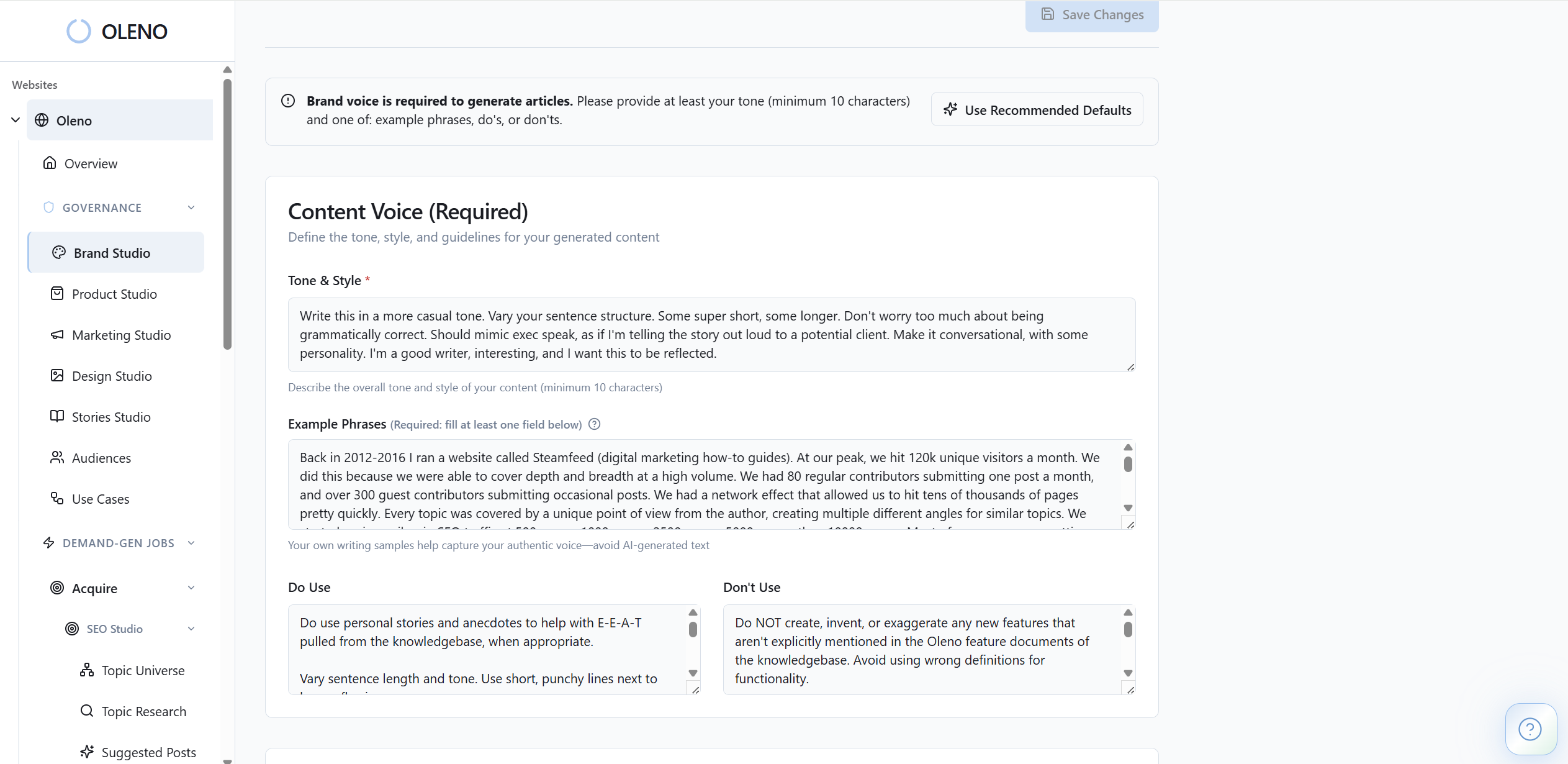
For teams managing multiple brands or websites, that matters a lot. It reduces the exact rewrite loop most agency owners and marketing leaders are stuck in now. Not because writers suddenly become smarter overnight, but because the system stops asking them to memorize everything.
The content pipeline runs from approved context, not memory
Once governance is in place, Oleno uses studios and operations layers to run content reliably. Programmatic SEO Studio creates acquisition content at scale by discovering topics from your site, knowledge base, and competitive landscape, then producing, scoring, enhancing, and publishing articles on a steady cadence. Product Marketing Studio handles feature and use-case content. Buyer Enablement Studio supports decision-stage content. Stories Studio brings in founder stories, customer anecdotes, and sales insights so the work feels lived-in instead of flat.
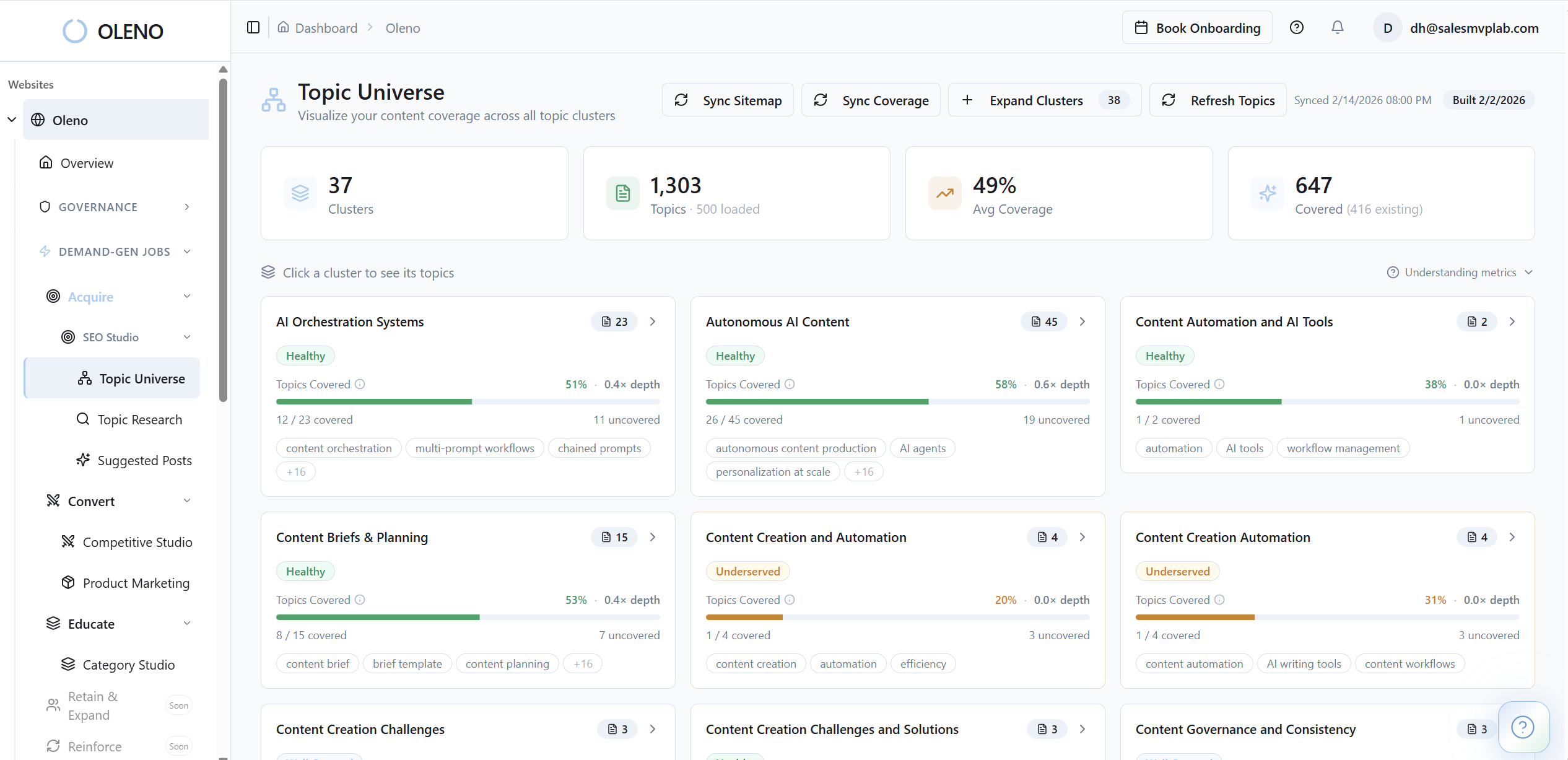
Then the Orchestrator runs the pipeline on a regular cycle, selecting approved topics and enforcing quotas and pacing at the job level. The Quality Gate checks voice, structure, grounding, and quality thresholds before content reaches review. That's a very different model than juggling prompts, freelancers, and spreadsheet status columns. In practice, it means the hours you were losing to context transfer and QA can go back into strategy and client relationships.
A founder version of this is how the product started. The original workflow came from manually prompting GPTs, copy-pasting drafts into a CMS, and burning 3-4 hours a day on repetitive content work before building a system to process approved topics, create drafts, QA them, and publish them. That's the part I like about it. It wasn't built from theory. It was built from irritation.
Why agencies use Oleno when headcount is the wrong fix
For agencies and lean marketing teams trying to increase output without turning review into a full-time job, the appeal is pretty simple. Oleno keeps strategy human while making production more systematic. Storyboard helps plan coverage across audiences, personas, products, and use cases. Executive Dashboard gives leadership visibility into cadence, quality trends, and coverage gaps. Content Refresh & Drift Monitoring helps prevent old assets from drifting away from current governance data.
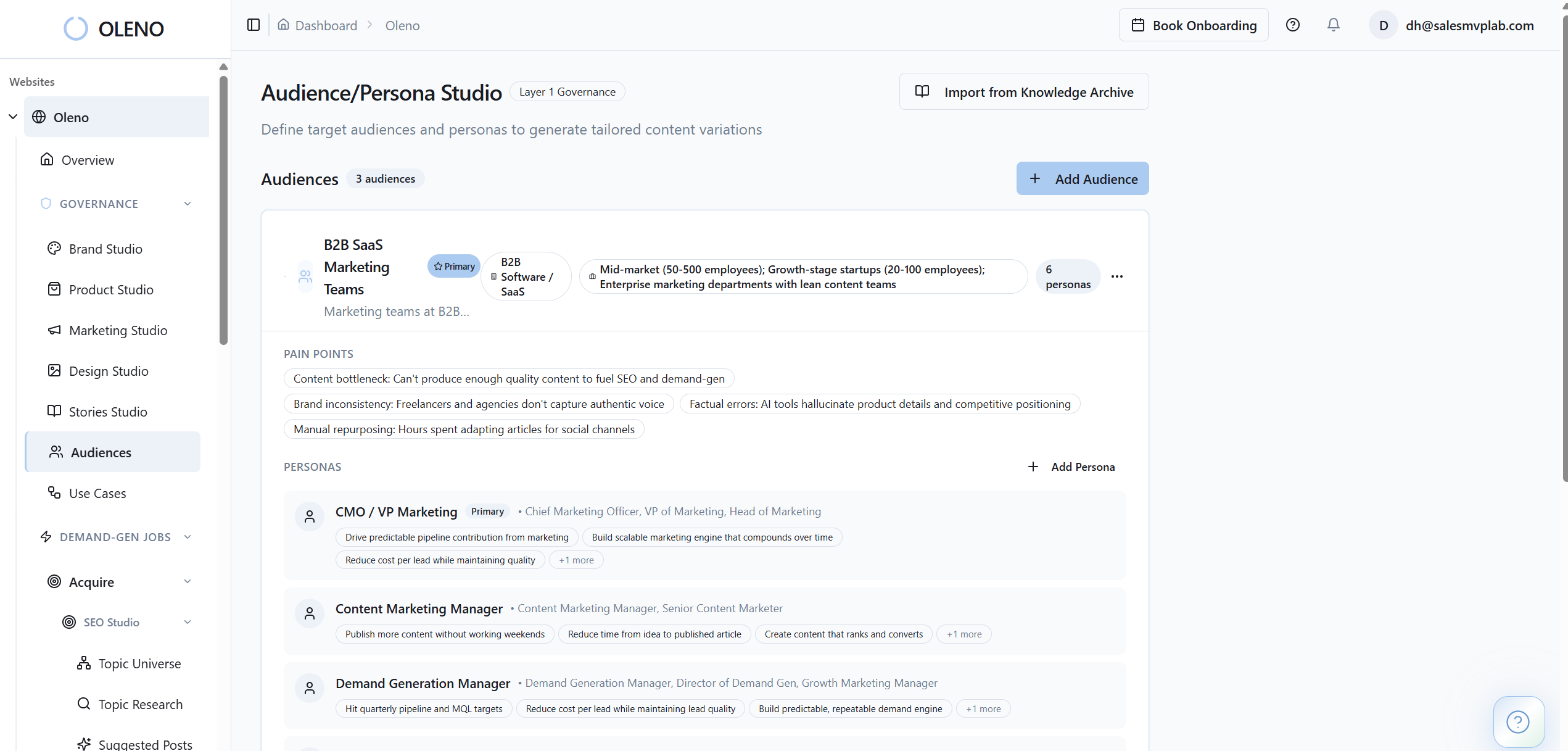
That doesn't make Oleno right for everyone. If you're a solo creator, a pre-revenue startup with no defined positioning, or an enterprise with a huge in-house editorial operation already humming, it may not be the right fit. But if you're an agency owner or marketing leader stuck between "we need more output" and "we can't keep hiring just to manage rewrites," it's a pretty direct answer. If you want to see how that works in practice, book a demo.
Where content strategy trends are heading next
The next phase of content strategy trends is pretty clear to me. Strategy will matter more. Raw drafting will matter less. And the teams that look efficient on paper but still depend on heroic editing will get exposed.
A lot of agencies are going to keep buying faster writing tools and wonder why margins don't improve. Others are going to build systems that preserve voice, enforce product truth, and create a steady publishing cadence without chewing up senior time on every draft. That's where the separation will happen.
If you're leading an agency, that's the real question now. Not "how do we make content faster?" It's "how do we make strategy survive contact with production?" Solve that, and a lot of the noise goes away.
About Daniel Hebert
I'm the founder of Oleno, SalesMVP Lab, and yourLumira. Been working in B2B SaaS in both sales and marketing leadership for 13+ years. I specialize in building revenue engines from the ground up. Over the years, I've codified writing frameworks, which are now powering Oleno.
Frequently Asked Questions