6 Best SEO Software Platforms for 2026

57 SEO tools later, the pattern is pretty clear: most platforms don't fail on keyword research, they fail in the 10 steps that happen after it. If you've spent this week chasing briefs, rewrites, approvals, and publishing delays, you already know the problem isn't "SEO software" in the old sense.
The best SEO software for 2026 isn't just a keyword database or a content scorer. It's the system that helps your team decide what to publish, turn that into credible content, keep it on message, and actually get it live without creating a review circus.
A few years ago, I saw this firsthand on content-heavy teams. Keyword research was rarely the bottleneck. The bottleneck was always the messy middle: the brief was thin, the writer lacked context, product marketing wanted changes, demand gen wanted a different angle, and publishing slipped another week. That's why a real seo software comparison has to go beyond rankings dashboards and look at workflow design.
What the Best SEO Software Actually Needs to Do
The best seo software now has to handle more than rankings and keyword ideas. Google still rewards helpful, people-first content, while AI search surfaces content that is clear, extractable, and trustworthy (Google Search guidance). In practice, that means the winning stack has to connect research, writing, governance, and publishing.
| Platform | Best for | Starting price | Primary strength | Primary limitation | Workflow complexity |
|---|---|---|---|---|---|
| AirOps | SEO and content ops teams with technical capacity | ~$99 to $199/month | Flexible workflow automation and AI search tracking | Longer setup time | High |
| Jasper | Marketing teams focused on brand-aware drafting | $49/month | Brand voice controls and broad template set | Shallower SEO workflow depth | Medium |
| Copy.ai | Small GTM teams that want fast copy output | ~$24 to $29/month | Speed and ease of use | Lighter governance and SEO workflow support | Low |
| Byword | Teams running programmatic SEO campaigns | $5/article or $99/month | Bulk article generation | Less suited for nuanced expert content | Medium |
| Outrank | Smaller teams pursuing automated SEO publishing | $49 promo, typically $99/month | End-to-end SEO automation | Quality control concerns | Medium |
| Oleno | Scaling SaaS marketing teams that need governed execution | $109/month | Governance plus ongoing SEO production system | Requires upfront setup discipline | Medium |
Key Takeaways:
- AirOps stands out for technical SEO and content ops teams that want configurable workflows and AI search tracking, but setup takes real effort.
- Jasper is a strong fit when brand-aware drafting matters more than deep SEO workflow orchestration or long-form governance.
- Copy.ai wins on speed and low entry price, especially for small GTM teams, but it isn't built as a full seo workflow software layer.
- Byword and Outrank are attractive programmatic seo tools when volume matters, though quality-sensitive teams usually need tighter editorial control later.
- Teams with multiple contributors usually need governance before they need more generation, because drift after draft creation is where cost piles up.
The shift from standalone SEO tools to content operating systems
SEO software used to mean rank tracking, keyword clustering, and on-page suggestions. That's still useful. But it's not enough anymore.
A content lead gets the keyword list on Monday. By Tuesday they're in Docs, Slack, Asana, and a CMS, trying to translate search intent into something that actually sounds like the company. Three reviewers show up late. Product marketing flags accuracy issues. The post goes live a week behind schedule. Sound familiar?
I'd call this the Post-Keyword Gap. That's the part most lists skip. If your tool stops at SERP analysis, you still need another system for briefs, narrative control, publishing, and quality review. That's why standalone SEO tools are slowly turning into content operations platforms.
The core evaluation criteria for modern SEO software
Modern seo software for marketing teams should be judged on five things: research depth, content quality controls, governance, publishing support, and setup friction. Google has been explicit that helpful content needs first-hand value and clear purpose, not just optimized structure (Google Search guidance). And AI search visibility increasingly rewards pages with direct answers, clean structure, and extractable claims (Search Engine Journal).
The SIMPLE test works well here: Source quality, Intent match, Message control, Production speed, Launch reliability, and Editorial overhead. If a tool scores low on three or more of those six, it probably won't hold up once you move past 10 articles a month.
Most buyers overweight drafting speed. Fair enough. Speed is visible. The hidden cost is editorial drag. When review time exceeds draft time, you didn't buy leverage. You bought another queue.
Why Choosing SEO Software Is Harder Than It Looks
Choosing seo software is harder because most demos show generation, not operational reality. The real costs appear after month one, when multiple contributors, changing messaging, and publishing deadlines expose context gaps. That's why many teams switch tools even after seeing solid early output.

Where teams lose time after keyword research is done
The biggest time loss usually happens after the keyword is approved. Writers need context. Editors need confidence. PMMs need product accuracy. Someone still has to publish.
Back when I was the only marketer on a team, I could knock out 3 to 4 solid posts a week because the context lived in my head. Once more people got involved, output actually slowed down. Not because people were bad. Because context transfer is hard. Really hard.
A head of content opens a brief at 9:10 AM. The keyword is there, sure, but the angle is vague, the differentiator is missing, and there are no approved product points. By 2 PM the writer has a draft, but half of it needs rewriting because it sounds generic. The PMM jumps in, demand gen wants a stronger CTA, and the article slips. Again.
If your team has more than three reviewers touching the same long-form piece, you need governance before you need more generation. That's the rule. It saves money because it cuts rework, not because it magically writes perfect drafts.
Why content quality, governance, and publishing matter together
Content quality breaks when governance and publishing live in separate tools. That's the hidden connection. A good draft that takes 12 days to approve is still a bad system.
Some teams prefer a modular stack, and that's valid when ops maturity is high. If you already have tight briefs, documented positioning, and a reliable publishing process, separate tools can work. But when those foundations aren't locked in, splitting quality, governance, and publishing usually creates drift.
The 3-Layer Drift Model is useful here. Layer 1 is message drift, where the content sounds a little off. Layer 2 is factual drift, where product or market claims start getting fuzzy. Layer 3 is operational drift, where publish dates and ownership get messy. Once you're at Layer 2, manual review time climbs fast. Once you're at Layer 3, your SEO content automation is mostly theater.
That sets up the real question: which platforms reduce drift, and which ones mainly accelerate drafting?
AirOps Review
AirOps is a strong option for technical SEO and content ops teams that want configurable workflows and AI search visibility support. Its value comes from flexibility, AI search optimization positioning, and workflow design depth rather than instant simplicity. For buyers who like building systems, that can be a real advantage.
AirOps strengths for AI search and workflow automation
AirOps leans hard into AI search and workflow automation. The company has publicly emphasized AI search optimization and has built around configurable workflows, prompts, and process design (AICerts coverage, AirOps AI search report). That makes it appealing for growth teams trying to adapt content for search beyond the classic ten blue links.
A technical SEO lead will probably like this immediately. You can shape workflows around your stack instead of forcing your stack around the tool. That matters if you've already got a strong ops person, clear process maps, and patience for setup.
AirOps also benefits from a no-code workflow builder model and a broader automation posture that fits content operations, not just article drafting (AirOps prompt article). If you're the kind of team that wants control knobs everywhere, that sounds pretty good.
AirOps limitations for teams that want fast time-to-value
The tradeoff is time-to-value. Flexible systems often ask you to design the machine before the machine pays off.
A mid-market team buys AirOps in January. February becomes workflow design month. March turns into prompt tuning and QA cleanup. By April they're getting value, but only because someone internally owned the implementation. I've seen versions of that story a lot.
That's not a knock. That's a buyer-fit issue. If you want a highly tailored ai seo platform, setup is part of the deal. If you want fast deployment with less process design, the same flexibility can feel like overhead. AirOps itself has also written about the risks of low-quality automated content and sloppy programmatic execution, which tells you they understand the problem space well (AirOps on AI slop, AirOps on programmatic SEO risk).
AirOps pricing and best-fit buyer profile
AirOps offers a free tier, with paid plans commonly quoted around $99 to $199 per month and enterprise pricing handled separately (AICerts coverage). That pricing puts it in the conversation for serious growth teams, but the real cost includes setup time.
The best fit is pretty specific: SEO and growth managers, or a CMO with technical content ops support, who want configurable workflows and AI search tracking. If your team enjoys building process, AirOps makes sense. If your team is already overloaded, that same freedom can turn into another implementation project.
How Oleno is Different: AirOps is built for teams that want to design workflows. Oleno is built for teams that want governance defined first, so voice, positioning, and narrative rules are set once in Brand Studio and Marketing Studio, then applied across ongoing SEO production.
Jasper Review
Jasper is a practical choice for marketing teams that care about on-brand AI writing and collaborative drafting. Its appeal comes from brand voice features, templates, and a familiar marketing workflow rather than deep SEO systems. For content teams producing campaigns across channels, that can be enough.
Jasper strengths for brand-controlled content creation
Jasper has spent years positioning itself as an AI writing platform for marketers, and that shows in the product. Reviews consistently point to brand voice support, templates, and marketing-friendly workflows as core strengths (Deeper Insights review, Jasper site, Jasper pricing overview).
A content marketing manager can get productive quickly. That's important. Not every team needs a heavy content operations layer. Sometimes you just need decent drafts, campaign copy, and a shared place to work.
There's also a case to be made for Jasper's breadth. If you're handling blog posts, ads, emails, landing pages, and social, one broad marketing writer can cover a lot of ground. That's a real strength.
Jasper limitations for SEO-first teams
Jasper is less compelling when your main need is a tightly run SEO content machine. Native technical SEO depth is not the center of gravity, and teams still need fact-checking and editorial review before publishing (Deeper Insights review, Software Finder review).
This is where the Draft-to-Truth rule matters. If your category has product nuance, regulated claims, or tight positioning, brand tone isn't enough. You also need approved product truth and narrative control. Jasper helps with tone. It doesn't solve the whole alignment problem.
A PMM reviewing a Jasper draft at 4:30 PM might say, "This sounds like us, but half of these product details are mushy." That's the issue. Tone match isn't the same as strategic accuracy.
Jasper pricing and value tradeoffs
Jasper starts at $49 per month for the Creator plan, with higher team and enterprise tiers above that (Jasper pricing overview, Spendflo pricing guide). For smaller teams, that can feel reasonable. For larger teams, the value question shifts from per-seat price to how much extra review work remains.
If you want a marketing writing assistant with brand controls, Jasper is a credible choice. If you need seo content automation tied to planning, governance, and publish reliability, you may outgrow it.
How Oleno is Different: Jasper is strong on tone and drafting. Oleno adds Product Studio to ground output in approved product descriptions and feature boundaries, so SEO, product marketing, and competitive content can stay aligned to the same narrative.
Copy.ai Review
Copy.ai is attractive because it's fast, accessible, and easy to adopt. It works well for small GTM teams that need quick copy generation across sales and marketing use cases. The limitation is that speed doesn't automatically become an SEO system.
Copy.ai strengths for fast, template-led production
Copy.ai's appeal is straightforward: fast onboarding, a broad template set, and low entry cost. Reviews consistently highlight ease of use and range of use cases across marketing and sales (Deeper Insights review, Zapier comparison, Copy.ai changelog).
For a founder-led team or small marketing group, that's compelling. You log in, generate copy, move on. No big implementation cycle. No need for a dedicated ops person.
That simplicity has real value if your use case is broad GTM output. Emails, ad copy, landing page ideas, outbound messaging. Fine. Maybe even great. But broad isn't the same as deep.
Copy.ai limitations for collaborative SEO workflows
Copy.ai is less specialized for long-form SEO workflows and governed editorial production. Reviews often note variable output quality and the need for editing, especially on more substantial pieces (Deeper Insights review, Autoposting review).
If your team publishes 4 posts a month, you can probably absorb that. If you're trying to run an ongoing SEO software comparison process across writers, PMMs, and demand gen, lighter collaboration and permissions start to matter.
So what's the rule? If your main job is generating copy snippets fast, Copy.ai fits. If your bottleneck is coordination across a content team, it doesn't fix the real problem.
Copy.ai pricing and best-fit buyer profile
Copy.ai offers a free plan, with paid plans starting around $24 to $29 per month based on public reviews and plan summaries (Deeper Insights review). That's low enough to make it a sensible entry point for small teams.
The best fit is a founder, head of marketing, or lean GTM team that wants quick output without much setup. That's a perfectly fair use case. It just isn't the same thing as buying the best seo content software for a multi-contributor content operation.
How Oleno is Different: Copy.ai speeds up drafting. Oleno is built for repeatable production, with Storyboard, Brand Studio, and Marketing Studio creating a structured planning and governance layer around SEO output instead of relying mainly on prompts.
Byword Review
Byword is built for volume. If you're running large keyword sets and need batch production, it deserves a serious look. The question is whether your strategy values page count more than message nuance.
Byword strengths for programmatic SEO at scale
Byword is one of the clearer programmatic seo tools in this group. Reviews emphasize bulk article generation and scale-oriented workflows for SEO campaigns (Skywork review, Tripledart guide). If your goal is coverage across a large keyword universe, that's useful.
Back in my old publishing-heavy days, we saw traffic jumps at 500 pages, then 1,000, then 2,500, then 5,000. Not because every page was a hit. Most weren't. But breadth plus enough quality created compounding search visibility. That's the logic Byword taps into.
Byword also works when the content pattern is repeatable. City pages. Comparison pages. Large-scale informational coverage. When the structure is stable, batch generation can make a lot of sense.
Byword limitations for nuanced demand-gen content
The tradeoff is nuance. Reviews repeatedly position Byword as strong for scale, but less ideal for opinionated, expert-led, or highly differentiated content (Skywork review, Search Atlas alternatives review).
This is where the Catalog vs Narrative framework helps. If you're building a catalog, Byword works. If you're building demand around a point of view, product story, and differentiated positioning, the cracks show faster.
A demand gen leader doesn't just need 200 pages. They need 200 pages that still sound like one company. That's much harder.
Byword pricing and value tradeoffs
Byword is commonly cited at $5 per article or $99 per month, depending on plan structure and usage (Skywork review). That can be cost-effective if volume is the primary goal.
The best fit is an SEO manager or agency strategist running high-volume campaigns. If your metric is coverage, it's compelling. If your metric is narrative consistency tied to pipeline, you need to evaluate the editing load that comes after generation.
How Oleno is Different: Byword centers batch generation. Oleno centers strategic coverage, with Audience context, Marketing Studio, and a planning layer that help teams decide what to publish, for which segment, and how each piece should frame the narrative.
Outrank Review
Outrank is designed for teams that want an automated path from keyword discovery to long-form publishing. That makes it interesting for smaller teams chasing throughput. The issue is whether the output quality holds up when editorial standards get stricter.
Outrank strengths for automated long-form SEO workflows
Outrank pitches an end-to-end SEO workflow, from keyword discovery to article generation and publishing, which is exactly why smaller teams look at it (Outrank site, Outrank product article, Outrank SMB SEO article). On paper, that's attractive. Especially if your team is understaffed.
A small content team at 8:00 AM wants the machine to keep moving without constant human intervention. Keyword in. Brief out. Draft done. Publish live. That promise is powerful because headcount is tight.
And honestly, for some teams, that's enough. If speed beats polish in your model, automation-first tools can be a very practical choice.
Outrank limitations for quality-sensitive teams
Quality-sensitive teams need to look harder. Comparative reviews and alternative roundups have flagged concerns around content quality and factual reliability, especially when automation is pushed hard (Baby Love Growth comparison, Competitive Intelligence Alliance article).
That's the throughput trap. You save time up front, then lose it in cleanup. Or worse, you publish weak pages that need replacing later.
If your legal, PMM, or brand team reviews every article, low-trust first drafts are a tax. And taxes compound.
Outrank pricing and best-fit buyer profile
Outrank is often cited at $49 promotional pricing, with regular pricing closer to $99 per month (Outrank site, Baby Love Growth comparison). That puts it in range for smaller teams seeking autopilot-style SEO publishing.
The best fit is a content marketing manager or SEO lead at a smaller company that values workflow automation and can tolerate more quality variance. If you need strict editorial confidence, you'll want a tighter control layer.
How Oleno is Different: Outrank focuses on throughput from keyword to publish. Oleno adds Quality Gate, governance studios, and product-truth grounding so teams can scale output without treating cleanup and rewrites as normal operating costs.
How Oleno Fits Teams That Need More Than Draft Generation
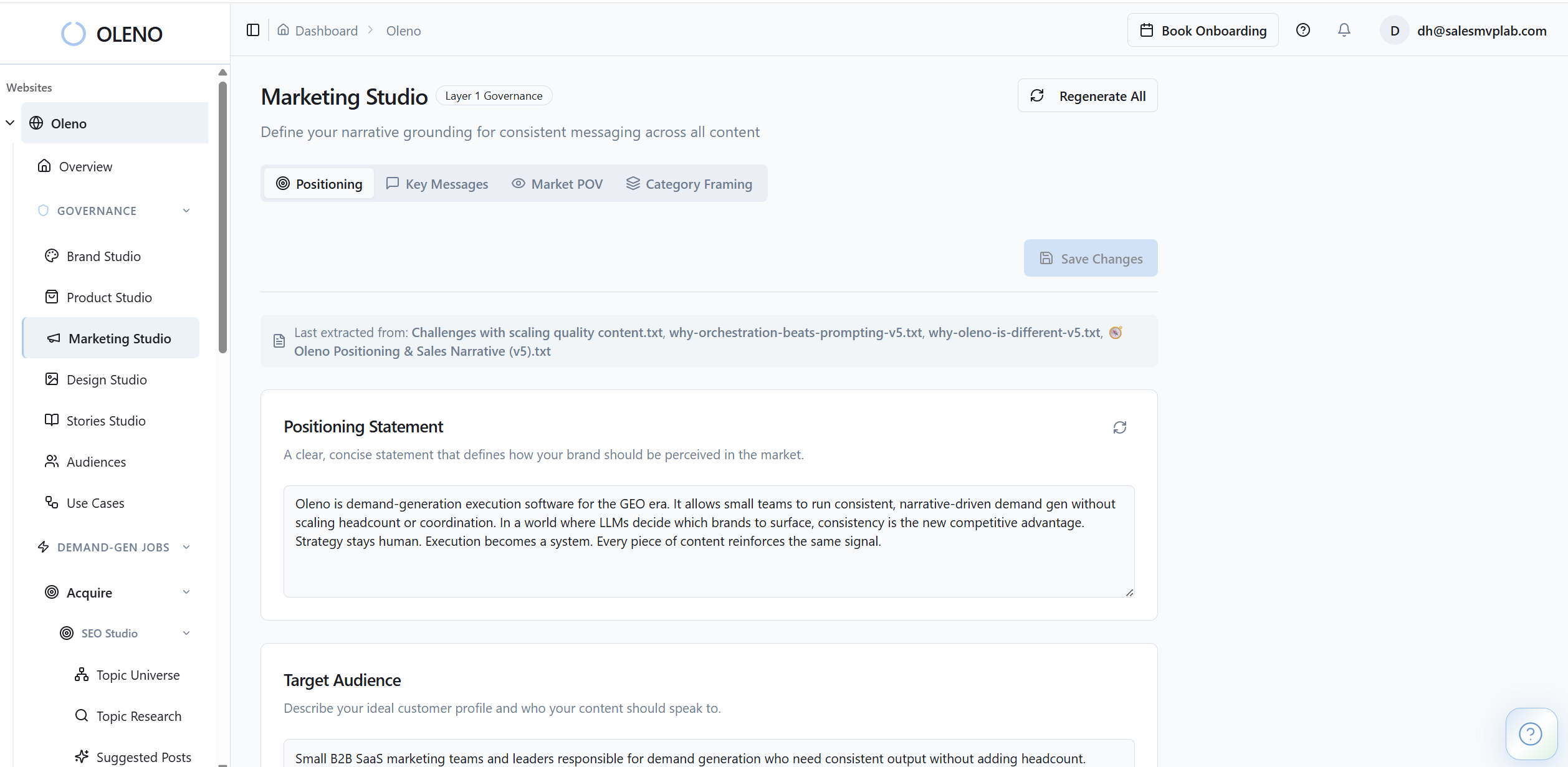
Oleno fits teams that already have contributors but lack a governed system connecting strategy to execution. Its strength is not just generating drafts, it's encoding brand voice, product truth, planning, and quality rules so output stays aligned as volume rises. For scaling SaaS marketing teams, that's usually the real bottleneck.
Governance before generation
This is the part a lot of tools skip. They start with "write faster." Oleno starts with "agree on the truth first."
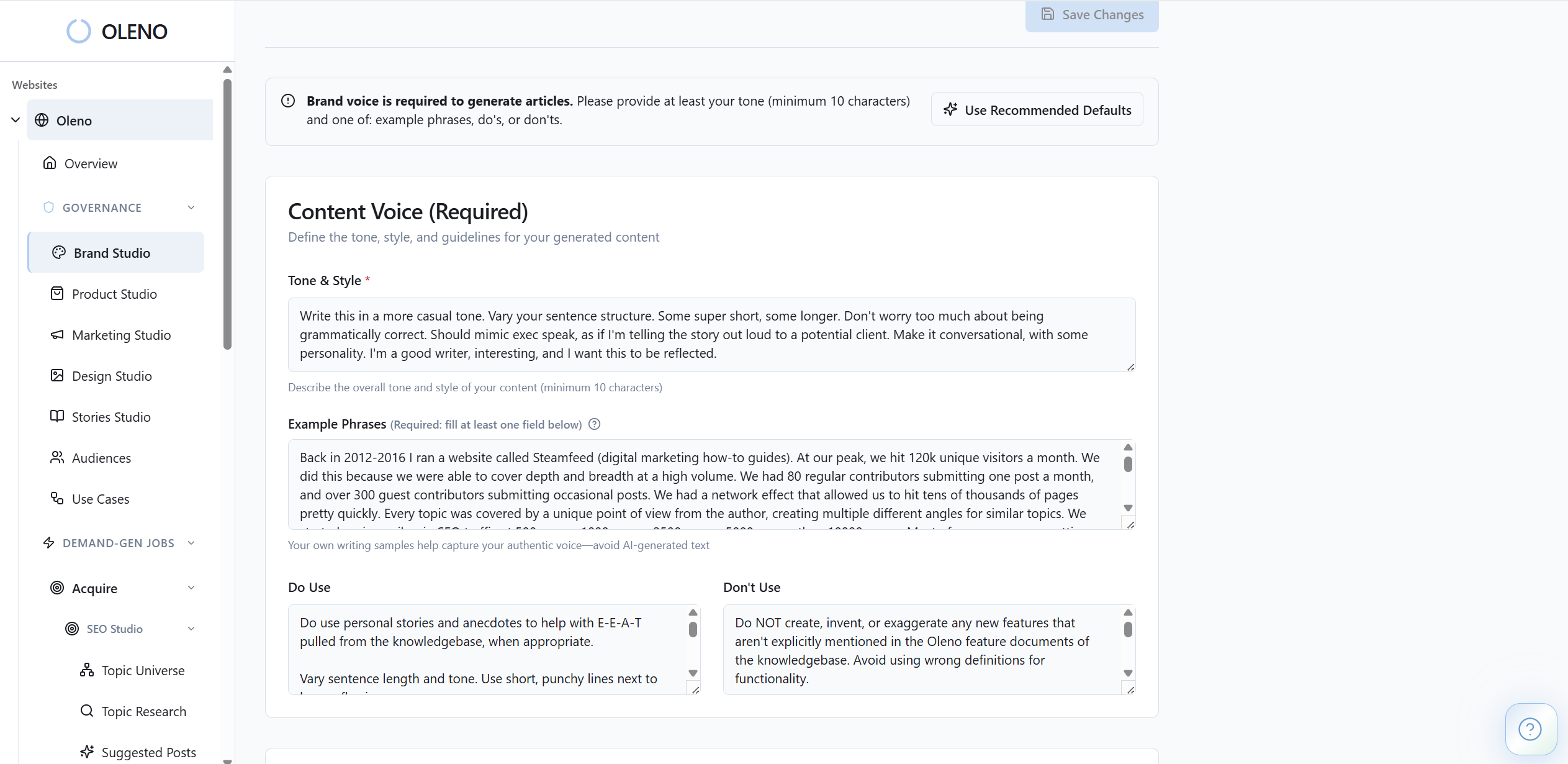
For a CMO or VP Marketing with content, PMM, and demand gen all touching the same pipeline, that matters a lot. Brand Studio and Marketing Studio let teams define voice, positioning, and narrative rules once. Product Studio keeps approved product descriptions and feature boundaries in the system. So the draft isn't guessing who you are every single time.
I think this is the biggest shift in the category. Not more AI. Better constraints. Because once you have multiple contributors, freedom is usually what creates the rework.
If your team is still solving off-brand output with more comments in Google Docs, that's a signal. You don't need another drafting tool. You need governance. You can request a demo if you want to see how that looks in a real SaaS content workflow.
A planning layer for ongoing SEO production
Oleno also fits teams that need a system for ongoing SEO content scaling, not just one-off article generation. Storyboard and the planning layer help teams map content across audiences, use cases, and business priorities, then keep production moving without everything resetting every quarter.
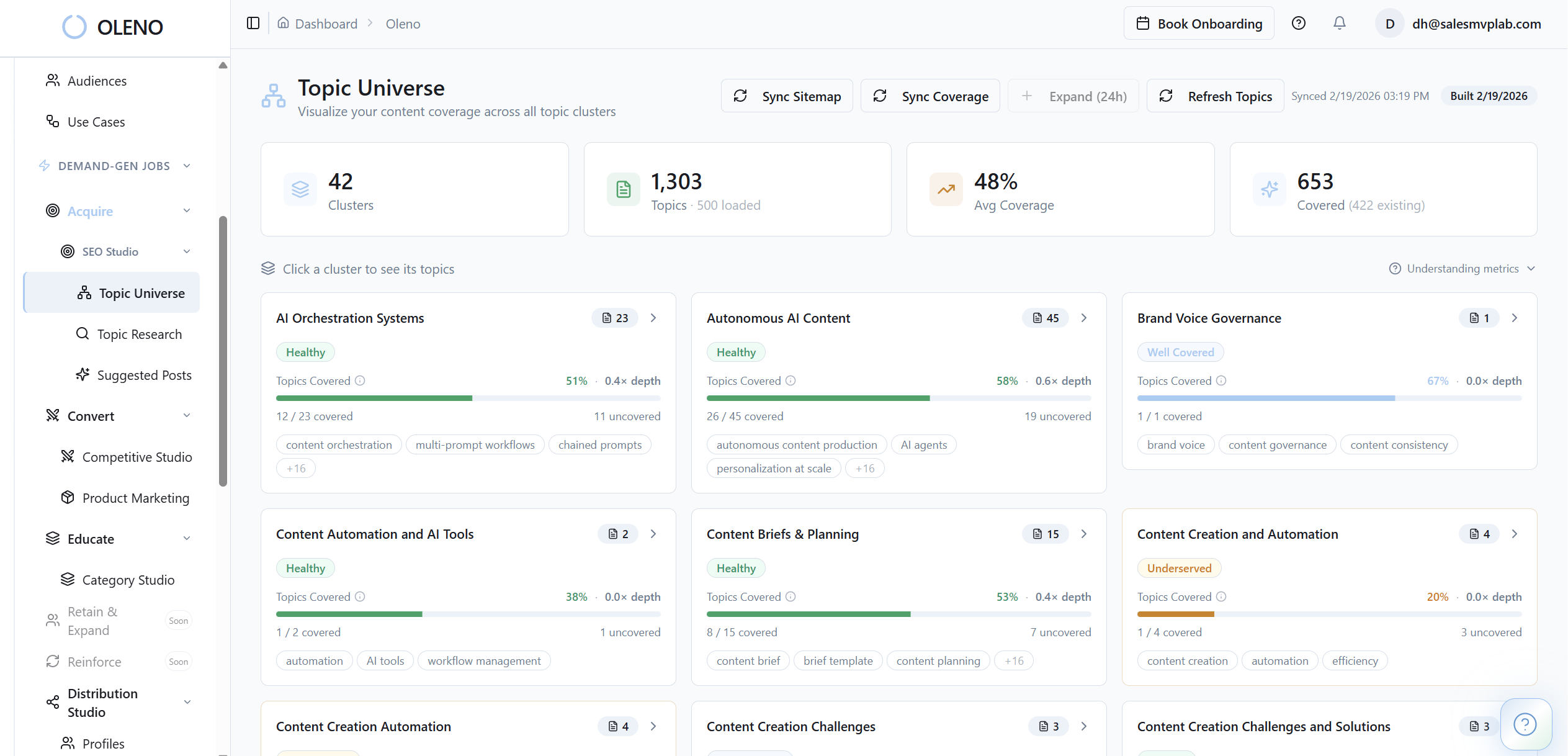
That matters more than people think. I watched teams rank really well and still miss demand gen because the content sat too far from the product narrative. Great traffic. Weak connection to pipeline. Painful lesson.
The planning layer closes that gap by making SEO production part of a broader operating rhythm. Discover, angle, brief, draft, QA, publish. Not random acts of content. A system. And if your team wants to look at that in the context of ongoing production, request a demo and walk through the workflow.
Who should evaluate Oleno next
Oleno is a fit for scaling SaaS marketing teams and CMO or VP Marketing leaders who already have contributors but lack a single governed system. It's particularly relevant when brand voice, narrative consistency, product truth, and SEO execution all need to stay aligned as output scales.
AirOps is still a stronger fit for SEO and growth managers who want configurable workflows, AI search tracking, and the freedom to tailor systems around an existing stack. That's a legitimate choice. If you have technical content ops capacity, it may be the right one.
But if your real issue is rework tax, context gaps, and too many cooks in the content kitchen, the decision rule changes. If review cycles are the main bottleneck, choose governance-first software. If workflow customization is the main goal, choose builder-first software.
Comprehensive SEO Software Comparison Grid
The right seo software comparison depends on what kind of team you are, not just what features sound impressive in a demo. Some tools are built for customization, some for drafting speed, and some for programmatic scale. A few are trying to solve the coordination problem that appears once content becomes a team sport.
| Platform | Primary user | Content quality controls | Brand governance | SEO workflow depth | Programmatic SEO support | Publishing support | Collaboration and permissions | Reporting and dashboards | Ease of setup | Best content type | Pricing model | Starting price | Best-fit team size | Recommended use case |
|---|---|---|---|---|---|---|---|---|---|---|---|---|---|---|
| AirOps | SEO / Growth Manager | Medium | Medium | High | High | Medium | Medium | High | Medium to low | AI-search-focused SEO workflows | Hybrid | ~$99 to $199/mo | Mid-market | Configurable automation with AI search tracking |
| Jasper | Head of Content | Medium | High for tone | Medium | Low to medium | Low | Medium to high | Medium | High | Marketing copy and branded drafts | Subscription | $49/mo | SMB to mid-market | On-brand drafting across channels |
| Copy.ai | Founder or Head of Marketing | Low to medium | Low to medium | Low | Low | Low | Low to medium | Medium | High | Short-form GTM content | Hybrid | ~$24 to $29/mo | Small teams | Fast, low-cost content generation |
| Byword | SEO / Growth Manager | Medium | Low | Medium | High | Medium | Low to medium | Medium | Medium | High-volume programmatic pages | Hybrid | $5/article or $99/mo | SMB to agency | Batch SEO content production |
| Outrank | Content Marketing Manager | Low to medium | Low | Medium | High | High | Low to medium | Medium | Medium | Automated long-form SEO output | Subscription | $49 promo, typically $99/mo | Small teams | Autopilot-style SEO publishing |
| Oleno | CMO / VP Marketing, scaling SaaS team | High via QA and grounding | High | High | High | High | High | Executive visibility oriented | Medium | SEO, product, and demand-gen content | Subscription | $109/mo | Mid-market SaaS teams | Governed content execution tied to demand generation |
If you're comparing tools right now, use a simple split. Choose AirOps if your team wants configurable workflows and has the patience to tune them. Choose Jasper if you mainly need branded drafting for marketing. Choose Copy.ai if budget and speed matter most. Choose Byword or Outrank if scale and automation are the top priority.
Choose Oleno when the issue isn't "Can AI write this?" but "How do we keep strategy, product truth, brand voice, and publishing aligned across a growing team?" That's a different problem. And usually a bigger one.
For teams in that bucket, book a demo makes sense because the real value shows up in the workflow, not in a single generated paragraph.
The category is moving from tools to systems. The teams that figure that out first will waste less time, publish with more consistency, and build search visibility that actually compounds.
About Daniel Hebert
I'm the founder of Oleno, SalesMVP Lab, and yourLumira. Been working in B2B SaaS in both sales and marketing leadership for 13+ years. I specialize in building revenue engines from the ground up. Over the years, I've codified writing frameworks, which are now powering Oleno.
Frequently Asked Questions