6-Step Content Gap Audit for Teams Without Traffic Data

Most teams chase traffic dashboards like a heartbeat monitor. I get it. At Steamfeed we watched spikes at 500, including the rise of dual-discovery surfaces:, 1,000, then 10,000 pages. At PostBeyond I wrote from muscle memory, then lost the hours as my scope grew. At Proposify we ranked for the wrong stuff, great content, weak tie-in. Traffic hid the real gaps. Structure and coverage told a cleaner story.
So here is the shift. Run a content gap audit without touching analytics. Just your sitemap, knowledge base, and what you have published. You will spot overlap, saturation, and missing intent faster, and you will walk out with a focused 30/60/90 plan. If you want a system to run it continuously, Oleno can operationalize the entire loop, but let’s first nail the playbook.
Key Takeaways:
- Treat the audit as a 48–72 hour sprint using only owned assets
- Optimize for coverage and differentiation, not clicks or rank
- Label clusters as underserved, healthy, well-covered, or saturated
- Quantify overlap and redundancy, then merge and redirect to one canonical
- Score pages on coverage value, not traffic, to prioritize your 30/60/90 slate
- Enforce cooldowns so authority compounds instead of cannibalizing
- Turn this into a repeatable system each quarter, then automate with Oleno
Why Traffic-Free Audits Surface Better Opportunities
Traffic-free audits focus on what you control and what you actually publish, which makes blind spots obvious. By inventorying your sitemap and knowledge base, you see clusters, gaps, and saturation without noise from seasonality. Run it quickly as a time-boxed sprint with firm constraints so you decide fast.

What is a traffic-free gap audit and why does it matter?
A traffic-free gap audit is a 48–72 hour sprint that uses only your sitemap, including the shift toward orchestration, knowledge base, and published content to identify opportunities. You define a single objective and hard constraints, then label coverage and differentiation against your pillars. This exposes issues traffic often masks, like duplicate angles and narrative drift.
You’re optimizing for authority, not clicks. That means your goal sounds like this: “Identify 8–12 briefs to grow authority in onboarding and implementation.” Set scope to 150–300 URLs max. Decide success criteria up front, such as a prioritized shortlist, saturation labels, and a 30/60/90 sequence. When you compress time, you ship decisions, not debates. If you want context on why a system-first approach works, skim autonomous content operations and the shift toward content orchestration.
Where the real signal lives
Your knowledge base and sitemap show what you believe, ship, and support. That is the source of truth. Inventory that first, then judge each cluster as underserved or saturated based on breadth and intent coverage. Teams that skip this step chase someone else’s map and repeat generic advice.
Build a quick topic ledger with columns for URL, H1, primary concept, cluster, target reader, and last updated. Keep it simple, one row per page or concept. You are mapping coverage, not performance. For additional context on audit structure, Nielsen Norman Group has a solid overview of content audits and inventories, and seoClarity outlines practical gap identification patterns.
Your Best Topics Are Buried In Your KB And Sitemap
The fastest wins are hiding in your own content. When you align your sitemap, knowledge base, and live pages, patterns jump out, like thin coverage on onboarding or redundant “how-to” posts. Scoping decisions and a lightweight intent rubric keep the audit focused and useful.

Who should define scope and in what timeframe?
Keep the core team small and decisive. One strategist, one product marketing lead, and one SME can define scope in 90 minutes. Agree on audience, pillars, and timeframe, then capture non-negotiables, like compliance constraints that affect merge or delete decisions. Fast alignment beats committee edits every time.
Write a short intent rubric in plain English. What questions should your content answer, for whom, and in what order. That rubric helps you spot articles that “sound right” but do not advance your narrative. It also prevents long debates later. If someone pushes back, the rubric decides, not the loudest voice.
Align your audit inputs: KB + sitemap + published pages
Export your sitemap. Pull a knowledge base export or embedding index. List current blog and docs pages. Normalize fields to URL, H1, meta description, TL;DR, last updated. If structure varies, a simple parser or quick manual clean-up builds a consistent ledger that downstream labeling can actually use.
Label each row with one cluster and one intent, such as how-to, comparison, or concept. First pass accuracy at 80 percent is fine, you will refine during clustering and saturation tagging. For a practical walkthrough that matches this setup, see the gap analysis workflow. WG Content describes useful audit artifacts too in their content audits and gap analysis, and Jessica La shares a concise gap analysis approach.
Curious what this looks like in practice at scale? See how a system-led approach frames decisions in autonomous content operations.
The Hidden Cost Of Overlap, Redundancy, And Saturation
Overlap and redundancy burn time and dilute your message. You pay to create and maintain duplicate pages, then you stall on updates because no one knows which page is canonical. Saturation looks like three articles with the same promise and near-identical H2s. You do not need analytics to spot either.
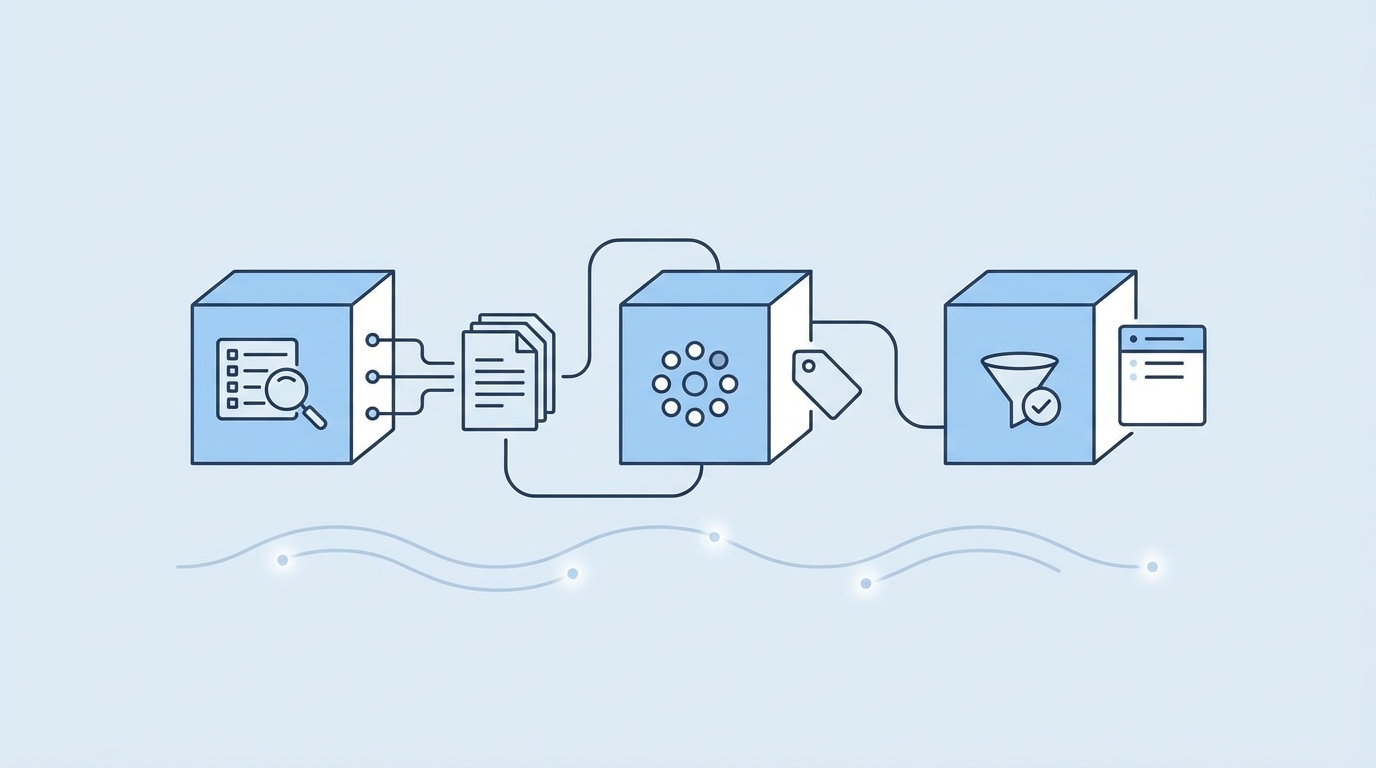
The rework tax no one budgets for
Let’s pretend you have 220 posts across 8 clusters. If 18 percent overlap, you are paying twice, creation cost and cannibalization. At $500 per piece and 40 overlapping articles, that is $20,000 sunk, plus editorial hours to reconcile. The bigger cost is narrative dilution. Sales loses a clean, linear story.
Redundancy hurts operations. Every refresh triggers a “which one do we update” discussion. That delays shipping and adds context switching. Merge policies and cooldowns cut this dramatically. Tendo’s Crowe case study shows how scoring and consolidation reduce complexity in the real world, worth a read for the scoring and gap analysis approach. And if draft speed has increased your duplication risk, here is a useful framing on AI writing limits.
Saturation signals you can spot without analytics
Saturation is obvious when you know what to scan. Look for multiple pages answering the identical head question with slight wording changes. If titles, TL;DRs, and H2s mirror each other, that is saturation, even with zero traffic data. Another tell is a cluster of pages interlinking with the same noun phrase.
When in doubt, compare intros. If they make the same promise and share most of their H2s, flag for merge. Keep the freshest, most complete version. Redirect the rest, and move unique details into the canonical. For systemic overlap patterns and why they persist, this content operations breakdown explains how fragmentation creates repeat work.
Ready to stop paying the rework tax and see a cleaner path forward? Try generating 3 free test articles now. Try generating 3 free test articles now.
Stop The Rework Cycle With A 30/60/90 Plan You Can Enforce
A 30/60/90 plan turns your audit into action. You score pages for coverage value, then schedule merges, refreshes, and net-new briefs over three months. Cooldowns enforce discipline so you do not over-publish a hot topic while ignoring neglected pillars.
Score pages for ‘coverage value’ (day 2, afternoon)
Define a simple 0–5 rubric per page, then be consistent. Score information presence, snippet-readiness, internal linkage, product proximity, and freshness. Anything three or under goes to merge and redirect or gets a light refresh brief. Keep the rubric short enough that you can apply it quickly and repeat it quarterly.
Weight the scores by saturation. In saturated clusters, even a high-scoring overlap loses to a meaningful gap elsewhere. In underserved clusters, a three can beat a four if it unlocks a pillar you have ignored. Write this rule down so it is enforceable, not optional.
Prioritize a 30/60/90-day slate and set cooldowns (day 3, morning)
Draft a shortlist of 4–6 briefs per month for 90 days. Balance by cluster and intent. Enforce rules like no more than one article per week in any saturated cluster, and a 90-day cooldown after you hit a topic. Cooldowns keep you from re-litigating the same idea and help authority compound.
Write one-line briefs. Target question, audience, why-now, product tie-in, and what it must add that your canon does not. Keep each under 80 words to drive execution. The goal is to hand this off without creating another planning meeting.
How do you keep this running each quarter?
Rerun a mini-audit every 90 days. Update the inventory. Re-score with the same rubric. Track three operational metrics only, including why content now requires autonomous, percent of clusters moving from underserved to healthy, percent of pages passing snippet-readiness, and percent of merges completed. You are measuring coverage progress, not traffic.
Keep a cooldown ledger. If someone violates cooldown, require a documented delta, such as a new product capability, a regulatory change, or a materially different audience question. Otherwise, it waits. For prioritization signals that help, this guide on topic prioritization signals keeps planning grounded in your own inputs.
Run The 48–72 Hour Audit Using Only Owned Assets
Three compact work blocks get you from raw inventory to a clean shortlist. Morning of day one you build the canonical inventory. Afternoon you cluster topics and label saturation. Morning of day two you detect overlap with semantic similarity and pick canonicals. Clear, repeatable, documented.
Create a canonical inventory from sitemap and KB (day 1, morning)
Pull sitemap URLs into a sheet. Append knowledge base pages and published articles. Normalize columns to URL, title, cluster, intent, last updated, TL;DR, and primary question. Use simple regex or a small script to strip tracking parameters and unify trailing slashes. You want one canonical row per concept or page.
Add two quick flags, “merge candidate” and “outdated.” Do not decide yet. You are setting up decision speed. Freeze this snapshot. All downstream tags refer to this version to avoid row drift. If you want a primer on turning this list into a production pipeline, see the sitemap topic bank.
Cluster topics and label saturation (day 1, afternoon)
Group by cluster using your pillar list. If you have embeddings, run a quick cosine similarity to confirm groupings. If not, a manual pass that scans titles and H2s is enough. Tag each cluster as underserved, healthy, well-covered, or saturated based on page count and the breadth of questions answered.
Add guardrails. For each saturated cluster, mark “cooldown eligible.” For underserved clusters, mark “expansion eligible.” These labels become rules for prioritization, not opinions. The deterministic side matters more than perfect clustering on day one. For further reading on semantic grouping, this ACM paper on semantic similarity methods offers useful context.
Detect content overlap with semantic similarity (day 2, morning)
Run a similarity check on titles, TL;DRs, and H2s. Flag pairs with high semantic likeness, for example 0.8 or higher. For flagged pairs, scan intent and audience. Keep the deeper, more recent, or more product-connected page as the canonical. Note merges in a “redirects needed” column so engineering can move quickly.
Create a “coverage map” of questions answered inside each cluster. If two pages answer the same three or four sub-questions, consolidate. If one answers more breadth but lacks specifics, keep it and move unique details over. For an end-to-end walkthrough, GlobalTalent outlines a useful gap methodology. And if you want to see this in a packaged system, read why content needs autonomous content systems.
Instead of wrestling with ad hoc scripts, see how this workflow runs daily with zero handoffs. Try using an autonomous content engine for always-on publishing. Try using an autonomous content engine for always-on publishing.
How Oleno Operationalizes This Playbook End To End
Oleno turns this sprint into a repeatable system. Topic Universe maps your coverage, briefs are scored for information gain before writing, and deterministic linking, schema, and QA gates keep outputs consistent. You decide priorities. The pipeline enforces the rules without extra meetings.
Topic Universe mapping and saturation labels
Oleno’s Topic Universe organizes your knowledge base and sitemap into clusters, tracks coverage breadth, and labels each cluster as underserved, healthy, well-covered, or saturated. It prioritizes suggestions where gaps are largest and enforces a 90-day cooldown so you do not over-publish the same idea. You get an audit backbone that always reflects your real content.
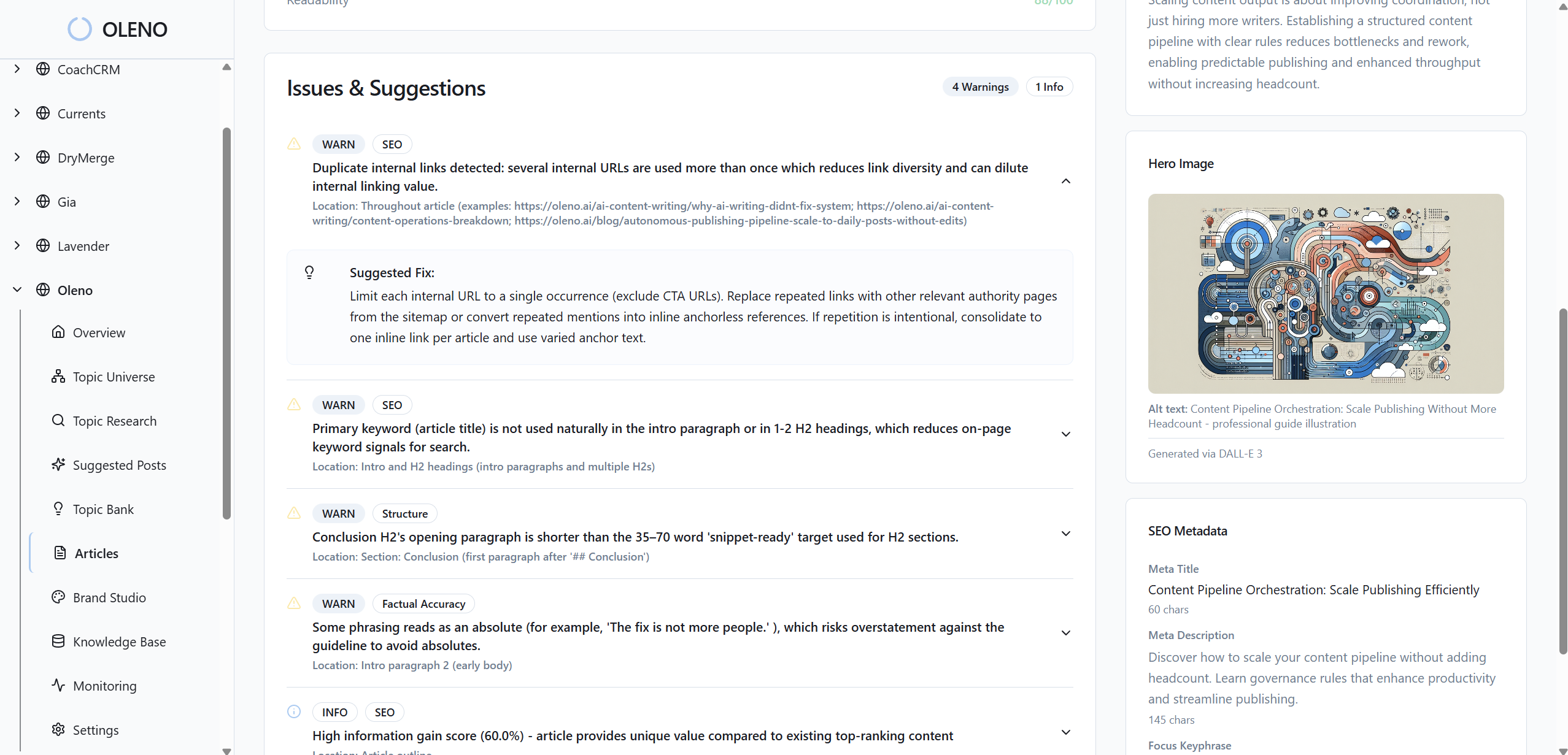
This changes planning conversations. You still choose the pillars and sequence, including ai content writing, the system handles the mechanical parts, mapping, saturation status, and cooldown rules, consistently. No more spreadsheet drift, no more re-tagging the same pages every quarter.
Brief generation with information gain scoring
Before any draft is written, Oleno scores briefs for uniqueness. Competitive research identifies what is already said and calculates an Information Gain Score. Low-differentiation outlines get flagged early so you do not create more overlap. High-gain briefs move forward and are rewarded during QA.
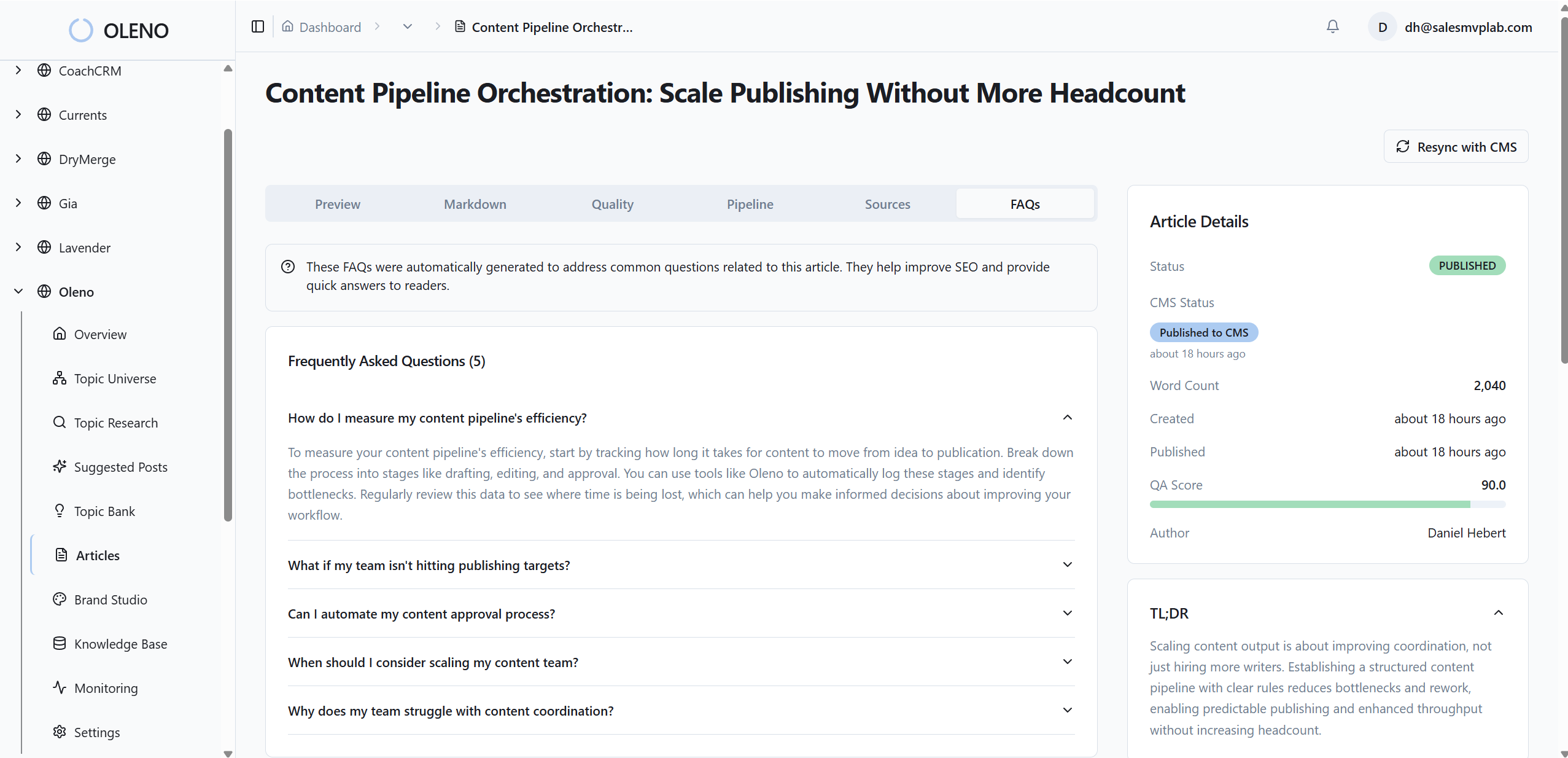
The benefit is simple and practical. Your shortlist adds new information to your canon instead of repeating it. Your writers or SMEs start from a stronger angle, and your publishing calendar reflects coverage strategy, not guesswork.
Deterministic linking, schema, and QA gates
After drafting, internal links are injected from your verified sitemap using deterministic rules, not guesses. Schema for Article, FAQ, and BreadcrumbList is generated programmatically, then validated. The QA gate checks 80 plus criteria, including snippet-readiness and structure, and content does not publish until thresholds are met. Publishing connects directly to WordPress, Webflow, or HubSpot.
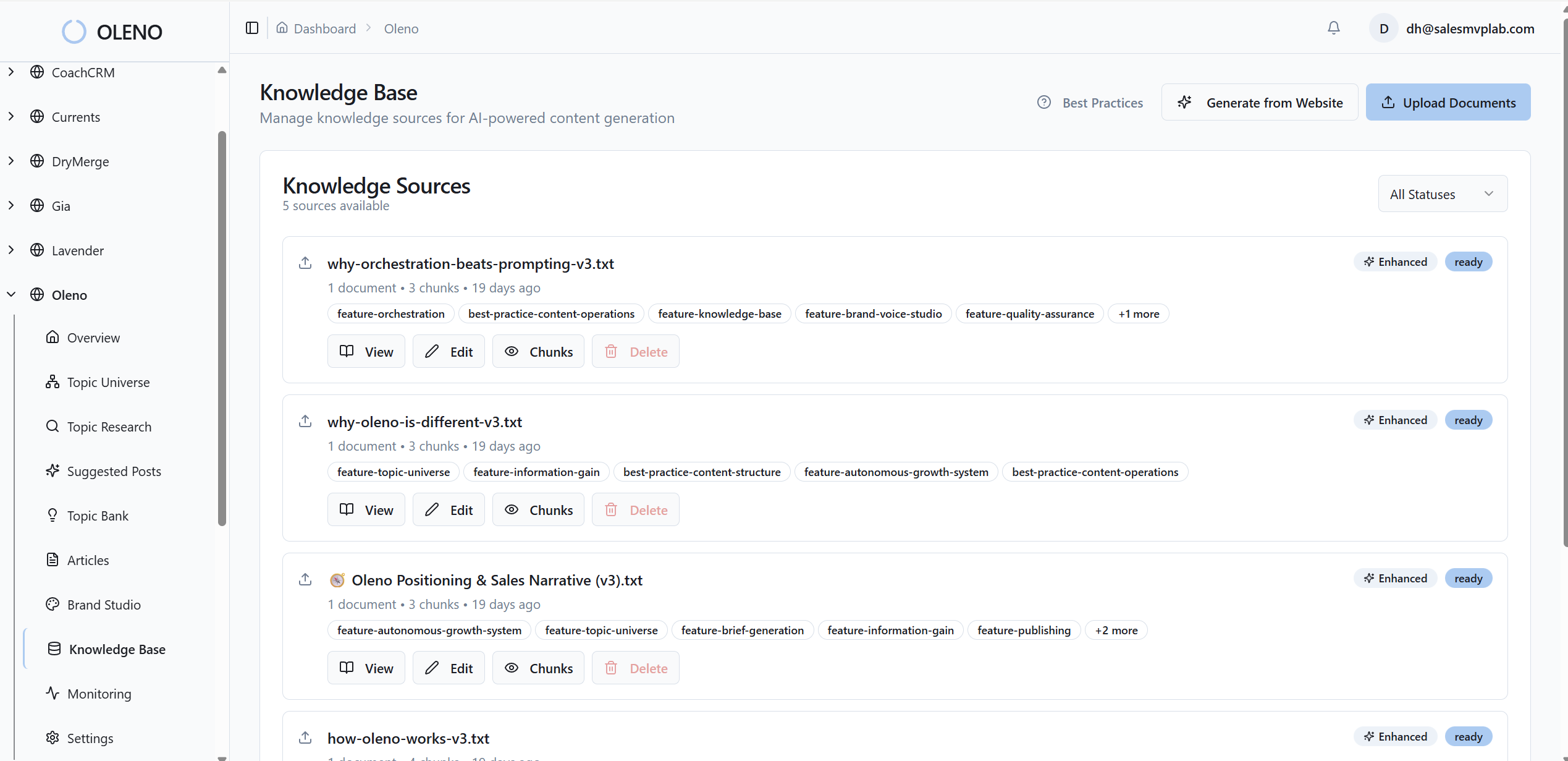
Remember the rework tax you felt during merges and refreshes. This is where you claw it back. Oleno eliminates the manual, error-prone steps that cause duplicate publishing, broken schema, and weak internal links. The outcome is an article that is ready to ship, on-brand visuals included, with less editorial firefighting.
Want to see the pipeline create your first shortlist and draft without prompts or handoffs? Try Oleno for free. Try Oleno for free.
Conclusion
If your team is stuck waiting for traffic signals, you will keep missing the obvious. The sitemap and knowledge base already tell you where authority is thin, where redundancy drags, and where your narrative needs depth. A 48–72 hour, traffic-free audit gets you from fuzzy instincts to a concrete 30/60/90 plan you can actually enforce.
Run the sprint with owned assets, score coverage value, set cooldowns, and merge aggressively. Then make it a system. Whether you keep it in a tight quarterly ritual or plug it into Oleno to run end to end, the result is the same. Less rework, fewer meetings, and content that compounds.
About Daniel Hebert
I'm the founder of Oleno, SalesMVP Lab, and yourLumira. Been working in B2B SaaS in both sales and marketing leadership for 13+ years. I specialize in building revenue engines from the ground up. Over the years, I've codified writing frameworks, which are now powering Oleno.
Frequently Asked Questions