7-Day Brand Voice Onboarding Bootcamp for New Writers

Most teams can smell when a draft isn’t “us,” but they struggle to explain why or fix it fast. I’ve been on both sides. As the only marketer, shipping in my own voice is easy. As the leader onboarding new writers, voice turns into a long edit chain and a lot of guessing.
You don’t fix that with a PDF. You fix it with reps, a clear rubric, and a short bootcamp that turns voice from fuzzy taste to a practiced skill. Seven working days is enough to align tone, rhythm, and claims, and to cut edit cycles in half. Not perfect, but meaningfully better.
Key Takeaways:
- Voice is a practiced skill, not a style guide; build daily reps with a rubric
- Use a 5-part rubric (clarity, tone, rhythm, vocabulary, POV) to depersonalize edits
- Train across formats early, then lock constraints (ban lists, CTA patterns, claims)
- Measure progress daily, aim for 4 out of 5 on each criterion by Day 7
- Teach product truth and boundaries to prevent legal clean-up and rework
- Simulate publishing with a QA check to catch drift before it ships
Why Teams Struggle To Teach Brand Voice Quickly
Most teams struggle to teach voice because they hand over a style guide and hope. Voice lives in examples, rewrites, and cadence, not in a PDF. The fix is a compact bootcamp with scored reps, short cycles, and feedback tied to a rubric, so muscle memory forms fast.

The doc is not the skill
Most teams share a doc, then months pass with uneven tone and heavy edits. You don’t learn a voice by reading rules, you learn it by rewriting against those rules under time pressure. Short drills, speed constraints, and immediate feedback build the pattern recognition you need.
When I was running content at PostBeyond, I could ship 3 to 4 strong posts a week because I used a tight framework and wrote in my own voice. As the team grew, quality dipped and speed slowed, not because writers weren’t good, but because we lacked shared reps. Treat voice like you’d treat sales discovery practice, frequent, fast, and scored. For a deeper orientation on voice components, Sprinklr’s overview is a helpful primer on tone, vocabulary, and cadence across channels, see Sprinklr’s guide to brand voice.
What is a voice rubric and why does it matter?
A rubric turns taste into something you can measure. Use five criteria, clarity, tone, rhythm, vocabulary, and POV. Score each from 1 to 5. Now your feedback isn’t “make it punchier,” it’s “tone is a 3 because sentences average 24 words and CTAs hedge.”
Rubrics depersonalize edits. Writers stop defending choices and start closing gaps. Editors get consistent, too. If you want a structured training approach, the UX Content Collective’s training resources cover rubric-based critique methods you can adapt. I also like Jacob Tyler’s framing on the impact of consistent voice on brand trust, see Jacob Tyler on the power of brand voice.
Show then practice beats telling
Writers learn fastest when they see a marked-up example, then immediately do it. Rotate through formats, blog intros, social blurbs, product walkthrough copy. Keep the sessions short, 20 to 45 minutes. Score every round. Feedback connects to the rubric and the specific lines changed.
When you stack seven days of immediate practice, alignment stabilizes. Ad-hoc telling doesn’t stick, scored practice does. The benefit shows up in fewer edits next week, not next quarter. If you want to skip the theory and see a working system, Request A Demo.
Voice Drift Is An Operational Problem, Not A Taste Issue
Voice drift happens because your process relies on people’s heads, not shared rules. Traditional onboarding covers history and product, but ignores how to write like the brand under time pressure. The fix is operational, encode rules, train across formats, and enforce constraints in the flow.

What traditional onboarding misses
The standard onboarding checklist is fine, company story, ICP, product. Then the first draft lands and sounds off. Reviews happen, comments pile up, but nothing got codified. The same issues repeat across pieces because you taught context, not the craft of your voice.
At LevelJump, we shipped strong ideas, but our early drafts had uneven tone. We made the jump when we turned recurring edits into explicit rules and examples. “Shorten sentences by 30 percent in intros.” “Use benefit, then proof in CTAs.” That change scaled beyond one editor. Rules beat memory.
The hidden complexity across formats
Voice shifts by format. “Direct and friendly” in a tweet can be 7 words. On a product tour page, it might be two short sentences, then a specific CTA pattern. Writers need to practice format-specific micro-patterns, sentence length, POV framing, and CTA structure.
Train that early. It’s easier to adapt a stable core voice than to retrofit it later. Sprinklr covers multi-channel voice guidance at a high level, see Sprinklr’s guide to brand voice. The point is simple, core voice stays constant, the expression flexes by format.
Why consistency needs constraints
Constraints reduce variance. Ban lists, required phrases, claim boundaries, and approved examples create a safe lane for speed. Most writers move faster when they know what’s never allowed and what always works. That’s not rigid, that’s reliable.
You can define this once so it applies everywhere. In Oleno, brand voice rules, banned terms, CTA style, and structure are encoded up front, so every piece gets checked against the same guardrails automatically. Your process carries the rules, not the people.
The Hidden Costs Of Edit-Heavy Onboarding
Edit-heavy onboarding burns hours and creates a bottleneck you can’t hide. The cost shows up in rework, legal cleanup, and lost publishing cadence. A short bootcamp cuts that cost by creating alignment early, then a QA step prevents drift from shipping.
The rework tax on editors
Let’s pretend you onboard three writers. Each early draft takes 3 hours of edits. Two drafts per week. That’s 18 hours weekly. Over a quarter, 200 plus hours vanish into rework. That’s strategy time you never get back. A seven-day bootcamp that halves edits gives you a day a week back.
I’ve lived this at multiple companies. When voice rules were fuzzy, edits piled up. When we locked rules and practiced them daily, edit time dropped fast. You don’t eliminate edits, you reduce the delta.
The downstream risk to legal and product truth
Loose claims create risk and slow you down. Without explicit boundaries, new writers improvise. That invites corrections, escalations, and sometimes pulled content. Teach disallowed claims, qualifiers, and approved descriptions during onboarding to prevent cleanup rounds later.
Oleno bakes this into product truth and claim control. Writers learn the same boundaries the system enforces, so fewer surprises make it to review. Reworked often covers the time savings from structured onboarding and clear rules, see Reworked on structured onboarding.
Opportunity cost in lost velocity
When edits drag, publishing dates slip. That kills compounding effects. Fewer assets, fewer tests, fewer learnings. If your bootcamp gets writers to publish-ready faster, you reclaim cadence, which is usually the difference between a flat channel and one that builds momentum.
Consistency is the asset. Every week you ship on rhythm, your narrative gets tighter and your surface area grows. Still handling this manually without guardrails? Stop the bleed and Request A Demo.
What It Feels Like When Voice Drifts Early
Voice drift feels like a scramble, not a system. Launch weeks turn into late edits. Reviews stall on taste debates. Sales loses faith in marketing’s reliability. A compact bootcamp, backed by a rubric and QA, pulls that pain forward and solves it before it matters.
When a launch needs last-minute rewrites
You brief a launch. Five drafts land. They read like five different companies. Now you’re up late rewriting while sales waits on assets. It’s not that the writers aren’t talented. The process didn’t give them the patterns or constraints to hit the mark.
A bootcamp with side-by-sides, annotations, and scored rewrites narrows the gap early. You’ll never remove all last-minute tweaks, but you’ll dodge the fire drill more often than not.
How do new writers respond to ambiguous feedback?
“Make it punchier” or “sounds off” is a dead end. Writers guess, send, and get corrected again. The relationship gets tense and slow. A rubric turns that into specifics, “average sentence length is 22 words, target 12 to 15,” “CTA hedges, commit to a verb, then benefit.”
Once the rules are clear, alignment speeds up. Editors give the same feedback the same way. Writers self-correct. Confidence goes up on both sides.
Why should leadership care about voice drift?
Because it burns capacity, delays go-to-market, and weakens your market position. Voice is how your strategy shows up in the world. If posts, pages, and emails swing from piece to piece, your message blurs. Leaders don’t have to write, they just need to sponsor the system that keeps voice tight.
Voice discipline is operational discipline. When it’s encoded, teams ship on time and say the same thing the same way. That’s how trust is built.
A Seven Day Bootcamp That Trains For Measurable Alignment
This bootcamp converts voice from abstract to practiced in one week. Every day runs a short exercise, scored to a rubric, across formats. By Day 7, writers hit 4 out of 5 on each criterion and pass a timed assessment. Not perfect, but publish-ready with fewer edits.
Step 1: Prep the voice kit
Build a one-pager your team actually uses. Define voice attributes in plain English, list banned terms, include approved phrases, and show CTA patterns. Add two before and after examples with margin notes. Then attach your 5-part rubric, clarity, tone, rhythm, vocabulary, POV.
Keep it short, printable, and present in every session. The goal is fast reference, not a binder. If you expect people to memorize, you’ll get drift. If you make it easy to check, you’ll get consistency.
Step 2: Day 1 immersion rewrites with annotation
Kick off with two short paragraphs that violate your voice. Give writers 20 minutes to rewrite, then ask them to annotate their changes against the rubric. Share an annotated answer key. Discuss gaps to calibrate, not to grade.
Run it again with new examples. You’ll see scores converge quickly. The annotation step matters. It forces writers to internalize the why behind the change, not just the edit itself.
Step 3: Day 2 show and tell transformations
Walk through side-by-sides across formats, social, email, and a product snippet. Ask writers to call out what changed, sentence length, POV, CTA structure. Then have them produce a third variant that keeps voice intact while shifting angle.
Score with the rubric and record deltas. The exercise teaches flexibility without drift. Voice stays the same, the expression adapts to the format.
Step 4: Days 3 to 4 produce two short assets
Assign a blog intro and a social blurb. Timebox to 45 minutes. Editors do a single pass using the rubric, then demonstrate edits live so choices are visible and repeatable. Writers submit a second draft with self-scores. Track movement daily.
Aim for 4 out of 5 on each criterion before advancing. You’ll see rhythm and tone click first, then POV and vocabulary tighten next. That’s normal.
How Oleno Codifies Voice, Truth, And QA For This Bootcamp
Oleno turns your bootcamp rules into a system that runs daily. You define voice, product truth, and claim boundaries once. Oleno applies them during drafting and blocks publishing until quality checks pass. That’s how small teams keep output consistent without adding editors.
Step 5: Day 5 bias and boundaries training with product truth
Teach disallowed claims, required qualifiers, and approved product descriptions. In Oleno, this lives in product truth and claim control, so writers learn the exact boundaries the system enforces later. Show risky phrasing next to the approved version. Create a short red flag checklist for legal triggers.
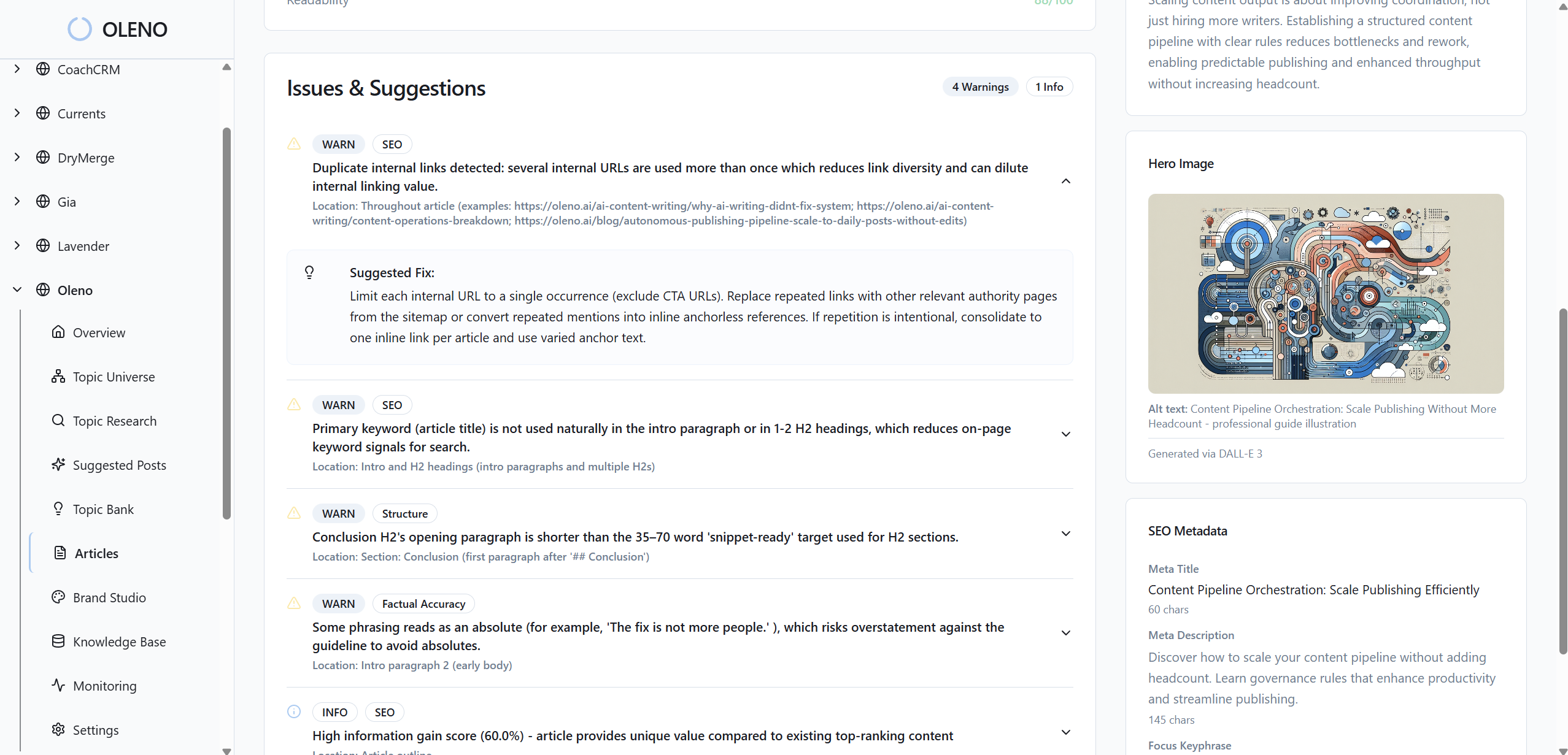
This prevents the quiet, costly kind of rework. The “pull it back” email that derails your week. Oleno’s claim control keeps drafts inside the guardrails you set, which means fewer back-and-forth loops and quicker approvals.
Step 6: Day 6 peer review and rubric calibration in a shared framework
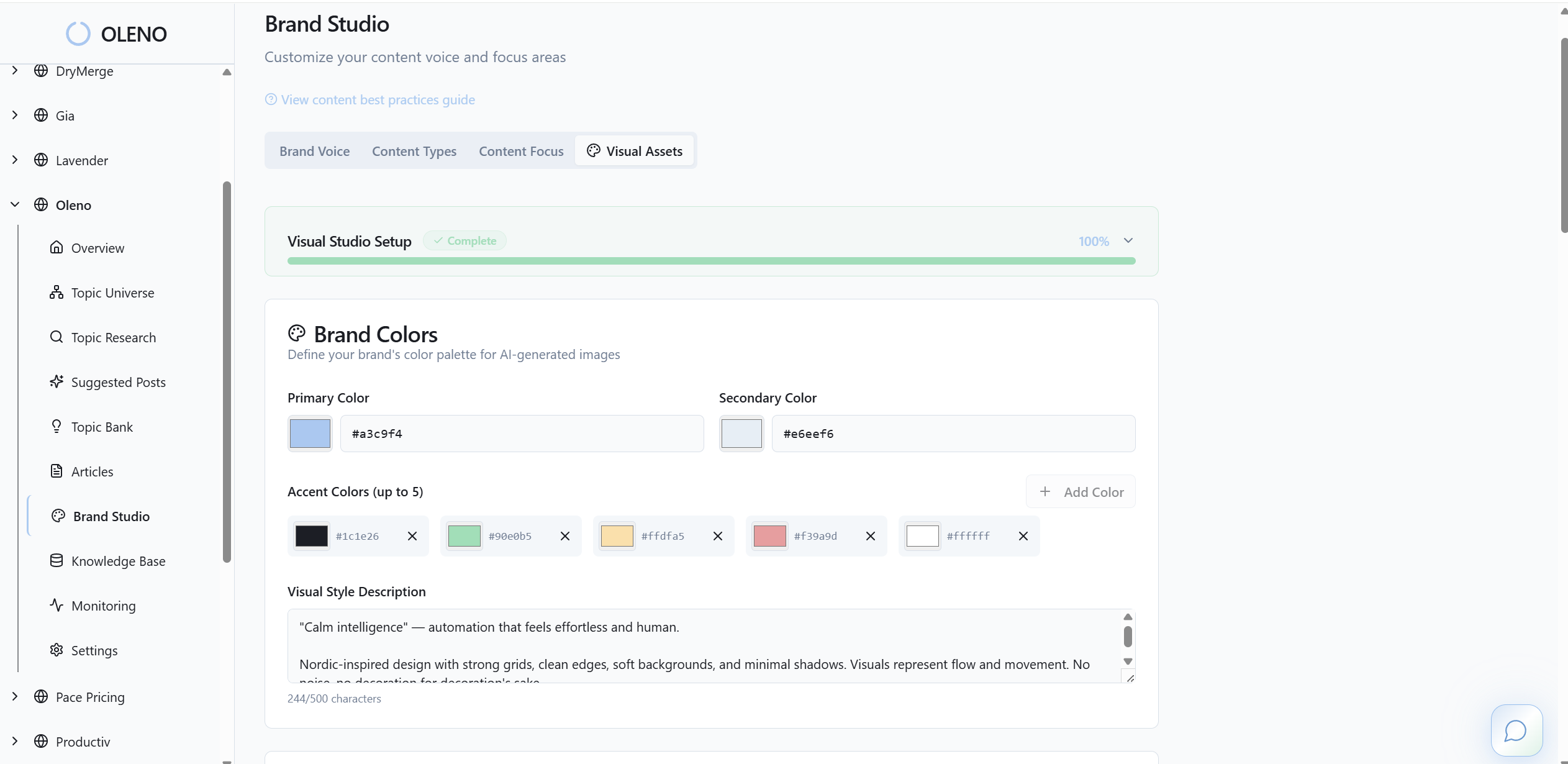
Run a peer review circle. Each writer scores two drafts with the rubric. Editors compare variance and align what a 3 versus a 4 really looks like. In Oleno, brand voice and writing rules, banned terms, and CTA patterns become the single source of truth.
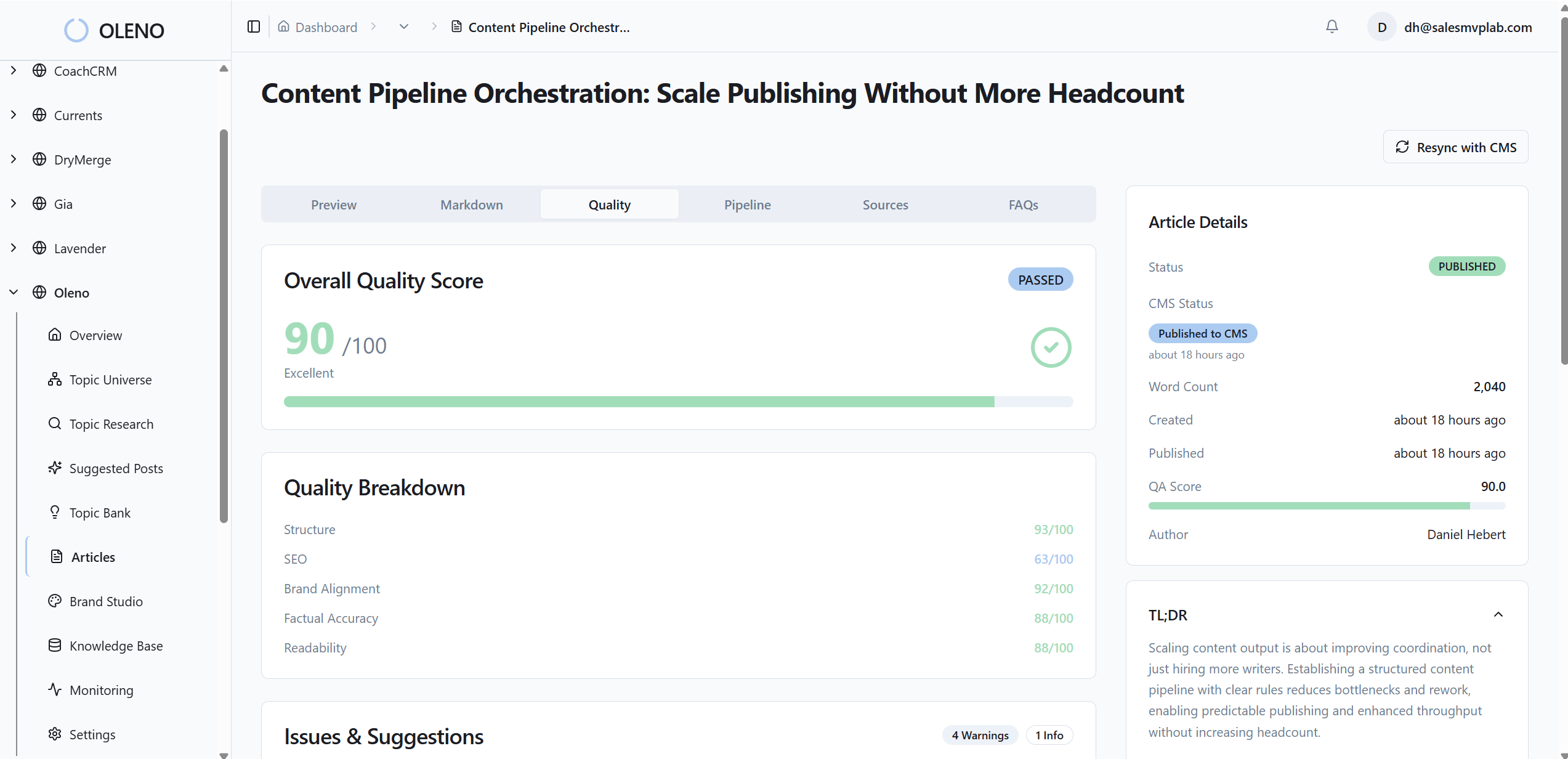
Because governance applies everywhere in Oleno, the rules live in the system, not in a doc. That’s how drafts written two weeks apart still sound like you. The QA gate checks voice, structure, clarity, and product truth before anything reaches your CMS.
Step 7: Day 7 live assessment and publish simulation with QA
Close the week with a timed final. Writers draft under a day-of deadline, you grade with the rubric, and set a pass or hold threshold. Then run a mock publish in Oleno. Walk through how the QA gate blocks issues, how drafts move to CMS, and how you would roll back if needed.
That simulation cements confidence. Writers see what “ready” looks like. Editors trust the guardrails. You leave with 30, 60, and 90 day checkpoints to catch drift, plus an operating system that enforces what you trained. Ready to cut edit cycles and ship on rhythm? Request A Demo.
Conclusion
Voice is not a vibe, it’s a practiced pattern that your system needs to protect. A seven-day bootcamp builds the muscle, a rubric keeps feedback objective, and Oleno encodes the rules so they apply on every draft, not just the ones you touch. Fewer surprises, fewer edits, more consistent output. That’s how small teams compound.
About Daniel Hebert
I'm the founder of Oleno, SalesMVP Lab, and yourLumira. Been working in B2B SaaS in both sales and marketing leadership for 13+ years. I specialize in building revenue engines from the ground up. Over the years, I've codified writing frameworks, which are now powering Oleno.
Frequently Asked Questions