90-Day Topic Mapping: Plan Content to Build Long-Term Authority

Most marketing teams treat content planning like a gym routine: pick a cadence, fill the calendar, feel virtuous. Then twelve weeks later you’re staring at three similar posts, a pillar page that never quite tips, and a pipeline that doesn’t care how hard you worked. I’ve been on every side of that table, solo marketer, team lead, sales leader who has to live with the output.
Here’s the thing. Frequency can look like momentum, but authority is built by coverage discipline. You need a 90‑day topic map that enforces what gets written, when you’re allowed to re‑cover it, and why it adds something new. When you run that system, the noise drops. The compounding shows up.
Key Takeaways:
- Stop planning by calendar; plan by coverage gaps and cooldown rules
- Label pillar saturation and enforce a 90‑day re‑coverage window per topic
- Score ideas on information gain to prevent thin repeats and cannibalization
- Bake internal links and JSON‑LD into briefs so compounding is deterministic
- Use a weekly queue that rotates pillars and prioritizes underserved clusters
- Let a system, not a meeting, decide what ships next
Ready to skip the calendar churn and see the workflow? Try a quick spin: Try Generating 3 Free Test Articles Now.
Why Frequency-First Calendars Kill Authority
Publishing on a rigid cadence doesn’t create authority; consistent coverage does. Calendars push teams to revisit the same angles, miss gaps, and ship generic drafts that add little. A 90‑day topic map flips this, plan by pillars, saturation, and cooldowns. Think “coverage-first,” not “Monday/Wednesday.”

The Frequency Trap Most Teams Fall Into
Posting more often feels productive because activity is visible and measurable. But when cadence drives selection, you end up repeating ideas, cannibalizing clusters, and diluting internal links. You optimize for motion, not momentum. The irony: more output often stalls authority because coverage gets lopsided.
I learned this the hard way. At one company, we chased a weekly cadence and published variations of the same “best practices” post three times in six weeks. Rankings flatlined, sales asked for “the one definitive link,” and we didn’t have it. The fix wasn’t heroics. It was rules: pillars first, cooldowns enforced, information gain or it doesn’t ship.
What Is a Topic Map and Why Does It Matter?
A topic map is a 90‑day plan built from your sitemap and knowledge base, grouped into pillars, labeled by saturation, and governed by re‑coverage rules. It decides what gets written and when, with clarity about why it adds new information. It’s the antidote to calendar‑first planning.
The mechanics aren’t exotic. Inventory your content, cluster by pillar, label saturation, and assign cooldowns. Then rotate pillars weekly while prioritizing underserved clusters. For structure examples, I like practical tools like 90 Day Planning Templates For Marketing; translate that thinking to coverage, not tasks. The outcome is consistency without sameness.
Cooldowns and Re-Coverage Rules Beat Guesswork
Cooldowns prevent back‑to‑back posts on the same angle, which reduces cannibalization and forces depth across the map. Re‑coverage rules schedule intelligent returns to proven topics only when you can add information gain. Set a 90‑day cooldown per topic and a re‑coverage window by cluster saturation.
Here’s a simple rule set that works: if a cluster is “underserved,” prioritize it now; if “healthy,” rotate it weekly; if “well‑covered,” check information gain first; if “saturated,” only re‑cover after 90 days with a new angle. That one change turns “what feels right” into “what the system allows.” It’s calmer to run. More predictable, too.
Your Real Constraint Is Coverage Discipline Across Pillars
Coverage discipline means mapping every page to a pillar, labeling saturation, and enforcing where new work fits. Teams don’t fail from lack of ideas; they fail from drift. Treat your KB and sitemap as a single source of truth, then let labels determine what ships next. It keeps authority moving forward.

Audit Your Knowledge Base and Sitemap the Right Way
Start by inventorying every page and artifact, blog posts, docs, one‑pagers, webinars, customer stories. Normalize titles and intents (learn, compare, buy), and map each to a canonical topic. Merge lookalikes, and flag orphans that sit outside any pillar. You’re building an index, not a calendar.
The payoff is clarity. You’ll see where you’ve got depth, where you’re thin, and where you drifted from the product narrative. At this stage, a simple spreadsheet beats a fancy dashboard. If you want a structure reference, a straightforward outline like 90 Day helps you formalize checkpoints. The key is consistency, run the audit once, then keep it live.
How Do You Label Saturation Accurately?
Label each cluster as underserved, healthy, well‑covered, or saturated based on three inputs: number of strong pages, recency, and uniqueness of angles. A saturated label doesn’t mean “stop forever.” It means “respect cooldowns” and “re‑cover only with clear information gain.”
Keep the rules blunt on purpose. For example: underserved = zero to one quality page in the last 90 days; healthy = two to three unique angles in 120 days; well‑covered = three to five plus; saturated = any cluster with near‑duplicate angles. You can refine later. Simple labels beat clever math because teams actually follow them.
Cluster Mapping Turns Inventory Into Pillars
Once inventory and labels exist, group pages into pillars that match your product and the customer journey. Define the canonical pillar page, list supporting clusters, and outline allowed angles. The point is to pre‑decide what belongs where, so every new draft has a home and a set of siblings.
This is where compounding begins. When a new article knows its hub and siblings, deterministic internal linking becomes possible later. That structure matters more than people admit. It’s also where drift gets caught, if a new idea can’t find a pillar, it’s either not strategic or needs reshaping. Both outcomes save time.
The Hidden Costs Of Ungoverned Publishing
Ungoverned publishing looks fast but bleeds authority. Duplicate angles split signals, rework burns hours, and missing structure kills snippet and citation eligibility. You pay in time, credibility, and lost compounding. A few guardrails, cooldowns, information‑gain checks, and schema defaults, change the math quickly.
Duplicate Coverage Cannibalizes Your Cluster
Publishing two near‑identical takes on the same topic splits authority and confuses users. Search engines hesitate which page to trust; your internal links scatter; your pillar never becomes “the one.” Cannibalization starts slow, then compounds as each new “similar” page siphons momentum from the best one.
You want one strongest page per angle with a clear network around it. That clarity pays off in sales, too, when a buyer asks for proof, you share one definitive link, not three “kind of similar” posts. If you need a planning gut check, frameworks like 90 Days Project Templates remind teams to sequence, not stack, like‑for‑like work.
Rework and Review Time Balloons Without Rules
Let’s pretend your team ships 12 posts a month. Without cooldowns and information‑gain checks, 4 get flagged late for duplication, 3 need rewrites, and 2 never publish. That’s 30–40% waste. People get tired of “one more round.” Morale dips. Deadlines slip.
Add a brief template with a differentiation field and a hard “duplicate check” early, and most of that waste disappears. We did exactly this at a previous company, just a simple gate that asked: what new sub‑question are we answering, and where does it link? Rewrites dropped, and energy shifted back to coverage, where it should live.
Missed Internal Links and Schema Hurt Compounding
Authority compounds when every new page connects to the right hub, siblings, and next actions. Without deterministic rules, links are random and JSON‑LD is inconsistent. The cost shows up as fewer featured snippets, weaker crawl paths, and orphaned pages that never contribute.
Bake link placement and schema into your brief and publishing checklist. Define “link to pillar in intro,” “link to two siblings mid‑body,” and “link to next‑action page in conclusion.” Set JSON‑LD defaults for Article and FAQ. A little determinism lets machines understand your site structure, which, let’s be honest, matters more every quarter.
Still wrangling calendars and rewrites manually? There’s a simpler path: Try Using An Autonomous Content Engine For Always-On Publishing.
The Experience Of Shipping Noise Instead Of Authority
Noise looks like activity; authority feels like clarity. You know you’re shipping noise when buyers ask for proof and you send three overlapping links. Or when a sprint ends with a rewrite because a similar post already exists. A 90‑day map prevents both. It makes variety intentional and narrative consistent.
When a Big Prospect Asks for Proof and You Send Three Overlapping Links
You feel it immediately, the confidence dip. None of the links are definitive, each repeats the same points, and your champion stalls. I’ve been there, on calls where we started negotiating which post “kinda” covered the angle. It’s not about writing more; it’s about planning so one link closes the loop.
The fix is structural. Topic maps, cooldowns, and allowed angles give you “the one” for each claim. And when re‑coverage is allowed, it’s because a new sub‑question or example justifies it. That’s how you build a library sales trusts, not a pile the team hopes will work.
The 3-Week Content Sprint That Ends in a Rewrite
You sprint, publish, celebrate. Then someone finds a similar post from nine months ago. Cue the late‑night rewrite and the frustrating rework. It’s avoidable. With saturation labels and a 90‑day cooldown, duplication becomes rare, not routine.
When I was at PostBeyond, I could write quickly because I used a tight framework. As the team grew, quality slowed because context wasn’t codified. Discipline solved it, shared structure, differentiation checks, and a coverage‑first plan. The writing didn’t get slower. It got cleaner.
Who Cares About Your Pillars When the Site Feels Generic?
If every post sounds the same and covers the same ground, buyers tune out. They don’t need 20 versions of “best practices.” They need new angles, specific examples, and a structure that stands up to scrutiny. A 90‑day map forces variety where it matters, so each piece moves someone forward.
A simple way to sanity‑check your plan: does every H2 open with a direct answer a machine could cite? Can a human skim and trust you added something new? If the answer isn’t yes twice, the angle probably isn’t ready. Tools like an IT 90‑Day Roadmap template can inspire sequencing, but apply it to coverage.
Run A 90-Day Topic Map That Compounds Every Week
A 90‑day topic map enforces cadence by rules, not meetings. Build the canonical inventory, label saturation, define cooldowns, and prioritize by information gain. Then run weekly queues that rotate pillars. Lock briefs, links, visuals, and schema into the process so compounding is default, not luck.
Build the Canonical Inventory and Cluster Labels
Export your sitemap and knowledge base. Normalize titles and map each asset to a canonical topic and intent. Group into pillars and apply saturation labels from underserved to saturated. For each pillar, name the hub page and list required supporting pages. This becomes your board. Not a calendar.
Two weeks in, something shifts. Topic selection stops being opinion‑driven and becomes rule‑driven. You’ll spot gaps faster, argue less, and keep drafts aligned to a clear narrative. If you want a structure cue card, grab a planning guide like 90 Day Planning Templates For Marketing and adapt headings to pillars, clusters, and cooldowns.
Define 90-Day Cadence Rules That Prevent Over-Coverage
Write rules that anyone can apply in five minutes. Example: a 90‑day cooldown on identical angles, at least one underserved post per week, and pillar rotation that prevents two “well‑covered” clusters back‑to‑back. Add re‑coverage windows for high‑value hubs when you’ve got new data or examples.
Then publish the rules in your planning doc and hold the line. The rules decide, not the meeting. Practical guardrails to encode:
- Cooldown per topic: 90 days minimum
- Pillar rotation: no back‑to‑back “well‑covered” clusters
- Queue policy: one underserved post per week
Interjection. You’ll adjust numbers later. Start strict to reset habits.
Prioritize With Information Gain, Not Volume
Score candidate topics by expected information gain, unique sub‑questions, proprietary data, or first‑hand examples you can add beyond existing pages. Pair that score with saturation and cooldown status, and a weekly queue writes itself. If volume is high but information gain is low, reshape the angle or skip it.
This is where most teams reclaim hours. You stop debating “will it rank?” and start asking “what are we adding?” When we applied this lens at a previous company, weak ideas lost quickly, strong ones got stronger, and the drafts read like they belonged together. Authority compounds when your library stops repeating itself.
How Oleno Automates 90-Day Topic Mapping From Inventory To Publish
Oleno turns the 90‑day map into a continuous system. Topic Universe enforces saturation labels and 90‑day cooldowns. Briefs carry information‑gain checks. Internal links and JSON‑LD are deterministic. QA and Visual Studio keep outputs on brand. You get the compounding benefits without manual policing. That’s the point.
Topic Universe Enforces Cooldowns and Saturation Labels
Oleno’s Topic Universe maps your landscape from your sitemap and knowledge base, groups topics into clusters, labels saturation, and enforces a 90‑day cooldown before re‑coverage. The benefit is straightforward, less duplication, fewer cannibalized posts, and a weekly queue that respects rules without spreadsheet gymnastics.
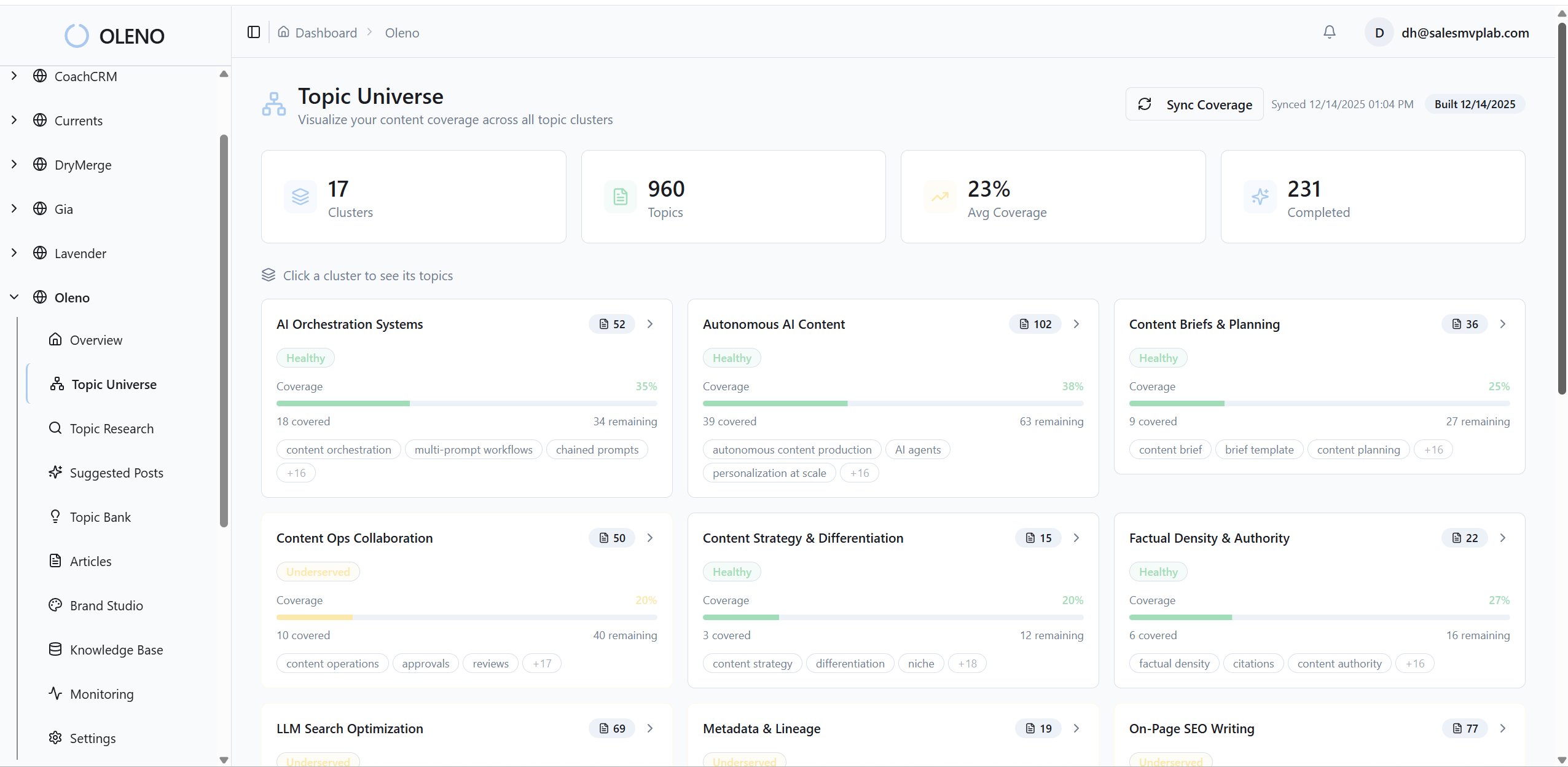
Because Topic Universe tracks coverage per pillar in real time, suggestions align with gaps, not guesses. You’ll see “underserved” clusters rise in priority, while “saturated” ones wait until information gain justifies re‑coverage. It’s governance without the headache. For a planning reference that mirrors this cadence thinking, see 90‑Day Roadmap Projects and adapt it to pillars and clusters.
Brief Generation With Information Gain Scoring
Every approved topic becomes a structured brief that includes competitive research and an Information Gain Score. Low‑differentiation outlines get flagged early, so you avoid shallow repeats. You only publish when the draft adds something new, which directly reduces the rework pain you’ve probably felt.
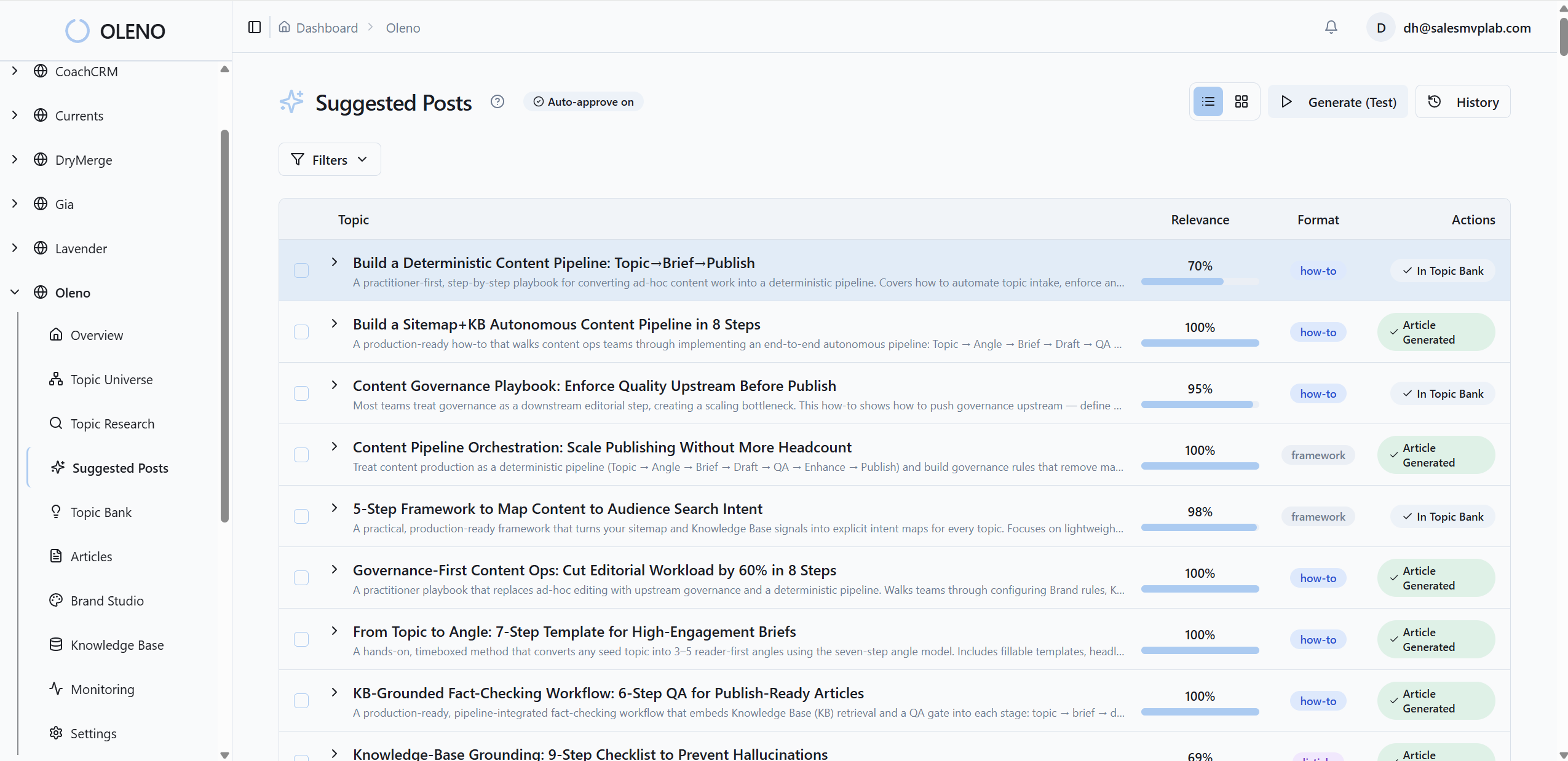
In practice, this looks like one field with teeth: “What new sub‑question, data, or example are we adding?” If the answer is thin, the brief doesn’t advance. Oleno keeps that discipline consistent. It’s not about writing less, it’s about shipping pages that make the pillar stronger.
Deterministic Links, Schema, QA, and Visuals
Internal links are injected from verified sitemaps using exact page titles, and JSON‑LD for Article, FAQ, and BreadcrumbList is generated automatically. Links and schema follow rules, not vibes. That means fewer orphans, cleaner citation structure, and better eligibility for featured snippets and AI assistant references.
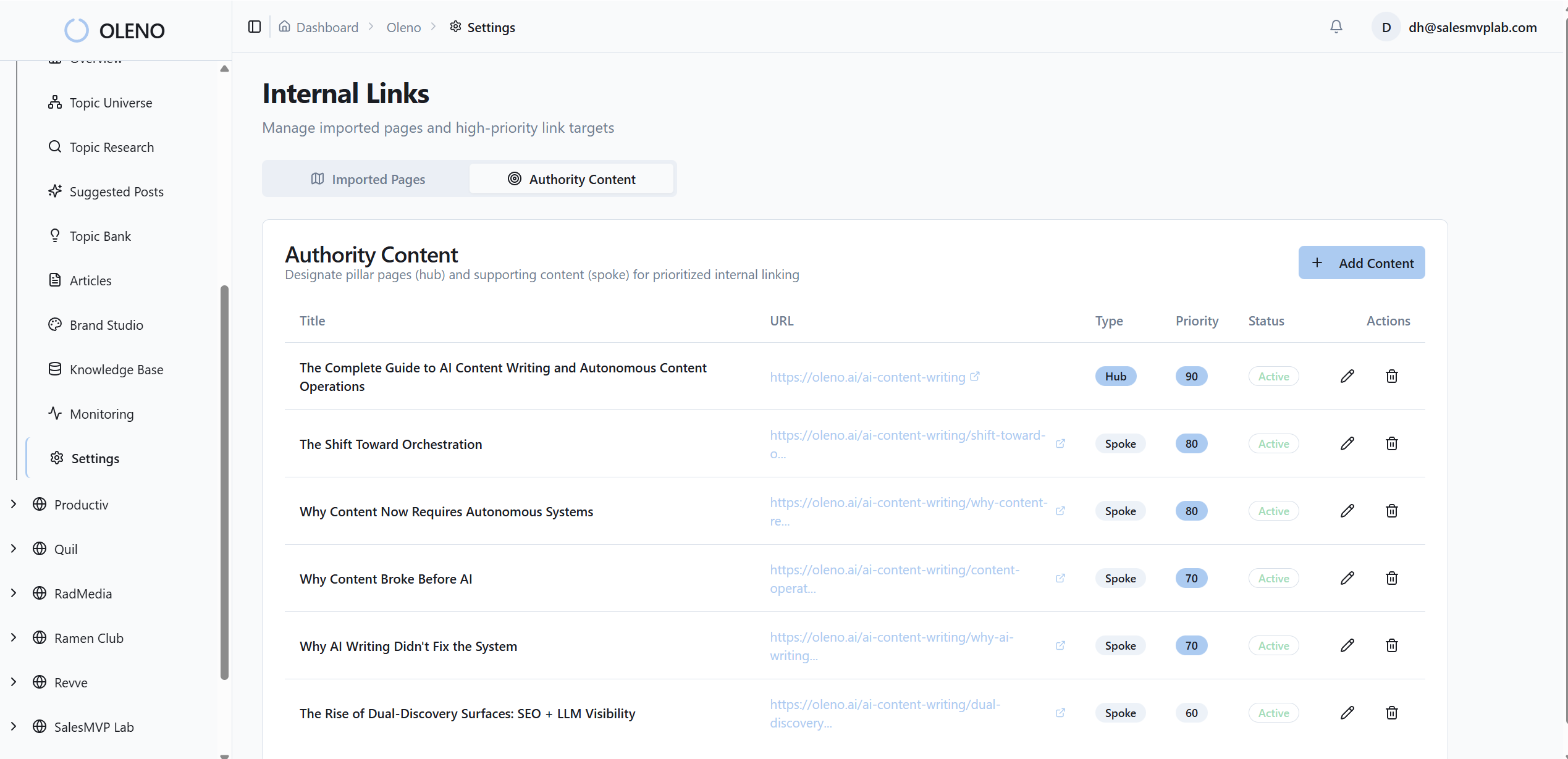
Before anything ships, Oleno’s QA evaluates structure, information gain, and voice alignment. Visual Studio generates brand‑consistent images and places product screenshots where they matter most, especially in solution sections. The outcome is fewer late edits, reduced visual inconsistency, and content that looks and reads like your brand. Oleno handles it end‑to‑end so your team focuses on narrative, not plumbing.
If you’re ready to turn coverage discipline into muscle memory, let the system do the heavy lifting. Try Oleno For Free.
Conclusion
You don’t need more content meetings. You need a 90‑day topic map that enforces coverage, rotation, and information gain, then a system that runs it daily. When you do that, the noise drops. Authority compounds. And the “one link” you send to a buyer actually earns the click.
About Daniel Hebert
I'm the founder of Oleno, SalesMVP Lab, and yourLumira. Been working in B2B SaaS in both sales and marketing leadership for 13+ years. I specialize in building revenue engines from the ground up. Over the years, I've codified writing frameworks, which are now powering Oleno.
Frequently Asked Questions