How to Audit Demand Gen Execution in 30 Minutes
Most people run a “demand gen execution audit” by staring at outputs.
How many posts did we ship. How many keywords did we move. How many campaigns did we launch.
That audit misses the real problem.
Demand-generation execution software is an operational system that ensures consistent, end-to-end marketing execution by encoding governance (positioning, product truth, voice) and running content, SEO, and distribution so outputs compound into a coherent brand signal across humans, search engines, and LLMs. Unlike content tools or AI writers that accelerate drafts, demand-generation execution software aligns decisions, workflows, and publishing so consistency scales with volume.
The enemy is Fragmented Demand Generation, which is a patchwork of tools, prompts, and people where narrative, product truth, and voice live in different places. Drift is the default. In the GEO era, that drift gets punished, because LLMs don’t “experience” one page at a time like a human does. They synthesize across everything they can find and they reward the brands that look consistent at scale.
Key Takeaways:
- A demand gen execution audit should measure the system (governance + consistency + GEO signals), not the assets.
- Fragmented Demand Generation usually shows up as rework tax, conflicting claims, and channel-by-channel voice drift.
- You can spot 80% of execution problems in 30 minutes by scoring three checks and writing down the top three fixes.
Stop Counting Content And Start Auditing Execution
A demand gen execution audit works when you treat execution as the unit of analysis, not content. Outputs are snapshots. Execution is the movie. Content is the artifact you can see; the system is the machine you can trust. Systems compound and make good work inevitable. Outputs don’t. Not “how much did we ship,” but “how reliably do we ship the same truth.”
Output Velocity Looks Great On Paper But It Doesn’t Compound
Shipping 12 posts this month can be a win. It can also be noise.
If every piece is created like a one-off event, you end up with 12 slightly different versions of your positioning. A new writer phrases the product differently. A PMM tweaks the claim. Demand gen changes the CTA. SEO adds a section to chase an angle. Now you’ve got a library that looks “active” but it’s not building a repeated signal.
I’ve watched this happen even on teams with good people and good process. Someone says “we have templates,” and they do. But templates don’t carry product truth, they don’t carry the exact language you want to repeat, and they don’t force the team to use the same definitions every single time.
So the work doesn’t stack. It resets.
Here’s the difference at a glance:
| Old Way: Fragmented Demand Generation | New Way: Demand-Generation Execution |
|---|---|
| Asset-by-asset prompts and ad hoc reviews | Orchestrated workflows with encoded governance |
| Templates that drift by contributor | Shared source of truth enforced in every job |
| Volume-first, narrative varies by channel | Consistency-first, volume compounds brand signal |
| Hero edits to "fix" drafts | Quality gates prevent publishing off-brand |
| Pageviews as success metric | Pipeline alignment and GEO coherence |
Fragmented Demand Generation Hides In Your Stack
Fragmented Demand Generation doesn’t show up as a single broken tool. It shows up as little mismatches that create a big cost.
A few examples you’ll recognize:
- Your blog says one thing about who you’re for, and your LinkedIn says another.
- One piece claims you “integrate with everything,” another is more cautious (and closer to truth), and now the sales team doesn’t know what to repeat.
- The competitive pages are tight and direct, but the top-of-funnel content reads like generic education.
- CTAs are all over the place, and each writer has a different opinion on what “the next step” should be.
None of that is evil. It’s normal. It’s also expensive.
Because when the system is fragmented, you pay the tax in reviews, rewrites, and coordination. You don’t notice it in week 1. You really notice it in month 6.
GEO Punishes Inconsistency More Than Low Volume
GEO changes the scoreboard. The goal isn’t only ranking a page. The goal is showing up as the brand that’s consistently associated with a set of problems, definitions, and points of view.
LLMs pull from lots of places. They don’t care that you had one great post. They care if your positioning is stable across dozens or hundreds of assets, because that’s what makes a brand “safe” to cite.
That’s why “more content” isn’t automatically the play anymore. Volume times inconsistency is just a faster way to confuse the market, and it’s a faster way to confuse the machines too.
Consistency across scale beats raw volume for visibility in LLM-driven search. I agree with that take strongly, and I think most teams are still operating like it’s 2019.
Rethink The Audit Around Systems Not Assets
A useful demand gen execution audit asks a blunt question: does our system make good marketing inevitable, or does it depend on heroic catches and taste-driven edits? Not “is this post good,” but “can this machine produce on-message work every time, at speed.” When you audit the machine, you finally see why Fragmented Demand Generation keeps winning the calendar and losing the category.
When you audit the system, you’re looking for four layers:
- governance (what’s true, what we believe, how we sound, who we target)
- workflow (handoffs, approvals, how work moves)
- coverage (are we actually covering the funnel and the category)
- signals (does all of this show up as one coherent story across channels)
This part matters because if governance is weak, you can’t “process” your way out of it. You’ll just create faster drift.
Governance Is Your Marketing Source Code
Governance is the stuff that should not be up for debate every time you publish.
If you want a quick list, look for these artifacts and ask if they’re current:
- positioning and category framing
- product definitions and approved claims (plus boundaries, what you won’t claim)
- voice rules and terminology (what you say, what you avoid)
- audiences and personas (how the same topic changes by role and context)
- use cases (what buyers are actually trying to do)
Most teams have some of this. Few have it in a form that gets enforced. It lives in heads, old Notion pages, and slide decks that nobody opens after kickoff.
That’s why audits fail. They measure assets. They don’t measure the source code.
Orchestrated Work Beats Prompting Every Day Of The Week
Prompting produces text. Orchestration produces a system.
Prompting feels like progress because you can get a draft in minutes. But it pushes judgment onto humans: somebody has to catch inaccuracies, somebody has to fix voice drift, somebody has to remember the latest positioning shift, somebody has to publish it correctly, somebody has to repurpose it without making it weird.
As output increases, coordination cost increases too. That’s the trap.
The approach I prefer is boring, but it works. You encode the judgment up front. Then the workflow repeats. Then quality is predictable. That’s when you can actually scale without creating a headache.
Judge Pipeline Alignment Not Pageviews
Pageviews matter, but they’re not the audit.
A system can “win” SEO and still miss pipeline if the content drifts away from what you sell and why it’s different. I’ve lived that movie. Great writing, great design, strong rankings, and then you realize the content is basically detached from your solution narrative.
A pipeline-aligned asset has a few tells:
- the problem is framed in a way your product actually solves
- the terminology matches what sales says in real conversations
- the product truth is consistent (no invented claims, no fuzzy promises)
- the CTA makes sense for the funnel stage and it doesn’t change randomly
If the assets don’t tie back, it isn’t a content issue. It’s an execution issue.
Evidence You Can See In One Sitting
Fragmented Demand Generation isn’t abstract. You can see it in a single coffee. Coordination bloat, misalignment, and drift show up in the cracks: reviews that take longer than writing, subtle claim differences that create big confusion, and channels that sound unrelated. Once you notice the pattern, you can’t unsee it. And you realize it’s systemic, not stylistic.
Coordination Cost Often Exceeds Creation Cost
If you’re a scaling SaaS marketing team, you probably have enough talent. You have writers, PMM, demand gen, SEO, design. The struggle is the handoffs.
A realistic example, let’s pretend:
- Writer spends 4 hours drafting
- PMM review takes 45 minutes, plus 30 minutes of Slack back-and-forth
- CMO tweaks positioning language in a doc, 20 minutes
- Demand gen wants a different CTA, 15 minutes
- SEO asks for a structure change, 30 minutes
- Editor cleans it up, 60 minutes
- Publishing and formatting, 30 minutes
- Social repurposing, 60 minutes
That’s not “one post.” That’s a mini project.
Now multiply it by 20 pieces a month. Suddenly the problem isn’t writing. The problem is that the system makes every asset a coordination exercise.
Rankings Without Alignment Don’t Create Demand
At Proposify we had a killer content team. Great writers with a ton of personality. Great designers. We ranked incredibly well for lots of topics.
But a lot of that content was too far away from the solution. Stuff like “how to manage an SDR team.” Useful. Also not connected.
So we were getting traffic and we couldn’t tie it back. It’s a painful feeling because you’re doing “marketing” and it still doesn’t feel like demand gen. That gap is what an execution audit is supposed to surface fast.
If you’re worried your content is detached, your audit shouldn’t start with keyword performance. It should start with narrative linkage. Can a reader travel from problem to your product truth without a giant leap.
Breadth Plus Depth Plus Consistency Creates Step Function Gains
Back in 2012 to 2016 I ran a site called Steamfeed. We hit 120k unique visitors a month at peak, mostly because we had both breadth and depth at volume.
We had 80 regular contributors submitting one post a month, and over 300 guests occasionally. We started seeing SEO spikes at 500 pages, 1000 pages, 2500 pages, 5000 pages, then 10000 pages. Most pages got under 100 views a month, but the catalog compounded because the quality bar and the structure were consistent enough to build authority across topics.
That’s the real lesson. Compounding doesn’t come from one hero post. It comes from a system that can publish a lot while staying coherent.
What Fragmentation Feels Like On Monday Morning
Fragmented Demand Generation feels like the weekly reset, where you’re always “getting aligned” and you never actually get ahead. You plan on Sunday, lose the thread by Tuesday, and by Friday you’re shipping “something” that passed review but doesn’t sound like you. Good people. Broken system. And next week? Same loop, new calendar.

The Weekly Reset That Never Ends
The loop is usually predictable.
Monday: strategy meeting. Tuesday: briefs and prompts. Wednesday: drafts are “close.” Thursday: edits turn into rewrites. Friday: publish gets pushed.
Then you do it again.
A lot of CMOs end up losing confidence here, not because the team is bad, but because the system can’t produce reliable output. You can’t build a demand gen engine on vibes.
Too Many Cooks And No Single Voice
When PMM edits for accuracy, demand gen edits for conversion, SEO edits for structure, and the writer edits for flow, you often end up with a stitched-together artifact. It passes review. It doesn’t sound like one company.
You can spot this in minutes with an audit. Look for CTA variance, mixed terminology, and tiny claim differences that create big confusion over time. The content isn’t “wrong.” It’s inconsistent. That inconsistency is the real cost.
The 30 Minute Demand Gen Execution Audit
A 30-minute demand gen execution audit is a quick scoring exercise that tells you where your system is failing, so you stop guessing and stop fixing the wrong thing. You’re not critiquing content quality here, you’re diagnosing the machine that produces content. Fast, honest, and repeatable. Score it, name the top three fixes, and move.

You’ll score three checks from 0 to 2. Total score out of 6. You’ll also write down the top three fixes. That’s the output.
And yes, it can be done in one sitting.
The 5 Minute Governance Check: Source Of Truth Or Scattered Docs
Your first five minutes are simple. Find the source of truth. Or admit it isn’t real yet.
Check these five things:
- positioning and category framing
- product truth: definitions, approved claims, boundaries
- voice and terminology
- audiences and personas
- use cases
Score it like this:
- 0 = missing, outdated, or nobody can find it
- 1 = exists, but it’s not enforced, people still “interpret”
- 2 = current, explicit, and actually used as the reference point in work
A lot of teams land at 1. The dangerous part is you think you’re at 2.
Write down what’s missing. Don’t fix it yet. Just be honest.
The Standalone Three Pillars That Make Execution Work
If you want the simplest frame for the whole category, it’s this:
- Governance-First Alignment: Centralize positioning, product truth, voice, audiences, and use cases so every asset repeats the same approved facts and POV.
- Orchestrated Execution: Replace prompt-by-prompt work with system workflows that enforce consistency across content, SEO, and distribution.
- GEO-Ready Signals: Maintain a repeated brand narrative that humans, search engines, and LLMs can recognize and cite.
You can do the audit without any software. But you can’t avoid these pillars.
The 10 Minute Consistency Scan: Three Assets Three Channels One Story
Pick three recent assets across channels. Don’t overthink it.
I like:
- one SEO article
- one bottom-of-funnel page (competitive, use case, product-led)
- one LinkedIn post or thread promoting something
Now scan for four things:
- do you use the same category definition and problem framing
- do product claims match, including what you won’t claim
- do CTAs point to the same buyer journey, or are they random
- does the tone feel like one company, not three contributors
Score each dimension 0 to 2, then give the whole consistency check a single score:
- 0 = obvious drift, conflicting language, mixed claims
- 1 = mostly aligned, but you see variation and “interpretation”
- 2 = tight, repeatable, no surprises
One weird trick here is to read the first paragraph of each asset out loud. If it feels like three different companies, you’ve got a system problem.
The 10 Minute GEO Signal Check: Can Machines Summarize You Correctly
GEO signal checking doesn’t need fancy tooling. You’re looking for coherence.
Do three quick searches:
- your brand name + the core problem you solve
- your brand name + the category term you want to own
- a core competitor or alternative topic + “alternatives” or “vs” (whatever matches your world)
Then ask an LLM a simple question: “Who are the best resources on [your category] and how do they define it?”
Look for two things:
- are you visible at all
- if you show up, is the definition correct and consistent with what you want to repeat
Score it:
- 0 = invisible or misrepresented
- 1 = intermittent, you show up sometimes but the story varies
- 2 = you show up and the framing is stable
Use the last five minutes to write down the top three fixes that would move the score fastest. Usually it’s governance clarity, consistency enforcement, or missing BOFU coverage.
If you want to see what a system-based approach to this audit looks like in practice, request a demo.
What Good Looks Like In Practice With Demand Generation Execution Software
Demand-generation execution software makes the audit boring, because the system is doing what it’s supposed to do. Governance is encoded once. Execution repeats. Output stays consistent even when priorities shift and people change. Not heroics, but habits. Not vibes, but verification.
That’s the point. Reliability over heroics.
Turning The Checklist Into A Weekly Operating Cadence In Oleno
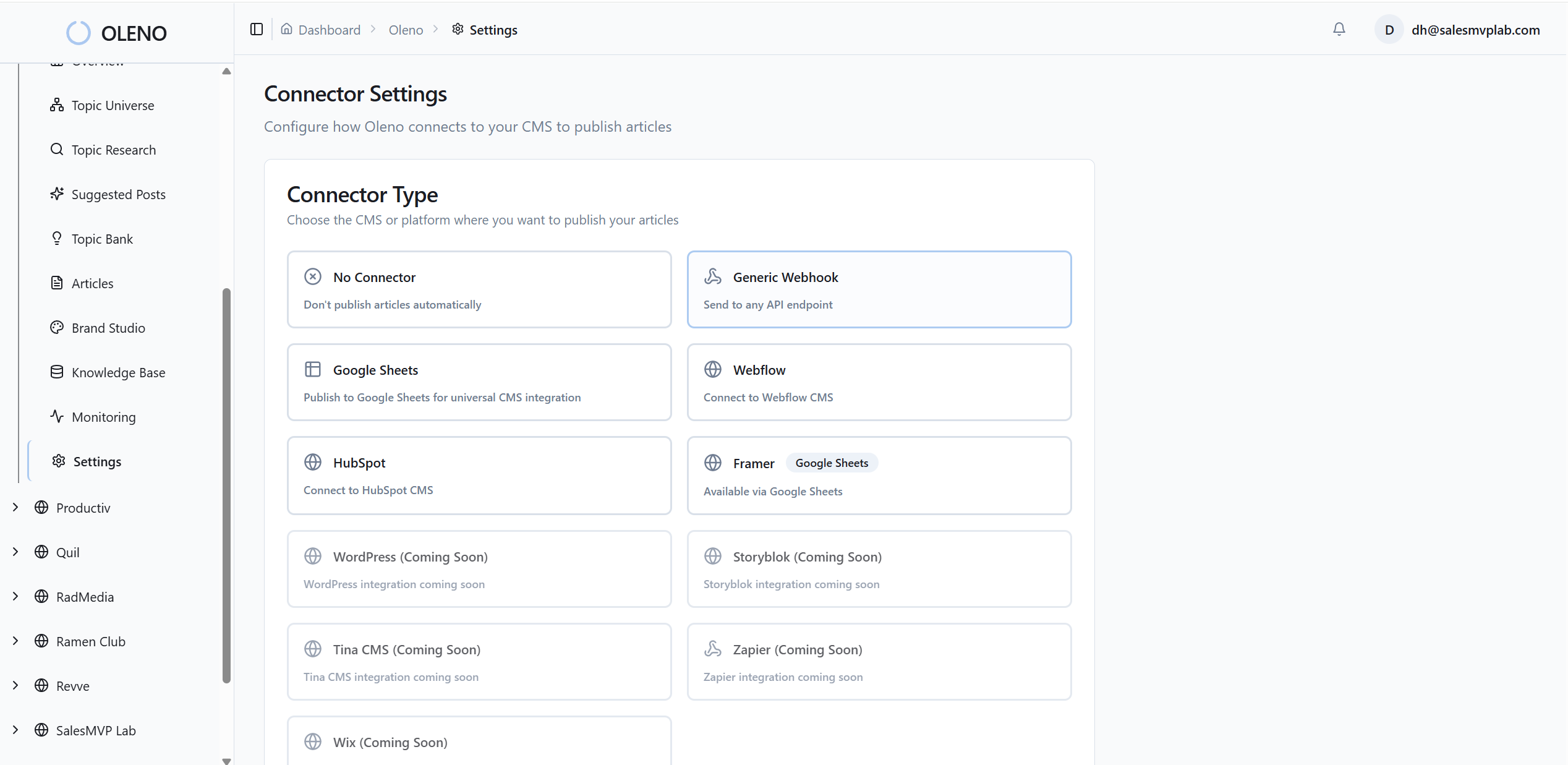
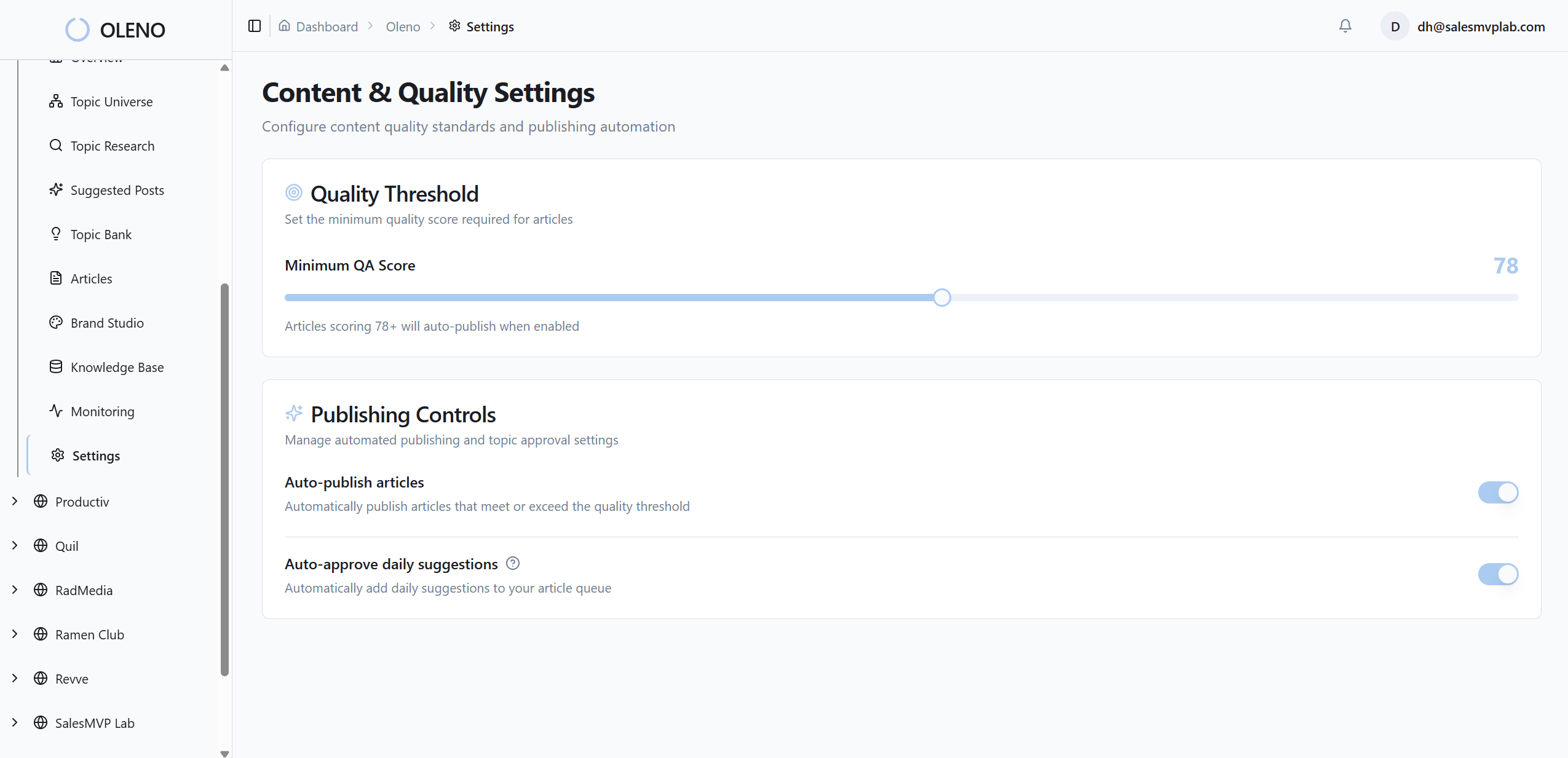
Oleno is built around the idea that strategy stays human and execution becomes a system. In practice, that means you define your voice and rules in brand studio, your category framing in marketing studio, and your product truth in product studio, then you run work through a pipeline that won’t publish unless it passes the quality gate.
You also get a real production loop with topic universe plus the orchestrator, so topics don’t rely on someone’s mood or a random brainstorm. Then when content is ready, cms publishing pushes it live without the copy-paste circus.
The way I’d map this back to the audit is pretty literal:
- Governance check moves toward a 2 because the source of truth lives in one place
- Consistency scan tightens because the rules get injected into every job, not re-explained in every brief
- GEO signal improves over time because the system keeps repeating the same definitions and claims
If you’re trying to reduce rework tax, this is where it starts.
Mid-way through a setup, most teams want to sanity check their current state against the audit before they change anything. If that’s you, request a demo and we’ll run through it live.
Scaling From 4 To 8 Pieces Up To 20 To 40 Plus Without Losing The Plot
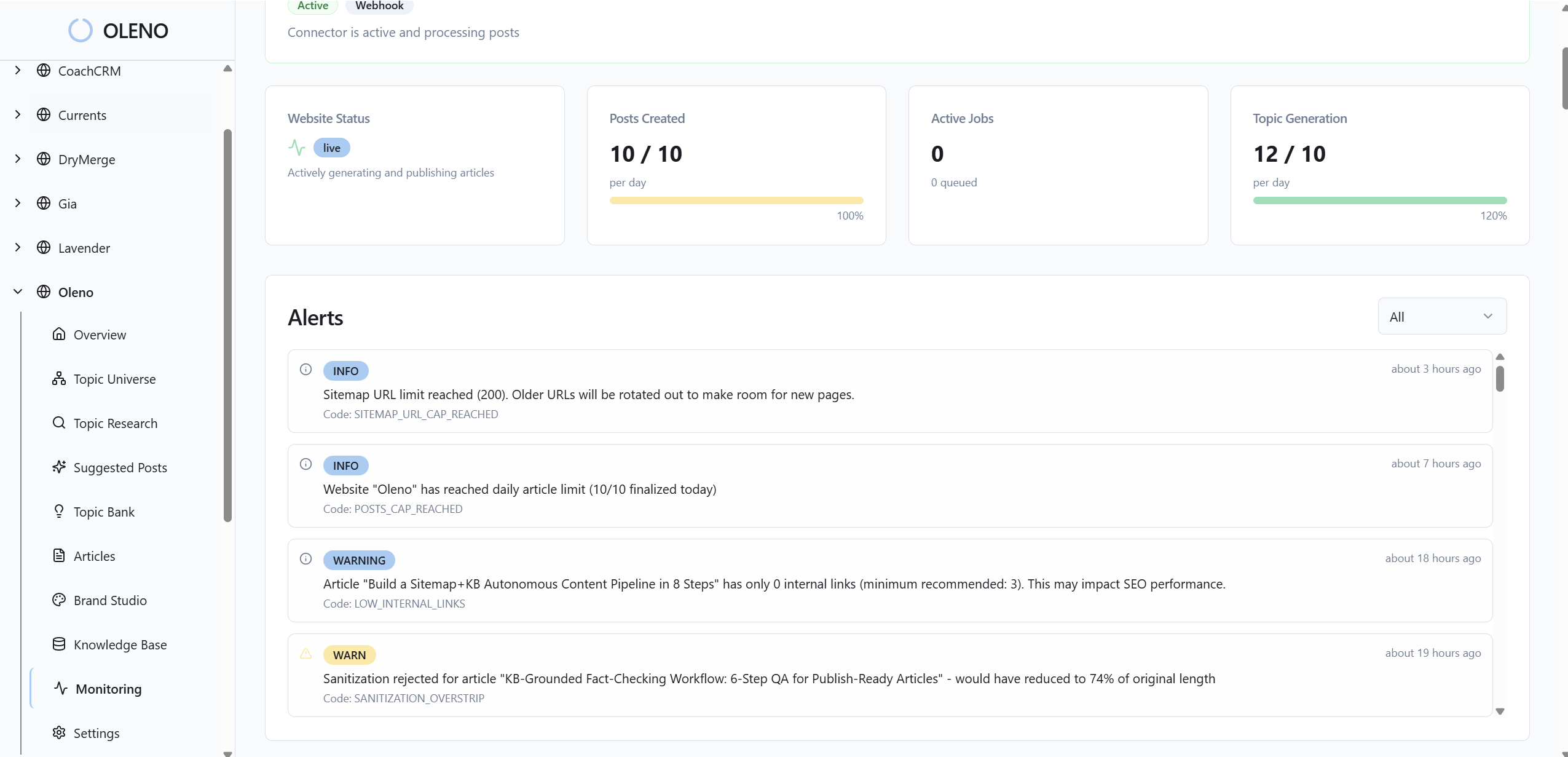
One of the clearer outcomes teams use Oleno for is SEO content scaling: going from 4 to 8 articles a month to 20 to 40 plus, without adding headcount. That’s not a promise for everyone, it depends on your current baseline and how much you already have defined, but the mechanism is real. When the workflow is repeatable and the quality gate blocks weak drafts, you stop paying for chaos with meetings.
The part CMOs usually care about isn’t only output. It’s trust. A system where content stays on-message, product claims stay accurate, and distribution doesn’t feel like an afterthought.
That’s what demand-generation execution software looks like when it’s operationalized, and Oleno is one concrete example of it.
From Fragmented Demand Gen To A System You Can Actually Run
A demand gen execution audit in 30 minutes won’t fix your whole marketing engine. It will show you where the system is broken, and it will stop you from wasting a quarter polishing outputs while the source code stays messy. Not more content, but better execution. Not new tools, but a new spine for the work.
Fragmented Demand Generation is sneaky. It looks like activity. It feels like momentum. Then you zoom out and realize nothing compounds.
Run the audit. Score it honestly. Fix the top three things first.
If you want to see how this looks when the workflow is encoded and enforced, book a demo.
About Daniel Hebert
I'm the founder of Oleno, SalesMVP Lab, and yourLumira. Been working in B2B SaaS in both sales and marketing leadership for 13+ years. I specialize in building revenue engines from the ground up. Over the years, I've codified writing frameworks, which are now powering Oleno.
Frequently Asked Questions