AI-Assisted Content Workflow: 8-Step Playbook to Cut Draft Time 60%
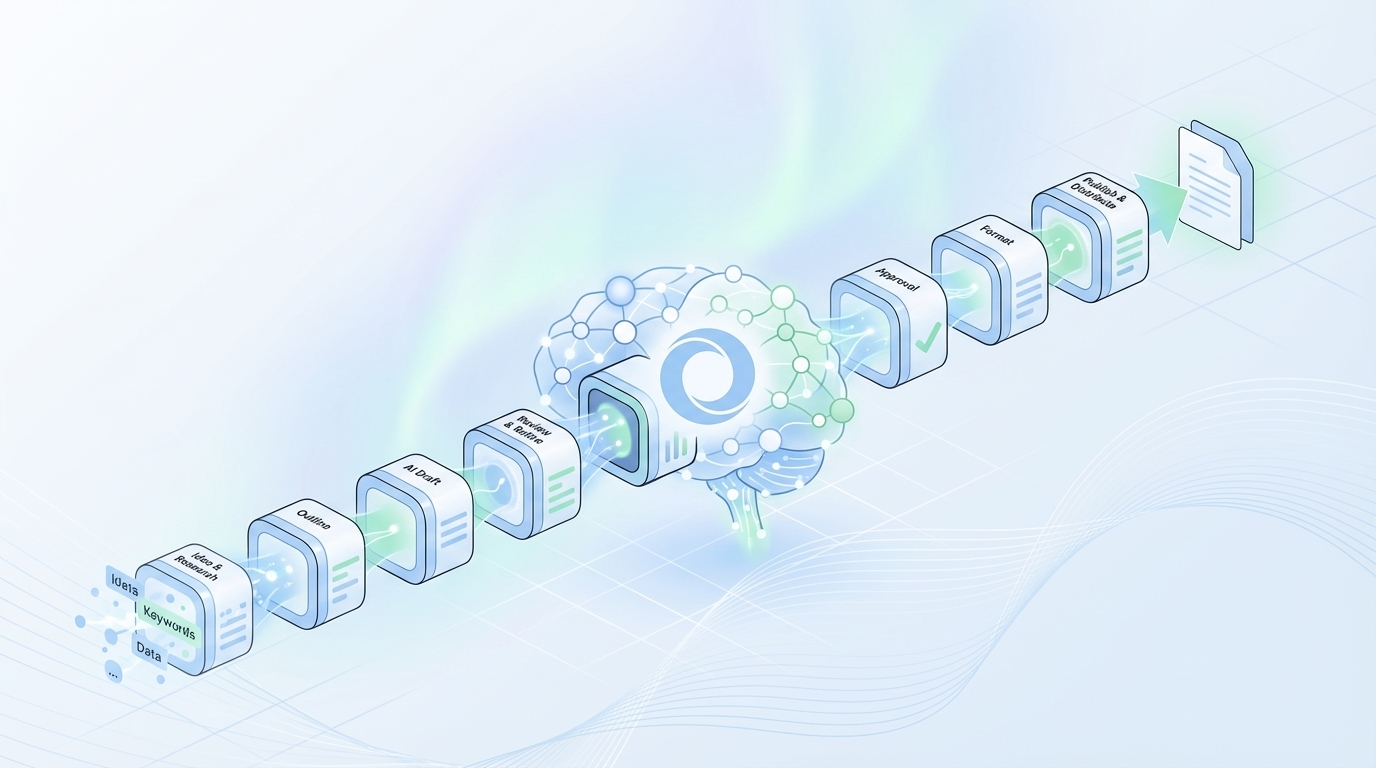
Most teams bolt AI onto an old editorial process and hope for speed. You get it: more drafts moving through the system, more quickly. But here’s the rub — speed without rules just multiplies rework. You don’t save time; you defer pain. I’ve been there, pushing volume, then paying in downstream edits and late publish headaches.
So let’s approach this like operators, not hopeful optimists. Treat AI like a system with standards, not a chat box. Write your acceptance criteria before word one. Decide where humans judge and where machines execute. Then hold the work to the rules. You’ll cut cycles without losing the pen. You’ll also sleep better.
Key Takeaways:
- Encode acceptance criteria early to prevent downstream rework and legal escalations
- Shift control into standards (briefs, voice rules, QA gates), not post-hoc edits
- Pick models by task and risk; don’t overpay for heavyweight synthesis everywhere
- Ground drafting in a verified KB to cut hallucinations and reduce edit time
- Automate CMS handoffs (links, schema, fields) to eliminate publish delays
- Track operational inputs you control (acceptance rate, rule violations), not vanity metrics
- Use Oleno to enforce differentiation, structure, visuals, and publishing deterministically
Why Speed Alone Bloats Editorial Debt
Speed by itself increases editorial debt because it multiplies low-quality outputs that need fixing later. The cost shows up in rework, compliance escalations, and brand cleanup. For example, teams ship more “first drafts,” then burn days reconciling voice drift and missing schema in the final miles.

The hidden multiplier on rework
When teams bolt AI onto old processes, they move words faster, not quality. You end up publishing half-baked drafts that feel close, but not quite ship-ready. Then the edits start. Brand voice tweaks. Fact corrections. Compliance clarifications. Multiply that by every article in flight and you’ve built a rework factory.
The real cost is downstream, and it compounds. One fuzzy brief triggers three interpretation gaps. Each gap spawns a ping to legal, a visual revision, and a CMS fix. I’ve watched good writers look slow because the system around them was undefined. The fix is upstream: acceptance criteria, structure, and guardrails that prevent the mess before it starts.
What changes when AI is treated like a system?
AI becomes predictable when governed by rules, not ad hoc prompts. You define inputs, checkpoints, and handoffs. The variance falls. Writers stop firefighting and start operating a pipeline. You don’t lose editorial control; you move it earlier, where it actually matters.
That means your definition of done is visible before anyone writes. It also means failures trigger rule updates, not ad hoc rewrites. The effect is subtle at first, then obvious: fewer back-and-forths, fewer “can you quickly fix” Slacks, fewer late-night page updates that introduce new mistakes. The machine handles structure; your humans focus on story.
Why acceptance criteria beat brand vibes
Brand vibes are subjective. Acceptance criteria are specific and testable. “Sounds like us” invites debate; “opens every H2 with a 40–60 word direct answer” is concrete. The practical list isn’t long, but it is precise: factual grounding, voice rules, snippet-ready H2 openers, schema present, and no fabricated links.
Governance doesn’t have to be heavy. It has to be clear. If you need a place to start, the governance framing in the CMA AI Playbook lays out simple, auditable rules. Interjection. Make the rules visible where work begins, not in a wiki nobody opens.
The Real Bottleneck Lives In The Workflow, Not The Writer
Bottlenecks appear because workflows lack defined inputs, research consistency, and QA gates. Drafts stall in unclear briefs and scattered sources, not in talent gaps. For instance, a crisp brief schema and deterministic handoffs do more for velocity than adding another writer.
Where drafts actually stall
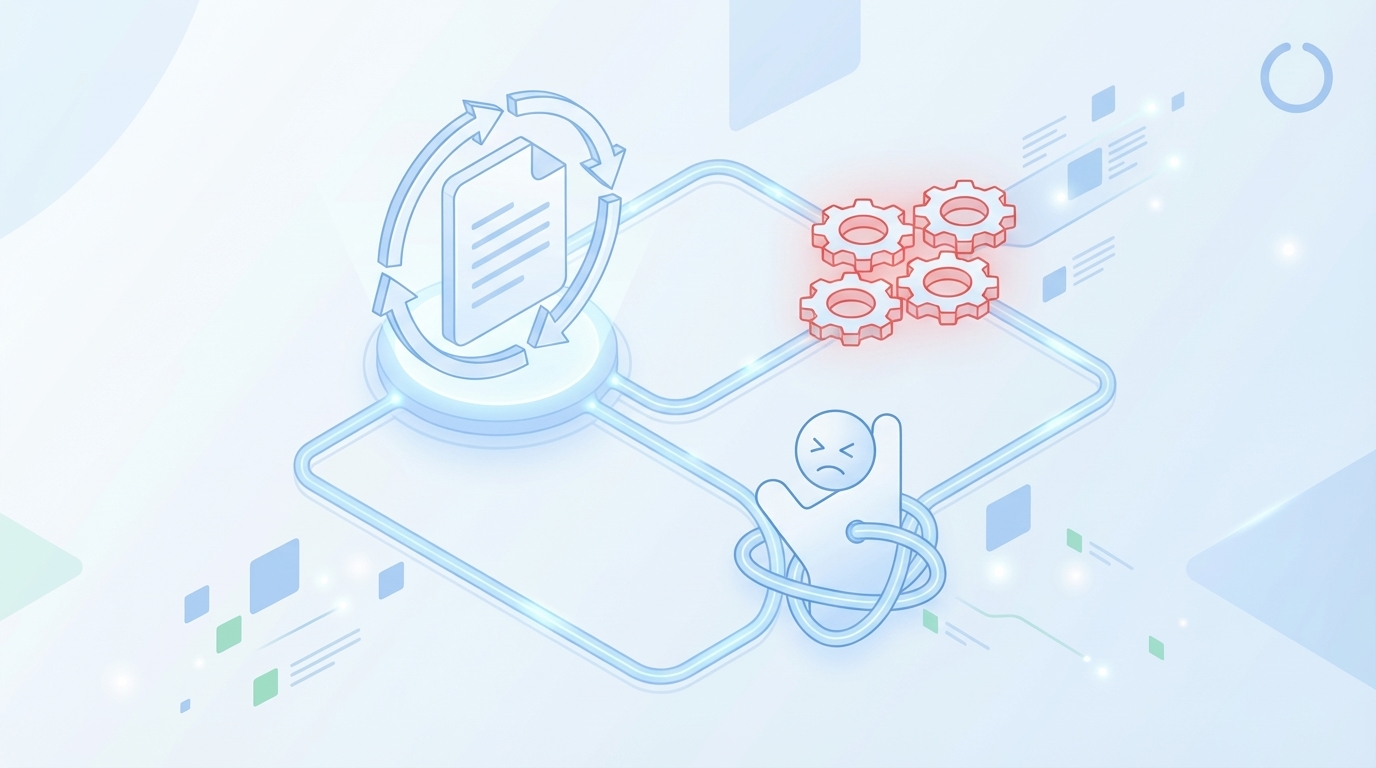
Drafts don’t die in the writing. They die in fuzzy inputs, scattered research, unclear voice, and undefined QA gates. I’ve seen great writers wait days on decisions that should’ve been encoded once and reused forever. You don’t fix that with more writing hours. You fix it by removing blockers.
Do it with templates, guardrails, and deterministic handoffs. Make your brief a contract: audience, angle, sources, and differentiation specifics. Make your QA gate a rubric. Make your “do not say” list visible. Once the system owns the boring decisions, writers can move. Editors can edit. Legal can scan for exceptions, not rewrite the story.
How do you keep control while using AI?
Move control into standards. Use brief schemas, model rules, voice constraints, legal-trigger flags, and a publish-ready rubric. Humans write the laws; AI executes within those boundaries. Editors review exceptions, not every sentence. You keep the pen; you just stop redlining everything.
Decision frameworks help here. The Kelley AI Playbook explains how to align model choices and risk with governance. Translate that to content: low temperature for factual tasks, retrieval for claims, human checks only where judgment matters. Control is designed, not enforced after the fact.
What teams miss about model selection
Model choice isn’t a brand decision; it’s a task decision. Use small models for lookups and transforms, larger models for synthesis, and strict retrieval for factual claims. Temperature is a policy, not a guess. Overusing heavyweight models burns budget without raising quality.
I like a simple matrix: retrieval plus low temperature for facts, midsize models for outlines and section rewrites, larger models for complex synthesis. Encode defaults in your tool or brief. Don’t rely on the operator’s “feel” each time. Consistency beats cleverness when you’re trying to ship at scale.
The Costs You Can See And The Ones You Can’t
Costs show up as edit time, compliance risk, and publish friction. Hidden costs live in context switching, duplicated research, and morale. Example: a team that “saves” three drafting hours per post but adds two rounds of legal review nets no gain and more stress.
Hours lost to copy-paste research
Manual sourcing burns hours and still misses key references. Without a governed research step, you get inconsistent claims, duplicated effort, and source drift. One writer copies something close, another finds a better source, and the editor gets both. Multiply by ten posts and you’ve lost a week to copy-paste.
A lightweight sourcing pipeline with human verification changes this. Require three sources in-brief, confirm accuracy, annotate with pull quotes. Now editors trust the inputs. You’ll see the reduction quickly: fewer “can we cite this?” comments and tighter first passes. Operational playbooks like the AI Content Playbook outline how stage-by-stage efficiencies add up.
Let’s pretend you produce 10 posts a month
Assume 6 hours per first draft and 4 hours of edits per post. That’s 100 hours. If AI cuts drafting 60 percent but doubles edits because of hallucinations or off-voice tone, you’re right back at 100 hours—with more frustration. The win only happens when edits drop. Upstream rules do that.
Let’s tighten the math. If governance trims edit time from 4 to 1.5 hours and keeps drafting to 2.5, you’re at 40 hours total. Not perfect, but the direction is obvious. The control levers aren’t poetic intros; they’re acceptance criteria, KB grounding, and deterministic handoffs.
Risk exposure in regulated reviews
Legal and compliance hate surprises. If brand and factual drift sneak in, reviews stall. Encode disallowed claims, cite requirements, and KB-first drafting. You don’t promise zero risk; you reduce surface area. Fewer back-and-forths. Fewer late-night rewrites. Fewer publish delays.
Content lifecycle controls matter here. The governance approach in OpenText’s productivity guidance shows how mapping fields, versioning, and controlled publishing reduce downstream risk. Translate that into your process. Don’t leave it to tribal knowledge.
You Know The Pain When Drafts Need Three Rounds Of Fixes
Three rounds of fixes signal upstream ambiguity, not lack of talent. The scramble comes from fuzzy briefs, ad hoc sourcing, and last-mile publishing snags. For example, I’ve had “approved” posts derailed when legal flagged a stretch and design replaced visuals at 9 p.m. on launch eve.
The 3am scramble story
I’ve been in the seat where a post is “done” and legal catches a factual stretch while design finds off-brand visuals. Everyone’s right. Everyone’s late. You’re rebuilding under pressure. The lesson was simple. Put the guardrails earlier. Reduce the number of places a draft can go wrong. Ship without the scramble.
Once we moved rules upstream—voice, claims, visuals, and structure—the midnight messages dropped. Not to zero. But enough to reclaim mornings. It’s not about heroics. It’s about removing avoidable failure modes from the system.
When a great idea still misses demand
At Proposify we ranked across big keywords but missed the product tie-in. Strong writing. Weak alignment. Even high-traffic content can fail demand when strategy, topic selection, and narrative structure are disconnected. We helped sales teams send proposals. Some articles taught SDR management. Great reads. Little pipeline.
The fix wasn’t “write better.” It was a system-level change. Align topics to clusters tied to the solution. Enforce a narrative that connects problem to product without being pushy. Editorial quality plus strategic alignment, or you’re just feeding pageviews.
Who feels the drag across the team?
Everyone. Sales gets leads that don’t convert. Design scrambles visuals. Editors become human linters. Engineering gets pulled into CMS fixes when publishing breaks. The cost isn’t only time—it’s credibility between teams. That’s the hidden tax.
When content operates as a system, the friction drops for the entire org. Writers get clearer briefs. Editors get cleaner drafts. Legal sees fewer surprises. Devs aren’t asked to hotfix CMS fields at 6 p.m. on Friday. It’s calmer. And yes—faster.
The 8-Step AI-Assisted Content Workflow That Preserves Control
An eight-step workflow preserves control by encoding rules upfront and placing humans at judgment checkpoints. It defines done, automates handoffs, and makes failure repeatable for learning. For example, acceptance criteria, KB-first drafting, and idempotent publishing eliminate most last-mile thrash.
Step 1: Define goals, KPIs, and acceptance criteria
Write the finish line before you start. Document target outcomes like draft time per asset, publish-ready pass rate, information gain thresholds, and percent of sections that open with snippet-ready paragraphs. Define your acceptance rubric, banned claims, required citations, and voice rules. Now the team shares one definition of done.
Make it visible in the brief template, not in a policy doc nobody reads. Track rule violations as an operational KPI, like a linting error. When something fails, update the rule or the template. Don’t just rewrite. That’s how you compound learning without adding meetings.
Step 2: Automate research, then verify sources
Use a brief template with required sections for problem, audience, angle, sources, and differentiators. Automate source gathering from your KB and trusted domains. Then run a human verification pass to confirm facts and pull quotes. Keep a source log in the brief. Editors stop guessing and start editing.
The small shift is big: research becomes a governed stage, not a loose set of tabs. That reduces duplication and drift. It also gives legal the confidence that claims trace back to approved references. You’re not slowing down; you’re removing downstream surprises.
Step 3: Choose models with rules for task, cost, and risk
Set a matrix. Retrieval for facts. Small models for transforms and rewriting. Larger models for synthesis and outline creativity. Temperature low for accuracy tasks, higher only for ideation. Encode the defaults in your brief or tool. Don’t let model selection be a vibe. Make it a policy.
This isn’t about worshiping a model. It’s about right-sizing cost and reducing variance. Overpaying for heavyweight models everywhere won’t buy accuracy. Governing how you use them might. And it’s easier to maintain when the rules are documented once and reused.
Step 4: Generate the outline with prompt templates and a handoff checklist
Use an outline prompt that enforces structure: target reader, thesis, section objectives, and required snippet-ready openers. Attach a handoff checklist that confirms angle clarity, section-level evidence, and internal link intents. The outline becomes the contract between research and drafting.
This is where most drift starts. Lock the angle, define the evidence, and confirm the shape. If the outline fails, fix it here. Don’t let uncertainty roll downhill into messy drafts that require “voice surgery” later.
Step 5: Draft with KB grounding and structured prompts
Draft section by section. Pull facts from your KB. Use prompts that require citations inline and forbid speculative claims. Keep paragraphs 40 to 80 words and open each H2 with a direct answer. You’re writing for humans and machines, so structure for both. Hallucinations drop when grounding is standard.
One more practical tip. Annotate where a human anecdote or proof point belongs inside the draft. It nudges the editor to add real texture without derailing the structure. The goal isn’t robotic prose; it’s clean scaffolding that holds authority and voice together.
Step 6: Run human-in-the-loop reviews at the right checkpoints
Place humans where judgment matters. Editorial pass for voice and clarity. Fact-check pass against the KB and approved sources. Legal pass for disallowed claims. Make each pass checklist-driven so it scales. If an article fails, fix the rule upstream so the failure doesn’t repeat.
This is the difference between endless debate and fast decisions. A checklist compresses subjectivity. Editors spend their energy on nuance, not policing commas. Want to see a governed pipeline without more headcount? Try Using An Autonomous Content Engine For Always-On Publishing.
Step 7: Automate CMS integration with APIs, webhooks, and versioning
Wire outputs to your CMS with connectors or webhooks. Map fields, add schema, and inject internal links deterministically. Keep versioning so humans can roll back with confidence. Publishing should be idempotent, so retries don’t create duplicates. Automation moves work, not responsibility.
If you’re mapping this in-house, borrow from lifecycle practices like those described in OpenText’s content management guidance. The goal is boring reliability: the same result, every time, regardless of who presses “publish.”
Step 8: Monitor performance inputs and improve your artifacts
Track operational KPIs you control: acceptance rate, edit time, rule violations, and brief completeness. Maintain a prompt and checklist library with date-stamped changes. A/B test openings or CTAs where allowed. Improvement lives in your artifacts, not only in ad hoc feedback.
This isn’t analytics theater. It’s operations. When a failure repeats, update the rule, not just the draft. Over a quarter, you’ll see edit time fall, publish friction drop, and fewer escalations. That’s compounding efficiency you can trust.
How Oleno Ships Publish-Ready Content Without Extra Headcount
Oleno ships publish-ready articles by turning strategy, research, writing, visuals, and publishing into one governed pipeline. It enforces differentiation, structure, and correctness through code—not late edits. For example, briefs get information gain scoring before writing, and internal links are injected from verified sitemaps only.
Brief generation with information gain scoring
Oleno creates strategic briefs, analyzes top results, and scores outlines for uniqueness before any drafting happens. Low-differentiation briefs get flagged so the angle is fixed upstream. Editors inherit stronger inputs and fewer rewrites. The outcome is pragmatic: reduced wasted drafting time and tighter first passes.
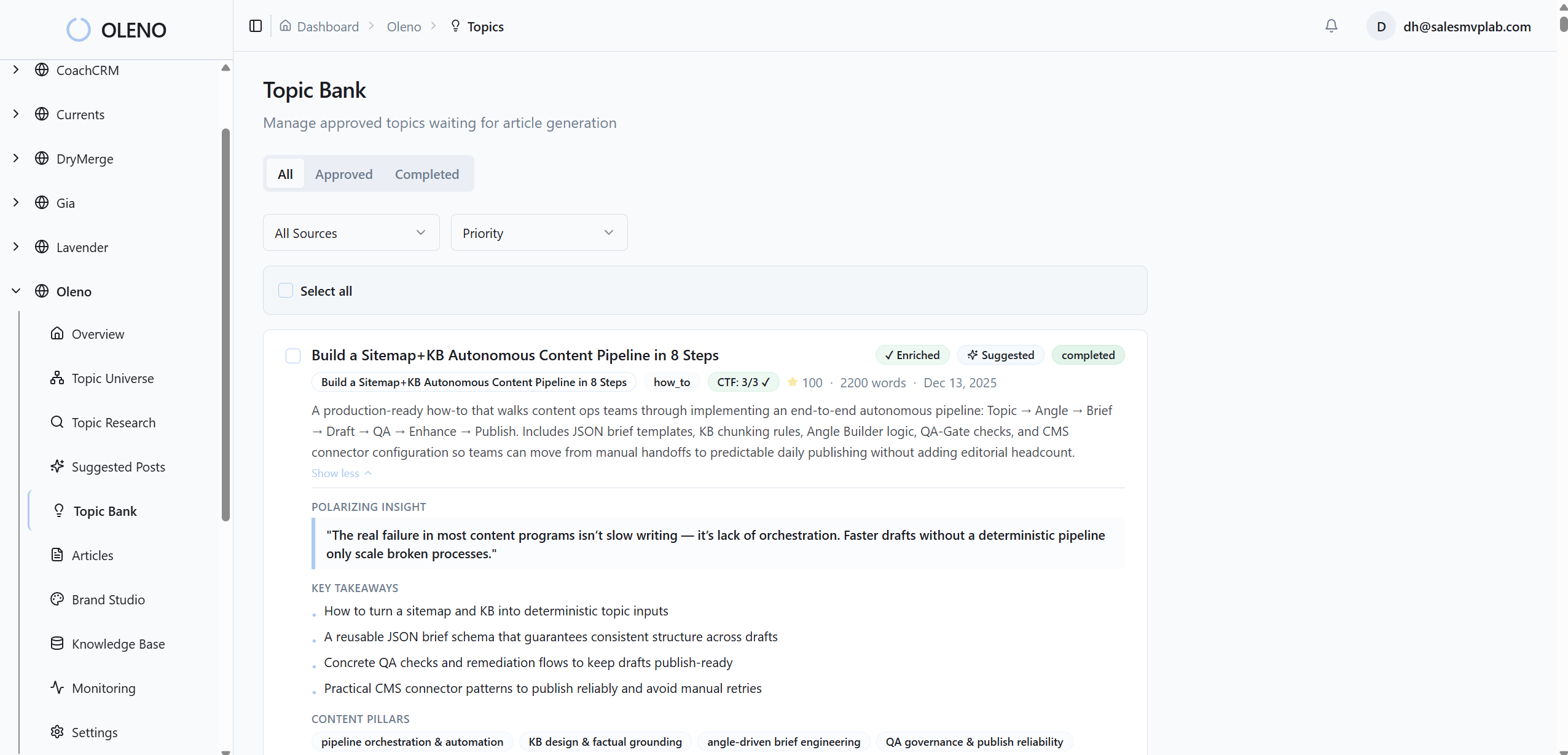
Because competitive research exists only to improve originality and depth, you’re not copying; you’re deciding what’s missing and adding it. Oleno keeps that decision visible with an Information Gain Score so teams know why a brief passes or re-enters refinement.
Deterministic internal linking and schema
Oleno injects internal links only from verified sitemaps, with anchor text matching page titles. JSON-LD for Article, FAQ, and Breadcrumb is generated and validated. This turns correctness into code. Fewer broken links, fewer missed schema fields, fewer publish blocks when it’s go time.
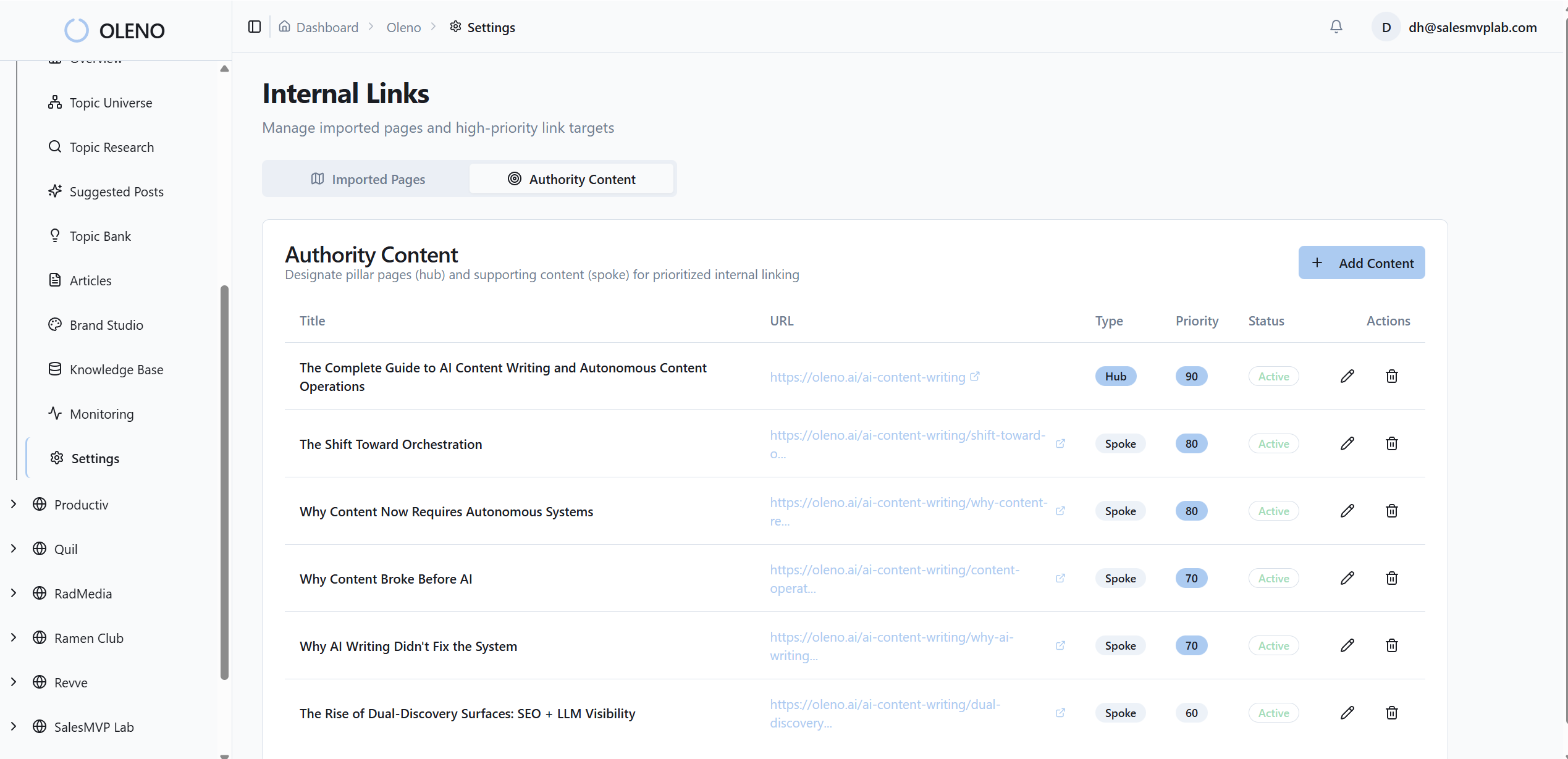
Deterministic publishing matters on busy teams. Oleno maps CMS fields automatically and prevents duplicates on retries. If a publish fails, it tries again—without creating a second post. You don’t need another dashboard; you need predictable delivery.
Brand-consistent visuals with Visual Studio
Oleno’s Visual Studio generates brand-consistent hero and inline images using your colors, style references, and tagged product screenshots. It places visuals intentionally, prioritizing solution sections and matching screenshots to relevant topics using semantic similarity.
You stop shipping great text with generic visuals. Alt text and filenames are generated automatically, so your accessibility and SEO hygiene don’t depend on someone’s memory. It’s not design theater; it’s brand consistency you can rely on.
QA gate and idempotent publishing
Every Oleno draft passes 80-plus checks for structure, voice, grounding, and snippet readiness. Failing checks trigger refinement loops automatically. Publishing maps fields to WordPress, Webflow, or HubSpot with duplicate prevention and retries. Your team reviews outcomes, not plumbing.
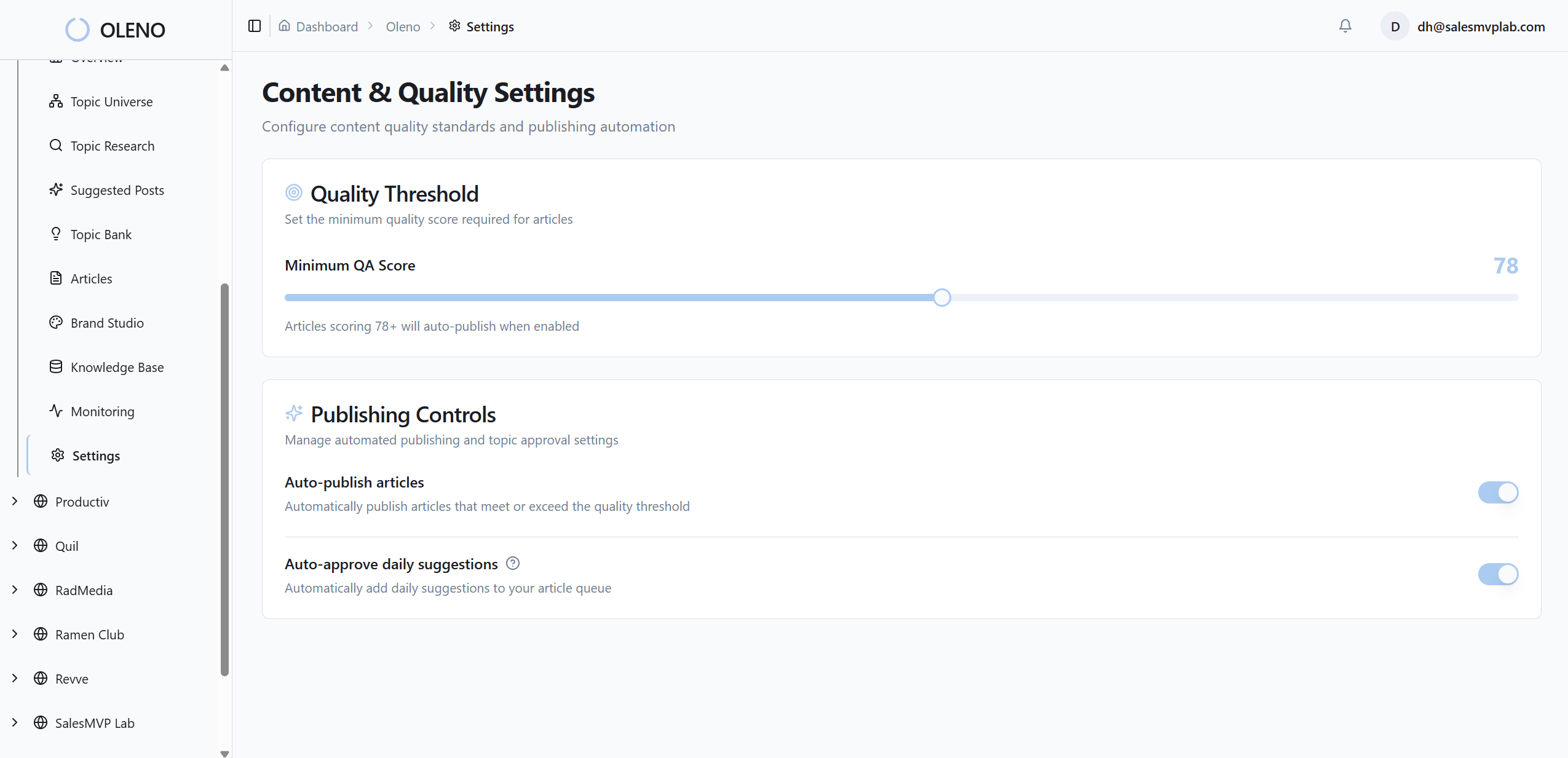
If you want to see this end-to-end without adding headcount, start small. Generate a few articles, review the QA rubric, and examine the publish artifacts. You’ll see where the time goes. Then decide if you want more. Curious? Try Generating 3 Free Test Articles Now.
Conclusion
If you want AI to actually reduce draft time, treat content like a system. Move decisions upstream with clear acceptance criteria, govern research and drafting with your KB, and automate the boring but brittle handoffs. You’ll cut cycles, lower risk, and keep control. That’s the point. You don’t need heroics. Just a reliable pipeline that learns.
About Daniel Hebert
I'm the founder of Oleno, SalesMVP Lab, and yourLumira. Been working in B2B SaaS in both sales and marketing leadership for 13+ years. I specialize in building revenue engines from the ground up. Over the years, I've codified writing frameworks, which are now powering Oleno.
Frequently Asked Questions