AI content orchestration for B2B demand generation teams

5 articles a month is usually where the DIY AI content stack starts to crack. Not because the model got worse. Because ai content orchestration is a content operations problem, and most B2B SaaS teams are still treating it like a writing problem.
The marketer opens ChatGPT, pastes the positioning again, pastes the product notes again, asks for a draft, fixes the voice, copies the article into the CMS, then turns around and does it again for LinkedIn or email. Fine for one piece. Painful by the fourth. Broken by the tenth.
Key Takeaways:
- AI writing tools can produce decent drafts, but they don't create a dependable demand generation content system.
- Consistent publishing cadence comes from workflow design, source grounding, review discipline, and distribution habits.
- Platform orchestration beats standalone AI writing when product truth, brand voice, and repurposing need to hold across many pieces.
- Human judgment should stay at the points where the outcome actually changes: research direction, brief, outline, and draft edits.
- AI engines reward clear structure, specific claims, and consistent product definitions alongside classic SEO fundamentals.
Why AI Writing Tools Break Demand Gen Content
AI writing tools break demand gen content because they treat each asset as a fresh copy task instead of part of a governed system.

The draft was never the bottleneck
A standalone AI writer can get you words. That part is solved enough. The bigger issue is all the work around the words: deciding the angle, grounding the claims, checking product messaging, shaping the structure, keeping the voice consistent, publishing the piece, and turning it into channel-specific follow-up.
We see this constantly with in-house SaaS marketers. The first few AI-assisted articles feel fast because the marketer is carrying the whole system in their head. They know the positioning. They know which product claims are safe. They know what the sales team actually says on calls. Then the team tries to scale that motion, and the hidden work shows up. Faster drafts just expose the operational mess sooner.
The diagnostic is pretty simple. If every article requires you to re-explain your product, paste the same voice notes, rewrite the intro from scratch, and manually adapt the piece for another channel, you don't have an AI writing problem. You have a content operations problem. Better prompts won't fix that. They just make the same fragile process run a little faster.
One-off prompting loses product truth
Product truth decays fast in SaaS. A feature ships, pricing changes, a use case gets retired, a competitor claim gets risky, or the homepage moves to a new message. If the AI tool is working from whatever someone pasted into a chat window three weeks ago, the draft can sound confident and still be wrong.
Picture a content manager on Tuesday afternoon. Product marketing updated the positioning last Friday, sales is already using the new story, and the blog draft still says the old thing because nobody remembered to update the prompt doc. The draft looks fine at a glance. Then a PM catches it in review and the piece goes back into another round. Everyone loses time, and the marketer loses trust in the workflow.
A better test: ask where product truth lives. If the answer is "in a Google Doc, in a Slack thread, and in someone's head," the writing tool is not the system of record. It can't be. Source grounding needs update discipline, not vibes. If a claim matters enough to publish, it needs to come from a place the team can update when the product changes.
If you want to pressure-test whether your content workflow needs an orchestration layer, request a demo and bring the messiest article process you have.
Cadence is an operating model
Consistent publishing cadence is an operational outcome, not a writing trick. You don't get it by asking a model to write faster. You get it by designing a repeatable flow where each person knows which decision they own and which work the system should carry.
The trap is assuming cadence means volume. Fair concern. Plenty of teams have been burned by content calendars that turned into a quota machine. Cadence only matters if quality holds. The point isn't to publish more because the calendar says so. The point is to stop rebuilding the same content process from scratch every week.
Use this rule. If your team publishes fewer than 4 long-form pieces a month, a simple AI-assisted workflow can probably work. If you're trying to publish 8 or more pieces a month across blog, social, email, and sales enablement, you need content orchestration. Not because you're bigger. Because every handoff, review, source update, and repurposing step starts compounding.
How Content Orchestration Turns Content Into an Operating System
Content orchestration turns content into an operating system by making judgment, source grounding, cadence, and distribution part of the workflow.
Diagnose the workflow before buying another writer
Start by mapping the last 5 pieces your team shipped. Not the ideal workflow. The real one. Who picked the topic? Where did research come from? Who approved the brief? Where did product truth get checked? Who copied it into the CMS? Who turned it into LinkedIn, email, or sales copy?
You want the uncomfortable version. We prefer doing this as a forensic pass because the pattern shows up fast. The bottleneck usually isn't "we need better writing." It is usually one of three things: nobody owns the brief, product claims get checked too late, or repurposing happens after everyone is tired of the asset.
Ask these questions before you evaluate any ai content orchestration platform or AI writer:
- Where does source material enter the workflow?
- Which decisions require a marketer's judgment?
- Which steps are repeatable production work?
- Where does brand voice drift?
- Which channel adaptations happen late or not at all?
If you can't answer those 5 questions, the tool comparison will be noisy. You'll end up comparing outputs instead of comparing operating models.
Keep human judgment where it changes the piece
The judgment points are fewer than people think. In our view, the marketer needs to shape the research direction, approve the brief, approve the outline, and edit the draft. Those are the moments where a smart human changes the outcome. Everything else is production work around those decisions.
Some teams hear that and worry it adds friction. That's valid. If you only need a one-off draft for a low-stakes page, pausing at multiple points feels heavy. Use a writing assistant. You'll be fine. The orchestration argument only holds when the byline matters, product accuracy matters, and the piece is part of a steady demand gen motion.
The rule I like: keep humans on decisions, move machines onto assembly. A marketer should decide whether the article should argue against standalone AI writing tools or against workflow-builder complexity. The marketer should not spend 20 minutes reformatting a blog section into a LinkedIn post or copying metadata into a CMS. That split is where content orchestration starts to pay off.
Ground every asset in current source material
Source grounding means every draft starts from approved product facts, positioning, voice, customer proof, and research sources before writing begins. It sounds obvious. It is rarely how AI content gets produced. Most teams still treat grounding as a prompt-writing chore.
The mechanism is boring, which is why it works. Create one place for product truth. Create one place for positioning. Create one place for voice examples. Create one place for customer stories and sales insights. Then require every brief and draft to pull from those sources, not from memory or whatever was pasted last time.
Set a maintenance rule. Product truth gets reviewed whenever a release changes a claim, a pricing page changes, a feature is renamed, or sales stops using a message. If that sounds too strict, remember the alternative: every writer and every AI session now carries a different version of reality. That's where pipeline content starts contradicting product marketing.
Turn cadence into a visible queue
Cadence gets easier when the work is visible. A content calendar alone is not enough because it only shows due dates. You need to see which pieces are waiting on research, which are stuck in brief approval, which are ready for draft edits, and which are blocked by product review.
We learned this the hard way running content-heavy programs. The calendar would say the piece was "due Thursday," but the real issue was that nobody had approved the angle on Monday. By Thursday, the writer was rushing, the editor was guessing, and the final draft had to carry decisions that should have been made earlier. Bad system. Predictable outcome.
Use a simple threshold. If more than 25% of your in-flight pieces are waiting on the same person, you don't have a writing capacity problem yet. You have a review ownership problem. Fix that before hiring another writer or adding another AI tool.
For teams that want to see how a governed content queue works in practice, request a demo and ask to walk through research, brief, outline, and draft flow.
Repurpose from the source asset without flattening it
Content repurposing fails when teams treat every channel as a summary channel. The blog becomes a LinkedIn recap. The LinkedIn post becomes an email intro. The email becomes a shorter blog teaser. Same idea, less texture each time.
A better approach is to repurpose from the argument, not the article. Pull out the polarizing take for LinkedIn. Pull out the diagnostic checklist for email. Pull out the comparison table for sales enablement. Pull out the direct-answer section for AI search discovery. Same source asset. Different job.
Here is the practical rule. Before adapting a long-form asset, assign each channel one role:
- Blog: earns search and AI engine visibility with depth, structure, and specific claims.
- LinkedIn: tests the sharpest opinion in public.
- Email: moves an already-warm audience toward a decision.
- Sales enablement: gives reps language for objections and internal buying committees.
If every channel says the same thing in a smaller box, the message gets flatter. Good content orchestration preserves the point of view while changing the format.
Write for search and AI engines at the same time
Classic SEO and AI engine visibility now overlap, but they are not the same job. SEO still cares about crawlability, intent match, internal links, and helpful content. AI engines care about extractable answers, clear definitions, specific claims, and consistency across your content library.
Google's own guidance on creating helpful, reliable content still matters. So does the newer reality that AI surfaces pull passages into answers, often without the reader visiting every source. Google's documentation on AI features and your website makes the same point in a more technical way: structured, accessible content is easier for systems to understand.
The content choice changes when you write for both. You stop writing articles that only chase a keyword. You write pages that define your category, answer buyer questions directly, show product specificity, and repeat your core market language consistently. AI content orchestration matters here because one-off prompts won't maintain those definitions across 100 pieces.
How Oleno Keeps Content Grounded
Oleno keeps content grounded by storing the team's strategy once and pulling it into every research run, brief, outline, draft, edit, and publish step.
Strategy memory replaces the Monday re-prompt
Oleno is built for the marketer who doesn't want another blank writing surface. Brand & Voice Memory stores how the team sounds. Positioning & Messaging Control stores what the team believes, who it sells to, and which messages matter. Product Truth Library stores the product facts the system is allowed to use.
The practical difference is simple. Instead of re-prompting ChatGPT every Monday with the same voice, ICP, product truth, and market POV, the marketer loads that material once and then shapes each piece at the moments that matter. Research direction. Brief. Outline. Draft edits. The AI does the production work between those points, but the marketer stays in the editor's seat.
Oleno's Research step also shows sources before writing begins. The marketer can drop sources, add their own URLs or documents, or rewrite the angle before the brief is generated. That matters because hidden research is where a lot of AI content goes wrong. If the source layer is wrong, the draft is just wrong with better grammar.
Quality control is built into the flow
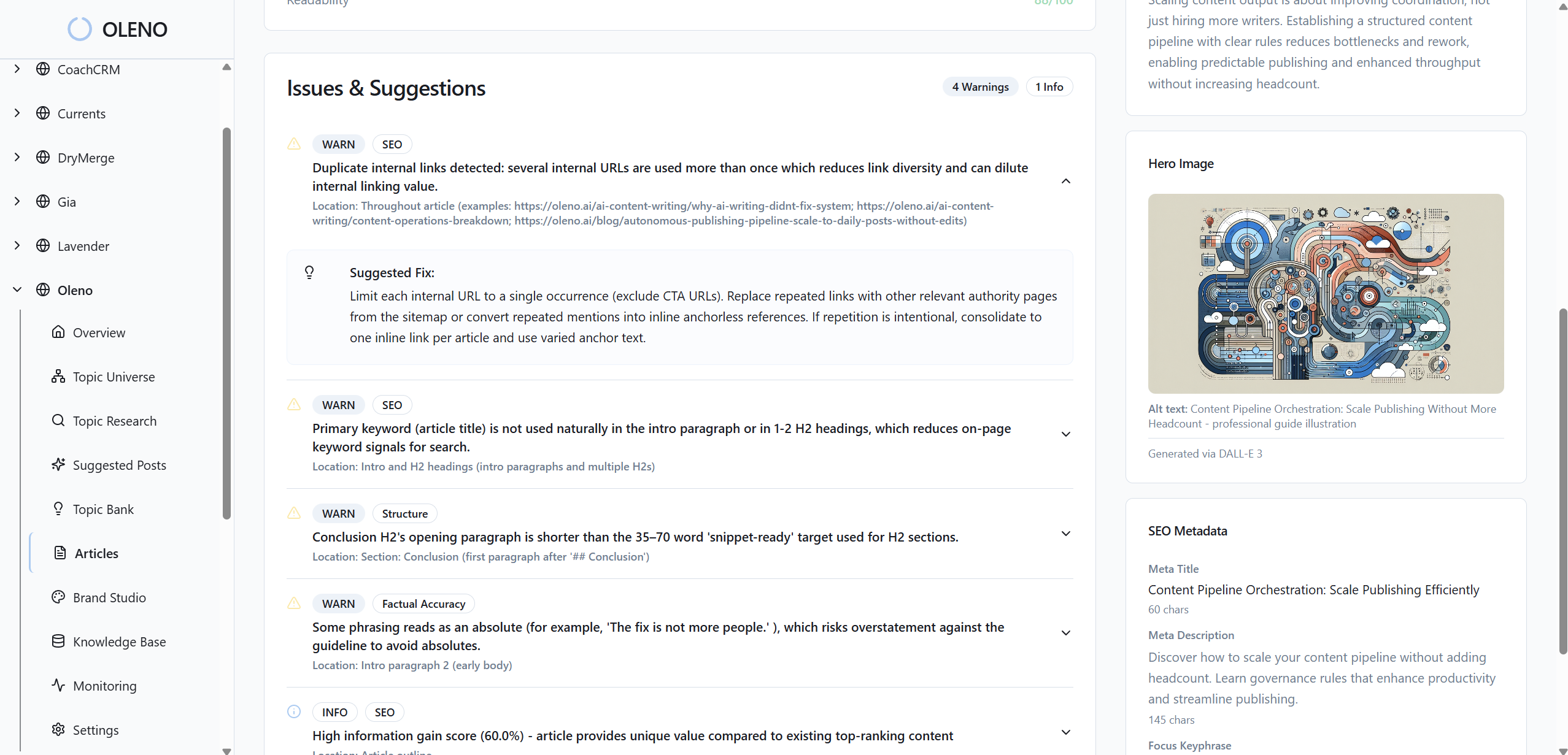
Oleno's Quality Gate scores drafts for factual grounding, voice match, structure, link health, and SEO density before the marketer reviews the piece. It doesn't replace editing. It catches obvious drift before the editor wastes attention on problems the system can flag.
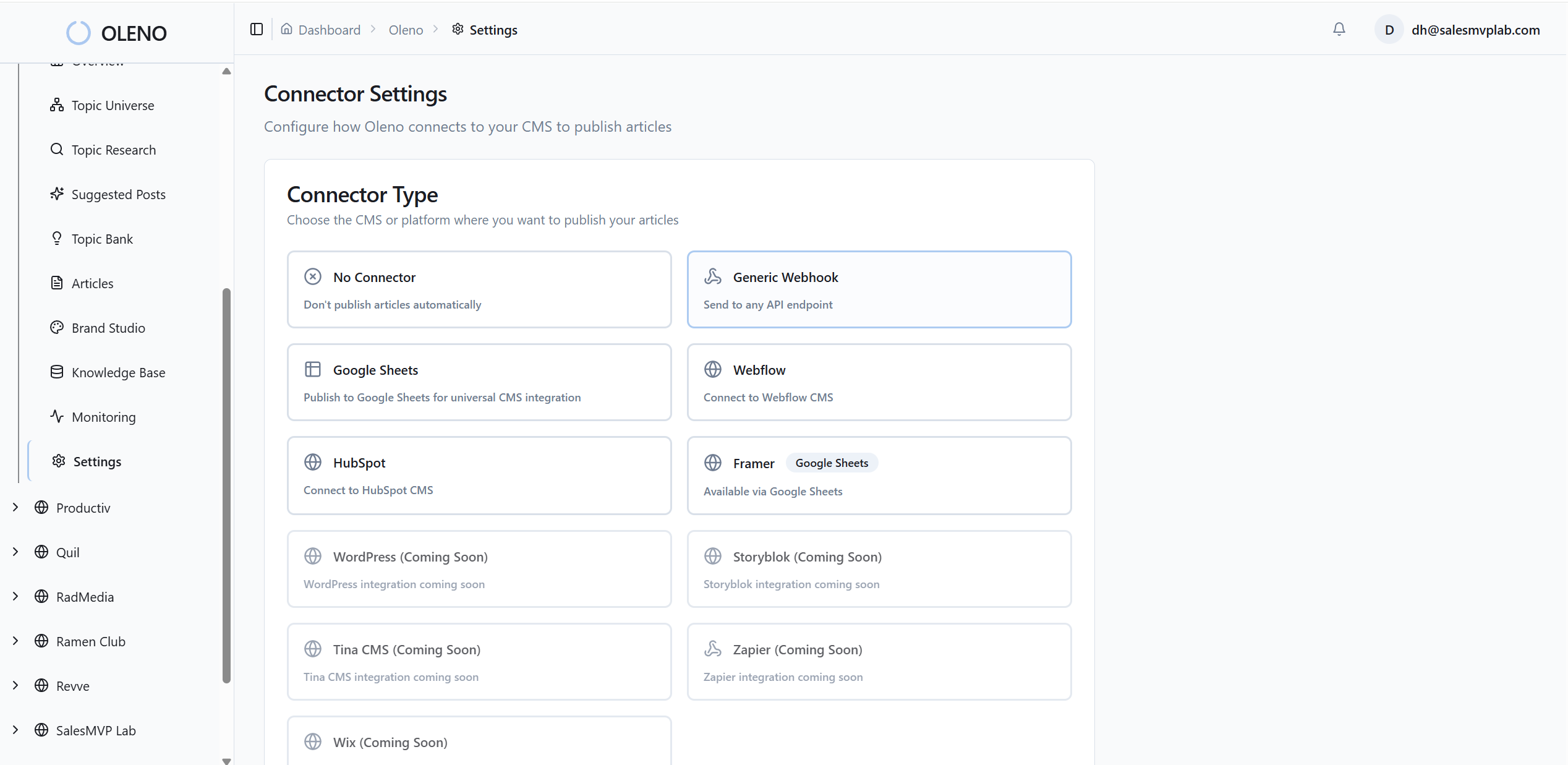
The product also supports the workflow after draft. Edit works on selected text and reloads the same governance context, so a rewrite doesn't drift away from the approved voice or product truth. Publish pushes approved content into supported destinations like WordPress, Webflow, Storyblok, HubSpot, Tina, Wix, Framer, Google Sheets, Webhook, and Zapier. No claim here should be surprising. The point is not magic. The point is removing the manual glue that makes cadence fall apart.
Oleno is not for every team. If you want a one-shot writing assistant, use one. If your positioning isn't settled yet, fix that first. If you care about sustained demand generation content across search, AI engines, social, and sales follow-up, the orchestration layer is the difference between a promising draft and a system you can run every week.
If your current AI stack is producing drafts but not a dependable content operation, book a demo and we'll show you where orchestration changes the work.
Build the System Before You Scale Output
AI content orchestration is the right move when the cost of content is no longer writing, but keeping judgment, product truth, brand voice, cadence, and distribution aligned.
The decision is pretty clear. If you need occasional copy, a standalone AI writer is enough. If you need steady demand generation output that holds up across blog, email, social, sales enablement, classic search, and AI search discovery, build the operating model first.
Better prompts can improve a draft. A better system improves the content engine.
About Daniel Hebert
I'm the founder of Oleno, SalesMVP Lab, and yourLumira. Been working in B2B SaaS in both sales and marketing leadership for 13+ years. I specialize in building revenue engines from the ground up. Over the years, I've codified writing frameworks, which are now powering Oleno.
Frequently Asked Questions