Audit Framework: Map Topic Saturation to Find Content Gaps

Most content audits still worship a keyword spreadsheet. You get volumes, difficulty scores, and a false sense of progress. Then six weeks later, your team ships “new” posts that step on old ones and cannibalize the winners. I’ve been on both sides of that mess — running content and receiving leads from it — and the pattern repeats.
At Proposify, we ranked for lots of terms. The issue? Much of it didn’t ladder back to the product story, so authority never compounded into demand. Earlier at PostBeyond, I could write fast using a framework, but as the team grew, context got diluted and quality dipped. At LevelJump, we were three people. Zero bandwidth to write. The answer wasn’t “more.” It was making coverage visible and governed, so each draft had a reason to exist.
One more lens. Back when I ran Steamfeed, we hit 120k monthly uniques with volume and variety — but it worked because breadth and depth moved together. Topic coverage created momentum. That’s the point here. You don’t need thousands of writers. You need a saturation map that shows what to write next and what to retire.
Key Takeaways:
- Replace keyword lists with a topic saturation map to avoid repeats
- Score clusters on coverage, recency, and overlap to label health
- Normalize intent across pages so clusters progress buyers coherently
- Quantify rework and cannibalization to make the cost of drift visible
- Use cooldown rules and deterministic linking to prevent over-coverage
- Turn audit findings into a 90-day plan grounded in information gain
Why Keyword-Heavy Audits Keep Teams Stuck In Redundancy
Keyword-heavy audits keep teams stuck because they optimize for terms, not coverage. A saturation map shows cluster health — underserved, healthy, well-covered, saturated — so you stop repeating yourself. It’s practical: fewer duplicates, cleaner internal links, and a clear next-best topic. Example: one canonical “what is” page, not five.

What Is A Topic Saturation Map And Why It Beats Keyword Lists?
A topic saturation map converts your sitemap and knowledge base into clusters, then labels each cluster by coverage state. Instead of staring at 500 isolated keywords, you see how the topic actually lives on your site. It’s a sanity check in one view: where you’re thin, where you’re overweight, and where you’re colliding.
The real win is decision quality. With a map, every draft has a reason to exist. Something is missing, something is out-of-date, or something is duplicative. That’s it. In practice, you go from “should we chase this keyword?” to “does the cluster need a new informational explainer, a commercial comparison, or a refresh on the canonical?” Cleaner, faster, less rework.
The Metrics That Actually Matter For Authority
Authority compounds when clusters stay coherent. Measure three things per cluster: coverage count (how many pages by intent), recency (days since publish or update), and overlap signals (title similarity or repeating H2s). Add a basic cannibalization check by comparing intent labels and URL patterns. You’re building a coverage score, not a rank report.
Simple thresholds make it actionable. Underserved might be one page and 365+ days since publish. Healthy might be three pages with distinct intents and a recent update. Well-covered might be five pages with no overlap. Saturated flags duplicates or near-duplicates. Keep the math explainable to stakeholders, or it won’t be used.
Where Conventional Audits Go Wrong
Most audits index keywords and traffic metrics, then stop. They rarely map intent or cluster health, so teams chase volume while repeating ideas. I saw this firsthand at Proposify — strong rankings, lots of attention, but content too far from the product journey to move pipeline. Authority didn’t stack; it scattered.
A saturation map prevents that by forcing alignment to topic health and buyer progress. If your “what is” plus “how-to” don’t ladder to a commercial explainer and a product page, your cluster leaks energy. If you’ve got five “best practices” posts saying the same thing, you’re burning resources. This is structure, not guessing. For a solid inventory view to kickstart the process, see this audit walkthrough.
Ready to skip the theory and see what this feels like in practice? Try a quick run. Try Generating 3 Free Test Articles Now.
See The Real Root Cause Behind Missed Authority
Missed authority isn’t a writing problem; it’s a cluster problem. Trust is built when pages within a topic work together across intent. Normalize labels, audit progression, and stop copying SERPs. Example: make informational pages ladder to navigational and product stories, not float alone.

Intent Clusters, Not Single Posts, Earn Trust
Search engines and humans both evaluate coverage depth at the topic level. Label every page by intent, then roll up by cluster. The pattern you want: informational → navigational → commercial → transactional. That sequence signals “we’re the authority here” without forcing every page to convert.
When clusters lack progression, you get scattered wins and no compounding signal. A great explainer post can rank, sure, but it won’t help sales if there’s no commercial next step. Your audit should validate the journey: are we teaching, then guiding, then proving? If not, the plan writes itself.
How Do You Normalize Intent Across Your Site?
Standardize labels to four buckets: informational, navigational, commercial, transactional. Make simple rules to reduce debate. If a page answers a “what is” or “how to,” it’s informational. If it organizes access to deeper pages, it’s navigational. If it compares options or highlights features, it’s commercial. If it’s pricing or signup, transactional.
Normalize with consistency checks. Run pattern searches on H1s for “what is,” “vs,” “best,” “pricing,” and apply defaults. Then review outliers. The point isn’t perfection; it’s shared language so saturation labels and priorities are meaningful. This is how you make decisions quickly and defend them later.
What Traditional Gap Analysis Misses In SERPs
SERP scans show common subtopics and structures, which is useful. The trap is copying. Use competitor coverage to spot what’s missing, but move beyond bullet mirroring. Mark what they cover, what you cover, and what’s shallow — then translate into information gain opportunities.
Your job is to add something new: a better framework, a clearer visual, a proof point others skipped. That’s how you avoid over-coverage while still competing effectively. For a pragmatic way to frame this work, this “gaps to wins” approach pairs well with cluster mapping: content audit strategy: gaps to wins.
The Hidden Costs Of Over-Coverage And Blind Spots
Over-coverage wastes hours, splits signals, and confuses users. Blind spots slow pipeline because navigational and commercial bridges don’t exist. The costs are real: rework time, slower internal decisions, fractured UX. Imagine three “ultimate guides” tripping over each other. Nobody wins.
Engineering Hours Lost To Rework And Cannibalization
Let’s pretend you ship four similar posts in a quarter. Writers spend 30 hours per piece. Editors spend 4 hours each untangling overlapping H2s and links. That’s 136 hours on content that confuses search and readers. Odds are you’ll rewrite two of them later and merge the rest.
Those hours don’t show up on a dashboard, but you feel them in every backlog. Multiply by a year and a small team just burned three weeks of productive time. A saturation map and cooldown rules cut that dramatically. Want a template to quantify it? This audit framework template provides a baseline structure you can adapt.
The Cascade On Pipeline And UX
Overlapping content splits link equity and dilutes internal links. Sales can’t find a canonical page, so they send an outdated post. Prospects bounce between near-duplicates and exit. The net effect is slower paths to product pages and fewer qualified demos. Not every page needs to convert. Every page should help conversion.
When clusters are coherent, handoffs work. Informational content educates, navigational content organizes, commercial content persuades, transactional pages close. Your internal links then become guidance, not noise. That’s what compounding authority looks like operationally.
Why Governance Debt Compounds Over Time
Publish long enough without coverage rules and the fixes pile up. Broken cannibalization, inconsistent schema, missing product visuals, and ad-hoc links will slow everything. It becomes governance debt. You pay it in slow editorial cycles and post-publish cleanup.
Treat it like tech debt. Pay a small cost now — standard intent labels, simple thresholds, a 90-day cooldown, deterministic internal linking — to avoid big rewrites later. If you need a governance lens to take to leadership, adapt principles from this internal auditing competency framework.
When Publishing More Starts To Hurt More
Publishing more can drag performance when you split intent across multiple URLs. Five posts on the same idea don’t beat one canonical page with real information gain. This is the moment to stop, map saturation, and consolidate. Example: retire near-duplicates, refresh the winner.
The Week You Publish Five Posts And Traffic Dips
You ship a burst. Traffic stalls or dips. Why? Because the five posts are variations of an idea you already cover well. You split the signal and none of them win. I’ve watched this play out across teams with aggressive calendars. It feels productive. It isn’t.
The fix is upstream. Label the cluster as saturated, consolidate overlapping posts, and plan one high-gain update instead of five thin spins. Then measure sanity metrics: fewer URLs ranking for the same query, stronger internal link paths to product pages, faster page selection by sales. That’s progress.
Remember The 3 A.M. Incident You Had To Fix?
We’ve all been there. A late-night publish goes live with broken schema and off-brand visuals. It ships anyway. The fix eats hours and trust. The real fix is earlier in the pipeline: enforce which clusters are in cooldown, inject schema automatically, and place internal links deterministically.
When those rules live in the system, incidents decline. You won’t eliminate surprises, but you’ll reduce the frequency and the blast radius. That’s worth a quiet inbox and fewer “urgent” pings overnight.
Who Inside Your Org Pays The Price?
Writers pick up frustrating rework. Editors become traffic cops. Sales loses trust in content and hoards their own docs. Leaders start to question the entire program. None of this is about talent. It’s about lack of structure and visibility.
You change that by making saturation labels and cooldowns visible to everyone. Clear rules, clear priorities, fewer surprises. If you need a change-management angle to socialize this shift, this framing helps: content audit: gaps to wins. And if standardized metrics resonate with your execs, point to disciplines that codify disclosures, like this reporting framework update.
Still dealing with duplicates and midnight fixes? It doesn’t have to stay that way. Try Using An Autonomous Content Engine For Always-On Publishing.
A Practical Framework To Map Saturation And Find Gaps
A practical saturation audit moves from inventory to intent to scoring to SERP-level information gain. Keep rules simple, consistent, and explainable to stakeholders. Example: one table to track fields, four intent labels, three signals for saturation, and a short list of high-gain opportunities.
Inventory And Crawl Your Sitemap And KB For A Canonical Topic List
Start with a single source of truth. Export your sitemap, list all knowledge base docs, and normalize titles and slugs. De-duplicate by canonical topic, not URL. Keep a fields table: topic, url, intent, last_publish, last_update, product_area. Include product docs; they anchor commercial and transactional angles.
Two notes. First, resist the urge to over-model. You need a clean list, not a data warehouse. Second, mark pages you’ll consider “retire or merge” candidates upfront. Those often become quick wins as you uncover overlap during clustering. For an inventory primer that complements this, see this step-by-step content audit process.
Cluster Topics And Standardize Intent Labels
Group pages by parent topic and define the four intents: informational, navigational, commercial, transactional. Write two or three labeling rules per intent. Then tag pages programmatically where possible using title/H1 patterns and basic heuristics. Manual review should focus on edge cases, not the entire set.
You’re aiming for consistent roll-ups. This also sets you up for guardrails like one primary commercial page per cluster and 90-day cooldown windows. When everyone speaks the same intent language, prioritization becomes a conversation about customer progress, not keyword density.
Score Saturation With Coverage, Recency, And Overlap
Compute a simple coverage score per cluster: page_count_weighted + recency_bonus + overlap_penalty. Mark thresholds for underserved, healthy, well-covered, and saturated. Recency can be days since last publish or update. Overlap is a basic similarity score between H1s or repeating H2s — start with cosine similarity on titles if you have it.
Keep the math simple. You’re not building a ranking model. You’re building an explainable decision tool for stakeholders. If they understand why a cluster is labeled saturated, they’ll accept consolidation and cooldowns. That alignment is the real efficiency gain.
Run SERP-Level Information Gap Analysis
For priority clusters, scan top-ranking pages. List recurring subtopics, questions, and media types: tables, checklists, diagrams. Compare those lists to your cluster pages. Mark missing and shallow items. Translate into information gain opportunities, not copy-paste bullets.
Two outputs matter: a short “what’s missing” list and a “what to consolidate” list. The first drives briefs for new or refreshed content. The second trims noise. If you like templates for this step, this audit framework is a useful starting point you can adapt to cluster scoring.
How Oleno Turns Coverage Mapping Into A 90-Day Plan
Oleno turns coverage mapping into a daily-running system. Topic Universe maps clusters and saturation, briefs quantify information gain, cooldowns and deterministic links enforce governance, and QA/schema/visuals/publishing ensure what ships is complete. Example: the plan doesn’t live in a doc; it publishes.
Topic Universe Maps Clusters And Saturation Automatically
Oleno ingests your knowledge base and sitemap, then groups topics into clusters with saturation labels: underserved, healthy, well-covered, saturated. It enforces a 90-day cooldown before re-coverage, so you avoid repeating yourself. Those rules mean fewer duplicates and cleaner architecture without weekly spreadsheet edits.
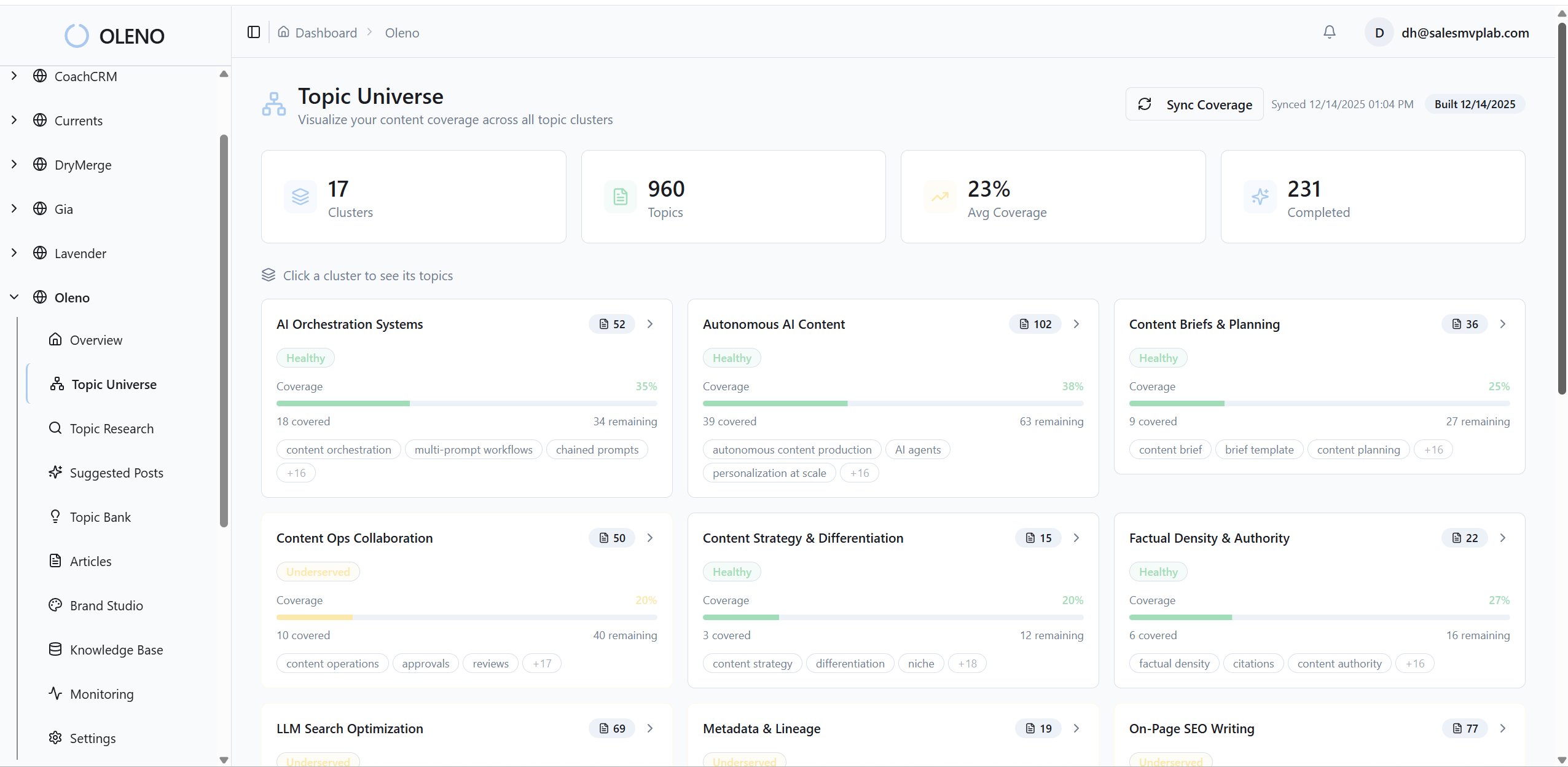
Because Topic Universe runs continuously, your next-best topics surface automatically as coverage changes. You approve, and work moves forward without manual coordination. Less guessing, more compounding.
Information Gain Briefs Expose Missing Angles
Brief Generation analyzes top-ranking coverage, identifies common sections, and flags missing or shallow areas. Each brief receives an Information Gain Score so derivative outlines get fixed before words are written. If the score is low, you adjust the angle early, not after a draft lands in review.
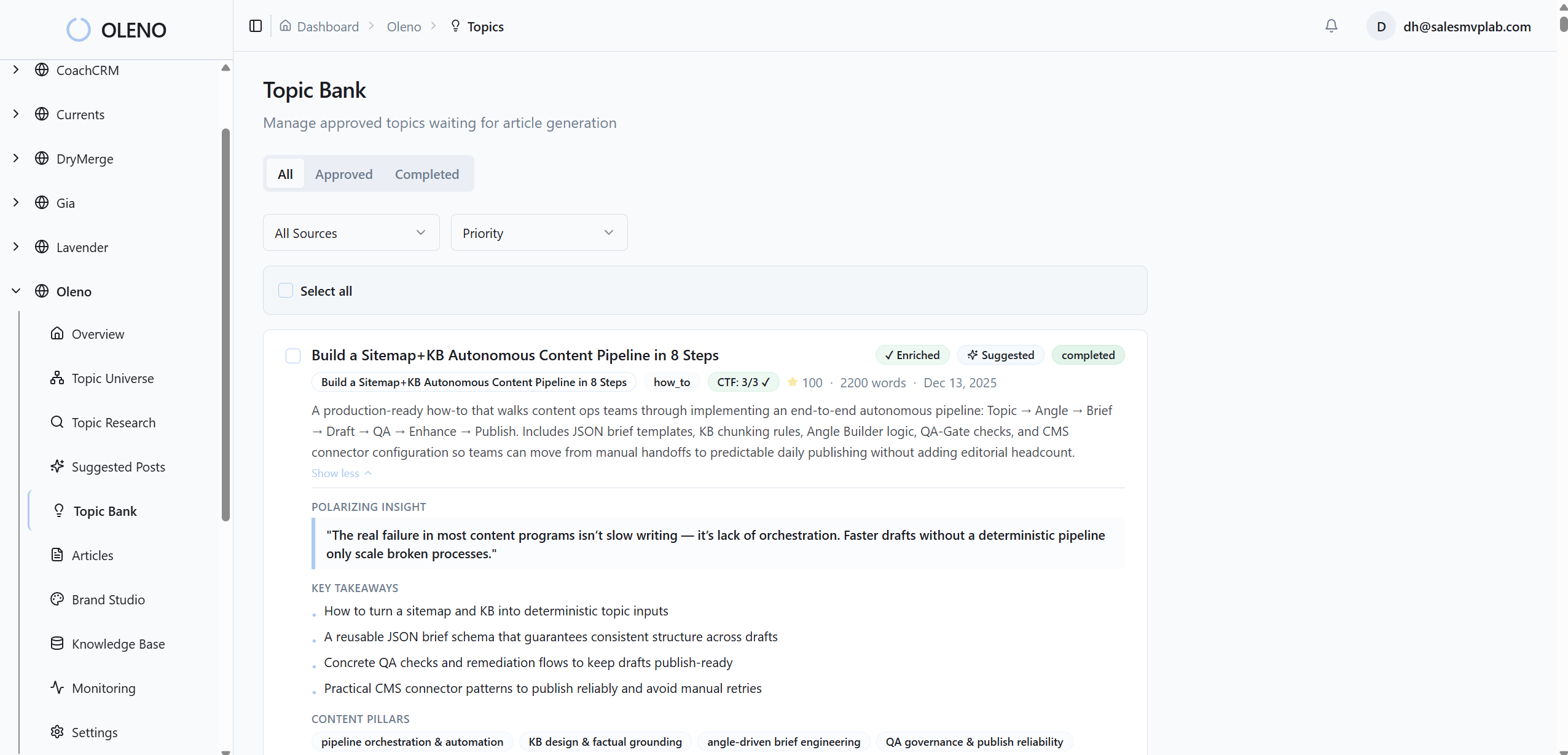
This step ensures every new article adds something the cluster is missing — not another “ultimate guide” that sounds like the rest. Over time, that discipline builds authority that sticks.
Cooldown Governance And Cannibalization Guardrails
Oleno enforces cooldown rules at the cluster and topic level. Internal links are injected only from verified URLs with exact-match anchor text. Those deterministic rules reduce cannibalization, eliminate fabricated links, and keep site architecture coherent. You write once, then let code handle structure cleanly.
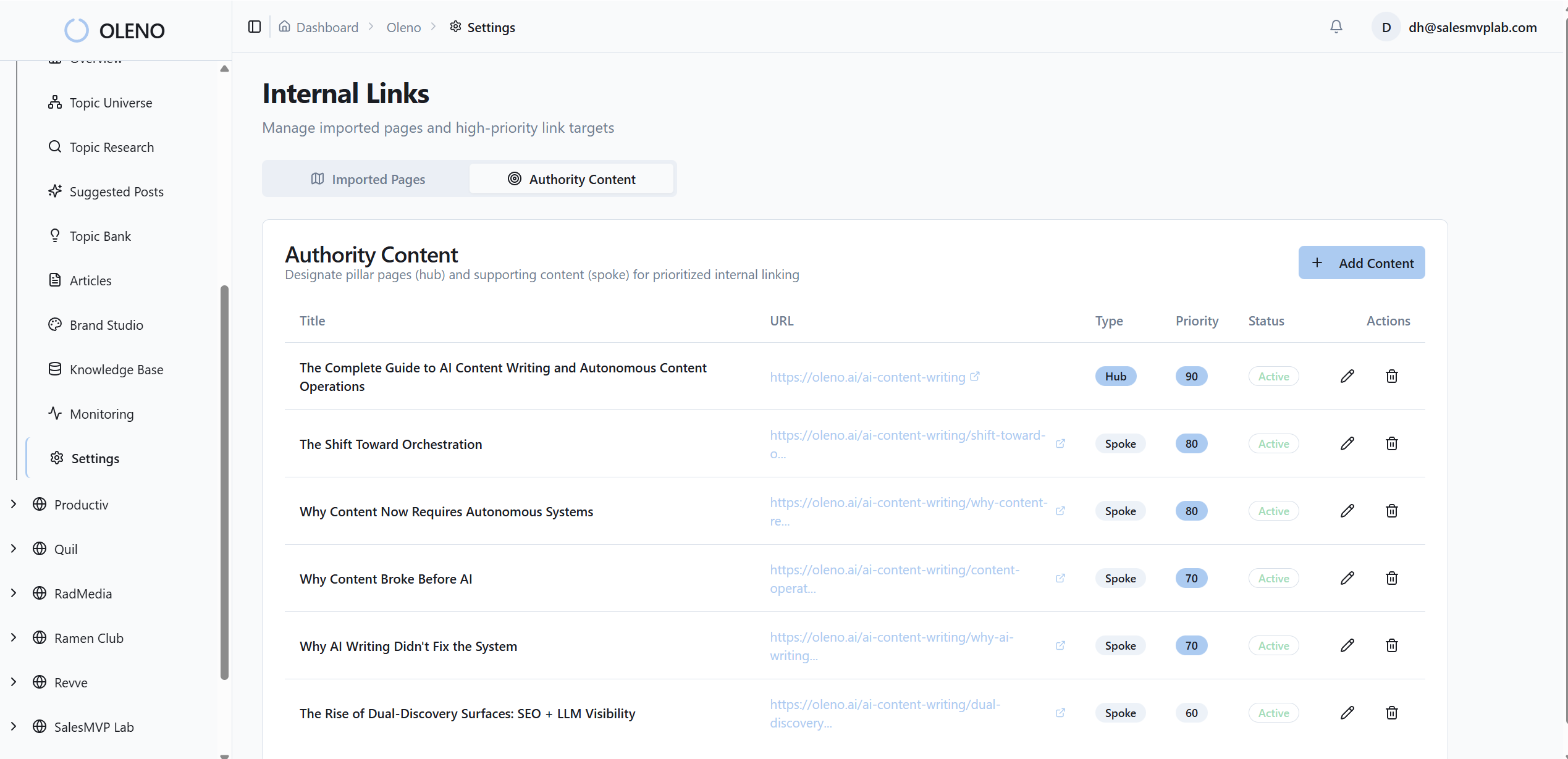
This is where rework costs drop. No more manual link hunts, fewer near-duplicate drafts, and a clear canonical for sales to share. The debt we calculated earlier? This is how you stop accruing it.
QA, Visuals, And Publishing Tie The Plan To Execution
Oleno’s QA checks 80+ criteria across structure, voice, and snippet readiness. Visual Studio generates brand-consistent hero and inline images and matches product screenshots to relevant sections. Schema is generated automatically. Publishing connectors deliver clean HTML into your CMS without duplicate posts.
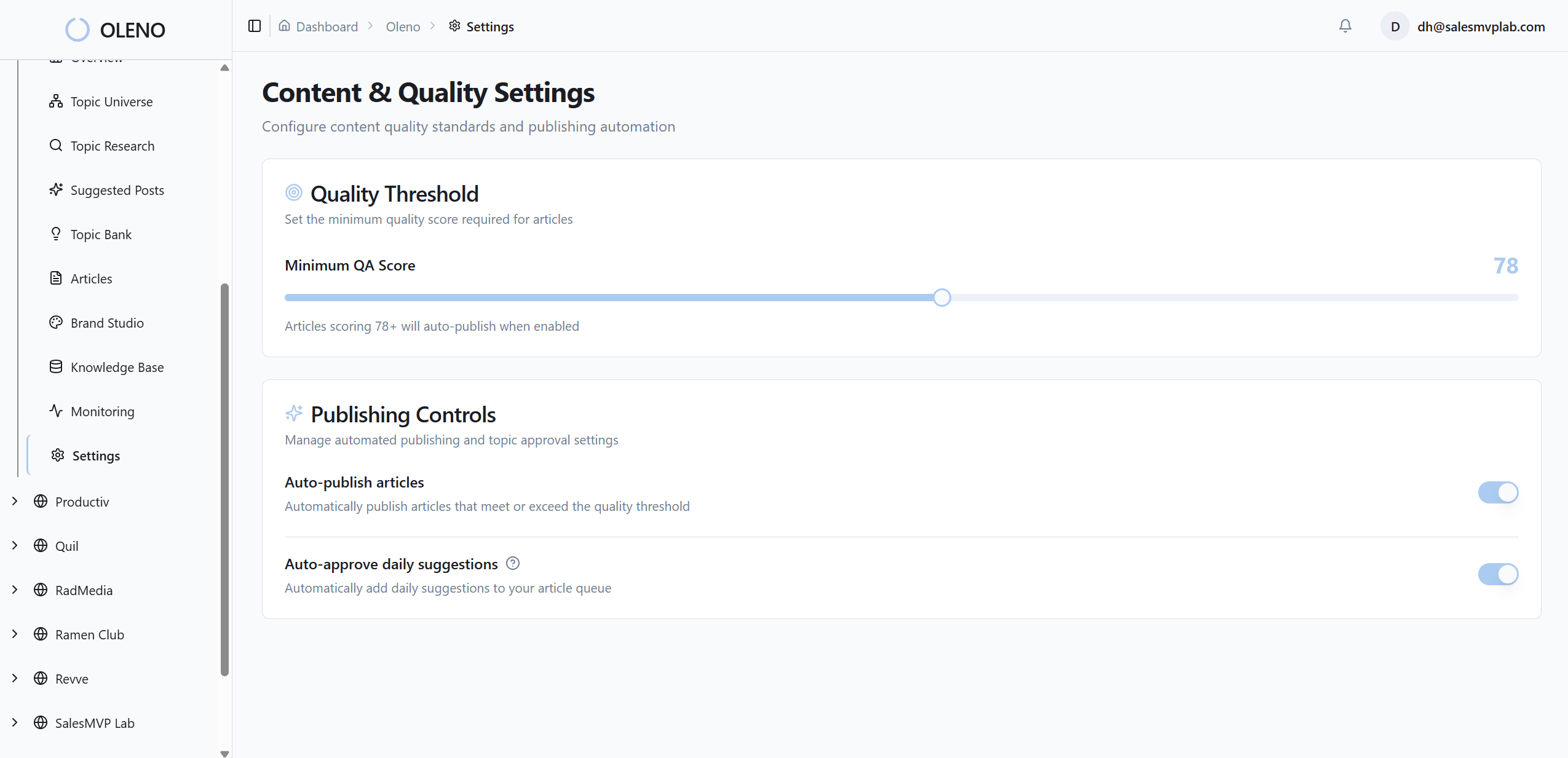
Here’s the practical difference. With Oleno, strategy, differentiation, visuals, and shipping are one system. Topic Universe, Information Gain Scoring, deterministic internal linking, schema generation, and automated QA work together so the 90-day plan ships itself. If you’re ready to operationalize this, Try Oleno For Free.
Conclusion
You don’t need another keyword list. You need a visible, governed map of coverage that tells you what to write, what to refresh, and what to retire. Build clusters around intent, score saturation with simple signals, and let cooldowns and deterministic links keep you honest. Then let a system run it daily. Less redundancy. More authority. Faster path to trust.
About Daniel Hebert
I'm the founder of Oleno, SalesMVP Lab, and yourLumira. Been working in B2B SaaS in both sales and marketing leadership for 13+ years. I specialize in building revenue engines from the ground up. Over the years, I've codified writing frameworks, which are now powering Oleno.
Frequently Asked Questions