Automated Content QA: Build an 80‑Criteria Pre‑Publish Pipeline

I don’t worry about commas anymore. I worry about whether the article ships correctly on the first try. When you’ve lived through enough 3pm scramble publishes and Monday-morning rollbacks, you get allergic to “we’ll catch it in editing.” You won’t. Not consistently. Not at scale.
Here’s the shift. You move quality out of opinions and into rules. Codify what’s non-negotiable—section hierarchy, snippet-ready openers, JSON-LD, alt text, verified internal links, brand visuals—and let code enforce it. Humans focus on narrative and nuance. Machines guard the structure. That’s how you stop paying the rework tax.
Key Takeaways:
- Turn subjective edits into deterministic checks—then run them on every draft
- Group your 80 checks across structure, voice, KB grounding, visuals, links, and schema
- Use JSON schema validation and sitemap resolution to kill silent failures
- Set a pass threshold (85+), log failures, remediate automatically, and retry
- Keep humans for narrative calls; let code enforce correctness
- Publish through mapped CMS connectors with duplicated prevention, not copy-paste rituals
Why Teams Keep Shipping Avoidable Errors
Most teams ship avoidable errors because quality is treated as taste, not a gate. A deterministic pre-publish pipeline removes guesswork by automating checks across structure, visuals, links, and schema. When rules are code, there’s no “I thought someone checked that.” It either passes, or it doesn’t.

The hidden variability that kills consistency
Quality falls apart in the gaps between “looks good” and “is correct.” One editor loves long intros, another hates them. One person remembers alt text, another doesn’t. That’s variability. And variability is expensive. If you’ve ever debated heading depth in Slack, you already know this.
So you codify the non-negotiables. H2 openers follow a 3-sentence snippet pattern. Paragraph sizes sit in a range. JSON-LD exists and validates. Internal links resolve against a verified sitemap. Alt text meets length rules. This isn’t stifling creativity; it frees it. The story gets attention because the system handles structure.
When we did this, arguments dropped to zero. No more “should we include FAQ schema?” It’s in the gate. Pass or fail. The pipeline enforces the basics so reviewers can focus on point of view, not plumbing.
What does an 80-check gate change?
An 80-check gate changes your default. You stop asking “is this ready?” and start asking “did it pass?” That’s different. Every draft faces the same tests—structure, clarity, KB grounding, visuals, links, schema. If it passes, it moves. If it fails, remediation triggers. No heroics. No exceptions.
You also move fixes earlier. A missing Article schema doesn’t become a late-stage problem. The system catches it right after drafting, when it’s cheapest to fix. Same with dead links or off-brand visuals. The gate is a speed enabler, not a speed bump. You’re removing rollbacks, not adding steps.
There’s a broader benefit too: standardization compounds. Teams learn the shape of “done.” Writers draft closer to spec. Designers know where visuals land. Publishing stops surprising people. If you’ve ever wished content felt boringly reliable, this is how you get there—reliability by design, not chance.
Why checklists without code still break
A Notion checklist isn’t a gate. It’s a wish list. During crunch time, humans skip steps, interpret loosely, or assume someone else handled it. That’s not bad intent—it’s reality. The only way to prevent drift is to convert checks into code and run them every single time.
Programmatic validators don’t forget. They don’t get tired. They don’t assume. They parse the DOM to validate heading depth, inspect paragraph density, verify TL;DR presence, lint alt text, and validate JSON-LD. They resolve internal links against the sitemap. Pass/fail, with logs. Boring? Yes. Effective? Absolutely.
If you’ve never turned process into code, start small. Pick five checks that bite you most often—broken links, missing schema, off-brand screenshots, inconsistent openers, duplicate slugs—and enforce them deterministically. Once people feel the relief, you’ll have momentum to scale to 80.
Want to see a governed pipeline instead of a checklist? Try Oleno For Free.
What Actually Causes Quality Drift In Content
Quality drifts because work is fragmented across tools and roles, and no single system owns correctness end to end. Editors fix words, not JSON-LD. Designers don’t control link integrity. Writers can’t validate schema. You need creativity from people and determinism from code working in sequence.

What traditional editing misses
Editors excel at clarity and flow. They’re not JSON-LD validators or sitemap resolvers. The moment your workflow depends on every specialist remembering every technical detail, you’ve guaranteed drift. Not because people aren’t capable, but because the system makes it easy to miss.
The root cause is fragmentation. Draft in one tool, images in another, links pasted from memory, schema bolted on later. Handoffs multiply risk. Fix the system, not the sentence. Put drafts through a pipeline that owns correctness across text, visuals, links, and schema in one flow. Then your editors can focus on narrative decisions that actually move the needle.
If you’re thinking “this sounds like CI/CD, but for content,” you’re right. The analogy holds. In software, we push code through unit tests, integration tests, and deployment gates. Content deserves similar treatment. Useful context from software QA practices is covered in Implementing QA in a CI/CD Pipeline.
Determinism vs probability in your workflow
LLMs are great at drafting. They’re probabilistic by nature—creative, fluent, occasionally unpredictable. Keep that. Let models write. Then let code enforce correctness. That split—creativity first, determinism second—cuts variance without sanding off your voice.
So you wire in deterministic checks: schema validation using JSON schemas for Article, FAQ, and BreadcrumbList; internal link resolution against a verified sitemap; snippet-readiness checks for H2 openers; alt text length and filename linting. It’s not glamorous. It works. You’ll still have room for tone and perspective, but with guardrails that protect you from silent failures.
And here’s a nuance. Determinism doesn’t mean rigidity. You can set tolerances—paragraph ranges, opener length bands, style constraints—so the system enforces quality without turning everything into the same piece. Rules protect outcomes. People own the story.
The Cost Of Letting Bad Drafts Slip Through
Letting bad drafts through costs hours, momentum, and trust. Rollbacks eat engineering time. Structural errors quietly depress discoverability. Scale amplifies defects. A pass/fail gate with logs and remediation flips the math. More content, same standards—not more chaos.
Engineering hours lost to publish rollbacks
Let’s pretend you publish ten articles a month. Two need rollbacks for schema or link errors. Each rollback drags in a marketer, a developer, and an editor for an hour each. That’s six hours gone. Per month. Seventy-two hours a year. All of it frustrating rework.
The harder cost is attention. Rollbacks yank teams out of deep work for “quick fixes” that never feel quick. This is avoidable. A gate that validates JSON-LD and resolves links kills most rollback reasons before anything gets near the CMS. Your developer’s calendar will notice.
Rollbacks also erode confidence. Once leadership sees reversions in the CMS log, every publish gets extra scrutiny. That turns “ship daily” into “ship when everyone’s free to double-check,” which is just another way of saying “ship less.”
The SEO penalty of structural errors
Structural errors rarely throw alarms. They just make your content less visible. H2 openers not written for snippets. Missing FAQ schema. Internal links without descriptive anchors. It all adds up to silent opportunity loss. Death by a thousand cuts.
The fix is cheap compared to the loss. Codify openers with a snippet-ready pattern. Require FAQ and BreadcrumbList schema when relevant. Verify anchors and link destinations. Score it. If the score misses threshold, fix it before it ships. As a reference point, teams standardize structure in CI/CD for the same reason—predictability. See QA in CI/CD Pipeline for how consistent checks reduce regressions.
One more angle. Structure is the easiest thing to standardize. Voice takes taste. Structure takes rules. Automate the part that rules can handle and free up your editorial judgment for the rest.
What happens when a broken workflow scales?
Broken workflows don’t scale linearly. They compound. Double output and you don’t just double defects—you double places for defects to hide. Reviews thin out. People assume someone else caught it. Anxiety rises; quality dips.
A real gate scales in the opposite direction. You push more drafts, standards stay put. Minimum pass score. Clear logs. Auto-remediation where safe. Human review when necessary. The system gets more valuable as volume grows because it catches more than you could manually. That’s the shift from “hero edits” to predictable publishing.
If you’re serious about volume, treat quality as infrastructure. You wouldn’t scale a product without automated tests. Don’t scale content without an automated QA gate.
Still spending cycles chasing fixes after publish? It’s time to change the default. Try Generating 3 Free Test Articles Now.
The Human Side: Rework, Missed Deadlines, Credibility Hits
The human cost shows up first: last‑minute scrambles, missed handoffs, and “why does this look off?” conversations. A gate with clear rules reduces panic, lets people do their best work, and shifts reviews from cleanup to craft.
The 3pm publish panic you keep repeating
You’re minutes from shipping. Someone spots a broken table of contents. The hero image has no alt text. Now you’re pinging a designer and roping in a developer. Deadline slips, trust drops. You promise, “We’ll add a checklist.” You won’t follow it under pressure.
A gate solves this by making panic impossible. If it fails, it doesn’t publish. Simple. The system enforces a baseline: valid schema, resolved links, structured openers, approved visuals. You can still hit your deadline—because the work happens upstream, not via a last‑minute swarm.
Leadership feels this too. They’re not nitpicking verbs; they’re reacting to visuals and structure. If those look off-brand or incomplete, credibility takes a hit. Objective rules for colors, screenshot placement, and schema presence keep you out of that conversation.
Who on your team feels this most?
Writers carry the edits. Designers absorb the emergency requests. Developers become the safety net. And because responsibility is shared, nobody actually owns the final quality. It’s exhausting.
Reassign ownership to the system. Let the gate own correctness. Writers focus on arguments and clarity. Designers work on brand and meaning, not patching filenames. Developers stay out of content unless there’s a true exception. Reviews shift from “fix the markup” to “strengthen the story.” That’s a better job for everyone.
If you’re worried about “too rigid,” set rules with ranges and context. Tight where failures are costly (schema, links). Flexible where voice matters (examples, anecdotes). You’ll keep personality and drop the errors.
A Practical Way To Build An 80‑Check Pre‑Publish Pipeline
An 80‑check pipeline starts with grouping what matters, turning each requirement into a deterministic test, and wiring remediation. Keep creativity in drafting. Put rules in code. Score it, gate it, and deliver it safely to your CMS.
Design the rubric and keep checks atomic
Start with seven groups: structure, clarity, brand voice, KB grounding, visuals, internal links, and schema. Inside each, define atomic checks that are simple to evaluate. “H2 opener matches 3‑sentence pattern.” “Paragraph length within range.” “FAQ JSON‑LD includes required properties.” “Every internal link exists in the sitemap.” Small checks stack into big confidence.
Assign weights by risk. A malformed Article schema should weigh more than a slightly short opener. Do the same for visuals: alt text length, descriptive filenames, brand color tokens present, product screenshots in solution sections. Document remediation for each failure so the system (or a human) knows the next move.
Two tips. One, avoid compound checks (“if X and Y and Z”)—those hide failure causes. Two, write plain‑English descriptions for each check. When something fails at 2am, clarity matters more than elegance.
Automate validation, scoring, and handoff to the CMS
This is the engine. Parse the DOM to inspect headings, paragraph density, TL;DR presence, and list balance. Validate JSON-LD against schemas for Article, FAQ, and BreadcrumbList. Resolve every internal link and require an exact match to the sitemap. Lint visuals for alt text length, filenames, and color tokens. Log failure details with line‑level references.
Then score it. Use a weighted model with a minimum pass of 85. If non‑critical checks fail (e.g., alt text length a few characters short), auto‑remediate and re‑score. If critical checks fail (schema invalid, unresolved link), queue for human review with diffs and a tight checklist. Only drafts that meet threshold move to your CMS connector.
Finally, deliver through mapped fields with draft vs publish controls and duplicate detection. No copy‑paste into a WYSIWYG. No manual image embedding. Treat it like a CI/CD deploy with a release gate. If you want a primer on this kind of test wiring in delivery pipelines, the CI/CD Testing Automation Guide is a useful frame.
How Oleno Enforces An 80‑Check QA Gate From Draft To Publish
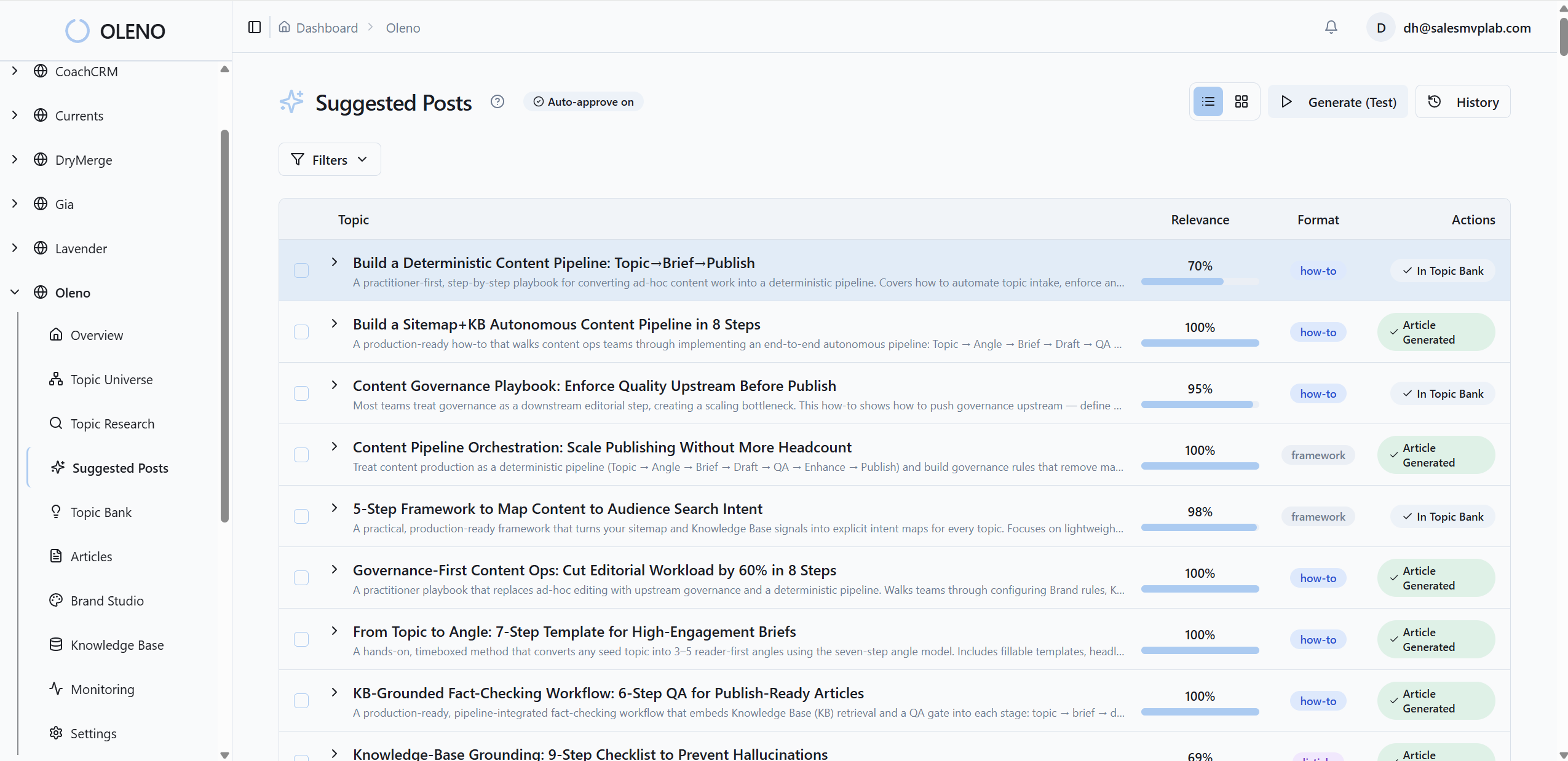
Oleno runs a closed‑loop pipeline that turns strategy into publish‑ready articles with deterministic checks across text and visuals. It enforces an 80+ criteria gate, auto‑refines low‑scoring areas, and only hands approved drafts to your CMS—no manual stitching required.
Deterministic links, validated schema, and on‑brand visuals
Oleno injects 5–8 internal links using only verified URLs from your sitemap, with anchors matching page titles. No fabricated links. It generates JSON‑LD for Article, FAQ, and BreadcrumbList, then validates before attaching. Visual Studio applies your brand palette, logos, and tagged product screenshots, prioritizing solution sections where context matters most.
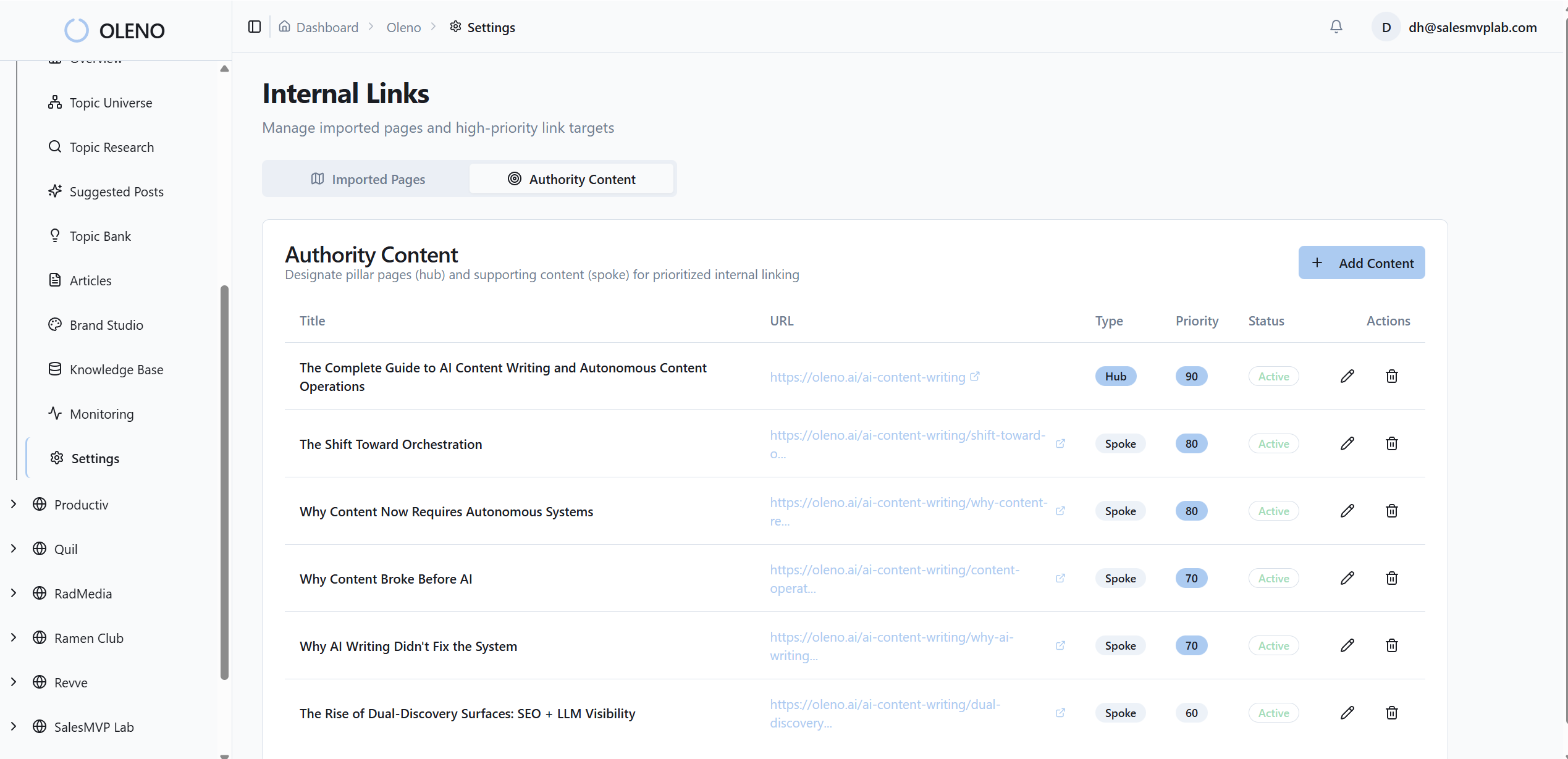
Alt text and SEO‑friendly filenames are created automatically and linted for length. Placement isn’t random; screenshots are matched semantically to relevant sections. The benefit is straightforward: fewer silent failures, stronger accessibility, and cleaner eligibility for rich results. It’s guardrails without guesswork.
You still own the narrative. Oleno handles the parts machines do better—link integrity, schema correctness, visual consistency—so your team can sharpen the argument and examples. That’s the split that keeps speed and reduces risk.
QA scoring with refinement loops and a real pass threshold
Every draft in Oleno goes through 80+ checks covering structure, information gain, tone normalization, snippet‑ready openers, visuals, links, and schema. There’s a minimum pass score of 85. If a draft misses, Oleno refines the weak spots and re‑tests automatically. No ping‑ponging between tools, no “who fixes this?” debates.
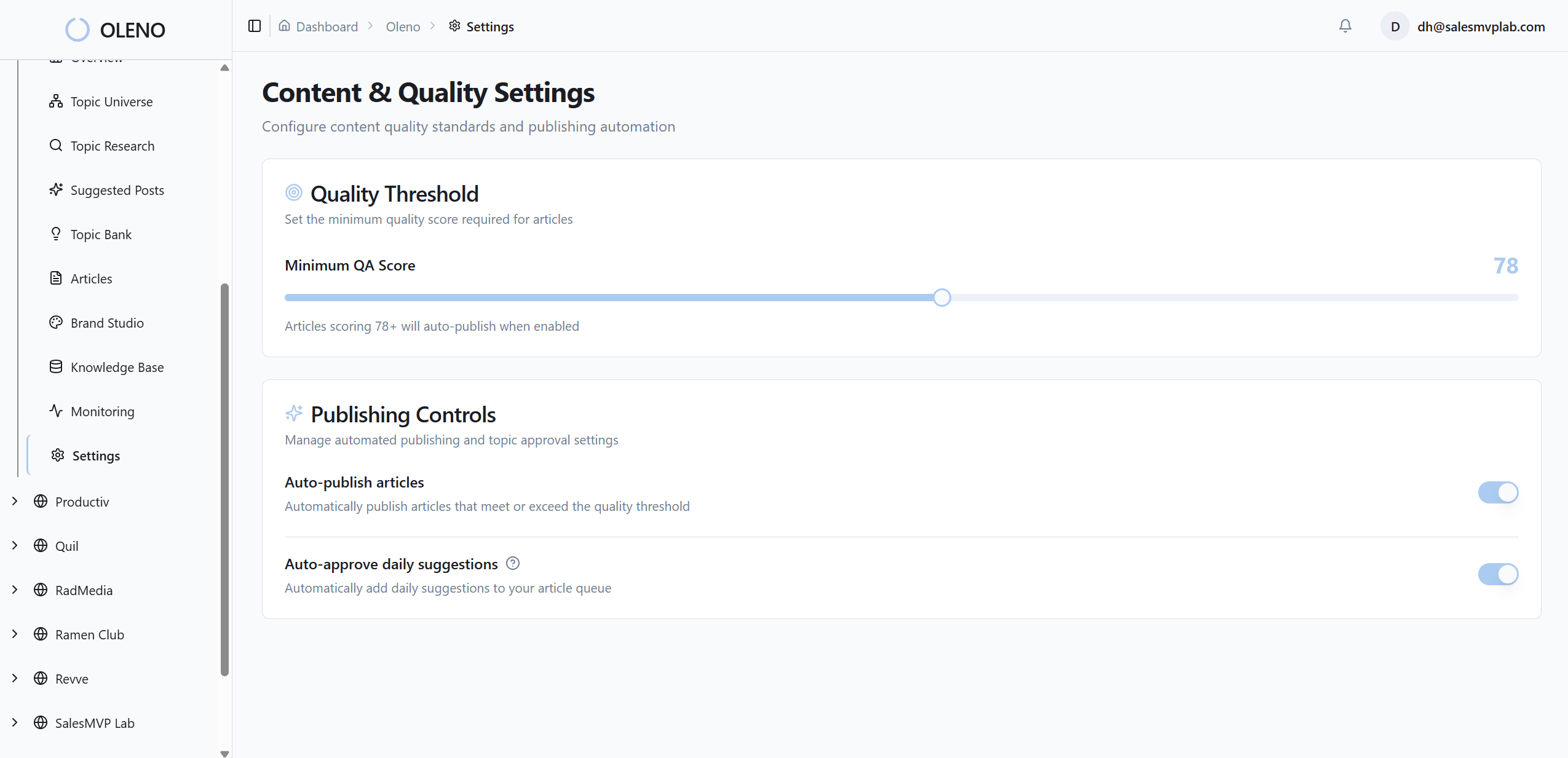
This matters because QA isn’t a feeling. It’s a system. Oleno removes AI‑sounding language, enforces brand phrasing, and validates the snippet‑ready structure we talked about earlier. Logs capture what failed, what changed, and what passed. You get predictable outcomes and fewer surprises at publish time.
If you’ve been stuck editing tone while structure slips, this flips the default. Let the pipeline police structure. Let your team invest attention where persuasion lives.
Ready to stop babysitting drafts and start shipping standards? Try Using An Autonomous Content Engine For Always‑On Publishing.
CMS connectors, draft controls, and duplicate‑proof delivery
Once QA passes, Oleno maps fields and delivers directly to WordPress, Webflow, or HubSpot as draft or live—your choice. It prevents duplicate publishing and surfaces delivery failures with notifications, so you’re informed without living in a dashboard. Text, visuals, links, and schema arrive together, correctly embedded.
No manual HTML. No broken embeds. No “who published this twice?” messages. Publishing becomes a reliable step, not a nail‑biter. And because Oleno’s pipeline is deterministic where it matters, you get repeatable results across brands or sites without inventing new workflows every time.
Bottom line: Oleno doesn’t replace your voice. It removes the accidental errors that keep your voice from being heard clearly and consistently.
Conclusion
You don’t need more edits. You need fewer decisions. Move quality out of opinions and into rules, run those rules every time, and only ship what passes. That’s how you trade rework for rhythm.
Do it yourself with a tight rubric and validation pipeline. Or let Oleno run it end to end—draft to visuals to validated schema to publish—so your team can focus on the story while the system enforces the standard. When quality is a gate, not a hope, publishing gets predictably boring in the best way.
About Daniel Hebert
I'm the founder of Oleno, SalesMVP Lab, and yourLumira. Been working in B2B SaaS in both sales and marketing leadership for 13+ years. I specialize in building revenue engines from the ground up. Over the years, I've codified writing frameworks, which are now powering Oleno.
Frequently Asked Questions