Automated QA Gates: Enforce 80+ Content Checks Before Publish
Most teams treat “final pass” like a safety net. It isn’t. It’s a wish. When you’re releasing multiple articles a week, fatigue creeps in, standards drift, and small misses stack into big, public mistakes. You don’t need more heroic editing. You need a gate that blocks publish until reality matches the rules you actually care about.
I learned this the slow way. Back when I scaled Steamfeed to 120k monthly visitors, volume made cracks visible. We had breadth, depth, and dozens of writers, but if structure slipped or tone wobbled, the rework tax hit us later. At PostBeyond, I could write fast and on-voice; the team, without the context in my head, struggled. The fix wasn’t “try harder.” It was turning expectations into enforceable rules.
Key Takeaways:
- Stop betting quality on “final pass.” Build a blocking QA gate with a pass score.
- Codify a QA contract with severity levels and fail actions, no ambiguity, no stall-outs.
- Design atomic rules and order them so cheap checks fail fast; heavier checks come later.
- Validate visuals and JSON-LD pre-publish to prevent silent SEO losses and template breaks.
- Use remediation loops for auto-fixes; escalate only for high-severity factual issues.
- Measure outcomes with logs and replayable failures, not vibes or one-off green checks.
Why Manual Final Pass Reviews Keep Failing You
Manual final passes fail because humans are inconsistent under speed, context shifts, and fatigue. A deterministic QA gate produces the same outcome every time, across writers and weeks. Think CI/CD for content: rules run, a score is computed, and publish stays blocked until it passes, no exceptions.
The Hidden Cost of Optional Checklists
Optional checklists feel polite. They’re also a trap. When quality is a suggestion, it becomes the first thing sacrificed when deadlines tighten. You still publish, then pay the tax later, support tickets for broken breadcrumbs, a brand lead pinging tone drift, an editor quietly rewriting intros on weekends. That recurring drag isn’t visible in a dashboard, but it shows up in morale and credibility.
I’ve lived both sides, hands-on writer and busy exec. The checklist looked fine on paper and failed in production. Why? No gate. Without a pass/fail boundary, “done” is a moving target and standards are negotiable in the heat of the moment. A gate flips that dynamic. It enforces “done” as a contract, not a conversation.
What Does Deterministic Gating Change?
Determinism moves QA from vibes to verifiable. Each rule returns the same answer, today, next week, across authors. You can tune thresholds, replay failures, and improve rules without arguing over taste. It’s closer to how engineering treats deploys than how content teams treat “good enough.”
One more shift: you stop betting on hero editors. The system carries the load. Structure checks. Banned terms. Snippet-ready H2 openers. JSON-LD validity. These aren’t opinions; they’re rules a machine can enforce. That clarity compounds. Over time, edits shrink and trust grows. For a useful parallel from software, see the focus on quality gates in continuous delivery research in the ACM paper on deployment pipelines.
Why Most Teams Underestimate Rule Design
Rules aren’t just grammar. You’ll need syntactic checks (headings, paragraph lengths), semantic checks (voice, tone, banned terms), KB-grounded checks (factuality against your source of truth), and asset checks (visuals, alt text, schema). Designing evaluation order matters: cheap checks should fail fast; expensive checks should run only when worth it.
The other common miss is rule clarity. “Feels AI-ish” won’t work. “No sentence begins with ‘Furthermore’” will. “H2 opener must be 40-60 words in 3 sentences” will. Over time, you’ll graduate to semantic linting and KB validation, but you earn the right to run heavier checks by making your engine ruthless at the basics first.
Ready to see a gated workflow without the heroics? You can move faster with better guardrails. Try Using An Autonomous Content Engine For Always-On Publishing.
The Root Cause Is No QA Contract To Enforce
The real blocker isn’t tooling, it’s ambiguity. A QA contract defines non-negotiables, pass score, severities, and fail actions in machine-readable form. Once the contract exists, the gate can enforce it consistently, and your team debates rules, not edits.

What Is a QA Contract and Why Does It Matter?
A QA contract is a formal spec for “what must be true before publish.” It lists mandatory vs advisory checks, the pass score, the weighting model, and what to do when something fails. Think of it as API docs for quality. Everyone knows the rules. The machine knows how to evaluate them. Nobody is guessing in the comments.
What makes it powerful is that it’s versioned and auditable. When you tighten tone rules or add a schema requirement, it’s a contract change, not an editorial suggestion. That shift moves your team from subjective editing to objective improvement. If you want a research angle on rule clarity and knowledge-grounded validation, see this CEUR-WS paper on rule-based content validation.
Severity Levels, Pass Scores, and Fail Actions
Severity is how you control blast radius. Critical issues block publish and trigger remediation. Major issues block until an auto-fix or human approval. Minor issues log but allow progress. Map those severities to weighted points so a baseline pass score, say 85, reflects actual risk, not vibes.
Define exact fail actions per severity. If JSON-LD fails, auto-generate and re-validate. If tone drifts, run the linter and suggest rewrites. If a factual assertion can’t be verified, stop and route to a human. The contract removes dead ends. There’s always a path forward, automated first, human only when needed.
The Cost Of Shipping Without Gates Adds Up Fast
Skipping gates looks faster. It isn’t. You trade silent SEO losses, brand drift, and weekend rollbacks for a few minutes saved today. Over a quarter, those micro-failures pile into real money, rework hours, damaged trust, and missed opportunities.
Let’s Pretend You Missed Basic Schema
Let’s pretend an article ships without valid JSON-LD. You lose rich result eligibility. Breadcrumbs break. Support gets pinged. Someone patches templates and re-publishes. It reads like a small fix until you multiply by weekly releases. That’s dozens of hours per quarter and a credibility hit you didn’t need.
A gate that generates and validates Article, FAQ, and BreadcrumbList schema pre-publish turns that scramble into a non-event. It’s the difference between catching a unit test failure locally and firefighting in production. There’s broader support for pre-merge checks in other fields too; see this applied perspective from Harrisburg University on quality gates in DevOps pipelines.
The Rework Tax on Voice and Structure
Voice drift doesn’t trip an alert. It creates a quiet, expensive tax. Editors rewrite intros, normalize phrasing, fix headings, and remove banned terms after the fact. It feels like “polishing,” but it’s hours you could have spent on new work. Multiply by team size and cadence and you’re under water.
A gate that enforces snippet-ready H2 openers, heading hierarchy, paragraph length, and brand linter rules shrinks diff sets dramatically. Review turns into decision-making, not reconstruction. It’s still creative. It’s just bounded by rules that catch the predictable issues before they land on your desk.
Still dealing with these fixes manually? See how a gate changes the math. Try Generating 3 Free Test Articles Now.
The Human Pain You Can Eliminate With A Gate
Most quality issues don’t look catastrophic. They feel like friction, until one breaks in public. A gate takes the punch first, so you don’t have to.
The 3am Rollback You Did Not Need
We’ve all been there. A last-minute headline change stretches the hero. Images overflow. CSS behaves badly. You roll back at 3am and promise to “tighten the process.” A pre-publish gate that validates HTML, image ratios, and alt text, with a safe draft mode, blocks that failure at the source. You sleep. The gate holds the line.
The psychological benefit is real. When the system catches template breakage, you stop bracing for impact on every release. That headspace matters for teams shipping often. You’re not fearless, but you are protected by rules that don’t get tired.
When Stakeholders Flag Tone Drift
You publish. A stakeholder DMs you, “This doesn’t sound like us.” Now you’re rewriting paragraphs, juggling opinions, and burning an afternoon on cleanup. Most of that goes away when voice rules are codified. Ban the phrases you don’t use. Normalize sentence rhythm. Align openings to your narrative. The machine enforces the floor; you refine the nuance.
Tone isn’t purely mechanical, and I won’t pretend it is. But the repeatable parts, banned terms, sentence construction patterns, opener structure, absolutely are. Put those in code and your “post-mortems” get a lot shorter.
Build An Automated QA Gate That Blocks Publish Until The Score Passes
You build a real gate the same way you build reliable software: contracts, small composable rules, evaluation order, and clear paths to fix failures. It isn’t fancy. It’s disciplined.
Define Your QA Contract, Pass Score, and Severity Levels
Write the contract like a spec. Each rule needs a name, inputs, expected state, severity, and a fail action. Start with 30–40 rules across structure (H2 openers, heading hierarchy), brand (tone lint, banned terms), facts (KB-verified assertions), visuals (ratios, filenames, alt text), and schema (Article, FAQ, BreadcrumbList). Set a baseline pass score, 85 is a useful starting point, and version the contract.
As you scale, add rules toward 80+ without bloating the pipeline. Use comments and examples in the contract itself so writers and editors can understand what’s enforced and why. You’re creating shared language and shared guardrails.
Design a Rule Engine with Atomic Checks and Evaluation Order
Atomic rules do one thing and return one result. “Paragraph length under 120 words” is atomic. “Sounds good” is not. Order matters. Run cheap syntactic checks first to fail fast. Then semantic and KB checks. Then heavier asset validation. This reduces wasted compute and keeps feedback tight for humans.
Collect all failures and compute a weighted score the same way every run. The score shouldn’t be mysterious, document the weights and severity mapping. Give teams the exact reasons for failure and the simplest path to remediation. Interjection: resist regex-only traps; semantic checks need actual language models.
Build a Scoring Pipeline with Batching and Incremental Runs
Batching gives you throughput. Incremental runs give you speed while editing. If a writer adjusts headings, don’t re-run visual validation. If schema changes, re-run only the structured data rules. Aggregate per dimension (structure, voice, facts, visuals, schema) and roll up to a global score that drives the publish decision.
Log every rule output with timestamps and version IDs. You want replayable failures and a history of improvements. When someone asks, “Why did this fail?” you can show the evidence, not just the outcome.
How Oleno Enforces 80+ Checks And Ships Only When Ready
Oleno treats quality as a blocking gate. Drafts are evaluated against 80+ criteria, structure, brand voice, information gain, visuals, and schema, with a minimum pass score enforced before publish. Low-scoring areas trigger automated refinement loops. Articles remain in draft until they pass, which reduces rework and public surprises.
How Does Oleno Score and Block Until Ready?
Oleno evaluates every draft against a broad rule set and enforces a minimum pass score, for example, 85, before anything moves beyond draft. Structure and tone linting, snippet-ready H2 openers, information gain expectations, and KB-grounded checks are all part of that evaluation. If the score falls short, Oleno auto-refines weak sections and re-tests until the content clears the bar.
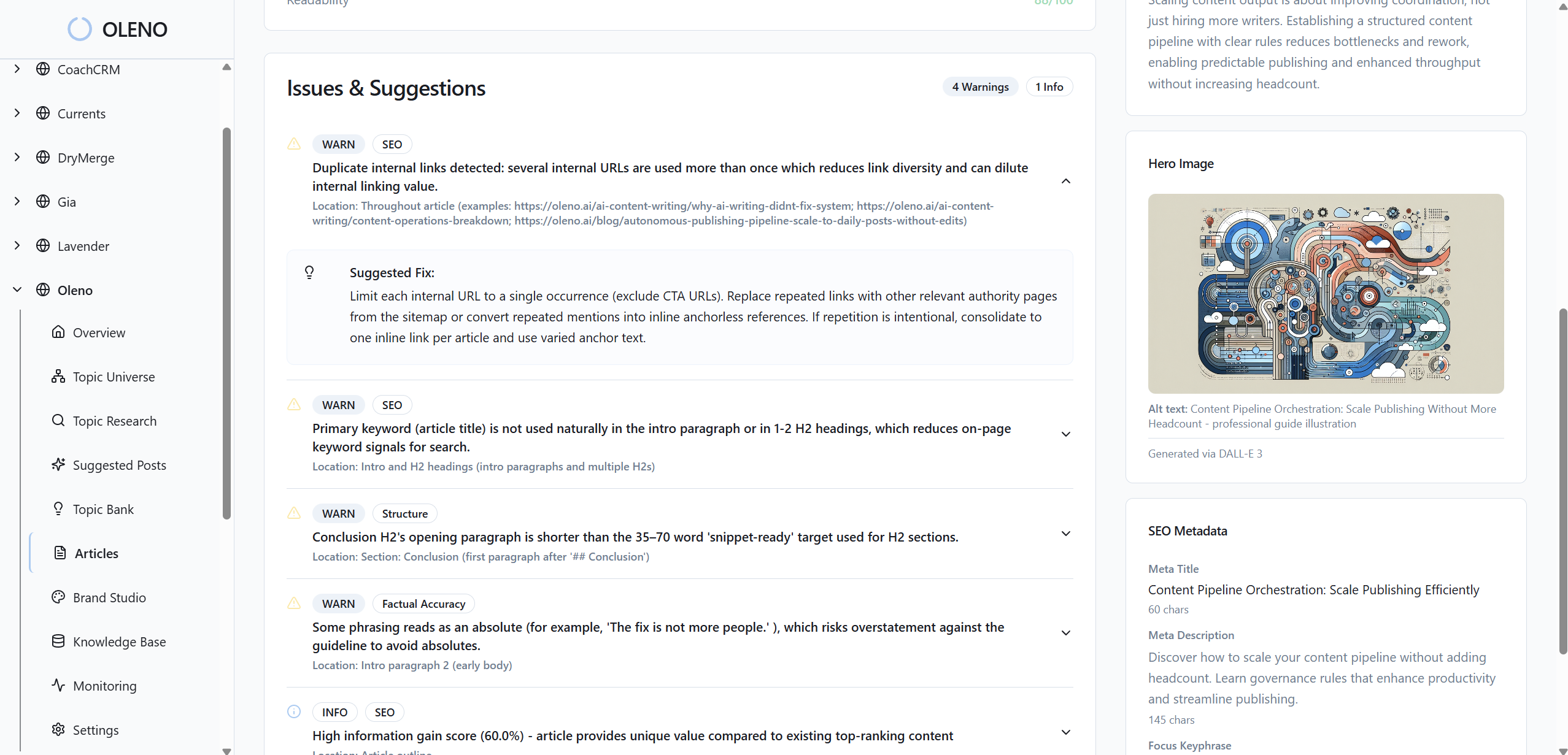
This is not a “gentle nudge.” It’s a gate. The rules are explicit, the results are deterministic, and the remediation loop is built-in. You tune the contract; Oleno enforces it consistently.
Deterministic CMS Connectors That Prevent Bad Publishes
Publishing is where small QA misses become public problems. Oleno’s connectors for WordPress, Webflow, and HubSpot map fields automatically, support draft or live modes, and prevent duplicate publishing. If the QA score is below threshold, delivery is blocked. If a publish attempt fails, you get a clear notification with context, not a mystery toggle in a CMS.
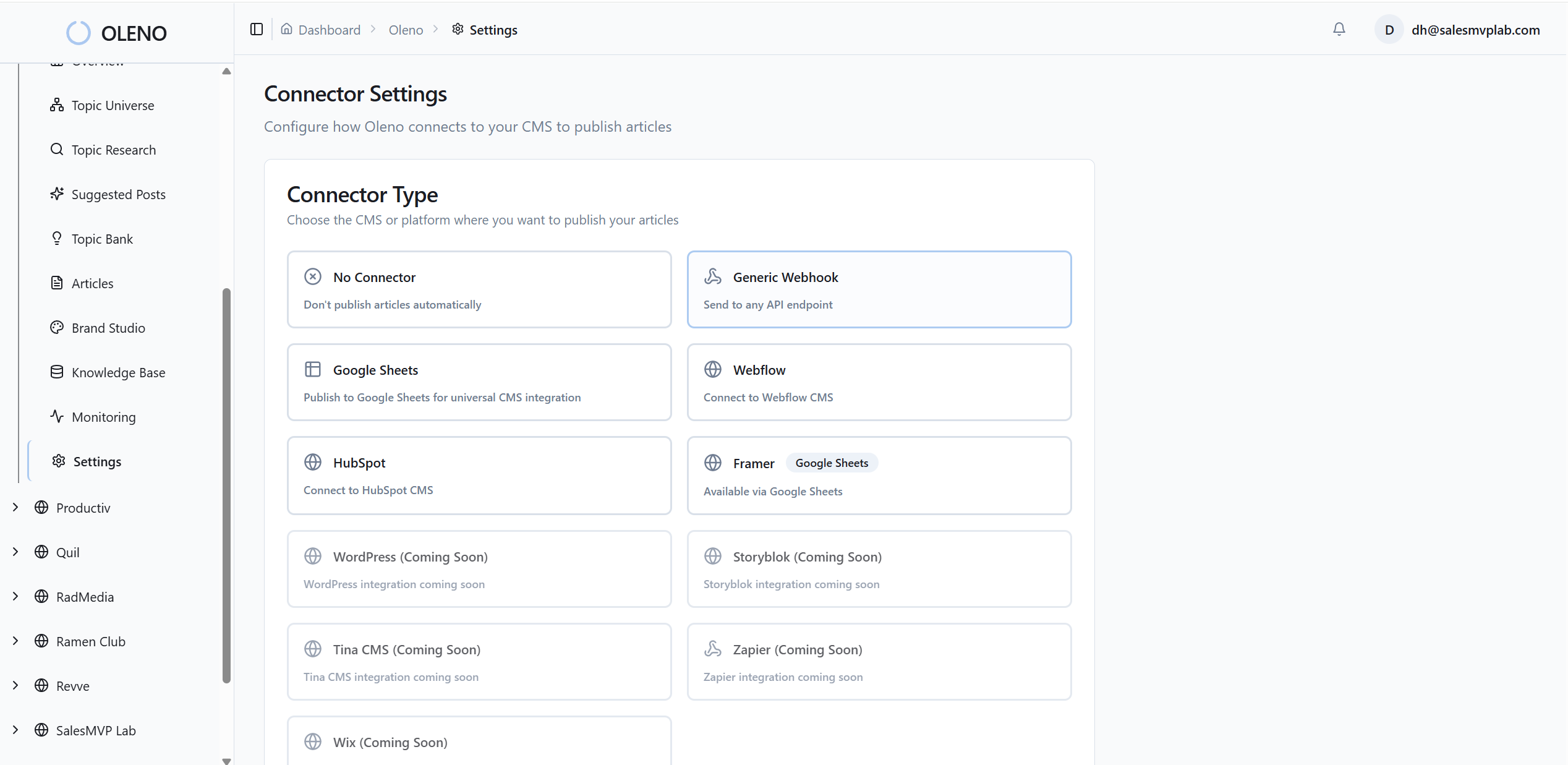
This removes fragile, manual steps that often undo good QA. The publish decision is tied to the score, not to someone remembering a checkbox.
Visual and Schema Validation Baked Into the Gate
Oleno’s Visual Studio generates brand-consistent hero and inline images, validates aspect ratios, and produces SEO-friendly alt text and filenames. On the structured data side, Oleno generates JSON-LD for Article, FAQ, and BreadcrumbList and validates it before delivery. Presentational quality and structured clarity get enforced together, no separate handoffs, no guessing.
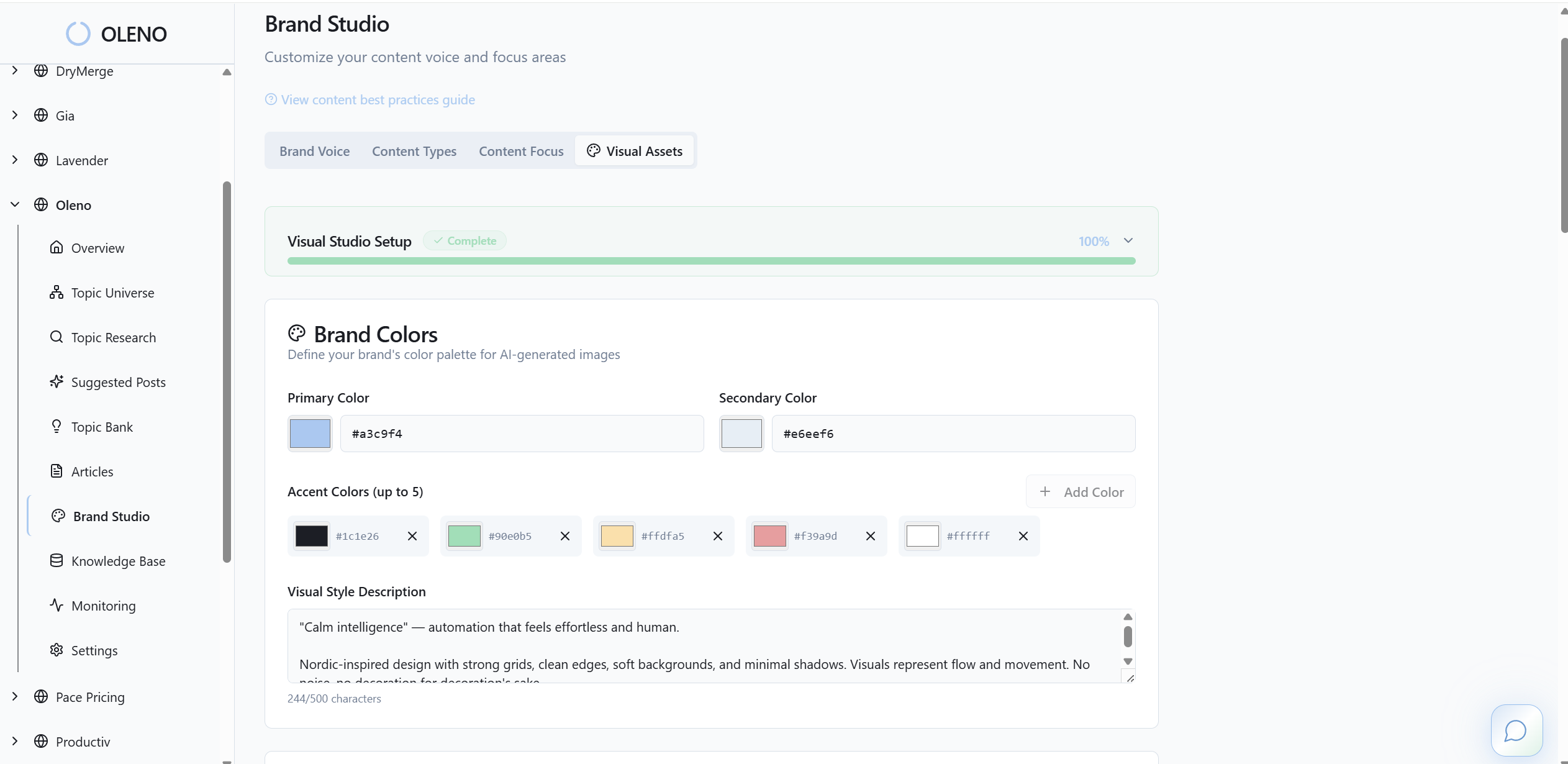
It’s the difference between catching a stretched hero in staging and apologizing for a broken hero on your demand page. Also, between losing rich results quietly and shipping with proven-valid schema.
Ready to replace last-minute edits with a predictable gate? Let Oleno handle the enforcement while your team focuses on narrative. Try Oleno For Free.
Conclusion
You don’t fix quality with harder edits. You fix it with a contract and a gate that enforces it. Define the rules, weight the risks, and make publish contingent on a score that means something. That’s how you reduce rework, avoid public surprises, and free your team to focus on story over structure. When quality is a system, enforced, logged, and repeatable, you ship faster and sleep better.
About Daniel Hebert
I'm the founder of Oleno, SalesMVP Lab, and yourLumira. Been working in B2B SaaS in both sales and marketing leadership for 13+ years. I specialize in building revenue engines from the ground up. Over the years, I've codified writing frameworks, which are now powering Oleno.
Frequently Asked Questions