Automated SERP-Driven Topic Selection: Real-Time Intent Loop

Most teams pick topics from a sitemap or a spreadsheet, then wonder why the content is discoverable but irrelevant. The fix is automated serp-driven topic selection that listens to live SERP signals and feeds them back into your briefs. If you ignore those signals, you hand clicks and snippets to competitors who do not.
I learned that the hard way. We scaled volume, hit decent rankings, and still missed what searchers actually wanted in the moment. Intent shifted faster than our editorial process. Once we wired a SERP feedback loop into topic selection and briefs, drafts matched the page one pattern without copying it. Rankings and CTR moved. Faster than I expected.
Key Takeaways:
- Build automated serp-driven topic selection so live SERP signals shape what you write and how you structure it
- Normalize SERP features into rules you can apply across briefs, not one-off edits
- Translate features into structure changes: definitions first, lists for “how to,” tables for comparisons
- Score ideas with intent weight, knowledge coverage, and business value, then publish in that order
- Add safeguards so you do not swing wildly with every SERP wobble
- Measure CTR lift and track time-to-snippet, target a 7 to 14 day reaction window
Why Automated SERP Driven Topic Selection Beats Static Plans
Automated SERP driven topic selection outperforms static plans because it adapts to real-time intent while keeping your narrative intact. Search pages reveal what the audience expects to see, from definition boxes to lists to product carousels. When your process reads and applies those signals, you stop guessing and start matching demand.
Static inputs create discoverable, irrelevant content
Relying on a sitemap and a static knowledge base seems safe, but it is the root cause of mismatch. You prioritize coverage of what you already know, not what searchers expect today. I have seen teams publish solid pieces that never earn a click, because the layout, depth, or angle is wrong for page one.
Content can rank on brand strength alone. Then it stalls. Without live SERP feedback, you miss subtle shifts like a surge in “vs” queries or a rewrite of the snippet pattern. Those shifts look small in isolation. At scale, they cost you weeks and a pile of wasted drafts.
SERP features are intent signals, not trivia
Featured snippets, People Also Ask, video rows, and comparison blocks are not decorations. They are demand maps. If a definition block leads page one, open with a clean definition. If numbered steps own the top, structure yours as steps. Copycats fail. Pattern matching to intent wins.
Treat features as rules you can generalize. One page tells you little. Ten pages across a cluster reveal structure, depth, and media that the market rewards. That is the difference between chasing a keyword and aligning with intent you can bank on.
The Real Problem With Static Inputs for Topic Selection
The real problem is not keyword selection. It is that no one owns the pipeline from SERP signal to brief change to published page. Teams collect “insights,” then hope writers interpret them the same way. Hope is a slow editor.
Sitemaps and knowledge bases are references, not signals
A sitemap shows where you have content, not what the market wants next. A knowledge base shows what you can safely claim, not how people search for it. Both matter, but neither responds to intent shifts. When you use them as primary inputs, you lag behind the SERP by weeks.
I like sitemaps for guarding coverage and avoiding duplicates. I love a knowledge base for product truth. But treating them as traffic maps is a mistake. They anchor you to yesterday’s plan, which is why teams miss new “how to” surges or comparison waves until the quarter is over.
The hidden lag in your process
Even when someone flags a SERP change, it takes time to turn that into a new outline, a different intro, or a table that matches buyer evaluation. Meetings pile up. Drafts get stuck in review. By the time you publish, the SERP has shifted again. You did not fail at writing. You failed at speed of alignment.
The fix is a repeatable path from signal to structure change. Not a Slack message. Not a one-off request. A rule that converts a SERP feature into a brief edit, then enforces it before a draft goes live.
The Cost of Ignoring SERP Signals
Ignoring SERP signals wastes budget, loses clicks, and slows pipeline. Each missed alignment compounds across clusters. You feel it in CTR, in rewrite hours, and in leadership trust. The numbers add up fast.
Time and money you lose
A misaligned draft can look fine in a doc. Then it gets no traction. You rewrite the intro to chase a snippet pattern. You add a list the SERP clearly rewards. That is another review cycle. Another week. If your team rewrites 10 percent of drafts, you are losing days every month to avoidable fixes.
Research time balloons too. Without rules, every writer re-learns the SERP pattern from scratch. Multiply that across 20 to 40 monthly pieces and you burn hours on repetition, not progress. It is not just slow. It is costly, especially when evaluating automated serp-driven topic selection.
Signal loss in rankings and CTR
SERP features reshape clicks. Featured snippets and People Also Ask can siphon attention even when you rank in the top three. Studies show that SERP layouts change where users click, often reducing classic blue-link CTR on stacked-feature pages. Ahrefs has a solid breakdown of how features pull clicks in their overview of SERP features and CTR impact.
If you do not respond, you lose. When a definition box owns the top, your long preamble kills snippet odds. When “vs” pages surge, your generic product page will not match evaluation intent. Google explains how featured snippets work in their own Search Central documentation. Align or accept lower CTR.
What It Feels Like When Intent Shifts Under You for Automated serp-driven topic selection
You know the feeling. A topic that looked like a layup turns into a ghost. Traffic trickles in. Sales asks where the evaluation content is. Your calendar looks full, but outcomes feel thin. You start second guessing your entire plan.
Life inside reactive mode
Monday through Thursday becomes triage. You hunt for quick wins, beg for edits, and try to unblock drafts that keep bouncing around. The team is working hard. Output ships. Results underwhelm. The problem is not effort. The problem is you are always late to the intent party.
Motivation drops when good work dies on the vine. People stop believing the plan. Leaders lose patience. Slack fills with hot takes and pet ideas. That noise is expensive. Morale aside, it pulls you even further from the market’s actual demand.
How it lands with leadership
Executives do not want a lecture on algorithms. They want to know why CTR is down and why competitors show up in every comparison box. If your answer is a shrug, trust erodes. If your answer is a system that reacts in 7 to 14 days, trust grows.
I have had both conversations. Only one buys you space to operate. The faster you can show a SERP-aligned change and a measurable lift, the easier the next conversation gets.
The New Way: Build a SERP Feedback Loop For Topic Selection
The new way treats SERP features as inputs that directly change briefs, outlines, and publish order. You collect signals, normalize them into rules, score topics by intent and value, then enforce structure before a draft goes live. It is simple to describe. It is powerful when you run it every week.

Collect and normalize SERP signals
Start by deciding what to watch. For each target and cluster, capture which features appear most often and in what order. Track the snippet pattern, list usage, table presence, video rows, and the share of “vs” or “alternatives” pages. Then normalize that into a small rule set your writers can follow without debate.
Two teams looking at the same SERP often disagree on what matters. Rules fix that. For example, “Definition-first, 45 to 60 words, then a three-sentence context block” is a rule that removes subjectivity. Google documents what featured snippets favor in their Search Central guidance. Use that clarity to your advantage.
Once your rules exist, you can apply them programmatically. That is where speed shows up. People stop arguing taste and start following patterns that the market is already rewarding.
Convert features into brief edits
Translate each feature into a specific brief change. Do not leave it abstract. Make it mechanical so anyone on your team can do it the same way.
Here is a simple mapping you can adopt:
- Featured snippet present, open with a 40 to 60 word definition and a 3-sentence answer block This is particularly relevant for automated serp-driven topic selection.
- People Also Ask dominant, add a Q&A H3 stack that mirrors top questions
- Comparison-heavy SERP, include a two-column table that contrasts the primary dimensions
- “How to” pattern, add a 5 to 7 step numbered sequence with short, action-led steps
When you make these edits upstream, drafts ship faster and rewrites drop. You are not gaming search. You are respecting what people clearly want to read.
How Oleno Makes Automated SERP Driven Topic Selection Safe And Repeatable
Oleno operationalizes the new way by encoding voice, POV, and product truth first, then letting SERP-informed rules shape briefs and drafts inside a deterministic pipeline. You get speed without voice drift, accuracy without legal risk, and a QA gate that refuses to publish misaligned work. The result is reliability, not roulette.

Governance-first so signals do not break your voice
Governance prevents a common failure mode, chasing SERP patterns and losing your tone. Brand Studio locks your vocabulary, sentence rhythm, and CTA style so drafts still sound like you. Marketing Studio captures your point of view and narrative frames, so even definition-first pieces reinforce how you see the problem.
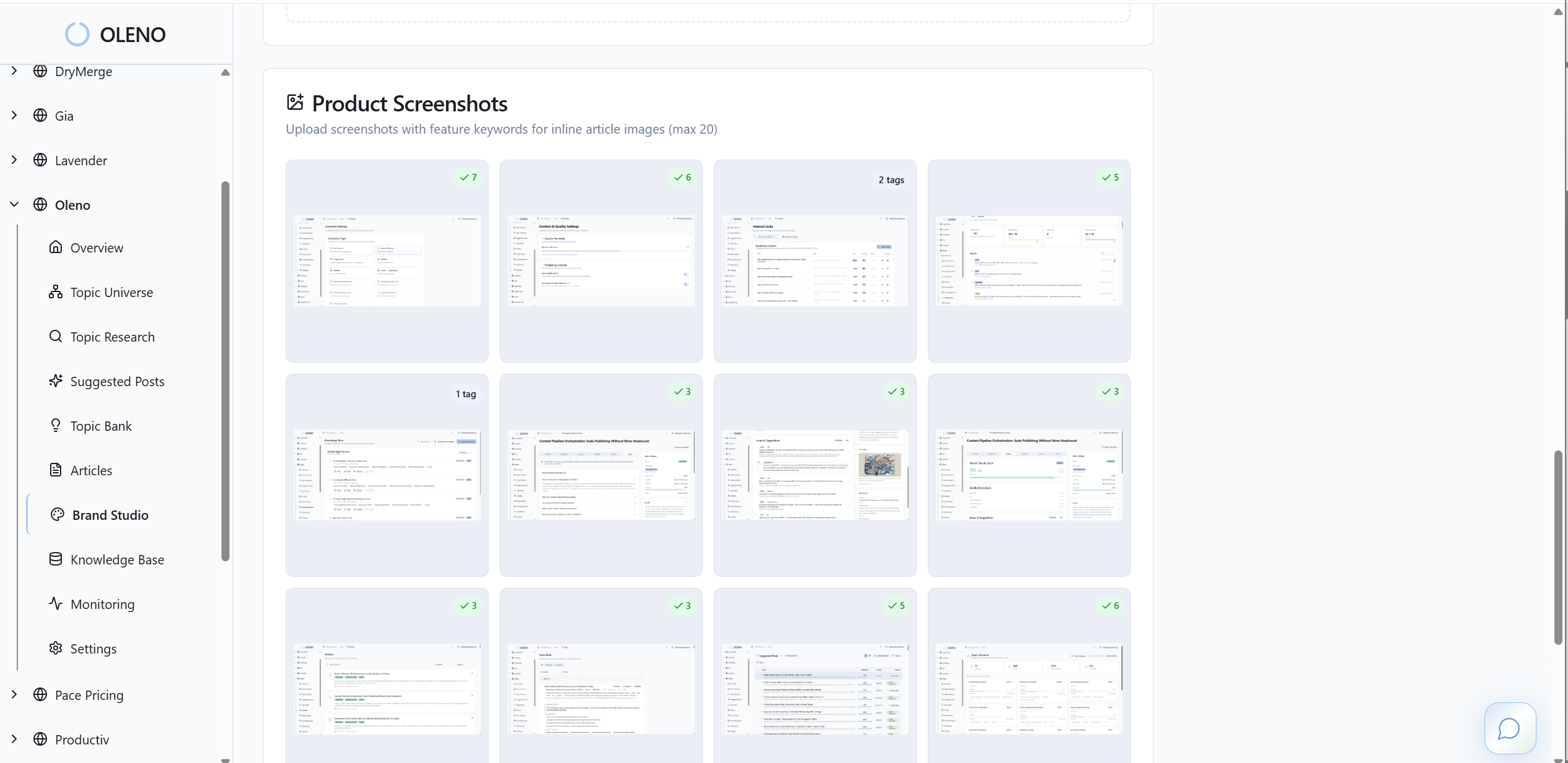
Product Studio keeps claims inside approved boundaries. That matters when SERP features nudge you toward comparison content. You can address evaluation intent without crossing lines or inventing capabilities. The Knowledge Archive grounding ensures facts come from your truth, not the open web.
Deterministic pipelines and a QA gate
Programmatic SEO Content turns topic discovery into governed briefs that already reflect SERP patterns your team defines. Drafts follow locked structures and pass a non-negotiable QA gate for voice, structure, clarity, and factual grounding before anything can publish. If a draft drifts, the QA gate blocks it, triggers targeted fixes, then re-runs checks.
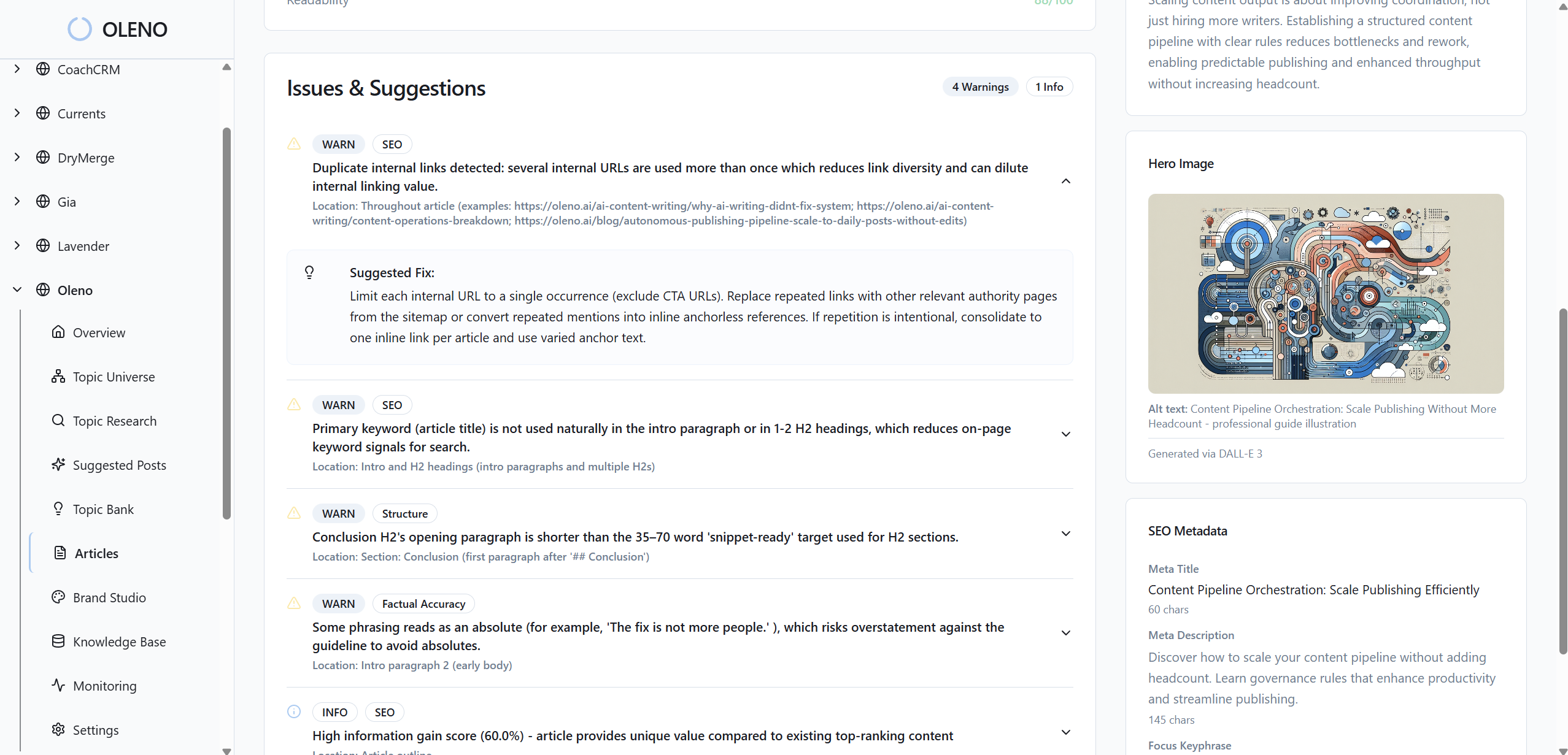
Variation Layer and Topic Universe expand high-value ideas across audience and use case combos without duplicating thin pages. CMS Publishing pushes approved content straight into your site as drafts or live posts, which removes handoffs and keeps cadence steady. Measurement and System Health show whether the engine is actually running, so you can spot bottlenecks before they stall output.
Operational safeguards that prevent oscillation
A good system adapts, it does not thrash. Oleno lets you set rate limits on how often a rule can change per cluster, which prevents overreacting to single-day SERP noise. You can cap edits to a weekly or biweekly cadence, then review outcomes before the next adjustment.
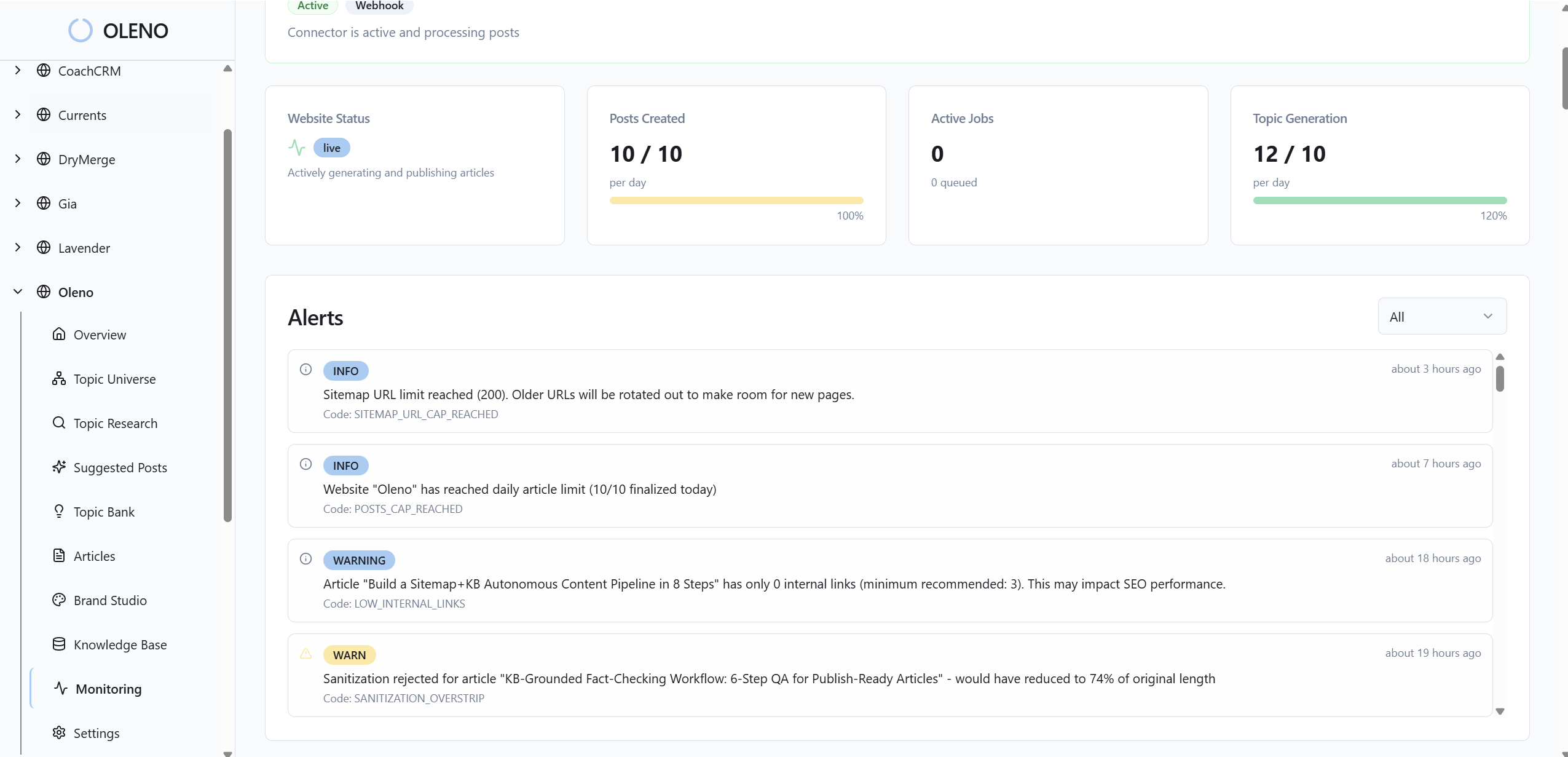
Legal or compliance-sensitive areas stay protected because governance and the QA gate enforce approved claims. That balance is key. You respond to the market without risking accuracy or brand integrity. SparkToro’s analysis of zero-click searches in 2022 shows how fast attention patterns move. Safeguards keep you agile without chaos.
Conclusion
Sitemaps and static knowledge bases are essential, but they are not signals. Automated serp-driven topic selection closes the loop by reading the SERP, converting features into rules, and enforcing those rules in your briefs and drafts. Do that and you will see higher CTR on published pages, plus faster time-to-snippet detection inside a 7 to 14 day window.
You do not need more guesswork. You need a system that listens and responds. If you want that reliability without adding headcount or coordination overhead, Oleno was built for it. Request a Demo
About Daniel Hebert
I'm the founder of Oleno, SalesMVP Lab, and yourLumira. Been working in B2B SaaS in both sales and marketing leadership for 13+ years. I specialize in building revenue engines from the ground up. Over the years, I've codified writing frameworks, which are now powering Oleno.
Frequently Asked Questions