Automating B2B Marketing Content Workflows for Scale

You don't have a content output problem if 3 drafts are sitting in review, 2 are waiting on product accuracy checks, and 1 is lost between Google Docs and the CMS. The real reason content workflows fail to scale is that every handoff asks a marketer to re-explain the same product truth and angle from scratch. Add AI writers to that mess and you don't get scale. You get faster drift.
The issue usually isn't effort. The issue is that the workflow was built for a smaller team, a slower publishing cadence, and one person holding the whole strategy in their head. Then AI gets added, output goes up, and every weak handoff gets louder.
Key Takeaways:
- Automation should remove manual handoffs, not replace strategic editorial judgment.
- Consistent publishing cadence matters more when teams are small and stretched thin.
- Product docs, messaging, and launch updates need to stay attached to every draft.
- Content workflows must be structured for AI citation and retrieval, not only traditional search.
- Disconnected AI tools create more coordination work when there is no shared workflow layer.
- The right workflow separates production work from approval authority.
Why Content Workflows Break When Output Goes Up
Content workflows break at scale because the work starts moving faster than the context around the work. The draft exists, but the source of truth is somewhere else. The marketer then becomes the human bridge between product truth, editorial workflow, CMS formatting, social repurposing, and approval points.

More AI Writers Usually Means More Review Debt
The instinct is to add more generation capacity. More prompts. More drafts. More articles in the queue. I get why people do it, because the first week feels amazing. You go from staring at a blank page to having five drafts waiting for review.
Then the mess shows up. One draft uses old product messaging. One sounds like a blog your competitor would publish. One misses the actual pipeline angle. One has a decent intro, but the rest reads like a summary of search results. The team didn't remove work. They moved the work into review.
A content workflow is closer to a newsroom assignment desk than a typing pool. The assignment desk decides the angle, the source list, the headline, the section flow, and who needs to sign off before publishing. If you only add more writers to the room, the assignment desk gets buried faster.
Small Teams Feel the Break First
A solo content lead at a 40-person SaaS doesn't have spare cycles. A three-person marketing team doesn't either. One person is writing the launch post, fixing the website copy, giving sales a one-pager, and answering the founder's Slack message about why last week's blog intro feels off.
That's why consistent publishing cadence matters more when teams are small and stretched thin. A larger team can absorb some sloppy process with people. Smaller teams can't. They need the workflow to carry more of the load.
The day-in-the-life version is simple. It's 4:47 PM on Thursday, the article is supposed to publish Friday, the PMM says the feature language is wrong, demand gen wants the CTA changed, and the social version doesn't match the blog angle. Nobody did anything bad. The workflow just didn't keep the source truth attached.
If that handoff map is the part you want to pressure-test with someone who sees these workflows every day, you can request a demo and bring the messy version.
The fix starts by deciding what the system should carry, and what a human should still decide.
How to Make Content Workflows Scale Without Losing Control
Content workflows scale when the system automates movement, memory, and checks while humans keep control of the decisions that shape trust. That means product truth travels with the draft, approval authority stays explicit, and every asset is structured for both buyers and retrieval systems.
Audit the Handoffs Before You Automate Anything
At five articles per month, you can hide a broken workflow with effort. Past that, the cracks usually show up in the same places: brief creation, product review, brand voice edits, CMS formatting, and repurposing. We might be wrong about the exact number for your team, but five is where I usually see the pain become obvious.
Map one article from topic to publish. Not the ideal version. The real version. List every handoff, every tool, every approval point, every place where someone copies text from one system into another, and every place where context gets re-explained.
Use a simple rule. If a step only moves information from one place to another, automate it. If a step decides what the piece should say, who it serves, or whether the claim is true, keep a human in charge. Automation should remove manual handoffs, not replace strategic editorial judgment.
A useful audit should answer five questions:
- Where does the topic start?
- Where does product truth enter?
- Who approves the angle?
- Who approves the factual claims?
- Where does the approved asset become blog, social, email, or sales enablement?
That last question matters more than it looks. Most review debt starts after the article is "done."
Keep Product Truth Attached to the Draft
A product launch note lands in Slack on Monday. The pricing page changes Tuesday. Sales asks for a new objection-handling angle Wednesday. By Friday, the content draft is using a sentence from last quarter because the AI tool only saw the prompt, not the actual product truth.
Source grounding fixes that. The workflow needs a living source of truth for product docs, positioning, product messaging, customer stories, and launch updates. Not a folder people promise to check. A layer that gets pulled into the brief, outline, draft, edit, and refresh process every time.
Sometimes the source truth is messy. A founder note might literally say, "For many companies, customers and users are two different things." Then someone adds, "the homeless are the company product's users, the donors are the customer (i.e., who's paying for it)." Someone else asks, "For positioning and marketing mix do you think I should focus on potential donors or the homeless?" Messy notes like that are actually useful. They show the real audience decision underneath the content.
Your workflow should preserve the useful mess, then turn it into a clean editorial decision. "This will inform which audience is your core audience for the plan." That sentence is the job. If the draft skips that audience decision, the article can sound polished and still aim at the wrong buyer.
The practical test is harsh but fair. Before a draft moves to review, ask: could someone verify every product claim without opening five tabs and three Slack threads? If the answer is no, your content workflow is creating rework by design.
Automate Movement, Not Approval Authority
Who gets to approve the angle? That question sounds political, but it's really workflow design. If everyone can change the angle after the draft exists, the article will keep restarting under the skin.
The better split is production versus authority. Production work includes research synthesis, brief drafting, outline scaffolding, first draft creation, formatting, metadata, image handling, and CMS publishing. Approval authority includes the angle, the source list, the product claims, the outline logic, and the final edits that protect the byline.
There is a real concession here. Fully autonomous content can make sense for low-stakes pages where authority doesn't matter much. Template pages. Basic glossary entries. Simple location pages. If your brand doesn't care deeply about the byline, human pauses will feel like drag.
For B2B SaaS content tied to pipeline, the tradeoff flips. The human decisions are where the differentiation lives. AI can do the production work around those decisions, but the marketer needs to stay in the editor's seat when the piece chooses a point of view.
A good approval structure is usually four decisions:
- Research direction: which sources and angle are allowed into the piece.
- Brief approval: what the piece will argue and who it's for.
- Outline approval: how the logic moves from problem to answer.
- Draft approval: whether the final piece is true, useful, and on voice.
If your workflow doesn't pause at those four moments, you'll probably pay for it later in edits.
Build Cadence Around Review Capacity
Cadence breaks in review, not drafting. A team can generate ten articles in a week and still publish two if the same person has to fact-check, rewrite, format, and repurpose every piece. The calendar looks ambitious. The queue tells the truth.
Set cadence from approval capacity first. If one marketer can properly review two long-form pieces per week, don't plan for six just because AI can produce six drafts. Plan for two strong pieces, then automate the non-decision work around them so that review time stays clean.
The diagnostic is simple. Look at the last 30 days of content and sort every stalled asset into one of four buckets:
- Waiting for product facts
- Waiting for angle or structure approval
- Waiting for voice edits
- Waiting for formatting, publishing, or repurposing
If more than half of stalled assets sit in the first three buckets, you don't have a production problem. You have a source grounding or approval authority problem. If most sit in formatting and repurposing, automation can probably remove a lot of drag quickly.
For small teams, the goal isn't to publish every possible draft. The goal is a publishing cadence the team can sustain without creating a review backlog that poisons the next month. I would rather see two good articles every week for a year than ten rushed articles followed by six weeks of cleanup.
If you want to see where your current review capacity would break inside an orchestration-first workflow, request a demo with one recent article and the handoffs behind it.
Structure Assets for Retrieval Before Repurposing
A blog post and a LinkedIn post shouldn't be two unrelated writing jobs. They should be two expressions of the same approved argument. Same product truth. Same audience logic. Same point of view. Different shape.
Content repurposing fails when the team treats each channel as a fresh prompt. The blog says one thing. The social post says a softer version. The email changes the problem. Sales pulls a snippet that loses the nuance. Narrative drift doesn't always happen because people disagree. Often it happens because every channel starts from a different source.
Start with the approved long-form asset as the parent. Then break it into child assets only after the angle, proof, and claims are approved. The parent carries the truth. The child assets carry the distribution.
AI-engine readiness adds another layer. Content workflows must be structured for AI citation and retrieval, not only traditional search. Google's own guidance on creating helpful content still centers usefulness, but retrieval systems also reward clean answer shapes, clear headings, and passages that can be lifted without losing meaning.
Use a retrieval pass before publishing:
- Does each H2 open with a direct answer?
- Are definitions short enough to quote?
- Are lists used where buyers ask "how" or "what steps"?
- Are product claims tied to sources?
- Can a paragraph stand alone if an AI engine extracts it?
Google also documents how site owners can think about AI features in Search, and the practical lesson is pretty blunt. If the article buries the answer under three setup paragraphs, machines miss it and busy buyers skim past it.
Use Quality Control Before the Human Review
Automated checks work best before the editor opens the draft. If a human has to catch broken links, old feature names, voice drift, missing sources, weak headings, and CMS formatting every time, the workflow is still built around manual cleanup.
Quality control should catch the predictable errors. Voice mismatch. Unsupported product claims. Missing source links. Bad heading structure. Thin answer paragraphs. CTA placement issues. Publishing readiness. The human reviewer should then spend their time on the higher-value work: argument, taste, accuracy, and whether the piece is worth attaching to the brand.
Prompting alone won't solve that. A strong prompt can improve one draft. It doesn't create a shared workflow layer. Disconnected AI tools create more coordination work when there is no shared workflow layer, because every tool needs context, every output needs reconciliation, and every handoff becomes another place for drift.
A fair counterpoint: if you're publishing one high-effort article per month, a general AI tool plus a careful editor might be enough. No need to overbuild. The workflow problem becomes real when you need multiple pieces per week, consistent product messaging, social repurposing, and a repeatable review process.
The better question isn't "which AI writer gives us the nicest first draft?" The better question is "which parts of our content workflow should never depend on someone remembering to paste the right context?"
How Oleno Keeps Marketers in Control
Oleno is built for B2B SaaS marketers who want content workflows to scale without handing the strategy to the machine. The marketer shapes research direction, brief, outline, and draft edits. Oleno does the production work between those decisions and keeps source truth attached.
Strategy Memory Carries Across Every Piece
Oleno stores brand voice, positioning, product truth, audiences, customer stories, and writing samples once, then uses that context across the content workflow. That matters because re-prompting the same positioning every Monday is not a system. It's memory work wearing a software costume.
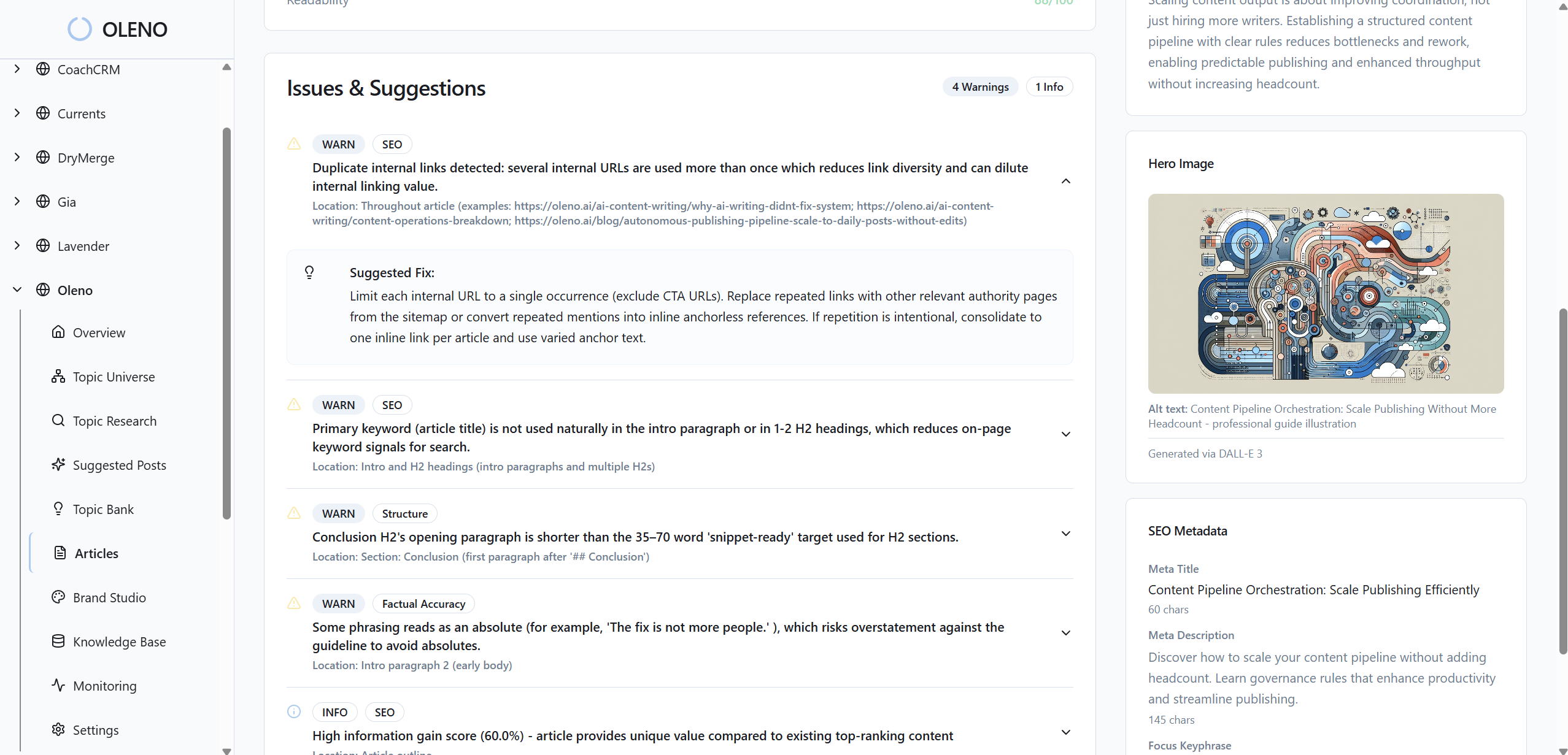
The Product Truth Library is the piece that protects factual accuracy. Product features, integrations, pricing, help-center sources, and launch updates are structured as allowed source material, so drafts don't invent capabilities that were never approved. Brand & Voice Memory and Positioning & Messaging Control do the same thing for voice and strategy.
The Quality Gate then checks the draft before the marketer sees it. It scores grounding, voice match, structure, link health, and SEO density. That doesn't replace the editor. It removes the predictable cleanup work so the editor can focus on whether the piece says something worth publishing.
The Workflow Pauses Where the Marketer Should Decide
Oleno's workflow has four explicit shaping points: Compose, Research, Brief, Outline, and then Draft review. The marketer sets the angle, reviews sources, edits the brief, shapes the outline, and makes final edits before anything publishes. The system doesn't ask the marketer to build workflow logic from scratch.
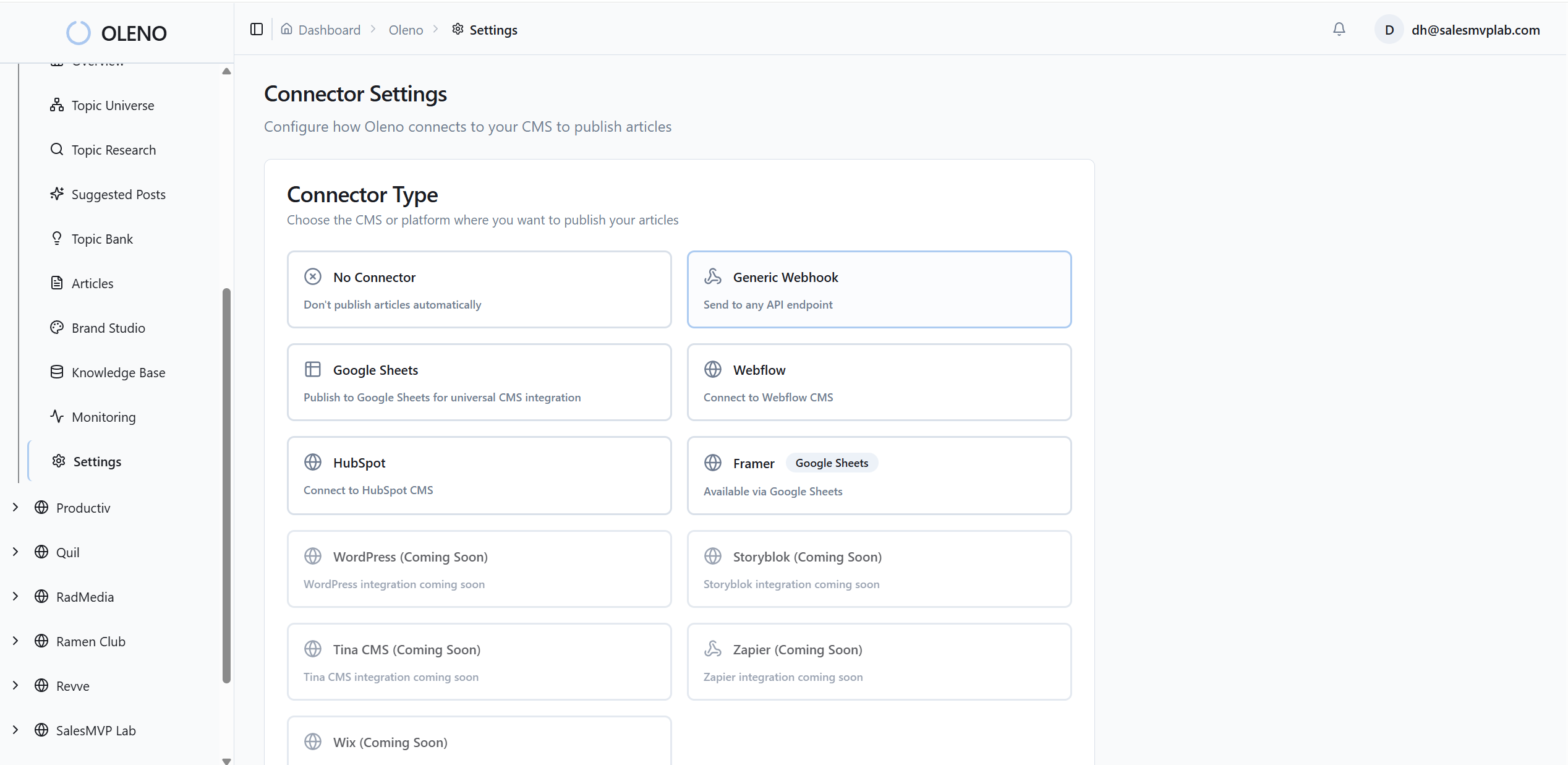
Publishing is part of the same workflow. Oleno can push approved content into supported destinations like WordPress, Webflow, HubSpot, Storyblok, Tina, Wix, Framer, Google Sheets, generic Webhook, and Zapier. It also handles matching social repurposing from the approved long-form article, so the blog and social versions don't drift apart.
If you want the AI to run in the background with no per-article review, this probably isn't the right mode. Fair enough. Some teams want that. For marketers who care about the byline, product accuracy, and pipeline focus, the better design is different: the marketer makes the calls, and the system carries those calls through production.
For teams trying to replace disconnected drafts, manual CMS work, and review debt with one governed content workflow, book a demo and walk through the current process you want to fix.
Build the Workflow Before You Add More Output
Scaling content doesn't start with more drafts. It starts with a workflow that knows where product truth lives, where humans need approval authority, and where automation should remove handoffs. Once those pieces are clear, content workflows scale without forcing the marketer to become the glue between every tool.
Map the process first. Mark the handoffs. Protect the decisions. Then automate the parts that never needed human taste in the first place. That is how small B2B SaaS teams build a publishing cadence they can actually sustain.
About Daniel Hebert
I'm the founder of Oleno, SalesMVP Lab, and yourLumira. Been working in B2B SaaS in both sales and marketing leadership for 13+ years. I specialize in building revenue engines from the ground up. Over the years, I've codified writing frameworks, which are now powering Oleno.
Frequently Asked Questions