Automating Content Workflows to Boost Productivity

Small teams don't usually fail because they lack writers. They fail because 6 people are each carrying a different version of the strategy, and content workflows break under the weight of all that hidden context.
If you're automating content workflows to save time, you've probably felt the opposite happen. More drafts. More reviews. More weird off-brand copy. More work.
Key Takeaways:
- Automating content workflows to save time only works when you automate the system, not just the writing step
- The biggest bottleneck is usually context transfer, not draft production
- If your review loop exceeds 2 rounds on most articles, your workflow is broken upstream
- Head of Content teams need a governed operating model, not more prompts
- In the GEO era, consistency across 50 pieces beats random brilliance across 5
- The right setup maps content jobs to funnel stages, owners, and rules before anything gets drafted
Why automating content workflows usually creates more work first
Automating content workflows usually fails when teams try to speed up output before they fix alignment. The result is faster draft creation, but slower approvals, more rewrites, and more narrative drift. That's why a lot of teams feel like automation made the problem worse, not better.
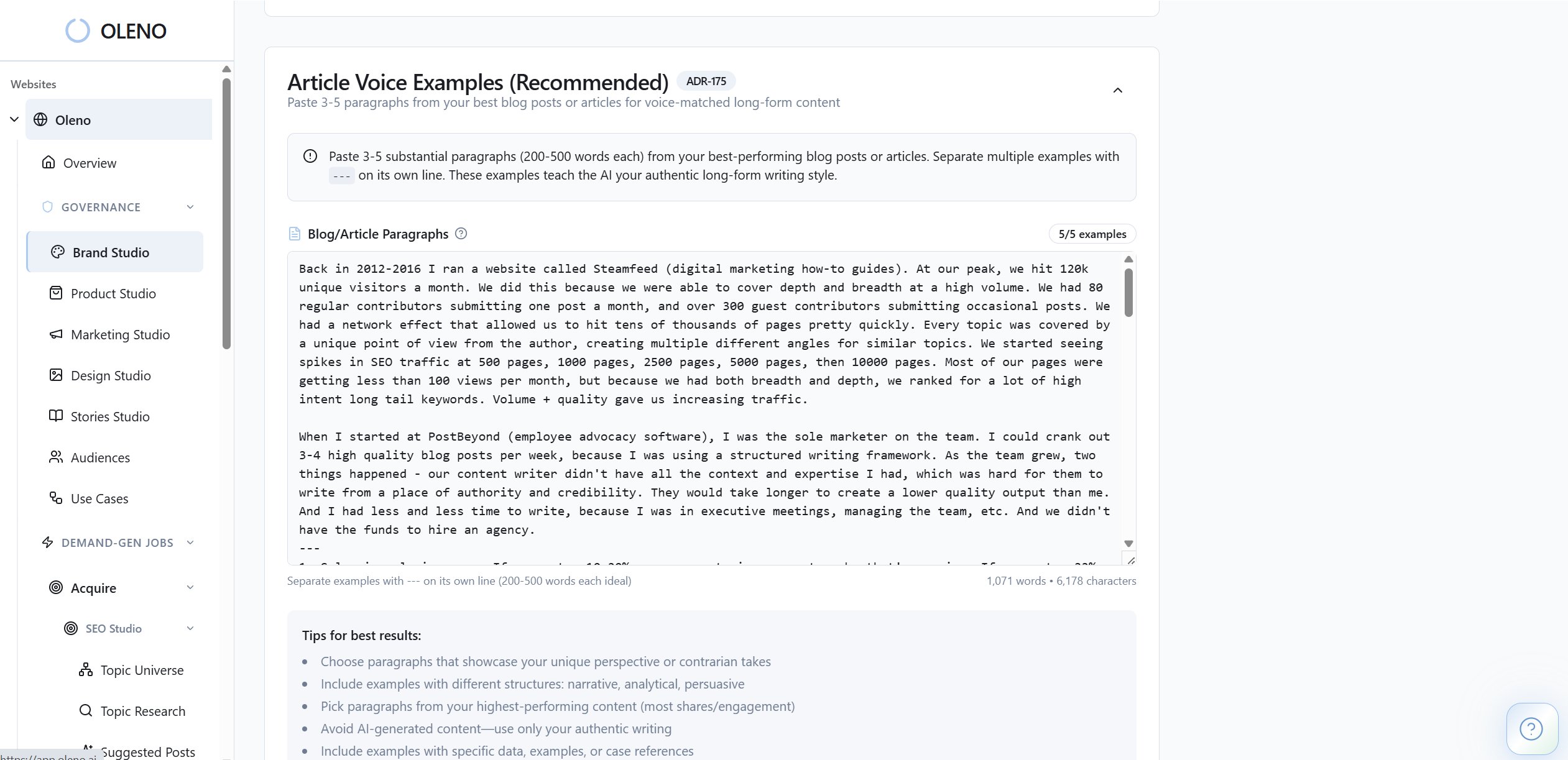
Back in 2012-2016 I ran a digital marketing site that hit 120k unique visitors a month. We had 80 regular contributors and 300+ occasional guest contributors. What I learned pretty fast was simple: volume only compounds when the system underneath it holds together. Otherwise you just create more mess, faster.
The draft was never the real bottleneck
A lot of content leaders assume the problem is production speed. Writer takes too long. SME is late. Agency missed the brief. AI draft needs cleanup. Fair. Those are real issues. But they're usually downstream symptoms.
The real issue is context fragmentation. I call it the 3-Gap Model: strategy gap, product gap, and audience gap. Strategy gap means the writer doesn't fully get your market point of view. Product gap means they don't know what is and isn't true. Audience gap means they can't feel the difference between a Head of Content at a 150-person SaaS company and a founder at a 20-person startup.
When those three gaps exist, automating content workflows to save time won't save time. It just creates more assets that need correction. And correction is expensive because senior people get pulled back into work they thought they delegated.
The review loop is your diagnostic
One of the fastest ways to diagnose broken content workflows is to count review rounds. If most articles need 3 or more rounds, you don't have a writing issue. You have a system issue. That's the Review Loop Threshold, and honestly, it's one of the cleaner signals I've seen.
Picture a Head of Content on Tuesday at 4:30 PM. One draft came back from a freelancer, another from an internal writer, and a third from an AI tool. All three are technically fine. None of them sound like the company, the product language is a little off, and the examples are generic. So now that Head of Content is rewriting intros, fixing claims, adding nuance, and asking PMM to sanity check. Again.
That's the part people don't talk about enough. It's not just inefficient. It's draining. After a while you stop feeling like you run content. You feel like content runs you.
Prompting scales output, not reliability
Some teams prefer prompt stacks, and that's valid for early experimentation. If you're still figuring out tone, offers, or positioning, loose prompts can help you explore. But once you need a weekly cadence across multiple contributors, prompting starts to break in very predictable ways.
Two prompts written a week apart won't produce the same judgment. Ten prompts across five contributors definitely won't. So your supposedly automated content workflow turns into a human QA wrapper around inconsistent machine output. You saved 45 minutes drafting and lost 2 hours reviewing. Bad trade.
That's the hidden cost. When the system doesn't carry the context, your team does. So the next question becomes obvious: if faster drafting isn't the fix, what actually is?
The real problem is context transfer, not content creation
The real problem in most scaling SaaS teams isn't writing content. It's transferring judgment from the people who hold the strategy to the people or tools doing the execution. Once you see that, automating content workflows starts to look very different.

When I was the sole marketer at a SaaS company, I could push out 3-4 high quality blog posts a week because the whole strategy was in my head. Positioning, objections, product nuance, customer pain, all of it. Then the team grew. And two things happened. The writer didn't have the same context I had, and I had less time to write because I was in exec meetings and managing people. Output slowed down even though we had more help.
Your content team is losing a game of telephone
Most organizations pass strategy downstream like a game of telephone. Leadership has one version. PMM has another. Content turns it into a brief. Writer interprets the brief. Editor fixes what got lost. Then leadership says, "This doesn't sound like us."
Of course it doesn't. The original signal got weaker at every handoff.
I think this is where a lot of automation conversations go wrong. They treat the workflow like a factory line. Brief in, draft out. But content isn't assembly work. It's translation work. You're translating company truth into market-facing language over and over again. If the source truth isn't encoded well, every handoff adds drift.
Why GEO raises the bar
This matters more now because GEO changed what gets rewarded. In classic SEO, you could sometimes win with decent structure, decent keyword targeting, and a lot of pages. Google still rewards relevance, sure, but LLM-driven discovery is harsher about inconsistency. If your brand says one thing on the site, another thing in articles, and a third thing in founder content, you weaken the signal.
A Google Search Central guide on creating helpful content doesn't call this out in SaaS demand gen language, but the implication is there: coherent, people-first, experience-backed content holds up better than generic scaled output. Same with how AI systems cite sources. They lean toward brands that sound like they know what they believe.
That's why content workflows now need a repeatability layer. Not because AI is magical. Because inconsistency gets exposed faster.
The old workflow optimizes pieces, not the portfolio
A freelancer can optimize a post. So can an SEO tool. So can an AI writer. An agency can even help you ship more of them. But most of these setups optimize individual pieces, not the full portfolio.
That's a huge distinction. I use the Portfolio Signal Rule here: if your workflow can't deliberately cover acquisition, category education, evaluation, product, and proof on a steady cadence, then you're not running a demand-gen system. You're publishing isolated assets and hoping they add up.
And sure, not every company needs that on day one. Pre-product startups usually don't. Solo creators usually don't. Even some very large enterprises already have enough internal capacity that this exact problem shows up differently. But for that 100-500 employee SaaS team with too many cooks in the kitchen, this is where the wheels come off.
So if the fix isn't "write faster," the better question is this: what does a workflow look like when context actually survives the trip?
How high-output teams automate content workflows without losing quality
High-output teams automate content workflows by encoding judgment before production starts. They define who the content is for, what the company believes, what the product can honestly claim, and which job each piece is supposed to do in the funnel. Then they automate execution inside those boundaries.
This is the part most teams skip. They automate the middle. The winners systemize the beginning.
Start with a maturity check, not a tool purchase
Before you automate anything, diagnose which stage you're in. I use a simple spectrum for this.
Stage 1 is Ad Hoc. Topics come from Slack, founder ideas, random keyword docs, or whatever felt urgent that week. Stage 2 is Template Driven. You have some repeatable briefs and maybe a decent editor, but quality still depends on who touched the piece. Stage 3 is Governed Execution. Voice, POV, product truth, and audience framing are defined once and applied repeatedly. Stage 4 is Orchestrated Cadence. Content gets planned and produced continuously across the funnel with clear coverage logic.
If you're in Stage 1 or 2, buying another drafting tool won't fix the underlying problem. If you're in Stage 3, then automating content workflows to save time actually starts to pay off. If you're in Stage 4, now you're compounding.
This surprised me more than anything else. A lot of teams think their issue is insufficient output software. Usually it's insufficient decision infrastructure.
Build the system in this order: audience, truth, narrative, job
The sequence matters a lot. Get it wrong and you'll spend months patching the workflow later. I call this the ATNJ sequence: Audience, Truth, Narrative, Job.
Audience means who you're talking to in real terms. Not "marketers." More like Head of Content at a mid-market SaaS company, carrying editorial standards, trying to cut review time and still hit calendar. Truth means what your product does, doesn't do, and which use cases matter. Narrative means your point of view about the market. Job means what this specific piece needs to accomplish in the funnel.
If X is unclear upstream, then Y gets vague downstream. If audience is vague, examples get generic. If truth is vague, claims get risky. If narrative is vague, the piece becomes neutral education. If job is vague, you get nice content with no demand-gen pull.
You can see why automating content workflows to save time often backfires. Teams are automating ambiguity.
Use the 70/20/10 rule for review design
Review should shrink over time. That's the goal. The 70/20/10 Review Rule is useful here. Roughly 70% of quality should come from governed inputs and structure, 20% from automated checks and pre-publish validation, and 10% from human polish. If humans are still responsible for 50%+ of the quality lift on every piece, the workflow isn't mature.
A team I saw years ago had great writers and great designers, and they ranked incredibly well. But the content was detached from the actual solution, so it didn't create much demand-gen pull. Great asset quality. Weak system alignment. Different problem, same lesson.
That's why your review process should focus on exceptions, not fundamentals. Review for strategic sharpness, new nuance, edge cases. Don't use senior people as a patch for missing structure. That's expensive, and it doesn't scale.
Map content jobs to the funnel before you scale volume
Not all content should do the same thing. Sounds obvious. But most calendars ignore it. They end up overweighting top-of-funnel articles because those are easiest to brief and easiest to approve.
A better model is job-based execution. Acquisition content captures demand. Category education shapes how the market thinks. Evaluation content supports buyers comparing options. Product content explains fit. Proof content reinforces trust. If you don't map these content jobs deliberately, your workflow will drift toward whatever is easiest to produce, not what the business actually needs.
And if you've ever wondered why your team publishes consistently but pipeline impact still feels fuzzy, that's often why. Volume without job balance is like hiring a sales team where everyone only does top-of-funnel outreach. Activity looks great. Revenue doesn't move much.
For structure ideas on this, Content Marketing Institute's operations coverage is useful. Not because it gives the full system, but because it shows how much operational discipline content teams now need once they go beyond one or two contributors.
Treat executive thought leadership as a workflow, not an occasional favor
This is especially true for executive thought leadership. Most companies handle it badly. Founder has a strong opinion. Someone records a Loom or grabs a voice note. Marketing turns it into a post. Everyone says they'll do more of this. Then three weeks pass and nothing happens.
The better approach is to treat stories as reusable assets. Founder stories. Customer anecdotes. Sales call patterns. Objection language. Industry examples. Store them, categorize them, and use them when relevant. If you don't, each thought leadership piece starts from zero and sounds thinner than the person actually is.
A while back, one small SaaS team used founder videos to create content faster. It helped on speed. But the pieces lacked the structure needed for search intent, and topic selection wasn't great. So they got some output, but not much compounding effect. Good raw material. Weak operating model.
That's the bigger lesson. Raw insight is not enough. You need a system that can turn it into repeatable, high-quality execution.
Pair automation with complementary functions, not fantasy expectations
There's a case to be made for expecting one system to do everything. I get the logic. Teams are tired of tool sprawl. But this doesn't work for everyone, and frankly, it usually creates disappointment.
Content execution is one layer. You still need technical SEO for crawlability and indexing. You still need keyword research or demand validation. You still need analytics to understand what converts. You may still need PR, paid media, email, and social engagement. The better mental model is not replacement. It's fit.
If your content engine doesn't sit cleanly beside the rest of your stack, adoption gets messy. If it does, the team finally stops spending half its week stitching together briefs, prompts, revisions, approvals, and publishing tasks manually.
That brings us to the practical question. What does this look like in software when it's actually done right?
How Oleno turns manual coordination into governed execution
Oleno turns manual coordination into governed execution by separating the decisions your team should make once from the work your team shouldn't have to redo every week. It fits alongside your stack, then replaces the planning, coordination, and prompt-heavy parts that quietly eat your team's time.
Governance first, then execution
This is probably the most important design choice. Oleno doesn't start with "write a draft." It starts with the inputs that determine whether the draft should exist and what it should say.
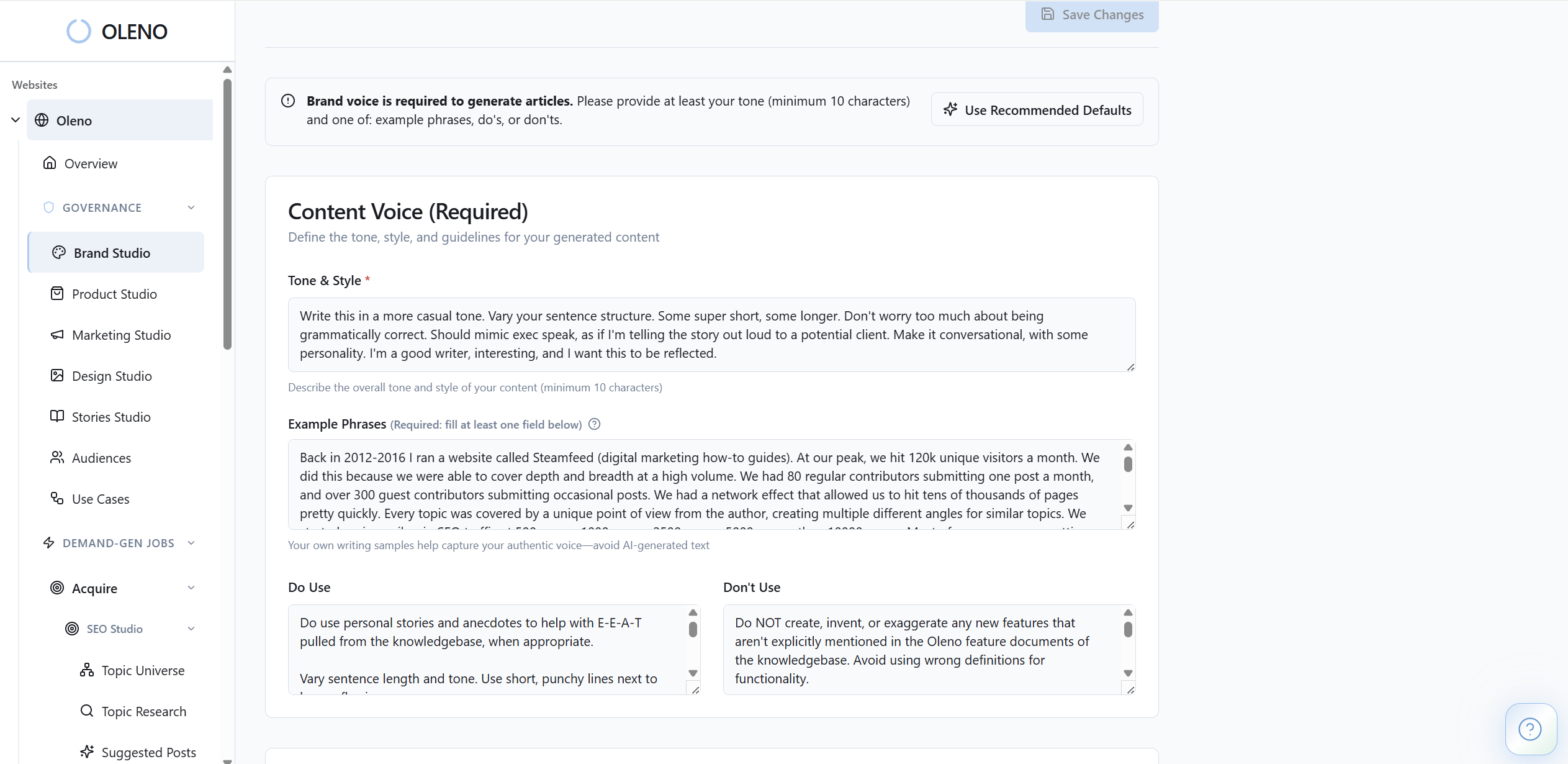
Brand Studio defines tone, style, vocabulary, and structure rules so voice doesn't drift contributor to contributor. Marketing Studio encodes your key messages, category framing, and narrative point of view so content doesn't collapse into bland education. Product Studio grounds content in approved product truth, boundaries, and use cases so claims stay accurate.
That's a much better way to automate content workflows to save time. You're not asking the machine to guess what matters. You're giving it a governed frame so the work comes out closer to right the first time.
Job-based pipelines and always-on cadence
Then the execution layer takes over. Programmatic SEO Studio handles acquisition content at scale through topic discovery, structured briefs, draft creation, scoring, and publishing workflows. Product Marketing Studio supports mid-funnel product-led education. Category Studio handles long-form opinionated thought leadership. Buyer Enablement Studio supports bottom-of-funnel decision content.
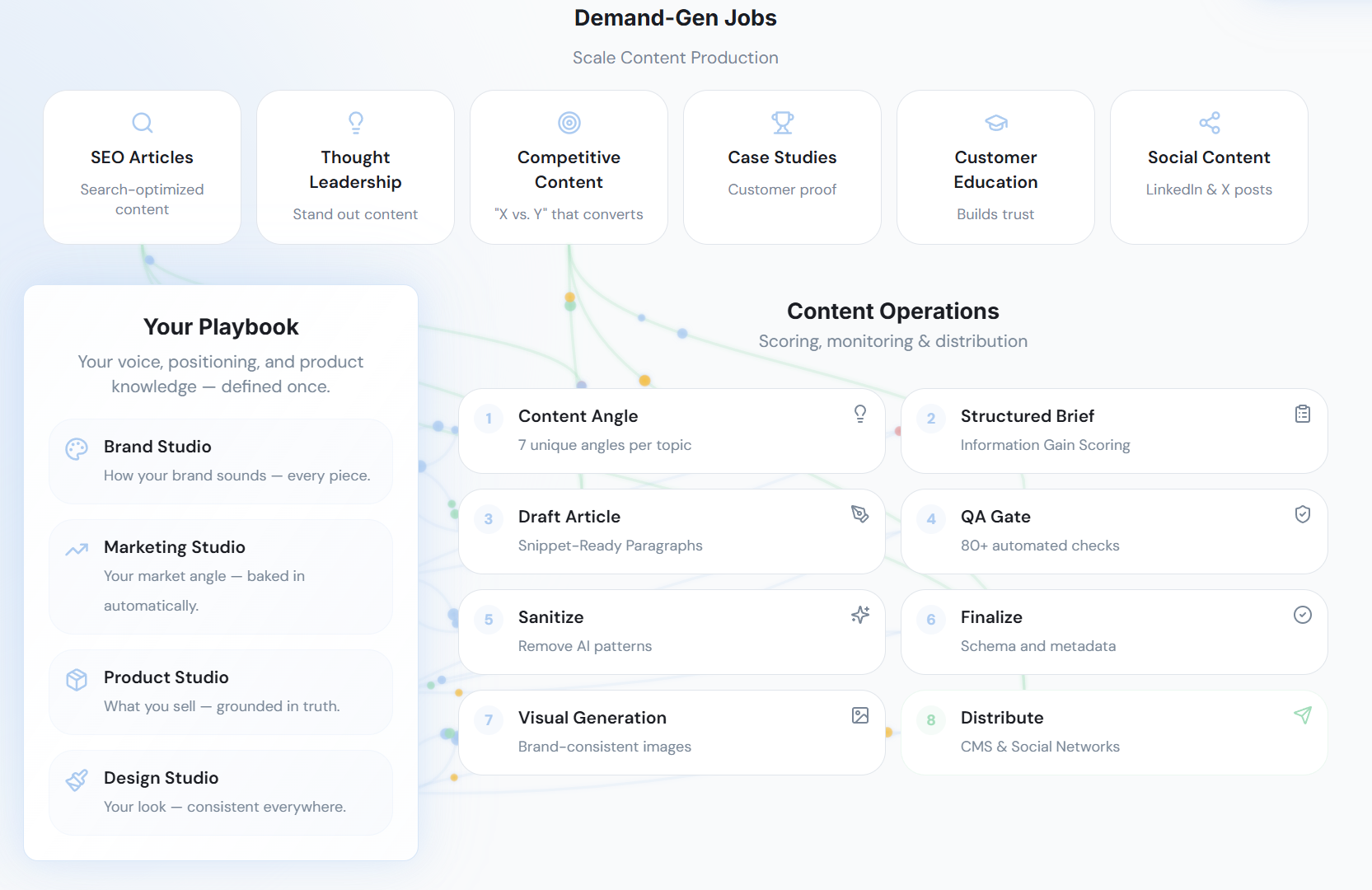
This is where the job-based execution mapped to funnel becomes practical instead of theoretical. Different content types need different arcs, different evidence, and different levels of product grounding. Oleno handles that through dedicated blueprints rather than one generic "content generator."
The Orchestrator matters here too. It schedules approved topics, runs blueprints, and enforces quotas without constant manual babysitting. That's a big deal for lean teams. When content only happens when someone has a free afternoon, cadence dies.
Better thought leadership without founder bottlenecks
For executive thought leadership, Stories Studio gives teams a governed place to document founder stories, customer examples, sales insights, and real anecdotes. Then those can be pulled into the right content during angle and draft stages, instead of relying on someone to chase the founder every time a post is due.
Audience & Persona Targeting and Use Case Studio add another layer of accuracy. They make it easier to frame the same topic for the right reader and the right job-to-be-done, instead of publishing generic advice that could belong to anyone. Storyboard helps allocate content across those dimensions so the calendar doesn't get lopsided.
And because Quality Gate evaluates voice, structure, clarity, grounding, and SEO before content moves forward, bad output gets blocked instead of becoming your editor's cleanup job. If you'd like to see how that fits your current process, book a demo.
A better content workflow starts before the draft
Automating content workflows to save time sounds like a production problem. Most of the time it's a systems problem. Once you fix context transfer, job mapping, and governance, automation actually starts doing what people hoped it would do in the first place.
That's the shift. Stop treating content like isolated tasks. Start treating it like an operating system that has to hold together over time. If your team already has the strategy but can't get consistent execution out the door, that's exactly the gap Oleno is built to close.
About Daniel Hebert
I'm the founder of Oleno, SalesMVP Lab, and yourLumira. Been working in B2B SaaS in both sales and marketing leadership for 13+ years. I specialize in building revenue engines from the ground up. Over the years, I've codified writing frameworks, which are now powering Oleno.
Frequently Asked Questions