Battlecard → Comparison Page: PMM Playbook for Evidence-Based Content

If you have battlecards lying around, you can turn that work into a battlecard comparison page that earns trust, ranks, and actually helps deals. The trick is simple to say and hard to do. Lead with evidence, not opinion. Build a repeatable workflow, so legal says yes faster and you do not lose your voice in the review cycle.
I have seen the opposite too many times. Pages that read like PR, thin claims, and quiet edits that erase the point of view. The fix is a system. When PMMs run an evidence-first process, you cut rework, reduce risk, and compress time-to-publish. That is the path to one battlecard comparison page per week, consistently.
Key Takeaways:
- Treat competitive claims as governed records with sources, not lines in a doc
- Map battlecard rows to H2s, H3s, and schema to keep SEO intent intact
- Require source type, snapshot date, and reviewer to pass legal fast
- Use a short QA checklist to block risky language and hallucinated claims
- Regenerate pages from a single matrix when pricing or packaging changes
- Reuse the published page as a sales battlecard with minimal tweaks
Your Battlecard Comparison Page Is a Liability Without Evidence
A public comparison only works if every claim is backed by a primary source, a quote, or a reproducible test. Unverified lines invite legal friction, slow approvals, and break trust with buyers. Set a rule now, if you cannot point to an artifact, the claim does not ship on your battlecard comparison page.
Most teams start with strong opinions. I get it. You live the product every day. But opinions without proof are a risk magnet. They trigger long comments, tense rewrites, and sometimes a full takedown. Evidence reverses that pattern. It moves the conversation from wordsmithing to verification. That is safer and faster.
Want a sanity check you can apply in minutes? Pick three comparison claims at random. For each, find the exact source. If you cannot pull a doc, a screen, or a time-stamped page in 60 seconds, the claim is not ready. You just found the hidden cost of weak sourcing.
Why most competitive pages get blocked
Most comparison pages fail because they lead with assertions that no one can substantiate on review day. Legal asks for proof, teams scramble, and the page enters approval purgatory. Make your default simple, every comparative statement needs a source, a date, and a place it lives in your system so audits are fast.
When you set this expectation up front, reviewers change how they read. They stop debating adjectives and start checking artifacts. That shifts power back to PMM. It also lowers the odds that a subjective edit sneaks in and dulls your point of view.
I have seen teams try to push through anyway. It always backfires. Someone screenshots a contradiction, a competitor notices, or a rep shares the page with a buyer who knows the details better than your copy. Evidence-first content prevents that very public mistake.
What counts as evidence?
Evidence is anything a third party could inspect without you in the room. Official docs, UI screenshots, pricing pages with timestamps, recorded demos, and customer quotes with permission all count. Hearsay does not. Aggregate claims only work when you publish the method behind them and link the source for review. The FTC advertising substantiation guidance is a good north star.
Teach teams to attach the source type, the snapshot date, and where it lives in your knowledge base. This is boring work that saves you hours later. It also creates a habit. People write differently when they know they need to show their homework.
If you are not sure whether something qualifies, ask a simple question. Could a competitor reproduce this claim with public info or a product seat? If the answer is no, you are in risk territory.
The hidden SEO cost of weak claims
Unsubstantiated content rarely earns links or snippets. It also invites quiet edits that break consistency, which erodes topical authority over time. Evidence-first pages do the opposite. They earn mentions, they get cited in analyst notes, and they pass manual reviews. That is how you stabilize rankings and rebuild trust with buyers who have been burned by fluff.
There is a second benefit most teams miss. Credible sources make your page citable by AI systems. Clear attributions, structured data, and precise language increase the odds you get pulled into answers. That is free distribution you do not want to miss.
If you want the quick version, the internet rewards clarity and proof. Opinions are common. Evidence is rare. Choose rare.
Treat the Battlecard Comparison Page as a Publishable Artifact, Not a Sales One-Pager
A sales battlecard is built for rapid-fire objection handling. A battlecard comparison page is a public artifact that needs governance, citations, and on-page structure. Shift the DRI from sales to PMM and make PMM accountable for source attribution, voice, and positioning. Sales input still matters, but PMM owns what is true and what gets published on the battlecard comparison page.
This change sounds small. It is not. It moves your process from ad hoc to systematic. Legal approves systems, not one-offs. When you show the workflow, the review gets lighter and more predictable.
You also unlock reuse. A page that is clean enough for buyers is clean enough for reps. You do not need two separate assets with competing claims.
Shift the owner from sales to PMM
Make PMM the single owner for public claims, source hygiene, and final language. Sales can nominate objections and field intel, but PMM decides what becomes a public statement and how it is worded. That separation prevents internal shorthand from leaking onto your site and reduces the risk of outdated or private details slipping through.
This role clarity also speeds drafting. One person, or a small PMM pod, controls the artifact. Feedback comes in as suggestions tied to sources, not rewrites tied to preferences. The page gets sharper without growing heavier.
If your culture resists this at first, explain the risk profile. Public content has a different bar than internal notes. It deserves a different owner.
Build a single source of truth
Centralize approved facts, claim boundaries, and no-go statements in one place. Store competitor features, packaging, and pricing snapshots with dates. Tie every claim to a record with status, owner, and the exact source location. When a competitor updates pricing, you update one record and the change flows everywhere. That prevents the slow bleed of wrong statements.
This also helps onboarding. New PMMs can ship real work faster when the truth is documented and linked. You stop relying on Slack archaeology to find the answer to a simple question.
You will be tempted to cut this corner. Do not. The few hours here save dozens later.
Why this reframe protects speed and safety
When you treat the comparison page as the output of a governed process, reviews focus on verification, not taste. Legal scans the dashboard, spots a few exceptions, and moves on. That cuts cycle time, reduces tense edits, and stops the back-and-forth that wastes hours.
It also builds trust with execs. They learn that your process prevents sloppy claims. That trust buys you faster sign-offs when you need them most.
One last point. Systems scale. One-off documents do not.
The Cost of Unverified Claims in Competitive Pages
Unverified claims create a hidden tax on time, trust, and pipeline. Each disputed line pulls people into meetings and rewrites. Buyers notice exaggeration, which drags down win rates and extends cycles. Repurposed internal notes leak private details. The costs add up fast across every battlecard comparison page you publish.
Put numbers to it. That is how you make the problem undeniable. Most teams are shocked when they quantify the waste.
The fix is not more careful writing. It is a different process. Evidence first, governed claims, and a short QA gate that blocks risk.
Time lost to legal ping-pong
Each ambiguous line invites a round of prove it. If three reviewers spend 20 minutes per disputed claim and you have eight claims, you just burned eight person-hours on one asset. Multiply that by a quarterly refresh and a few competitors. The waste gets ugly.
You also pay the context-switching tax. PMMs bounce between collections, legal threads, and edits. Work stretches across days. Deadlines slip.
This is not a talent problem. It is a system problem. Your process pushes judgment onto people and they drown in it.
Pipeline risk from credibility damage
Buyers compare pages side by side. If your copy leans on vague superlatives, they bounce or, worse, screenshot contradictions. Credibility loss is expensive. It reduces win rate, increases discount pressure, and extends sales cycles. The 2024 Edelman Trust Barometer shows how fragile trust is in high-stakes decisions. Your content either earns it or loses it.
I have sat in calls where a buyer quotes a line from a page and asks for proof. If you cannot back it up, the tone of the call changes. Doubt creeps in. Deals slow down.
Precision is a growth lever, not just a compliance box to tick.
The copy-paste mistake with battlecards
Repurposing internal battlecards directly into web pages seems fast, but it backfires. Internal shorthand, outdated pricing, and private roadmap hints leak into public content. That creates regulatory risk and forces emergency takedowns. The rework costs more than doing it right once with enforceable rules.
There is a simpler way. Separate the truth layer from the presentation. Keep claims governed. Generate pages from that source. You will never paste a risky line again.
If you need a quick gut check, ask whether a stranger could understand and verify your public page without asking you for context. If not, you are still in internal mode.
What It Feels Like to Ship Competitive Content Without a System
The experience gives the game away. Approval threads balloon. Tone drifts. People lose weekends to rewrites that go nowhere. By the time the page ships, competitors have changed pricing and your copy reads like it survived a knife fight. That is not a content problem. It is a missing system for your battlecard comparison page workflow.

You are not alone. Most teams live this for months, then quietly stop publishing comparative content. They know it is risky and exhausting. There is a better way.
Start by recognizing the patterns. Then replace them with process.
Death by approvals
You send a draft, then wait. Edits conflict. Comments contradict. Threads fragment across docs and Slack. By the time you get consensus, the market has moved. Morale drops, urgency spikes, and the final copy reads like a committee.
Approvals should feel like a final check, not a second writing sprint. When they do not, you are carrying too much judgment in review instead of in your system.
Small fix that changes everything. Move the debate to sources and status before anyone writes a sentence.
Brand voice whiplash
Multiple authors and emergency edits fracture tone. Some sections feel promotional, others defensive. Leaders sense the drift and jump in late. That triggers top-down rewrites that remove sharp claims. The page ships neutral, fails to differentiate, and underperforms in search and in sales conversations. NN/g’s guidance on credibility aligns with this, consistent tone and clear evidence signal trust to readers, which you can see in Nielsen Norman Group’s web credibility research.
You can avoid the whiplash. Define voice rules once. Enforce them automatically. Then let reviewers react to sources, not style.
It sounds obvious. It is also rare.
The PMM Workflow to Turn a Battlecard Comparison Page Into SEO-Ready Content
Turn your internal battlecard into a publishable asset by teaching the team an evidence policy, building a feature matrix with citations, and aligning legal on a short review checklist. Then map the matrix to H2s, H3s, and schema so the page is both truthful and citable. That is how you get one battlecard comparison page per week, safely.
This is not theory. It is a repeatable workflow. Do the setup once, then iterate fast. You will halve legal review time within a couple cycles.
You will also protect your brand voice. Structure preserves it when pressure hits.
Define your evidence policy and claim types
Write a one-pager that lists allowed claim types, required source classes, and disallowed language. Tag each claim as feature parity, advantage, limitation, or customer-validated outcome. Require a source field, link, snapshot date, and reviewer. This blocks risky phrasing and makes audits trivial when competitors update pages.
Keep it practical. One page is enough. People follow rules they can remember. If you need inspiration, look at how the FTC’s guidance frames substantiation, then strip it down to what your team actually uses.
I like to add two examples under each claim type. It reduces guesswork and speeds drafting.
Build the feature matrix and source-attribution layer
Design a matrix with rows for evaluation criteria and columns for your product and competitors. For each cell, add a short, neutral descriptor plus a citation. Store the raw sources and screenshots in your system of record. When something changes, you update the artifact once and regenerate the page. No more chasing ghosts in old docs.
This matrix becomes the heartbeat of your comparison content. It also doubles as the backbone for sales battlecards. One truth, two outputs.
If you do one thing this quarter, do this. It pays for itself fast.
How do you keep legal safe without killing speed?
Front-load legal by aligning on the policy, the matrix format, and the review checklist. Give legal a dashboard of claims with source status and last-verified dates. Invite them to approve the system, then spot-check changes. System approval cuts most redlines, so reviews focus on exceptions rather than every sentence.
When trust builds, cycle time drops. People stop wordsmithing and start verifying. That is the shift you want.
Ready to turn this into a working system for your team? Cut your next approval cycle in half. Request a Demo
How Oleno Operationalizes the Battlecard Comparison Page Workflow
Oleno turns the workflow above into daily execution. Product Studio governs claims and boundaries, Brand and Marketing Studios enforce voice, and QA checks catch risky language before anything ships. You move from manual coordination to a governed pipeline that generates an evidence-first battlecard comparison page on demand.

The best part, refreshes take minutes. Update a record, regenerate, and reviewers verify exceptions. That is how you turn weeks into days.
This also plays nice with SEO. Structured claims and clean citations align with Google’s product review best practices. You earn trust and visibility at the same time.
Governed claims and Product Studio as the safety net
Oleno’s Product Studio stores approved product descriptions, claim boundaries, pricing, and packaging. PMMs attach sources, snapshots, and reviewer notes to each competitive claim. This eliminates invented features and keeps copy inside safe zones. It directly reduces the legal ping-pong you calculated earlier, because reviewers check the record, not a dozen comments.
You can set recency thresholds so stale sources fail QA. That prevents the slow drift that hurts credibility. It also gives legal confidence that old claims are not slipping through.
In practice, this feels like a lightweight checklist that blocks bad risks automatically.
From matrix to page with voice control
You define brand voice and narrative rules once in Brand and Marketing Studios. Oleno then transforms the feature matrix and sources into a comparison page that reads on-brand, cites evidence inline, and matches SERP intent. That replaces hours of manual rewriting and stops voice whiplash across updates.
Because structure is set, writers focus on clarity, not formatting. You get consistent H2s and H3s that map to buyer questions, which increases snippet capture and LLM citations.
It is the same play every time, and that is the point.
Integrated QA and faster refresh cycles
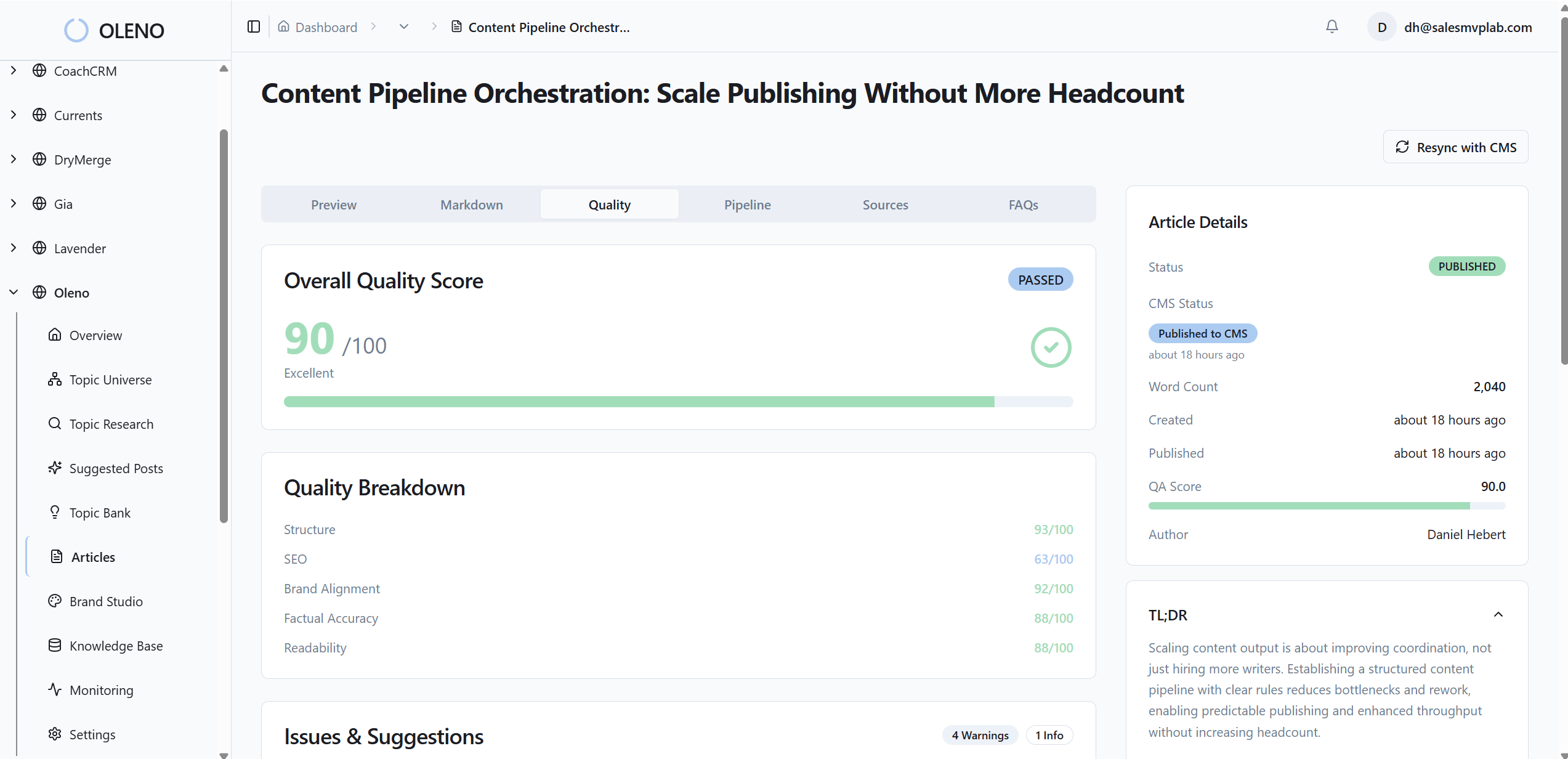
Oleno’s QA checks enforce source presence, recency, and banned phrasing before anything ships. When a competitor changes pricing, you update the record and regenerate. Review time drops from hours to minutes because reviewers verify exceptions, not entire drafts. That is the compounding speed you wanted and the credibility buyers actually feel.
Feature highlights that make this work:
- Bold governance rules: Product Studio prevents out-of-bounds claims with source checks
- Voice controls: Brand and Marketing Studios lock tone, terms, and structure
- Evidence enforcement: QA flags missing citations or stale snapshots before review
- Matrix to page: The engine converts your matrix into a clean, on-brand page
- Refresh in minutes: Update a record, regenerate, and publish safely
Seeing this in your environment is usually the unlock. One source of truth, two outputs, half the review time. Request a Demo
Before we wrap, one more question. Want to see how teams launch evidence-first pages without adding headcount and cut legal review time in half? Book a Demo
Conclusion
Most teams treat competitive content as opinion and PR. That is wrong for a public artifact. Competitive pages must be evidence-first or they do more harm than good. The path forward is clear, build a single source of truth, map it to your battlecard comparison page structure, align legal on the system, then ship weekly.
If you do this, PMMs can publish one evidence-backed comparison page per week, keep brand voice intact, cut legal review cycles in half, and move time-to-publish from weeks to days. That is not theory. It is the system that lets your expertise show up reliably, every time.
About Daniel Hebert
I'm the founder of Oleno, SalesMVP Lab, and yourLumira. Been working in B2B SaaS in both sales and marketing leadership for 13+ years. I specialize in building revenue engines from the ground up. Over the years, I've codified writing frameworks, which are now powering Oleno.
Frequently Asked Questions