Best AI SEO Tools for Small Business

Best AI SEO Tools for Small Business
Most small businesses don’t lose at SEO because they picked the “wrong” tool. They lose because the tool turns into a second job. You buy it thinking “this will save me time,” then you end up juggling briefs, drafts, edits, optimization scores, publishing steps, and a bunch of tabs you swore you’d never open again.
This guide is a practical comparison of a handful of popular AI SEO tools that small teams actually consider: AirOps, Byword, Copy.ai, Frase.io, Jasper, plus where Oleno fits if you’re trying to ship publish-ready articles without building a whole content ops department.
Quick Reference: Best AI SEO Tools For Small Business
| Tool | Best For | Starting Price | Notable Strength | Primary Limitation |
|---|---|---|---|---|
| AirOps | Teams prioritizing AI answer-engine visibility (AEO) with governed workflows | Free; paid commonly ~ $99–$449/mo | Tracks AI citations/share of voice and extractability | Heavier setup; needs content-ops rigor |
| Byword | Programmatic SEO and bulk long-form generation | $5/article or $99/mo | Batch generation and variable-driven templates | Learning curve; not great for nuanced expert content |
| Copy.ai | Fast short-form and template-driven content | Free; paid ~ $24–$29/mo | Multi-model access with easy UI | Inconsistent quality; limited collaboration |
| Frase.io | SERP-driven briefs and on-page optimization | Free; paid from ~$38/mo | Topic Score and semantic guidance | Drafts require editing and fact-checking |
| Jasper | On-brand marketing content across formats | ~$49/mo (Creator, monthly billing) | Brand voice controls and broad templates | Limited deep SEO features; review required |
| Oleno | Automated, publish-ready articles (text + visuals) without manual handoffs | From $449/mo | Deterministic system that generates, validates, and publishes together | No rank tracking, dashboards, or analytics by design |
 |
Key Takeaways:
- If you want SERP-driven briefs and optimization scoring, Frase.io is usually the most direct fit for SMB workflows (Skywork Frase Review).
- If you’re publishing hundreds of pages, Byword’s programmatic approach can pencil out, but you’ll plan for editing and setup time (Skywork Byword Review).
- If you need fast marketing copy across formats, Jasper and Copy.ai are strong, but neither is primarily an SEO research platform (Zapier Comparison).
- Oleno is for small teams that want a governed pipeline that goes from topic to published article, including visuals, and don’t want dashboards or rank tracking.
What Small Businesses Actually Need From AI SEO Tools
Small businesses need AI SEO tools that reduce decisions and rework, not tools that create more steps. The winning setup is usually the one that helps you pick topics, produce credible content, and publish consistently, without forcing you to become an SEO technician. For example, a SERP-brief tool like Frase.io helps with structure, while a programmatic tool like Byword helps with volume.

Here’s the blunt reality. Most SMBs aren’t trying to “do SEO.” They’re trying to get leads, calls, demos, bookings. SEO is just the channel that keeps compounding if you don’t break the process.
Back when I ran a content site, the traffic didn’t come from one genius article. It came from shipping a lot of solid pages consistently. Most pages were small. Some popped. The compounding was the point. Small businesses need tools that make consistency realistic.
So what does that translate to in requirements?
The SMB Checklist That Actually Matters
You’re typically optimizing for four things: speed to publish, acceptable quality, repeatability, and a workflow you’ll still follow in month three.
In practice, that means:
- A clear path from idea to draft (briefs help, but only if they’re not a headache).
- Some kind of quality guardrails so you don’t publish fluff.
- A way to keep brand voice consistent, especially when multiple people touch content.
- A publishing workflow that doesn’t break when you’re busy.
One interjection. Keyword volume dashboards rarely fix execution.
The Hidden Time Tax Of Modern SEO Tools
The hidden time tax is the extra labor you don’t budget for, like rewriting AI drafts, cleaning up outlines, and wrestling formatting into your CMS. Most platforms save time on drafting, but many still require heavy human effort for fact-checking, tone alignment, SEO formatting, and publishing. For example, Frase.io can speed up SERP research, but teams often still edit drafts for specificity and accuracy (G2 Frase Reviews).

Let’s pretend you’re a 5-person business and you want to publish 8 blog posts a month. Sounds reasonable. If each post takes 3 hours of “tool time” (brief, draft, optimize, rewrite, format, upload), that’s 24 hours. Three full workdays. And that’s before you do the stuff that actually makes the post good, like adding real examples, screenshots, or customer language.
This is where a lot of teams get into frustrating rework. The tool did “80%,” but the last 20% is where your credibility lives.
Where The Time Tax Shows Up
It usually hits in the same places:
- Editing AI drafts into something you’d put your name on
- Reconciling “optimization scores” with real-world readability
- Keeping internal links, schema, and formatting consistent
- Managing handoffs (writer to editor to SEO to publisher, even if that’s all you)
If you’ve ever opened a draft and thought, “I can’t publish this, but I also don’t have time to fix it,” you’ve met the time tax.
AirOps: AI Search Optimization And Content Ops
AirOps is a strong option if you care about AI search visibility (AEO) and you’re willing to set up workflows to manage content operations. It’s positioned around AI search optimization and governance, not just writing speed. For example, AirOps talks about AEO and content quality risks like “AI slop” in its own writing (AirOps on AI Slop).
AirOps tends to attract teams who are already a little more “ops-y” about content. You’re not just writing posts. You’re building a repeatable machine, sometimes with approvals, refresh cycles, and structured processes. AirOps also shows up in conversations about AEO as a category, including funding and positioning around AI search optimization (AICerts AirOps Funding).
AirOps Strengths For Small Teams
AirOps is useful when a small team wants to behave like a larger team, meaning you want process, governance, and repeatability without stitching everything together manually. Their messaging leans into AEO as a distinct motion, not just “SEO with AI,” which is directionally right if you believe answer engines will keep taking more clicks (AirOps AEO Strategy).
AirOps also publishes content about the shift in how content is evaluated and produced, which lines up with the idea that content ops matters as much as content writing (AirOps CMO Series). That’s not a feature list, but it tells you where their head is at.
Strengths you’ll feel day-to-day:
- AEO-forward framing and workflows (AirOps AEO Strategy)
- Focus on avoiding low-quality scaled content outcomes (AirOps on AI Slop)
- Positioned for teams that want governed processes, not one-off drafts (AICerts AirOps Funding)
AirOps Limitations And Pricing/Value
AirOps can be a lot for a small business if you mostly want content out the door. The setup and configuration overhead is real, especially if you’re not already disciplined about process. That’s not a knock. It’s just the tradeoff of flexibility.
Pricing also tends to land in SMB-to-midmarket territory with a free tier and paid tiers often discussed around the $99 to $449 range for typical plans (AICerts AirOps Funding). As always, check current pricing, it changes.
Where the value breaks down for SMB:
- If you’ll actually use the AEO and workflow discipline, it can make sense.
- If you just need “publish 6 posts a month,” you might feel the overhead.
How Oleno is Different: AirOps is oriented around configurable workflows and AEO visibility concepts, which can mean more setup and operational work. Oleno skips dashboards and tracking by design, and instead runs a deterministic pipeline from topic to published article, including visuals, with QA-Gate enforcing quality before it ships.
Byword: Programmatic SEO At Scale
Byword is a solid fit when you want programmatic SEO, meaning you’re generating lots of pages from a structured template and keyword set. It’s built for volume and repeatability more than nuanced thought leadership. Reviews and comparisons commonly describe Byword in the context of scaling SEO content production (Skywork Byword Review).
If you’re a small business with a catalog-like use case, lots of locations, lots of integrations, lots of “same page, different variable” needs, programmatic can work. It can also go sideways fast if you publish thin pages. That’s not Byword’s fault, that’s strategy.
Byword Strengths For Small Teams
The main strength is that Byword is designed for bulk publishing. It’s not pretending to be a general writing assistant. It’s closer to a production system for SEO pages.
If you’ve got the right input data and you’ve done the upfront thinking, you can scale. That’s why Byword shows up in programmatic SEO conversations and tool roundups (Babylove Growth Comparison).
Strengths that matter:
- Programmatic/batch workflows as the core motion (Skywork Byword Review)
- Often discussed as a tool for scaling SEO content production (Babylove Growth Comparison)
- Strong alignment with programmatic SEO tactics described in broader guides (TripleDart AI SEO Guide)
Byword Limitations And Pricing/Value
The learning curve is the cost. Programmatic SEO is not “press button, get traffic.” You need templates that don’t produce repetitive junk, and you need a strategy that won’t get you stuck in a sea of near-duplicates.
Pricing is often described as hybrid, like per-article or a subscription (commonly referenced around $5 per article or $99 per month) (Skywork Byword Review). That can be great if you’re truly publishing at scale. If you’re not, you might be paying for a machine you don’t need.
Common mismatch scenarios:
- You publish 10 posts/month. Byword might be overkill.
- You need deeply opinionated, experience-based content. You’ll still be editing.
How Oleno is Different: Byword leans into programmatic scale, which is great when you have structured inputs and a high page count plan. Oleno is built around a deterministic pipeline that generates, validates, and publishes complete articles (text plus visuals), with QA-Gate checks and a systemized flow that reduces manual handoffs rather than optimizing for bulk templates.
Copy.ai: Fast Templates For High‑Volume Teams
Copy.ai is typically best when you want quick, template-driven marketing content and you care more about speed than deep SEO research. It’s positioned as a general AI writing platform with workflows and broad use cases. Reviews highlight its template approach and marketing focus (Deeper Insights Copy.ai Review).
Copy.ai is the kind of tool you adopt quickly. That’s the point. The interface and templates make it easy to produce drafts across formats, which is why it’s often compared directly to Jasper (Zapier Comparison).
Copy.ai Strengths For Small Teams
Small teams like Copy.ai because it lowers the activation energy. You can go from nothing to “a thing on the page” fast. If you’re doing a lot of emails, landing page sections, ad variants, or social posts, that matters.
Third-party reviews often frame Copy.ai around speed and breadth of templates (Autoposting Copy.ai Review). And if you’re not trying to build an SEO research workflow inside the tool, that’s fine.
Strengths you’ll notice:
- Template-led drafting for common marketing assets (Deeper Insights Copy.ai Review)
- Often described as easy to use and quick to ramp (Autoposting Copy.ai Review)
- Commonly compared with Jasper as a generalist marketing AI tool (Zapier Comparison)
Copy.ai Limitations And Pricing/Value
Copy.ai’s downside for SEO-focused teams is that “fast drafts” can mean “more editing.” That’s not a scandal, it’s just the nature of broad tools. Content quality can vary depending on prompt quality, context, and how much domain specificity you bring.
Pricing is frequently described as having a free plan and paid plans in the ~$24 to $29 per month range in reviews and comparisons (Autoposting Copy.ai Review). For a small business, that can be a good deal, as long as you’re honest about the editing time you’ll spend.
If you’re trying to rank, you’ll usually add something else for SERP research and on-page structure. Or you’ll do it manually. That’s the trade.
How Oleno is Different: Copy.ai helps you draft quickly across lots of formats, but it often assumes you’ll do the final shaping and publishing. Oleno runs a fixed pipeline from topic to publish, including visuals, with Knowledge Base grounding and QA-Gate checks so a small team can reduce rewriting and formatting work.
Frase.io: SERP‑First Briefs And Optimization
Frase.io is one of the more straightforward picks when your main goal is SERP-driven briefs and on-page optimization. It’s designed to analyze top results and guide what to include, then score content against that target. That SERP-first approach is a core theme in reviews and product discussions (Skywork Frase Review).
For SMBs, Frase is often “good enough SEO structure” without buying a giant suite. And it’s got a lot of public feedback you can read through, which I always like when a tool will sit at the center of your workflow (G2 Frase Reviews).
Frase.io Strengths For Small Teams
Frase shines when you want to stop guessing what to write. You feed it a query, it pulls together themes from top-ranking pages, and it gives you a content path that is at least anchored in what the SERP seems to reward.
It’s also generally positioned as accessible for smaller teams, including on pricing and usability, which shows up across review sites (Capterra Frase Overview).
Strengths to expect:
- SERP-based content brief and research workflow (Skywork Frase Review)
- Public user feedback and established product footprint (G2 Frase Reviews)
- Generally SMB-friendly positioning compared to heavier SEO stacks (Capterra Frase Overview)
Frase.io Limitations And Pricing/Value
Frase doesn’t magically make content “yours.” You still have to bring experience, examples, and a point of view. And like most AI-assisted drafting, you should plan for fact-checking and editing, especially if you’re writing anything technical or regulated. Users regularly discuss pros and cons around workflow and output quality in reviews (G2 Frase Reviews).
Pricing is often cited as starting around $38/month for paid plans, with a free tier available in some form depending on the current packaging (Capterra Frase Overview). For SMBs, that’s usually a reasonable spend if it replaces manual SERP research.
Where Frase can frustrate you:
- You chase the score and end up with rigid writing.
- You still need a publishing pipeline and quality checks elsewhere.
How Oleno is Different: Frase.io is excellent at SERP-derived structure and optimization scoring, but it typically still expects you to manage drafting, editing, and publishing steps. Oleno is built around an end-to-end deterministic pipeline (topic to publish) with QA-Gate enforcement and built-in visual generation, so small teams can ship complete articles without stitching together a workflow.
Jasper: On‑Brand Marketing Content For Teams
Jasper is usually the best fit in this list when brand voice and cross-format marketing output matter more than hardcore SEO research. It’s a marketing platform first, and it’s often discussed in terms of brand controls, collaboration, and broad content use cases. It’s also commonly compared head-to-head with Copy.ai because they compete for the same “marketing team AI” budget (Zapier Comparison).
If you’re a small business that needs a lot more than blog posts, like campaigns, ads, and sales assets, Jasper can make sense. But you’ll still want to validate claims and tighten SEO structure with other processes.
Jasper Strengths For Small Teams
Jasper’s strength is that it’s built to help teams write in a consistent voice across a lot of asset types. That’s why it’s popular with agencies and marketing teams that need to output quickly without sounding like five different people.
On pricing, multiple third-party breakdowns consistently cite a Creator plan around $49/month, with other tiers and enterprise options varying (Samantha North Jasper Pricing, Wise Jasper Pricing). For a small team, predictable pricing is helpful, even if it’s not the cheapest.
Strengths that show up for SMBs:
- Common positioning around on-brand content and marketing workflows (Jasper Product Site)
- Widely cited entry pricing around $49/month for Creator (Samantha North Jasper Pricing)
- Frequent comparisons that highlight its marketing suite angle vs other writers (Zapier Comparison)
Jasper Limitations And Pricing/Value
Jasper isn’t an SEO suite. You can use it for blog posts, sure, but deep SERP research and on-page scoring typically live elsewhere. You also still want manual fact-checking. That’s a common theme across AI writing tools, and Jasper isn’t exempt.
Price perception is the other piece. $49/month can be fine, but if you’re a solo founder trying to keep spend tight, it can feel like a “nice to have,” especially if you still need an SEO research tool on top (Wise Jasper Pricing).
So the value equation tends to be:
- Worth it if you need breadth of marketing content and brand consistency.
- Less compelling if your main goal is ranking blog posts with SERP-driven briefs.
How Oleno is Different: Jasper is a broad marketing writing platform, which is useful when you need many asset types and collaborative workflows. Oleno is narrower and more systems-oriented: it runs a deterministic pipeline that produces publish-ready articles (including visuals), grounded in your Knowledge Base and checked by QA-Gate, without asking you to manage a draft-to-publish process.
When Oleno Makes Sense For Small Teams
Oleno makes sense for small teams when you want publish-ready articles produced through a repeatable system, not a prompt-and-edit loop. It’s designed to run a deterministic pipeline from topic selection through publishing, including visuals, with quality checks enforced before anything ships. For example, if you’re tired of rewriting AI drafts and doing CMS busywork, that end-to-end approach matters.
I’ve been on the “small team, big content ambition” side of the table. You start with energy, you ship a few posts, then the week gets busy and the process collapses. Not because you don’t care. Because the workflow is fragile.
Oleno is built around the idea that content is infrastructure. A system. Not a heroic task you do when you have time.
Core Differentiators For Small Business (Oleno)
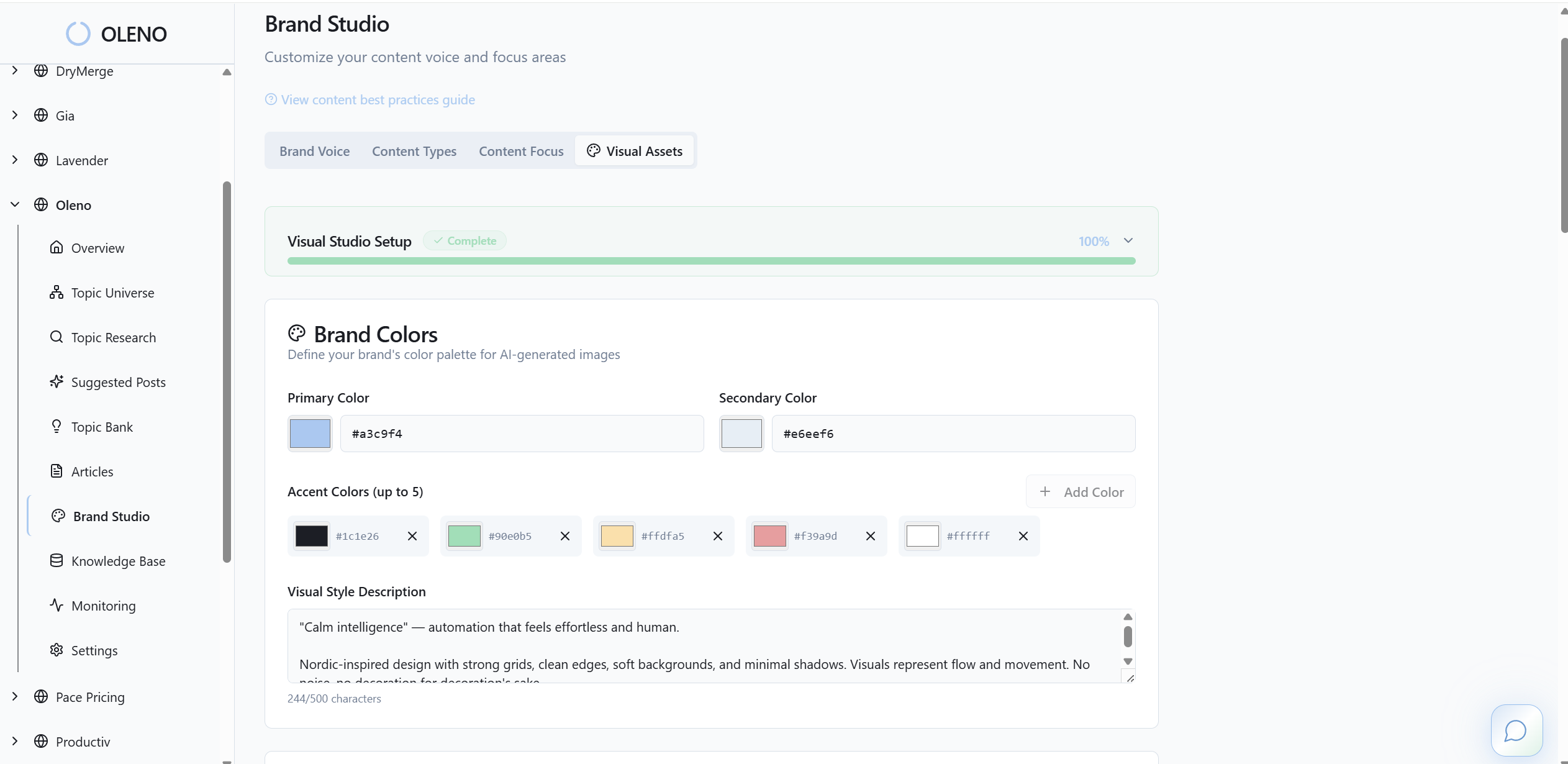
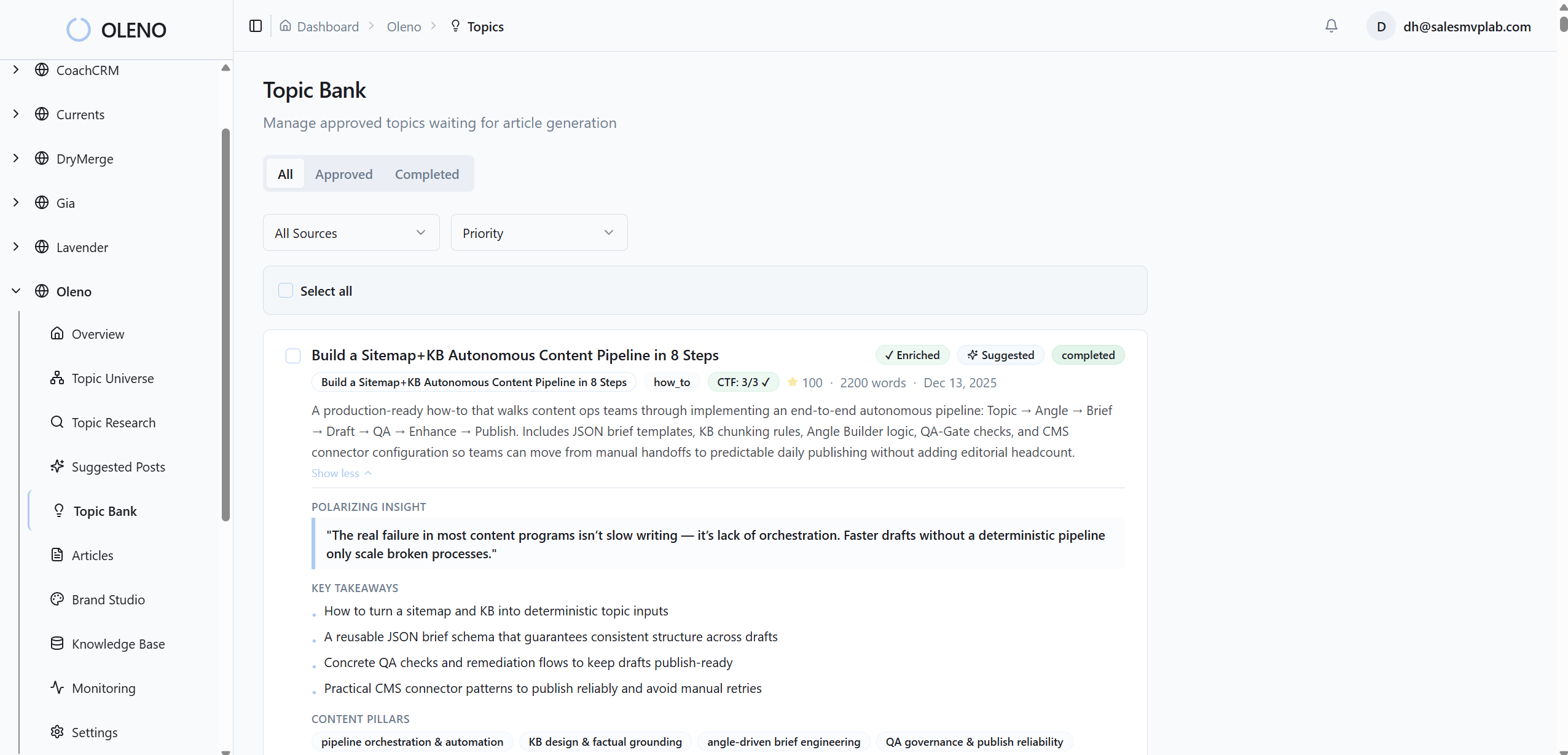
Oleno’s core difference is that it’s not mainly a writing interface. It’s a governed pipeline that runs the same sequence every time: topic, angle, brief, draft, QA, enhancements, image, publish.
A few specifics that matter for SMB reality:
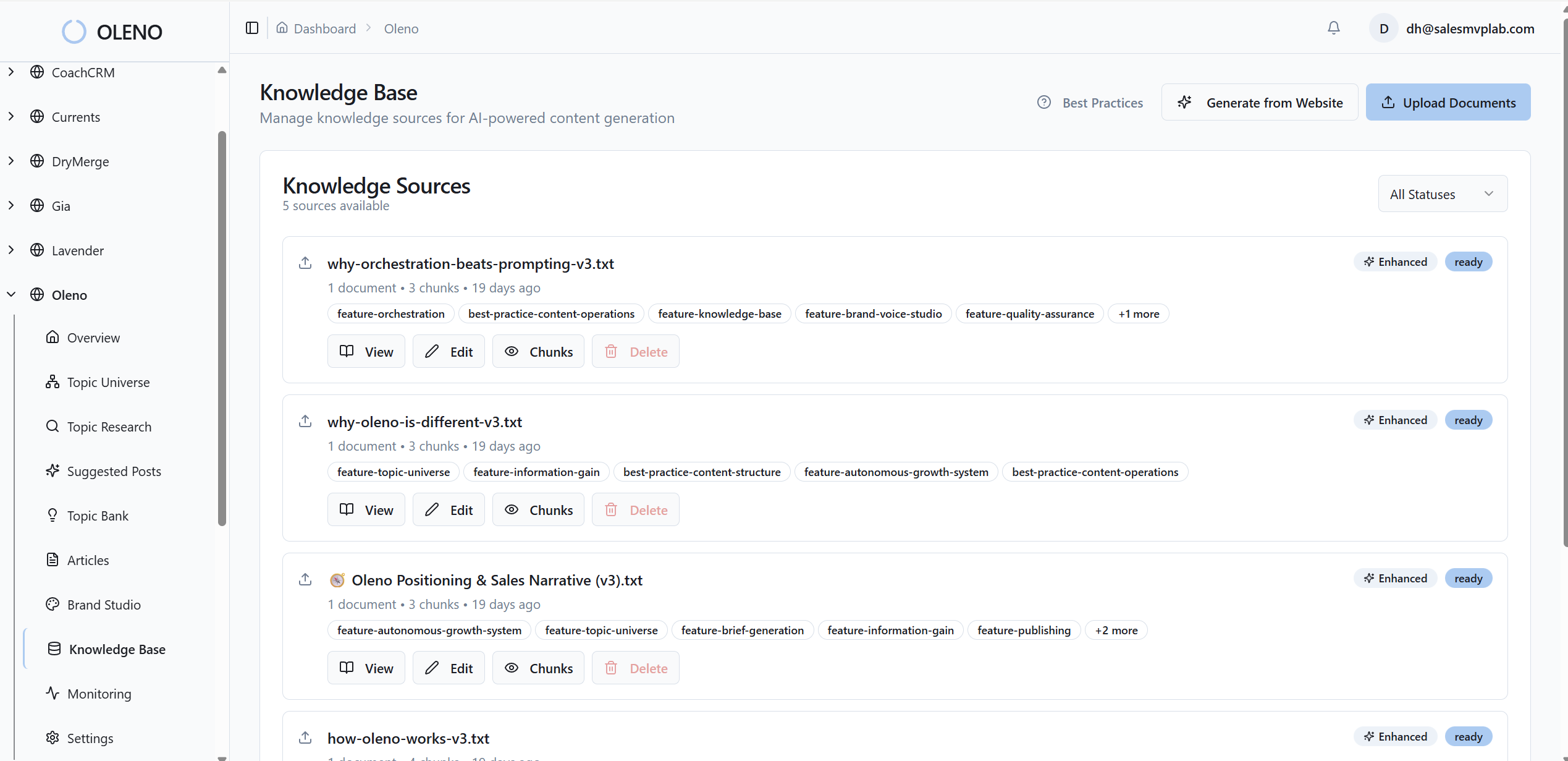
- Knowledge Base grounding so claims stay anchored in your approved context (you’re not starting from zero every draft).
- Brand Studio rules for tone, phrasing, structure, and banned terms, which helps when multiple people touch content.
- QA-Gate enforcement across structure, voice alignment, KB accuracy, SEO formatting, LLM clarity, and narrative order, with a minimum passing score of 85.
- Automatic retry if QA fails, which is basically the opposite of “here’s a draft, good luck.”
- CMS connectors so publishing is part of the pipeline, not a separate chore.
- Visual Studio to generate and place brand-consistent images with the article, instead of treating visuals as an afterthought.
- Topic Universe mapping that organizes topics into clusters, tracks coverage and saturation, and enforces a 90-day cooldown so you don’t over-publish the same thing.
- Deterministic internal linking and schema injection, so basics don’t get missed when you’re in a rush.
One nuance. Oleno intentionally does not include analytics, dashboards, rank tracking, or external monitoring. That’s a product choice. If your team wants reporting inside the same tool, you’ll want something else for that.
Getting Started And Fit (Oleno)
Getting started is about giving the system the right inputs so it can run without you babysitting it. That means your Knowledge Base, your sitemap, your focus areas, and your brand constraints.
From there, the small-team fit tends to look like this:
- You want daily or near-daily publishing without having to coordinate writers, editors, and uploads.
- You’re okay not having dashboards inside the same tool because you already use separate analytics.
- You care about consistent structure and voice, because you’ve been burned by random AI tone drift.
- You want fewer manual steps, fewer handoffs, and fewer opportunities for something to break.
If you want to pressure-test it without committing to a big migration, you can Request a demo now. It’s a clean way to see if the outputs match your bar and your brand constraints.
Final Verdict And Comparison Grid
The best AI SEO tool for a small business depends on whether you need SERP-driven optimization, programmatic scale, fast marketing templates, or an end-to-end publishing system. Frase.io tends to win for SERP briefs and scoring, Byword tends to win for programmatic volume, and Jasper or Copy.ai tends to win for general marketing production (Skywork Frase Review, Skywork Byword Review, Zapier Comparison). Oleno is a fit when your bottleneck is the workflow itself, not just drafting.
Feature And Fit Comparison Grid
| Criteria | Oleno | AirOps | Byword | Copy.ai | Frase.io | Jasper |
|---|---|---|---|---|---|---|
| Setup effort for SMB | Automated pipeline; no manual handoffs | Higher; configurable workflows | Moderate; templates/programmatic setup | Low; easy to start | Low-moderate; SERP brief workflow | Moderate; suite configuration |
| Programmatic/bulk generation | Not specified | Available via workflows | Core capability | Bulk options available | Limited | Available via templates/agents |
| SERP analysis & automated briefs | Not specified | Available | Available | Not native | Core capability | Limited native depth |
| On-page optimization scoring | Not specified | Partial | Partial | No | Core capability | No |
| AEO/AI search visibility tracking | Not specified | Core capability | No | No | Available | No |
| Brand governance/voice controls | Focus on on-brand outputs; no manual governance suite listed | Brand kits and governance | Tone customization and prompts | Brand voice features | Brand profiles and controls | Brand Voice/BrandIQ |
| Workflow automation | Deterministic, continuous system (no manual handoffs) | No-code workflow builder | Templates + batch ops | Automation workflows | Limited | Pipelines/agents |
| Image/visual generation | Generates visuals with text | Not highlighted | AI images supported | Partial/varies | Not highlighted | Image suite available |
| Analytics, rank tracking, dashboards | Deliberately not included | Dashboards and tracking | GSC integration and tracking | Not core | GSC integration and reports | Not core |
| Publishing/integrations | Publishes as part of automated system | CMS/CRM/APIs | CMS and GSC | API and some integrations | WordPress/Chrome; GSC | Enterprise integrations |
| Content reliability (editing required) | Validated before publishing; no human-in-the-loop editing | May need human review for expert depth | Often needs editing for nuance | Editing commonly required | Editing and fact-checking recommended | Manual review recommended |
| Best fit summary | Small teams wanting publish-ready, brand-complete articles | Teams investing in AEO and workflow governance | Agencies/teams scaling programmatic pages | SMBs needing fast templates and volume | SEO teams optimizing pages from SERP data | Marketing teams prioritizing brand consistency |
If you’re leaning toward an end-to-end system instead of another drafting tool, you can try using an autonomous content engine for always-on publishing. That’s usually the fastest way to see if the “pipeline” approach matches how your team actually works.
What I’d Do If I Were In Your Seat
If you want a simple decision rule, here it is:
- Pick Frase.io if your team is SERP-led and you like optimization workflows, and you’re fine editing drafts (G2 Frase Reviews).
- Pick Byword if you’re committed to programmatic volume and you have the inputs and templates to support it (Skywork Byword Review).
- Pick Copy.ai if you need speed across lots of marketing formats and you don’t want heavy setup (Deeper Insights Copy.ai Review).
- Pick Jasper if brand voice consistency across campaigns matters more than SEO-native research (Samantha North Jasper Pricing).
- Consider AirOps if you’re investing in AEO and you’re willing to run content like an ops function (AirOps AEO Strategy).
And if what you really want is, “Stop giving me drafts. Just publish the thing, with the right structure and visuals,” that’s the Oleno lane. If you want to poke at it without a big commitment, Request a demo.
The final thought: tools don’t create compounding. Systems do. Pick the one you’ll actually keep using when you’re busy.
About Daniel Hebert
I'm the founder of Oleno, SalesMVP Lab, and yourLumira. Been working in B2B SaaS in both sales and marketing leadership for 13+ years. I specialize in building revenue engines from the ground up. Over the years, I've codified writing frameworks, which are now powering Oleno.
Frequently Asked Questions