Best Autonomous Content Marketing Software for Small Marketing Teams

Most teams looking for the best autonomous content marketing setup are comparing the wrong things. They compare writers vs AI, tool vs tool, prompt quality vs prompt quality. That's not the real fight.
The real fight is whether your demand gen actually runs like a system, or whether it's still a pile of disconnected tasks that just happen to create content.
Key Takeaways:
- The best autonomous content marketing system is not the one that writes the fastest. It's the one that keeps strategy, voice, audience, and product truth aligned at scale.
- Most AI content tools fail because they optimize channel output, not marketing execution.
- Prompting creates drafts. Orchestration creates a repeatable demand-gen engine.
- GEO raises the bar because LLMs reward consistency, clear positioning, and repeated narrative across many assets.
- Scaling SaaS teams usually don't have an ideas problem. They have a coordination problem.
- Autonomous content marketing only works when governance comes before generation.
- Tools like Oleno matter when they enforce the system, not when they just produce more words.
Why Most Autonomous Content Marketing Setups Break Down
Most autonomous content marketing setups break down because they automate writing before they fix alignment. That sounds efficient at first. It usually creates more review, more rewrites, and more meetings.
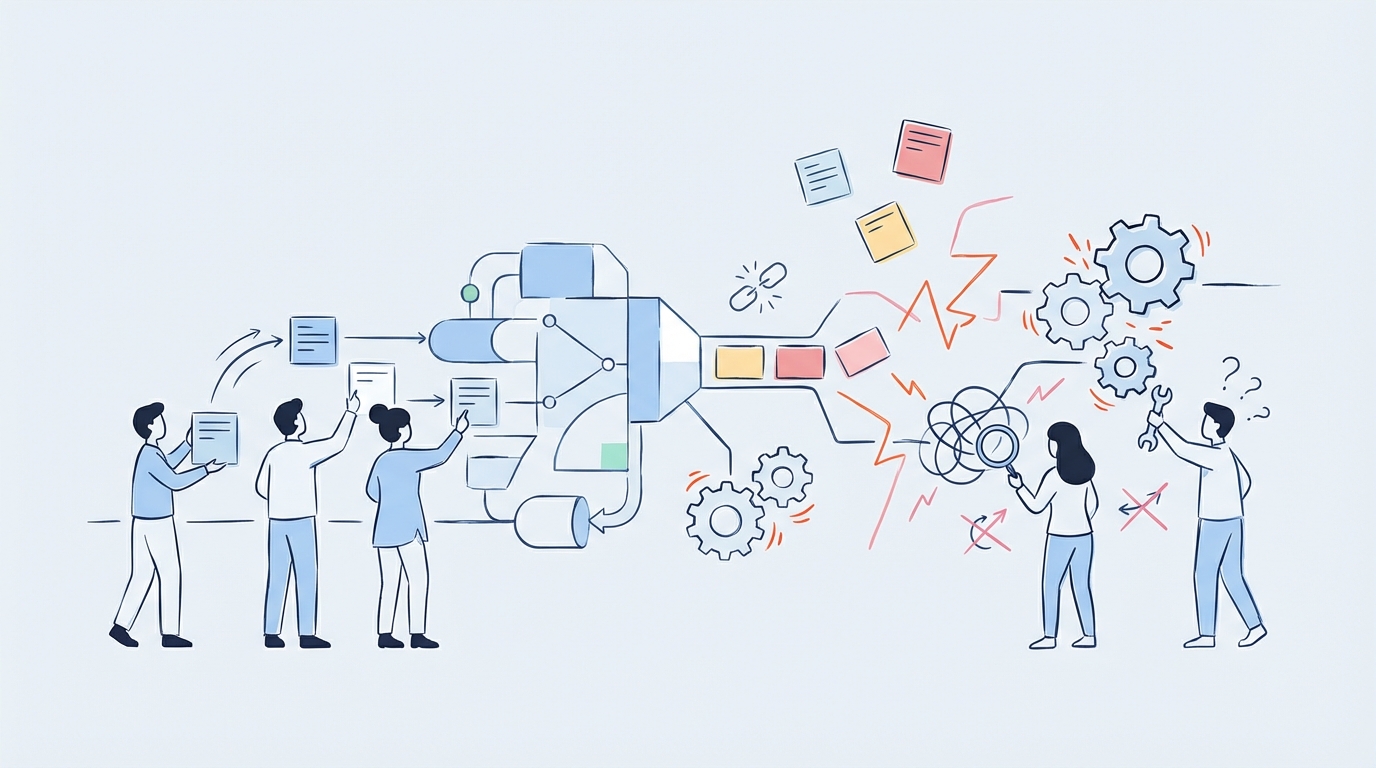
I’ve seen this pattern a bunch of times. Early on, one strong marketer can carry a content program by force of context. They know the customer, they know the product, they know what the company is trying to say, and they can push out good work fast. Then the team grows. More writers come in. PMM has one view of the story, demand gen has another, SEO wants keyword coverage, leadership wants stronger POV, and suddenly content quality gets weird.
The issue isn't output volume
The issue isn't that your team can't generate enough drafts. AI can give you drafts all day long. The issue is that most of those drafts are built without the stuff that actually makes marketing work.
They don't know your market POV. They don't know your category framing. They don't know the enemy you're positioning against. They don't know which claims are safe to make, which use cases matter most, or how your best customers actually talk about the problem. So you end up with content that looks finished but lands flat. Sound familiar?
A lot of teams blame the model here. I don't think that's quite right. The model is doing what it was asked to do. The real mistake happened earlier, when the company treated content generation like a standalone task instead of part of a larger system.
Content drift is what really kills trust
Content drift is what really kills trust. One article sounds sharp and opinionated. The next sounds generic. One landing page frames the market one way. A webinar deck frames it another way. A comparison post gets too aggressive. A feature page gets too vague. Over time, the whole thing starts to feel stitched together.
For scaling SaaS marketing teams, this gets expensive fast. You already have talent. That's not the problem. The problem is rework tax. Content gets written, reviewed, rewritten, softened, approved late, and then published after the moment passed. Coordination cost starts beating creation cost.
And yeah, it wears on the team. When your people keep redoing work they thought was done, they stop trusting the system. Eventually they stop trusting the tools too.
GEO makes the old mess more obvious
GEO makes the old mess more obvious because LLMs are not just looking for pages. They're looking for signals of real expertise, repeated clearly and consistently across many assets. McKinsey has been making the broader point for years that personalization and relevance matter when buyers evaluate brands. LLM-driven discovery pushes that further.
In SEO, you could sometimes get away with tactical wins. In autonomous content marketing, especially the kind people call the best autonomous content marketing, you can't fake coherence for very long. If your market story changes article to article, if your product definitions drift, if your audience language is generic, that weakness compounds.
That's why the old stack struggles. Not because the tools are useless. Because they were built to optimize pieces, not the whole engine.
The Best Autonomous Content Marketing Starts With Marketing, Not Prompts
The best autonomous content marketing starts with marketing fundamentals. Not prompts. Not workflows. Not a list of fancy AI tricks. Marketing first.
I remember hearing April Dunford on a panel years ago, and one line stuck with me hard. Tactics without strategy are shit. Crude wording maybe, but dead on. Because once you've actually been inside enough SaaS teams, you see it everywhere. People obsess over channels and tools when the real issue is they haven't nailed the story.
Bad marketing systems hide behind tool activity
Bad marketing systems hide behind tool activity. You can have a keyword platform, an AI writer, a CMS, a social scheduler, a few freelancers, a PMM review cycle, and still have a broken engine.
Why? Because none of those things answer the core questions. What market are you trying to shape? What does your company believe that others miss? Who are you actually talking to? What problems matter to that audience? Which use case gets buyers in the door first? What should never be said about the product? What should always be reinforced?
If those answers are not encoded somewhere stable, autonomy just means automated inconsistency.
The real root cause is missing governed context
The real root cause isn't weak copy. It's missing governed context. That changes the whole conversation.
Best autonomous content marketing systems have to know four things before they write anything useful:
- Your market point of view
- Your audience and persona context
- Your product truth and boundaries
- Your brand voice and rules
Without those, every draft is basically starting from zero. Even with templates. Even with good prompts. Even with smart writers reviewing after the fact.
I've watched this happen with small teams and bigger ones. One good marketer can hold all that context in their head for a while. But once you have multiple contributors, or multiple content types, or multiple funnel stages, it breaks. Not all at once. Slowly. Then all at once.
Why autonomous content marketing often disappoints
Autonomous content marketing often disappoints because people buy a writing shortcut and expect a demand-gen system. Those are not the same thing.
Prompting is useful. I’m not against it. We were surprised by how fast it could speed up first drafts for narrow tasks. But prompting pushes judgment back onto humans. Humans still have to catch inaccuracies, clean up positioning, enforce voice, decide what gets created next, and keep everything aligned over time.
That means the humans are still carrying the system. The software is just spitting out text.
The best autonomous content marketing doesn't ask humans to carry the system manually. It lets humans define the system once, then keeps execution inside those boundaries.
What strong autonomous systems actually do
Strong autonomous systems turn marketing into a repeatable operating model. Google's own guidance on helpful content keeps circling back to people-first value and original expertise. That's not some side note anymore. It's the whole game.
So what does that mean in practice? It means the system has to preserve positioning. It has to understand old way vs new way framing. It has to handle audience differences. It has to enforce product accuracy. It has to keep narrative consistency across acquisition, category education, evaluation, and product-led content.
That's a lot. Which is exactly why a draft generator alone doesn't cut it.
How to Build an Autonomous Content Marketing System That Actually Holds Together
An autonomous content marketing system that actually holds together has to separate strategy from execution. Strategy stays human. Execution becomes systematic. That's the shift.
This is where a lot of teams get unstuck. They stop asking, "How do we generate more content?" and start asking, "What has to be true before generation happens?" Better question. Much better.
Encode your point of view before you scale anything
Encode your point of view before you scale anything. If you don't, your content will default to neutral education, and neutral education is usually forgettable.
Your best autonomous content marketing system should know your category framing, your key messages, your market point of view, and the enemy you're positioning against. For a lot of SaaS teams, that enemy is not one competitor. It's the old way of operating. Patchwork tools. Manual coordination. Quarterly resets. Endless review loops. Generic AI content with no real stance.
You need that point of view showing up again and again across articles. Not word for word. But clearly enough that a buyer, or an LLM, starts to see the same signal repeated.
I've found this is where a lot of content programs either become real or stay fluffy. Once the POV is clear, decisions get easier. Topics get easier. Angles get easier. Reviews get easier.
Model audience, persona, and use case together
Model audience, persona, and use case together. Most teams do one or two of these. Very few do all three in a useful way.
Audience tells you the company context. Persona tells you who inside that company cares. Use case tells you what job they are trying to get done. Put those together and the content starts sounding like it belongs in a real buying conversation.
For a CMO or VP Marketing at a scaling SaaS company, the angle is not "how to publish more blog posts." It's "how do I build a system that proves ROI, reduces rework, keeps the story tight, and gives me executive visibility without adding more coordination overhead?" That's a very different article.
Best autonomous content marketing systems understand that distinction. They don't write to a generic reader. They write to the buyer you actually need.
Lock product truth before drafts get loose
Lock product truth before drafts get loose. This one matters more than people realize.
A lot of AI-assisted content goes bad in subtle ways. Not because it's wildly wrong. Because it's slightly wrong. A feature gets overstated. A use case gets stretched. A product claim gets phrased too broadly. A reader might not notice every time. Your team does. And once your PMM team stops trusting the drafts, the whole system slows down.
So your autonomous content marketing setup needs approved product definitions, feature boundaries, and supported use cases built in from the start. Not patched in at review. Before.
This is boring operational work. I know. But it's the kind of boring work that saves you from endless revision debt later.
Build topic selection as a system, not a brainstorm
Build topic selection as a system, not a brainstorm. The teams that compound are not randomly publishing. They're covering territory on purpose.
That means topic discovery, prioritization, and coverage have to be tied back to your audience, funnel, product, and market narrative. You want acquisition content, sure. But you also want category education, buyer enablement, product-led education, and point-of-view content. If you only automate top-of-funnel SEO, you'll create traffic and still leave revenue on the table.
Honestly, this is one of the most overlooked parts of the best autonomous content marketing conversation. People talk about writing. They don't talk enough about deciding what should exist.
Put quality gates before publishing, not after regret
Put quality gates before publishing, not after regret. Quality should not depend on whether one tired reviewer catches everything at the end of the week.
A solid system checks voice, structure, clarity, repetition, factual grounding, and SEO readiness before something reaches the finish line. HubSpot's State of Marketing reporting keeps showing how teams are under pressure to produce more with less. That pressure is exactly why quality control has to be systematic.
And this is where you finally get leverage. Not because the machine wrote faster. Because the machine enforced the standards humans were previously trying to hold together by memory and effort.
If you want to see what that kind of governed execution looks like in practice, Request a Demo.
Why Oleno Fits the Best Autonomous Content Marketing Model
Oleno fits the best autonomous content marketing model because it starts with governance, then runs execution inside those rules. That sounds simple. It's actually the whole difference.
A lot of tools start at the draft. Oleno starts earlier. It lets the marketing team define what the company believes, how it sounds, who it's speaking to, and what is true about the product. Then the system uses that context across the content pipeline.
Governance keeps the story from drifting
Brand Studio, Marketing Studio, and Product Studio are a big part of this. Brand Studio lets teams define tone, style, vocabulary, and article voice examples so outputs don't wander all over the place. Marketing Studio encodes category framing, key messages, and narrative structures, which is critical if you're trying to shape a category instead of just ranking for keywords. Product Studio keeps approved product definitions, claims, and boundaries in one place so content doesn't drift into invented nonsense.
That matters for scaling SaaS teams because drift is the tax you keep paying when more contributors enter the system. Oleno reduces that tax by making context reusable instead of tribal.
Execution gets mapped to real marketing work
Oleno also maps execution to actual demand-gen jobs, not just "write article." Programmatic SEO Studio handles acquisition content at scale with topic discovery and a locked-outline process. Category Studio is built for long-form category narrative and thought leadership. Buyer Enablement Studio supports bottom-of-funnel decision content. Product Marketing Studio handles product-led education.
That mix matters. Because the best autonomous content marketing strategy isn't one content type repeated forever. It's full-funnel coverage that reinforces the same story from different angles.
After you've taught the system your rules, the Orchestrator can schedule approved topics, run job blueprints, and enforce per-type quotas on a regular cycle. Then the Quality Gate evaluates voice, structure, clarity, grounding, and SEO before weak content slips through. And for leadership, the Executive Dashboard gives a read on output cadence, quality trends, coverage gaps, pipeline health, and quota use.
That's the part I like. You stop managing random acts of content. You start managing an operating system.
If you want to see how a governed engine handles category content, SEO content, product content, and buyer content without the usual coordination mess, Request a Demo.
Oleno is built for executive-level control
For a CMO or VP Marketing, this is not about replacing judgment. It's about finally putting judgment in the right place.
You define the positioning. You define the audience. You define the use cases. You define the product truth. You define the voice. Oleno executes within that. That means small teams can operate with the consistency of much larger ones, and bigger teams can stop bleeding time through handoffs and rewrites.
We're not 100% sure every team needs full autonomy on day one. Some will want heavier review at first, and that's fair. But the best autonomous content marketing model for executive teams usually looks like this: leadership sets the rails, the system keeps the train moving, and humans step in where judgment actually matters.
Want to see that in action with your own positioning and content model? Book a Demo.
Why the Teams That Win Will Run Content Like a System
The teams that win with autonomous content marketing won't be the ones with the flashiest prompts. They'll be the ones with the clearest fundamentals and the strongest system for repeating them.
That's why the best autonomous content marketing approach starts with strategy, locks down governance, and only then automates execution. Do that well, and content compounds. Skip it, and you just automate drift.
Oleno was built for teams that are done babysitting fragmented execution and want demand gen to run like an actual system.
About Daniel Hebert
I'm the founder of Oleno, SalesMVP Lab, and yourLumira. Been working in B2B SaaS in both sales and marketing leadership for 13+ years. I specialize in building revenue engines from the ground up. Over the years, I've codified writing frameworks, which are now powering Oleno.
Frequently Asked Questions