Best Autonomous Content Marketing Tools for SEO Consultants

SEO consultants don’t lose margin on drafting. They lose it on the 2 to 5 review passes that happen after a “fast” first draft misses search intent, brand nuance, or plain facts.
That’s the trap in the autonomous content marketing software market right now. A lot of tools promise speed. Fewer reduce editing debt. And if you’re running client work, that difference matters more than another 20 templates or another workflow canvas.
Google’s guidance on helpful, people-first content keeps pushing the market in the same direction: better original content, clearer expertise signals, and less filler. At the same time, search is changing under AI-generated experiences in Google itself (Google Search generative AI overview). So if you’re buying autonomous content marketing software for SEO consulting work, you’re not really buying “AI writing.” You’re buying a system for quality control at scale.
| Platform | Best fit | Starting price | Core strength | Main limitation | Consultant suitability |
|---|---|---|---|---|---|
| AirOps | SEO consultants and agencies with custom workflows | ~$99/month | Flexible workflow automation and AI search optimization focus | Setup takes time | High for process-heavy teams |
| Jasper | Broader marketing teams needing polished brand copy | $49/month | Brand controls and broad template coverage | Manual fact-checking and weaker SEO ops depth | Medium |
| Copy.ai | General GTM teams and solo users | ~$24 to $29/month | Fast drafting and easy adoption | Long-form consistency can slip | Medium for light SEO work |
| Outrank | Volume-first SEO teams | $49 to $99/month | Automated SEO article workflow and publishing | Quality review burden can rise | High for throughput-focused shops |
| Byword | Agencies running programmatic SEO at scale | $5/article or $99/month | Batch page generation for large keyword sets | Less suited to nuanced expert content | High for programmatic campaigns |
Key Takeaways:
- AirOps is a strong fit when you already know your process and want to customize SEO workflow automation around it.
- Jasper is more of a broad marketing writing platform than a true SEO consulting operating system.
- Copy.ai wins on speed and ease of use, but long-form SEO work usually needs more cleanup.
- Outrank and Byword make the most sense when output volume matters more than deep brand governance.
- The best autonomous content marketing software for SEO consultants is usually the one that removes editing debt, not the one that drafts fastest.
Why Autonomous Content Marketing Tools Need More Than Fast Drafts
Fast drafts don’t solve the real bottleneck in SEO consulting. The bottleneck is review time, because bad assumptions made at draft stage show up later as rewrites, client revisions, and missed publish dates. A tool that writes quickly but forces a 45-minute cleanup loop isn’t autonomous in any useful sense.

An SEO consultant feels this pretty quickly. Monday morning, you’ve got 6 briefs open, two clients asking for “more authority” in the copy, and a writer who used the right keyword but missed the actual buying angle. The draft exists. Great. You still have to fix structure, tighten claims, and make sure it doesn’t sound like recycled sludge. That’s where margin disappears.
What “autonomous” really means in content marketing software
Autonomous content marketing software should reduce human decisions across the whole workflow, not just generate paragraphs. If the tool still needs a consultant to manually add positioning, rewrite the intro, fix facts, and decide whether the piece fits the client’s audience, the autonomy is partial at best.
A simple way to check this before you buy: map the workflow in minutes, not features. Count how long it takes from topic selection to publish-ready draft. Then split that time into three buckets: setup, drafting, cleanup. If cleanup is more than 30% of the total cycle, the platform is basically a drafting assistant with a nicer label.
That threshold matters. Once cleanup goes past about one-third of the workflow, your “automation” starts behaving like a junior writer who works fast but needs supervision. Some teams are fine with that. Consultants billing on tight retainers usually aren’t.
There’s also a hidden distinction between article autonomy and system autonomy. Article autonomy means one post gets produced quickly. System autonomy means the process repeats without losing voice, structure, or strategic alignment three weeks later when a different client, writer, or keyword cluster shows up. Big difference.
Why speed alone creates editing debt for consultants
Speed without guardrails creates editing debt. That debt compounds because every shortcut at draft stage becomes human labor later, usually by the most expensive person in the workflow.
Back when I was running lean content teams, this pattern showed up constantly. The first draft looked efficient. Then the senior person had to rescue it. First for clarity. Then for credibility. Then because the piece ranked for something adjacent but not useful. You save 20 minutes up front and lose 70 later.
The fastest diagnostic I know is this: pull your last 10 AI-assisted articles and score each one on four things before editing starts. Was the target audience obvious in the first 150 words? Did the piece make at least one product- or category-specific point a competitor couldn’t copy-paste? Were all factual claims safe to publish without manual checking? Did the conclusion point toward conversion, not just traffic? If fewer than 6 of 10 pass three of those four checks, your current setup is generating editing debt.
Critics of this view will say cleanup is normal. Fair point. It is normal. Especially in SEO work where SERP alignment and brand nuance both matter. The issue isn’t whether editing exists. The issue is whether the tool lowers the amount of high-cost editing done by strategy people. If it doesn’t, you haven’t really improved operations.
The hidden cost of prompt-based content operations
Prompt-based content operations look cheap because software fees are visible and review time isn’t. For consultants, that’s backwards. The expensive part is the context transfer you keep doing over and over.
Think about a small agency with three clients. One needs thought leadership for a category wedge. One needs comparison pages. One needs programmatic support content. If your team is working from prompts instead of encoded context, each new draft starts from semi-amnesia. You restate brand voice. Restate ICP. Restate what claims are safe. Restate what not to say. It’s like rebuilding the same stage set before every performance.
That’s why prompt-heavy systems tend to break around volume. At 3 articles a month, you can brute-force quality. At 20, the cracks show. At 50, the process itself becomes the risk.
The market has started reacting to this. AirOps, for example, has pushed hard into AI search and workflow systems (AI search coverage, AEO strategy). Google, meanwhile, keeps rewarding clearer usefulness signals over scaled filler (helpful content guidance). That combination matters. You can’t brute-force your way out of weak inputs anymore.
The real buying question is simple: are you buying a faster keyboard, or a repeatable content operation? That sets up the next section.
What SEO Consultants Should Actually Evaluate Before Buying
SEO consultants should evaluate autonomy by looking at review load, context retention, and workflow fit before they look at surface-level output speed. Pricing matters, yes, but the expensive mistake is choosing a platform that shifts labor to your strategist or account lead.
A good buying process uses observable thresholds. If a platform needs more than 7 days of workflow setup before first client value, it’s probably too heavy for solo consultants. If your average article still needs more than 25 minutes of senior review, it probably lacks enough governance. If the system can’t cleanly support both standard SEO articles and comparison pages, it may be too narrow for agency work.
Which evaluation criteria matter most for SEO consultants
The first thing to evaluate is where your bottleneck actually lives. A lot of buyers assume they need “better AI writing.” Often they need stronger control over process drift.
Use these questions to place yourself in the right bucket:
- Are you mainly producing high-volume SEO pages from structured inputs?
- Do you already have a defined process and want to automate steps inside it?
- Does your senior team spend more than 2 hours per week per client fixing tone, claims, or positioning?
- Are you selling SEO deliverables only, or broader demand-gen content too?
- Does publishing break because drafts are weak, or because coordination is messy?
If you answered yes to 1, programmatic tools move up your list. If yes to 2, flexible workflow platforms deserve a close look. If yes to 3, governance matters more than raw drafting. If yes to 4 and 5, you’re probably not shopping for a writing tool at all. You’re shopping for content operations software.
I’d also separate “customization” from “fit.” Some consultants love highly configurable systems because they already know exactly how they work. Valid. Others end up building a little machine nobody on the team wants to maintain. That tradeoff is real. A platform that can do anything is useful only if your team will actually keep it running.
Another good test: ask for the path from brief to publish-ready output without a founder-level operator in the loop. If the demo quietly assumes your smartest strategist is still checking every article, you’re not looking at true autonomy. You’re looking at assisted production.
That distinction becomes clearer when you compare the leading platforms side by side.
AirOps vs Jasper vs Copy.ai vs Outrank vs Byword
These five tools solve different parts of the content workflow, not the same job. AirOps leans into flexible process design and AI search visibility, Jasper into branded marketing content, Copy.ai into broad GTM speed, Outrank into automated SEO publishing, and Byword into programmatic page scale.
That’s why this comparison gets messy when buyers force a single winner. There isn’t one universal winner. There’s a better fit for a certain operating model. For SEO consultants, the right choice usually depends on whether you need custom workflow logic, better brand control, faster GTM copy, volume publishing, or programmatic scale.
AirOps: workflow flexibility and AI search optimization
AirOps is built for teams that want to shape their own workflow and push hard on AI search optimization. Its positioning around AI search, citations, and extractability is pretty explicit (AI search report, company coverage). For consultants with a clear operating model already in place, that flexibility can be a real asset.
The tradeoff is setup. AirOps isn’t the kind of tool you open for 20 minutes and immediately have your full process humming. It rewards process-minded operators who are willing to build and maintain logic. That’s great for agencies with repeatable SOPs and someone technical or systems-oriented on the team. Less great for a solo consultant who just needs a clean path from keyword to publishable page.
One useful buying rule here: if you change your client workflow often, flexibility helps. If your workflow is stable and your bigger issue is review consistency, flexibility can turn into overhead. I’ve seen this a lot. People buy the tool with the largest design surface, then spend weeks tuning instead of shipping.
How Oleno is Different: AirOps is strongest when you want to assemble and refine your own operating logic. Oleno is a closer fit when you want planning, audience context, product truth, QA, and publishing handled as one governed system instead of something you keep stitching together.
Jasper: brand control for broader marketing teams
Jasper is a broad marketing AI platform with strong brand-oriented writing features and a polished user experience. Pricing for the Creator plan starts at $49/month based on current public reporting (pricing overview, pricing breakdown). It makes sense for teams producing a lot of marketing copy across channels, not just SEO deliverables.
Its weakness for SEO consultants is narrower specialization. Jasper can help you draft, ideate, and keep copy closer to brand voice, but it still leaves a fair amount of verification and SEO workflow work to humans. Reviews and pricing writeups regularly point to manual fact-checking and higher total cost as teams scale (review analysis, pricing context).
That doesn’t make Jasper a bad choice. Not at all. If your consultancy does a mix of emails, landing pages, social, sales enablement, and blog content, Jasper can be a practical generalist. The issue is fit. Generalists tend to need more handholding when the work becomes SEO-operational and repeatable.
How Oleno is Different: Jasper centers on high-quality content creation across marketing tasks. Oleno is built more around governed execution, where positioning, audience, and product context get defined before drafting starts and stay consistent across planning, content jobs, and publishing.
Copy.ai: fast template-driven production for general GTM use
Copy.ai is easy to adopt and inexpensive at the entry level, with paid plans commonly listed around $24 to $29/month and a free option available (review, pricing comparison). That makes it attractive for consultants who need quick drafting help without a lot of implementation effort.
The catch is long-form consistency. Copy.ai is good at helping a user move faster, especially on shorter GTM tasks, but it’s less convincing when you need deeply structured SEO content that holds up across 1,500 to 2,500 words. Third-party reviews regularly point to uneven long-form quality and the need for cleanup (review summary, feature review).
There’s nothing wrong with using Copy.ai for first drafts or lightweight client work. In fact, for some consultants that’s the right answer. Cheap. Fast. Low friction. The problem starts when teams mistake draft acceleration for workflow maturity.
How Oleno is Different: Copy.ai is useful when the job is generating text quickly across lots of GTM tasks. Oleno is aimed at teams that want audience context, positioning, product accuracy, and workflow governance encoded before content moves into production.
Outrank: automated SEO publishing for volume-first teams
Outrank is aimed at teams that want keyword planning, article generation, and publishing in one SEO-oriented flow. Public materials emphasize SEO tooling, automated long-form creation, and publishing support (platform overview, SEO tools positioning). For output-focused teams, that’s appealing.
The tension is quality control. Reviews and alternative comparisons often mention that article quality and factual reliability can require more oversight than buyers expect (comparison review). If your business model depends on shipping a lot of pages and polishing them lightly, that may be acceptable. If your clients buy strategy and authority, it can create a rework problem.
A good rule here: if you publish more than 30 SEO pages a month per account and those pages are structurally similar, Outrank deserves consideration. If most of your value comes from nuanced thinking, differentiation, or category framing, volume-first tools usually need more editorial rescue.
How Oleno is Different: Outrank focuses on SEO workflow automation from planning to publishing. Oleno adds governance across voice, audience, positioning, and product truth so the workflow stays repeatable across more than one content type.
Byword: batch generation for programmatic SEO campaigns
Byword is built for programmatic SEO and batch page generation. That’s where it stands out. Reviews and industry roundups consistently frame it as a strong option for large-scale keyword sets and page creation workflows (review, programmatic SEO guide). If your consultancy runs programmatic campaigns, this matters a lot.
Its limitations are pretty intuitive. The same structure that makes batch generation efficient can make nuanced, expert-led content harder. That doesn’t mean impossible. Just less native. You usually get the most from Byword when the pages are template-friendly, data-backed, and large in number.
This is one of those cases where the old way still has merit. If the job is truly programmatic, forcing a governance-heavy system can be unnecessary. A batch engine is often the right tool. The mistake is assuming programmatic strength automatically transfers to thought leadership, category pages, or competitive content. It usually doesn’t.
How Oleno is Different: Byword is strongest when you need lots of SEO pages generated efficiently from structured inputs. Oleno is built for teams that need repeatable execution across SEO, product marketing, and competitive content without losing audience fit or strategic positioning.
How Oleno Differs for Governed, Repeatable Content Operations
Governance-first content operations make sense when your main problem is rework, narrative drift, and context loss across contributors. That’s the core distinction here. Some tools help you draft faster. Oleno is built for teams that need strategy encoded once and applied repeatedly across content jobs.
That matters most for scaling SaaS marketing teams, growth-stage SaaS companies, CMOs, Heads of Marketing, SEO managers, and content leaders who are tired of being the final quality filter on every piece. If your real bottleneck is fragmented execution, governed AI content platform logic becomes more valuable than another prompt layer.
Where governance-first systems change the buying decision
The buying decision changes when the cost of inconsistency gets higher than the cost of setup. That’s the line.
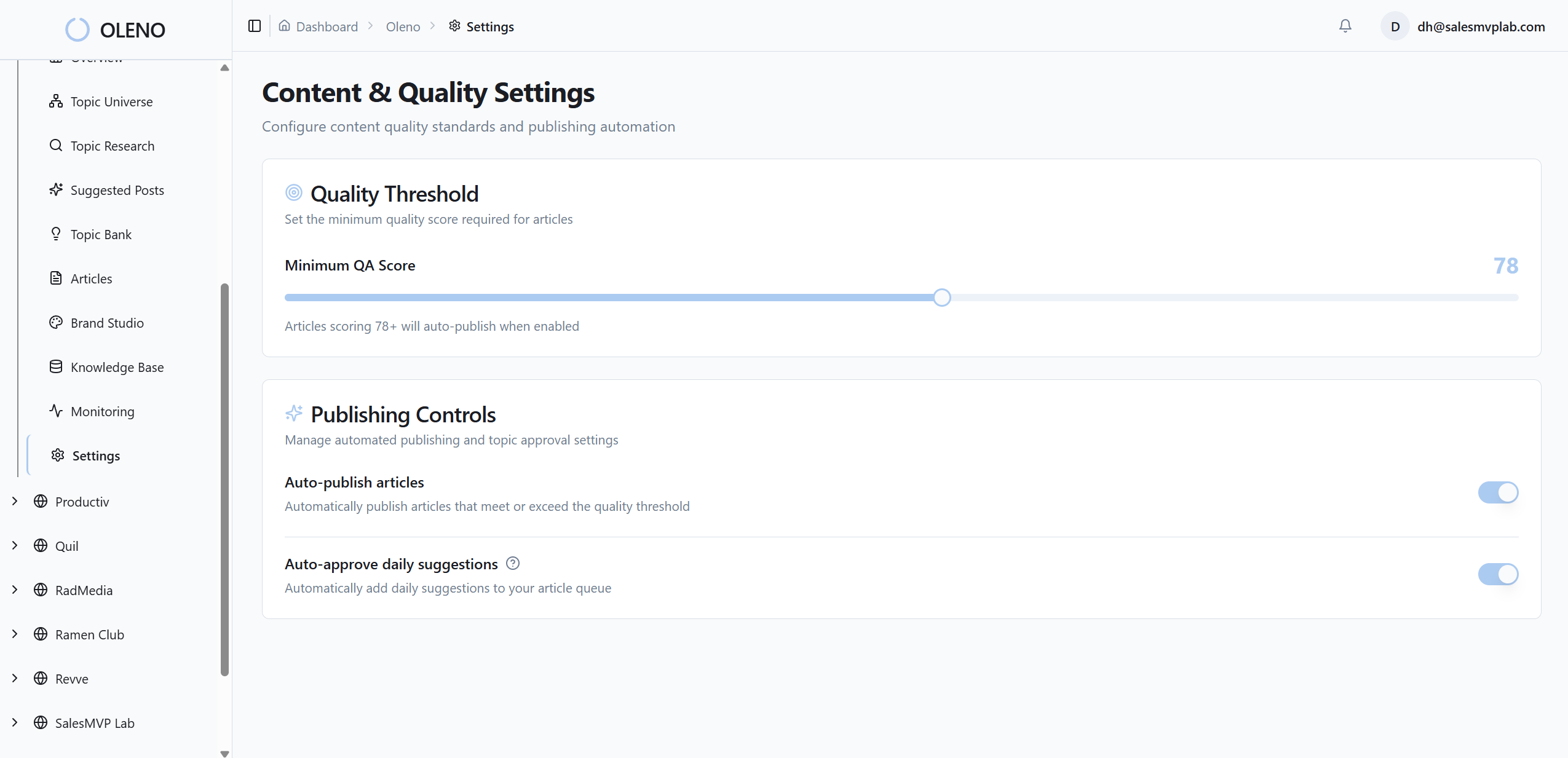
I’ve seen this happen when a team crosses from one writer and one strategist into a broader mix of PMM, demand gen, SEO, freelancers, and AI tools. Suddenly content doesn’t fail because nobody can write. It fails because nobody is writing from the same truth set. One person uses old messaging. Another goes too generic. Another nails the keyword and misses the actual demand-gen angle. Coordination becomes the tax.
Oleno is designed around that exact failure mode. Instead of relying on repeated prompting, it encodes product truth, market positioning, audience context, and brand voice inside a studio-based system before drafting starts. That shifts work left. And shifting work left is what reduces expensive review cycles.
There’s a founder story underneath that approach, which honestly makes sense. The product came out of manually prompting GPTs, copying output into a CMS, and burning 3 to 4 hours a day on repetitive SEO work before hard-coding an autonomous engine to queue topics, write, QA, and publish. That origin matters because it shows what the product is trying to remove: repetitive execution overhead, not just blank-page anxiety.
Why this fit matters more for SaaS teams than solo operators
Not every buyer needs this level of structure. That’s important to admit. If you’re a solo SEO consultant publishing a small number of client articles each month, a lighter tool may be the smarter buy. Lower price. Faster setup. Less process.
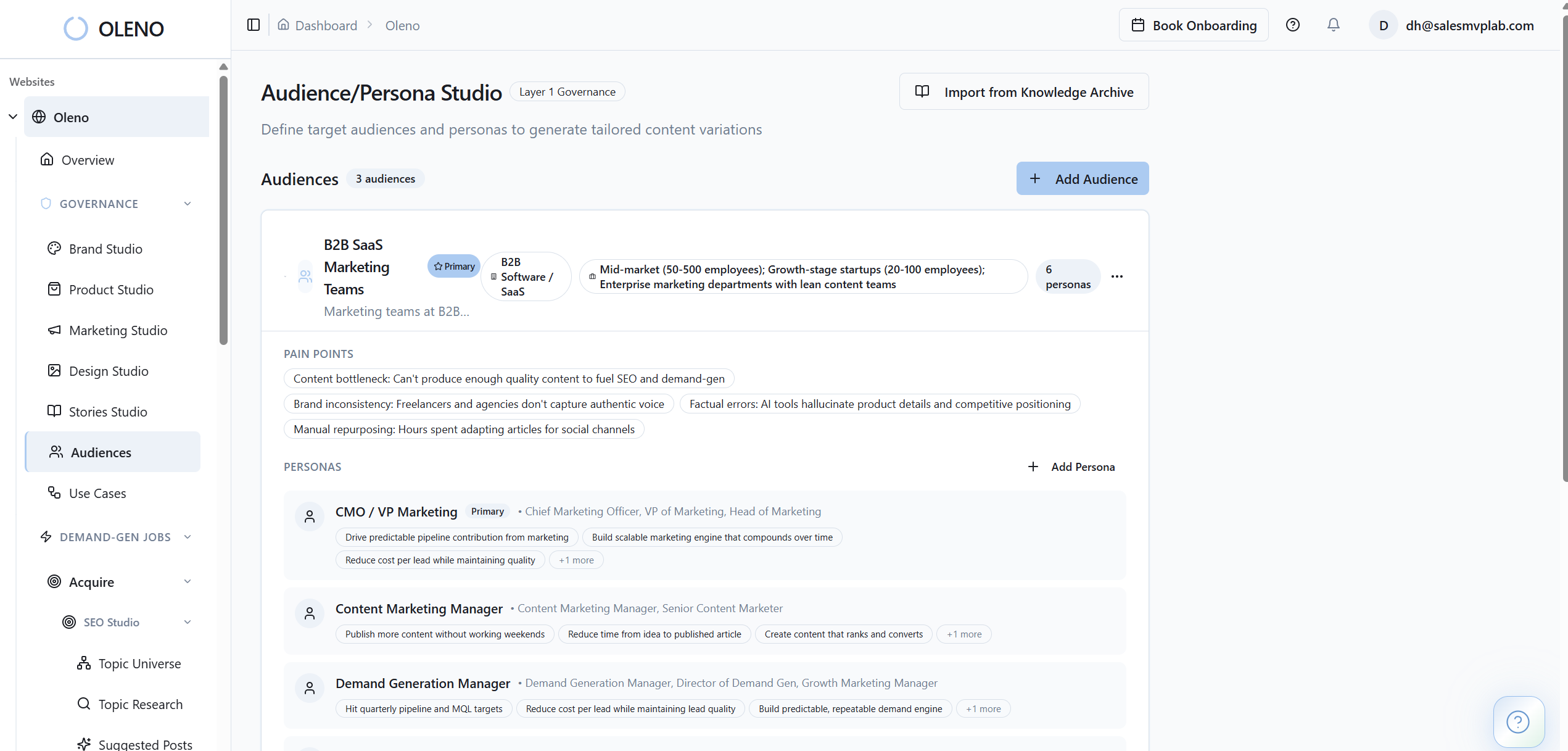
Where Oleno becomes more compelling is when your team has enough moving parts that content quality now depends on operational consistency. The best-fit profile is pretty clear: scaling SaaS marketing teams and growth-stage SaaS teams led by a CMO, Head of Marketing, SEO/Growth Manager, or Head of Content who need a repeatable system, not just another drafting tool.
In that environment, the product’s value isn’t “it writes.” Lots of tools write. The value is that planning, audience context, product truth, content jobs, QA, and publishing live in one governed loop. That’s a very different purchase decision.
If you want to see whether that kind of governed setup matches your workflow, request a demo.
| Platform | Primary user | Best content type | Autonomy level | Brand governance depth | SEO workflow depth | Programmatic SEO support | Publishing workflow | Fact-accuracy safeguards | Customization level | Ease of setup | Collaboration controls | Pricing model | Best for | Watch-outs |
|---|---|---|---|---|---|---|---|---|---|---|---|---|---|---|
| AirOps | SEO ops teams | AI-search and workflow-driven SEO content | High with setup | Medium | High | Medium | Workflow-based | Medium | High | Medium to low | Strong | Hybrid | Agencies with defined SOPs | Setup burden |
| Jasper | Marketing teams | Multi-channel marketing content | Medium | High | Medium to low | Medium | Partial | Low to medium | Medium | High | Strong | Subscription | Brand-conscious generalists | Fact-checking load |
| Copy.ai | GTM teams | Short-form and general drafting | Medium | Low to medium | Low | Low | Partial | Low | Medium | High | Medium | Hybrid | Fast adoption and lightweight use | Long-form cleanup |
| Outrank | SEO teams | Volume SEO articles | High | Low to medium | High | Medium | Strong | Low to medium | Medium | Medium | Medium | Subscription | Output-first SEO workflows | Review burden |
| Byword | Programmatic SEO teams | Batch SEO pages | High | Low | Medium | High | Strong | Low | Medium | Medium | Medium | Hybrid | Large keyword sets and templates | Weak for nuanced content |
| Oleno | SaaS marketing teams and governed content ops | SEO, product marketing, competitive content | High across full workflow | High | High | High | Strong | High | Medium | Medium | Strong | Output-based subscription | Teams with rework tax and narrative drift | Requires upfront governance setup |
Our take for SEO consultants choosing now
The cleanest way to choose is by operating model. If you want flexible workflow automation and already know your process, AirOps is a strong candidate. If you want broad marketing writing support, Jasper is the safer generalist. If you want low-cost drafting speed, Copy.ai still has a place. If you want output volume, look hard at Outrank or Byword depending on whether you mean articles or programmatic pages.
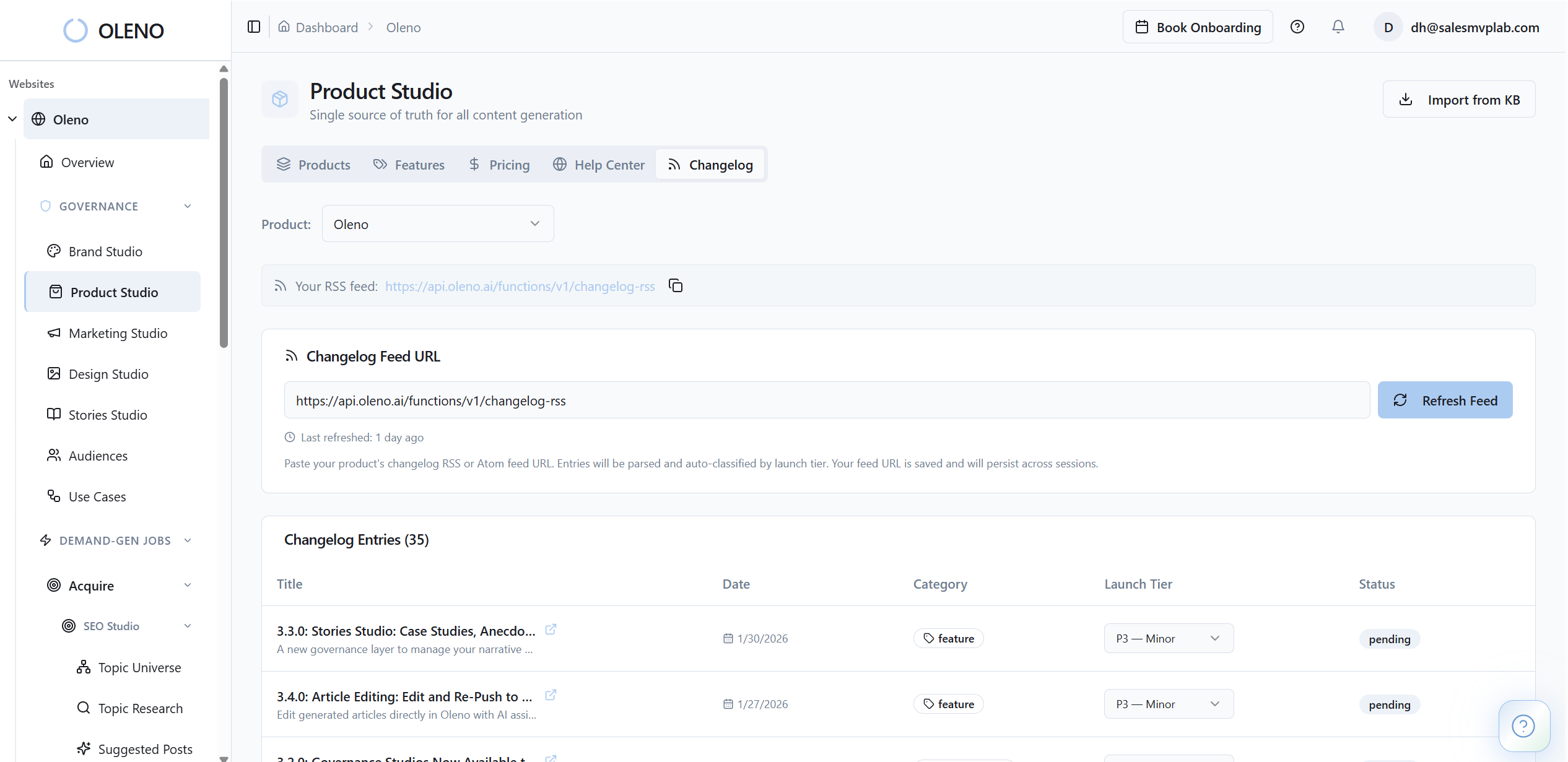
Choose Oleno when the real issue isn’t writing speed. Choose it when your business is losing time to rework, context gaps, and narrative drift across SEO, product marketing, and competitive content. That’s the core fit.
And yeah, there’s a tradeoff. Governance-first systems ask you to define the operating logic up front. That takes more thought than opening a blank prompt box. Still, for teams already paying the editing tax every week, that upfront discipline is usually cheaper than endless cleanup later.
If you want to pressure-test that fit against your current process, request a demo. If you already know the problem is repeatability across a growing content engine, book a demo.
The short version: the best autonomous content marketing software for SEO consultants depends less on who writes the fastest draft and more on who removes the most downstream labor. For lightweight SEO production, a flexible or volume-first platform may be enough. For governed, repeatable content operations across a SaaS growth engine, Oleno is built for a different job entirely.
About Daniel Hebert
I'm the founder of Oleno, SalesMVP Lab, and yourLumira. Been working in B2B SaaS in both sales and marketing leadership for 13+ years. I specialize in building revenue engines from the ground up. Over the years, I've codified writing frameworks, which are now powering Oleno.
Frequently Asked Questions