Best Autonomous Growth System for Founders in 2026

74% of companies now use AI in at least one business function, but most founder-led growth stacks still break at the same place: the handoff between draft and trustworthy publication (McKinsey). If you tried to build an autonomous growth system this year, you probably felt it already. The drafts show up fast. The confidence doesn't.
Founders usually say "autonomous growth system" when they mean a machine that can find topics, generate content, keep quality high, and publish consistently without needing daily babysitting. That's a bigger ask than most tools actually solve. Google's push into AI-powered search experiences has only raised the bar, because now visibility depends not just on output volume but on whether your content is structured clearly enough to be surfaced and cited (Google Search AI Overviews).
Some platforms are built for fast copy. Some are built for SEO workflows. Some are built for configurable automation. Very few are built for the messy middle where founders lose time: review, context transfer, positioning drift, and publishing reliability. That's the part worth evaluating first.
Quick reference for founders comparing autonomous growth platforms
These platforms solve different versions of the autonomous growth problem. AirOps leans into configurable AI search workflows, Jasper into on-brand generation, Copy.ai into speed, Outrank into SEO throughput, and Byword into programmatic scale. The right choice depends less on feature count and more on whether you need raw output, operational flexibility, or governed execution.
| Platform | Best for | Starting price | Primary strength | Primary limitation | Founder fit |
|---|---|---|---|---|---|
| AirOps | SEO and growth teams with ops maturity | Free tier, paid plans around $99/mo (AI Certs) | Custom no-code workflows for AI search use cases | Setup and maintenance can grow quickly | Good if you like building systems yourself |
| Jasper | Marketing teams focused on brand voice and campaign copy | $49/mo (Samantha North) | Strong brand voice tooling and broad creative use cases | SEO depth is lighter and fact review still matters | Good for founder-led marketing that needs polished copy fast |
| Copy.ai | Small teams needing quick GTM output | Free tier, paid plans from about $29/mo (Deeper Insights) | Fast template-led creation across sales and marketing | Output quality can vary across longer assets | Good for early-stage teams with low budget |
| Outrank | Teams pushing automated SEO publishing | $49/mo (Outrank) | End-to-end SEO article workflow with publishing focus | Editorial depth can be uneven | Good for founders testing search volume quickly |
| Byword | Programmatic SEO operators and agencies | $99/mo or per-article pricing (Skywork) | Batch generation at scale | Narrower fit for nuanced category or product-led content | Good for spreadsheet-heavy SEO programs |
Key Takeaways:
- AirOps is strongest for teams that want a flexible autonomous growth platform and have the time to configure workflows properly.
- Jasper makes sense when brand voice matters more than SEO depth, especially for founder-led campaigns and broad marketing copy.
- Copy.ai is the easiest low-cost entry point, but fast output often creates editing debt on longer-form content programs.
- Outrank and Byword are better fits for SEO throughput than broader AI demand generation system needs.
Why most autonomous growth systems break at the last mile
Most autonomous growth systems fail because they automate production before they stabilize judgment. A draft can appear in two minutes, but review, factual confidence, narrative consistency, and publish readiness still slow the system down. The result looks autonomous in a demo and very manual by week three.

What founders usually mean by an autonomous growth system
A founder opens five tabs at 9:10 p.m. One for keyword research. One for an AI writer. One for notes from sales calls. One for the CMS. One for a spreadsheet tracking what already got published. Three drafts get created. None are truly ready.
That's the real category. Not "AI writer." Not "workflow automation." It's the full path from idea to live page, with enough structure that you don't need to reread everything like a nervous cofounder before it goes out.
I think this is where buyers get tricked by demos. The Draft-to-Trust Gap is usually the real bottleneck. If a platform removes writing time but adds review time, you didn't automate growth. You just moved the work downstream.
A simple rule helps here: if you still need a founder or senior marketer to do final truth-checking on more than 30% of outputs, your system isn't autonomous yet. It's assisted.
Where automation helps and where teams still need judgment
Automation works well when the task is repetitive, bounded, and easy to validate. Topic clustering, outline generation, template-based copy, and scheduled publishing all fit that bucket. Strategic positioning, product nuance, and deciding what not to publish usually don't.
There's a fair case for saying founders can accept rough drafts early on. That's true. In a small company, speed matters a lot. But the tradeoff changes once content becomes a repeatable growth channel instead of a side project.
Think of it like hiring a junior SDR who can send 500 emails a day. Useful? Sure. Autonomous? Not unless the targeting, messaging, and follow-up logic are solid. Content automation is the same. The throughput impresses you first. The misses show up later.
The 3-Layer Autonomy Test works well here:
- Can the system decide what to make next?
- Can it produce something usable without heavy rewrite?
- Can it publish without creating brand or factual risk?
If the answer is no on even one layer, you've got partial automation. Not a true autonomous growth system.
The hidden cost of fast content without governance
Fast content gets expensive when every asset creates cleanup work later. That cleanup usually shows up as rewrites, internal Slack threads, founder approvals, stale product claims, and articles that rank but never support demand generation.
Back when I was running high-volume content, the pattern was always the same. Volume helped. A lot. But only when the underlying system preserved quality and point of view. Otherwise you ended up with dozens or hundreds of pages that technically existed and strategically went nowhere.
There's also a weird compounding effect here. Bad governance behaves like interest on a credit card. One weak article is manageable. Fifty weak articles create a maintenance problem. Two hundred create a narrative problem.
A practical threshold: once you're publishing more than 8 pieces a month across multiple contributors, undocumented brand rules start costing more than the writing itself. That's when governance stops being a nice-to-have and becomes infrastructure. The next section gets more practical: what should founders evaluate before they buy anything?
What founders should evaluate before automating growth
Founders should evaluate setup load, governance depth, editing debt, and publishing reliability before they compare flashy AI features. Tools differ less in what they can generate than in how much operational drag they create after generation. That difference determines time-to-value.
How setup complexity changes time-to-value
A no-code system can still be high-friction if every workflow needs to be designed, tested, and maintained by your team. That's why time-to-value isn't really about whether onboarding is short. It's about how many judgment calls the platform pushes back onto you.
Some founders genuinely want that flexibility. Fair enough. If you have an ops-minded growth lead, configurable systems can work really well. But if you're the one still approving landing pages at midnight, flexibility can become disguised labor.
Use the 2-Week Rule. If you can't get a reliable publishing motion running inside 14 days, the platform probably fits a more mature ops team than a founder-led growth motion. That's not a flaw in the tool. It's just a fit problem.
How to diagnose whether your team needs speed or control
Three questions usually sort this out fast. Are you short on drafts, or short on trust? Are you trying to publish more, or publish without rewrites? And is your bottleneck creative ideation, or coordination overhead?
A head of growth running experiments across landing pages and ad variants may care most about speed. A CMO with product marketing, content, and demand gen all contributing to the same narrative usually cares more about control. Different problem. Different tool.
I wouldn't overcomplicate this. If one person owns everything, choose speed first. If three or more people touch content before publish, choose control earlier than you think. That's why the competitor spread below matters.
AirOps vs Jasper vs Copy.ai vs Outrank vs Byword
These five tools represent five different answers to the autonomous growth question. AirOps emphasizes flexible workflow automation, Jasper emphasizes polished content creation, Copy.ai emphasizes fast GTM output, Outrank emphasizes SEO autopilot, and Byword emphasizes scale. None of them solve the exact same job.
AirOps for AI Search and Workflow Automation
AirOps is built for teams that want a configurable autonomous growth platform around AI search and workflow logic. Its appeal comes from flexibility, not from an opinionated content operating model. That makes it powerful for the right team and heavy for the wrong one.
Where AirOps stands out
AirOps has leaned hard into AI search workflows and citation-aware content thinking, and that positioning is pretty visible in its public messaging (AI Certs, AirOps AI Search Report). If you're trying to build a custom machine around research, prompts, generation, and post-processing, that flexibility is attractive.
What I like about this kind of setup is simple: it respects that workflows differ. A growth team with a technical operator can stitch together an AI growth system for founders that reflects their own process instead of forcing a prebuilt mold.
That said, flexible systems often assume more internal ops maturity than buyers realize. You're not just buying software. You're buying design responsibility.
Where AirOps requires more internal ops maturity
A configurable builder creates upside and drag at the same time. The upside is control. The drag is that someone has to define the logic, maintain it, and notice when the output quality starts drifting. AirOps itself talks openly about low-quality AI content and the need to avoid "AI slop" (AirOps), which tells you the problem is real enough to warrant a whole point of view around it.
Picture a lean startup with one founder and one contractor. They can absolutely get a workflow running. But when prompts multiply, exceptions pile up, and publish standards become inconsistent, the system starts to feel less like software and more like a side project.
If you want a custom workshop, AirOps makes sense. If you want a factory line already laid out, maybe less so.
Who gets the most value from AirOps
The strongest fit is usually an SEO or growth lead who wants workflow flexibility, AI search coverage, and room to tune the machine over time. That lines up well with teams optimizing for search execution rather than broader governed demand generation.
How Oleno is Different: Oleno takes a governance-first approach with planning, governance, and execution layers already structured for demand-gen work. For teams that don't want to build their own workflow architecture from scratch, that opinionated model reduces operational overhead.
Jasper for on-brand content production
Jasper is a content automation platform built around polished generation, brand voice support, and broad marketing use cases. It tends to fit teams that want strong creative output faster, especially across campaigns and short-to-mid-length content. Its tradeoff is that content trust still depends on human review.
Where Jasper stands out
Jasper remains one of the more recognized names in AI writing, and its positioning still centers on broad marketing use cases and branded content support (Jasper, Deeper Insights). The platform is good at helping teams move from blank page to usable draft quickly.
Compared with Copy.ai, Jasper is often described as the more polished writing environment for structured brand work (Zapier). That's a meaningful distinction if your founder content automation motion includes email, landing pages, campaign copy, and sales assets alongside blog work.
In plain English, Jasper is the nice suit in the closet. It shows up well. You still need judgment to know when to wear it.
Where Jasper still needs human oversight
Brand voice support does not equal factual reliability. That's the gap. Jasper can help content sound right, but founders and PMMs still need to verify product truth, positioning nuance, and strategic alignment. Especially in B2B SaaS. Especially when launches or competitive pages are involved.
And the price climbs faster than lighter tools. Public pricing references place Jasper at $49/month entry with higher tiers and enterprise packages depending on needs (Samantha North, Spendflo). That's not unreasonable. But it does mean the ROI case gets weaker if your team still has to do heavy fact checking.
My bias? Jasper is often strongest when the creative team already knows the story and just wants faster first drafts. The burden shifts when the tool is expected to preserve product truth on its own.
Who gets the most value from Jasper
Jasper fits founder-led marketing teams, agencies, and brand-conscious teams that want fast on-brand creation across many content formats. It fits less well when your main pain is cross-functional governance across PMM, SEO, and demand gen.
How Oleno is Different: Oleno centers governed execution, using Brand Studio and Marketing Studio to keep positioning and point of view stable across recurring demand-gen jobs. That matters when the issue isn't generating copy, but keeping product truth and narrative alignment intact over time.
Copy.ai for fast, template-led GTM output
Copy.ai is built for speed, ease of adoption, and broad GTM use cases. It works well when a team needs fast output across sales and marketing motions without much setup. The catch is that longer-form consistency can still require more editing than buyers expect.
Where Copy.ai stands out
Copy.ai has always been easy to pick up. That's part of its appeal. Reviews and comparisons consistently highlight speed, templates, and breadth of use cases across GTM teams (Deeper Insights, Zapier).
For a founder wearing six hats, that matters. You don't want to spend two weeks configuring an AI demand generation system just to ship some outbound copy, product blurbs, and social posts. Copy.ai gets you moving fast.
And the price makes experimentation easier. Public sources point to a free tier and paid entry around $29/month (Deeper Insights).
Where Copy.ai can create editing overhead
Low-friction tools often create a Review Tax later. That's my name for the time you spend fixing tone drift, structure drift, or generic output after the draft is already in your hands. The initial win feels huge. The cumulative editing load is what catches up.
This doesn't mean Copy.ai is weak. It means the tool is optimized for breadth and speed more than durable governance. If you want an autonomous growth platform that supports recurring long-form programs, the editing burden becomes part of your true cost.
There's a reasonable counterpoint here. Early-stage teams can live with editing overhead because budget matters more than polish. Totally fair. But once content becomes weekly infrastructure, that tradeoff starts to bite.
Who gets the most value from Copy.ai
Copy.ai is a good fit for small teams, solo marketers, and founders who need quick GTM output at a low entry cost. It's less suited to multi-contributor content operations where narrative consistency matters every week, not just on launch week.
How Oleno is Different: Oleno is built to reduce rewrites across recurring programs by grounding content in shared audience, brand, and marketing context. That makes it a better fit when your core problem is not "how do I get drafts fast?" but "how do I stop fixing the same drift every week?"
Outrank for automated SEO content at volume
Outrank is designed for SEO throughput, with a strong focus on keyword-driven content production and publishing automation. It fits teams that want search-focused execution with less manual coordination. It becomes less comfortable when editorial nuance matters as much as volume.
Where Outrank stands out
Outrank clearly positions itself around automated SEO workflows, article generation, and publishing efficiency (Outrank, Outrank). If your goal is to turn keywords into live pages quickly, that's a straightforward value prop.
This is where a lot of founder content automation buyers get excited. You can see a direct line from keyword list to output. Clean. Understandable. Fast.
And for some businesses, that's enough. Especially if the content program is narrow, search-led, and focused on lower-risk topics.
Where Outrank may need editorial backstops
SEO throughput and category authority are not the same thing. Outrank can help teams publish a lot, but higher-stakes content still needs editorial backstops for nuance, claims, and differentiation. That's especially true when your content has to do more than rank. It also has to move buyers.
I've seen this movie before. Teams get traffic on informational terms, then realize the content doesn't really strengthen demand generation. The system made pages. It didn't make narrative.
A useful rule: if the page needs to represent your product category, your point of view, or a competitive stance, don't assume autopilot SEO is enough.
Who gets the most value from Outrank
Outrank fits SMBs, founders, and SEO operators who want automated publishing around keyword programs and can tolerate lighter editorial control. It fits less well for teams that need one system for SEO, category education, product marketing, and buyer-stage content.
How Oleno is Different: Oleno uses Storyboard and Content Calendar to plan programs before production starts, then applies governance layers to keep positioning intact as output scales. That broader system matters for teams building demand generation, not just SEO throughput. If you want to talk through that fit in context, request a demo.
Byword for programmatic SEO scale
Byword is a programmatic SEO platform aimed at batch generation and content scale. It works best when the content model is structured, repeatable, and driven by templates or large keyword sets. It gets narrower when the goal shifts from scale to nuanced market education.
Where Byword stands out
Byword's reputation is tied to scale. Third-party reviews consistently frame it around bulk article generation and programmatic SEO use cases (Skywork, Tripledart). That's useful if your content model is data-led and repetitive enough to benefit from batch output.
For agencies or operators managing many pages across similar templates, this can be efficient. Very efficient, actually. That's the promise.
It reminds me of building page templates at scale years ago. When the structure was right, traffic compounding kicked in at weird thresholds. 500 pages. 1000 pages. 2500 pages. Then it got interesting.
Where Byword is narrower in scope
The same design that makes Byword strong for programmatic scale also narrows its fit. Deep category content, differentiated product narratives, and founder-led thought leadership don't always compress cleanly into batch logic. That's not a criticism. It's a category boundary.
There's also a usability question. Programmatic systems can feel natural to SEO specialists and awkward to generalist marketers. If your team isn't already comfortable with templates, inputs, and large-scale content ops, the learning curve is real.
The hidden issue isn't whether Byword can generate a lot. It can. The question is whether what you need is really scale, or governed relevance.
Who gets the most value from Byword
Byword fits SEO agencies, affiliate programs, and operators who need volume-first publishing with a programmatic structure. It is less ideal for B2B SaaS teams trying to connect SEO, category, competitive, and product content inside one AI content operations platform.
How Oleno is Different: Oleno is built as a governed content operating system with planning, governance, and execution layers that support SEO, product, category, and competitive workflows from one system. That wider scope matters when growth content has to reinforce the same market narrative across many content types.
How Oleno approaches autonomous growth differently
Oleno approaches autonomous growth as a governed execution problem, not just a generation problem. It starts at $109/month for 1 post per day, scales to $1,057/month for 10 posts per day, and moves to custom pricing above that. The key distinction is that planning, governance, and execution are treated as one system.
Why governance changes output quality over time
The best fit for Oleno is a scaling SaaS marketing team or CMO who already has contributors and needs one governed system to reduce rework, preserve positioning, and keep demand generation moving. It also fits founders who want to delegate content once the rules are defined up front.
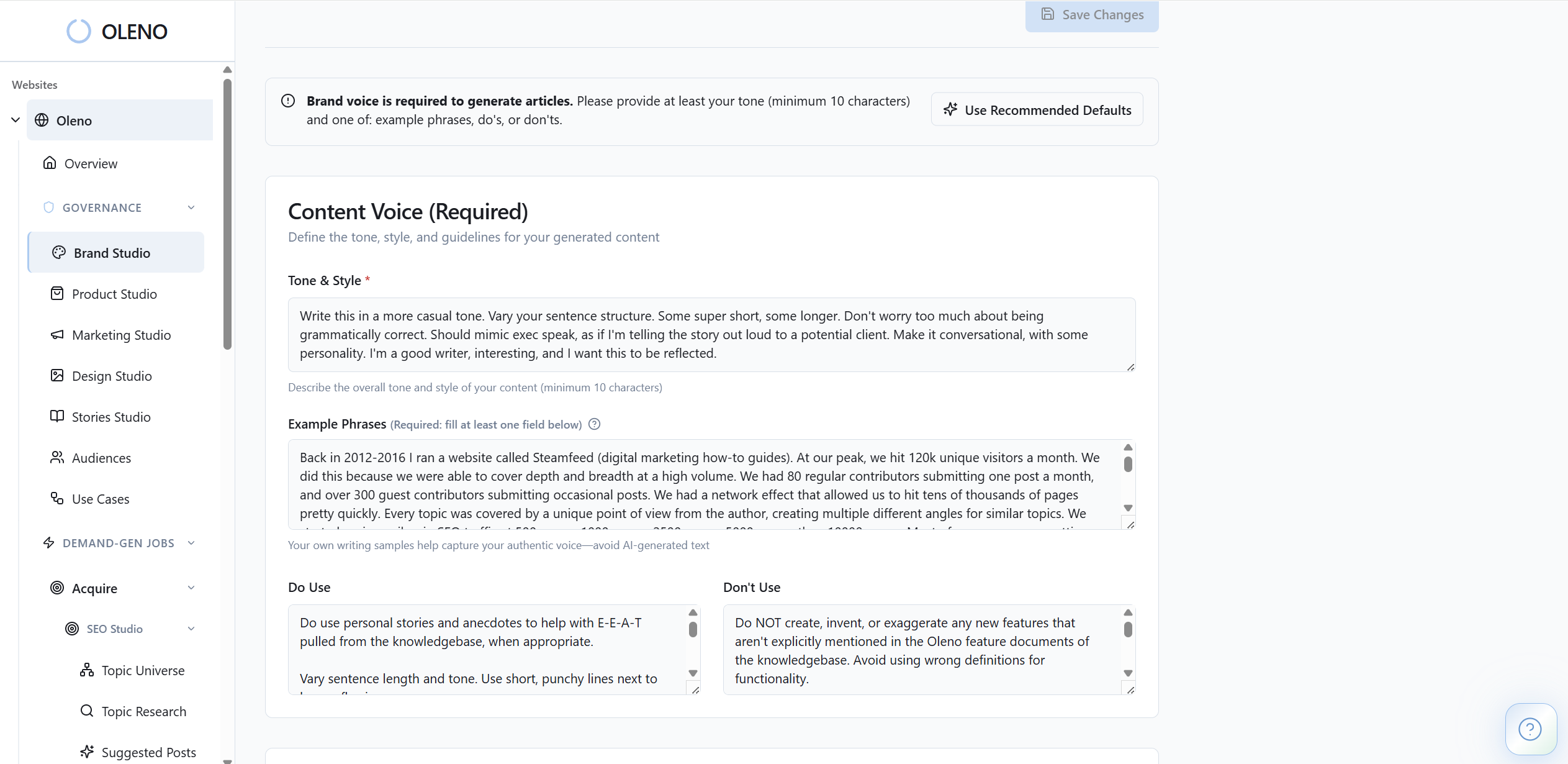
That fit matters because governed output ages better. Brand Studio gives teams a place to encode the rules. Marketing Studio keeps point of view and market framing aligned. The governance-first model is built to reduce the drift that shows up when multiple people, or multiple AI workflows, all touch the same content stream.
I like to think of this as guardrails versus steering wheels. Some platforms hand you more steering wheels. Oleno puts guardrails on the road first.
That tradeoff is real. A fully governed system can feel more opinionated during setup. Some teams will prefer looser tooling. That's valid. But if your current pain is rework tax, mixed messaging, and too many cooks in the content kitchen, opinionated structure is often exactly what makes the output usable.
Which teams benefit most from a systemized content engine
Oleno is strongest when content is already a team sport. Head of content, PMM, demand gen, founder, SEO lead. Once those roles exist, loose AI tooling usually creates context loss between them. Storyboard and Content Calendar help teams plan content programs before execution starts, which is different from simply generating drafts on demand. You can see how that planning layer is framed in Oleno's planning feature overview and how governance is treated as a first-class function in its governance feature overview.
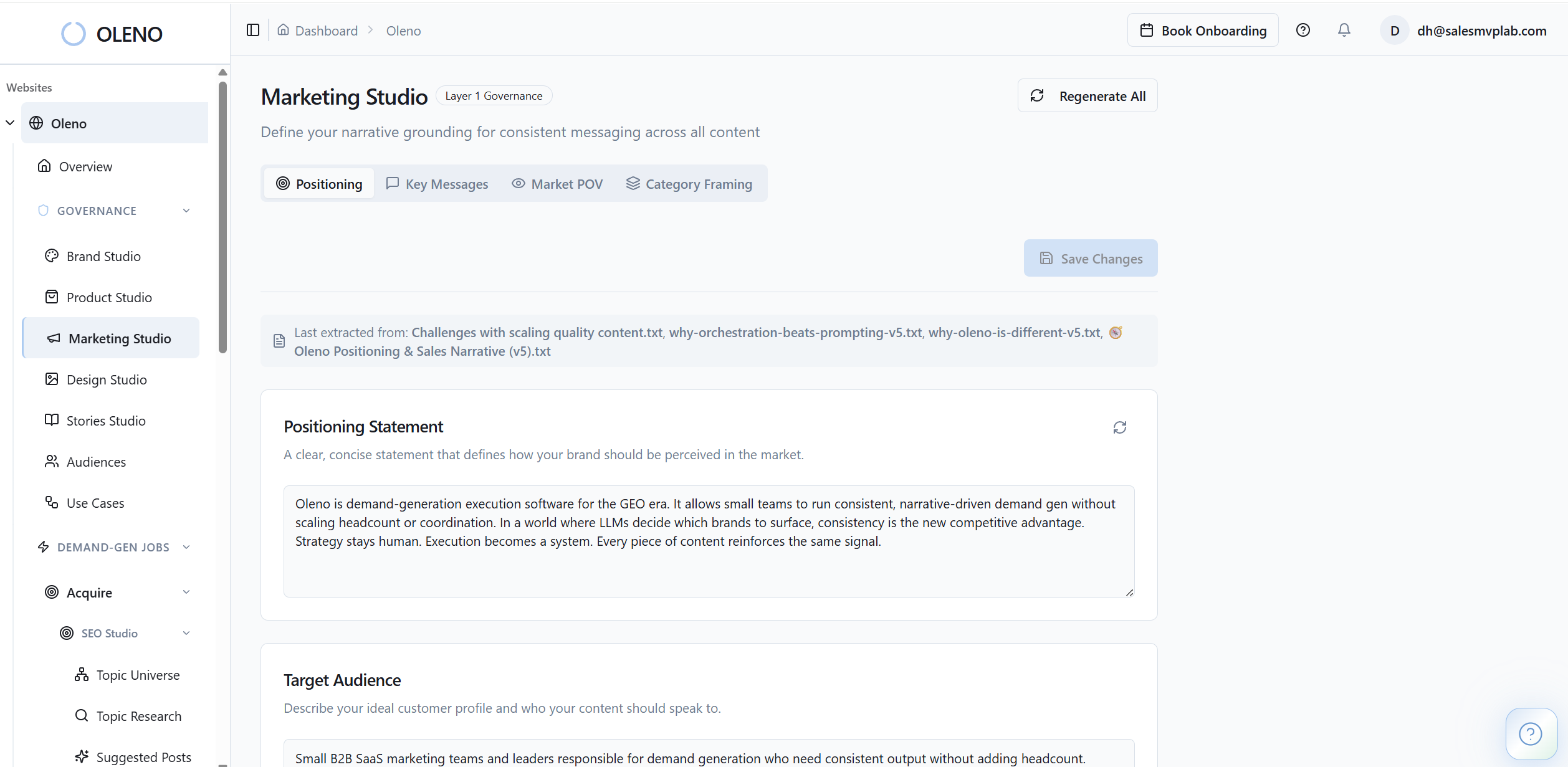
The system also fits growth-stage teams trying to scale SEO content production without adding endless coordination overhead. That's where governed demand-gen execution starts to matter more than another prompt workflow.
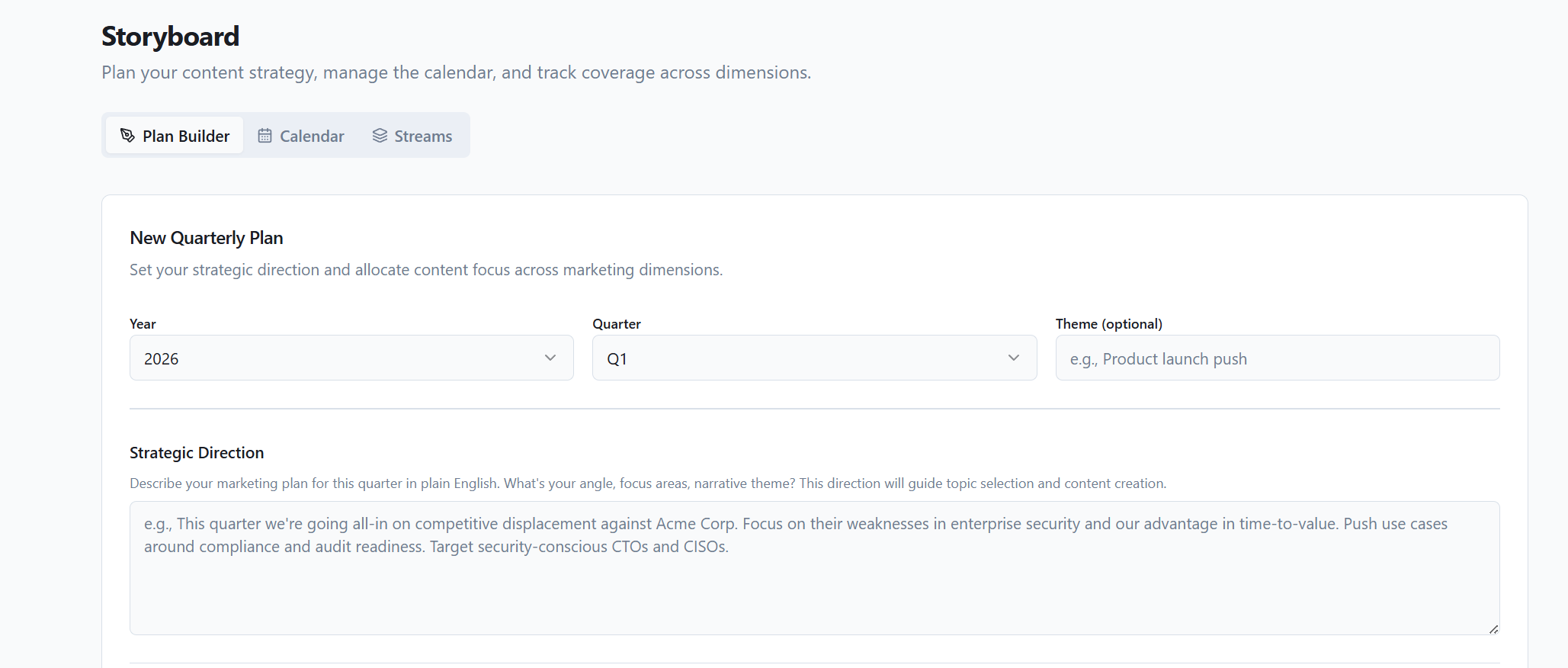
For founders, the practical question is simple: do you want a box of parts, or a system with a point of view? If you want to see how that governed model looks in practice, request a demo.
Which platform fits your team stage and growth model
The right platform depends on whether your team is optimizing for speed, flexibility, SEO throughput, or governed execution. Founders usually choose lighter tools when they need output immediately and choose structured systems when coordination costs start to dominate. Team stage changes the answer more than feature checklists do.
| Platform | Core positioning | Best-fit team size | Primary use case | Brand governance depth | Workflow flexibility | SEO depth | Publishing automation | Collaboration controls | Pricing model | Time-to-value | Human editing required | Best for founders | Best for marketing teams | Not ideal for |
|---|---|---|---|---|---|---|---|---|---|---|---|---|---|---|
| AirOps | Configurable AI search workflows | Small to enterprise teams with ops support | AI search and workflow automation | Medium | High | High | Medium | Medium | Hybrid | Medium | Medium to high | Founders with technical or ops support | SEO and growth teams | Teams wanting an opinionated system |
| Jasper | On-brand content generation | Small to enterprise | Campaign and brand copy | Medium | Medium | Medium | Low | Medium | Subscription | Fast | Medium | Founder-led marketing | Creative and brand teams | Teams needing deeper governance |
| Copy.ai | Fast template-led GTM output | Solo to small teams | Short-form GTM assets | Low | Medium | Low to medium | Low | Low to medium | Hybrid | Very fast | Medium to high | Budget-conscious founders | Small GTM teams | Teams running governed long-form programs |
| Outrank | Automated SEO publishing | Solo to small teams | Keyword-driven content | Low to medium | Medium | High | High | Low | Subscription | Fast | Medium | Founders testing SEO quickly | Lean SEO teams | Teams needing broad demand-gen support |
| Byword | Programmatic SEO scale | Small to mid-size SEO operators | Batch page generation | Low | Medium | High | Medium | Low | Hybrid | Fast once configured | Medium | Founders with structured page models | SEO agencies and operators | Teams needing nuanced category content |
| Oleno | Governed demand-gen execution | Growth-stage to mid-market SaaS teams | Systemized content engine across planning, governance, and execution | High | Medium | High for recurring SEO programs | High | High | Subscription, $109/mo to $1,057/mo, then enterprise | Medium | Lower when governance is set up | Founders ready to delegate with rules | Scaling SaaS marketing teams and CMOs | Teams wanting only lightweight prompt-based copy |
If you're a founder trying to get the first consistent content motion off the ground, a lighter tool may honestly be enough. Copy.ai or Jasper can be perfectly sensible choices when the goal is speed and the content burden is still mostly on one person. AirOps also makes sense if you have the appetite to design your own autonomous growth platform and maintain it.
But once growth becomes cross-functional, the evaluation changes. That's when rework, context gaps, and narrative drift start costing more than the subscription fee. If that sounds familiar, request a demo and look specifically at whether a governed system would remove the review loops your team is stuck in.
The short version is this. Choose speed-first tools when you're still proving the channel. Choose a governed system when the channel is proven and the real problem is keeping quality, positioning, and cadence intact as more people get involved. That's the split that actually matters.
About Daniel Hebert
I'm the founder of Oleno, SalesMVP Lab, and yourLumira. Been working in B2B SaaS in both sales and marketing leadership for 13+ years. I specialize in building revenue engines from the ground up. Over the years, I've codified writing frameworks, which are now powering Oleno.
Frequently Asked Questions