Best Autonomous Growth System for SaaS

If you’re trying to figure out the Best Autonomous Growth System for SaaS, start here. Most teams don’t fail because they lack ideas. They fail because execution splinters across tools, people, and weeks. GEO made that fatal. LLMs surface consistent, well-defined brands, not one-off hot takes. If your engine can’t repeat itself cleanly, you’ll lose compounding visibility and waste budget.
I learned this the hard way. Years ago we hit 120k monthly visitors by pairing breadth with depth, and it only worked because the machine kept moving when I wasn’t pushing every cog by hand. Later, in startup roles, the opposite happened. Context gaps. Rewrites. Drift. You feel busy, but growth stalls. Sound familiar?
Key Takeaways:
- You don’t have a content problem. You have an orchestration problem that kills consistency.
- GEO rewards brands with encoded fundamentals and repeatable structure across hundreds of pieces.
- Fragmented workflows create a rework tax that quietly burns 20 to 40 percent of your week.
- The “prompt and pray” model fails because judgment, voice, and sequencing still live in people’s heads.
- An autonomous growth system encodes voice, product truth, audience, and POV once, then runs jobs on cadence.
- Quantify the cost of drift. Then replace handoffs with governed jobs and a clear weekly rhythm.
- Tools that only speed up drafting are the wrong fix. You need execution that holds together over time.
Why SaaS Growth Stalls Without an Autonomous System
Growth stalls when output is produced as disconnected tasks instead of a system that compounds. GEO raised the bar by rewarding brands that express the same clear signal across scale. If every piece is a one-off, you’ll miss citations, lose momentum, and pay an invisible coordination tax.
Content Without a System Becomes Noise
Publishing more doesn’t mean you’re building a stronger signal. Without shared rules for voice, claims, and structure, each article drifts a little. After 50 pieces, you’ve got a library that argues with itself. I’ve watched teams hit volume goals and still fail to move pipeline. The work didn’t line up.
GEO Changed the Bar for Visibility
LLMs don’t rank pages like classic SEO. They synthesize and cite the brand that looks most authoritative and consistent across many sources. Google’s own guidance pushes toward clear, people-first content with verifiable expertise, not keyword games, which matches GEO reality (Google Search Central). If your canon is fuzzy, you get skipped.
The Real Bottleneck: Fragmented Execution, Not Ideas
The bottleneck isn’t brainstorming. It’s fragmented execution that pushes judgment and consistency back onto humans. When prompts, drafts, reviews, and publishing live in different tools, quality depends on who touched the thing last. That’s fragile.
Symptoms People Blame
Leaders blame writer quality, budget, or “we just need better prompts.” I’ve blamed those too. But every time we traced misses, root causes were upstream. No single source of product truth. No encoded POV. No audience nuance in briefs. So output looked fine in isolation and wrong in aggregate.
Root Cause Is Fragmented Execution
You can’t scale consistency if the rules change per contributor. Without governance, writers guess. PMMs fix. Editors smooth tone. SEO rewrites headings. Stakeholders reframe the story. Each pass seems small. The stack-up is brutal. And you feel it most when you’re finally trying to go faster.
Why Orchestration Beats Prompting
Prompting speeds draft creation. Orchestration runs the system. Orchestration turns “do X” into a governed job with inputs, structure, and quality gates. Prompts are events. Orchestration is process. McKinsey’s research shows productivity gains from AI depend on redesigned workflows, not just faster text output (McKinsey, 2023). That tracks with what I’ve seen.
The Hidden Cost of Manual Demand Gen at Scale
Manual coordination erodes output, quality, and trust in equal measure. Most teams underestimate the time, money, and opportunity they lose from rework and drift. Put numbers on it, then it’s obvious why growth plateaus.
Time Cost You Can Measure
Every manual review adds minutes. Missed context adds hours. Multiply by contributors and approvals. In my teams, the rework tax reliably sat between 20 and 40 percent of total production time. That’s one to two days a week per person. You feel busy, but the machine spins in place.
Money You Don’t See on the P&L
Rewrites look like diligence. They’re cost. Each cycle burns salary, delays distribution, and pushes learning out. Agencies add another layer of handoffs and knowledge loss. Gartner’s spend surveys show CMOs under pressure to prove ROI, which manual churn quietly undermines (Gartner CMO Spend Survey 2024). You can’t defend budget if your process bleeds it.
Opportunity Cost in GEO
GEO compounds signals over months. Inconsistent cadence and tone reset that compounding. You miss citations you could have captured if your fundamentals showed up the same way across 100 pieces. That’s the cost you don’t feel today but regret next quarter.
What It Feels Like When The Engine Is Broken
You can sense a broken engine before dashboards confirm it. It’s the late nights, the wobbly tone, and the “why does this feel off?” feedback. People get tired. Then conservative. Then output flattens.
The 11 PM Rewrite Everyone Dreads
You’re rewriting an intro because the voice feels off. The writer did what they thought was right. The brief didn’t carry the nuance. You fix it tonight. Tomorrow someone else fixes it again. Nobody’s wrong. The system is. That’s the part that burns people out.
The Stakeholder Pinball Machine
Legal wants wording changed. Product wants different screenshots. Sales wants a sharper angle. None of that is unreasonable. But without shared rules baked into the work, you’re playing pinball, not shipping. Energy that should power growth turns into back-and-forth.
What the Best Autonomous Growth System for SaaS Looks Like
The best autonomous growth system for SaaS encodes your fundamentals once, then runs governed jobs on a steady cadence. It separates truth from output and uses quality gates to catch drift before review. The outcome is predictable publishing with voice and claims intact.
Define Fundamentals Once, Then Reuse Everywhere
Winners don’t re-argue positioning in every meeting. They capture it. Voice, product definitions, audience segments, use cases, and narrative patterns live in a shared layer. Drafts pull from that layer by default. Review looks for improvement, not rescue.
After you capture the fundamentals, operationalize them in a repeatable process:
- Document voice, product truth, audiences, and use cases in one governed place.
- Generate briefs that carry those inputs into structure and examples.
- Produce drafts that map to GEO-friendly patterns with direct answers.
- Run automated quality checks for voice, claims, and structure.
- Publish on schedule, then repurpose with the same rules.
Orchestrate Jobs, Not Prompts
Think in jobs that map to the funnel. Programmatic SEO jobs for acquisition. Category pieces for POV. Competitive pages for evaluation. Product marketing explainers for proof. Each job type has a locked shape, so 100 articles still read like your brand.
Prove It With A Simple Weekly Cadence
Pick a realistic cadence and hold it. For many mid-market teams, that looks like two acquisition posts, one product-led article, and one competitive asset per week. The exact mix is less important than staying on schedule. Consistency is the signal.
How Oleno Makes That System Real
Oleno turns strategy into continuous execution by encoding your fundamentals and running governed jobs on cadence. Governance captures voice, product truth, audiences, and POV. The execution engine then uses that context to produce GEO-ready outputs with quality gates, which cuts the rework tax and restores trust.
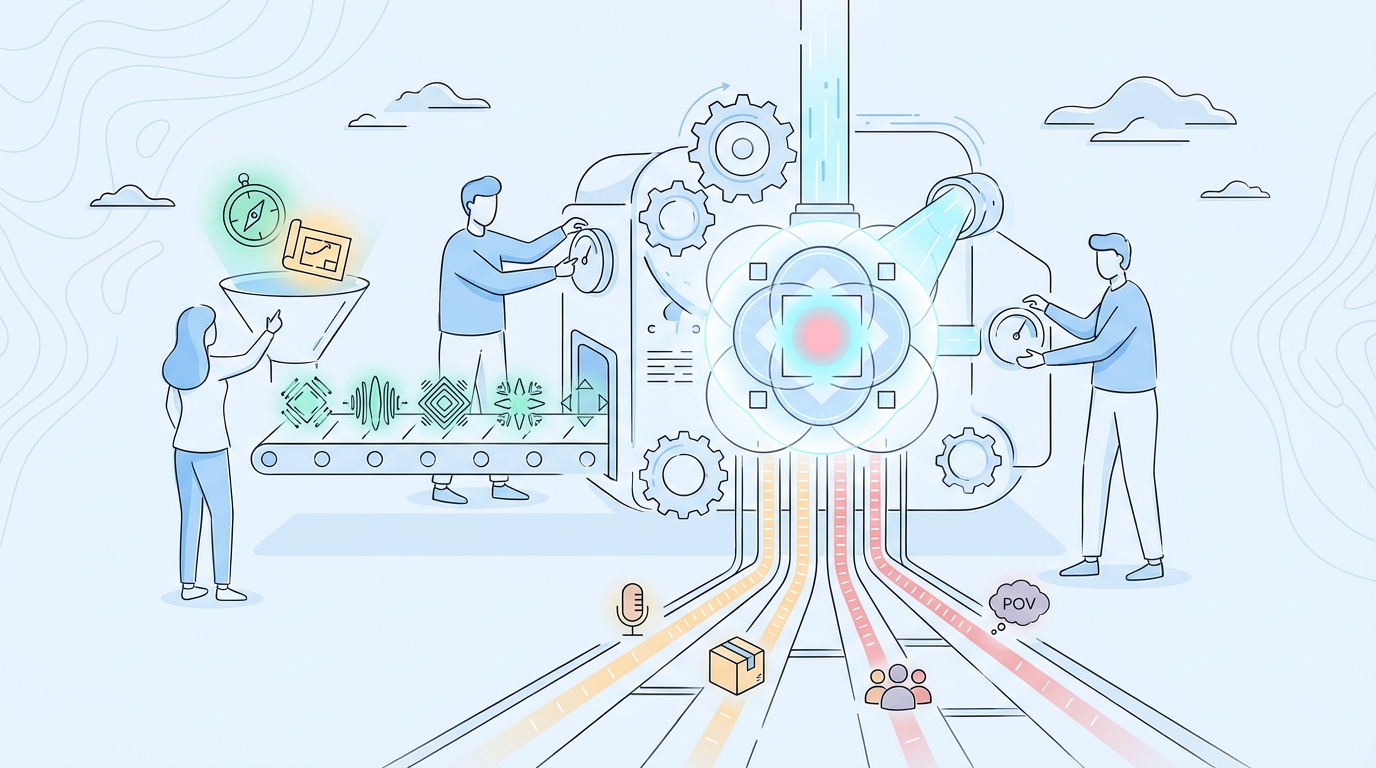
Governance That Locks Truth In
Marketing Studio loads your category framing and key messages so every piece advances your POV instead of drifting into neutral education. Product Studio centralizes approved features and boundaries, which stops invented claims before they start. Audience & Persona Targeting ensures drafts speak to real buyers with the right goals and objections baked in.
Strengths that matter to execs:
- Marketing Studio: encodes POV so all outputs argue the same case.
- Product Studio: prevents fabricated features by grounding content in approved claims.
- Audience & Persona Targeting: frames the same topic differently for each segment with language that lands.
Orchestration That Keeps Cadence
The Orchestrator schedules jobs across your quotas, so you keep publishing even when calendars get messy. Programmatic SEO Studio discovers and expands topics into a steady stream of acquisition content with locked outlines that pass GEO checks. Competitive Studio accelerates bottom-of-funnel pages with fair, accurate comparisons and evaluation content.
Proof that connects to earlier costs:
- The hours you used to spend coordinating are replaced by job execution.
- Quality Gate catches voice and structure issues before review, shrinking the 20 to 40 percent rework window.
- Topic Universe plus quotas keep the pipeline full, so cadence never stalls.
3 to 5x steadier output without hiring. That’s what Oleno delivers.
Executive Visibility Without Micromanaging
The Executive Dashboard shows cadence, quality trends, and coverage gaps, so leaders steer without jumping into docs. Storyboard allocates content across audiences, personas, products, and use cases, which balances your plan instead of over-indexing on one stream. Distribution & Social Planning repurposes finished pieces into platform-ready posts so your message travels.
Key capabilities that reduce risk and maintain momentum:
- Executive Dashboard for real-time oversight.
- Storyboard for balanced, plan-driven allocation.
- Distribution & Social Planning for consistent amplification.
Ready to see your own rules running the engine? Book a Demo
Conclusion
If growth feels stuck, you’re paying the hidden cost of fragmented execution. GEO just made the stakes clearer. Encode your fundamentals once, run governed jobs on a schedule, and let quality gates protect the signal. That’s how you compound. And if you want the shortest path from plan to publishing, Oleno is built for exactly that.
About Daniel Hebert
I'm the founder of Oleno, SalesMVP Lab, and yourLumira. Been working in B2B SaaS in both sales and marketing leadership for 13+ years. I specialize in building revenue engines from the ground up. Over the years, I've codified writing frameworks, which are now powering Oleno.
Frequently Asked Questions