Best B2B Content Generation Tools for Small Business

If you’re a small B2B team trying to ship consistent blog content, the hard part usually isn’t “writing.” It’s everything around writing. Picking topics. Building briefs. Keeping voice consistent. Getting something publish-ready without living in a loop of “draft, fix, rewrite, approve, publish.”
And yeah, AI helps. But only if you choose the right kind of tool for the way your team actually works.
Best B2B Content Generation Tools for Small Business: From Ideas to Published Posts
The best B2B content generation tool for a small business is the one that reliably gets you from topic to published post with the least coordination overhead. Some tools optimize for volume (Outrank, Byword), others for on-page scoring and SERP analysis (Surfer), others for flexible workflows and AI search work (AirOps), and others for brand-forward marketing copy (Jasper). Oleno is different because it’s built for hands-off, publish-ready long-form content once configured.
| Tool | Best For | Starting Price | Standout Capability | Primary Limitation |
|---|---|---|---|---|
| Oleno | Hands-off, publish-ready long-form content grounded in your expertise | from $449/mo | Autonomous topic selection, structure, creation in your voice, and publishing | Not a manual editor, assumes you want automation once configured |
| Outrank | High-volume SEO articles with SERP-led briefs and one-click publishing | $49 to $99/mo | End-to-end workflow geared for volume and automation | Quality and factual accuracy may vary, fewer native data integrations |
| Byword | Programmatic SEO campaigns using templates and batch generation | $5/article or $99/mo | Template variables and batch production at scale | Learning curve, not ideal for deep expert content without editing |
| Surfer | On-page optimization and data-backed content outlines | $79/mo (annual billing) | Live content scoring and SERP Analyzer | Scoring can feel prescriptive, pricing can be high for very small teams |
| AirOps | Custom workflows and AI search optimization | Free, SMB often ~$99 to $449/mo | No-code workflow builder and AI search optimization focus | Setup can be heavy, support and docs feedback is mixed |
| Jasper | On-brand marketing content across formats | $49/mo | Brand voice controls and broad template library | Requires fact-checking, limited technical SEO features |
Key Takeaways:
- Outrank and Byword work well for volume, but you’ll usually need human review for nuanced, expert-heavy B2B posts.
- Surfer is strong when you want data-driven outlines and on-page scoring, but it’s less “publish the whole thing for me.”
- AirOps fits ops-heavy teams that want custom workflows and AI search optimization, but setup can be a real project.
- Oleno is built for small teams that want publish-ready long-form content without prompts, editing loops, or coordination overhead.
The Hidden Time Tax of DIY AI Content Workflows
DIY AI content workflows usually cost small teams more time than they expect, because the “draft” is the smallest part of the process. The real tax shows up in topic selection, brief creation, reviews, fact-checking, rewriting, and publishing coordination. A tool that saves 30 minutes of writing can still cost you hours of frustrating rework.

Let’s pretend you’re shipping two posts a week. Nothing crazy. You’re a founder or a lean marketer and you’re trying to stay consistent.
Here’s what the week turns into:
- Monday: keyword research, competitor scanning, picking a topic you actually have a right to write about.
- Tuesday: outline, brief, internal notes, sources, someone pings you with “can we mention X?”
- Wednesday: draft in an AI writer, then you realize the draft is generic, so you rewrite half of it.
- Thursday: fact-check, add examples, remove claims you can’t back up, fix tone.
- Friday: publish, internal links, images, formatting, and the “why does WordPress hate me” moment.
That is the headache. Not the blank page.
This is why tool choice matters more for small businesses than for big teams. Big teams can absorb process. Small teams can’t. If you still need a human to drive every step, you didn’t really buy leverage. You bought a faster keyboard.
So as you read the comparisons below, keep one question in your head: “How many handoffs does this remove?”
Outrank for Small Business: Volume-Focused SEO Content
Outrank is a good fit for small businesses that want to publish a lot of SEO content quickly with a more guided, end-to-end flow. It positions itself around programmatic SEO content generation and publishing, which can be attractive when you’re trying to grow organic traffic without building a big content team. Compared to optimization-first tools like Surfer, Outrank is more about generating and shipping.

Outrank: Strengths For Small Teams
Outrank’s core appeal is that it tries to bundle the workflow, not just the writing. If your current process is “keyword list in a spreadsheet, outline in a doc, draft in an AI tool, publish in your CMS,” you’ll probably like that Outrank aims to connect those dots.
It’s also clearly built for SEO content, not just generic marketing copy. You see that in how it talks about SEO tools for small businesses and AI SEO content generation as a primary use case, not an add-on (Outrank, Best SEO Tools for Small Businesses, Outrank, AI SEO Content Generator).
If you’re a small team, this “fewer tools” story matters. Every tool is another login, another workflow, another place to drop the ball.
Key strengths you’ll typically care about:
- SEO-focused content generation positioning (Outrank, AI SEO Content Generator)
- Small business SEO tooling narrative and bundling approach (Outrank, Best SEO Tools for Small Businesses)
- A product direction oriented around publishing outputs, not just drafting (Outrank, AI SEO Content Generator)
One interjection. Volume is a strategy, not a feature.
If you’re in a category where you can win by covering lots of long-tail queries, Outrank’s “ship more” orientation can be practical.
Outrank: Limitations And Value
Outrank’s tradeoff is pretty common with volume-first systems: quality variance. When your system is optimized to produce a lot, you often still need a human editor for expert nuance, factual rigor, and that “this actually sounds like us” feeling.
Also, Outrank’s public content leans heavily into SEO content generation and small business SEO workflows, but you don’t see the same emphasis on deep proprietary knowledge grounding that enterprise tools or more governed systems talk about (Outrank, AI SEO Content Generator).
So the value calculation for a small B2B team usually looks like this:
- If you need consistent publishing and you’re okay doing a review pass, it can be a solid accelerator.
- If you’re writing in a high-trust space (security, finance, compliance, healthcare), you’ll likely feel the editing tax.
A fair way to think about it: Outrank can help you ship more content. It may not remove the need for someone to be accountable for correctness and differentiation.
How Oleno is Different: Outrank centers on SERP-led workflows and volume, and you may still need humans to manage briefs, edits, and publish steps. Oleno is designed to run end-to-end after configuration: it determines topics using your site and knowledge base, sets angle and structure before drafting, enforces quality with an automated QA gate, then publishes via CMS connectors.
Byword for Small Business: Programmatic SEO at Scale
Byword is a strong option for small businesses or agencies that want to run programmatic SEO campaigns with batch generation and structured templates. It’s positioned for producing lots of pages from keyword lists and repeatable formats, which is useful when your strategy is coverage and scale. Compared to Outrank, Byword leans harder into templates and bulk operations.
Byword: Strengths For Small Teams
Byword gets talked about a lot in the context of scaling SEO content. That’s the brand. If you’re building glossaries, location pages, “alternatives” pages, integrations pages, or other repeatable page types, a template-driven system is often the only way you get to hundreds of pages without losing your mind.
Third-party reviews frame Byword as a tool built for scaling programmatic SEO output, not as a general AI writer (Byword AI Review: Scaling SEO Content in 2025). You also see it show up in broader “best AI content tools” roundups, usually in the context of bulk output and SEO use cases (Best AI Content Tools 2025 Comparison).
If you’re a small team, the big win is simple: batch creation. Instead of treating each post as a mini-project, you treat it like a production line.
Strengths that tend to matter in practice:
- Programmatic SEO positioning and scaling narrative (Byword AI Review: Scaling SEO Content in 2025)
- Strong fit for repeatable page formats, which is the heart of most programmatic SEO plays (TripleDart AI SEO Guide)
- Often mentioned alongside other scale-first AI content tools (Best AI Content Tools 2025 Comparison)
If your site growth plan is “own the long tail,” Byword can be a reasonable engine.
Byword: Limitations And Value
The catch with programmatic tools is that templates are both the superpower and the constraint. You can scale fast, but you also risk creating a lot of pages that feel same-y unless you invest in structure, differentiation, and real subject-matter detail.
And there’s a learning curve. Programmatic SEO sounds simple until you’re 40 pages in and you realize you need better variables, better data inputs, better internal linking decisions, better examples. That’s not really a Byword problem. That’s programmatic SEO.
The value question for small B2B teams is: do you have the operational maturity to set it up well? Reviews that discuss scaling also tend to imply there’s real setup involved, because there has to be (Byword AI Review: Scaling SEO Content in 2025).
So, Byword can be great when:
- Your content types are repeatable.
- You’re okay investing in templates and structure.
- You have someone who can own quality control.
It can be frustrating when:
- You’re trying to publish expert thought leadership.
- You don’t have time to do a real setup.
- You’re sensitive to content sounding generic.
How Oleno is Different: Byword is built for template-driven, user-planned programmatic campaigns, which usually means ongoing setup and quality oversight. Oleno is designed to decide topics from your sitemap and knowledge base, enforce angle and structure before drafting, validate quality via QA-Gate, and publish without prompting or coordination once configured.
Surfer for Small Business: Data-Driven Optimization
Surfer is a strong choice for small businesses that care most about on-page optimization, SERP analysis, and data-backed content guidance. It’s less of a “push-button publishing engine” and more of a system that helps you write pages that match what’s ranking. Compared to volume tools like Byword and Outrank, Surfer is usually chosen for control and optimization.
Surfer: Strengths For Small Teams
Surfer’s reputation comes from its SEO tooling: content editor workflows, SERP analysis, and optimization features. If you’ve ever had the experience of publishing a solid post and watching it go nowhere, you start to appreciate tools that tell you “here’s what top pages include, here’s the terms they cover, here’s the structure pattern.”
Surfer also keeps shipping updates, and it’s pretty explicit about product iteration through release notes and updates (Surfer, January 2025 Update). For small teams, that matters because you want a tool that keeps pace with how search is changing.
There are also plenty of practical guides on how to use it, which usually signals the tool has enough depth that people need help getting the most out of it (How To Use Surfer SEO).
Where Surfer tends to shine:
- SEO-focused content editing and optimization workflows (EntreResource, Surfer SEO Review)
- Active product updates and iteration (Surfer, January 2025 Update)
- Established usage patterns and education content (How To Use Surfer SEO)
This is the tool you pick when you want to tighten up what you publish, not just publish more.
Surfer: Limitations And Value
Surfer can feel prescriptive. That’s kind of the point, but it can push your team into writing to the score. Some practitioners love that. Others feel it creates a uniform “SEO content” vibe, especially if everyone is chasing the same SERP patterns.
Also, Surfer is not inherently a publishing system. It’s an optimization and content editing environment. You still need someone to pick topics, create drafts, do internal approvals, format, and publish. Even if Surfer helps you write a better page, you still own the workflow.
On pricing, small teams sometimes feel it more, especially when the tool is one part of a stack rather than replacing the stack (EntreResource, Surfer SEO Review).
So Surfer is high value when:
- You already have writers (internal or freelance).
- You want more predictable on-page coverage.
- You’re willing to work inside the scoring model.
It’s less ideal when:
- You’re trying to remove coordination overhead.
- You want autonomous publishing, not another step in the chain.
How Oleno is Different: Surfer helps optimize what you choose to write, but it still assumes humans run the workflow and push publish. Oleno is designed to automate the full pipeline (topic, angle, brief, draft, QA, image, publish) using your knowledge base for grounding and QA-Gate for consistent quality checks.
AirOps for Small Business: Custom Workflows and AI Search Optimization
AirOps is a good fit for small businesses that want customizable AI content workflows and a stronger focus on AI search optimization concepts. It’s positioned more like content operations infrastructure than a single-purpose writing tool. Compared to Surfer, it’s less about on-page scoring and more about building a system that fits your team.
AirOps: Strengths For Small Teams
If you’re the kind of team that already has a process, AirOps can be appealing because you can encode that process. Workflows, templates, governance, and a broader point of view on content quality show up in their writing. The “AI slop” piece is a good example of the platform’s stance on low-quality AI outputs (AirOps, AI Slop).
AirOps is also closely tied to AI search optimization narratives, and they’ve raised meaningful funding tied to AI search optimization positioning, which signals market momentum for that category (AirOps Secures $40M for AI Search Optimization).
They also publish content aimed at CMOs and content leaders that frames the change happening in content, which is usually useful context if you’re rethinking your production model (AirOps, The New Content Era (CMO Series)).
Strengths you may care about:
- Strong POV on AI content quality problems (AirOps, AI Slop)
- AI search optimization positioning and category focus (AirOps Secures $40M for AI Search Optimization)
- Executive-oriented content operations framing (AirOps, The New Content Era (CMO Series))
This is the tool you pick when you want flexibility and you’re willing to design your own pipeline.
AirOps: Limitations And Value
The flip side of flexibility is setup. Small teams often don’t have time to build and maintain workflows, especially if the goal is “just get content out consistently.”
AirOps can be a better fit when you have content ops maturity. If you don’t, it can turn into another internal project. Not impossible. Just real.
And because it’s workflow infrastructure, you may still need humans to do the judgment calls. What’s the topic? What’s the angle? What claims are allowed? Someone usually owns that, unless you’re using a system explicitly designed to remove it.
So the value tends to show up when:
- You have repeatable processes you want to systematize.
- You care about AI search optimization as a core initiative.
- You have time to configure and maintain workflows.
It’s less compelling when:
- You just want publish-ready long-form content with minimal involvement.
- You don’t have a dedicated ops owner.
How Oleno is Different: AirOps is a flexible workflow builder, which can be powerful but often requires significant setup and ongoing attention. Oleno is designed for autonomous execution after configuration: it uses your sitemap and knowledge base to decide what to write, sets structure before drafting, runs QA-Gate checks, and publishes via CMS connectors without prompting or coordination.
Jasper for Small Business: On-Brand Marketing Content
Jasper is a solid choice for small businesses that want on-brand marketing content across channels, not just SEO blog posts. It’s often used for campaign assets, product marketing copy, and a broad mix of formats. Compared to tools like Surfer or Outrank, Jasper is more “marketing studio” than “SEO production line.”
Jasper: Strengths For Small Teams
Jasper’s biggest strength is brand-forward content creation. If your problem is “we need good copy in our voice, across lots of formats,” Jasper is built for that. And because it’s a widely covered tool, you can find lots of pricing breakdowns and plan explanations, which helps small teams budget and compare (Jasper Pricing Overviews, Jasper Pricing (Roundup), Wise, Jasper Pricing Explained).
The practical upside for a small team is speed plus consistency. Not perfect consistency, but real controls that are designed for brand use cases.
Strengths that typically matter:
- Strong focus on marketing content workflows and brand consistency (pricing and product positioning are widely covered) (Jasper Pricing Overviews)
- Easy entry point for small teams that want a generalist tool with structure and templates (Jasper Pricing (Roundup))
If you’re doing a lot of campaign work, Jasper can be a clean fit.
Jasper: Limitations And Value
Jasper is not an SEO-first platform in the way Surfer is. It can be used for SEO content, sure, but you’ll likely bring your own research, your own briefs, and your own optimization checks.
Also, like most prompt-driven systems, outputs still require fact-checking. That’s not a knock, it’s just reality when you’re generating text without deep proprietary grounding and deterministic quality enforcement.
The value equation for B2B blogging is: Jasper can produce drafts and assets quickly, but it doesn’t inherently remove the coordination tax. You still manage the process.
So Jasper tends to be best when:
- You need marketing copy across channels.
- You have a human owner for content quality.
- SEO is part of the mix, not the entire job.
It’s less ideal when:
- Your main goal is always-on publishing of long-form SEO posts.
- You want the system to decide topics and push publish for you.
How Oleno is Different: Jasper is a flexible, prompt-driven marketing co-pilot, which means your team still owns topic selection, structure, edits, and publishing steps. Oleno is designed to run the full pipeline after setup: it determines what to write from your site and knowledge base, enforces structure and differentiation before drafting, validates quality through QA-Gate, and publishes on a schedule without prompting.
Why Oleno Fits Small B2B Teams
Oleno fits small B2B teams when the real constraint is coordination, not ideation or typing speed. It’s built to decide what to write, create complete long-form articles in your voice grounded in your knowledge base, enforce quality checks, and publish to your CMS without prompting or editorial handoffs. Compared to tools that stop at “draft,” Oleno is designed to run the end-to-end system.
Before I get into features, here’s the lived reality: small teams don’t fail at content because they don’t know what to say. They fail because content becomes a part-time job spread across three people who already have full-time jobs.
I’ve been on both sides of this. When you have volume and a machine for production, traffic compounds. When you don’t, everything becomes “we’ll do it next week.” Next week turns into next quarter.
So the question isn’t “which tool writes the nicest paragraph.” It’s “which tool removes the most steps without making you nervous about what gets published.”
Oleno: Core Differentiators For Small B2B Teams
Oleno is an autonomous content creation platform. That means it’s designed to run the pipeline end to end: topic selection, angle, brief, draft, QA, enhancements, image, then publish. No prompt libraries. No editing loops. No coordination rituals.
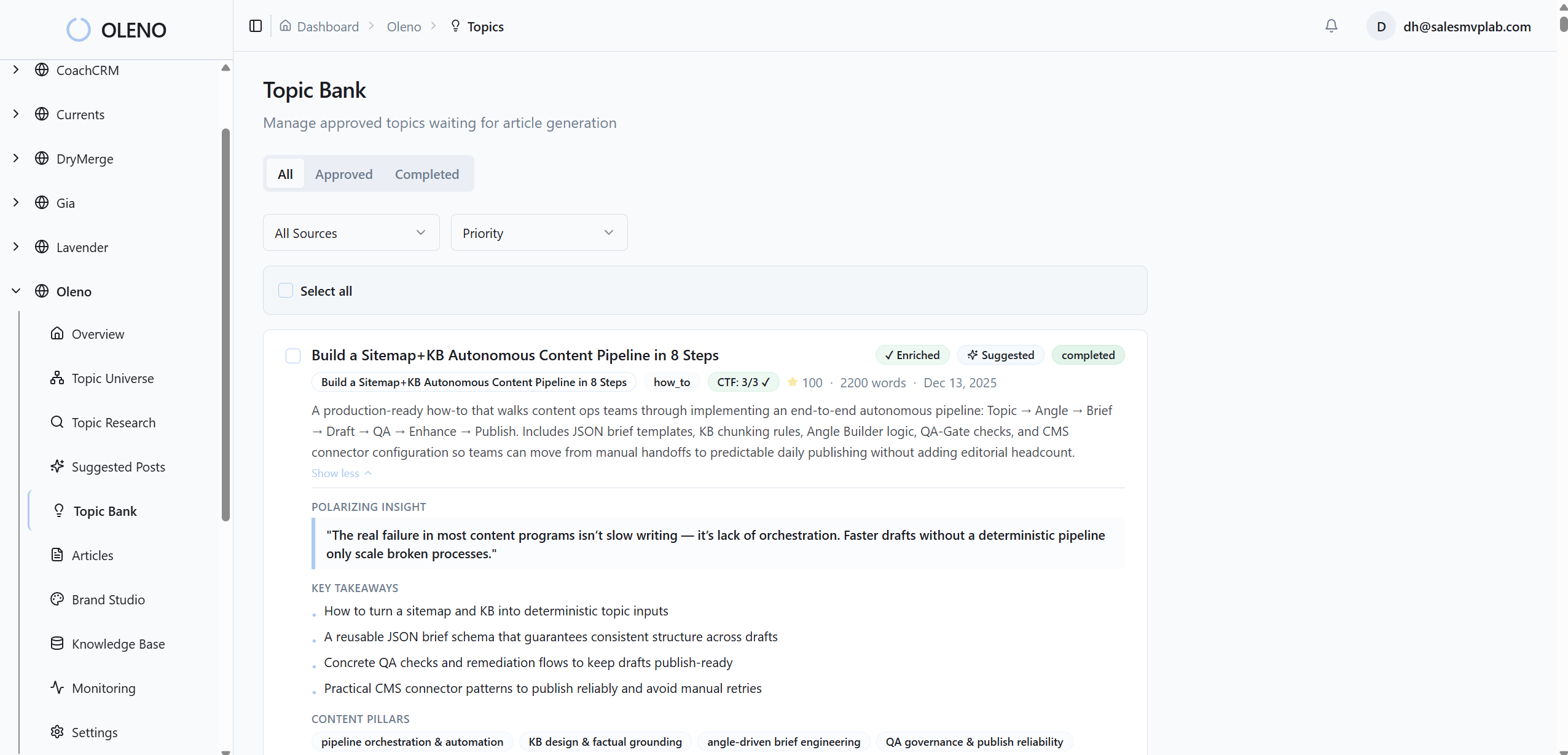
There are a few pieces of that worth calling out, because they map directly to the weaknesses you see in the other tools.
First, grounding. A lot of AI content gets generic because it starts from zero context. Oleno uses your sitemap and knowledge base so claims can be grounded in your actual expertise, not just vibes. This matters more in B2B, where prospects can smell generic from a mile away.
Second, deterministic quality checks. The QA-Gate runs 80+ checks and uses a minimum passing score of 85. If a draft fails, it improves and re-tests automatically. This is how you avoid the “publish, regret, unpublish” cycle. Not always, but more often than manual spot-checking.
Third, it’s structured before it writes. That sounds subtle, but it changes the output. The system defines the angle and structure before drafting, then writes into that frame. That’s how you reduce the risk of repetitive, low-information posts.
And the real differentiator for small teams is operational: it publishes directly to your CMS through connectors. You’re not copying and pasting drafts into WordPress at 11pm.
Here’s what that looks like in practice:
- Automated discovery using your site and knowledge base
- Angle and structure defined before drafting
- Drafting grounded in the knowledge base
- QA-Gate enforcement (85 minimum score, 80+ checks)
- Automatic retries when QA fails
- CMS publishing via connectors
- Internal logs of pipeline events (inputs, outputs, QA scoring, publish attempts, retries, version history)
One thing Oleno is not: an analytics or monitoring tool. The internal logs are for the system to operate reliably, not for performance reporting.
If you want to see what hands-off publishing feels like for your own site, you can Request a demo now.
Oleno: Getting Started And Pricing
Oleno starts by connecting your site and knowledge base so the system can understand what you know and how you talk. Then you confirm the workflows you want and the publishing schedule. After that, it runs autonomously.
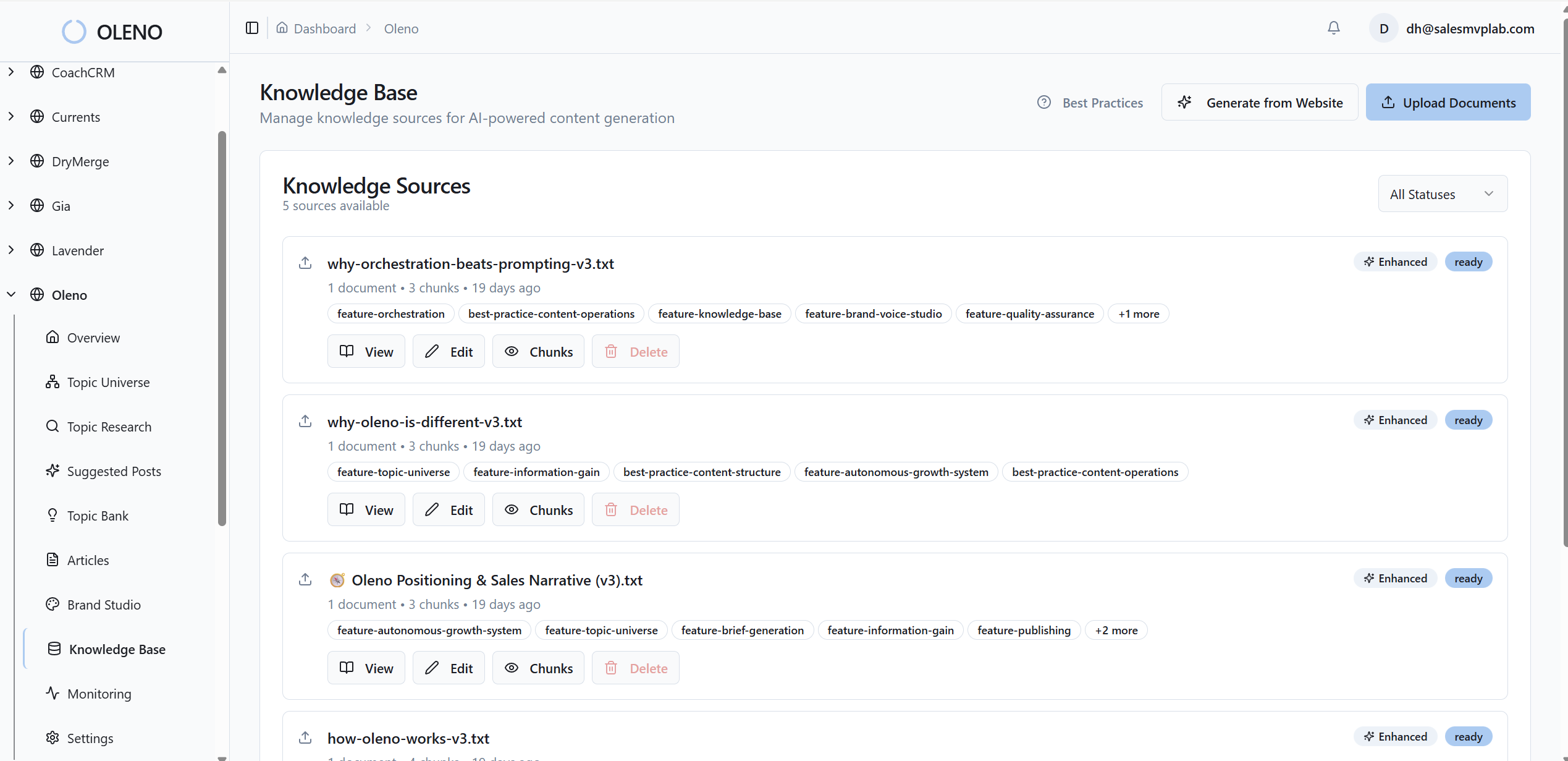
This is the part small teams care about: you don’t need to become a prompt engineer or build elaborate workflows. You configure the system once, then you supervise at a higher level.
Pricing is straightforward for small teams:
- Starts at from $449/mo (SEO + Social)
- Scales up to $449/mo (Full-Funnel GEO) to $1,349/mo (Narrative Control)
- 11+ posts/day is handled via enterprise plans through sales
If you’re the founder or the one-person marketing team and you’re thinking, “cool, but will it sound like us?” that’s the whole point of using your knowledge base and Brand Studio controls to enforce tone and phrasing through the pipeline.
If you want to pressure-test it without a big commitment, you can Request a demo.
Conclusion Grid: Feature and Fit Comparison
The most useful way to choose is to match tools to the constraint you actually have: volume, optimization, workflows, or hands-off publishing. Outrank and Byword are typically picked for speed and scale, Surfer for SERP-driven optimization, AirOps for custom workflows and AI search optimization, and Jasper for on-brand marketing assets. Oleno fits when you want the system to run end-to-end after setup.
| Criteria | Oleno | Outrank | Byword | Surfer | AirOps | Jasper |
|---|---|---|---|---|---|---|
| Orientation | Autonomous long-form publishing | SEO content automation (SERP-led) | Programmatic SEO at scale | SEO optimization and AI drafts | Custom content workflows + AEO | On-brand marketing content |
| Autonomous topic selection | Yes (analyzes site/knowledge base and decides what to write) | Generates 30-day plans from keywords | User-driven (batch from keyword lists/templates) | No (research/optimization first) | Workflow-defined (user builds) | No (user plans content) |
| Differentiation enforced pre-draft | Yes (structure first, rejects repetitive content) | SERP-driven brief alignment | Templates and prompts | SERP pattern analysis | Workflow rules and governance | Brand voice guidance |
| Writes in your brand voice | Yes (grounded in your expertise) | Claims voice preservation | Brand tone customization | Guided by optimization | Brand kits/personas | Brand Voice controls |
| One-click or automated publishing | Publishes without prompting once configured | Yes (positioned for publishing flows) (Outrank, AI SEO Content Generator) | Publishing supported (per third-party reviews) (Byword AI Review: Scaling SEO Content in 2025) | No (editing/optimization focus) (EntreResource, Surfer SEO Review) | Via workflows/integrations (AirOps, The New Content Era (CMO Series)) | Workflow-based, not positioned as auto-publish in the same way (pricing/plan coverage) (Wise, Jasper Pricing Explained) |
| Programmatic/batch generation | Multiple workflows supported | Volume-focused positioning (Outrank, AI SEO Content Generator) | Yes (batch and templates) (Byword AI Review: Scaling SEO Content in 2025) | Partial (AI drafts per page) (EntreResource, Surfer SEO Review) | Yes (workflows) (AirOps, The New Content Era (CMO Series)) | Yes (templates) (pricing/plan coverage) (Jasper Pricing Overviews) |
| SERP analysis/briefs | Internal quality enforcement vs SERP mimicry | SEO positioning for small businesses (Outrank, Best SEO Tools for Small Businesses) | Commonly discussed in programmatic SEO context (TripleDart AI SEO Guide) | Yes (core feature set) (How To Use Surfer SEO) | Workflow-dependent | Limited native SEO research (pricing/plan coverage) (Jasper Pricing (Roundup)) |
| On-page scoring | QA-Gate checks (not a public score) | SEO workflow positioning (Outrank, AI SEO Content Generator) | Varies by setup, often template-led (Byword AI Review: Scaling SEO Content in 2025) | Yes (content scoring widely covered) (EntreResource, Surfer SEO Review) | Workflow-dependent | No (not SEO-first) |
| AI search optimization focus | No (not a monitoring product) | Not primary positioning | Not primary positioning | Some AI search-oriented features discussed in updates (Surfer, January 2025 Update) | Yes (category focus and funding narrative) (AirOps Secures $40M for AI Search Optimization) | No |
| Starting price (monthly) | from $449/mo | $49 to $99 (Outrank, Best SEO Tools for Small Businesses) | $5/article or $99 (plan-dependent) (Byword AI Review: Scaling SEO Content in 2025) | $79 (annual billing referenced in reviews) (EntreResource, Surfer SEO Review) | Free tier exists, paid varies (AirOps Secures $40M for AI Search Optimization) | $49 creator plan in pricing writeups (Wise, Jasper Pricing Explained) |
| Best fit summary | Small teams wanting hands-off, publish-ready long-form in their voice | SMBs chasing volume with SEO workflows | Agencies/SMBs running programmatic templates | Teams prioritizing on-page optimization | Ops-heavy teams needing workflows and AEO | Marketing teams focused on brand assets |
If you’re at the stage where you want to stop managing content production week-to-week, it’s worth testing a system that actually publishes. You can try using an autonomous content engine for always-on publishing.
Next Steps: How To Choose Without Overthinking It
If you’re a small B2B team, choose based on your bottleneck, not your curiosity. If you need volume, look at Outrank or Byword. If you need tighter SERP alignment, Surfer is usually the move. If you want workflow flexibility and AI search optimization initiatives, AirOps is worth a look. If you need broad marketing copy in your voice, Jasper is a common pick.
If your real problem is that content dies in coordination, then you’ll probably want to test an autonomous approach first. That’s the fastest way to find out if you can stop living in the draft-review-publish loop. You can Request a demo now.
At the end of the day, all of these tools can produce words. The differentiator is whether the tool reduces the headache of running the system.
About Daniel Hebert
I'm the founder of Oleno, SalesMVP Lab, and yourLumira. Been working in B2B SaaS in both sales and marketing leadership for 13+ years. I specialize in building revenue engines from the ground up. Over the years, I've codified writing frameworks, which are now powering Oleno.
Frequently Asked Questions