Best Content Marketing Software for Enterprise Teams

Enterprise content programs usually crack at the same point: around stakeholder number five, approval layer number two, and the first quarterly plan that looks smart in Slides but never survives real execution. If you spent part of this week fixing rewrites, chasing approvals, or cleaning up “pretty good” AI drafts, you’re not really shopping for another AI writer. You’re trying to find the best content marketing software for a much messier problem: control.
That’s what makes this category slippery. AirOps, Jasper, Copy.ai, Byword, and Outrank each solve a real piece of the puzzle. But enterprise content ops rarely fail because the model can’t write. They fail because the operating system around the writing is loose, inconsistent, or too dependent on tribal memory.
| Platform | Best For | Primary Strength | Primary Limitation | Starting Price | Enterprise Fit |
|---|---|---|---|---|---|
| AirOps | SEO and content ops teams with workflow owners | Flexible workflow automation and AI search optimization | Higher setup and ongoing operator overhead | ~$99/mo | Strong if you have process maturity |
| Jasper | Brand-sensitive enterprise marketing teams | Voice controls and broad marketing template coverage | Human fact review still matters | $49/mo | Strong for creative teams with review capacity |
| Copy.ai | Cross-functional teams needing fast rollout | Easy adoption and fast template-driven output | Long-form strategic depth can vary | ~$29/mo | Good for broad AI adoption, lighter governance |
| Byword | SEO teams and agencies running bulk page programs | Batch generation for programmatic SEO | Less suited to nuanced storytelling | $99/mo | Strong for scale-focused SEO programs |
| Outrank | Teams prioritizing automated SEO publishing | End-to-end keyword-to-publishing workflow | Precision and narrative control can vary | $49-$99/mo, depending on plan context (Outrank) | Good for output-focused SEO operations |
| Oleno | Scaling SaaS marketing teams needing governed execution | Governance-first content operations tied to strategy | Requires upfront strategy encoding | $109/mo | Strong for teams reducing rework and narrative drift |
Key Takeaways:
- AirOps fits enterprise SEO teams that are comfortable designing and maintaining custom workflows over time.
- Jasper works well for brand-conscious teams, but product accuracy still depends on human review.
- Copy.ai is fast to roll out across sales and marketing, though strategic long-form output may need more editing.
- Byword and Outrank are strongest when programmatic SEO volume matters more than multi-format governance.
- Oleno fits scaling SaaS marketing teams that already have contributors but need one system for voice, positioning, and product truth.
What Enterprise Teams Actually Need From Content Marketing Software
The best content marketing software for enterprise teams does four things well: it preserves strategy, cuts review overhead, supports collaboration, and keeps output consistent as volume rises. The writing layer matters, yes. But once five or more contributors are touching content, governance starts to matter more than generation quality alone. That’s the part most buying committees underweight.
The core evaluation criteria enterprise buyers should use
Most enterprise buyers start with feature checklists. Fair enough. It’s also where a lot of expensive mistakes begin.
A CMO sees AI drafting, approvals, integrations, SEO support, and analytics on six product pages. Everything looks close enough. Then rollout starts. The content lead is still rewriting intros at 10 PM, the PMM is fixing product claims in docs, and demand gen is asking why campaign content sounds like it came from three different companies. That’s not a software bug. That’s a systems problem.
I use a simple filter here: the 4G test. Governance, generation, glide path, and granularity. Governance asks whether the system can enforce voice, product truth, and audience rules. Generation asks whether it can create usable output. Glide path asks how hard rollout will be in a real org, not a polished demo. Granularity asks whether permissions, workflows, and review logic can match how your team actually works. If a platform scores low on two of the four, it usually won’t hold up past pilot.
What matters in practice:
- Governance over voice, claims, and audience targeting
- Workflow support that reduces handoffs, not adds them
- Collaboration controls for multi-role teams
- Rollout effort relative to internal process maturity
- Fit for long-form, SEO, and broader demand gen use cases
That last point splits the market pretty fast. Some tools are great at writing. Some are great at SEO production. A smaller group tries to handle actual content operations. And that distinction sets up the next decision.
Where enterprise teams outgrow standalone writing tools
Around 20 to 30 meaningful content assets per month, a lot of teams hit the same wall: editing starts costing more than drafting. Once PMM, content, SEO, and demand gen all need a say, the bottleneck stops being output. It becomes control.
Back when I was the only marketer on a team, I could write 3 to 4 strong blog posts a week because all the context lived in my head. Once more people got involved, speed dropped. Quality got uneven. Review time exploded. Not because the team got worse. Because the context got fragmented.
The default assumption is that better prompts fix this. I don’t think they do. Prompts are like sticky notes on a manufacturing line. Helpful at one station. Pretty useless when the whole system is drifting off spec. If brand voice, product messaging, and audience nuance live in docs nobody can enforce, every draft starts from partial memory.
A simple threshold helps. If more than 30% of your content time goes to review and rewrite, stop buying for generation alone. Buy for control. Cheap drafting gets expensive fast once editing and alignment pile on top. And that’s exactly where software evaluation gets warped by bad math.
Why Enterprise Content Marketing Software Decisions Get Expensive Fast
Sticker price is almost never the real cost. The real cost lives in rework, approval latency, operator overhead, and adoption drag. A $49 tool with a heavy editing tax can cost more than a $109 platform that removes two review rounds. That’s why comparing the best content marketing software on entry pricing alone usually leads people in the wrong direction.

The hidden cost of weak governance and manual review
Weak governance creates a compounding cost, not a one-time annoyance. Each draft might look close enough on first pass, but small misses in tone, product detail, and audience fit stack across dozens of assets. The result is a review tax that quietly eats headcount.
Picture a Head of Content on a Thursday afternoon. There are six drafts sitting in Asana, two launch emails in review, one sales enablement doc waiting on PMM, and a webinar page that sounds polished but says the wrong thing. None of the issues are dramatic. That’s what makes it brutal. Death by a thousand “small fixes” is still death.
I call this the Editing Tax Ratio. If a team spends more than 15 minutes editing every 500 words of AI-assisted content, governance is too weak upstream. If it’s above 25 minutes, you’re not automating writing. You’re automating rough drafts.
Some teams genuinely prefer loose systems because they value flexibility, and that’s a fair point. In a small team with one sharp editor, that can work. But at enterprise volume, flexibility without controls turns into drift. Cheap output. Expensive cleanup.
That cleanup slows trust too. And once people don’t trust the system, adoption dies before the contract is halfway through.
What matters most in enterprise rollout and adoption
Rollout works when the tool fits the org’s operating model. Teams with dedicated ops talent can absorb more configuration. Leaner teams usually can’t. Sounds obvious. It gets ignored all the time.
There’s a reason implementation stories vary so much across the same platform. One team has an SEO ops manager who loves building workflows. Another has a Head of Content who is also running editorial, reporting, and stakeholder management. Same software. Completely different outcome.
Use the Operator Load Rule here. If a platform needs a dedicated internal owner for more than 4 hours a week after setup, it’s usually best for workflow-heavy teams, not lean marketing orgs. If it can run with light supervision, it tends to fit broader adoption better. That one filter alone can save months of buyer regret.
Three rollout signals matter most:
- How much setup is required before first value
- Whether teams need a specialist operator
- How much manual QA remains after generation
- How clearly the tool maps to existing roles
This is where the best content marketing software question gets real. Not “Which demo looked slick?” More like, “Which system can our team actually run without creating a second job?” AirOps is a good place to start because it sits on the flexible end of the market.
AirOps for Enterprise Content Operations
AirOps is a strong fit for enterprise content operations teams that want configurable workflows, AI-search optimization, and cross-system automation. It leans toward flexibility over simplicity. For mature SEO teams, that’s a strength. For leaner teams without workflow ownership, it can become another system that needs constant tuning.
AirOps strengths for workflow-heavy SEO teams
AirOps stands out for teams that want to design the machine, not just use one. Its market positioning leans heavily into AI search optimization and citation visibility (AIcerts coverage), and its own content emphasizes extractability, AI search, and reducing low-quality output (AirOps blog).
That matters if your SEO team is already thinking beyond blue links. AirOps gives operators room to build nuanced workflows across inputs, prompts, outputs, and optimization layers. For a process-heavy team, that can be a very good thing.
Where it tends to work best:
- SEO and content ops teams with a dedicated workflow owner
- Enterprise teams running multi-step content production
- Orgs that value AEO and citation visibility tracking
- Buyers willing to invest in ongoing optimization
How Oleno is Different: AirOps gives teams a flexible workflow canvas. Oleno starts one layer earlier, with governance structures such as Brand Studio and Marketing Studio, so voice, positioning, and content rules are defined once instead of rebuilt inside each workflow.
AirOps limitations for teams that want lower operational overhead
What if the team wants results without turning into workflow engineers? That’s where AirOps can get harder.
The platform’s flexibility is real. So is the setup burden. Teams with weak process maturity often overbuild early, then spend time maintaining flows instead of shipping content. I’ve seen that movie before with configurable software. The power is real. So is the maintenance bill.
There’s also a quality nuance here. AirOps can support sophisticated outputs, but nuanced expert content still depends on inputs, flow design, and review discipline. That’s normal for workflow-driven systems. It just means buyers should be honest about operator skill before assuming the platform closes the gap by itself.
A quick diagnostic helps:
- Do you already have someone who owns content ops design?
- Can that person maintain workflows weekly?
- Are you comfortable trading setup time for flexibility?
- Is AI-search optimization a top-three priority right now?
If “no” shows up twice, AirOps may be more platform than process fit. Not bad. Just specific. And that specificity matters when you compare it to tools built for lower operational drag.
AirOps pricing and enterprise fit
AirOps starts around $99/month with higher tiers and enterprise options beyond that (AirOps market context). The more useful pricing lens is not the entry tier. It’s the operator cost required to make the system valuable over time.
That’s why AirOps fits a specific buyer profile so well: SEO and growth managers, plus content ops leaders at enterprise or agency teams who want configurable automation and are comfortable owning it. They’re usually willing to trade simplicity for flexibility.
If that’s your team, there’s a real case for it. But if your bigger problem is rework across PMM, content, and demand gen, flexibility alone won’t fix alignment. That issue shows up differently in Jasper, which is less about workflow assembly and more about brand-aware generation.
How Oleno is Different: AirOps is strongest when the buyer wants configurable workflow automation. Oleno is better aligned to scaling SaaS teams that already have contributors and need a system to enforce positioning, product truth, and narrative consistency without adding another ops-heavy layer.
Jasper for Enterprise Marketing Teams
Jasper is a premium AI content platform built for enterprise marketing teams that care about brand consistency, creative flexibility, and broad campaign support. It’s one of the cleaner fits for brand-sensitive teams. The tradeoff is that factual review and product accuracy still sit heavily with humans, especially in technical or differentiated categories.
Jasper strengths for brand-sensitive content teams
Jasper’s appeal is pretty easy to understand. It has strong brand voice controls, broad template coverage, and a collaborative environment that works well for marketing teams producing many asset types (Jasper review). Pricing starts around $49/month on entry plans, with larger team costs rising from there (Jasper pricing).
For campaign teams, that breadth matters. Ads, email, landing pages, blog drafts, social copy. Jasper is built for that spread. And some teams genuinely prefer a more flexible creative copilot to a stricter operating system. Totally valid.
The sweet spot looks like this:
- Brand teams with clear guidelines already documented
- Marketing orgs producing many campaign asset types
- Teams that want strong voice consistency in first drafts
- Buyers comfortable with human review for accuracy
How Oleno is Different: Jasper is strong at brand-aware generation. Oleno adds governance anchored in product truth, audience context, and market POV, which is useful when the bigger problem is not tone alone, but the rework that follows factual drift.
Jasper limitations for teams that need stronger factual controls
Brand voice is not the same thing as product truth. That gap matters more than most demos let on.
A PMM reviews a launch article. The tone sounds right. The pacing is good. The feature description is slightly off, the competitor framing is old, and one sentence overstates the product claim. Nothing is wildly broken. Still unusable. That’s enterprise content in one scene.
Jasper can absolutely help teams move faster. But for technical categories or product-led demand gen, human fact-checking still carries real weight. And built-in SEO research depth appears lighter than platforms designed around SERP analysis or enterprise SEO workflows (Software Finder context).
My rule here is simple: if product marketing touches more than 25% of your published content, judge the platform on correction rate, not draft quality. Correction rate predicts operational pain much better.
Jasper pricing and value considerations
Jasper’s value holds up best when creative range and brand voice are the top priorities. Costs rise with team size and usage, so larger orgs should model not just seat price, but review burden too.
That’s the real concession. Jasper is a legitimate option. For brand-sensitive teams running many campaigns, it can be a strong one. But if the main pain is coordination across PMM, SEO, demand gen, and editorial, a creative layer alone won’t close the gap. The question shifts from “Can it draft?” to “Can the whole team trust what it produces?”
How Oleno is Different: Jasper shines as a creative layer for enterprise marketing. Oleno is better suited to teams that need strategic inputs, product truth, and planning context carried through execution so fewer drafts come back for factual and positioning cleanup.
Copy.ai for High-Volume Content Workflows
Copy.ai is a strong option for teams that want fast adoption, broad use cases, and quick output across sales and marketing. It favors speed and accessibility. That makes it useful for cross-functional rollout. It also means long-form strategic content and deeper governance can need more manual support than enterprise publishing teams usually want from the best content marketing software in this category.
Copy.ai strengths for fast cross-functional output
Copy.ai has always been easy to pick up. That matters more than people admit. A tool that gets used in week one often beats a more sophisticated one that stalls in enablement.
Its strengths line up with that reality. Fast interface. Lots of templates. Broad GTM use cases. Multi-model flexibility. Reviews and comparisons consistently position it as a practical tool for fast drafting and experimentation across teams (Deeper Insights review, Zapier comparison).
The best-fit use cases:
- Sales and marketing teams sharing one AI layer
- Fast short-form production
- Teams testing AI adoption across functions
- Buyers who value rollout speed over strict governance
How Oleno is Different: Copy.ai works well as a broad AI copilot. Oleno is built more like an execution system for demand-generation content, where strategic inputs are carried into repeatable workflows instead of being re-added by hand for every asset.
Copy.ai limitations for enterprise governance and collaboration
Copy.ai starts to wobble when the work gets more strategic, more differentiated, or more cross-reviewed. Long-form quality can vary. Permissions and collaboration depth appear lighter than some enterprise-focused buyers want. And highly differentiated content often needs heavier editing to sound like an actual point of view instead of polished generalization.
That’s not unusual for general-purpose AI software. It’s the tradeoff. Simplicity up front. More cleanup later.
Think of it like renting a very fast car for a cross-country drive. Great for speed. Less fun once you realize you also need cargo space, suspension, and room for four other people’s baggage. Enterprise content ops comes with a lot of baggage. And that’s why volume-first tools lead naturally into the programmatic SEO crowd.
Byword and Outrank for Programmatic SEO at Scale
Byword and Outrank are strong choices for enterprises or agencies running large-scale programmatic SEO. Their strength is throughput. They’re designed to move from keyword and template to published pages quickly. That focus is useful when breadth matters most, but it can leave gaps for teams that also need narrative control, product nuance, and cross-functional governance.
Programmatic SEO strengths in Byword and Outrank
Byword is well known for bulk generation and SEO scale, especially for teams creating large page sets from structured inputs (Byword review, TripleDart market context). Outrank positions itself around automated keyword planning, long-form generation, and publishing workflows (Outrank product page).
If your goal is to cover lots of long-tail search territory fast, both make sense. This is where specialized programmatic tools earn their keep.
Where they fit best:
- Programmatic SEO campaigns at scale
- Agency or enterprise teams measured on page volume
- Structured content sets with repeatable templates
- Buyers prioritizing breadth and publishing cadence
How Oleno is Different: Byword and Outrank focus on SEO throughput. Oleno connects SEO execution to broader planning and governance layers, so audience, message, and brand rules shape output before generation starts.
Where programmatic platforms can fall short for broader content operations
Volume is not the same as authority. That lesson usually shows up after a team has already published a mountain of pages.
I’ve seen teams ship hundreds or thousands of pages and still struggle to connect that output back to demand gen. They get traffic. They don’t get narrative pull. Or the content ranks, but it sounds detached from the product story, so pipeline impact stays fuzzy. Painful, because the machine looks busy while the business case gets weaker.
Programmatic platforms can also be less natural for nuanced thought leadership, product marketing, and cross-functional enterprise content. That doesn’t mean they’re flawed. It means they’re specialized. If your strategy is 80% SEO page expansion, great. If it also includes launch content, competitive positioning, buyer education, and category definition, you’ll probably need more than a bulk publishing engine.
That’s the pivot. Once the buyer stops asking, “How many pages can we ship?” the next question becomes, “How do we keep strategy intact across everything?” That’s the question the final comparison needs to answer.
How Oleno Approaches Enterprise Content Operations Differently
Oleno approaches enterprise content operations as a governance problem first and a generation problem second. That changes the rollout model, the review burden, and the kind of team it fits. Instead of centering the system on prompts or workflow assembly, it starts by encoding brand voice, positioning, audience, and product truth upstream. For teams looking for the best content marketing software to reduce rework, that difference is material.
Governance-first differentiation
This is the part a lot of teams miss until they’ve tried two or three other tools first.
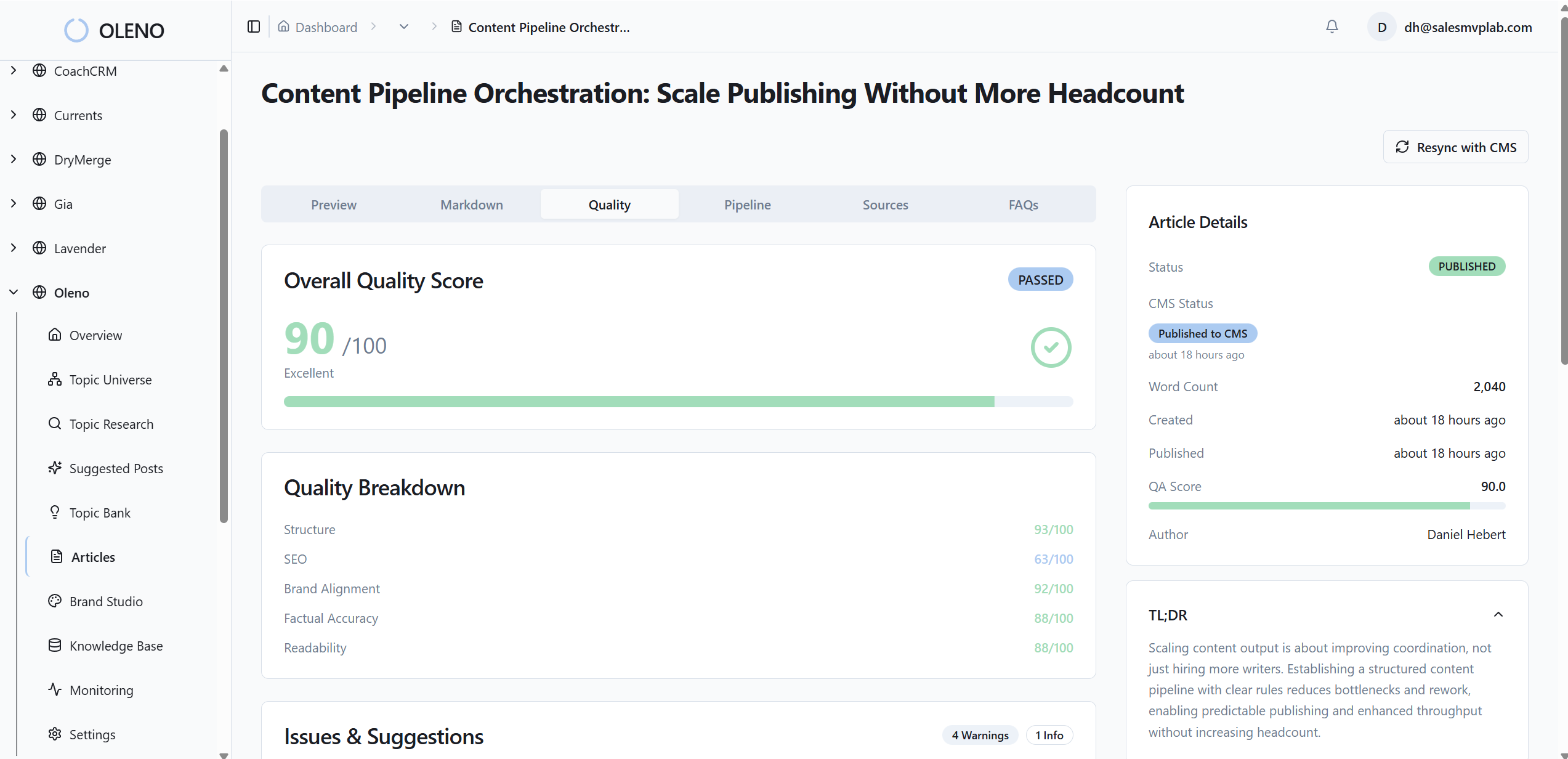
The product shape came from a pretty practical pain: too much time spent prompting, copying, pasting, checking, and manually loading content into a CMS. So the system was built to queue topics, write, QA, and publish with less manual friction. That backstory matters because it explains why the product behaves more like an operating layer than a chat box. Different starting assumption. Different outcome.
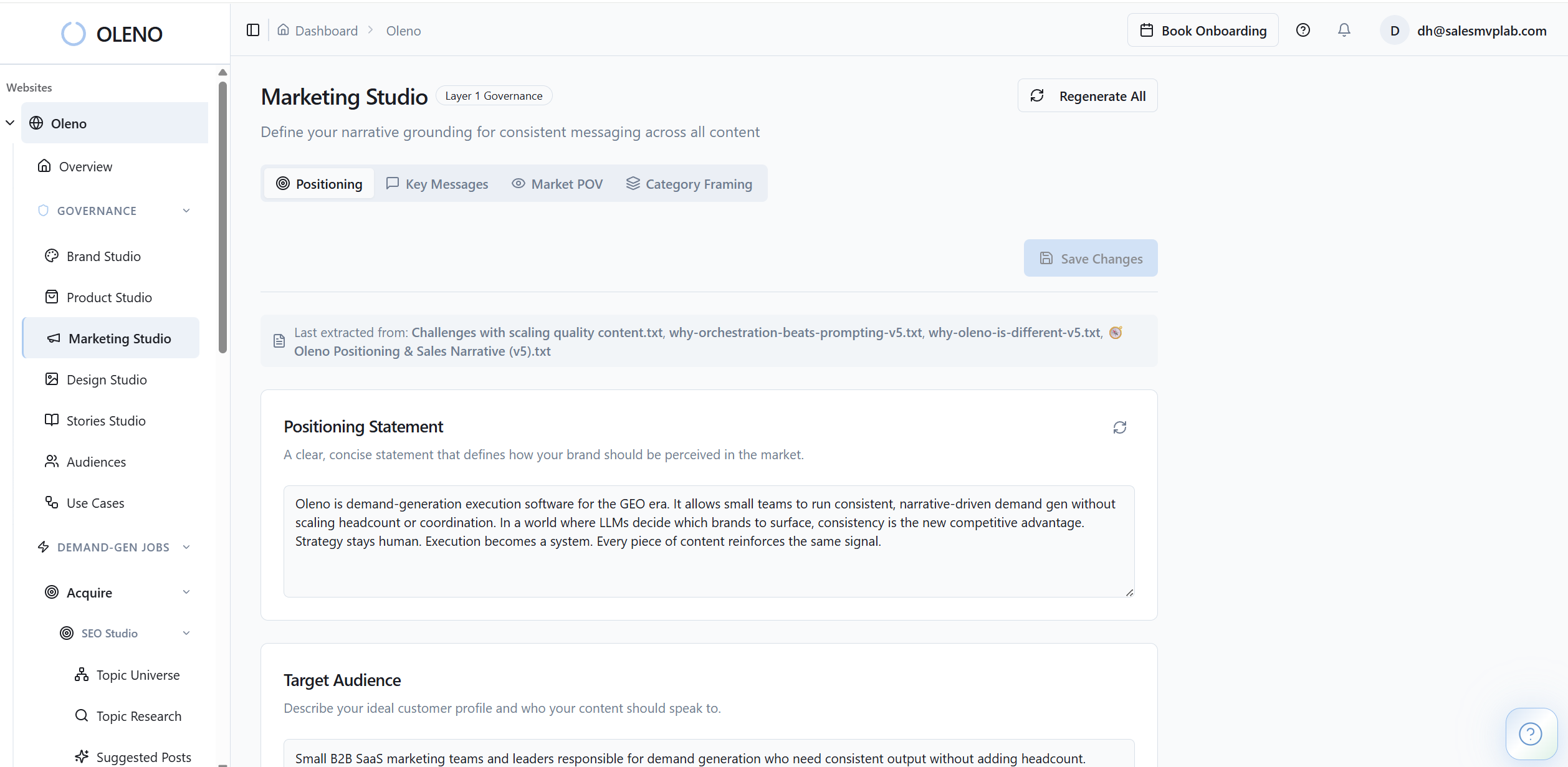
Oleno’s approach is grounded in governance layers such as Brand Studio and Marketing Studio, plus structured planning and execution paths for scaling SaaS teams. The point is to encode strategy once, then execute from that source instead of re-explaining the company every time a draft starts. For teams dealing with rework tax, narrative drift, and handoff overhead, that’s a meaningful shift.
I think of this as the Encode Once Rule. If your team repeats the same brand, audience, or product guidance more than 3 times a week across briefs and reviews, the issue isn’t writer effort. The issue is missing system memory.
If you want to see how that model maps to your team’s workflow, request a demo. The point isn’t more AI for its own sake. It’s less operational waste.
Best-fit teams and rollout model
Oleno is strongest for scaling SaaS marketing teams, usually 201 to 500 employees, where there are already people involved but no shared execution system. That means CMOs, Heads of Marketing, PMMs, and Heads of Content who don’t need more random output. They need less rework and tighter control.
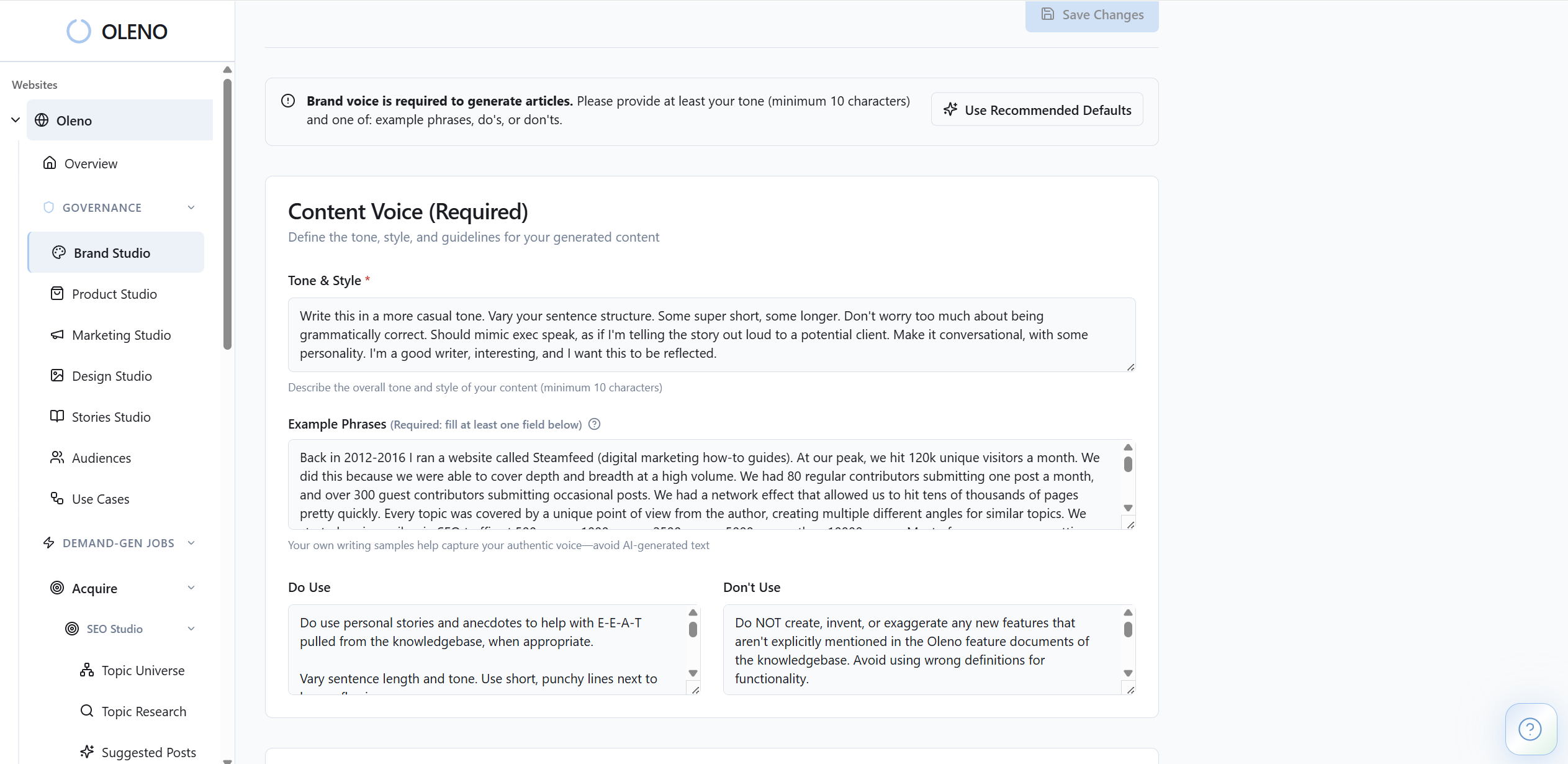
The rollout model is different from a workflow-builder-first product. You invest upfront in encoding strategy, voice, and product truth. That’s a real tradeoff. It takes intention. But it also sharpens the whole system. And to be fair, critics are right about one thing: if you only need quick copy for a small team, that overhead may not pay off. If coordination cost has already exceeded creation cost, though, it usually does.
Here’s the comprehensive view.
| Platform | Governance Controls | Brand Voice Support | Workflow Automation | Programmatic SEO | Product Accuracy Controls | Collaboration | Integrations | Analytics | Publishing | Pricing Model | Best-Fit Buyer |
|---|---|---|---|---|---|---|---|---|---|---|---|
| AirOps | Strong, workflow-defined | Strong | Strong | Strong | Moderate | Strong | Strong | Moderate | Moderate | Hybrid | SEO and content ops leaders with workflow ownership |
| Jasper | Moderate | Strong | Moderate | Moderate | Moderate | Strong | Strong | Moderate | Moderate | Subscription | Enterprise marketing teams focused on creative and brand consistency |
| Copy.ai | Light to moderate | Moderate | Moderate | Light to moderate | Light | Moderate | Moderate | Moderate | Light | Hybrid | Cross-functional GTM teams prioritizing fast adoption |
| Byword | Light | Light to moderate | Moderate | Strong | Light | Light | Moderate | Light | Strong | Hybrid | SEO teams and agencies focused on bulk content |
| Outrank | Light | Light to moderate | Strong | Strong | Light | Light to moderate | Moderate | Light to moderate | Strong | Subscription | SEO automation buyers optimizing for publishing cadence |
| Oleno | Strong, governance-first | Strong | Strong | Strong | Strong | Strong | Strong | Moderate to strong | Strong | Output-based subscription | Scaling SaaS marketing teams reducing rework and narrative drift |
If your evaluation is really down to workflow flexibility versus governance depth, that’s the actual fork in the road. The final step is choosing based on where your content operation breaks first, not which product promises the most in a sales call.
Which platform makes sense for your team
The best content marketing software depends less on headline features and more on where your current content operation breaks first. AirOps fits enterprise SEO and content ops teams that want configurable automation and have the operator capacity to manage it. Jasper fits brand-sensitive marketing teams that value creative flexibility. Copy.ai fits fast cross-functional rollout. Byword and Outrank fit programmatic SEO buyers chasing scale.
Oleno fits a narrower, but very real, enterprise buyer: scaling SaaS marketing teams with enough people to create complexity and not enough system to control it. If your issue is rework tax, context gaps, narrative drift, and too many cooks in the content kitchen, governance-first execution is the better lens.
That’s the choice I’d use:
- Choose AirOps if you want configurable workflows and have a strong ops owner.
- Choose Jasper if brand expression across campaign formats is the top priority.
- Choose Copy.ai if speed of adoption matters more than deep governance.
- Choose Byword or Outrank if programmatic SEO scale is the main business case.
- Choose Oleno if your team already has contributors, but lacks a system that keeps voice, positioning, and product truth intact across execution.
For teams in that last bucket, the next step isn’t another trial where you hope prompts behave better. It’s figuring out whether a governance-first rollout would actually remove review drag in your environment. Software choices are really operating model choices. Pick the one that matches how your team actually ships.
About Daniel Hebert
I'm the founder of Oleno, SalesMVP Lab, and yourLumira. Been working in B2B SaaS in both sales and marketing leadership for 13+ years. I specialize in building revenue engines from the ground up. Over the years, I've codified writing frameworks, which are now powering Oleno.
Frequently Asked Questions