Best Content Orchestration Platform for Small Business

If you’re a small business trying to scale content, the “best content orchestration platform” is the one that reduces coordination, enforces quality, and publishes reliably without you babysitting it all week. Most tools will help you draft faster. Fewer will keep your voice consistent, catch factual mistakes, and push content live without turning you into a full-time editor.
What to Look For in the Best Content Orchestration Platform for Small Business
The best content orchestration platform for a small business is the one that locks governance and quality checks into the workflow, then ships content to your CMS without manual copy-paste. Price matters, but setup effort and rework matter more because small teams can’t afford a tool that creates extra review cycles. For example, an SEO optimizer can improve drafts, but it won’t stop off-brand claims from slipping into published pages.
Non‑Negotiables for Small Teams (governance, QA, publishing)
If you’ve ever tried to “scale content” with a couple freelancers, a Notion board, and a shared Google Doc folder, you already know the failure mode. It’s not effort. It’s drift. Voice drift, facts drift, positioning drift. And suddenly you’re spending your nights rewriting intros because “it doesn’t sound like us.”
So for small teams, I look for three things that have to be non-negotiable: governance, a real QA checkpoint, and publishing that doesn’t break when you’re busy.
Governance is where most stacks are quietly broken. You might have brand guidelines, but they’re not executable. They’re just a PDF people ignore. Same with product truth. If your tool can’t enforce “these claims are allowed, these aren’t,” you’ll still be doing manual reviews forever.
A QA gate matters for a simple reason: speed without a quality floor is just faster rework. And publishing matters because copy-pasting into WordPress at 11 pm is not a content system. It’s a cry for help.
Here’s a plain-English checklist I’d use if I were buying this for a team of 1 to 5:
- Governance you set once: voice, terminology, claims boundaries
- Automated quality checks before anything ships
- Direct CMS publishing, with duplicate prevention
- Ability to create consistent variants (persona, segment, industry) without creating six off-brand versions
- A way to see cadence and quality trends, not just “how many drafts did we spit out”
Quick Reference: Top Picks for Small Teams
| Platform | Best For | Starting Price | Orchestration Focus | Setup Effort |
|---|---|---|---|---|
| Oleno | Governed long‑form production with on‑brand accuracy | from $449/mo (SEO + Social) | Governance + QA + CMS publishing + distribution | Low‑to‑moderate (one‑time governance setup) |
| Outrank | Automated SERP‑aligned long‑form with one‑click publishing | $49–$99/mo | Volume and SERP‑driven briefs | Low |
| Byword | Programmatic SEO at high volume (templates/batch) | $99/mo or ~$5/article | Bulk generation and GSC‑informed tracking | Moderate (template design) |
| Surfer | Optimization‑led drafting and content refreshes | ~$79/mo (annual) | On‑page scoring and SERP analysis | Low |
| AirOps | Custom workflows plus AI Search Optimization (AEO) | ~$99–$449/mo | No‑code automation and AEO tracking | Moderate‑to‑high |
| Jasper | Brand‑forward multi‑format marketing content | $49/mo | Templates, Canvas, pipelines, images | Low‑to‑moderate |
Key Takeaways:
- If you want “publish a lot of SEO pages fast,” Byword and Outrank are usually the starting point, with tradeoffs in governance and review.
- If you want “make existing pages rank better,” Surfer is typically more of an optimizer than a production line (Surfer SEO review).
- If you want flexible workflows plus AEO tracking, AirOps leans into that direction, but you should expect more configuration work (AirOps CMO series).
- If your biggest problem is keeping voice and claims consistent while shipping daily, Oleno is built around governance plus an enforced QA gate, then direct publishing.
The Hidden Time Tax of Manual Content Coordination
Manual content coordination costs small teams the most in rewrites and reviews, not in writing time. The work multiplies when voice and factual accuracy aren’t enforced up front, because every draft becomes a negotiation between “what the writer did” and “what the brand actually says.” A common example is spending an hour on a draft, then two more hours fixing positioning, claims, and tone.
I’ve lived this. When you’re the only marketer, you can crank out content because you’ve got all the context in your head. Then you add a writer and output drops. Not because they’re bad. Because they don’t have your lived understanding of the product, the market, and what you’re allowed to say.
Where Small Teams Lose Time (handoffs, reviews, rewrites)
Small teams lose time in the gaps between steps. The little handoffs you pretend don’t matter. Briefing. Reviews. “Can you tweak the angle?” “We can’t say that.” “This sounds generic.” “Can you add a competitor comparison?” It’s death by a thousand Slack messages.
And it’s sneaky. You don’t see it as a system cost. You see it as “just one more edit.”
These are the usual time leaks I see:
- Briefs that don’t contain enough product truth, so the draft is structurally fine but strategically wrong.
- Reviews that turn into rewrites because the draft misses voice, positioning, or basic claim boundaries.
- Publishing and distribution as separate workstreams, so you finish the article and then still have to create social variants.
- No consistent QA standard, so quality depends on who reviewed it and what mood they were in.
That’s why I’m pretty opinionated about orchestration. A writing tool is not orchestration. Orchestration is: the system creates the brief, creates the draft, validates quality, publishes, then repurposes, without you duct-taping ten steps together.
If you’re curious about what “orchestration” means in practice, Oleno leans hard into this idea: a governed pipeline that treats content like production, not like a one-off creative act (Oleno orchestration).
Outrank Review: Where It Fits for Small Teams
Outrank fits small teams that want SERP-aligned long-form content with minimal setup and quick publishing. It’s positioned around automating SEO content generation and publishing, which can be attractive when you’re trying to get momentum without hiring. As an example, Outrank highlights AI SEO content generation and publishing workflows on its site and blog (Outrank AI SEO content generator).
Outrank is also one of the more straightforward choices when “I need content this week” is the primary requirement. You’ll still need a human in the loop, especially if your product has nuanced claims or you operate in a category where wording matters.
Outrank: Key Strengths
Outrank’s strength is that it’s built for fast SEO execution. It leans into the concept of automated SEO content generation and publishing, and it speaks directly to small business SEO needs (Outrank best SEO tools for small businesses). That positioning is a good match for small teams who don’t want to assemble a workflow from scratch.
In practice, the appeal is simple: you can go from keyword to content to publishing without building a custom system. That’s valuable when you’re time-poor and trying to ship consistently.
What teams tend to like:
- A clearer path from topic to draft to publish
- SERP-oriented guidance that keeps drafts in the right neighborhood
- Less process overhead than a build-your-own workflow platform
Outrank: Limitations & Pricing/Value
Outrank’s main limitation for a brand-conscious team is that volume-first systems often push the hardest work downstream. You get drafts quickly, but voice control and factual accuracy still usually require manual review, especially if your product messaging has tight boundaries.
Pricing-wise, you’ll see Outrank positioned in the roughly $49 to $99 per month range in discussions and promos, and their site frames it as a subscription product (Outrank homepage). If your goal is “publish more SEO pages,” the value can be there. If your goal is “publish fewer pages but have them be bulletproof,” you may feel the review burden.
How Oleno is Different: Outrank is built to get you from SERP insight to publish quickly, but it doesn’t start from governance. Oleno encodes voice, narrative, and allowed claims up front, grounds drafts in your Knowledge Archive, and blocks publishing until the QA gate passes, which cuts the rewrite loop that eats small teams alive.
Byword Review: Programmatic SEO at Scale
Byword fits teams running programmatic SEO from templates and keyword lists, where volume is the strategy. It’s often discussed as a way to generate lots of pages quickly, with a workflow built around batch creation and structured inputs. A common example is using Byword to create large sets of pages from a list, which is exactly what many programmatic SEO campaigns need (Byword AI deep dive review (2025)).
If your small business is doing this kind of campaign, Byword can be a good fit. But you have to be honest about what programmatic content is: it’s structured, repeatable, and often requires extra care to avoid thin, samey pages.
Byword: Key Strengths
Byword’s strengths are pretty aligned with the programmatic playbook: templates, variables, batches, scale. If you’re an agency or a small team that’s comfortable designing templates and thinking in content systems, that’s a real advantage, especially when evaluating best content orchestration platform for small business.
You also see Byword show up in comparison roundups focused on scaling AI content production, which usually highlights its bulk output and programmatic angle (AI content tools comparisons). That’s a signal of where it fits in the market.
What I like about this category of tool is it makes the “10,000 pages” strategy feasible, at least operationally. Back in the day, I ran a site that hit traffic step functions at 500 pages, 1,000 pages, 2,500 pages, 5,000 pages, 10,000 pages. Most pages barely got views. That was fine. The long tail did the work.
Programmatic tools make that easier. No question.
Byword: Limitations & Pricing/Value
The limitation is the same as the strength. When you scale via templates, you risk ending up with content that’s structurally correct but strategically empty. That’s not a knock on Byword. That’s the nature of programmatic SEO if you don’t inject real expertise.
Pricing is typically described as $99 per month or a per-article model around $5 per article, depending on how you run it (Byword AI deep dive review (2025)). The watch-out is cost at scale. It can add up fast if you’re generating thousands of pages.
Also, templates take real work. If you’re a lean SMB and nobody on your team enjoys designing content templates, you might find yourself stuck.
How Oleno is Different: Byword is strong at template-driven scale, but governance and QA tend to live outside the system. Oleno applies Brand, Marketing, and Product governance to every piece, grounds drafts in your Knowledge Archive, and uses a QA gate to catch voice and claim issues before you publish a hundred off-brand pages.
Surfer Review: Optimization‑Led Workflow
Surfer is best when your workflow starts with “what does Google reward for this query” and ends with improving an existing page or drafting to an on-page score. It’s widely framed as an SEO content optimization product with a content editor, SERP analysis, and auditing (Surfer SEO review). For a small team, it can be a solid choice when you already have writers, but need tighter SEO execution.
Surfer is less of a full orchestration engine and more of an optimization cockpit. That’s not bad. It’s just a different job.
Surfer: Key Strengths
Surfer’s Content Editor and scoring workflow is the main draw, plus SERP Analyzer and audits depending on plan and use. Their product updates show they keep investing in the platform over time (Surfer January 2025 update).
If you’ve got a content backlog and want to refresh, Surfer tends to make that concrete. It gives you “do these things” guidance, which small teams often need because nobody has time to build bespoke SEO checklists.
It also has a learning curve that’s manageable. Lots of people document how to use it, which is usually a sign the workflow is standardized enough to teach (how to use Surfer SEO).
Surfer: Limitations & Pricing/Value
Surfer’s limitation in an orchestration conversation is that it doesn’t replace the rest of your content ops. You still need governance, briefs, approvals, fact checking, publishing, and distribution processes. Surfer can improve the SEO quality of a piece, but it won’t enforce “this claim is allowed” or “this is how we talk about ourselves.”
Pricing is often referenced around $79 per month on annual plans in writeups and comparisons (Surfer SEO review). For very small teams or freelancers, that can feel like a lot if you still need another tool for writing and another for publishing.
Also, scoring systems can nudge you toward formulaic content. That’s not always a problem, but if you’re trying to build a differentiated point of view, you’ll still need a human editor who’s willing to ignore the score sometimes.
How Oleno is Different: Surfer optimizes content in an editor, but it doesn’t run the full production line. Oleno bakes governance and a QA gate into the pipeline, then publishes idempotently to your CMS and generates distribution variants, so the work doesn’t split across five tools and three checklists.
AirOps Review: Customizable Workflows and AEO for Best content orchestration platform for small business
AirOps is a strong fit if you want customizable workflows plus an explicit focus on AI Search Optimization (AEO) and content quality in AI-driven discovery. They write about issues like “AI slop” and positioning content for AI search visibility, which signals what they care about (AirOps on AI slop). For a small team, the upside is flexibility, but the cost is usually configuration and ongoing maintenance.

If you have someone on your team who likes building workflows, AirOps can be compelling. If not, it can feel like buying a workshop, not a finished machine.
AirOps: Key Strengths
AirOps talks openly about a “new content era” and how content ops changes when AI systems become part of discovery and evaluation (AirOps CMO series). That’s aligned with where a lot of teams are going, especially teams doing programmatic SEO plus AI-driven search visibility.
They’ve also gotten attention for the category, including coverage tied to funding and the broader push into AI search optimization (AirOps secures $40M). That doesn’t prove product quality, but it does show market momentum.
The big strengths tend to be:
- Workflow flexibility, especially if you want custom pipelines
- AEO focus, which is becoming a real consideration for SEO teams
- A platform feel, not just a single-purpose writer
AirOps: Limitations & Pricing/Value
The downside of “platform” is you inherit platform overhead. Configuration, governance decisions, workflow upkeep, troubleshooting weird edge cases. For a lean SMB, that can be a deal breaker unless you’ve got someone who owns ops.
Pricing is often discussed in ranges like $99 to $449 per month for SMB tiers, depending on plan and usage, plus enterprise options (AirOps CMO series). The risk is you pay for flexibility you don’t use.
Also, even AirOps would likely agree that high-quality thought leadership still needs human polish. Their own writing about AI slop is basically a warning label that says “don’t assume automation equals quality” (AirOps on AI slop).
How Oleno is Different: AirOps is great if you want to build custom workflows and track AEO, but you’ll spend real time configuring and maintaining that. Oleno is designed as a deterministic production engine for small teams: define governance once, generate grounded drafts, enforce a QA gate, publish to your CMS, and push distribution variants without rebuilding the workflow every quarter.
Jasper Review: Brand‑Forward AI for Marketing Teams
Jasper is usually a good fit for teams that want a broad AI marketing workspace with brand controls and lots of content formats. It’s commonly positioned as an AI content generator for marketers, with templates and brand features (Jasper AI content generator). For small teams, Jasper can feel like a strong “marketing generalist” tool, especially if you need more than blog posts.

Jasper is less of an SEO orchestration engine and more of a brand-forward content creation suite. If your day includes ads, emails, landing pages, and social, that matters.
Jasper Review: Where it shines, and where it doesn’t
Jasper’s big win is usability and breadth. Templates, collaborative workflows, and a marketing-oriented UI. Pricing writeups often put their entry plan around $49 per month, depending on plan and billing (Jasper pricing overview).
Where Jasper is usually not the default choice is “I need a governed pipeline for long-form SEO that publishes daily with enforced QA.” You can absolutely create long-form in Jasper. You’ll still need your own governance enforcement and your own publishing process.
That’s the distinction. Jasper is a great workspace. Orchestration is a production system.
How Oleno is Different: Jasper is a strong brand-forward writing environment, but it still expects a human to do the final governance and fact-check work. Oleno grounds drafts in a Knowledge Archive, enforces a QA gate before publishing, and pushes directly to your CMS, which is a different posture for small teams trying to ship reliably.
Best Content Orchestration Platform for Small Business: Top Picks Compared
The top pick depends on whether you need optimization, programmatic volume, workflow customization, or governed publishing with QA. Outrank and Byword lean into speed and scale for SEO production, Surfer leans into on-page optimization, AirOps leans into customizable ops and AEO, and Jasper leans into broad brand-forward marketing creation. If you’re trying to run content like a system with enforced governance and publishing, Oleno is the most directly built for that job.
This is where small teams need to be honest about what they’re buying, especially when evaluating best content orchestration platform for small business.
If your biggest constraint is “we have no content,” a volume tool can be a good starting point. If your biggest constraint is “everything takes too long because every draft needs a rewrite,” then you don’t have a writing problem. You have a governance problem.
And if you’re spending hours per week moving drafts between tools and people, that’s orchestration debt. It will compound.
A quick gut-check I use:
- If you already have writers and editors, Surfer can make them more effective (Surfer SEO review).
- If you have a clear template-driven programmatic play, Byword makes sense (Byword AI deep dive review (2025)).
- If you want a simple publish-more workflow, Outrank is straightforward (Outrank AI SEO content generator).
- If you want custom ops plus AEO, AirOps is worth a look (AirOps on AI slop).
- If you need broad marketing content types, Jasper is a strong contender (Jasper pricing overview).
Why Oleno Suits Small‑Business Content Orchestration
Oleno suits small-business content orchestration because it prioritizes reliability over endless flexibility: you define voice, narrative, and allowed claims once, ground content in your Knowledge Archive, enforce a QA gate, then publish and distribute without manual coordination. Pricing is predictable and tied to output volume, starting at from $449/mo (SEO + Social). For example, if your team keeps losing cycles to rewrites and “does this claim match what we can say,” Oleno is designed to prevent that upstream.
Last summer I built a bunch of GPTs for a product I was marketing and I was living in copy-paste hell. Three to four hours a day. Same prompts. Same edits. Then I’d push it into my CMS manually. Total waste.
So I hard-coded an autonomous content engine into the CMS. It would queue topics, write, QA, publish. It started indexing fast. Traffic showed up. Then clients started asking, “can I use this?” After enough of those conversations, it was obvious it needed to be a product.
That’s basically why Oleno looks the way it does. It’s built around the parts that usually break for small teams.
Oleno: Core Differentiators for SMBs
Oleno’s differentiators show up when you care about governance and operational control, not just “generate text.” The core idea is that Brand Studio, Marketing Studio, and Product Studio define voice, point of view, and claim boundaries before you generate anything, so the system isn’t guessing what “on brand” means.
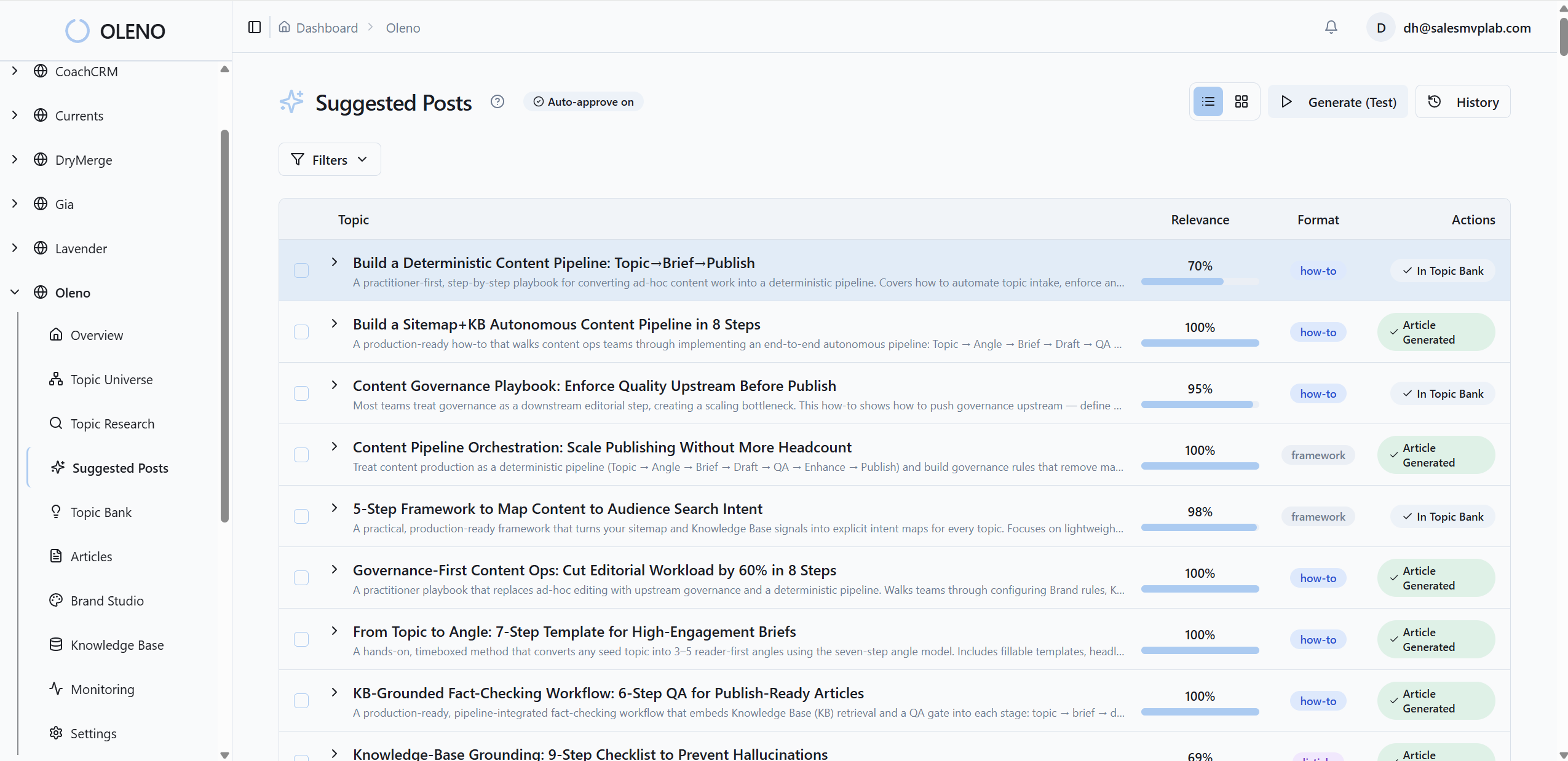
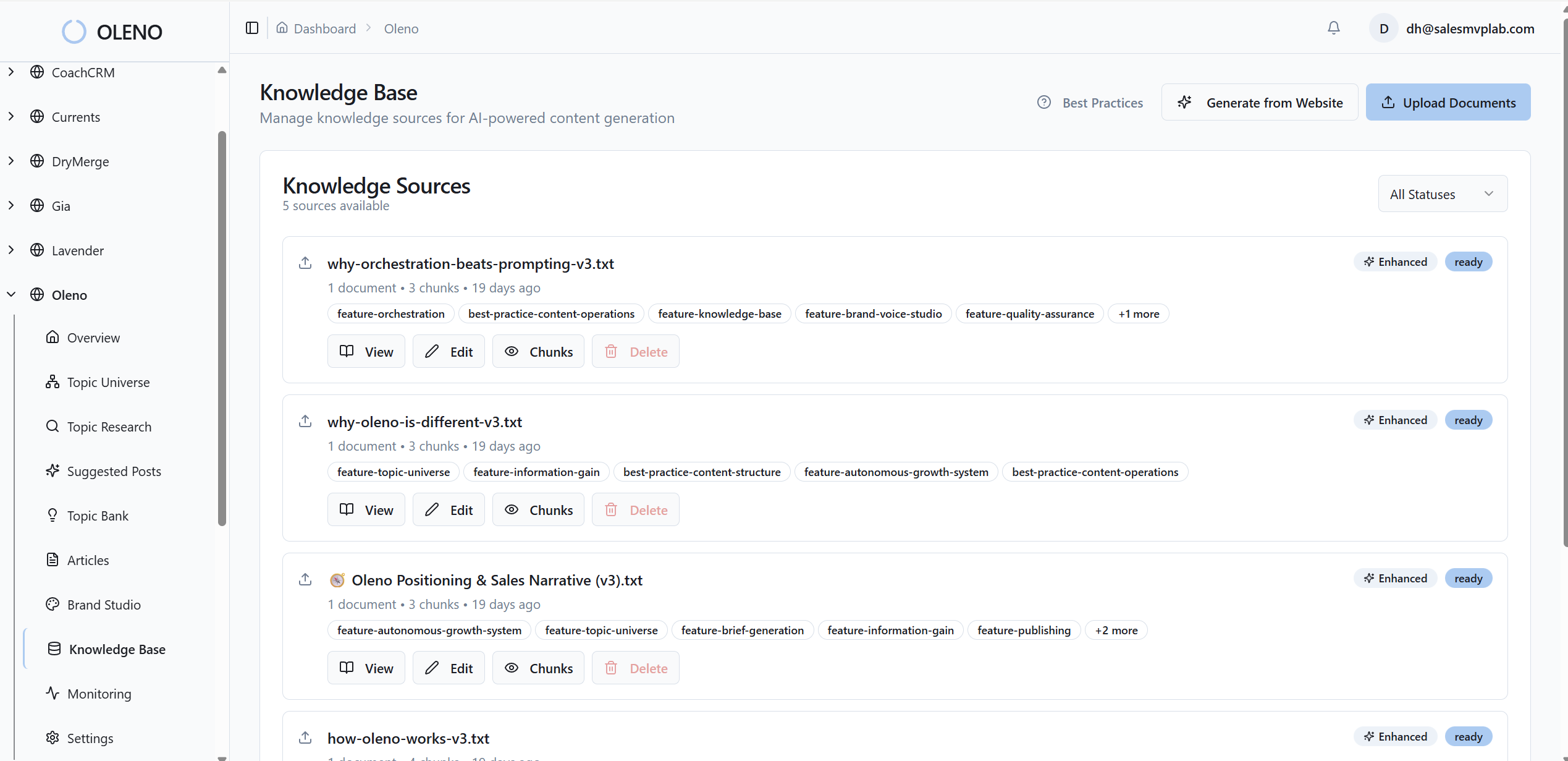
Then the Knowledge Archive grounds drafts in your internal material, which is the only way I’ve seen to consistently reduce hallucinated product details without turning your editor into a full-time fact checker. After that, the QA Gate before publishing checks voice, structure, accuracy, and readability, and the system can revise until it passes.
Finally, the workflow finishes the job: CMS publishing is direct and idempotent, so you don’t create duplicates, and Distribution lets you repurpose approved content into social variants without rewriting everything by hand.
The parts small teams usually care about most:
- Brand Studio: voice, tone, terminology, CTA rules
- Marketing Studio: narrative frameworks and POV consistency
- Product Studio: approved claims and feature boundaries
- Knowledge Archive: grounding across articles
- SEO Studio and Competitive Studio: scalable acquisition content
- QA Gate Before Publishing: consistent quality floor
- CMS Publishing and Distribution: hands-off execution
- Variation Layer: persona- and segment-specific variants
If you want to see whether this fits your exact workflow, request a demo and we’ll walk through how governance setup and publishing would look for your CMS and content cadence.
Getting Started and Pricing
Pricing is simple and output-based. Oleno starts at from $449/mo (SEO + Social), with higher tiers at $449/mo (Full-Funnel GEO) and $1,349/mo (Narrative Control).
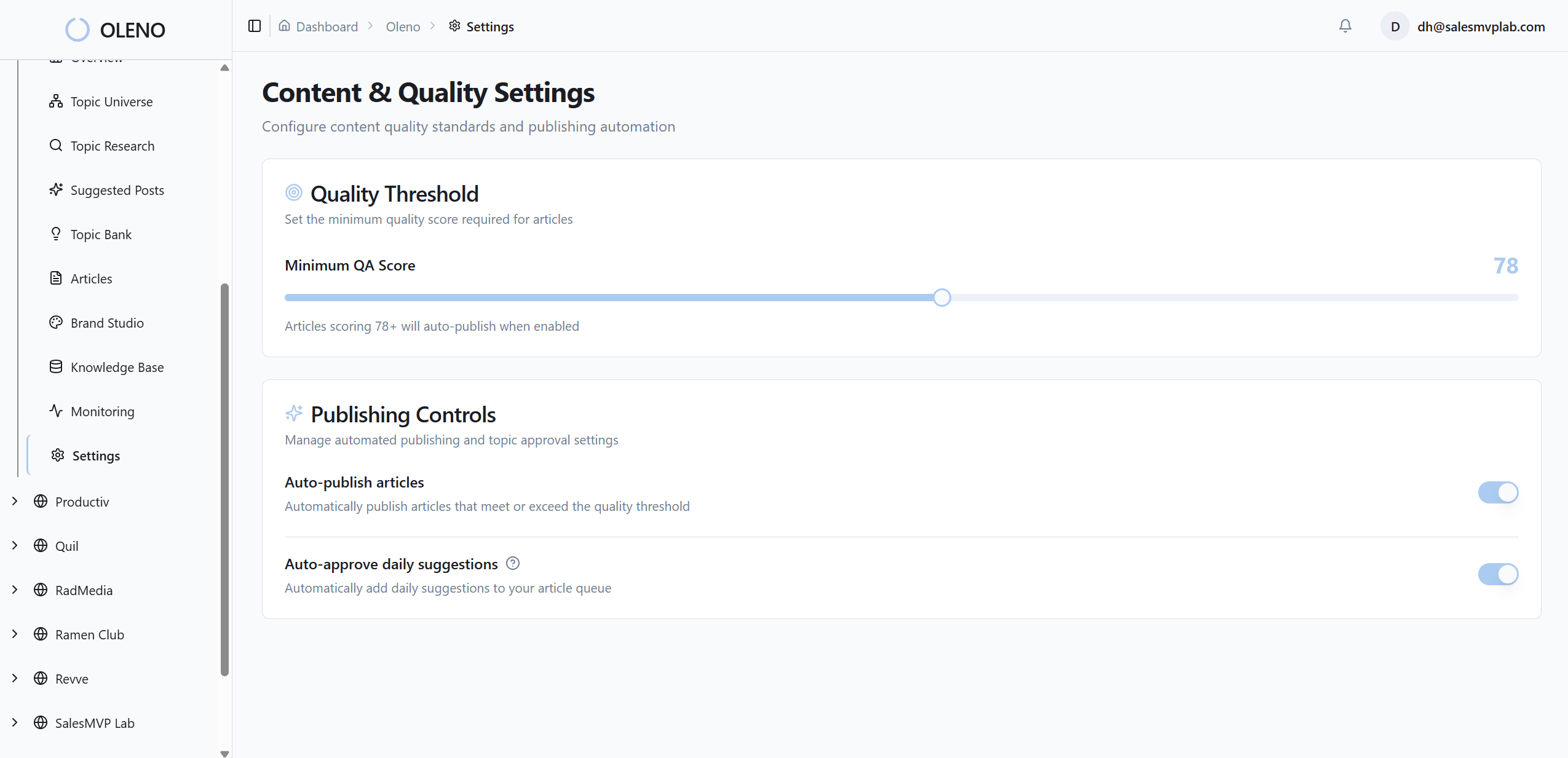
The setup is usually a one-time governance effort. You load the Knowledge Archive with the stuff you already have, brand docs, product docs, positioning, FAQs, sales calls if you want. Then you define the boundaries in the Studios. After that, the day-to-day is about operating the pipeline, not rebuilding it.
That’s the trade. You spend a little time defining “truth” once, so you don’t pay for it in rewrites forever.
Comprehensive Feature Grid
| Capability/Criteria | Oleno | Outrank | Byword | Surfer | AirOps | Jasper |
|---|---|---|---|---|---|---|
| Governance of brand voice and messaging | Yes (Brand & Marketing Studios) | Partial (brand voice preservation) | Partial (tone customization) | No (focus on optimization) | Yes (Brand Kits/governance) | Yes (Brand Voice/BrandIQ) |
| Factual grounding in internal knowledge | Yes (Knowledge Archive) | Partial (SERP/context; user uploads vary) | Partial (file uploads/knowledge) | No (SERP data; not internal grounding) | Yes (knowledge bases support) | Partial (context files; manual checks) |
| Programmatic SEO at scale | Yes (SEO Studio) | Yes | Yes (batch/templates) | Partial (Surfer AI drafting) | Yes (programmatic pages) | Partial (workflows/templates) |
| Non‑negotiable QA gate before publishing | Yes (automated QA checks and auto‑revise) | No (manual review recommended) | No (manual QA process) | No (editor scoring; human QA) | No (workflow‑defined; not enforced gate) | No (manual fact‑check) |
| Direct, idempotent CMS publishing | Yes (WordPress, Webflow, HubSpot, Storyblok, etc.) | Yes (WP, Webflow, Notion, API) | Yes (CMS + GSC integration) | Partial (WP/Docs integrations) | Yes (CMS connectors) | Partial (integrations vary) |
| Persona/segment variation at scale | Yes (Variation Layer) | No (volume‑first approach) | Partial (templates/variables) | No | Yes (workflow templates/personas) | Partial (templates + brand voice) |
| Competitive and alternatives pages systematized | Yes (Competitive Studio) | No (not specialized) | Partial (can generate; not governed) | No | Partial (workflows possible) | Partial (templates/agents) |
| Distribution to social with on‑message repurposing | Yes (Distribution with queues/scheduling) | Partial (in‑article assets; no social queues) | Partial (images; not distribution) | No | Partial (workflows/Integrations) | Partial (pipelines; varies by stack) |
| Measurement & system‑health ops signals | Yes (cadence, quality trends, sampling) | No (basic reporting) | Yes (GSC performance tracking) | Partial (site dashboard) | Yes (dashboards/analytics) | Partial (pipelines analytics) |
| AI Search Optimization (citations/AEO) | No (focus on governed publishing) | No | No | No | Yes (AEO, citations, extractability) | No |
| Real‑time GSC integration | No (not listed) | No | Yes | Yes | Yes | No |
| Multilingual support | Not primary focus (voice‑first governance) | Yes (150+ languages) | Yes (~9 languages) | Partial | Yes (varies by model/workflow) | Yes (model dependent) |
| Starting price (public) | from $449/mo (SEO + Social) | $49–$99/mo | $99/mo or ~$5/article | ~$79/mo (annual) | ~$99–$449/mo | $49/mo (Creator) |
If you’re trying to decide quickly, this is the simplest filter I know: do you want a tool that drafts and optimizes, or a system that enforces governance and ships. If it’s the second one, book a demo and we’ll map your current workflow to what the pipeline would look like with QA and publishing baked in.
Picking Your Tool Without Regretting It in 60 Days
The right platform is the one you’ll still be using after the initial excitement wears off. That usually comes down to whether the tool reduces rework, not whether it can generate another draft.
If you’re a small business and you’re trying to get content compounding, you want a system that makes “publish” the default outcome, not “draft.”
If you want to pressure-test this for your team, request a demo and we’ll focus on two things: how governance gets set once, and how the QA gate changes your edit load.
You don’t need a giant stack. You need a reliable one.
About Daniel Hebert
I'm the founder of Oleno, SalesMVP Lab, and yourLumira. Been working in B2B SaaS in both sales and marketing leadership for 13+ years. I specialize in building revenue engines from the ground up. Over the years, I've codified writing frameworks, which are now powering Oleno.
Frequently Asked Questions