Best Programmatic SEO Software for Small Business Teams

A $29 tool can become a $2,000 monthly mistake once you count rewrites, approvals, and missed publishing windows. If you tried programmatic SEO software this week and still ended up editing drafts in Google Docs at 10 PM, you already know the hard part is not generating words.
Small businesses looking for the best programmatic SEO software usually compare sticker price first. I think that's backward. The better filter is setup burden, content quality, publishing workflow, governance, and total cost of ownership over the next 6 to 12 months.
What Small Businesses Actually Need From Programmatic SEO Software
Small business teams need programmatic SEO software that increases usable publishing velocity, not just draft output. The real test is simple: does the tool reduce research time, editing loops, and coordination overhead after the first draft, or does it just create more cleanup wearing an AI costume?
| Tool | Starting Price | Best For | Primary Strength | Primary Tradeoff |
|---|---|---|---|---|
| AirOps | Free tier, paid plans commonly around $99 to $199/month | SEO and growth teams with workflow maturity | Configurable workflows and AI search focus | Setup can be heavy |
| Byword | $5/article or $99/month | Agencies and SEO operators publishing at scale | Batch programmatic page production | Less suited to nuanced brand content |
| Copy.ai | Free plan, paid plans around $24 to $29/month | Small teams needing fast drafting | Easy adoption and broad template coverage | Lighter SEO structure |
| Jasper | Around $49/month | Marketing teams prioritizing brand voice | Strong brand controls and collaboration | Higher cost for smaller teams |
| Outrank | $49 promotional, commonly $99/month | Lean teams wanting automated SEO articles | End-to-end article workflow | Quality reliability concerns |
| Oleno | $109/month | Teams needing governed SEO scale | Governance-first execution | More upfront structure |
Key Takeaways:
- Best for throughput: Byword fits teams chasing large-scale, repeatable page creation more than cross-functional brand control.
- Best for quick adoption: Copy.ai is the easiest starting point if you mainly want faster drafting, not a full programmatic SEO system.
- Best for workflow flexibility: AirOps makes sense when your team can handle setup and wants custom process design.
- Best for governed scale: Oleno fits marketing teams that already have contributors but need one system for voice, positioning, and repeatable execution.
The difference between content velocity and usable publishing velocity
Draft volume is not publishing velocity. Usable publishing velocity means a page goes from idea to live URL without getting trapped in research gaps, rewrite cycles, or approval mess.
Here’s the day most teams know something is off. A marketer opens an AI draft at 4 PM thinking the heavy lifting is done. By 5:30, they are fixing headings, checking whether claims match the product, rewriting the intro so it stops sounding generic, and pasting everything into the CMS by hand. The draft showed up fast. The publishable asset did not.
That’s why I use the 3-Handoff Rule. If a draft needs more than three human handoffs after generation, the tool is increasing labor, not reducing it. For a small business evaluating the best programmatic SEO software, that threshold matters because one extra review loop can wipe out the savings from cheaper software.
Before you compare feature lists, you need to know where these costs pile up.
What to evaluate before comparing pricing
Five things matter before monthly price even enters the conversation: setup burden, editorial control, SEO structure, publishing support, and governance depth. Miss two of those, and the “cheap” option gets expensive in slow motion.
A small team usually feels this around week three. At first, the output feels exciting. Then the edge cases start showing up. Product terms are off. Internal logic drifts. The SEO format is there, but the point of view is thin. Suddenly somebody on the team becomes the unofficial cleanup crew.
And to be fair, low-cost AI tools are attractive for a reason. If you’re a founder or solo marketer, getting words on the page fast can absolutely be the right first move. But if you publish more than 20 to 30 pages a month, the cost center shifts from drafting to correction. That’s the switch most buyers miss. Cheap software is cheap right up until a human has to babysit every page.
The next question is where that hidden cost shows up first.
Why Choosing the Wrong Programmatic SEO Platform Gets Expensive Fast
The wrong platform gets expensive when manual work shows up after the first draft. Most teams underestimate the cost of review time, content drift, and publishing friction because those costs land in people hours, not software invoices, which is exactly why picking the best programmatic SEO software is more operational than it looks.

Where small teams lose time after the first draft
Four cleanup zones usually do the damage: fact checking, SEO restructuring, brand cleanup, and CMS publishing. The draft is the midpoint. The expensive part starts when humans have to make the output safe enough to publish.
Picture a Head of Marketing at a 40-person SaaS company on Thursday afternoon. They have five draft pages open, one PMM sending corrections in Slack, a founder asking why the message sounds too broad, and no clean way to know which pages are actually ready. That person is not running programmatic SEO. They’re doing editorial triage.
I call this the Post-Draft Tax. If cleanup takes more than 25 minutes per article, the system breaks for lean teams. Sure, some teams will tolerate more because the content still ranks. Fair enough. But rankings without workflow discipline create a backlog that slowly eats the team alive.
That backlog is why article count is such a bad buying metric.
Why governance matters more than raw article count
Governance matters because programmatic SEO is a scale problem, and scale amplifies mistakes. More pages means more chances for off-brand phrasing, stale product claims, and inconsistent framing to spread quietly across the library.
Back in the Steamfeed days, we saw traffic spikes at 500 pages, then 1,000, then 2,500, then 5,000. Most pages got under 100 views a month. Still worth it. Volume plus quality plus breadth created compounding traffic. But the hidden part was control. Once quality drift sneaks into hundreds or thousands of pages, your content library starts behaving like a warehouse with broken shelf labels. Inventory exists. Trust doesn’t.
There is a fair counterpoint here. If you’re doing pure affiliate SEO or highly templated directory pages, raw volume can carry the model for a while. True. But for a small business trying to turn search into pipeline, governance beats raw article count once the library starts compounding. And that’s the line that separates the tools below.
AirOps for Small Business Teams
AirOps is a strong fit for teams that want configurable workflows and AI search operations, but it asks more from the user than simpler SMB tools. Its appeal is flexibility. Its risk is setup weight. For the right operator, that tradeoff can make sense.
AirOps strengths for workflow-heavy SEO teams
AirOps leans into workflow design and AI search visibility, which is why technical SEO and growth teams often look at it first (AI Certs). The platform appears to position itself around customizable systems, not just one-click writing.
That matters if your team wants to build a process, not just run prompts. A growth lead with a clear ops mindset can use a workflow-heavy setup to connect research, drafting, optimization, and distribution in one place. When a team already has process discipline, that flexibility can be genuinely useful.
The catch is obvious. Flexible systems assume you know what you’re building. If your team doesn’t already have clean process logic, a configurable tool can turn into an expensive sandbox.
AirOps limitations for lean operators
What happens when the person building the workflow is also the person writing copy, reviewing claims, and publishing pages? Usually, the system stalls.
Small teams often buy flexibility when they actually need constraint. AirOps can support broad integrations and custom automation paths, but that also means more design decisions up front (AirOps blog). For a lean operator, too many choices create drag.
A founder-led team feels this fast. Week one is exciting. Week two is mapping workflow branches. Week three is asking why the polished system still needs manual checking on every page. That’s not a knock on the product. It’s a maturity mismatch. If your team lacks a dedicated content ops owner, implementation overhead becomes the real price.
AirOps pricing and implementation fit
AirOps commonly enters the conversation with a free tier and paid plans often discussed around $99 to $199 per month, with custom enterprise pricing beyond that (AI Certs). That puts it in range for SMB buyers, at least on paper.
The paper price isn’t the decision point though. The better question is this: can your team absorb 2 to 4 weeks of setup effort and still maintain publishing cadence? If yes, AirOps may make sense. If no, the attractive starting price becomes misleading.
How Oleno is Different: AirOps starts from workflow flexibility. Oleno starts from governance inputs like Brand Studio and Marketing Studio, so positioning and voice are defined before pages scale. That matters when your team has multiple contributors and wants fewer rewrites, not more workflow branches.
Byword for High-Volume SEO Publishing
Byword is built for high-volume programmatic SEO publishing, and that focus makes it attractive for agencies and SEO operators chasing scale. The upside is throughput. The tradeoff is depth. If your success depends on template-driven coverage, that exchange can be reasonable.
Byword strengths for batch publishing
A lot of tools say they support scale. Byword is one of the few that appears to be clearly built around it. Third-party reviews regularly frame it as a strong option for bulk article generation and structured SEO campaigns (Skywork review, TripleDart guide).
This is where buyer fit matters. Byword is a better fit for SEO and growth managers or agency leads who care most about keyword throughput, batch publishing, and repeatable page creation. If your strategy is “cover the topic map fast, then refine winners,” Byword lines up with that operating model.
I get the appeal. I’ve lived versions of this. When scale starts working, you begin thinking in page clusters, not individual posts. That instinct is not wrong. But it does come with a tradeoff.
Byword limitations for nuanced brand content
High-volume page generation works beautifully for repeatable templates, and it works less well for nuanced, expert-led, point-of-view content. That’s not a flaw so much as a design center.
If your pages need product nuance, category framing, or a distinct opinion, batch systems usually need more editorial lift. A PMM or founder will spot the flattening effect fast. The structure is there. The page sounds fine. But “fine” is rarely enough when the content has to carry brand meaning too.
Here’s the earned pivot: if your business model rewards sheer topical coverage, Byword may be the right tool. If your business needs search pages to also reinforce a demand-gen narrative, you may outgrow pure throughput software earlier than expected.
Byword pricing and workflow fit
Byword’s entry point is often cited as $5 per article or $99 per month, depending on usage path and plan structure (Skywork review). That is attractive for large page sets because the economics are easy to model.
The threshold I’d use is 500-plus pages tied to repeatable templates. Below that, the batch advantage matters less. Above that, it matters a lot. That’s why Byword is one of the stronger options in this comparison for buyers optimizing for throughput and template scale over cross-functional governance.
How Oleno is Different: Byword treats programmatic SEO as a publishing scale problem. Oleno treats it as a demand-generation execution problem, with planning layers that connect audience, positioning, and SEO content scaling so the library compounds without narrative drift.
Copy.ai for Fast Content Production
Copy.ai is easy to adopt and useful for fast drafting, but it is less specialized for programmatic SEO than the more SEO-native tools here. The upside is speed and simplicity. The downside is that small teams often have to bolt on structure later.
Copy.ai strengths for lightweight teams
Copy.ai has long been attractive to smaller teams because the barrier to entry is low and the template range is broad (Deeper Insights review). If your main need is getting first drafts, landing page copy, emails, and lightweight marketing content out quickly, it does that job well.
That simplicity matters. A solo marketer or founder usually does not want to learn a whole operating model just to get content moving. They want something they can open and use in 15 minutes. Copy.ai fits that moment.
Short term, that can be a real win. Long term, the question becomes whether faster drafting is enough.
Copy.ai limitations for SEO structure and review-heavy workflows
Copy.ai tends to be less specialized for search-driven execution, and reviewers often compare it more as a general AI writing assistant than a true programmatic SEO platform (Zapier comparison). That usually means more manual work for keyword mapping, heading structure, internal consistency, and review flow.
This is where the limit matters. Not every small business needs a heavier system. If you’re publishing 5 to 10 assets a month, a broad AI writer may be plenty. But when the plan shifts to 50, 100, or 300 SEO pages, lightweight drafting tools start pushing operational work back onto humans.
How Oleno is Different: Copy.ai is a broad AI writing assistant. Oleno is built more like a governed operating system for SEO and demand-gen content, with verified inputs meant to reduce rework, narrative drift, and the constant “who fixes this draft?” problem.
Jasper for Brand-Controlled Marketing Content
Jasper is a solid choice for teams that care deeply about brand voice and collaborative marketing workflows, but it is less specialized for programmatic SEO execution than SEO-native platforms. Its strength is brand control across formats. Its weakness is search workflow depth.
Jasper strengths for brand voice control
Jasper is well known for brand-oriented marketing content and a more polished team experience, and public pricing sources regularly place its Creator plan around $49 per month (Samantha North pricing review, Wise pricing guide). For agencies and marketing teams producing campaigns across channels, that can make sense.
The appeal is straightforward. Jasper gives teams a cleaner way to manage voice than many lower-cost tools. If you’re writing ads, emails, landing pages, campaign assets, and blogs in one environment, that cross-format consistency is useful.
Jasper limitations for search-driven execution
Brand control is not the same thing as search execution. Jasper can support content production, but deeper SEO research and technical programmatic workflow do not appear to be the center of gravity. That means the team still needs separate discipline around structure, topic prioritization, and editorial QA.
I’ve seen this pattern a lot. Marketing teams buy a good writing environment and then expect it to become a content operating system. It rarely does. Good writing support solves one layer of the problem. Search execution needs more than that.
How Oleno is Different: Jasper helps teams keep style more consistent. Oleno connects voice control to approved market framing, planning layers, and product truth, which is a better fit when SEO content also has to stay strategically aligned across a growing team.
Outrank for Automated Long-Form SEO Workflows
Outrank is aimed at lean teams that want automated SEO article production with less workflow design. The attraction is obvious: keyword planning, briefs, generation, and publishing in one path. The risk is that volume-friendly systems can struggle when factual precision matters.
Outrank strengths for automated publishing
Outrank presents itself as an end-to-end SEO workflow, with article generation, SERP-driven support, and publishing-oriented automation (Outrank product page). That model is naturally appealing to small businesses that do not want to assemble five tools.
For a lean team, convenience is not trivial. One system that moves from topic to page draft to published asset can save a lot of switching cost. If your goal is consistent SEO article output with minimal setup, Outrank has a clear pitch.
Outrank limitations for quality-sensitive teams
Still, third-party comparisons and alternatives coverage raise recurring concerns around content quality and reliability at scale (BabyLove Growth comparison). That is the downside of high automation. The faster the machine runs, the more important your guardrails become.
That doesn’t mean automated publishing is a bad idea. Not even close. I’d argue it’s where the market is going. But if your pages need careful product accuracy or category nuance, the exception matters: automated long-form systems are strongest when the source material is repeatable and the stakes of minor drift are low.
How Oleno is Different: Outrank emphasizes automated article throughput. Oleno puts planning and governance earlier in the process, which makes more sense for teams that need pages to stay accurate, on-message, and reusable across broader demand-gen programs.
How Oleno Approaches Programmatic SEO Differently
Oleno approaches programmatic SEO as a governance and planning problem first, then an execution problem second. That changes the buying conversation from “How many pages can we generate?” to “How do we scale without rewrites, drift, and broken messaging?” For teams with multiple contributors, that shift is meaningful.
The governance layer behind Oleno's approach
The core difference is structural. Oleno starts at $109 per month, scales to $1,057 per month for 10 posts per day, and moves to enterprise pricing for 11 or more posts per day. That pricing only makes sense if you value governed output more than raw draft count.
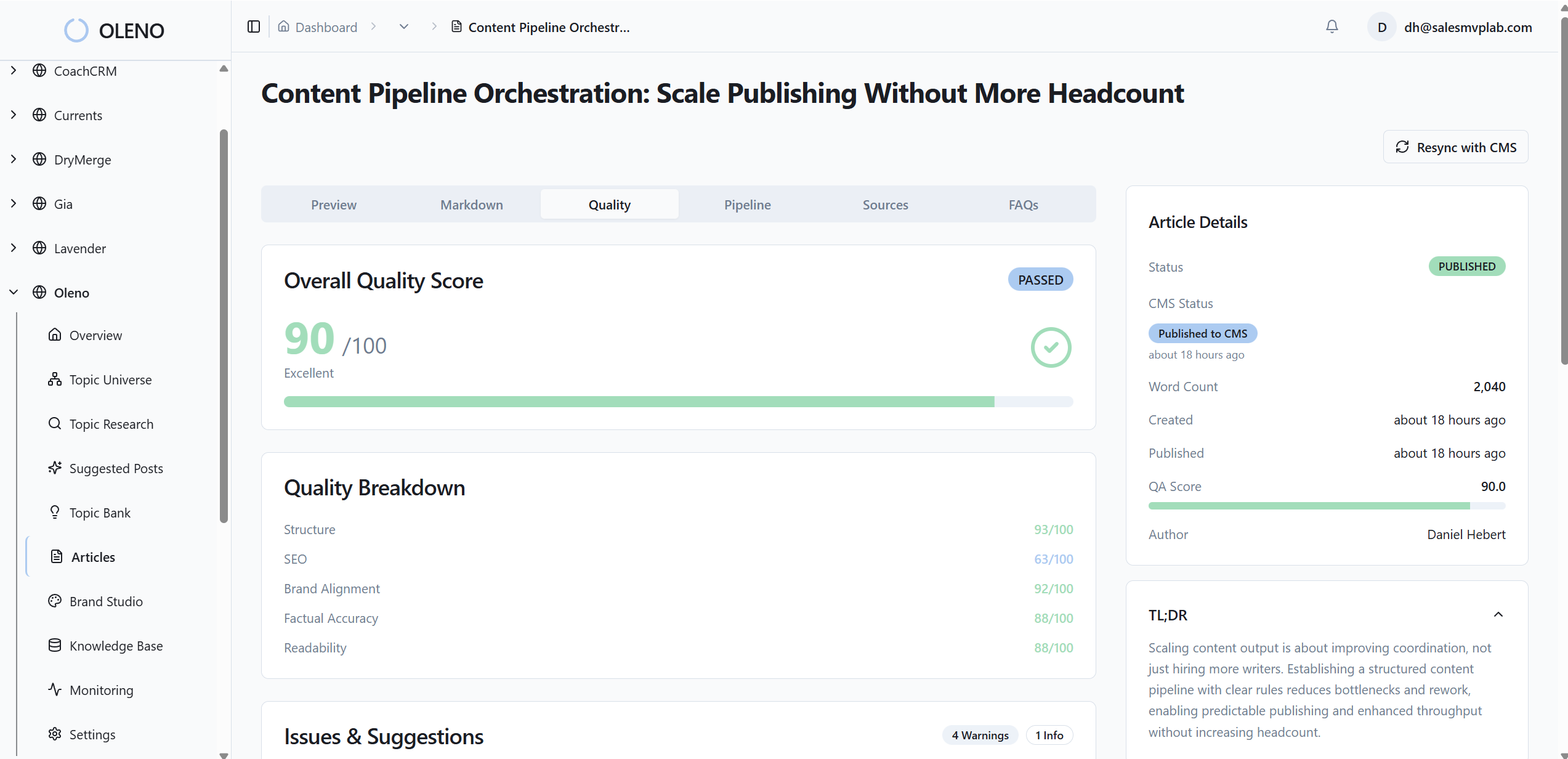
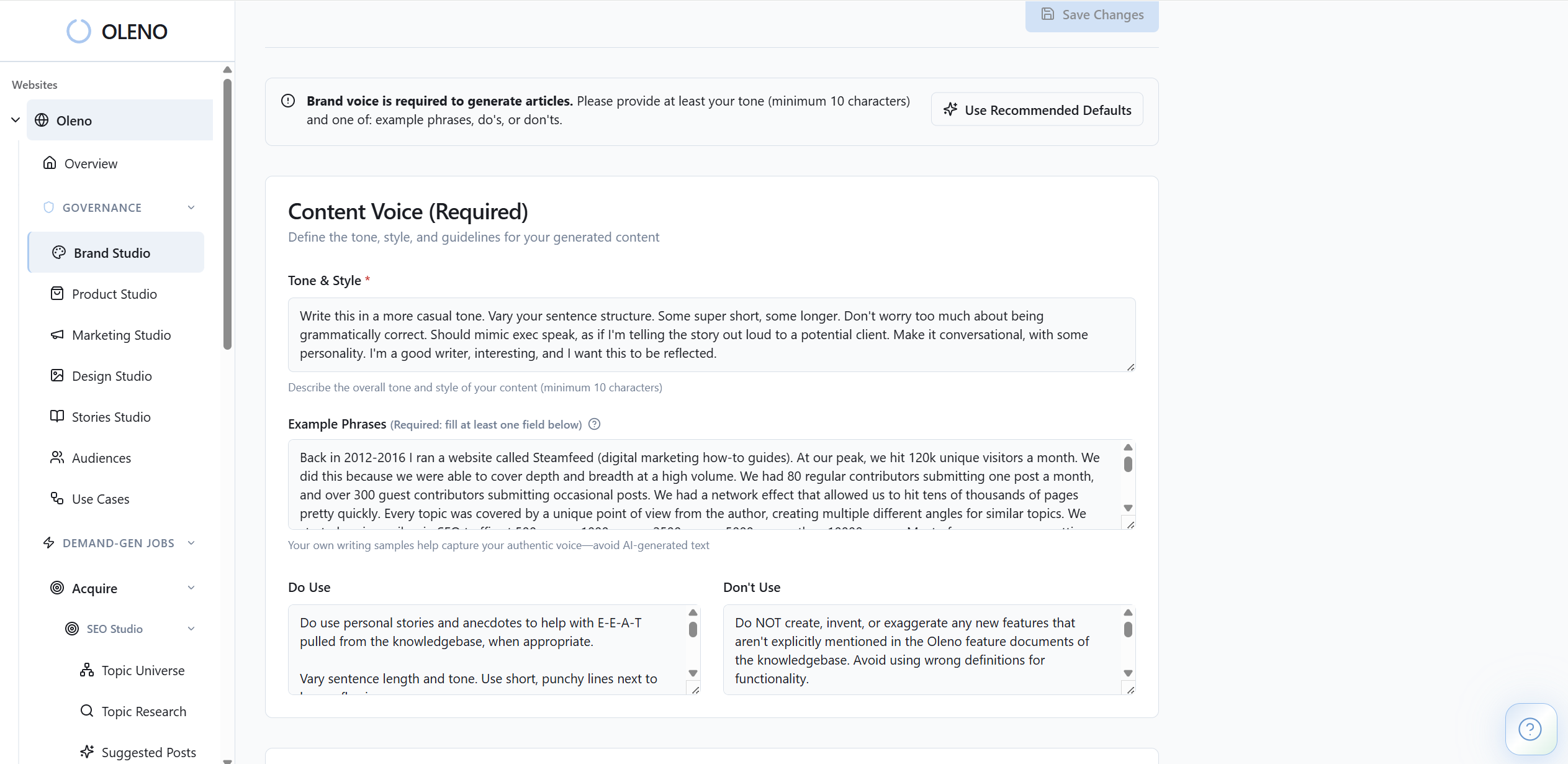
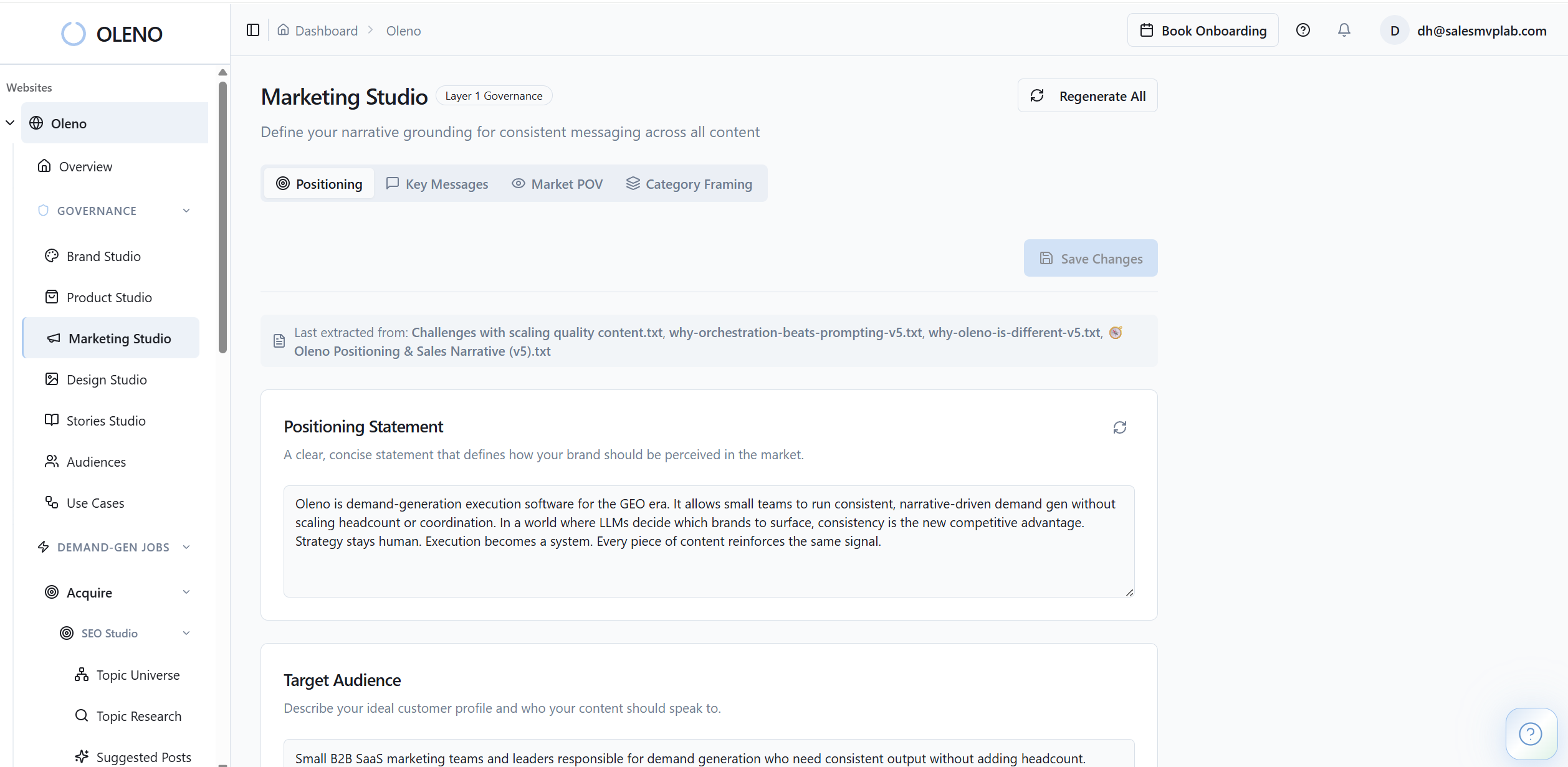
Brand Studio and Marketing Studio sit at the center of that model. Instead of asking every writer or workflow to reinvent brand context, the system defines voice, positioning, and strategic framing once, then uses those inputs across SEO content scaling. That is why Oleno is a stronger fit for Heads of Marketing, CMOs, and Heads of Content who already have contributors but lack one repeatable execution layer.
We built this logic from a practical pain. The founder story starts with manually prompting GPTs, copy-pasting into a CMS, and burning 3 to 4 hours a day on repetitive content work. The product came from hard-coding that process into a system that could queue topics, write, QA, and publish. That’s why Oleno feels more operational than inspirational.
If governance is the actual bottleneck on your team, see how Oleno handles planning and workflow fit. The real issue usually isn’t whether software can generate text. It’s whether your team can trust the system at page 50.
Best-fit teams for Oleno
Oleno is not for every buyer. Worth saying plainly. If you’re a solo operator who just wants a cheap writing assistant, you will probably find lighter tools easier. That is a valid choice.
The fit gets stronger when the team already has content, PMM, SEO, and demand gen contributors, but no shared system keeping everyone aligned. In that case, the job isn’t “generate words.” It’s “keep the signal consistent while scaling output.” Different problem. Different buying criteria.
That’s where the best programmatic SEO software usually stops being the cheapest tool and starts being the one that reduces resets. Oleno is built for that narrower use case: teams that need governance, approved positioning, and repeatable publishing without turning one person into permanent cleanup crew.
Which Programmatic SEO Software Fits Your Team Best
The best programmatic SEO software depends less on headline features and more on your operating model. Small teams should choose based on workflow maturity, editorial risk tolerance, and whether they need scale, speed, or governance most, which means the final decision is usually narrower than the category pages make it look.
| Tool | Pricing Model | Starting Price | Programmatic SEO Fit | Brand Governance | Workflow Flexibility | Publishing Support | SEO Research Depth | Ease of Adoption | Best Team Size | Best Use Case | Main Limitation |
|---|---|---|---|---|---|---|---|---|---|---|---|
| AirOps | Hybrid | Free tier, paid from around $99 | Strong | Medium | High | Medium | Strong | Medium | 3-15 | Custom SEO workflows | Setup load |
| Byword | Usage or subscription | $5/article or $99/month | Very strong | Low | Medium | Strong | Medium | Medium | 2-20 | Batch programmatic pages | Limited nuance |
| Copy.ai | Hybrid | Free, paid around $24 to $29 | Light to medium | Low | Medium | Light | Light | High | 1-10 | Fast general drafting | Weak SEO structure |
| Jasper | Subscription | Around $49/month | Medium | Strong on style | Medium | Medium | Light to medium | High | 2-20 | Multi-format marketing content | Less search-native |
| Outrank | Subscription | $49 promo, commonly $99 | Strong | Low to medium | Medium | Strong | Medium | High | 1-10 | Automated SEO articles | Quality concerns |
| Oleno | Subscription, volume-based | $109/month | Strong | High | Medium | Strong | Medium | Medium | 3-30 | Governed SEO content scaling | More upfront structure |
Byword is the strongest fit if you care most about throughput and template scale. Copy.ai is the easiest low-friction choice for lightweight drafting. AirOps works when your team wants workflow control and can absorb setup burden. Jasper makes sense when brand style across many formats matters more than search-specific operations. Outrank is appealing if you want one path from keyword to published article and can accept more review risk.
Oleno fits a narrower, but very real, buyer: scaling SaaS marketing teams and growth-stage teams that already have contributors, but lack a unified system for voice, positioning, and repeatable execution. One last thing. Small businesses usually think they need more output. In practice, they usually need fewer resets. Programmatic SEO software earns its keep when the 50th page is easier to publish than the fifth. That’s the real test.
About Daniel Hebert
I'm the founder of Oleno, SalesMVP Lab, and yourLumira. Been working in B2B SaaS in both sales and marketing leadership for 13+ years. I specialize in building revenue engines from the ground up. Over the years, I've codified writing frameworks, which are now powering Oleno.
Frequently Asked Questions