Blaze vs Byword: Which Should You Choose?

If you’re looking at Blaze vs Byword, you’re probably trying to answer a deceptively simple question: do we need more campaign content across channels, or do we need to scale SEO pages fast. They both “make content,” but the workflows and the downstream headaches are very different. Pick the wrong one and you’ll spend a quarter doing frustrating rework.
Blaze vs Byword: The Real Tradeoff Between Campaign Content and Programmatic SEO
Blaze tends to fit teams that want multi-channel campaign assets and scheduling in one place, while Byword is built around programmatic SEO and bulk article generation from large keyword sets. The tradeoff is usually breadth across channels versus depth and throughput for long-tail SEO pages. A good rule of thumb is that Blaze helps you ship campaigns faster, and Byword helps you ship lots of SEO pages faster (but with more template thinking).

Who this comparison is for
This is for the team that’s already doing “some content” and now wants consistency. Maybe you’re a founder doing posts at 11pm. Maybe you’re a small marketing team and you finally got budget for a tool, but you can’t afford to pick wrong and rebuild your workflow later.
It’s also for the agency-style mindset, even if you’re not an agency. The moment you say “we should publish 100 pages about X,” you’re in programmatic SEO territory. The moment you say “we need a week of assets for this launch,” you’re in campaign territory.
So here’s how I’d frame it:
- If your bottleneck is multi-channel asset creation and scheduling, Blaze is going to feel natural (based on how it’s positioned publicly) (Blaze Home, Blaze AI on Product Hunt).
- If your bottleneck is building and publishing lots of SEO pages from keyword sets, Byword is designed for that job (Byword Home, Byword AI Review).
How to read this guide (quick table, then deep dives)
You’ll get the quick “at a glance” view first, because skimming is rational. Then we’ll go deeper into each tool, and we’ll talk about the part most pages skip: the hidden costs over a quarter. Editing. Coordination. Publishing steps. The stuff that quietly eats the gains.
Here’s the skimmer table.
| What you’re optimizing for | Blaze.ai | Byword.ai |
|---|---|---|
| Primary use case | Multi-channel marketing and campaign content; social, ads, and on-brand assets | Programmatic, long-tail SEO content at scale with batch generation |
| SEO depth | General SEO help; not positioned as an SEO-first platform on-site | SEO-first with templates, SERP context, and GSC integration (vendor and reviews) |
| Automation style | Template-driven, multi-asset creation and scheduling | Batch/programmatic generation from large keyword sets |
| Learning curve | Lower for campaign creators | Higher for programmatic templates and batch workflows |
| Best fit | Small teams needing fast campaign content across channels | Marketing teams/agencies scaling SEO pages and tracking performance |
Key Takeaways:
- Blaze fits small teams that need multi-channel campaign assets and scheduling, more than SEO-first bulk page production (Blaze Home).
- Byword fits programmatic SEO teams generating hundreds of pages from keyword sets, but template setup can add a real learning curve (Byword AI Review).
- Pricing models differ: Blaze is subscription-based tiers, while Byword offers pricing options built around publishing volume (Blaze Pricing, Byword Pricing).
- If you’re worried about brand consistency and constant editorial cleanup, look hard at “rules first” workflows, not just generation speed.
Why This Choice Affects Your Traffic, Time, and Brand Integrity
This choice affects results because the tool you pick becomes your content operating system, not just a writing box. The wrong system creates messy handoffs, inconsistent voice, and content that doesn’t compound over time. For example, a tool optimized for campaigns may not help you scale long-tail SEO pages, and a programmatic SEO tool may not help you run launches.
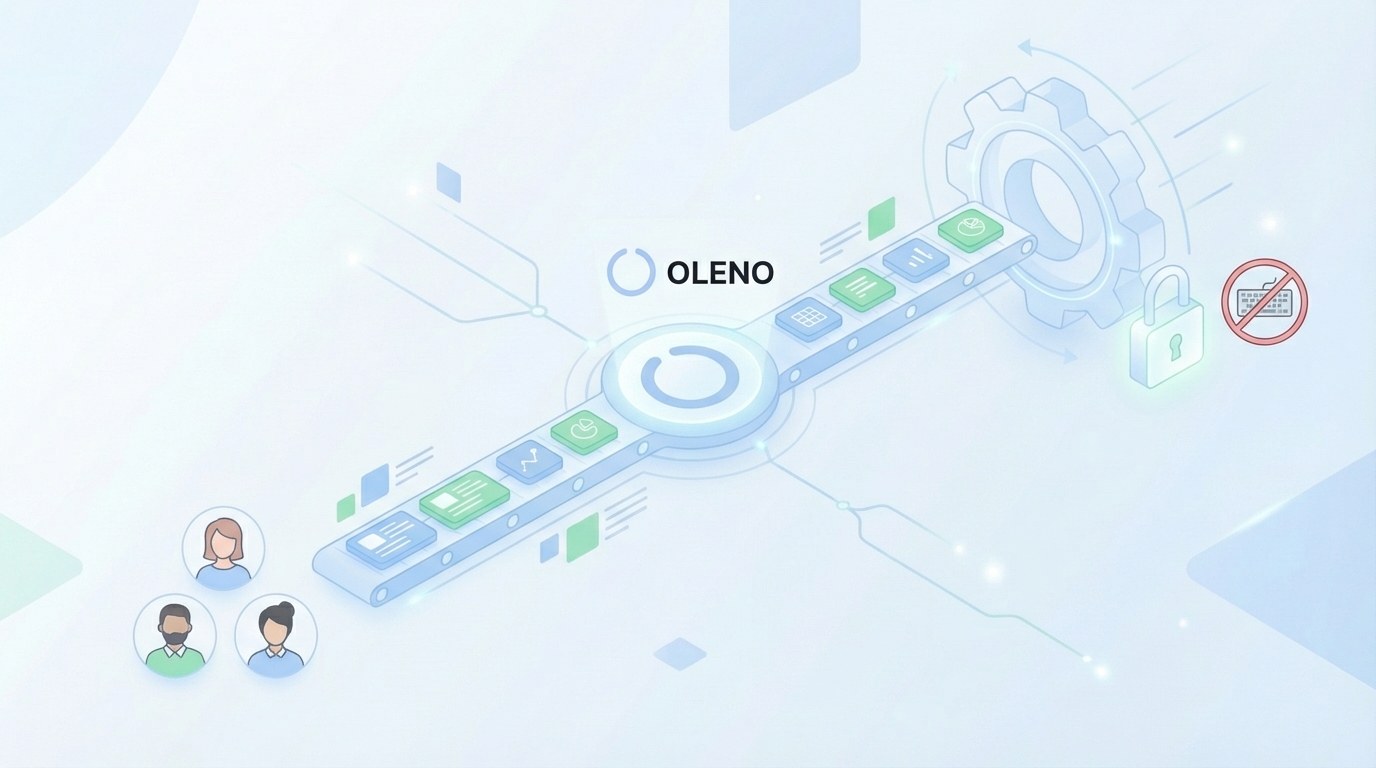
I’ve lived both sides of this. Back in 2012 to 2016 I ran a marketing how-to site, Steamfeed. We hit 120k unique visitors a month at the peak. Not because every post was a masterpiece. Most were under 100 views a month. It worked because volume plus quality compounds when you cover depth and breadth, and you keep publishing.
Then I’ve been the “team of three” person too. CEO, VP Product, me. You think you’ll write, then your calendar laughs at you. We resorted to recording videos, transcribing them, and shipping posts that way. Faster, yes. But the structure SEO needs was missing, and we didn’t have a real topic system. So we published. It didn’t always rank.
That’s why I get a little picky when people compare tools only on “does the draft sound good.”
What to evaluate beyond demos: governance, accuracy, and cadence
Most demos show you the happy path. Type a prompt, get a draft. Looks clean. Everyone nods.
But the real evaluation criteria is boring stuff:
Governance: can you define how you sound, what claims are allowed, what you won’t say, and keep that consistent across output. Accuracy: can you keep content grounded so you’re not constantly correcting wrong details. Cadence: can you publish on schedule without heroics.
Byword is explicitly positioned around scaling SEO content, including workflow elements tied to SEO output and performance, and reviewers discuss it as a way to scale programmatic SEO quickly (Byword Home, Byword AI Review). Blaze is positioned more like an all-in-one marketing creation platform that helps generate assets and run marketing output across channels (Blaze Home, Blaze AI on Product Hunt).
Neither positioning is “better.” It just changes what you should expect.
A campaign content system usually optimizes for:
- speed to asset
- variety of formats
- scheduling and multi-channel packaging
A programmatic SEO system usually optimizes for:
- repeatable page templates
- batch generation workflows
- publishing lots of pages with consistent structure
And if you’re a small team, cadence is everything. Miss two weeks, and your “system” is basically vibes.
Where cost hides over a quarter (rework, coordination, publishing)
The cost that matters isn’t just subscription price. It’s the people-time you burn making the output usable.
Let’s pretend you’re trying to publish 90 articles in a quarter. Three per week. Not wild.
Now pretend each “AI draft” needs:
- 30 minutes of editing for accuracy and voice
- 15 minutes to add internal links, metadata, and structure tweaks
- 10 minutes to coordinate review or approvals
- 10 minutes to publish and format in the CMS
That’s 65 minutes per article. Times 90. That’s 97.5 hours in a quarter. Over two full work weeks.
And that’s assuming you’re disciplined. In reality, you’ll have the “this doesn’t sound like us” loop, or the “this claim isn’t true, where did it get that” loop. That’s the headache.
This is where the Blaze vs Byword decision matters. If you buy Byword for SEO scale but you don’t have the template discipline and review process, you might generate a lot, then spend your quarter cleaning. If you buy Blaze for multi-channel campaigns but your real goal is long-tail search traffic, you might ship a lot of assets that don’t move organic traffic much.
Programmatic SEO itself is a specific play. It’s about scaling pages from structured patterns, like glossaries, location pages, integrations pages, comparison pages, and so on (TripleDart Programmatic SEO Guide). If that’s not your motion, a programmatic tool can feel like a lot.
Blaze.ai Overview
Blaze is generally positioned as a platform for small teams to create on-brand marketing assets and execute campaigns across channels. It emphasizes a unified workflow for content creation and publishing, rather than being a pure SEO programmatic engine. If your day is mostly “we need assets for this thing,” Blaze is likely closer to your natural workflow (Blaze Home).
Key strengths
Blaze’s clearest strength is that it’s built around campaign output, not just writing long-form blog posts. When you’re trying to support a launch, run weekly social, and keep the brand looking consistent, having one place for generation and scheduling can matter more than a perfect SEO brief.
From Blaze’s own positioning, it focuses on marketing output across channels and helping teams create content faster (Blaze Home). And its Product Hunt listing reinforces that it’s a “marketing” tool experience, not just a writing interface (Blaze AI on Product Hunt).
In practice, that usually means you’re getting value in two places:
- asset variety, because campaigns need more than blog posts
- speed, because small teams don’t have time to context-switch between five tools
Key strengths, based on public positioning:
- Multi-channel content generation oriented toward campaign execution (Blaze Home)
- Brand voice and templates to standardize outputs across assets (Blaze Home)
- A “creator plus publishing” posture that can reduce tool sprawl for small teams (Blaze AI on Product Hunt)
One interjection. The “all-in-one” promise is attractive, but you still need to validate depth in the one area you actually care about.
Notable limitations
Blaze may be less compelling if your primary goal is programmatic SEO at scale. Based on what’s emphasized on the public site, it doesn’t lead with things like programmatic page templates, SERP-driven template workflows, or Google Search Console integrations the way SEO-first platforms do (Blaze Home).
That doesn’t mean you can’t write SEO content with it. You can write SEO content in a Google Doc too. The question is whether the platform is designed around the repetitive, structured work of publishing lots of SEO pages with consistent patterns.
Another limitation is validation. Blaze has presence and activity, but compared to more SEO-specialized tools, buyers may find less third-party detail about how it performs for programmatic SEO workflows. That pushes you toward doing your own testing.
Notable limitations, based on public information:
- Less emphasis on SEO-specific programmatic workflows in its positioning (Blaze Home)
- Not primarily framed around bulk, long-tail SEO article production (Blaze Home)
- Buyers may need to do extra diligence on SEO depth and repeatability for scaled page programs (Blaze AI on Product Hunt)
Pricing and value
Blaze pricing is presented as tiered subscription plans on its pricing page (Blaze Pricing). I’m not going to throw specific dollar amounts in here because pricing pages change, and the thing that matters is value per workflow.
Where Blaze tends to be good value is when:
- you want campaign output across channels
- you’ll actually use scheduling/publishing features
- you’re trying to keep the brand consistent without a full creative team
If you’re buying it purely to scale organic traffic through programmatic SEO pages, you’ll want to pressure-test that use case early.
How Oleno is Different: Oleno starts with governance, you define voice, claims, and POV upfront, then runs content through a deterministic pipeline (Discover → Angle → Structure → Create → Validate → Publish). Rules apply automatically everywhere, so a small team can keep shipping consistent, opinionated demand-gen content without constant coordination.
Byword.ai Overview
Byword is built for programmatic SEO teams that want to generate lots of long-tail pages from structured keyword sets. It leans into batch workflows, templates, and an SEO-oriented process that connects research, generation, and publishing. If you’re serious about bulk article generation, Byword is designed for that kind of work (Byword Home, Byword AI Review).
Key strengths
Byword’s standout strength is scale. It’s repeatedly described as a tool for programmatic SEO and bulk article generation, where you can work from big keyword lists and generate lots of pages quickly (Byword AI Review). That’s a very specific problem, and most “general marketing content tools” don’t really solve it.
The other strength is the template mindset. Programmatic SEO only works if you can define a pattern and repeat it across many pages. The broader programmatic SEO concept is basically “structured page types at scale,” like glossary pages, integration pages, location pages, or category pages (TripleDart Programmatic SEO Guide).
Here’s the quick hypothetical example the team always asks for.
Let’s pretend you’re building a glossary for an HR software product:
- Keyword list: “what is skills matrix,” “what is succession planning,” “what is performance calibration,” 500 more.
- Page pattern: definition, why it matters, example, common mistakes, how to do it, FAQ.
- Variables: {term}, {role}, {industry}, {tool category}.
A programmatic tool like Byword is aiming to let you apply that pattern across hundreds of pages without manually briefing and managing each one. That’s the pitch, and it’s why agencies and SEO teams look at it (Byword Home, Byword AI Review).
Key strengths, based on vendor and third-party sources:
- Bulk article generation from large keyword sets (often described as a core Byword workflow) (Byword AI Review)
- Programmatic SEO positioning and workflow focus (Byword Home)
- Mentioned in broader “best AI content tools” comparisons as an SEO scaling option (BabyLoveGrowth Comparison)
Notable limitations
Byword’s limitations are usually the flip side of its strengths.
First, there’s a learning curve. If you’re not used to thinking in templates and variables, programmatic workflows feel a bit like building a spreadsheet with opinions. Great once it’s working. A slog the first time.
Second, depth and thought leadership are hard to mass-produce. Third-party reviews tend to frame Byword as excellent for scaling SEO content, but less naturally suited for truly deep, expert narrative without human editing (Byword AI Review).
Third, pricing can become a factor if you’re a solo user trying to do high volume. That’s not unique to Byword, it’s just the reality of high output tools. If you need thousands of pages, you’ll pay for that one way or another.
Notable limitations, based on reviews and pricing model reality:
- Template and batch workflows can be more complex than simple “type prompt, get post” tools (Byword AI Review)
- Deep expertise still tends to require hands-on editing and POV work (Byword AI Review)
- Higher volume tiers can change the economics for solo creators (review pricing against your actual page plan) (Byword Pricing)
Pricing and value
Byword pricing is publicly listed and includes options that reflect content volume, including subscription and pay-per-article style choices (Byword Pricing). The key thing to look for is how your expected publishing volume maps to the plan, and whether you’ll actually use the programmatic features you’re paying for.
Byword is usually strong value when:
- you have a clear programmatic SEO plan (page types, templates, keyword sets)
- you want bulk article generation more than bespoke thought leadership
- you’re ready to treat publishing like a production line, not an art project
If your real need is campaign content, you may end up paying for power you don’t use.
How Oleno is Different: Oleno defines voice, claims, and POV upfront, then enforces those rules across a deterministic pipeline. It’s designed for consistent, opinionated demand gen, governance-first, so what you publish compounds over time without depending on constant coordination.
When Oleno Makes More Sense for Small Teams
Oleno tends to make more sense when you’re a small team that needs consistent, opinionated demand-gen content on a steady cadence, and you don’t want to live in prompt tweaking and editorial cleanup. It starts by defining your voice, claims, and POV, then runs a deterministic pipeline from Discover through Publish. For example, instead of building one-off prompts per asset, you set rules once and keep shipping.
If you’ve never run content at scale, here’s the trap. You think the hard part is writing. It’s not. The hard part is keeping it consistent when three people are involved, everyone’s busy, and each draft needs twenty little decisions.
Back when I was the only marketer at a SaaS company, I could write 3 to 4 good posts a week because I had a framework in my head. As soon as the team grew, the output got slower and worse. Not because the writer was bad. They just didn’t have all the context, and I didn’t have time to transfer it. Meetings took over. The backlog grew. That’s the moment you need a system that enforces consistency without you being the bottleneck.
Core differences that matter in production
The practical difference is governance-first versus “generate first, fix later.”
With Oleno, the front-end work is defining how you sound and what you stand for:
- Brand voice
- Preferred terms
- Phrases to avoid
- Claim boundaries
- Narrative frameworks and POV
Then the system runs a deterministic pipeline: Discover → Angle → Structure → Create → Validate → Publish. The point isn’t to make content “creative.” The point is to keep it consistent and publishable without constant coordination.
This is also where it’s just different from the two competitors in this guide.
Blaze is generally oriented toward campaign creation and multi-channel marketing workflows (Blaze Home). That’s valuable, but it’s not the same as “we are going to ship SEO and demand-gen content every week, forever, and it needs to sound like us.” Byword is oriented toward programmatic SEO scale and batch generation (Byword Home, Byword AI Review). That’s valuable too, but teams can still end up doing lots of manual cleanup if governance and validation aren’t baked in.
If you’re the person who’s worried about brand integrity, this is the production reality I’d optimize for:
- define the rules once
- enforce them automatically
- publish on cadence
- review strategically, not line-editing every paragraph
A few specific differences small teams tend to care about:
- Governance-first setup (voice, terms, claim boundaries, structure rules) so you’re not re-litigating tone on every draft
- Deterministic pipeline so you’re not stuck in prompt roulette
- Validation before publish so “draft quality” doesn’t determine your calendar
Pricing is straightforward and based on output cadence: from $449/mo (SEO + Social).
Before you ask, yes, that sounds like “a lot” compared to some entry plans. But compare it to the hidden quarter cost we talked about. If you buy cheap and spend 100 hours fixing, you didn’t save money. You just moved cost into your calendar.
Right now, if you want to pressure-test this model, Request a demo now. It’s the fastest way to see whether the governance setup matches how your team works.
Getting started and what to expect in week one
Week one should feel like setup plus momentum, not setup forever.
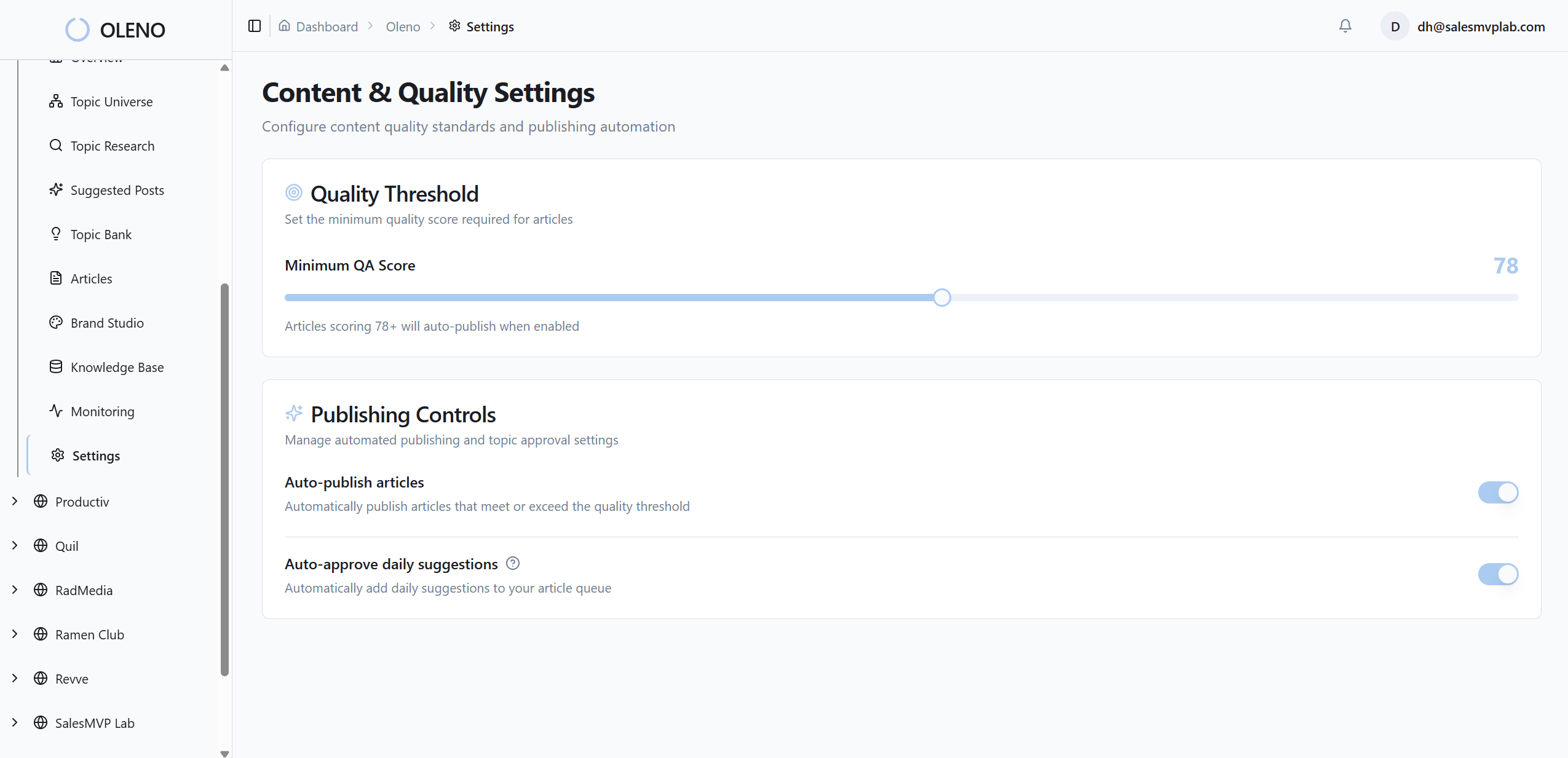
You start by defining your voice, claims, and POV. This is the part most teams skip, then they wonder why the output feels generic. Then you choose the “jobs” you want to run, like educational content, comparison content, product-led explanation, and customer proof. After that, the system runs the pipeline and keeps cadence.
Here’s what you should expect in plain terms:
- Day 1 to 2: you’re capturing narrative rules and boundaries, so content doesn’t drift
- Day 3 to 5: you’re running the first batches through Discover → Publish and tightening rules where needed
- End of week: you should have a repeatable cadence you can maintain without heroic effort
And this matters: the goal isn’t “publish 50 posts this week.” The goal is “we have a machine that keeps publishing while we do our actual jobs.”
If you want to see what always-on looks like without rebuilding your stack, try using an autonomous content engine for always-on publishing.
Feature-by-Feature Comparison (Blaze vs Byword vs Oleno)
This table summarizes how Blaze, Byword, and Oleno generally line up across the workflows people care about most: programmatic SEO scale, templates, publishing cadence, and rule-based consistency. It’s not a replacement for a hands-on trial, but it will help you pick what to evaluate first. For example, if you need bulk SEO pages, Byword will stand out, and if you need multi-channel campaigns, Blaze will.
| Criteria | Blaze.ai | Byword.ai | Oleno |
|---|---|---|---|
| Programmatic bulk article generation | Not the primary focus | Core capability (Batch Generator, templates) (Byword AI Review) | Produces steady demand-gen content once governance is set |
| Templates/variables for scaled pages | Campaign-oriented templates (Blaze Home) | Structured templates with variables for programmatic SEO (Byword Home) | Structure rules applied globally after setup |
| SERP analysis integration | Not emphasized on-site (Blaze Home) | Part of workflow per vendor materials and reviews (Byword AI Review) | Focuses on consistent, opinionated content vs. SERP mimicry |
| Google Search Console integration | Not highlighted on-site (Blaze Home) | Integrated per vendor/reviews (Byword AI Review) | Not positioned as an analytics tool |
| Publishing integrations | Emphasis on scheduling/publishing across channels (Blaze Home) | Part of end-to-end SEO workflow (Byword Home) | You define how content ships, keeps publishing on cadence |
| Multilingual support | Available for multi-channel content (vendor positioning) (Blaze Home) | Multi-language support (vendor/reviews) (Byword Home) | Governance applies across languages you choose to ship |
| On-page SEO scoring | Not a core emphasis (Blaze Home) | SEO-focused generation modes and metadata (vendor positioning) (Byword Home) | Quality enforced by rules and validation steps |
| Brand voice controls | Brand voice/templates (Blaze Home) | Brand tone customization and custom prompts (vendor positioning) (Byword Home) | Voice, terms, claim boundaries, and structure rules defined upfront |
| Knowledge grounding | General brand/context tools (Blaze Home) | File-based knowledge for prompts (vendor positioning) (Byword Home) | Positioning and product truths defined once; applied everywhere |
| Deterministic pipeline (no prompt tinkering) | Creator-first workflow (Blaze AI on Product Hunt) | Template/batch-first workflow (Byword AI Review) | Discover → Angle → Structure → Create → Validate → Publish |
| Quality enforcement/QA gates | Editorial review expected | Editorial review expected (Byword AI Review) | Consistency via governance and validation before publish |
| Cadence and consistency | Campaign scheduling focus (Blaze Home) | Batch throughput focus (Byword AI Review) | Keeps shipping on a steady cadence; compounds over time |
| Starting price (context) | Tiered subscription (see pricing page) (Blaze Pricing) | Hybrid (see pricing page) (Byword Pricing) | from $449/mo (SEO + Social); $449/mo (Full-Funnel GEO); $1,349/mo (Narrative Control) |
| Best fit summary | Campaign content across channels for small teams (Blaze Home) | High-volume programmatic SEO with tracking (Byword Home) | Small teams needing consistent, opinionated demand-gen content |
If you want to trial the “rules first, cadence second” approach quickly, Request a demo. That’s usually the fastest way to know if the workflow clicks.
Conclusion: Picking The Right Tool Without Regretting It Later
Blaze vs Byword isn’t a “which is better” decision. It’s a workflow decision.
Pick Blaze when your world is campaigns. You need on-brand assets across channels and you’ll use the creation plus scheduling posture it’s positioned around (Blaze Home, Blaze Pricing). You’ll move faster, and your team won’t feel like they’re doing tool gymnastics.
Pick Byword when your world is programmatic SEO. You have keyword sets, you want bulk article generation, and you’re ready to think in templates and repeatable page types (Byword Home, Byword Pricing, Byword AI Review). That’s how you build long-tail coverage.
And if you’re a small team that’s tired of constant prompt tweaking, inconsistent tone, and the “who’s publishing this” coordination headache, that’s where Oleno tends to fit. Governance first. Deterministic pipeline. Cadence you can actually maintain. If you want to pressure-test that in a low-friction way, Request a demo now.
Whatever you choose, optimize for the quarter, not the demo. Demos are fun. Quarters are where content either compounds or quietly dies in drafts.
About Daniel Hebert
I'm the founder of Oleno, SalesMVP Lab, and yourLumira. Been working in B2B SaaS in both sales and marketing leadership for 13+ years. I specialize in building revenue engines from the ground up. Over the years, I've codified writing frameworks, which are now powering Oleno.
Frequently Asked Questions