Blaze vs Outrank: Which Should You Choose?

You’re not really choosing between “two AI writing tools” here. You’re choosing what kind of content operation you want to run. Blaze is built for breadth across formats and distribution, while Outrank leans into SERP-driven SEO workflows and long-form publishing. The right pick depends on whether you need campaign output everywhere, or repeatable SEO output at scale.
Blaze vs Outrank: What Matters Most for High‑Volume SEO Content
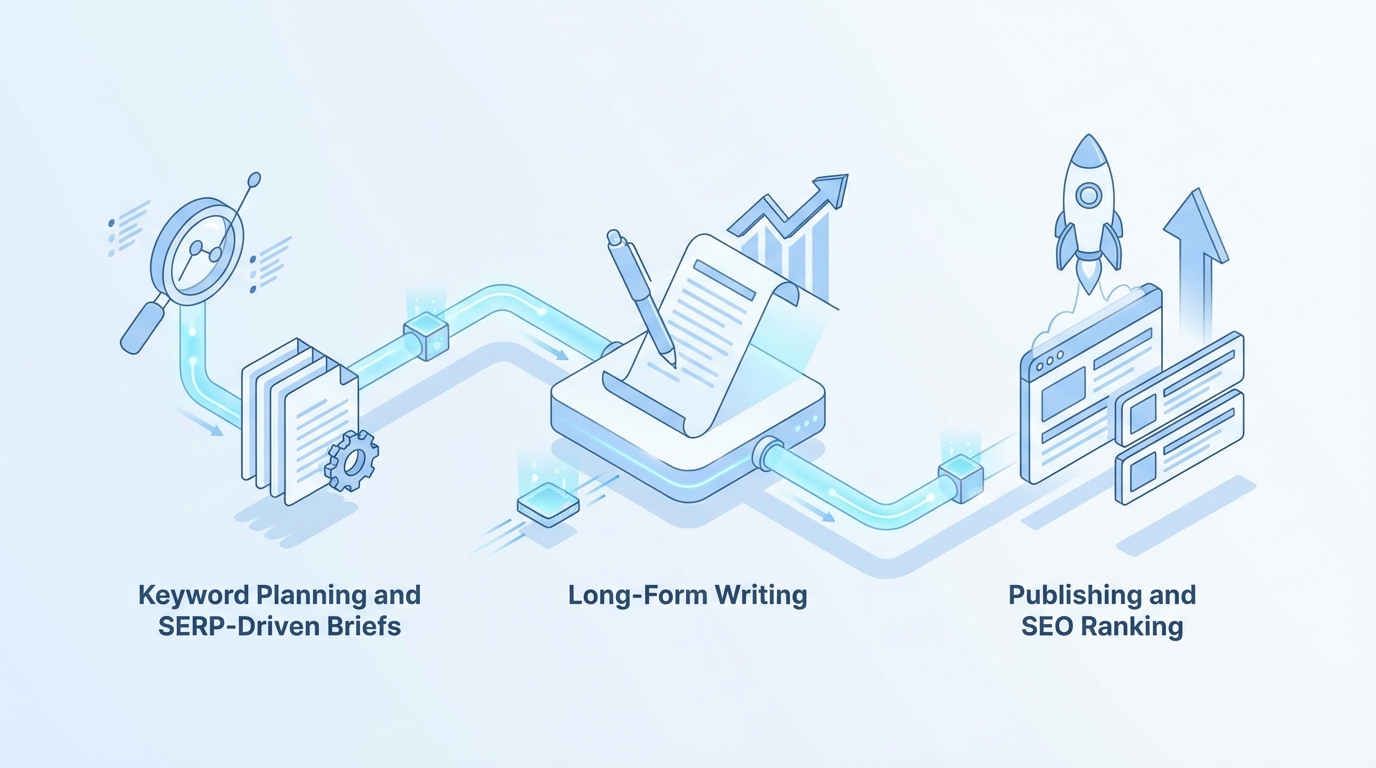
Blaze and Outrank optimize for different outcomes, so “best” depends on whether you care more about multichannel velocity or SERP-driven long-form SEO execution. Blaze is oriented around generating many types of marketing assets and pushing them out to channels, while Outrank positions itself around SEO workflows from research to publishing. If your goal is high-volume SEO content specifically, the gaps show up fast.
| Criteria | Blaze | Outrank | Best For |
|---|---|---|---|
| Primary Focus | Multichannel marketing content with visuals and distribution (Blaze Homepage) | SEO-led long-form workflow from planning to publish (Outrank AI SEO Content Generator) | Blaze for multi-format campaigns; Outrank for SERP-driven articles |
| Research & Briefs | General planning for multi-channel content (Blaze Homepage) | SERP analysis, clustering, and automated briefs (Outrank AI SEO Content Generator) | Outrank if ranking signals drive your roadmap |
| Content Generation | Broad set of formats (blogs, social, email, ads) (Blaze Homepage) | Long-form SEO article generation (Outrank AI SEO Content Generator) | Outrank for long-form; Blaze for breadth |
| Publishing | Positioned around multichannel distribution (Blaze Homepage) | One-click publishing positioning (WordPress, Webflow, Notion) (Outrank AI SEO Content Generator) | Outrank if CMS publishing is central |
| Collaboration | Team workflows (positioned for content production) (Blaze Homepage) | “Unlimited” positioning around usage (seats/rewrites) in its plan messaging (Outrank AI SEO Content Generator) | Both can fit teams; Outrank leans into SEO ops |
Key Takeaways:
- Blaze is a better fit when you need many content formats plus distribution workflows, not just SEO articles (Blaze Homepage).
- Outrank is a better fit when you want SERP-driven briefs and long-form SEO publishing built into one workflow (Outrank AI SEO Content Generator).
- Both can still create drafts, but neither fully removes the editing loop when accuracy and brand claims matter at scale.
- If you’re worried about inconsistent messaging across dozens of posts, Oleno’s “define rules once, enforce everywhere” approach is the different bet.
The Hidden Time Tax of AI SEO Tools
The hidden cost of AI SEO tools is usually human time, not subscription dollars, because drafting is cheap but reviewing, rewriting, and aligning stakeholders is not. Most teams still do topic wrangling, outline fixes, claim checks, and publishing handoffs manually, even when the tool says “end-to-end.” If you’re trying to ship 20 to 200 pages a month, this turns into frustrating rework fast.

TL;DR: Which One Fits Your Situation
If you’re producing a lot of campaign assets across channels, Blaze is generally pointed in that direction, since it’s positioned as an all-in-one content engine across formats (Blaze Homepage). If you’re mostly trying to build a repeatable SEO machine, Outrank’s workflow is more directly aligned to that, especially around SERP-driven briefs and publishing (Outrank AI SEO Content Generator). And if you’re already feeling the “why are we still rewriting everything” pain, the tool choice matters less than the operational design.
Back in 2012 to 2016, I ran a marketing how-to site that hit 120k monthly uniques at the peak. We got there the unsexy way. Volume plus quality, over years, with hundreds of contributors. The pattern was obvious: traffic didn’t just grow linearly, it jumped at 500 pages, 1,000 pages, then 2,500, 5,000, 10,000. The catch is that every jump came with coordination headaches.
That’s the part AI tools don’t really advertise. Drafting isn’t the bottleneck once you have AI. The bottleneck is keeping the machine pointed in the same direction.
In practice, you’ll usually feel the “time tax” in a few places:
- Topic selection and prioritization turns into debates.
- Writers (or AI outputs) drift from your POV.
- Edits start repeating, but nobody turns them into rules.
- Publishing becomes a weekly scramble.
Quality vs Velocity Trade‑offs
High-volume SEO content is always a trade. Velocity gets you surface area, quality gets you compounding results. The brutal part is that low-quality at high volume can poison your site, and high-quality at low volume can feel like you’re moving in slow motion.
Blaze leans into velocity across many formats, which is valid if your bottleneck is “we need output everywhere” (Blaze Homepage). Outrank leans into velocity for SEO specifically, by focusing on keyword planning, SERP-driven briefs, long-form generation, and publishing (Outrank AI SEO Content Generator).
Where teams get stuck is expecting one tool to do both: crank volume and maintain a sharp narrative and factual consistency. You can get close, but you’ll still pay for it somewhere, usually in editing time.
Let’s pretend you publish 40 SEO posts per month. If each post needs an extra 45 minutes of human cleanup (structure fixes, fact checks, internal alignment), that’s 30 hours. That’s basically a week of a senior marketer’s time. Every month. And it tends to get worse as you scale, not better.
Brand and Claim Consistency Gaps
Brand consistency sounds fluffy until you’re the one cleaning up the mess. The real issue is claims. What are you allowed to say? What do you avoid? What’s true about the product today, not six months ago?
Tools can help generate content. They don’t automatically know your company’s “truth set.” So teams end up bolting on manual review steps. Legal review. Product review. Founder review. It’s a headache.
Outrank explicitly positions around SEO execution, but even with an SEO-first workflow, you still need human review for accuracy and differentiation (Outrank AI SEO Content Generator). Blaze, being broader, can be great for output, but breadth usually increases the surface area for inconsistency unless you’re disciplined about review (Blaze Homepage).
Some teams are totally fine with that. If you’re a solo creator, you can just be the filter. If you’re a team, that filter becomes a process. Process becomes meetings. Meetings become slow.
Blaze AI: Strengths, Limitations, and Value
Blaze is a strong option when you want one place to create lots of marketing content formats, with emphasis on visuals and distribution rather than deep SEO workflows. It’s positioned around generating blogs, social, emails, and ads, which makes it appealing for small teams trying to cover many channels (Blaze Homepage). Compared to Outrank, Blaze is less explicitly SERP-driven, but broader for campaign production.
Where Blaze Fits (Strengths)
Blaze’s core strength is breadth. If you’re running campaigns, you rarely need “just a blog post.” You need the post, the email, the LinkedIn version, the ad variations, and some kind of image support. Blaze positions itself as an AI content platform built for that kind of multi-format output (Blaze Homepage).
I’ve seen this movie before. At one SaaS company I was a team of one in marketing, and I could crank out 3 to 4 solid posts a week because I had a structured writing framework. Once the team grows, the constraint changes. Now you’re coordinating people across channels, and you’re trying to keep messaging consistent while shipping faster. A broad tool can help.
Blaze is also fairly visible in “what’s new” style product updates, which usually signals active iteration on the product surface area (Blaze What’s New). That matters if you’re betting on it as a daily driver.
Blaze strengths, based on its positioning and public materials:
- Broad content coverage across formats like blogs, social, email, and ads (Blaze Homepage)
- Emphasis on distribution workflows and getting content out to channels (Blaze Homepage)
- Market awareness and community visibility (Product Hunt listing exists) (Product Hunt Blaze AI)
One sentence that matters: Blaze is for marketers who want to ship everywhere.
What to Watch with Blaze (Limitations)
Blaze may be less specialized if your goal is “rank a lot of long-form SEO pages with consistent on-page structure and SERP alignment.” That’s not a knock. It’s just a different product bet. The more a tool is built for many formats, the less it tends to go deep on SERP-driven briefs and long-form SEO operations.
Also, with multi-format generation, quality control becomes your job. You can get a lot of drafts fast, but you still need a human to verify claims, tighten positioning, and make the content sound like it came from someone with actual experience. Blaze can help generate. It won’t magically become your strategist.
Things to keep an eye on:
- If your SEO process relies on SERP reverse-engineering and consistent brief structure, you may need extra steps outside Blaze (Blaze Homepage)
- If factual depth matters (B2B, regulated, technical), expect a real editing pass before publishing
- If your team only needs SEO, Blaze’s breadth can feel like more UI and workflow than you want
Some teams love that breadth. Others find it distracting. Depends who’s driving the tool day to day.
Blaze Pricing and Value
Blaze publishes pricing tiers on its pricing page, and you should verify the current plan details there because these things change a lot in AI tooling (Blaze Pricing). In general, Blaze’s value tends to be strongest when you’re replacing multiple “little tools” used for different formats, since it’s positioned as an all-in-one content platform (Blaze Homepage).
The way I’d think about Blaze pricing is not “cost per article.” It’s “cost per campaign package.” If you’re genuinely using it to produce blog plus distribution assets, it can pencil out.
If you’re only using it for SEO articles, you might be paying for surface area you don’t use. That’s usually where ROI gets fuzzy.
How Oleno is Different: Blaze is built for breadth across formats, which is useful when your team’s output needs to span multiple channels. Oleno starts by defining voice, POV, product truths, and allowed claims once, then runs a deterministic pipeline (Discover → Angle → Structure → Create → Validate → Publish) so high-volume output stays consistent without constant coordination.
Outrank: Strengths, Limitations, and Value
Outrank is the better fit when you want an SEO-first workflow that goes from keyword planning and SERP-driven briefs to long-form writing and publishing. It’s positioned around automating SEO content production, including elements like research and one-click publishing to common CMS options (Outrank AI SEO Content Generator). Compared to Blaze, Outrank is narrower, but tends to map more closely to how SEO teams actually work.
Where Outrank Fits (Strengths)
Outrank’s main advantage is that it’s designed as a workflow, not just a writer. That’s a big deal if you’ve lived inside SEO operations. The tool positions around keyword discovery, SERP analysis, clustering, automated briefs, long-form generation, and publishing (Outrank AI SEO Content Generator).
Outrank also positions itself as an option for small businesses evaluating SEO tools, which hints at accessibility and a focus on getting to value without a giant setup (Outrank Best SEO Tools). Not proof of simplicity, but you can see who they’re talking to.
If you’re trying to scale programmatic-style SEO pages or consistent “money pages” (comparisons, alternatives, use-case pages), that structured workflow matters more than yet another chat-based writer.
Outrank strengths, grounded in their public positioning:
- SERP-driven briefs and SEO workflow automation (Outrank AI SEO Content Generator)
- End-to-end flow from planning to publishing (Outrank AI SEO Content Generator)
- Broad “AI SEO tool” positioning and category presence (Outrank Best SEO Tools)
What to Watch with Outrank (Limitations)
SEO-first tools can drift into “ranking checklists.” Sometimes that’s exactly what you want. Sometimes it produces content that feels samey, or disconnected from what makes your product different. I’ve been on the sales side of this too, watching leads come in from content that ranked well but had nothing to do with what we actually sold. Traffic feels good. Pipeline doesn’t.
Outrank’s workflow can reduce steps, but you still need to bring your POV. You still need someone to do the final judgment calls on: “Is this true? Is this differentiated? Does it match how we sell?”
Also, when a platform is tightly focused on SEO, teams sometimes find the storytelling layer rigid for thought leadership. That’s not always a downside. But if your brand relies on a strong narrative, you might feel boxed in.
Common watch-outs implied by the category and Outrank’s positioning:
- Factual accuracy and differentiation still require editorial review in most AI-driven workflows (Outrank AI SEO Content Generator)
- If you want deep integration into a broader analytics stack, you may still rely on separate tools (Outrank focuses on production workflow) (Outrank AI SEO Content Generator)
- SEO-first structure can feel less flexible for narrative-led content
And just to be fair, some teams prefer that structure. Especially if they’ve been burned by “creative” content that never ranks.
Outrank Pricing and Value
Outrank’s pricing is commonly referenced as a limited-time $49/month tier and a regular ~$99/month tier, and you should confirm current pricing directly on Outrank’s site because AI tool pricing changes constantly (Outrank Website). Third-party comparisons also discuss Outrank’s positioning among alternatives, which can be useful context when you’re doing due diligence (Outrank Alternatives Comparison).
Value-wise, Outrank tends to make sense when:
- You’re producing SEO content at consistent volume
- You want briefs plus generation plus publishing in one place
- You care more about repeatable structure than multi-channel campaign breadth
If you’re only writing one post a week and you love handcrafted content, you might not fully use the workflow.
How Oleno is Different: Outrank is optimized around SEO execution steps like SERP-driven briefs and publishing automation. Oleno takes a different angle: it defines market positioning, narrative frameworks, brand voice, and quality rules upfront, then runs demand-gen jobs through deterministic pipelines with QA gates so content stays aligned as you scale.
Decision Guide: Blaze vs Outrank by Team and Use Case
Blaze vs Outrank comes down to whether you’re running multichannel marketing production or an SEO content machine, because they optimize for different workflows. Blaze is positioned around many formats and distribution, while Outrank is positioned around SERP-driven long-form SEO from research to publishing (Blaze Homepage; Outrank AI SEO Content Generator). If you choose the wrong one, you’ll feel it in rework and process, not in the first draft.
Solo Creators vs. Teams
Solo creators often do better with breadth tools because you are the system. You can generate a blog post, pull out social snippets, rewrite it for email, and ship. Blaze fits that “one person, many channels” reality pretty well based on its product positioning (Blaze Homepage).
Teams are different. Coordination becomes the cost center. One person writes, another edits, someone from product corrects claims, marketing ops publishes, and now you have version chaos.
Outrank’s “workflow” focus can reduce some of that chaos for SEO teams because it’s built around a more linear SEO production line (plan, brief, generate, publish) (Outrank AI SEO Content Generator). It’s not that teams can’t use Blaze. They can. It’s that Blaze is built for broader marketing production, so SEO teams might still need additional discipline around briefs and structure.
I’ll give you the honest exec take: if you’re a team and you don’t define who owns final quality, both tools will feel “kind of broken.” The tool isn’t broken. Your process is.
Content Quality Controls and Risk
Quality control isn’t about grammar. It’s about risk. Bad claims. Outdated features. Incorrect comparisons. And in B2B, that stuff gets noticed.
Outrank’s SERP-driven approach can help you match what Google is already rewarding, but it doesn’t automatically solve factual accuracy or brand differentiation (Outrank AI SEO Content Generator). Blaze’s broad generation can produce a lot of material quickly, but you still need a review loop to keep it grounded and consistent (Blaze Homepage).
This is where teams often underestimate the cost. Let’s pretend you have:
- 2 subject matter reviewers
- 1 marketer editing for voice
- 1 SEO lead checking structure
If each post touches three people for 15 minutes each, that’s 45 minutes of collective review time. Multiply by 40 posts. You’re at 30 hours again. Same math, different flavor.
Honestly, that’s the lesson. Drafting is the cheap part.
Core Differentiators That Matter
When you’re deciding, I’d focus on a few differentiators that actually change your day-to-day:
Blaze tends to make sense if:
- You need multi-format output and distribution as a first-class workflow (Blaze Homepage)
- You want one place to generate campaign assets quickly
Outrank tends to make sense if:
- SEO is the primary channel
- You want SERP-driven briefs and long-form generation inside one SEO workflow (Outrank AI SEO Content Generator)
- Publishing automation to CMS is a core need (Outrank AI SEO Content Generator)
One interjection. A tool that matches your constraints beats a tool with “more features.”
Use‑Case Fit and Getting Started
If you’re starting from zero, pick the tool that matches the first 90 days of work you’ll actually do.
If you’re running scrappy marketing and need output everywhere, Blaze is the simpler mental model: generate lots of assets, keep moving (Blaze Homepage). If you’re building an SEO content engine and want structure around SERP-driven content production, Outrank is more directly aligned to that workflow (Outrank AI SEO Content Generator).
And if you’re already beyond “getting started,” the question shifts from tools to systems. That’s where the conversation gets interesting.
Why Oleno for Consistent Demand Gen
Oleno is a better fit when your real problem is consistent demand generation at scale, not just generating drafts faster. It’s built around defining governance once (positioning, narrative frameworks, brand voice, quality and safety rules), then executing repeatable demand-gen jobs through deterministic pipelines with QA gates and publishing control. Compared to Blaze and Outrank, it’s less about templates and more about running a system.
Before we get into it, here’s the grid that usually makes the decision clearer.
| Capability | Blaze | Outrank | How Oleno Approaches It |
|---|---|---|---|
| Use-Case Focus | Multi-format marketing and distribution (Blaze Homepage) | SEO long-form at scale (Outrank AI SEO Content Generator) | Runs demand gen like infrastructure, define voice/POV once, keep shipping |
| Keyword Research | General marketing planning (Blaze Homepage) | Automated keyword discovery and clustering (Outrank AI SEO Content Generator) | Starts with governance of what’s true and what claims are allowed (not a research tool) |
| SERP-Driven Briefs | Less specialized for SERP reverse-engineering (Blaze Homepage) | Real-time SERP analysis and automated briefs (Outrank AI SEO Content Generator) | Deterministic planning pipeline (Discover → Angle → Structure) for consistency |
| Long-Form Generation | Available, plus many other formats (Blaze Homepage) | Core strength with SEO-aligned structure (Outrank AI SEO Content Generator) | Opinionated content shaped by defined voice and POV |
| On-Page SEO Guidance | Varies by workflow (Blaze Homepage) | On-page scoring and suggestions (Outrank AI SEO Content Generator) | Quality is enforced via rules and validation, not keyword scores |
| Internal Linking Suggestions | Varies by use case (Blaze Homepage) | Suggested internal/external links (Outrank AI SEO Content Generator) | Not positioned as a linking tool, focuses on narrative coherence and accuracy |
| Publishing | Multichannel scheduling/cross-posting (Blaze Homepage) | One-click CMS publishing and API positioning (Outrank AI SEO Content Generator) | Structured execution through Publish stage, reduces coordination overhead |
| Collaboration | Team workflows for campaign content (Blaze Homepage) | Unlimited users/collaborators positioning (Outrank AI SEO Content Generator) | Rules apply everywhere automatically to keep teams consistent |
| Languages/Localization | Multi-language support positioning (Blaze Homepage) | 150+ languages/localization positioning (Outrank AI SEO Content Generator) | Language is governed by defined tone, terms, and structure rules |
| Brand Voice Controls | Brand voice options for generation (Blaze Homepage) | Brand voice preservation positioning (Outrank AI SEO Content Generator) | Brand voice and writing rules are defined once and enforced across outputs |
| Claim Control and Product Truth | Requires manual review (Blaze Homepage) | Requires human review for factual accuracy (Outrank AI SEO Content Generator) | Product truths and allowed claims are set upfront to reduce rework |
| Pricing (Starting Point) | Confirm current tiers (Blaze Pricing) | Often referenced $49 limited-time, ~$99 regular, verify current pricing (Outrank Website) | from $449/mo for 1 post/day, scales to 10 posts/day at $449/mo (Full-Funnel GEO) to $1,349/mo (Narrative Control), enterprise for 11+ |
If you want to see what that governance-first pipeline looks like in your actual context (your product, your categories, your voice), you can request a demo. It usually takes 20 minutes to figure out if it’s even relevant.
Here’s what we’ve learned building content at scale across different companies and team sizes: demand gen breaks when it’s fragmented. Content is over here. SEO is over there. Narrative is in someone’s head. Publishing is a checklist. Measurement is in another tool. You can produce activity like that, but it doesn’t compound.
Oleno is built around three layers:
- A governance layer where humans define intent (market positioning, product POV, narrative frameworks, brand voice, quality and safety rules).
- A job execution layer where specific demand-gen jobs run (acquisition content, educational content, comparison and evaluation content, product-led explanation, customer proof and reinforcement).
- An operational layer that makes it usable at scale (deterministic pipelines, QA gates, publishing control, visibility into what’s running, predictable cadence).
That’s the difference. It’s not “more AI.” It’s fewer handoffs.
And candidly, it’s for a specific moment in a company’s life. When you’ve proven content can work, you want to scale it, and you’re tired of the weekly scramble.
Conclusion: Making The Call Without Regretting It Later
Blaze and Outrank are both reasonable picks, as long as you’re clear on what problem you’re solving. Blaze is oriented toward multi-format marketing production and distribution, while Outrank is oriented toward a SERP-driven SEO workflow that includes briefs, generation, and publishing (Blaze Homepage; Outrank AI SEO Content Generator). The mistake is buying either one and assuming you’ve solved the system problem.
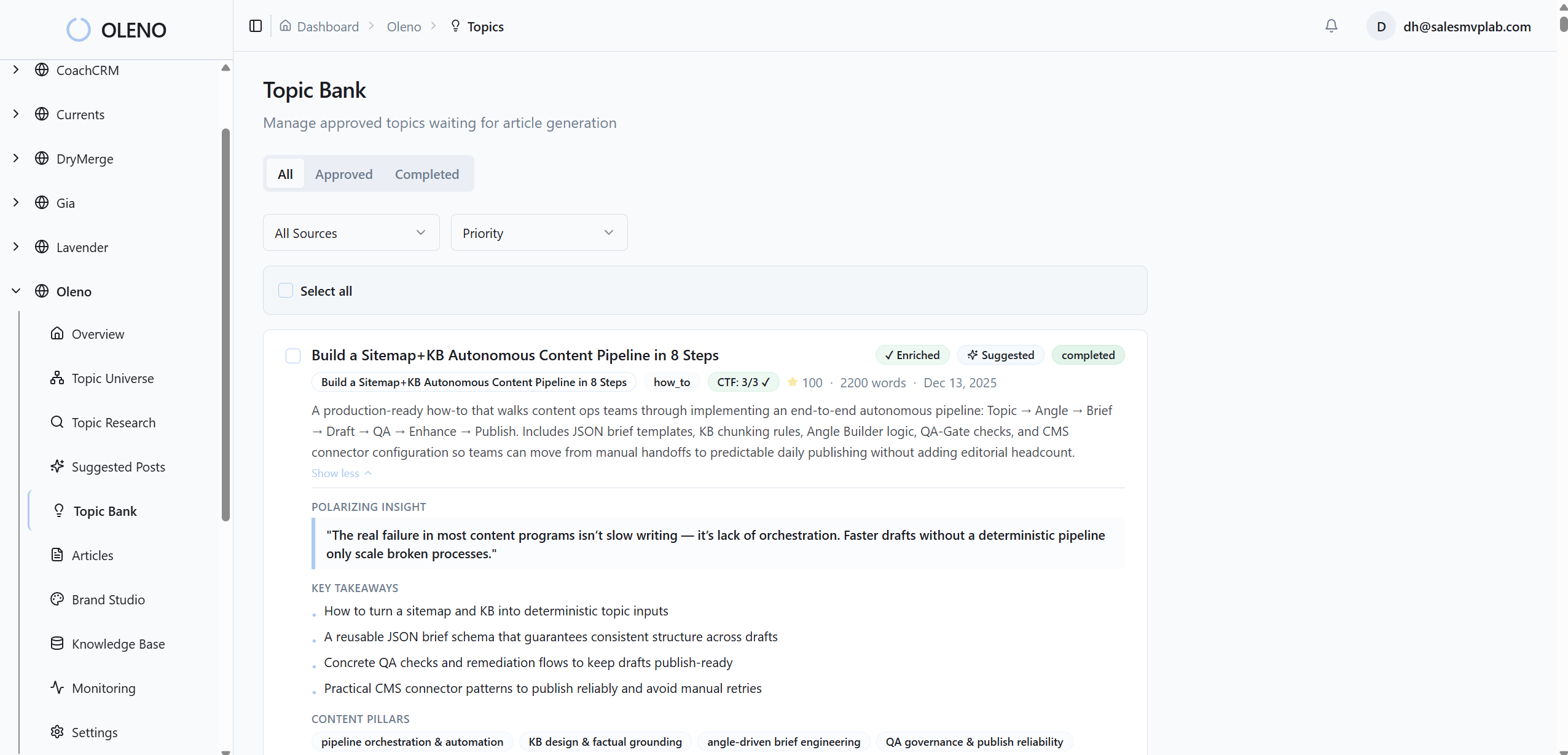
If you’re running campaigns and need content everywhere, Blaze is the cleaner match. If SEO is the channel and you want structure from keyword to publish, Outrank is the cleaner match. If your bigger fear is inconsistency at scale, the bet shifts toward governance plus repeatable execution.
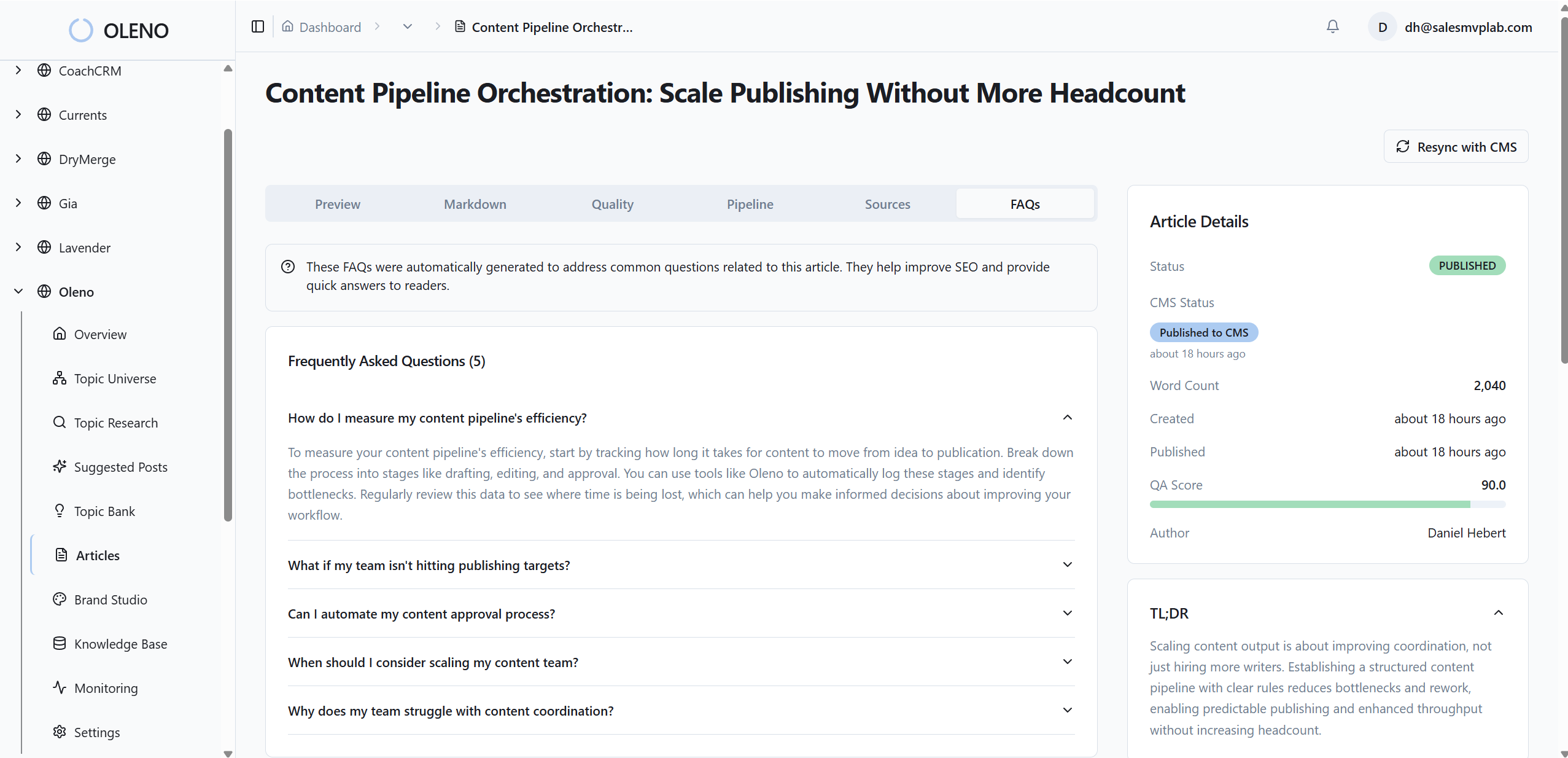
Ready to pressure-test this against your actual workflow? You can request a demo and we’ll map it to your team, your review process, and the volume you’re aiming for.
At the end of the day, pick the tool that reduces rework. That’s the real ROI. Drafts are cheap. Coordination isn’t.
About Daniel Hebert
I'm the founder of Oleno, SalesMVP Lab, and yourLumira. Been working in B2B SaaS in both sales and marketing leadership for 13+ years. I specialize in building revenue engines from the ground up. Over the years, I've codified writing frameworks, which are now powering Oleno.
Frequently Asked Questions