Build a Content Topic Universe: Cluster, Prioritize, and Scale Authority

Back when I ran Steamfeed, we hit 120k monthly visitors with zero “growth hacks.” We did it the old-fashioned way: breadth plus depth, stacked over time. Same story at PostBeyond and later LevelJump. When content compounded, demand followed. When it didn’t, we were just busy. And busy isn’t a strategy.
Here’s the thing most teams feel but rarely say out loud. Publishing more doesn’t mean you’re building authority. If your blog can’t remember itself, you’ll repeat angles, confuse internal links, and chip away at your own credibility. You don’t need another dashboard. You need a map. One that decides what’s next, what’s off-limits, and what actually moves authority.
Key Takeaways:
- Publishing more without a topic universe dilutes authority and creates avoidable overlap
- Start from your knowledge base and sitemap, not just keywords, to close real coverage gaps
- Define clusters with granularity rules and minimum semantic distance to avoid cannibalization
- Programmatic internal links and JSON-LD should be pipeline defaults, not last-mile chores
- Use coverage, recency, and information gain to label clusters from underserved to saturated
- Prioritize by impact and effort, not volume, and enforce cooldowns to keep signals clean
Why Publishing More Often Dilutes Authority
Publishing more often dilutes authority when articles repeat angles, compete for the same queries, and break internal link logic. The pattern looks like growth, but search engines read it as duplication and confusion. A simple inventory of 20 recent posts often reveals multiple variations chasing the same intent.

The duplication trap inside most blogs
Duplication doesn’t happen because teams are careless. It happens because there’s no shared inventory, no memory, and no rules on what’s “already covered.” Writers get a topic, not a map. Editors catch superficial overlap, not semantic sameness. Three posts later, you’ve got competing answers to one question and a cleanup project waiting.
I like a quick field test when this comes up. List your last 20 posts. Map them to five pillars. Then ask a blunt question: how many chase the same search intent with different phrasing? If more than 30 percent cluster to one pillar without net-new subtopics, you’re diluting authority. Not intentionally. But repeatedly.
You’ll see it in little ways too. Internal links contradict themselves. Two posts claim “definitive.” A comparison piece cannibalizes a how-to because both try to “rank for the head term.” None of this is malicious. It’s what happens when discrete posts pretend to be a system. They aren’t. And Google can tell.
What is a topic universe and why does it matter?
A topic universe is a living map of pillars, clusters, and subtopics tied to what you already know and what you’ve already published. It tells you where you’re thin, where you’re saturated, and where you should cool down. The goal isn’t volume. It’s coverage with information gain—each new piece adds something new.
This matters because authority compounds when coverage is intentional. The map stops you from guessing what to write next. It prevents duplication by design. It also clarifies internal link paths, so equity flows to the right hubs instead of getting lost in random cross-links. You stop stepping on your own feet.
At a practical level, a topic universe pairs your knowledge base with your sitemap. It normalizes titles and entities, labels clusters by saturation, and enforces a 90-day cooldown on recency-sensitive areas. You’ll publish less in hot spots and more in neglected corners. That shift alone reduces cannibalization dramatically.
Why discrete posts break compounding
Discrete posts don’t remember each other. That’s the core problem. Without shared rules, you create polite anarchy—good writing, bad system. The consequences are predictable: cannibalized keywords, inconsistent snippet structure, and contradictory internal links. Each article tries to win alone and ends up dragging others down.
Content compounding needs continuity. Clusters carry that continuity when they’re defined by intent, not just keywords. Saturation thresholds tell you when to pause. Deterministic links ensure each subtopic points to one canonical hub. When those rules live upstream, every article boosts the last one, not competes with it.
If you want a barometer, look at your orphan rate and link conflicts. If the numbers are high, it’s not a writing problem. It’s an absence-of-system problem. And no, adding another editing pass doesn’t fix it. You need rules that live before the draft, not band-aids after publish.
Ready to skip the theory and test-drive the approach? Generate a small batch and see the difference in structure and focus. Generate 3 Free Test Articles.
The Real Reason Coverage Breaks At Scale
Coverage breaks at scale because teams start from keywords, not their own knowledge base and sitemap. Keyword lists don’t know what you’ve already published or what your product actually solves. When inputs are blind to context, outputs skew to surface topics and miss bottom-of-funnel intent.

What traditional keyword research misses
Traditional keyword research is good at finding search behavior, not your truth. It can’t see your product, your market narrative, or your existing content assets. So teams over-serve the obvious and under-serve the intent that points back to the solution. Helpful? Sometimes. Aligned to demand? Not always.
Start the other way. Ingest your knowledge base and sitemap first. Normalize titles, tag intent classes, and dedupe near-duplicates by semantic similarity. Then enrich with external search signals. When you do this, blind spots show up quickly—like three mid-funnel explainers where one would do, and zero buying-stage comparisons where they matter most.
I’ve seen the drift play out. Support docs nudge the KB toward troubleshooting artifacts. Marketing posts tilt toward top-of-funnel education. Meanwhile, product stories sit too far away from the queries that should lead to them. External data helps, but only after your internal inventory is clean. For context on the broader “universe” concept in search, Search Engine Land’s analysis is a useful primer.
How do you define clusters that do not cannibalize?
Define clusters by intent class with clear scope boundaries. “One pillar, multiple clusters by intent” is the baseline rule. Each cluster should answer a different kind of question—overview, how-to, comparison, troubleshooting—with explicit limits on what belongs and what gets spun out into its own subtopic.
Put numbers on it. Use cosine similarity to enforce a minimum semantic distance between subtopics. If two outlines score above, say, 0.85 similarity, you consolidate or reframe. That threshold isn’t sacred; it’s a guardrail. The point is to prevent lookalike articles before they exist, not after they compete.
Then assign canonical internal links. Each subtopic points to one hub. Not whichever page the writer likes best. When all roads lead to a defined hub, link equity stacks instead of scattering. This is how you build coverage that climbs as a whole, not a set of posts that fight in the same ring.
The Cost Of Publishing Without A Map
Publishing without a map burns editorial hours, splits ranking signals, and pushes product stories away from the intent that should power demand. The costs aren’t theoretical. They show up as rework, missed snippets, orphan pages, and “why is this internal link going in circles?” Slower delivery. Weaker outcomes.
The editorial hours lost to rework
Without coverage visibility, you end up rewriting similar posts, merging duplicates, and patching internal links. Let’s pretend you publish 20 posts monthly and 25 percent overlap. If each duplicate costs two hours of edits plus one hour of relinking, you’re burning 15 hours a month on avoidable cleanup. That’s two working days, gone.
Those hours rarely appear on a plan. They show up in Slack pings at 5 p.m. and edits at 9 p.m. The more you publish, the worse it gets, because duplication compounds faster than authority. Editors turn into firefighters. Writers lose trust in the brief. And your best contributors start hedging effort because tomorrow’s rework is likely.
A map shrinks that waste by preventing redundant drafts upstream. You shouldn’t need a heavy process. Just a clear inventory, cluster rules, and a recency policy. Once those guardrails exist, “should we write this?” becomes an answerable question, not a debate thread.
The cascading impact on rankings and demand
Duplicate angles split signals. Two pages chasing the same head term confuse search engines and readers at the same time. Orphan pages don’t pass equity, so your hubs starve. And when product narratives live three clicks away from buying intent, demand capture turns into a hope, not a path.
You don’t need another dashboard to see the problem. Check average internal links per page. Look for keyword clusters with multiple URLs ranking on page two or three. Then read them like a buyer would. If a comparison is buried under three general explainers, your own structure is blocking revenue-adjacent traffic.
There’s a bigger point. Authority isn’t a single-article game. It’s a network effect across your site. Network effects fail when edges are noisy, hubs are weak, and paths are inconsistent. The fix isn’t more content. It’s better-connected content, published with intent.
For a clean definition of “universe” and why comprehensive coverage matters in research contexts, see the Encyclopedia of Survey Research Methods’ entry on Universe. Different field, same principle: define the whole, then sample intentionally.
Why internal links and schema cannot be afterthoughts
Internal links and schema are how machines understand your structure. If you bolt them on at the end, they’ll be inconsistent. One editor uses a hub, another uses a sibling article, a third forgets. JSON-LD gets skipped on busy days. The result is unpredictable clarity—exactly what snippets and AI assistants don’t reward.
Build determinism into the pipeline instead. Links should come from a verified sitemap, placed algorithmically at natural sentence boundaries, with anchor text that matches page titles. Schema should be programmatic: Article, FAQ, and BreadcrumbList at minimum. No guesswork. No “we’ll add it later” that never happens.
When this runs as code, humans get to focus on narrative and accuracy. The structure enforces itself. And yes, that reduces the recurring headache of manual fixes that pop up the night before publish. Consistency isn’t exciting, but it’s what machines reward.
Still dealing with this manually and losing hours to cleanup each month? You don’t have to. Use an Autonomous Content Engine.
When Content Ops Run Without Rules, It Feels Like This
Content ops without rules feel like shipping on hard mode: overlapping topics, late-night edits, and stakeholder tug-of-war. The writing can be good. The system is not. The human cost is real—frustrating rework, unclear ownership, and priorities that change by the hour.
When your team ships three versions of the same idea
I’ve seen it firsthand. At one company we pushed out strong ideas fast, then realized three posts answered the same question with minor phrasing changes. Smart people. Bad system. That discovery didn’t feel tactical—it felt deflating. We didn’t lose to competitors. We stepped on our own feet.
A topic universe would have blocked the third draft before it started. The brief would have flagged low information gain. The cluster would have been marked “saturated,” or a new angle would have been required to proceed. There’s relief in that kind of guardrail. Less second-guessing. More forward motion.
And the downstream effects show up immediately. Internal link conflicts drop. Editors stop adjudicating which version is “the real one.” Writers get clearer prompts. The same team, with the same effort, suddenly looks more credible because the system stopped them from duplicating themselves.
The 3 am edit scramble before publish
You know the drill. Draft’s solid, but the intro isn’t snippet-ready, links wander, visuals look off-brand, and schema’s missing. Shipping becomes a tired sprint. Not once. Often. It’s no one’s fault. It’s what happens when quality lives in catch-up mode instead of the pipeline.
Move the gates earlier. Check structure, voice, and information gain before writing begins, not after. Enforce snippet-ready openings at the section level. Let visuals pull from a brand library instead of last-minute hunts. When quality is systematized, publish is a button, not a scramble.
This isn’t about perfection. It’s about predictability. If every article has to be rescued before it ships, the system is telling you something. Listen to it, or it’ll keep you up at night.
A System To Map, Score, And Prioritize Your Topic Universe
A durable topic universe system inventories your content, defines clusters with granularity rules, labels coverage and saturation, and prioritizes what to publish next. It’s part data, part policy. Simple math beats gut feel when the goal is authority that compounds over time.
Inventory your knowledge base and sitemap with normalized signals
Start with extraction. Pull pages, docs, and briefs into one table. Generate embeddings, capture metadata, and tag for intent, persona, and lifecycle stage. Normalize titles so “What Is X?” and “X Explained” don’t masquerade as different topics. Dedupe near-duplicates by semantic similarity before clustering.
Make the inventory useful, not pretty. Add fields you’ll use to decide: URL, title, cluster label, last covered date, canonical hub, and information gain notes. The goal is to see overlap and gaps without squinting. When you can scan a pillar and know where you’re thin, planning finally becomes mechanical.
Two operational tips. First, lock naming conventions, or drift will creep back in three weeks. Second, capture canonical link paths at the URL level, not just in a doc. When the rules live with the content, you don’t have to re-teach them every month. For a strategic perspective on “universe” as a planning model, I like the framing in Growth Memo’s Universe.
Design pillars, clusters, and granularity rules
Tie pillars to product and market outcomes, not vague categories. Each pillar hosts multiple clusters by intent class—overview, how-to, comparison, troubleshooting—with explicit scope boundaries. If a draft crosses boundaries, you either split it or redefine it. Don’t let “comprehensive” become “confused.”
Write down granularity rules. Set a minimum semantic distance between subtopics so you don’t spin near-duplicates. Document allowed archetypes per cluster to avoid format collisions. If your comparison cluster starts getting “what is” explainers, the cluster isn’t tight enough or your process isn’t policing it.
Assign canonical hubs and link paths early. This is where compounding starts. When every path is known, editors stop improvising and writers stop guessing. Simple rules, enforced upstream, create downstream speed.
Compute coverage and saturation labels programmatically
You don’t need complex models to label coverage. A straightforward scoring formula works: Coverage score equals weighted subtopic count plus recency decay plus average information gain. Then apply thresholds: Underserved, Healthy, Well-covered, Saturated. The labels make planning visible at a glance.
Add a cooldown flag tied to last_covered_at. If a cluster is hot, pause it for 90 days unless an exception is justified. “Saying no with a date” defuses internal debate and keeps signals clean. It also forces creativity: if a writer wants in, they need a genuinely new angle to earn it.
Roll this up at the cluster and subtopic levels so you can zoom in and out during planning. A single table, refreshed weekly, becomes your operating rhythm. The payoff? Fewer debates, fewer duplicates, and a pipeline aligned to coverage and demand—not just an editorial calendar. For a different take on the “universe over keywords” shift, here’s a helpful framing: Universe, a better alternative to keyword research.
How Oleno Operationalizes Your Topic Universe End To End
Oleno turns the approach above into a governed pipeline: map topics and clusters, enforce cooldowns, score information gain before writing, inject links and schema deterministically, and ship brand-consistent visuals with CMS-ready delivery. It’s not another draft tool. It’s the system that makes publishing predictable.
Topic Universe maps clusters and enforces cooldowns
Oleno ingests your knowledge base and sitemap, normalizes them, and groups topics into clusters with live coverage states—underserved through saturated. It applies a 90-day cooldown at the cluster level so you don’t over-publish “hot” ideas while neglecting gaps. The result is a pipeline guided by coverage, not gut feel.
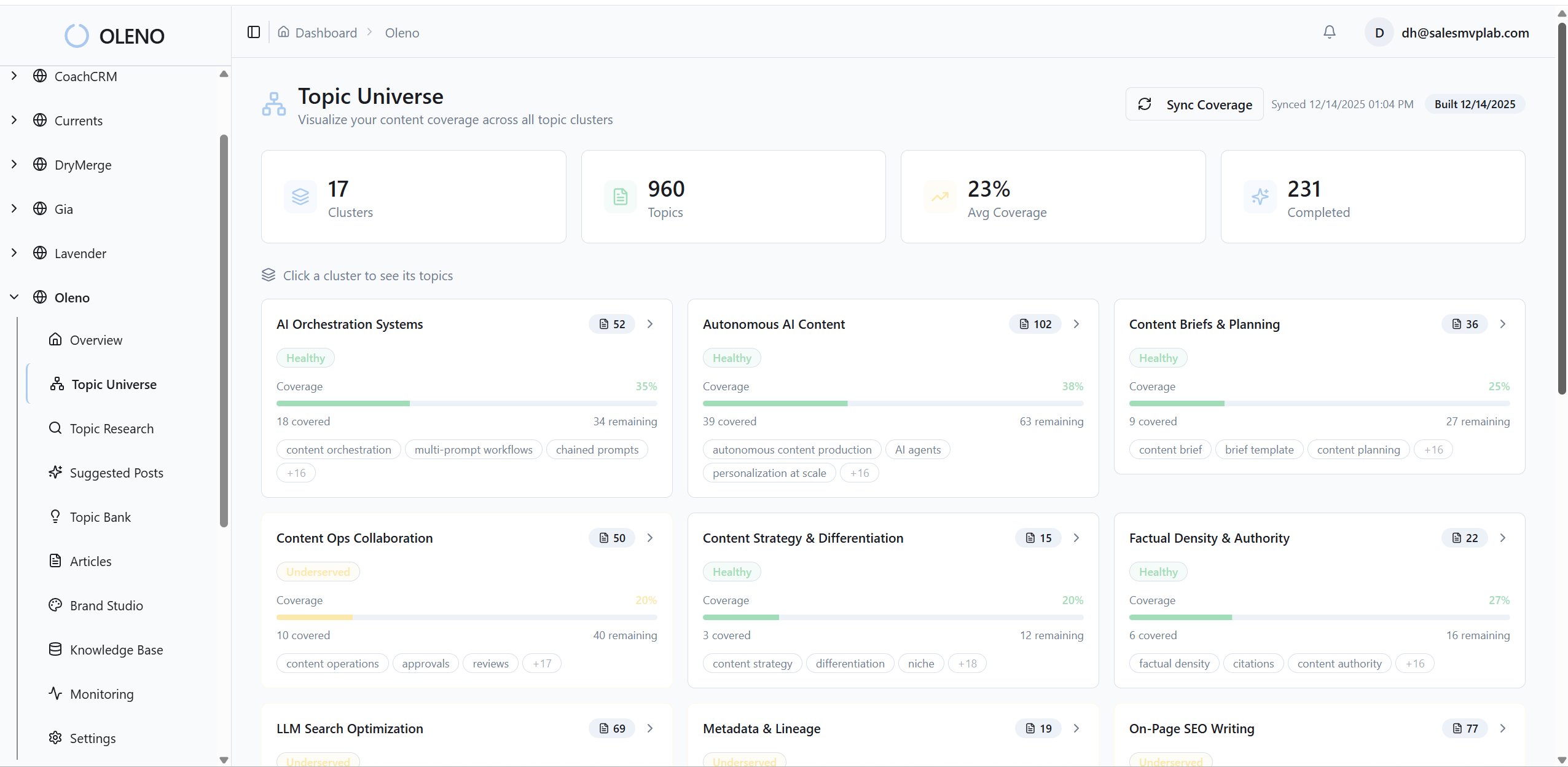
Because Topic Universe is persistent, planning stops from-scratch debates. You can answer “what’s next?” with data your team already trusts. Less overlap. Fewer internal link conflicts. And a clear line between what belongs now and what can wait. That alone cuts the rework hours most teams have normalized.
Oleno doesn’t try to be a performance dashboard. It focuses on what ships and whether it aligns to your pillars and rules. Authority is engineered by consistent execution over time, not by chasing week-to-week rankings.
Information gain briefs prevent low-value duplicates
Before any draft is written, Oleno generates a structured brief with competitive research and an Information Gain Score. If the outline doesn’t add something meaningfully new versus what you and the market have said, it’s flagged. Writers don’t have to guess at originality; it’s measured up front.
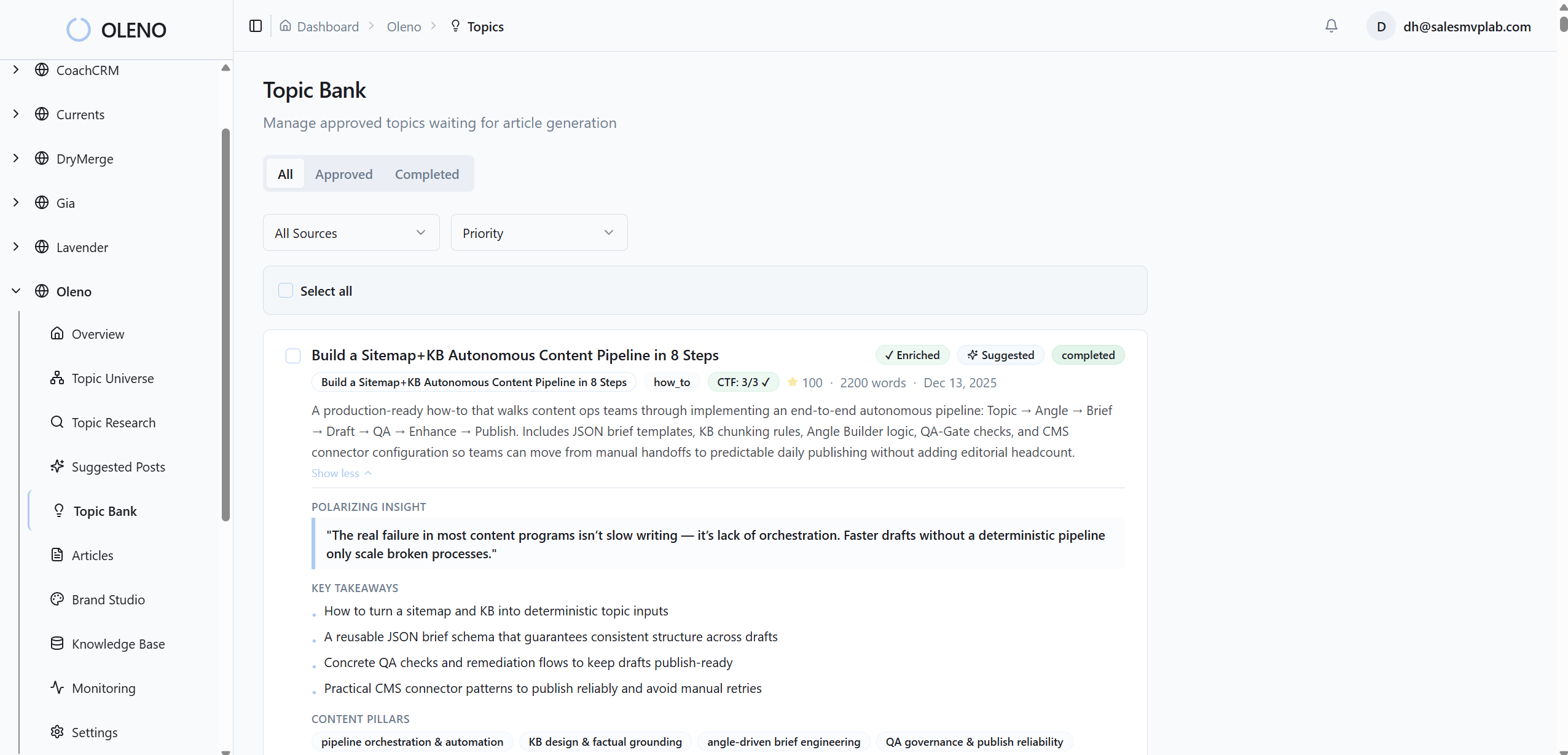
This step eliminates lookalike drafts and protects cluster edges. It nudges the team toward angles with higher odds of being cited—because they genuinely add value. Over a quarter, that lift compounds. You’ll publish fewer posts that need to be merged later and more posts that strengthen hubs immediately.
The briefs also include authoritative external link candidates, so your references are strong and relevant without tab-chasing. Again, less last-mile thrash, more time on narrative and accuracy.
Deterministic links, snippet structure, and schema by default
After draft, Oleno injects internal links from your verified sitemap, places them algorithmically at natural sentence boundaries, and matches anchor text to page titles. It opens every H2 with snippet-ready paragraphs and generates JSON-LD for Article, FAQ, and BreadcrumbList. No “we’ll add it later.” It’s built in.
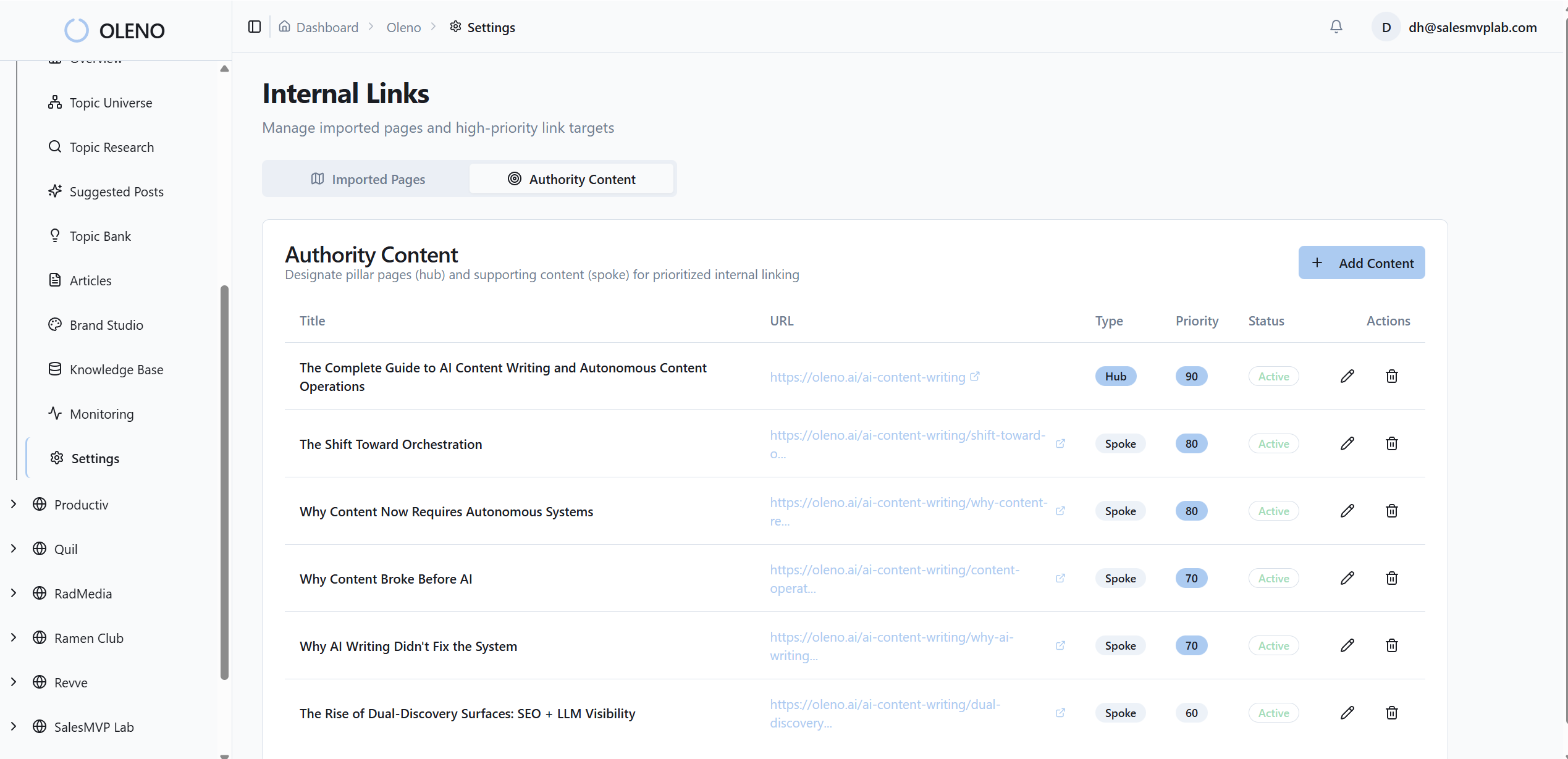
Determinism matters. It means you get consistent structure that machines can parse, every time. Editors get out of the link-wrangling business. Writers focus on adding clarity and specifics. QA checks enforce thresholds across structure, voice, and information gain before anything ships, so quality doesn’t depend on heroics.
Oleno also handles visuals and publishing with the same discipline. Visual Studio generates brand-consistent hero and inline images, matches product screenshots to relevant sections, and produces SEO-friendly alt text and filenames. Connectors deliver CMS-ready HTML to WordPress, Webflow, or HubSpot with mapped fields and duplicate-prevention. The last mile stops being a surprise.
If you want to see how a governed pipeline changes your week, spin up a small test. You’ll feel the difference quickly. Try Oleno for Free.
Conclusion
You don’t need more content. You need a content system that knows where authority is earned next. Map your universe. Enforce granularity and cooldowns. Let information gain decide what moves forward. Then make links, schema, visuals, and publishing deterministic so humans spend time on story, not structure.
We’ve all lived the other version—frustrating rework, last-minute edits, and posts that quietly compete with each other. You can change that. Build the map first. Then let it do its job, week after week, until authority looks less like a spike and more like infrastructure.
About Daniel Hebert
I'm the founder of Oleno, SalesMVP Lab, and yourLumira. Been working in B2B SaaS in both sales and marketing leadership for 13+ years. I specialize in building revenue engines from the ground up. Over the years, I've codified writing frameworks, which are now powering Oleno.
Frequently Asked Questions