Build a KB-Grounded Writing Pipeline to Stop Prompt Hallucinations

You can get a decent draft with a clever prompt. You know that. I know that. The problem is what happens next. Edits, reworks, fact checks, link fixes, brand tone cleanup. Multiply that by every article and you start to wonder why your “faster” workflow still feels slow and risky.
I’ve been on both sides. At PostBeyond, I could write 3–4 strong posts a week because I had the context in my head. As the team grew, quality dipped and timelines stretched, because the system was missing. At Steamfeed, we hit 120k monthly visitors by pairing volume with structure, not by freewheeling prompts. That pattern holds today. If you want consistent, grounded output, you need a pipeline, not a prompt.
Key Takeaways:
- Replace ad hoc prompts with a governed pipeline that encodes memory, structure, and quality checks
- Define “grounded” with testable rules, then wire retrieval, freshness, and versioning around it
- Quantify rework costs and set SLOs so quality is a product requirement, not wishful thinking
- Centralize brand rules and banned terms as machine-readable constraints, not tribal knowledge
- Use hybrid retrieval, deterministic caching, and per-section orchestration to keep outputs stable
- Block publish with a QA gate at 85+ score and leave an audit trail for every decision
- Ship deterministically: lock links, schema, and visuals, then publish idempotently
Why Prompt Hacks Keep Failing Your Team
Prompt hacks fail because they reset context every run, produce variable structure, and rely on manual editing to catch errors. Teams see the same patterns repeat, which burns time and trust. You feel it when a clean-looking draft hides fabricated links or off-brand claims that slip through.
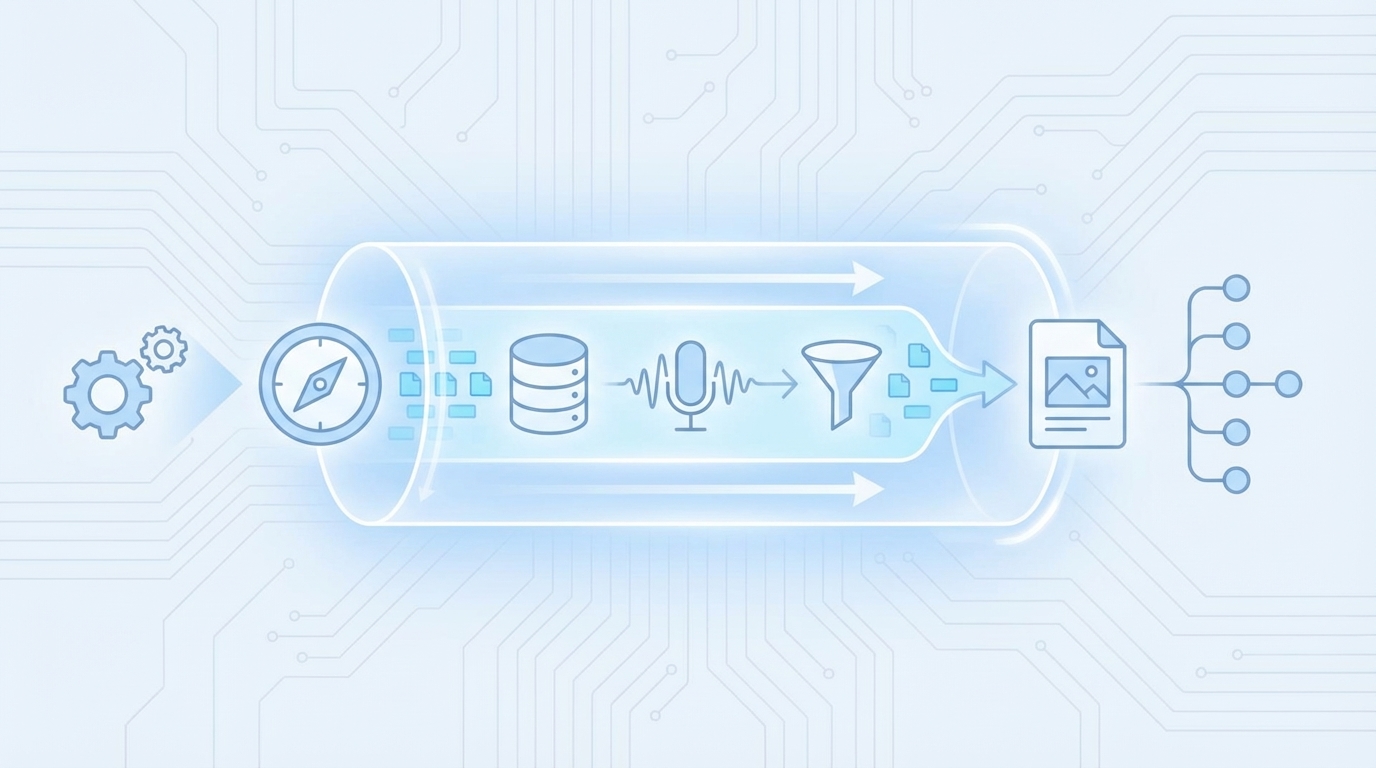
Audit failure modes and hallucination hotspots
Start by measuring where things break. Pull ten recent drafts and tag each factual miss, brand drift, structural mess, and link error. Note prompt variants, whether the model was forced to answer or allowed to abstain, and how long rework took. This gives you a baseline and a shared language for fixing it.
Now connect each failure to a root cause. No persistent memory creates inconsistent claims. No approved source list invites speculation. Freeform prompts create structural drift. Manual QA varies by editor and by day. You are not alone. Research into model reliability highlights why hallucinations show up under pressure, especially when prompts ask for facts without verified context, as outlined in OpenAI’s paper on why language models hallucinate and the ACM overview on LLM reliability.
Define where the model should say “I don’t know.” Document escalation rules like “missing KB source,” “conflicting claims,” and “ambiguous product behavior.” This gives the draft an escape hatch, which lowers error pressure later. You can see how upstream fragmentation fuels these problems in this quick content operations breakdown.
What does “grounded” actually mean for your content?
Write a testable definition: Every claim is supported by a KB source or clearly marked as opinion. Make it operational. Map KB fields, including source, snippet, last_updated, and version, into briefs and drafts so you can verify grounding at each step.
Be specific about allowed evidence. For product claims, prefer first‑party docs and release notes. For industry statements, cite peer‑reviewed or official sources. Cap retrieval to 5–8 high‑precision chunks. Filter stale or conflicting versions by applying freshness rules. Without these constraints, context bloat quietly reintroduces the hallucinations you thought you solved.
Curious what this looks like in practice? Try generating 3 free test articles now.
Treat Content As a Pipeline, Not a Prompt
Content becomes reliable when you convert it from a single prompt into a governed system with memory, structure, and quality gates. Think topic to brief to draft to QA to publish, the same way, every time. That shift is how teams move from individual wins to compounding authority.
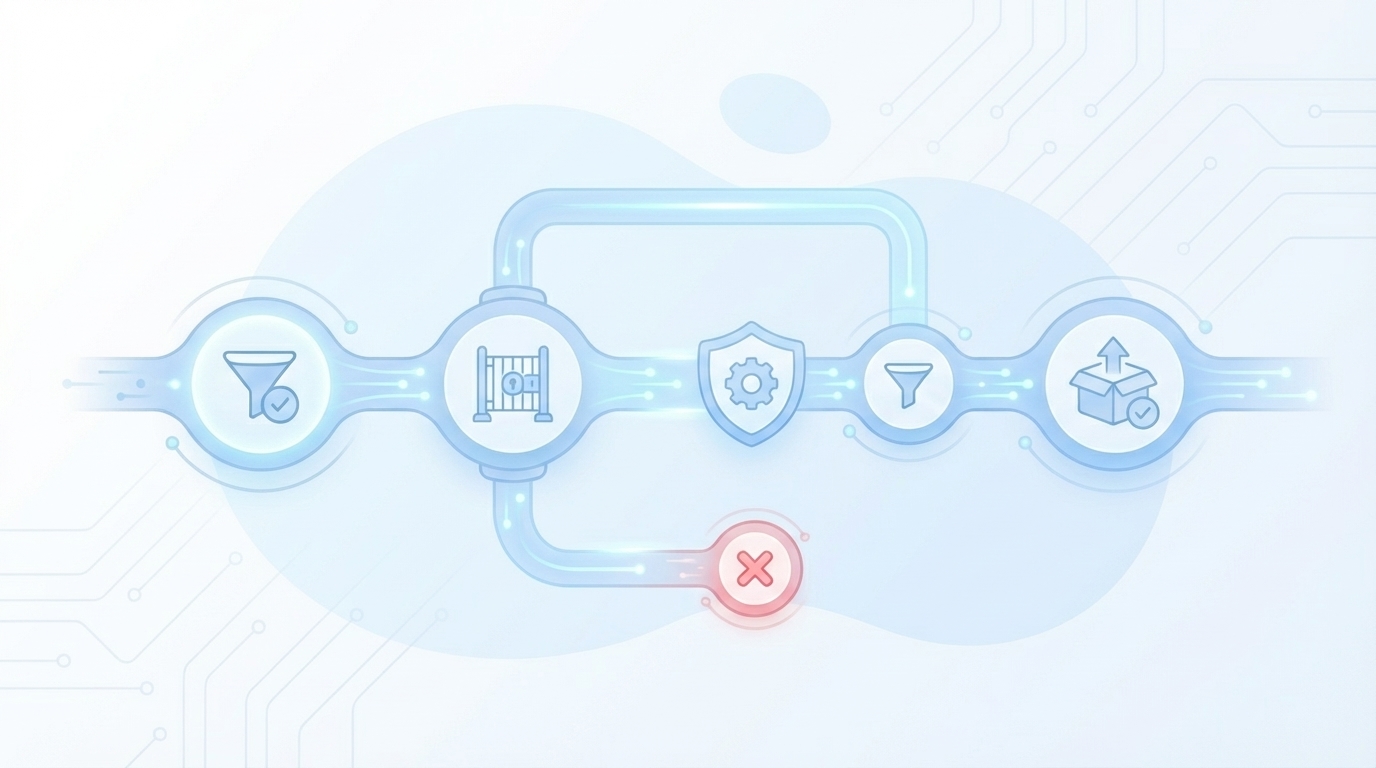
Design the knowledge base schema and versioning
Your KB is the backbone. Start simple: id, title, source_type, url, excerpt, embeddings, tags, product_version, last_updated, canonical. Add governance fields like risk_level, approval_state, and banned_terms exceptions. Version every record. Never mutate in place. Append new versions and mark canonical so you avoid split‑brain facts.
Chunk for retrieval, not for humans. Use section‑aware splitting on H2/H3 boundaries and aim for 300–800 token spans. Store per‑chunk metadata like headings, anchors, version, and freshness. Attach a stale_after date and queue re-embedding when it passes. Grounding works only if your memory stays fresh. For a deeper dive on why accuracy lives in the KB, see this guide on knowledge base accuracy.
Curate sources and build embedding + ingestion rules
Set the bar for what gets in. Pull from docs, product pages, feature specs, and support answers you’d gladly cite in a PRD. Strip out marketing fluff that is not factual. Normalize HTML to markdown, fix headings, preserve code blocks, and capture canonical URLs. Compute embeddings consistently and store sparse signals to enable hybrid retrieval later.
Wire a change feed. Use checksums or ETags to detect updates. When content changes, enqueue re‑chunk, re‑embed, invalidate caches, and bump KB version. Keep an audit log of what changed, when, and why. This is not vanity logging. It is how you explain what your model wrote and why. If you want a broader frame for why orchestration beats reactive prompting, this perspective on the orchestration shift helps.
You can also lean on outside research to shape your rules. Primer’s overview on grounded approaches to reducing hallucinations and this CEUR workshop paper on grounding methods offer useful guardrails.
The Hidden Costs of Ungrounded Drafts
Ungrounded drafts look fast. They cost you later. Rework compounds, trust erodes, and your team loses days to cleanup. That is why “better prompts” feel like they help, then stall. The bill shows up in editing hours, missed windows, and nervous reviewers.
How much are errors and rework costing you?
Let’s pretend you ship 20 drafts a month and 25 percent need major fixes. Each fix takes 90 minutes across a writer and editor. That is roughly 7–8 hours a week on preventable cleanup. Add brand reviews and link corrections and it doubles. These costs are common when teams chase draft speed without a system, which this note on AI writing limits covers well.
Different errors have different price tags. Factual errors can trigger legal review, which is slow and expensive. Fabricated links hurt credibility and can slip into production. Off‑brand tone creates frustrating rework and “please rewrite” loops. The research community has been clear about reliability risks and mitigation strategies, see OpenAI’s analysis of hallucinations and the ACL workshop paper on conversational AI safety.
Define SLOs that keep you honest
Treat quality like a product SLO. Set explicit targets for what you ship. For example:
- Maximum 5 percent factual flags per article
- Zero fabricated URLs in any draft
- Minimum 85 QA score required to publish
- 99 percent idempotent publishing with duplicate prevention
These numbers force tradeoffs. They also focus your roadmap. If your biggest failures are fabricated links, invest first in deterministic linking. If tone drifts, codify voice rules and banned terms. SLOs turn vague “quality” into measurable behavior.
Ready to eliminate preventable rework hours each week? Try using an autonomous content engine for always-on publishing.
Make the Pipeline Feel Safe, Not Fragile
People ship more when the system feels predictable. Safety does not mean slow. It means the rules are clear, violations are blocked fast, and the output looks the same level of good every time. That is how you publish confidently instead of holding your breath.
Encode brand voice, banned terms, and guardrails in one place
Centralize brand rules as machine‑readable constraints. Include tone, phrasing, rhythm, preferred terminology, CTA patterns, and banned terms. Apply them at brief time and draft time. When rules change, bump a version and re‑run the QA gate so drift does not linger.
Write negative rules as tests. No claims about performance analytics. No anthropomorphizing AI. Never call your Visibility Engine a monitoring tool. Translate them into lint checks that fail the gate. Add positive structure defaults too. Require snippet‑ready openings on every H2, sentence‑length ranges, and section independence. The more defaults you codify, the less debate later.
Deterministic briefs and information‑gain checks
Lock an outline schema. Include title, angle, thesis, counterpoints, section list, targeted questions, and KB citations per section. The draft must follow the brief. If the brief is weak, the draft will be weak, so invest upstream.
Measure originality before writing. Run information‑gain scoring during brief generation. Compare proposed coverage with top results and your own library. If the brief adds nothing new, refine or cut it. Do not hope uniqueness appears later. Enforce it early. The information gain mindset keeps your pipeline from publishing content that simply restates what already exists.
A Production Pattern for Grounded Drafting
Grounded drafting works when you control retrieval, calls, and checks. Use hybrid retrieval with strict filters, keep calls section‑scoped, and log everything. Then block publish unless quality clears the bar. This is how you get stable outputs week after week.
Implement hybrid retrieval and cache layers
Use both vector and sparse signals. Retrieve semantically with embeddings, then filter by tags, product_version, and freshness. Re‑rank with dense scores plus a short BM25 pass to avoid near‑duplicate drift. Limit to 5–8 chunks per section. Cache results by section hash, which includes brief_id, section_id, and kb_version, to keep runs deterministic.
Build a two‑tier cache. Keep hot reads in memory, like Redis, and use a persistent store keyed by versioned brief IDs for replays. Invalidate by KB version or checksum, not time alone. Log retrieval events for each section, including top‑k chunks, scores, and the final selected context. This aligns with patterns seen in research on RAG reliability, such as the arXiv preprint on retrieval-augmented generation reliability. For a broader system view, this primer on AI content writing offers helpful context.
Orchestrate LLM calls and manage context windows
Wrap prompts with structure. One call per section with a fixed template. Include a system prompt that encodes brand and structure rules, the brief section, and the retrieved chunks. Require answer first, then cite the KB snippet inline, avoid speculation, and decline if unsupported. Keep token budgets safe to avoid truncation.
Control expansions. If a section exceeds budget, split deterministically into subsections and stitch with a post‑processor. Keep few‑shot examples minimal and versioned. Prefer rules over examples. When prompts change, bump a prompt_version and record it in the audit log. Then connect quality to shipping by integrating a gate that blocks publish. For a deeper look at quality gates, dive into this overview of QA systems. You can also reference Primer’s research on grounded approaches for context on verification strategies.
Try a small pilot before rolling this out team‑wide. Start with one cluster, then expand once the process feels predictable.
How Oleno Operationalizes This Pipeline End-to-End
Oleno turns this pattern into a governed, end‑to‑end system that runs daily. It starts with strategy, encodes memory and voice, enforces differentiation, and ships text plus visuals with links and schema. No prompt juggling. No manual pasting. Just reproducible articles your team can stand behind.
Deterministic post‑processing: links, schema, and visuals
Remember fabricated links and visual chaos. Oleno eliminates both with code. It injects 5–8 internal links using only verified URLs from your sitemap and exact‑match anchors, so fabricated URLs are impossible. It generates JSON‑LD for Article, FAQ, and BreadcrumbList automatically.
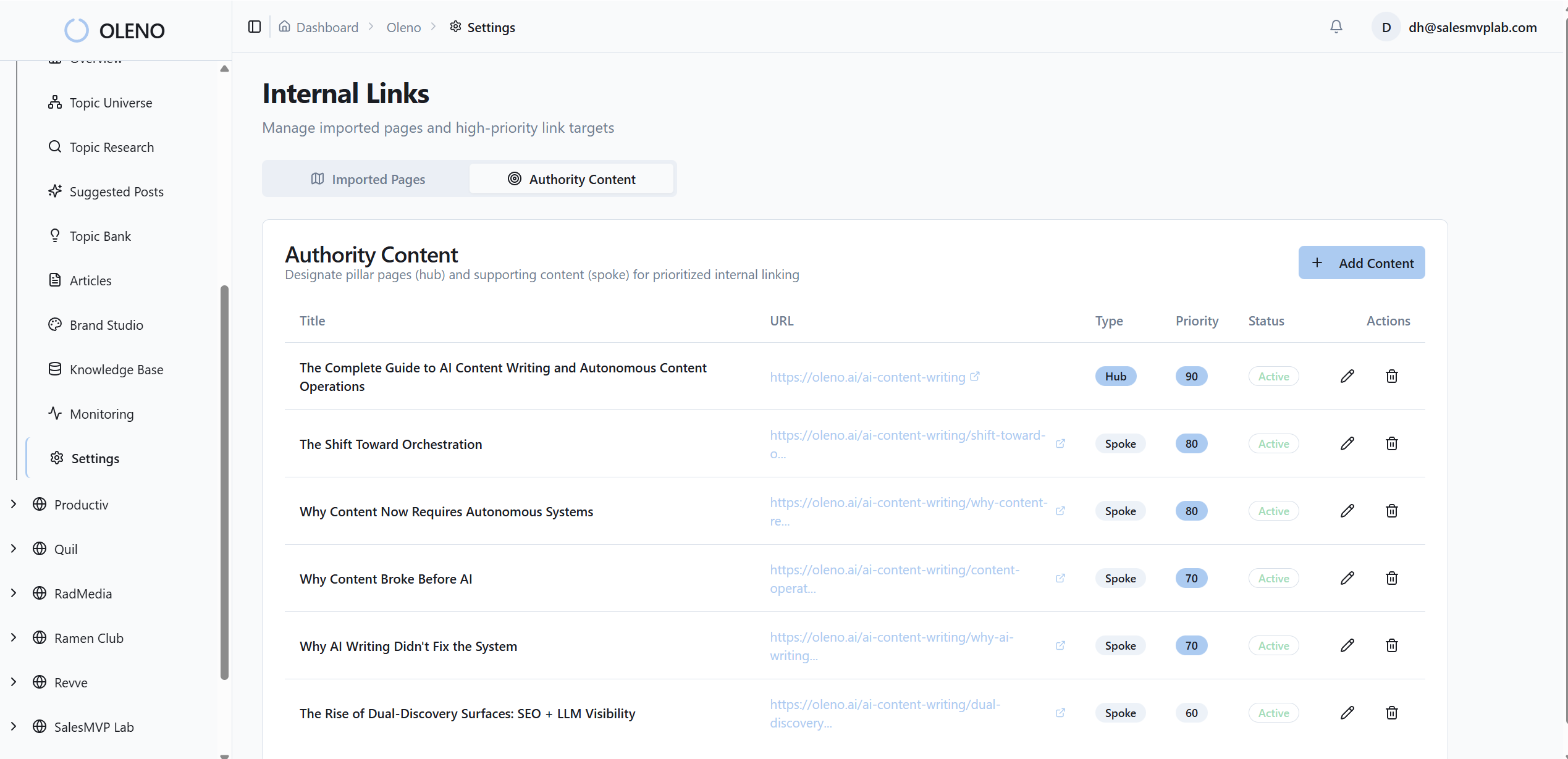
On visuals, Oleno’s Visual Studio uses your brand asset library to generate a hero and 2–3 inline images, match product screenshots to relevant sections with semantic similarity, and write alt text and filenames. Images are placed intentionally, not randomly, with solution sections prioritized for product visuals. This structure also supports dual audiences, humans and machines, which aligns with a dual‑discovery approach for SEO and AI assistants covered here: dual discovery for SEO and LLM visibility.
How publishing connectors stay idempotent
Oleno converts markdown to CMS‑ready HTML, maps fields automatically, embeds visuals and metadata, and publishes to WordPress, Webflow, HubSpot, or Google Sheets‑based workflows. Duplicate publishing is prevented with content hashes or CMS IDs. If delivery fails, Oleno retries with backoff and preserves a clean audit trail of attempts and states, draft or live.
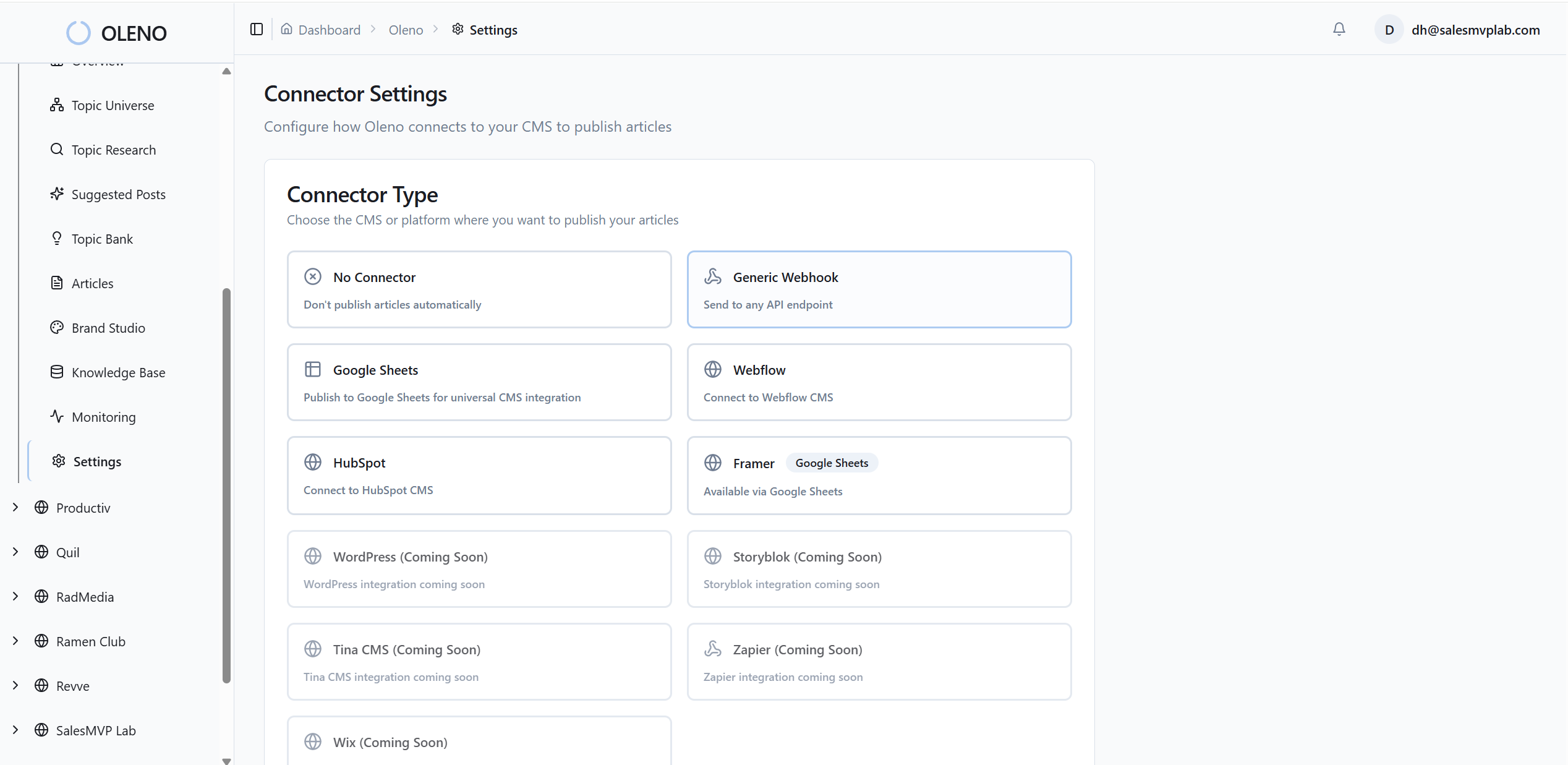
Publishing is treated as a governed stage. No pasting into a CMS. No last‑minute theme edits. The connector owns embedding visuals, schema, and URLs. That keeps outputs repeatable and reduces “it looked right in staging” surprises. For system‑level context on why this matters, see why modern content requires autonomous systems.
Log for explainability, not analytics
Oleno logs pipeline inputs, outputs, KB retrieval events, QA scoring, publish attempts, retries, and version history. This is operational truth, not a traffic dashboard. When a draft fails the gate, there are breadcrumbs for which rule failed, where, and how it was fixed. The ACM’s overview on LLM reliability reinforces why this kind of traceability supports safer deployments.
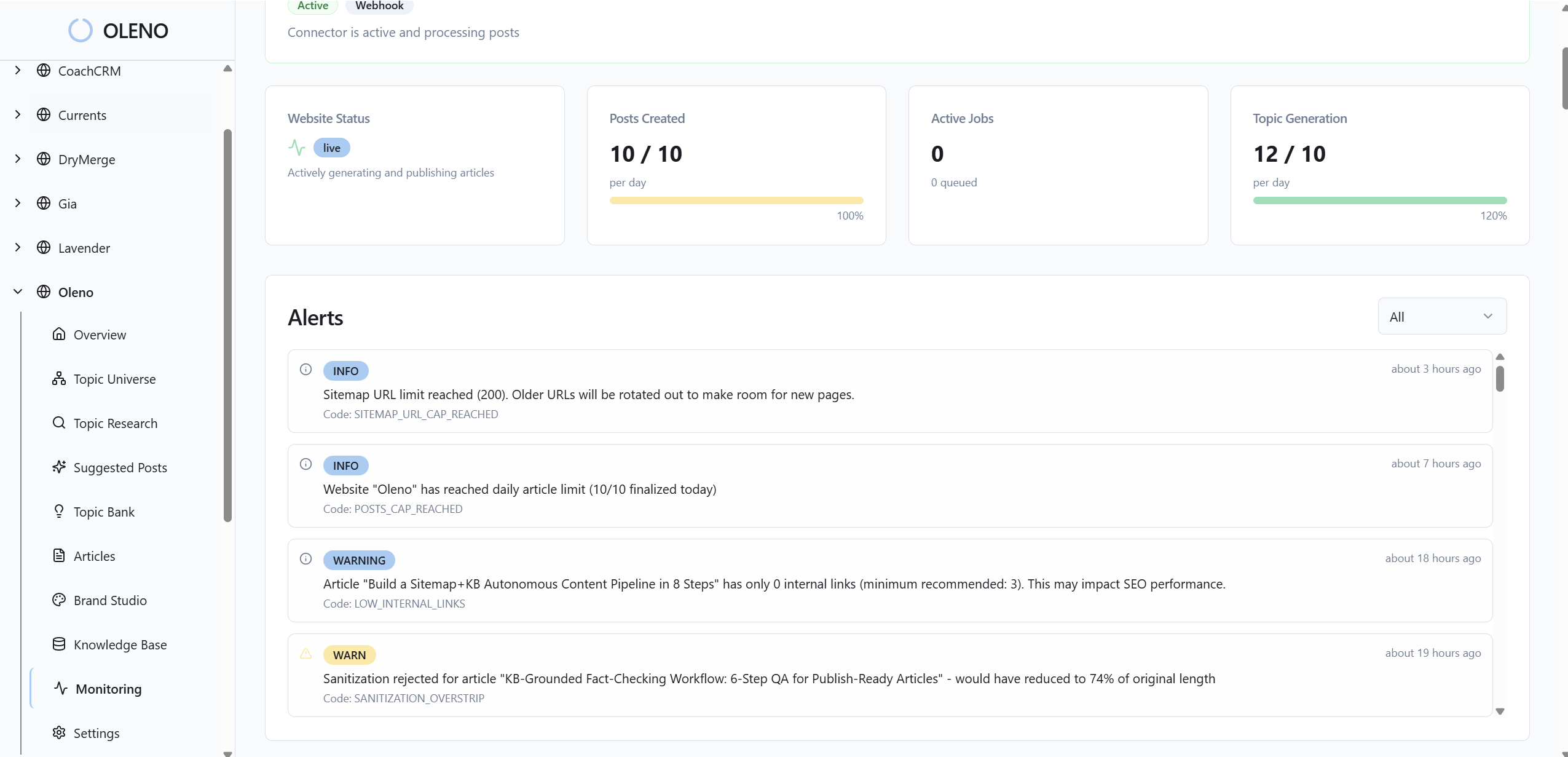
Now, the transformation callback. Those 7–8 weekly hours of preventable cleanup. The link fabrications that hurt credibility. The tone drift that sparked frustrating rework. Here is how Oleno addresses them directly:
- Oleno’s brief generation runs competitive research and assigns an Information Gain Score so originality is enforced before writing.
- Oleno opens every H2 with snippet‑ready paragraphs and validates structure in QA so sections stand alone for citation.
- Oleno’s deterministic internal linking uses only verified sitemap URLs, which means fabricated links never enter the draft.
- Oleno enforces 80+ quality checks and blocks publish below an 85 score, then runs targeted refinement automatically.
- Oleno’s publishing connectors handle field mapping and duplicate prevention, so you ship once, the same way, every time.
Want to see this pipeline end to end, without the manual glue work? Try Oleno for free.
Conclusion
Prompts get you words. Pipelines get you outcomes. When you encode memory, structure, and quality as system behavior, drafts stop drifting and publish‑ready work becomes normal. Grounding is not more context. It is the right context, versioned, fresh, and verifiable.
If you are tired of late‑stage edits and worried about credibility, start small. Define grounded, set SLOs, wire retrieval, and add a blocking gate. That alone will cut frustrating rework and raise the floor on quality. Then add determinism at the edges, links, schema, visuals, and publishing. At that point, the system compounds. You spend less time fixing, more time choosing what to write next.
About Daniel Hebert
I'm the founder of Oleno, SalesMVP Lab, and yourLumira. Been working in B2B SaaS in both sales and marketing leadership for 13+ years. I specialize in building revenue engines from the ground up. Over the years, I've codified writing frameworks, which are now powering Oleno.
Frequently Asked Questions