Build a Lean Content Ops Team That Costs Less Than a Mid-Tier Agency
Most teams assume the agency retainer buys certainty. It usually buys speed and capacity. The misses come from somewhere else, usually coordination and context. You see it in the back-and-forth, the off-brand phrasing, the “can we hop on a call” to fix a brief that never had product facts in the first place.
If your goal is predictable, publish-ready content, the unit that matters is not “hours.” It is “articles that need zero cleanup.” The fewer hands, the fewer surprises. A lean, governed pipeline beats a big retainer when the rules live upstream and the output is deterministic. That's the point.
Key Takeaways:
- Price work by publish-ready articles, not hours or drafts
- Replace “coordination tax” with clear SLAs and deterministic steps
- Build a 3-role core team that owns cadence, voice, and facts
- Enforce differentiation and structure before writing begins
- Track rework multipliers to expose hidden costs and quality debt
- Make cadence non-negotiable to stabilize trust across the org
Why Agency Retainers Cost More Than You Think
Retainers look simple, but true cost hides in coordination, revisions, and delays. Price the output you actually ship, not the meetings that try to fix it. A $15k retainer that yields six publish-ready articles is $2.5k per. If three needed heavy edits, your cost just jumped.

What A Mid-Tier Retainer Really Buys
Start by dividing the monthly fee by shipped, on-brand, SEO and LLM-structured posts. Include revisions, meetings, and wait time. If a $15k retainer yields six credible posts, baseline is $2.5k each. That is before hidden rework. Compare that to a lean model with a fixed cadence and fewer handoffs.
You also pay for context reset. New stakeholders, new briefs, and another round to get product nuance right. Research helps, but it does not erase resets. External data rarely mirrors what your sales team hears weekly.
For broader perspective on cost and capability tradeoffs, see the analysis in In-House vs. Agency cost comparisons and benchmark numbers in content marketing ROI roundups. Use them as guardrails, not gospel.
The Coordination Tax You Never Line-Item
The bigger leak is the coordination tax. Agencies win on breadth. You pay for resets, approvals, and context transmission. Price every delay at your burn rate. A two-hour call that avoids a rewrite is fine. Three revision cycles because the brief lacked product facts is margin lost.
This is where a system beats a service. A tight internal pipeline handles voice, facts, and structure as rules, not reminders. If you want to see how systems reduce coordination by default, study autonomous content operations and the orchestration shift. Drafting speed is not the lever. Coordination is.
Define Reliability Before You Price It
Write the SLA you actually want to buy: “Two publish-ready articles per week, snippet-ready H2 openings, schema included, brand visuals embedded, internal links correct.” If an external draft needs cleanup, price those edits into their true cost. If your in-house model ships publish-ready work, you are buying different products.
Reliability is measurable. Score every draft across four checks. If any fail regularly, your total cost spikes.
- On-brand voice
- KB-grounded facts
- Snippet-ready structure
- Compliant visuals
The Small Team That Outperforms The Retainer
A three-person core can outperform a mid-tier retainer on reliability, accuracy, and net speed. One person owns cadence and QA, one protects voice and clarity, one guards product truth. No heroics. Just tight roles and a governed pipeline.
The Three Core Roles
Assemble an ops lead, a writer and editor, and a KB owner. The ops lead owns cadence, QA rules, and publishing. The writer and editor expands briefs, enforces voice, and delivers clean narrative. The KB owner curates product facts, examples, and tagged screenshots. This trio replaces most retainer work and reduces failure modes.
Separate duties by failure mode. Ops prevents slip, KB prevents factual drift, writer prevents blandness. Use documented handoffs over ad-hoc chats. Overlap creates delays. Clear ownership shortens loops.
Tooling Stack That Replaces A Retainer
Lock facts and voice upstream. Use a Knowledge Base for product claims and a Brand Studio for tone, phrasing, and banned terms. Pair this with governed briefs that include an Information Gain Score to enforce differentiation before writing. After text, inject internal links from verified URLs, brand-consistent visuals, and JSON-LD schema automatically.
Prefer systems over dashboards. You do not need more analytics to ship consistently. You need deterministic steps that turn approved topics into publish-ready articles. Use CMS connectors to remove manual formatting and prevent duplicate publishing. For a deeper rationale, read why autonomous systems create stability without adding people.
Cadence And SLAs That Keep Flow
Set a fixed cadence first, then fit scope to pace. Protect cadence with a Topic Bank and cooldown rules to avoid over-covering the same idea. Cadence creates reliability. Governance guards quality. Establish pass or fail gates. No publish if voice deviates, facts are missing, or snippet-ready paragraphs are absent. Your ops lead enforces the gate.
Curious what this looks like in practice? Try using an autonomous content engine for always-on publishing.
The Hidden Costs Draining Your Content Budget
The obvious spend is the retainer. The hidden spend is rework and churn. Run the math on cost per article, then add multipliers for preventable fixes. You will likely find that slow, predictable publishing costs less over a quarter than fast drafts that need repeated surgery.

Run The Math On Agency Vs Lean Ops
Let’s pretend the agency retainer is $18k per month for eight solid articles. That is $2,250 per article. Now model a lean team. Ops lead allocation, writer and editor, KB owner plus platform. If all-in monthly cost is $12k and you ship ten publish-ready articles, you are at $1,200 per. Even if you add two freelancers, you are still under.
Stress-test throughput. If your lean team slips below six per month because of process gaps, parity disappears. Build buffers. Keep a Topic Bank with three weeks of approved ideas. Hold one freelance slot per week for spikes. Keep clear QA gates so drafts do not linger.
Where Rework Hides, And How To Price It
Price every preventable fix. Missing product facts is a KB issue. Off-brand voice is Brand Studio constraints. Weak structure is brief and QA rules. Assign rework multipliers for each failure mode and track them weekly for a month.
- Missing facts requiring rewrites
- Voice deviations requiring line edits
- Structure fixes to add snippet-ready openings
- Broken internal links or fabricated URLs
- Visuals that do not match brand style
Eliminate back-and-forth by enforcing snippet-ready H2 openings, deterministic internal link insertion, schema generation, and brand visuals as downstream steps that happen after drafting. The fewer manual touches after text, the lower your hidden cost. If you want a map of where the leaks usually start, here is a practical content operations breakdown.
For team and agency benchmarks that inform these multipliers, skim top agency KPIs and metrics and compare your flow to those ranges.
When Speed Collapses Quality, You Repay It Later
Cheap drafts that skip differentiation or structure often fail to drive pipeline. You revisit them later with heavy edits, or worse, you erode trust. The fix is upstream. Use information gain checks before writing and a clear QA gate before publishing. Slow is expensive. Predictable is cheaper over a quarter.
Quick note: Audit three published posts. Count the edits made after “final.” Multiply by your blended hourly rate. That is your quality debt. Now raise the QA pass threshold and tighten KB and voice rules.
What You Really Want: Predictable Pipeline Without Headcount Bloat
Predictability is fixed output, stable quality, and minimal coordination. If you can publish on the same day every week with no last-minute edits, you are winning. Tie your cadence to your business rhythm. It stabilizes expectations and reduces noise.
A Simple Definition Of Predictability
Define predictability as weekly output, quality thresholds, and coordination level. If you publish Tuesdays and nothing breaks, you are predictable. That is what founders and VPs actually care about. Not “more content” for its own sake. A pipeline that runs on time builds trust.
Anchor your cadence to meetings that already exist. Marketing reviews on Monday. Sales updates on Thursday. Publish enablement content Wednesday. You do not need a calendar revival. You need a rule everyone understands.
How To Spot Reliability Risks Early
Add upstream signals. Low Topic Bank inventory, a rise in low information-gain briefs, or increased QA failures are early warnings. Adjust scope before you miss cadence. Swap one long-form piece for two mid-length posts to keep the schedule intact.
Watch for rising last-mile edits. If voice linter hits increase or KB references go missing, refresh examples and tighten rules. It is not about adding people. It is about fixing the steps that cause churn. For practical guardrails, align your flow with a deterministic topic pipeline.
One Story: The “Tuesday Publish” Promise
We told a founder, “Two publishes every Tuesday. No Tuesday slips.” That single promise forced the team to front-load approvals, curate KB examples, and run a stricter QA pass. After three weeks, rework dropped and sales started citing the new pieces.
You can do the same. Start with a single publish day, protect it with a three-week content buffer, and revise upstream rules, not the schedule, when something breaks. The team will adapt to the boundary.
The New Operating Model: Lean Core, Governed Pipeline
This model replaces manual edits with rules, then runs those rules the same way every time. Editors design constraints. Ops enforces gates. Writers focus on clarity and narrative. Accuracy lives in code. Creativity lives in paragraphs.
Policies That Replace Manual Edits
Convert recurring edits into rules. Voice constraints, banned phrases, preferred terminology, and section-level structure. Enforce direct-answer openings for every H2 and JSON-LD schema generation for each article. When rules live in the pipeline, editors stop being fixers and become designers of constraints. That is where scale shows up.
Bake determinism where accuracy matters. Internal links from verified URLs, consistent image placement with brand styling, and mapped CMS fields that prevent broken publishing. You will cut “worried about” moments without hiring another coordinator. If you want to understand why drafting speed is not the lever, read about AI writing limits.
What Changes Week One
Week one, stand up three assets. A curated Knowledge Base with product facts and examples. A Brand Studio configuration for voice and phrasing. A Topic Bank of ten approved ideas. Implement a QA gate with pass or fail criteria. Publish a small piece to exercise the full path. Learn where it stuck.
Start tiny, then lock it in. One publish day. One review meeting. One owner per failure mode. Fewer hands, fewer surprises. Increase scope only after three stable weeks.
When To Flex With Freelancers Without Chaos
Define burst slots instead of headcount. Keep one to two freelancer seats for formats you have already governed. Clear briefs, KB links, and voice rules. You are buying throughput, not discovery. This keeps quality steady while adding capacity.
Cap freelancer surface area. Assign them specific content types with templates. Novel formats stay with the core team until rules exist. That minimizes back-and-forth and protects brand credibility.
Ready to reduce handoffs and surface rework early? Try generating 3 free test articles now.
How Oleno Automates The Lean Content Ops Workflow
Oleno turns the lean model into an automated pipeline. It decides what to write next, enforces differentiation before drafting, generates brand-consistent text and visuals, then publishes with links and schema in place. No manual stitching. No duplicate publishing.
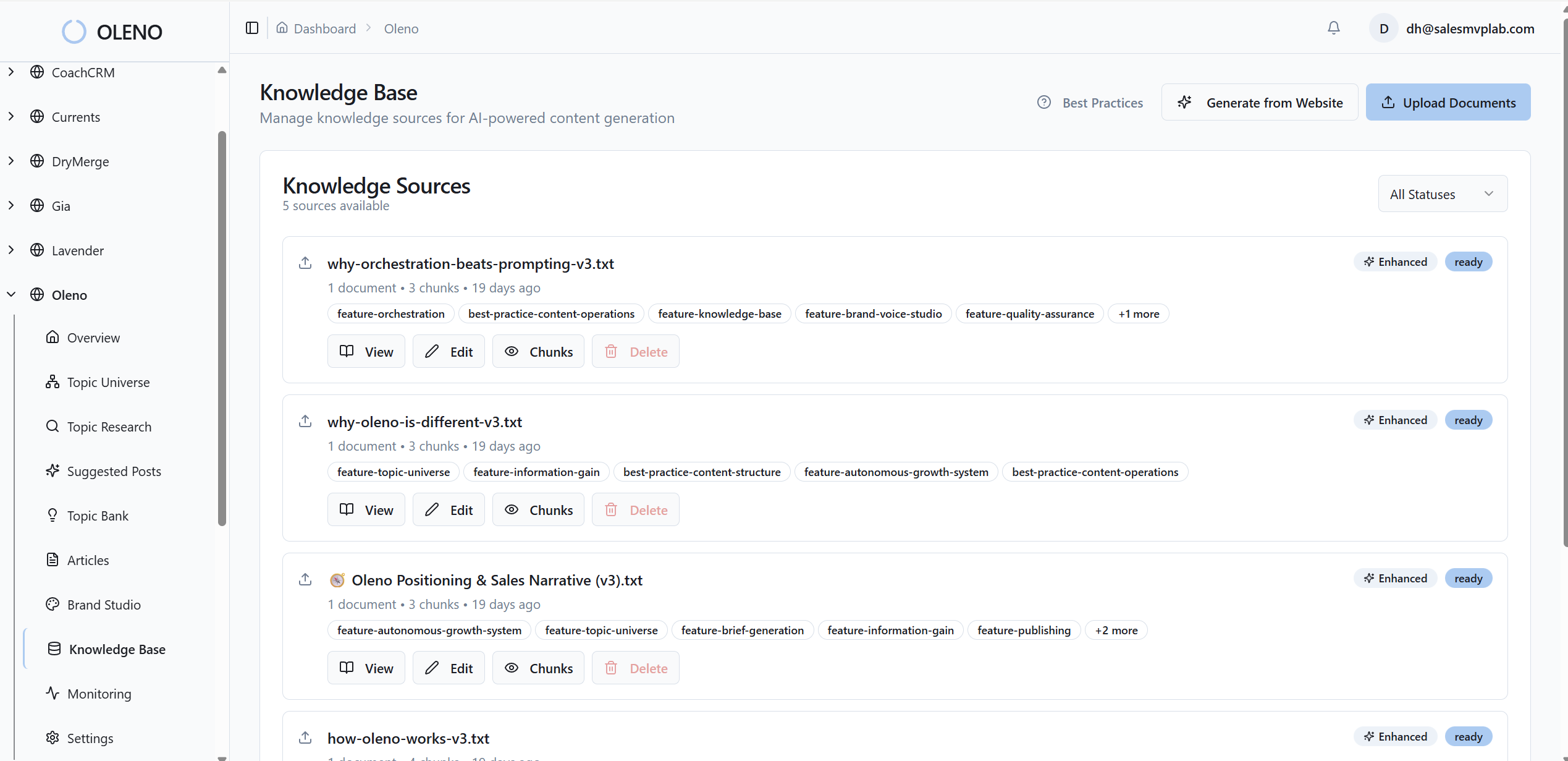
Set Up The 3-Role Model In Oleno
Configure Brand Studio with tone, phrasing, and banned terms, which gives your writer and editor guardrails. Import your Knowledge Base and tag product screenshots, which gives your KB owner a single truth source. The ops lead sets QA pass thresholds and CMS connectors. Each role owns the rules that prevent their failure mode from reaching production.
Assign outcomes, not tasks. The ops lead guarantees cadence and QA pass. The writer and editor guarantees narrative clarity and snippet-ready structure. The KB owner guarantees accuracy. Oleno’s governed pipeline enforces the rules consistently so each role can focus on upstream improvements.
Run The Daily Pipeline With Topic Universe And Briefs
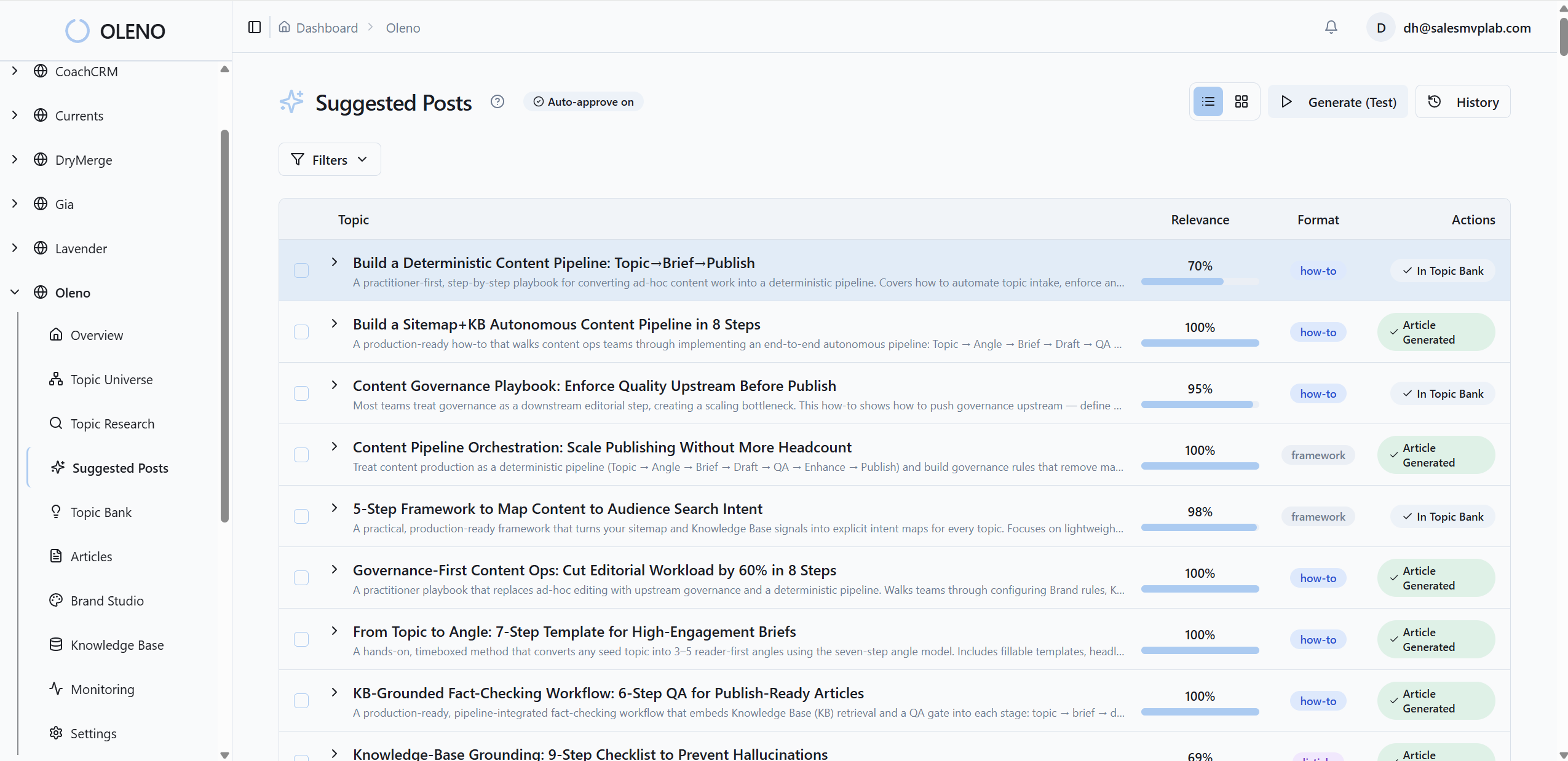
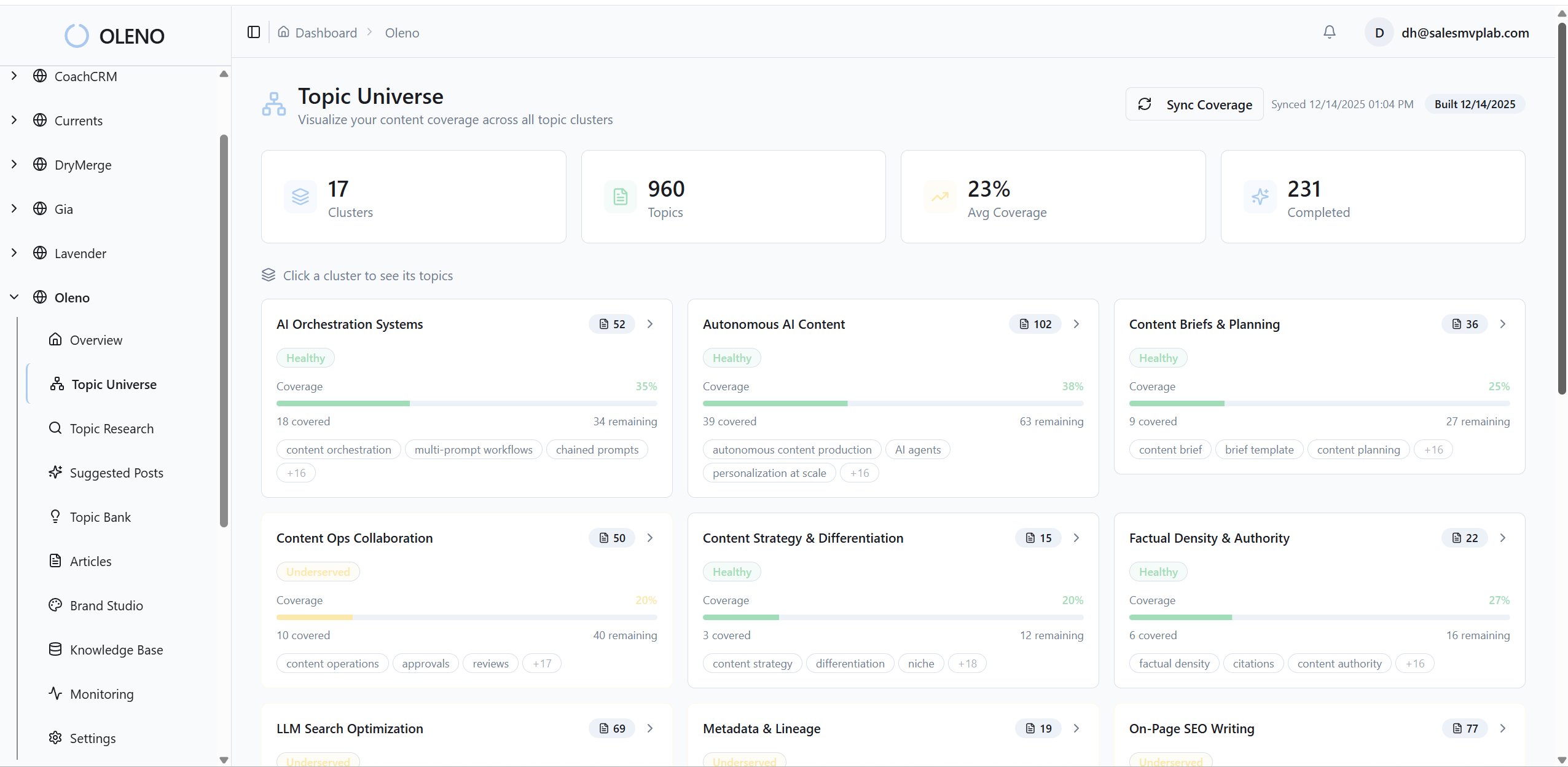
Use Topic Universe to keep a prioritized backlog and avoid over-publishing. Approve topics, then generate briefs with Information Gain Score checks to ensure your angle adds something new. Oleno drafts long-form content aligned to brand voice and KB facts. After text, Oleno injects internal links from verified URLs, brand-consistent visuals via Visual Studio, and JSON-LD schema automatically.
Quality is enforced before anything ships. Oleno’s QA Gate scores structure, voice alignment, information gain, snippet readiness, visual placement, and more. Drafts iterate until thresholds pass. This reduces “frustrating rework” and keeps cadence intact. You do not need daily micro-management, just approve good topics and let the governed stages run.
Measure Cost-Per-Article And Breakeven Without A Dashboard
Use a simple spreadsheet. Monthly all-in cost, including people allocations, platform, and freelancers, divided by publish-ready articles. Track rework hours and QA failures as separate inputs. Update weekly. If cost creeps up, fix upstream constraints or adjust cadence before adding headcount.
Model agency parity. If mid-tier cost per article is $2k to $3k, target $1.2k to $1.8k internally without trading away predictability. For clarity on discoverability requirements, align your structure for dual-discovery visibility. For QA accountability, standardize the scorecard your ops lead owns with these content governance metrics.
Remember that 2.5k-per-article baseline you calculated from the retainer? Oleno automates the work that inflates that number. Topic Universe stops duplicate coverage. Briefs enforce differentiation early. Draft generation aligns to brand voice and KB facts. Visual Studio produces brand-consistent images and pairs product screenshots to the right sections. Deterministic internal linking uses verified URLs only, and schema is generated programmatically. QA rejects drafts that miss the mark, and CMS connectors publish without manual formatting. That is how Oleno reduces coordination, protects cadence, and raises your publish-ready rate without bloat.
Curious how the governed pipeline feels end to end? Try Oleno for free.
Conclusion
If you price content by “time spent,” you will miss the real leak. Coordination, resets, and late edits kill predictability and inflate cost. A lean core team, clear SLAs, and rules that live in the pipeline shift you from chasing drafts to shipping articles.
Start with cadence. Protect it with a three-role model and a Topic Bank. Turn recurring edits into policies. Enforce differentiation and structure before writing. Then let governed stages do the heavy lifting. Agencies still have a place for spikes and specialty work. Your pipeline should be yours. When you own the rules, you own the outcome.
About Daniel Hebert
I'm the founder of Oleno, SalesMVP Lab, and yourLumira. Been working in B2B SaaS in both sales and marketing leadership for 13+ years. I specialize in building revenue engines from the ground up. Over the years, I've codified writing frameworks, which are now powering Oleno.
Frequently Asked Questions