Build a Topic Universe: Map Coverage Gaps from KB & Sitemap

Most teams still brainstorm topics like it’s 2015. Whiteboard, coffee, a headline list that feels smart. Then three weeks later you realize two posts hit the same angle and the one you actually needed never shipped. I’ve done that dance. At Steamfeed, we won with volume and breadth—but there was always a map behind the output.
When I moved into SaaS, the gap got louder. At PostBeyond, I could write fast and well because I had the context in my head. As the team grew, the context didn’t scale and duplicate topics crept in. At Proposify, content ranked but didn’t tie back to the product’s core narrative. Great pages, wrong map. That’s the problem a Topic Universe fixes. It turns guesswork into an operating system.
Key Takeaways:
- Build a Topic Universe from your KB and sitemap to stop duplicate coverage and direct authority where it matters
- Use canonical hygiene and taxonomy rules to make clustering reliable and saturation scoring honest
- Quantify duplication costs in hours and missed authority, then decide “update” vs. “new” with data
- Pre-plan 90 days with cooldowns and quotas so weekly scrambles don’t erode momentum
- Cluster with embeddings, score coverage states, and gate approvals on information gain—not keyword volume
- Automate execution: deterministic links, schema, visuals, and QA to keep strategy connected to shipping
Why Brainstorming Creates Redundant Topics
Brainstorming creates redundant topics because it ignores what you’ve already published and where your authority lives. It optimizes for novelty in a room, not coverage on a site. You need a system that maps pillars, tracks saturation, and plans sequencing, like a survey instead of a one-off snapshot.

What Is A Topic Universe And Why Should You Build One?
A topic universe is a living map of everything your brand can credibly cover, organized into pillars with clear saturation states. It pulls from your KB and sitemap to cluster related content and label it Underserved, Healthy, Well-covered, or Saturated. Think survey science: comprehensive, repeatable, decision-ready.
Most teams treat content like individual posts. A topic universe treats it like a portfolio. You’ll see where you’ve over-covered “what is” explainers and under-covered use cases, FAQs, or outcome stories. At Steamfeed, breadth plus depth worked because we filled clusters deliberately, not randomly. Same principle here—just systematized.
And yes, it means less heroic brainstorming. We’re not killing creativity. We’re pointing it. When the map says an Underserved pillar needs a comparison guide next, your energy goes into crafting the best one—not debating what to write.
Why Keyword Volume Leads You Astray
Keyword volume nudges teams toward generic angles and soft duplicates because it optimizes for search demand, not your authority landscape. It looks rational, then floods clusters with near-identical takes. Your KB and sitemap already tell you what’s on brand and where you’re credible.
Volume can be a useful signal, sure. But it’s a weak proxy for what your audience should hear from you next. I’ve seen teams chase a 10k-volume keyword, only to cannibalize two solid pages that were converting. Use your own graph first. Then, if you need to, validate that the next article addresses real intent.
If you want a mental model for doing this right, consider how space surveys avoid duplicate coverage. Missions like Euclid’s wide-area mapping plan coverage first, then collect data. Your topic universe should operate the same way.
Your KB And Sitemap Already Contain The Strategy
Your KB holds entities, claims, features, and narrative lines. Your sitemap shows what exists and what clusters you’ve actually invested in. Combine them and the next 90 days present themselves. No dashboards required. Just rules, labels, and a little discipline.
When we ran founder-led writing at a three-person startup, we recorded videos and transcribed them. Fast, yes. Structured for search? Not really. The missing piece was a map and rules that forced each new piece to add something. Normalize inputs, label coverage, enforce cooldowns. Suddenly, you’re shipping strategically.
And the payoff isn’t just SEO. Sales gets a canonical explainer. Success gets a robust FAQ. Product gets a place to point for feature narratives. That’s the compounding effect. Strategy becomes infrastructure.
Ready to skip theory and start building your own map? Try the approach end to end and Try Generating 3 Free Test Articles Now.
Turn Your Site Assets Into A Topic Graph You Can Operate
You turn site assets into an operable topic graph by inventorying canonicals, extracting entities, and clustering pages by semantic similarity. Canonical hygiene and consistent taxonomy make the math honest. With clean inputs, coverage scoring becomes reliable, and duplicate detection moves from gut feel to evidence.

What Should You Inventory From KB And Sitemap?
Start with everything that’s canonically you: KB docs, product pages, and blog posts. Capture the essentials—URL, title, H2s, canonical, last updated, taxonomy tags, and any feature references. If FAQs exist, pull them. From the sitemap, keep only indexable canonicals. You want signal, not noise.
This inventory isn’t busywork. It’s the foundation that lets embeddings, clustering, and scoring run cleanly. When we didn’t do this, our clusters got polluted by draft variants, UTMs, and old redirects. One afternoon of cleanup saved weeks of rework later.
Then structure it—consistently. Agree on title casing, tag sets, and how you store anchors. Treat it like disciplined test assets, because it is. There’s a reason mature teams standardize artifacts; the parallel with test asset management holds.
Why Canonical URLs And Taxonomy Rules Set The Ceiling
Canonical consistency prevents duplicate nodes that skew your map. Taxonomy provides the connective tissue—pillars, subtopics, intent classes. If canonicals are sloppy or tags are free-for-all, clusters blur, and saturation scores become unreliable. The result: bad priorities and avoidable overlap.
Lock the rules first. Define allowed tag sets, enforce canonicals, and align anchors. Once those are stable, entity extraction and clustering produce clear groups you can actually operate. If you need a system analogy, think rule-based planning: deterministic where it matters, like the way lane change modules codify decisions.
You’ll also expose duplication you couldn’t see with a skim. Those repeated “what is” intros. The same feature paragraph pasted into six posts. Release notes hitting the same concept every quarter. It’s fine. Now you can consolidate with intent.
The Hidden Costs Of Publishing Without Coverage Rules
Publishing without coverage rules costs you production hours, splits crawl equity, and dilutes category authority. The waste isn’t just the duplicate piece—it’s the ripple effect on future content. Quantify it in hours and opportunity, then decide updates versus net-new with clear thresholds.
What Does Duplicate Coverage Actually Cost?
Let’s pretend your team ships 20 posts this quarter at roughly six hours per post. If 30 percent are overlapping, that’s 36 hours gone. Add editing and clean-up? You’re easily at 50 hours. That’s more than a week of a practitioner you needed elsewhere.
The silent tax is in search. Duplicate angles split crawl and link equity. Category signals degrade. You’ll see “meh” performance across all the pieces, not just the duplicates, because none clearly owns intent. I’ve watched teams pour more writing hours in to “fix” this, which just compounds the mess.
Here’s the punchline: this is predictable. If similarity inside a cluster crosses a threshold, your overlap risk is up. No drama, just a decision—merge, redirect, or retitle for distinct intent. You keep authority concentrated.
When “Update” Beats “New”
If a page is healthy and close to the target intent, update it. Add missing subheads, answer the obvious FAQs, include a crisp visual, and tighten the intro. Merging thin fragments into a strong canonical often outperforms spinning up a sibling page that competes for the same head term.
We did this repeatedly after audits. Instead of three mediocre posts, we picked the strongest, redirected the other two, and refreshed the winner. Quicker. Cleaner. Safer. Authority flowed to one place and performance recovered. Not always dramatic, but consistently better.
Use saturation and freshness signals to trigger these decisions. If the cluster’s Well-covered and the gap is timeliness, don’t spawn a new page. Update. It’s less work for editorial and a better experience for your audience.
How Does Cannibalization Hide In Partial Overlaps?
Cannibalization rarely shows up as twins. It’s adjacent intros, similar conclusions, and the same head term tucked under different angles. If embeddings show tight proximity and titles target the same intent class, you’ve got a problem. You’ll feel it as flat clicks and ambiguous rankings.
Solve it with canonical decisions. Pick the page that best matches intent. Redirect or retitle the rest toward distinct variants—different job-to-be-done, persona, or scenario. And make it a rule upfront so you’re not debating it in a sprint review.
Want a mental model? Large surveys avoid re-scanning the same patch without purpose, as seen in wide-field mapping approaches. Your content should apply the same discipline.
Busy Weeks, Stalled Authority
Busy weeks stall authority when work doesn’t move clusters forward. Without a map, you’ll sprint but not accumulate. The fix is visibility: a shared universe of pillars, gaps, and cooldowns that turns weekly work into compounding coverage.
The Weekly Scramble That Never Ends
You brainstorm Monday, brief Tuesday, draft Wednesday, edit through Friday. Everyone feels productive. But nobody can answer, “Which cluster got stronger?” The map didn’t move. Next week looks the same because your system is meetings, not rules.
I’ve been that person green-lighting a clever idea because it sounded fresh. It shipped. It didn’t connect. Momentum died a little. The answer wasn’t more ideation; it was a board on the wall showing pillars, saturation states, and cooldowns. Once that existed, choices got obvious.
When the system is visible, editorial energy goes into information gain and narrative quality, not triage. And the scramble stops masquerading as progress. That’s the shift.
What Would Change If The Next 90 Days Were Pre-Planned?
A pre-planned 90 days swaps panic for pipeline. Gaps are marked Underserved, suggestions queue automatically, cooldown rules prevent floods, and overrides are rare—and documented. You still get flexibility for launches, but the baseline is steady.
Sales benefits because they can point to a planned pillar page instead of begging for a one-off. Product sees where feature narratives will land. Success knows when a canonical FAQ gets refreshed. It’s just easier to be a team when the map is shared.
If you want a tidy parallel, think of how research curation formalizes evidence selection. A plan is a filter, not a prison. It makes the next decision faster. And this style of lifecycle discipline has echoes in how asset lifecycles are handled and in the way curated indexes (like research digests) avoid noise.
Still managing content by whiteboard? There’s a faster path. You can Try Using An Autonomous Content Engine For Always-On Publishing.
Build The Pipeline: From KB And Sitemap To A Prioritized Topic Universe
You build the pipeline by standardizing inputs, clustering with embeddings, and scoring coverage to set priorities. Then you enforce cooldowns and approvals based on information gain. The output is a daily suggestion queue tied to real gaps, not guesses—your calendar without the meeting.
Extract And Standardize Your Inputs
Your first job is making the data clean and machine-readable. Pull KB docs, product pages, and blogs with URL, canonical, title, H2s, tags, last updated, and feature entities. Drop non-indexable or thin fragments that will be merged. Then normalize taxonomy to a controlled list.
The reason is simple: garbage in, garbage out. Embeddings and clustering rely on consistent patterns. When your tags drift or canonicals aren’t settled, you’ll get spurious clusters and noisy duplication alerts. That’s frustrating rework. Preventable, too.
Once standardized, you’ll see immediate wins—clearer overlap patterns, obvious gaps, better handoffs. It’s the unglamorous step that makes the rest of the system feel smart.
- After normalization, document the rules so they stick
- Keep an “exceptions” log for oddball pages
- Re-run the inventory after major site changes
Interjection. Consistency beats cleverness here.
- Set a quarterly hygiene review to catch drift
Cluster Topics Into Pillars With Sensible Thresholds
With clean inputs, generate embeddings. Chunk long pages by H2s or ~500 tokens to improve semantic resolution. Use a single embedding model across the set and compute similarity. Then cluster—HDBSCAN or agglomerative both work—with thresholds tuned for cohesion and coverage.
Label clusters using dominant entities and H2 patterns. Allow manual overrides for brand-essential pillars; rules aren’t a straitjacket. Keep an “unassigned” bucket so outliers don’t contaminate core pillars. Labels matter more than you think—scheduling gets easier when names are crisp.
The trick is balance. Too tight and you explode a pillar into fragments. Too loose and unrelated topics get glued together. Start conservative, pressure-test with real titles, and adjust. Borrow a page from large-scale surveys like COSMOS-Webb’s mapping approach—coverage first, then depth where signal warrants.
- Validate clusters by sampling 5–10 pages per group
- Rename clusters if your editors can’t guess the content
- Recompute after significant content merges or redirects
Score Coverage And Saturation States
Now score. At the topic level, count canonical pages and freshness. At the cluster level, aggregate coverage and weigh diversity of formats—docs, guides, FAQs, stories. Define thresholds for Underserved, Healthy, Well-covered, and Saturated that make sense for your cadence and resources.
Saturation isn’t punishment; it’s a signal to slow down and deepen or refresh. Underserved isn’t a greenlight to spam; it’s a nudge to fill core gaps with high-gain pieces. This is where editorial judgment meets the system. The numbers don’t replace taste; they sharpen it.
Flag near-duplicates by high intra-cluster similarity and route them for merge/redirect decisions. Feed those changes back into the graph so the next cycle is cleaner than the last. The loop is the point.
- Publish quotas per cluster to prevent floods
- Enforce a 90-day cooldown before re-covering a topic
- Document override reasons to keep trust in the system
How Oleno Automates Topic Universe Mapping End To End
Oleno automates Topic Universe mapping by ingesting your KB and sitemap, clustering topics, scoring saturation, and enforcing cooldowns. It then handles the rest—structured briefs, draft generation, deterministic links, schema, visuals, QA, and publishing. Strategy connects directly to shipping without manual handoffs.
Topic Universe Discovers, Clusters, And Tracks Saturation
Oleno pulls your knowledge base and sitemap, organizes topics into clusters, and labels them Underserved, Healthy, Well-covered, or Saturated. It applies a 90-day cooldown to avoid over-publishing, and it ties those states to a daily suggestions queue you can approve and ship.
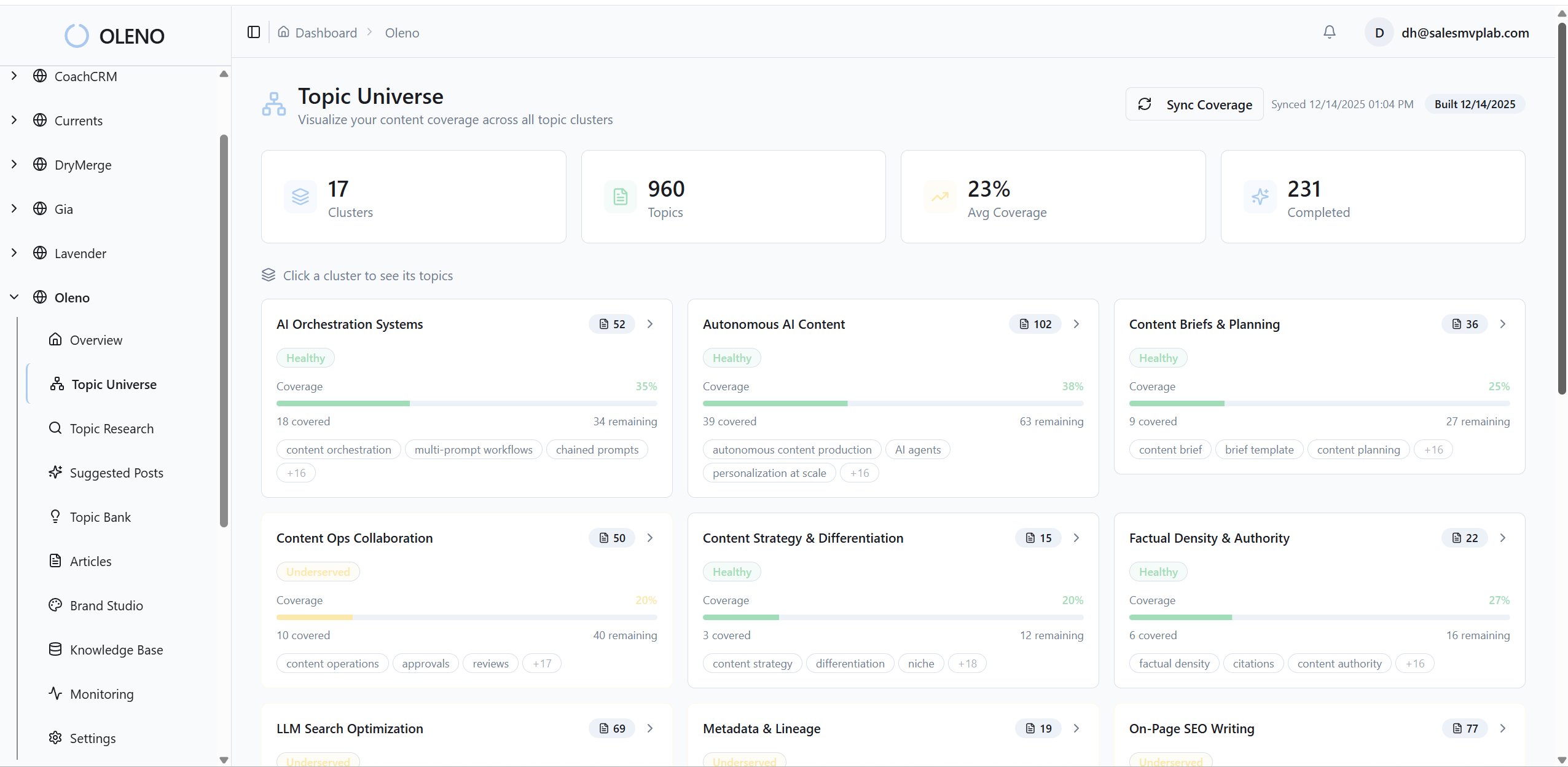
This is where most teams stall—ideas burn down, then everyone scrambles again. With Oleno, suggestions are prioritized by real gaps, not keyword volume. Approved topics flow straight into brief generation with competitive research and information gain checks embedded in the process. You get compounding coverage without spreadsheets.
I like that it starts before writing. The system enforces differentiation early and pushes only brand-relevant topics downstream. No chasing noisy dashboards. Just a clear map and a queue that stays full.
Deterministic Structure, Links, And Schema Remove Fragility
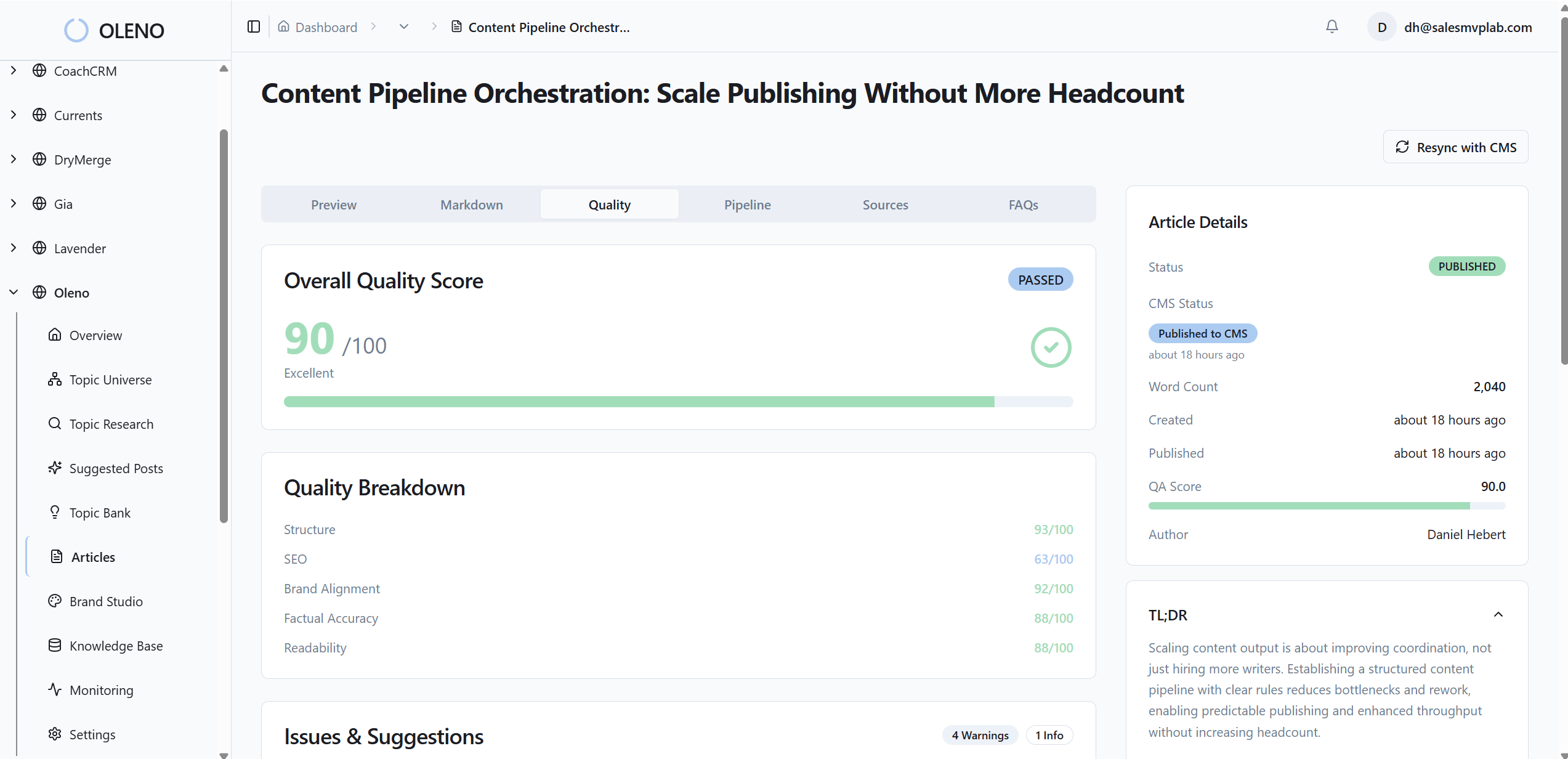
After drafting, Oleno does the fragile work deterministically. Internal links are injected from your verified sitemap with exact-match anchor text. JSON-LD schema is generated for Article, FAQ, and BreadcrumbList. A QA gate scores 80-plus criteria—structure, tone, snippet readiness—before anything can publish.
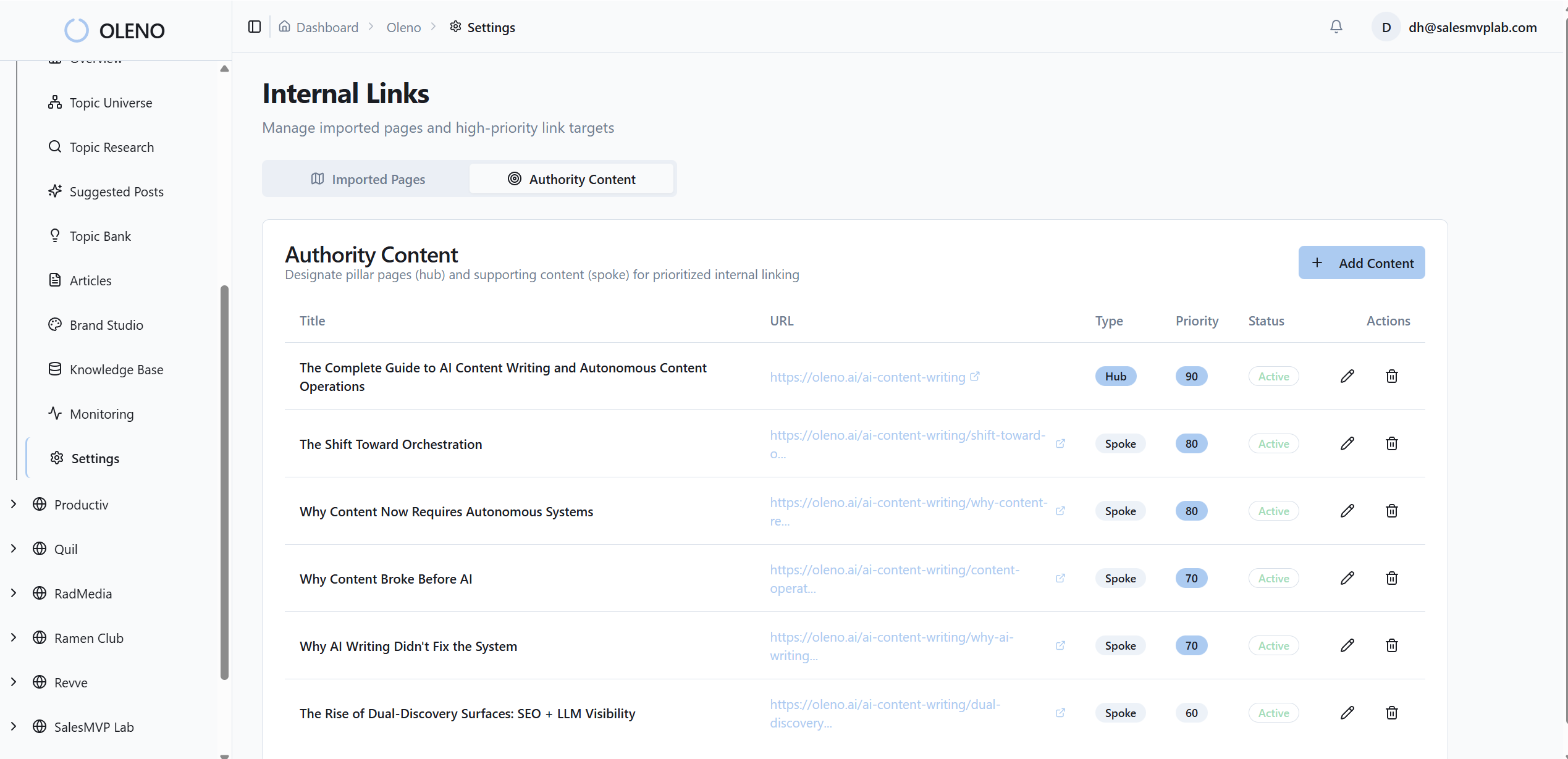
This turns accuracy into code. No fabricated URLs. No missed schema. No “we’ll fix it post-publish.” Visual Studio then generates brand-consistent hero and inline images using your colors, logos, and product screenshots, prioritizing solution sections and producing SEO-friendly alt text automatically.
Publishing is handled through connectors—WordPress, Webflow, HubSpot, or a structured export—so text, visuals, links, and metadata arrive together. It’s not a dashboard. It’s a pipeline. And that’s why the work compounds.
Curious how this pipeline feels in practice? See it from idea to publish and Try Oleno For Free.
Conclusion
You don’t need more ideas. You need a map. Build a Topic Universe from your KB and sitemap, enforce coverage rules, and let a system turn strategy into shipping. The weekly scramble slows down; authority starts to stack. Whether you automate with Oleno or run it manually, the principle stands: coordinate first, then create. That’s how content becomes infrastructure instead of busywork.
About Daniel Hebert
I'm the founder of Oleno, SalesMVP Lab, and yourLumira. Been working in B2B SaaS in both sales and marketing leadership for 13+ years. I specialize in building revenue engines from the ground up. Over the years, I've codified writing frameworks, which are now powering Oleno.
Frequently Asked Questions