Build a Topic Universe: Systematic Content Strategy to Scale Authority

Editorial calendars feel safe. Boxes, dates, topics. But when your strategy lives in a spreadsheet and your execution lives in Slack, you’re not running a system, you’re herding tasks. That’s why you ship more words yet build less authority.
I’ve lived this. Big content machines with hundreds of contributors. Tiny SaaS teams where the founder is the writer. The failure mode was always the same: great people, fragmented process, results that wobble. You don’t need a bigger calendar. You need a Topic Universe that drives what gets written and when.
Key Takeaways:
- Replace ad hoc ideas with a Topic Universe that prioritizes coverage gaps, not guesses
- Run a 4-state saturation model with cooldowns to prevent cannibalization and thrash
- Enforce differentiation early using information gain thresholds in briefs
- Treat internal linking and schema as rules, not polish
- Quantify and eliminate manual fixes with a governed, deterministic pipeline
- Use daily suggestions tied to gaps so publishing becomes continuous and calm
Why Your Editorial Calendar Keeps You Stuck
An editorial calendar gets you dates; a Topic Universe gets you authority. The difference is coverage logic, clusters, saturation labels, and re-coverage rules that prevent repetitive, low-gain articles. Example: instead of another “guide to onboarding,” you publish the missing angle for your “sales enablement” cluster.

The real bottleneck is fragmentation, not writing speed
Most teams blame throughput when fragmentation is the root. Strategy in spreadsheets. Research in open tabs. Writing in prompts. Publishing in the CMS. No shared state. No guardrails. That’s how you generate five variants of the same idea and spend hours doing cleanup no one budgeted for.
Here’s what actually breaks: decisions. Without rules, every task is a decision. Should we cover this topic again? Do we have enough coverage in this cluster? Is this brief differentiated? Those choices eat time, cause rework, and pull leaders into “quick” prioritization calls that are anything but quick. The fix isn’t typing faster. It’s eliminating decisions with a single source of truth that says what’s next, and why.
What is a topic universe and why does it matter?
A Topic Universe is a structured map of everything you can credibly publish, organized into clusters with saturation states and cooldowns. It answers one question daily: what should we write next to build authority? Simple. It prevents over-publishing the same ideas and pushes you toward gaps where new coverage actually compounds.
Think of it as portfolio management, not a calendar. Clusters label themselves: underserved, healthy, well‑covered, saturated. You enforce re‑coverage rules (like a 90‑day cooldown) and only write when you can add information gain or move a cluster to the next state. If you want more context on cluster logic, I like HubSpot’s guide to topic clusters for a foundational view.
Why ad hoc ideation creates repeated low gain content
Ad hoc ideation rewards what feels familiar. A headline sounds fresh, so the team jumps. But without saturation data, you’re repeating coverage that already exists, internally and across the market. That’s how cannibalization sneaks in. The net effect: diluted internal links, conflicting signals, crawl inefficiency, and content no one cites.
Flip the rule: publish only when you advance the story. In practice, that means enforcing an information gain threshold at the brief stage. If the outline doesn’t add unique substance, it doesn’t move forward. This isn’t rigid. It’s protective. You’ll write less, but each piece pulls its weight. Ready to move from calendar filler to coverage logic? Want a preview of how this feels in practice? Try Generating 3 Free Test Articles Now.
See The System, Not The Posts
A content system manages coverage, not just topics. It tracks cluster health, applies cooldowns, and sets minimum differentiation for anything new. For example, underserved clusters get first priority; saturated clusters trigger a pause until the cooldown expires.
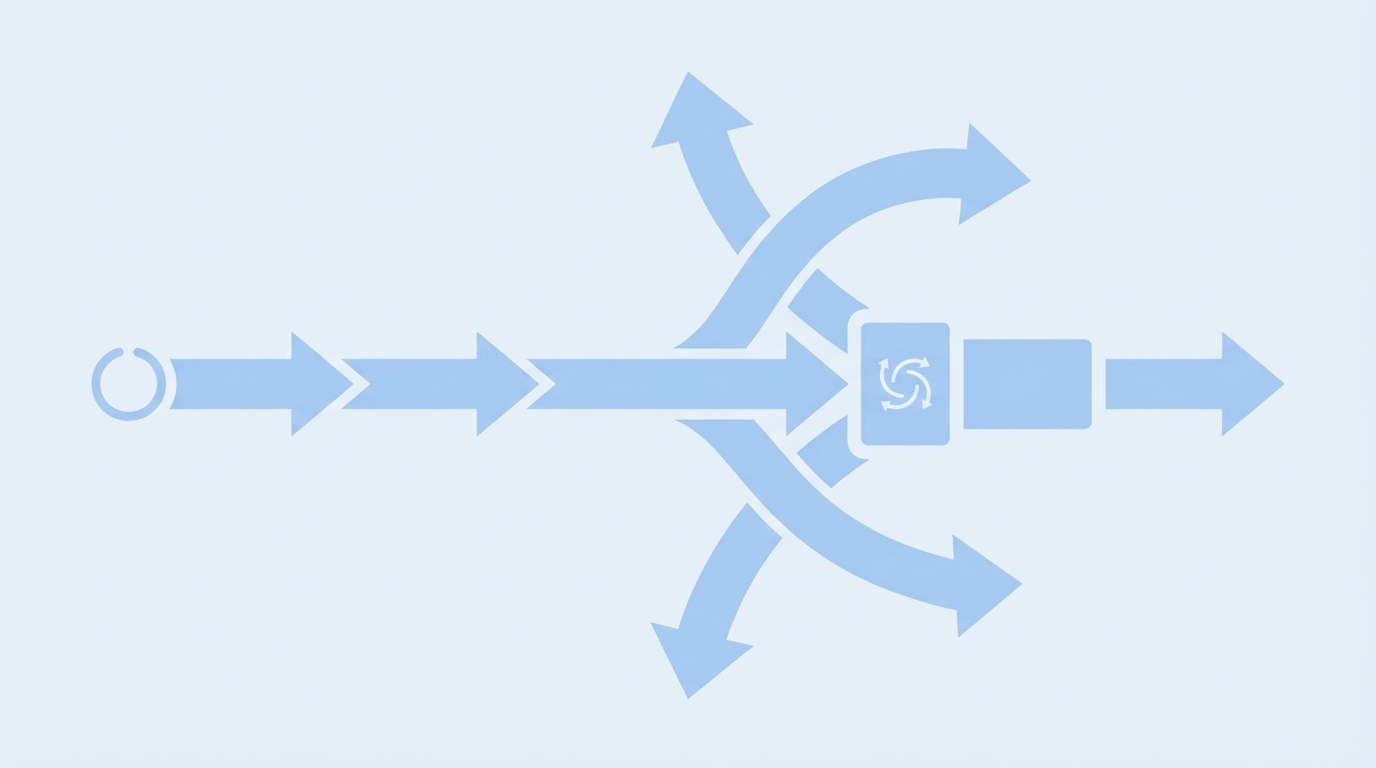
What traditional planning misses: coverage balance and cooldowns
Keyword-driven roadmaps miss portfolio health. You don’t need rank tracking to see imbalance; you need coverage states mapped to your knowledge base and sitemap. Four simple labels do the job:
- Underserved: publish now with new angles
- Healthy: maintain cadence with useful refresh
- Well‑covered: ship only if information gain is high
- Saturated: pause and enforce cooldown
Here’s the nuance. A saturated state isn’t “never write again.” It’s “don’t write again until either 90 days pass or you can exceed a higher differentiation bar.” That guardrail alone stops the “new month, new post on the same topic” habit. Over time, clusters stabilize. You’ll feel the difference in weekly prioritization. Fewer whiplash requests. More steady momentum.
How internal linking and schema become rules, not afterthoughts
Internal links and schema are not polish; they are policy. When links use only verified URLs, exact-match anchors, and contextual placement, you create a predictable graph that search engines can trust. Similarly, programmatic Article, FAQ, and BreadcrumbList schema remove ambiguity and make sections citable.
This is where machines should do the work. Deterministic linking rules reduce editorial guesswork and eliminate broken anchors. Programmatic schema clarifies meaning without yet another checklist. Want proof that clean structure matters? See Google’s Article structured data documentation. It’s mechanical. So treat it mechanically.
The Costs You Are Already Paying For Randomness
Randomness taxes teams through rework, cannibalization, and pipeline stalls. You feel busy while authority stands still. Example: 20 posts × 45 minutes of link/schema fixes = 15 hours of churn before you even look at differentiation.
Engineering hours lost to manual fixes and QA churn
Let’s pretend you ship 20 posts this month. You spend 45 minutes per post fixing internal links, alt text, schema, and tone. That’s roughly 15 hours of frustrating rework. Then two posts need partial rewrites after review because they don’t add anything new. Double the time. And none of this includes meetings or Slack threads to coordinate it all.
I’ve seen this dynamic in small teams and large ones. The hidden burn is context switching. Designers are pulled into last-minute image requests; editors reformat sections for “snippet readiness” manually; someone wants to add an FAQ schema after the fact. It’s not that people don’t care. It’s that the system invites variability. When you remove discretionary steps, you remove stalls.
The compounding drag of cannibalization
Cannibalization starts slow. Then your newest article steals impressions from your second-best performer, and rankings wobble as internal link equity splits. You update one piece, then the other, then both again. Meanwhile, crawl paths get messy and your coverage map becomes noise. You’re working harder to stand still.
A cooldown and clear saturation states won’t end cannibalization entirely, but they make it manageable. You pause what should pause. You set a higher differentiation bar when you must re-cover. For background, I’ve found Moz’s guide to keyword cannibalization a useful primer. We’ve just operationalized the fix with rules.
Where pipelines stall and momentum dies
Pipelines stall at predictable points: the brief (no angle), QA (structure or voice off), or publishing (schema and image placement). Each stall adds days and drains urgency. The fix isn’t a pep talk. It’s fewer decision points and clear gates, brief must meet an information gain threshold, QA checks structure and voice, publishing maps fields without manual cleanup.
Think of it as guardrails, not governance theater. When the rules live in code, the team can focus on substance: what we’re saying, not how to package it. Still dealing with these stalls every week? This is your signal to automate the boring parts. If you want to offload the glue work, you can Try Using an Autonomous Content Engine for Always-On Publishing.
When Content Feels Like Whiplash For Your Team
Whiplash happens when priorities aren’t anchored to coverage. New ideas jump the queue, drafts pivot mid-flight, and publishing dates slip. A rules-based system with cooldowns, states, and gain thresholds calms the queue.
The 3 pm prioritization shuffle no one asked for
You’ve seen it. A new idea lands at 3 pm. The calendar reshuffles. Two drafts go on hold. An editor tears up a perfectly good outline to chase the shiny object. Talent isn’t the issue. Priority discipline is. Without a coverage view, everything looks urgent and nothing compounds.
Make it boring by design. If a cluster is saturated, it doesn’t matter how good the idea sounds. It waits. If a topic doesn’t clear the information gain threshold, it’s revised or it’s out. And if an underserved cluster has two viable angles, you pick the one with higher business value and stronger product relevance. Not vibes. Rules.
When your best post steals traffic from your second best
It stings. You ship the post everyone loves and watch it siphon traffic from an older winner. Leadership asks for a fix, and the team scrambles. Without cooldowns and saturation states, you can’t show it was preventable. With them, you would have paused, re-angled, or chosen a different cluster.
I’ve been on both sides. Years ago, at a high-volume publication, we were flush with ideas and low on guardrails. We ranked, sure, but we also tripped over our own content. Later, on lean SaaS teams, the opposite problem showed up: strong founders’ POV, weak structure. When we enforced briefs and tied topics to clusters, output fell and impact rose. That’s the lesson.
A Practical Way To Build Your Topic Universe And Run It Daily
Build your Topic Universe from sources you control, knowledge base, sitemap, and focus areas, then apply clustering and state labels. Run it daily so suggestions never run dry. Example: underserved clusters queue new topics automatically; saturated clusters hold until cooldown expires.
Map your topic universe with reliable sources and clustering rules
Start with what’s real: your knowledge base, your sitemap, your product pillars. Generate topics from those inputs, then cluster by semantic proximity to those pillars. For each topic, define a lean data model: cluster ID, state (underserved/healthy/well‑covered/saturated), last covered date, cooldown until date, business value, and information gain target.
The goal isn’t a beautiful spreadsheet. It’s an object the team can operate. Daily. When a new idea arrives, you map it to a cluster and either accept it (it fills a gap) or defer it (cooldown active, low gain). Simple objects outperform complex dashboards in busy teams. Always have.
Measure coverage and saturation with a simple, 4-state model
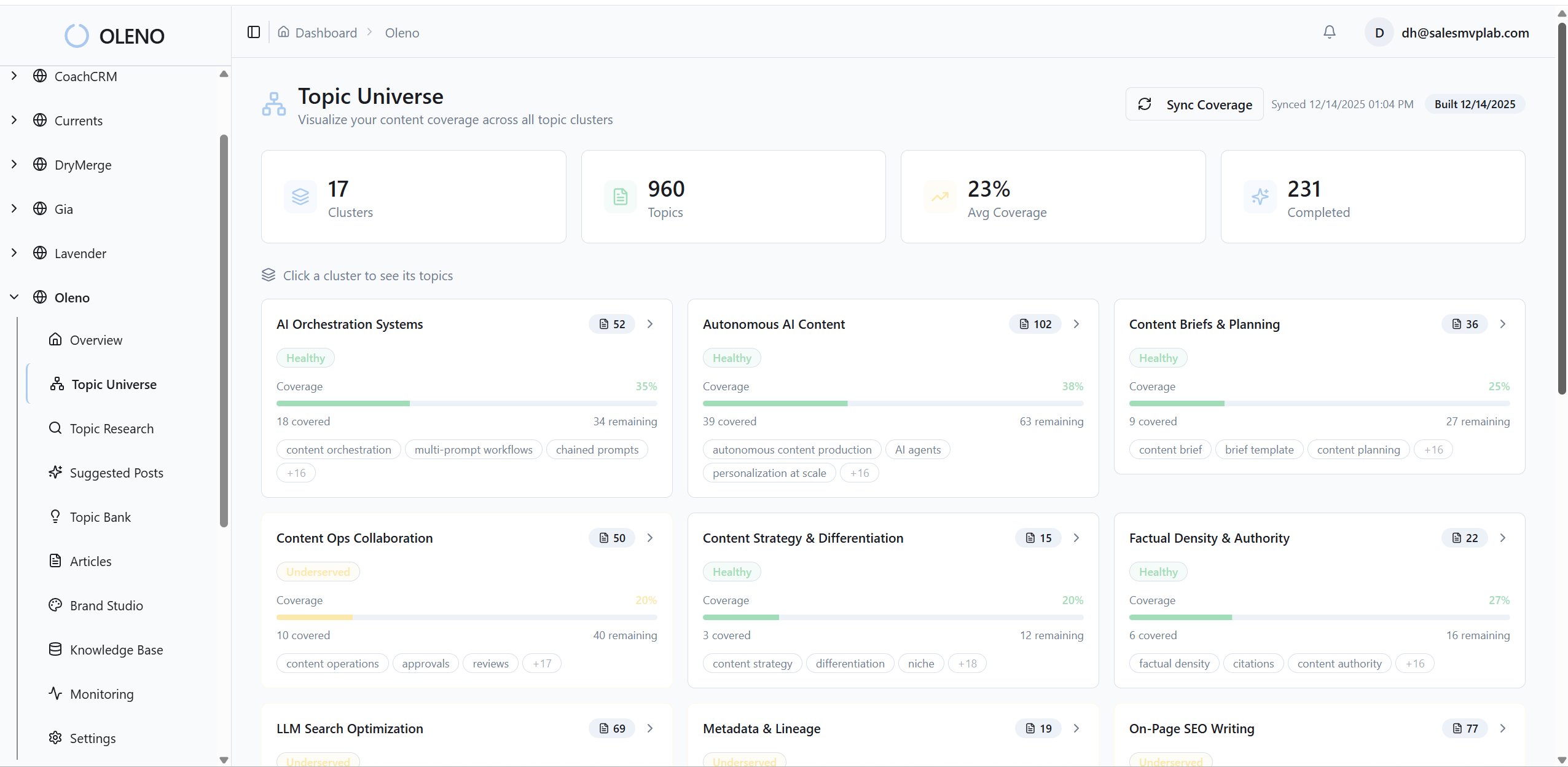
Now apply labels. Use numeric thresholds aligned to your scale. Example: underserved under 20% coverage, healthy 20–60%, well‑covered 60–90%, saturated over 90% within the last 90 days. Tie state updates to publish events so the map reflects reality, not last quarter’s plan.
This model creates guardrails you can actually run. You don’t need to debate whether you’re over-publishing a theme; the state tells you. You don’t need to guess whether a re-coverage is warranted; the information gain target sets the bar. For clarity on how people navigate content, Nielsen Norman Group’s work on information scent is a nice parallel, give clear signals and users (and machines) follow.
Design a topic to publish pipeline that runs every day
Keep it boring. Suggestions queue daily from gaps. Brief generation enforces differentiation with an information gain threshold. Drafts follow a snippet‑ready structure so each H2 opens with a direct answer. QA checks 80+ criteria for structure, voice, and clarity. Internal links and schema are injected deterministically. Then you publish.
Put governance in code, not in comments. That’s the shift. Humans make narrative decisions; machines enforce structure. The result is fewer stalls, fewer surprises on publish day, and a cadence the team can trust every week.
How Oleno Runs This System End To End
Oleno turns this approach into an always-on system. Topic Universe maps coverage. Daily suggestions respect cooldowns. Briefs enforce differentiation. Drafts, visuals, links, and schema ship together without manual choreography. Example: saturated clusters pause automatically; underserved clusters surface first with high-gain angles.
Topic Universe and daily suggestions that respect cooldowns
Oleno’s Topic Universe maps your entire landscape and labels saturation by cluster. It enforces a 90‑day cooldown before re‑coverage and generates daily topic suggestions based on gaps, your knowledge base, and configured focus areas. No keyword dashboards. No “who has an idea?” threads. Just a calm queue aligned to authority growth.
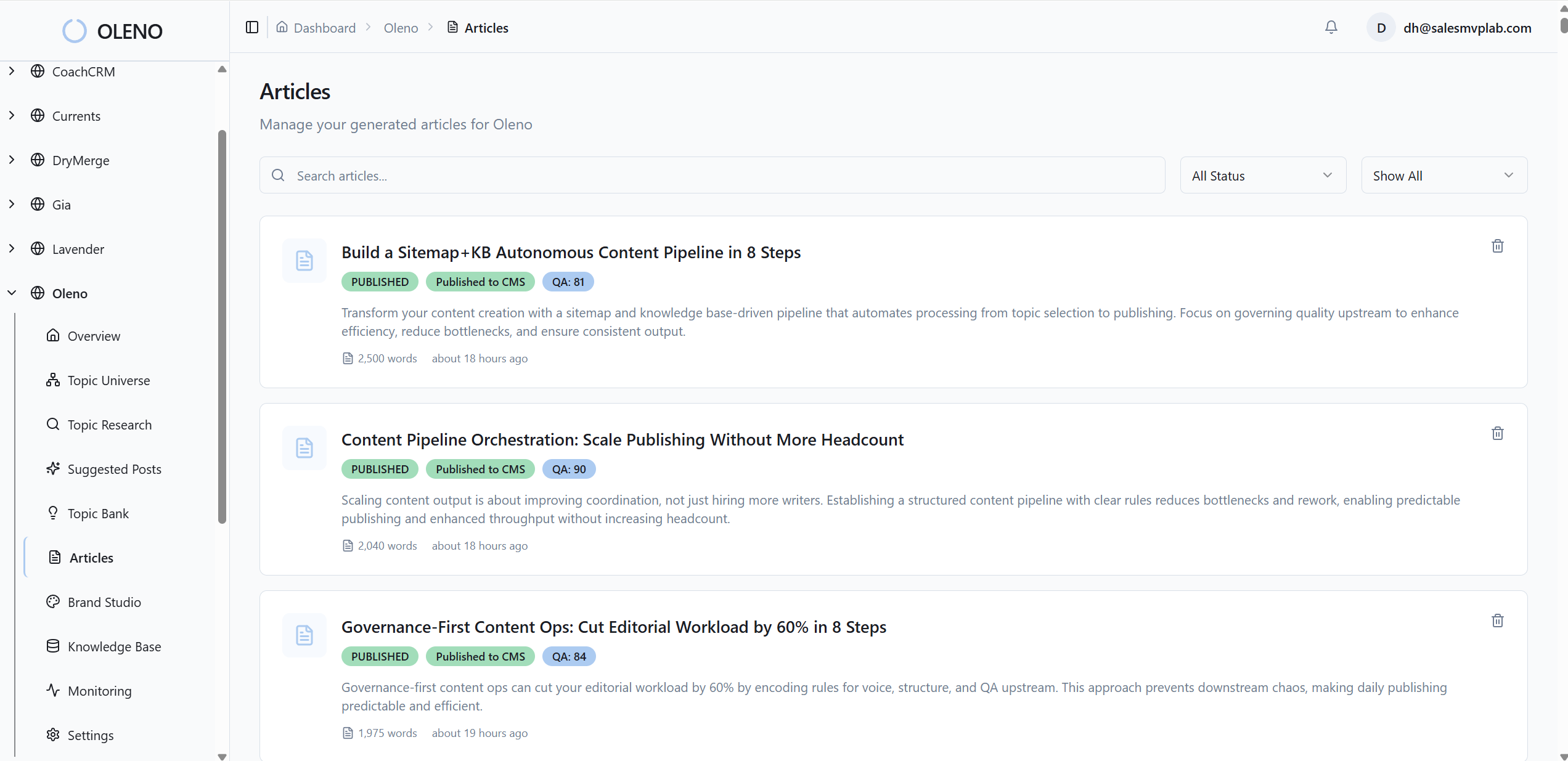
Every approved topic becomes a structured brief with competitive research and an Information Gain Score. Low-gain outlines get flagged before writing begins, which reduces downstream QA churn. The drafts that do move forward follow the same snippet‑ready structure, so your sections are easy to cite and easy to understand. You’ll write fewer posts, but stronger ones.
Deterministic internal links, schema, and brand visuals
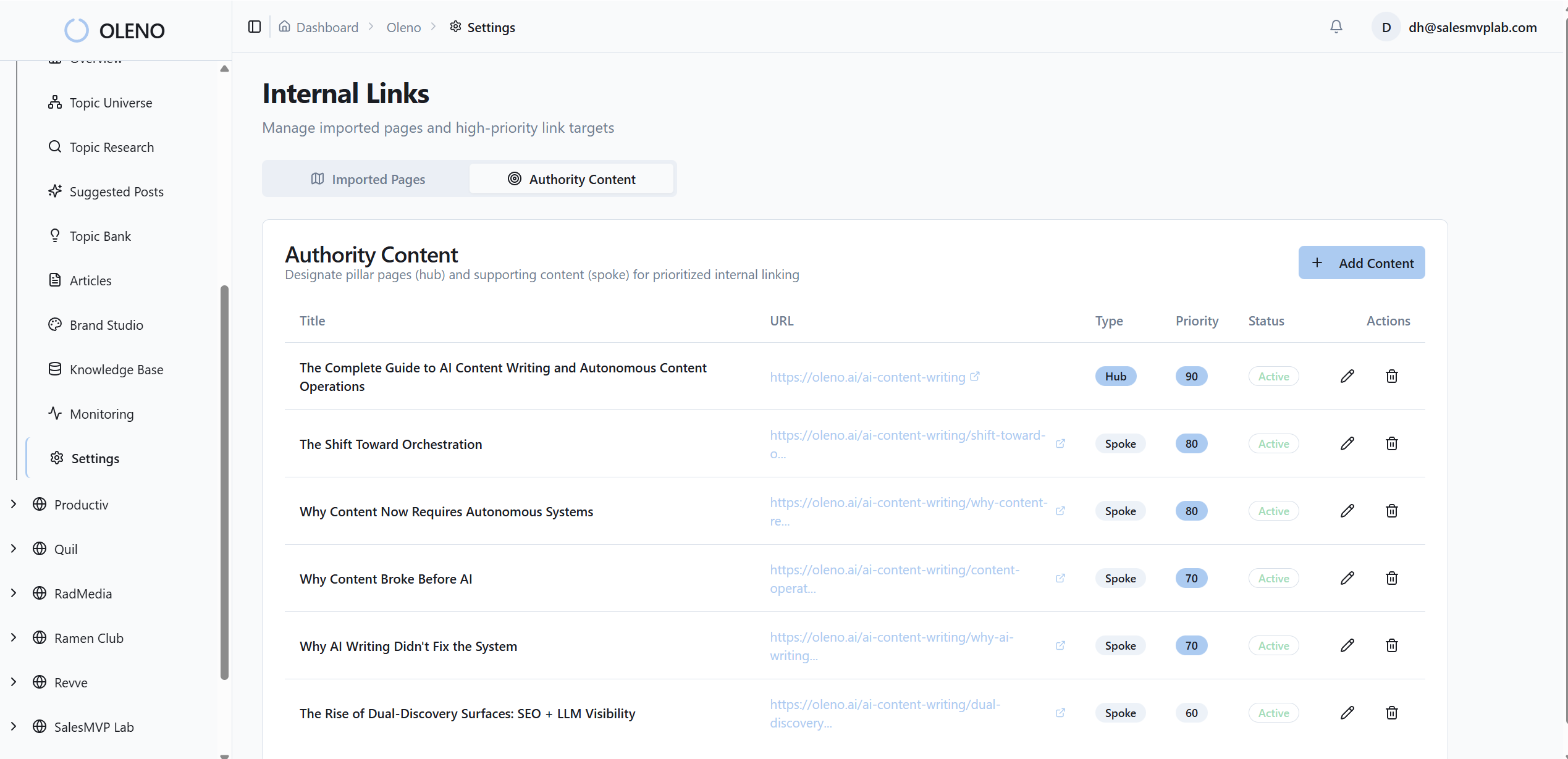
Oleno handles the “meta” deterministically. Internal links are injected only from verified sitemap URLs with exact‑match anchors and contextual placement. JSON‑LD schema is generated for Article, FAQ, and BreadcrumbList. Visual Studio creates brand‑consistent hero and inline images and matches product screenshots to the right sections using semantic similarity.
Then QA takes over. Oleno evaluates drafts against 80+ checks for structure, voice alignment, information gain, and snippet readiness. Once content clears those gates, Oleno converts to CMS‑ready HTML, maps fields, and publishes through connectors like WordPress, Webflow, or HubSpot. No paste-and-pray. No launch‑day debugging. If that’s the type of pipeline you want, Try Oleno for Free and see how your workflow changes in week one.
Conclusion
You don’t need more topics. You need a system. A Topic Universe gives you coverage logic, clusters, states, and cooldowns, so you stop shipping lookalike content and start compounding authority. The pipeline side matters just as much: briefs with information gain thresholds, deterministic structure, and QA gates that prevent rework.
Whether you run it in-house or let Oleno automate the heavy lifts, the principle holds. Make content an operating system, not a calendar. Trade randomness for rules. Trade hustle for steady momentum. That’s how authority grows over quarters, not bursts.
About Daniel Hebert
I'm the founder of Oleno, SalesMVP Lab, and yourLumira. Been working in B2B SaaS in both sales and marketing leadership for 13+ years. I specialize in building revenue engines from the ground up. Over the years, I've codified writing frameworks, which are now powering Oleno.
Frequently Asked Questions