Build an Autonomous Content System to Scale Content Operations in SaaS

When content breaks, it rarely looks like a single mistake. It looks like a late-night Slack about a voice tweak, an image that feels off, or a publish that half-fails in the CMS. I have been on both sides. The marketer trying to ship three strong posts a week, and the sales leader wondering why top-ranking articles did not turn into pipeline.
Back at Steamfeed, we saw what happens when volume and perspective compound. Hundreds of contributors. Tens of thousands of pages. Spikes at 500, 1,000, 2,500, 5,000, then 10,000 pages. Later at Proposify, we saw the flip side. Beautiful content that ranked, but a narrative that drifted away from the product story. Rank without revenue. If you want a system that actually compounds authority, you need coordination, not faster drafts. If you want the deeper blueprint, this breakdown pairs well with The Complete Guide to AI Content Writing and Autonomous Content Operations.
Key Takeaways:
- Treat content as a governed system, not a collection of tasks
- Lock accuracy to code: internal links, schema, filenames, alt text, publishing
- Make originality measurable at the brief with information gain scoring
- Use a topic universe to choose what to write next and when to re-cover
- Structure every H2 with snippet-ready paragraphs to earn citations
- Cut rework by enforcing QA before publish, not after
- Automate the end-to-end sequence while preserving brand control
Why Volume Without Coordination Stalls Growth
Most teams think more writers or faster AI will fix the calendar, but uncoordinated output creates repetitive content, voice drift, and an edit backlog. You need a system that orchestrates strategy, structure, visuals, and publishing, not just faster drafting. For context on why content now needs system thinking, see Why Content Now Requires Autonomous Systems.

The Signals That Show You’re Stuck In Project Mode
Uneven cadence and one-off briefs are easy tells. Brand voice that shifts post to post signals the handoffs are doing the talking, not the strategy. Articles that cannot be reused because visuals are off, or internal links point to stale pages, add a quiet tax you pay every week.
You can measure this. Track cycle time from draft to publish, rework hours per article, and the percent of posts that pass QA on the first attempt. When those numbers slip, you are optimizing for motion, not outcomes.
A simple example. Your best explainer should plug into a campaign, including saas, a product page, a one-pager. If it does not, the pipeline is project-based, not system-based. And it will slow you down when you try to scale.
What Most Teams Miss About Compounding Authority
Authority compounds when topic coverage is intentional. That means clusters with both breadth and depth, plus cooldowns so you do not pound the same angle every two weeks. It also means originality is enforced before writing, not discovered during a last-minute edit.
Build a topic universe that labels clusters as underserved, healthy, well-covered, or saturated. Score information gain at the brief to prevent rehashing. Structure every H2 for citation so search engines and AI assistants can reference your content cleanly. For the system-level case for orchestration, read The Shift Toward Orchestration.
What Is An Autonomous Content System And Why Does It Matter?
An autonomous content system turns strategy into publish-ready articles with a fixed pipeline. Strategy to brief to draft to visuals to QA to finalize to publish. Deterministic components like links, schema, and image placement run as code, not as favors, so you get predictable cadence and fewer surprises.
A practical example helps. You approve a topic. The system produces a differentiated brief, a draft with snippet-ready H2s, brand-aligned visuals, verified internal links, and JSON-LD. It ships without heroic editing. That is autonomy with control.
Curious what this looks like in practice? Request a demo now.
Treat Content As A System, Not A Set Of Tasks
Treating content as a system means one governed pipeline with clear inputs, including the rise of dual-discovery surfaces:, a fixed sequence, and a quality gate at the end. Fragmented tools invite drift and rework. Systems thinking centralizes rules for voice, structure, visuals, and publishing so creativity focuses on the narrative, not cleanup.

What Traditional Tooling Stacks Leave Out
Keyword tools and AI writers can move you faster at the surface, but they do not decide what should be written next, enforce uniqueness, or guarantee structural integrity. You need three things working together: a native strategy layer, a uniqueness check, and deterministic enhancements.
- A topic universe to choose and sequence topics intentionally
- Information gain scoring to validate originality at the brief
- Deterministic code for internal links, schema, filenames, and alt text
External documentation platforms like Archbee show how treating knowledge as a system input keeps content coherent over time. It is the same principle here. Get the inputs right, then run them through a consistent pipeline.
Where Determinism Should Replace Human Variation
Anything that can be right or wrong should be code-driven. Internal links drawn from a verified sitemap and placed with exact anchor text. JSON-LD that validates every time. Image placement with consistent filenames and alt text generated from rules. Use code where accuracy matters, keep creativity in examples and explanation.
This shift reduces rework and makes the pipeline explainable when something fails. You can debug rules and inputs instead of debating taste and memory.
How Do You Keep Brand Control While Automating?
Codify brand voice, banned terms, structure patterns, and visual style in one place. Then run automated QA against those rules before publish. Human taste still sets topics and angles. Compliance should not depend on a heroic Friday edit.
Governance patterns like Autonomous Break Glass are a useful analogy. Access is controlled, actions are logged, and exceptions are explicit. You can borrow that mindset for content without turning your team into tool operators.
Ready to eliminate coordination overhead? try using an autonomous content engine for always-on publishing.
The Hidden Costs Of Ad‑Hoc Content Production
Ad-hoc production looks fast, then the rework shows up. Drafts drift from the brief. Visuals are bolted on. Internal links are guesswork. Publishing fields do not map, so teams add another review. That creeping friction is why volume feels risky. For a deeper look at why draft speed alone falls short, see Why AI Writing Didn't Fix the System.
Cycle Time Inflation And Context Loss Across Handoffs
Every handoff drops context. The brief gets interpreted, then reinterpreted. Visuals chase the draft. QA patches structure at the end. Publishing tries to map fields that were never aligned. Each step adds delay and creates new places for errors to hide.
Consolidate steps behind a single sequence with shared inputs. Use the same knowledge base, including the shift toward orchestration, brand voice rules, and verified sitemap across the pipeline. When the inputs are shared and the sequence is fixed, rework drops by design.
How Much Does Manual Coordination Actually Cost?
Let’s pretend you ship eight posts per month. Each one quietly consumes six hours of coordination, fixing links, reformatting H2s, chasing images, cleaning up the CMS. That is 48 hours per month of non-creative work. At a blended $100 per hour, you are burning about $4,800 every month on friction.
Those hours could fund a deeper topic cluster or a product explainer refresh. Or they could help your team avoid burnout in Q4. You get the point.
The Opportunity Cost Of Ranking Without Narrative Fit
At Proposify, we ranked for plenty of high-intent topics. We also wrote content that did not connect back to proposals or e-signature. Leads landed and did not convert. Ranking is not the goal. Narrative fit is the goal.
If your article cannot point back to your product in a way that feels natural, you have a positioning gap. The fix lives upstream, in how topics are chosen and how briefs enforce differentiation. It is not an editing trick.
When Content Becomes A Headache Instead Of A Growth Engine
You can feel it in your calendar. A VP asks for a predictable plan and you hesitate. Drafts sound off. Visuals do not look like you. Publishing breaks on Friday and the fix steals Monday. The team is trying hard, but the system is brittle. You do not need another dashboard. You need a pipeline you trust.
The 3 A.M. Edit You Never Wanted To Approve
Last-minute edits usually signal upstream gaps. If voice, including why content broke before ai, facts, and structure are not codified, you end up fixing symptoms at publish time. Move those checks earlier and automate them. Voice linting. Knowledge base grounding. Snippet-ready H2s that open with direct answers.
One simple rule helps a lot. Sections should stand alone cleanly. When they do, reuse increases and last-minute rewrites fade.
When Your Best Post Can’t Be Reused Because Visuals Are Off‑Brand
If images are picked ad hoc, reuse dies. Standardize visual generation and placement with brand palettes, product screenshots mapped to relevant sections, and consistent alt text and filenames. Now that post can anchor a campaign, a one-pager, or a product page without redesign.
A quick mental model from security can help. Think in terms of attributes and guardrails, similar to SaaS Visibility application attributes. Define the allowed patterns, then make them automatic.
What Happens When A VP Asks For A Weekly Plan You Don’t Trust?
If you do not have a topic universe with coverage rules and cooldowns, your plan is a guess. Build a queue that prioritizes gaps, avoids over-publishing, and respects cooldowns. Your weekly cadence becomes predictable and you can say yes without crossing your fingers.
For integration-first thinking on the delivery side, it is useful to remember that modern SaaS expects clean connectors and mapped fields. That mindset shows up in platform docs like Google’s SaaS overview. Content should ship with the same clarity.
Design A Deterministic, 7‑Stage Pipeline That Compounds
A seven-stage pipeline converts content from projects into a governed system. Clear inputs, fixed sequence, deterministic enhancements. Creativity where it matters. Measure QA pass rate at or above 85 percent, inject five to eight verified internal links per article, keep draft to publish under 48 hours. That is a system you can explain to the board. For a deeper walkthrough, see The Complete Guide to AI Content Writing and Autonomous Content Operations and the perspective on dual discovery in The Rise of Dual-Discovery Surfaces: SEO + LLM Visibility.
Step 1-2: Build Your Topic Universe And Score Briefs For Information Gain
Start by aggregating your sitemap, knowledge base, and focus areas into a topic universe. Cluster by intent, label saturation from underserved to saturated, and enforce cooldowns before re-coverage. Then generate structured briefs that include thesis, competitive coverage, missing angles, outline, and authoritative external sources.
Score each brief for information gain, zero to 100. Low scores trigger rework before drafting, not after. This one step removes a surprising amount of later editing and strengthens differentiation where it counts.
- Topic universe clarifies what to write and when
- Information gain prevents repetition before it ships
- Cooldowns maintain momentum across clusters
Interjection. This is where many teams finally realize why last-mile edits never solved their originality problem.
Step 3: Draft With KB Grounding And Enforced Structure
Draft to the brief with brand voice rules and knowledge base facts injected contextually. Open every H2 with a concise, snippet-ready paragraph that answers the implied question in about 40 to 60 words. Keep sections modular so they stand alone and can be cited cleanly by search and AI.
Do not inject links or images at this stage. Text first. Structure locked. Creativity focused on clarity, examples, and proof. For why this matters to LLM citation as well as search, the analysis in The Rise of Dual-Discovery Surfaces: SEO + LLM Visibility is worth a look.
Step 4: Add Visuals And Structure For Citation
Generate brand-consistent visuals, one hero and two to three inline images. Map product screenshots to relevant sections. Assign SEO-friendly filenames and alt text automatically. Prepare and validate JSON-LD for Article, including why ai writing didn't fix, FAQ, and BreadcrumbList to clarify meaning for machines.
External teams that treat documentation and visual standards as inputs, like those covered in Archbee’s system approach, provide a helpful analog. Visuals and structure are not decoration, they are part of how content is consumed and reused.
Discover how coordination beats draft speed in daily operations. The Shift Toward Orchestration
How Oleno Automates The End‑To‑End System With Control Built In
Oleno turns the blueprint into a working pipeline. It starts at strategy, enforces differentiation in the brief, drafts with knowledge base grounding, generates brand visuals, injects verified internal links, attaches schema, runs QA, and publishes to your CMS with mapped fields. No manual handoffs. No fabricated URLs. Brand control without chase work.
Step 5-6: Enforce QA‑Gate And Publish With Verified Internal Links
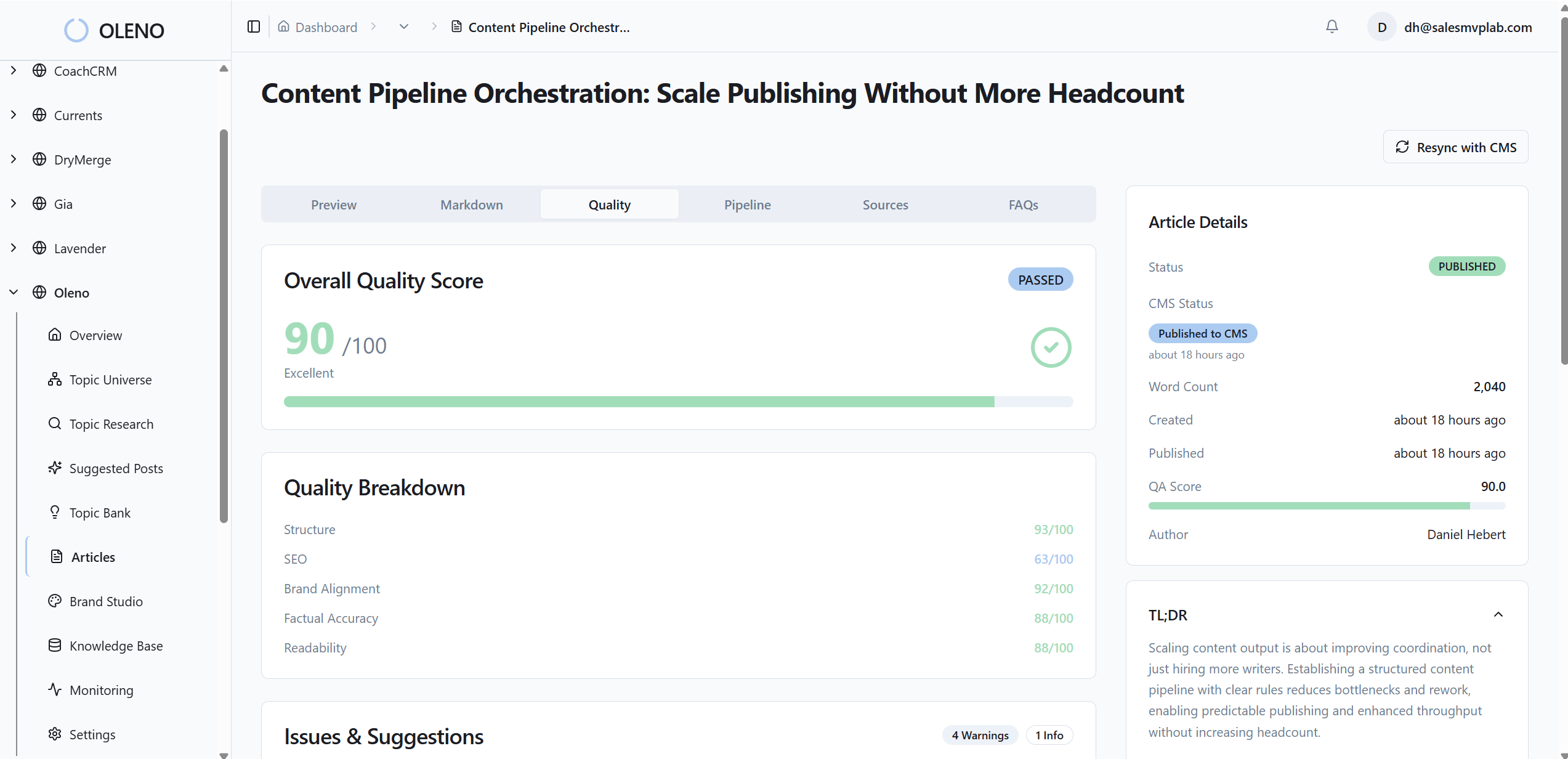
Oleno evaluates each draft against more than 80 checks including structure, brand voice, information gain, snippet readiness, knowledge base accuracy, visual placement, alt text, and schema validity. Low scores trigger refinement loops automatically. Teams use this to push QA pass rates to a dependable threshold before anything reaches a CMS. If you want the under-the-hood view, read the engineering overview in QA Systems.
Then Oleno injects five to eight internal links from your verified sitemap with anchor text matching page titles exactly. JSON-LD is attached programmatically. Publishing uses WordPress, including ai content writing, Webflow, or HubSpot connectors with mapped fields and idempotency so duplicates do not happen. This is accuracy by code, not by memory.
Step 7: Close The Loop With Topic Universe And Lightweight Signals
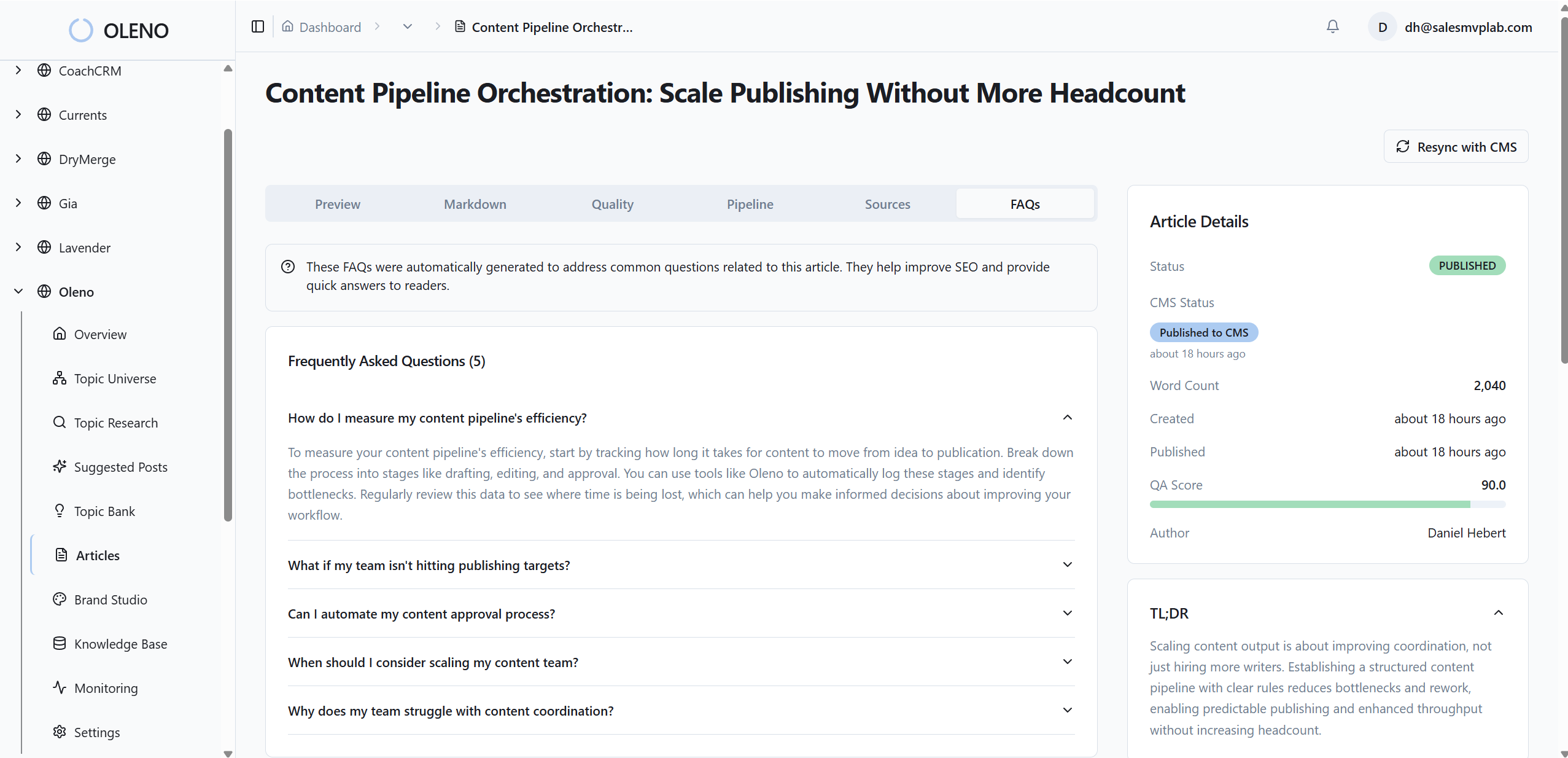
After publish, Oleno locks versions and sends debounced notifications for draft ready, publish success, generation failures, and low topic inventory. Coverage data feeds back into Topic Universe so your queue stays full without dashboards or rank tracking.
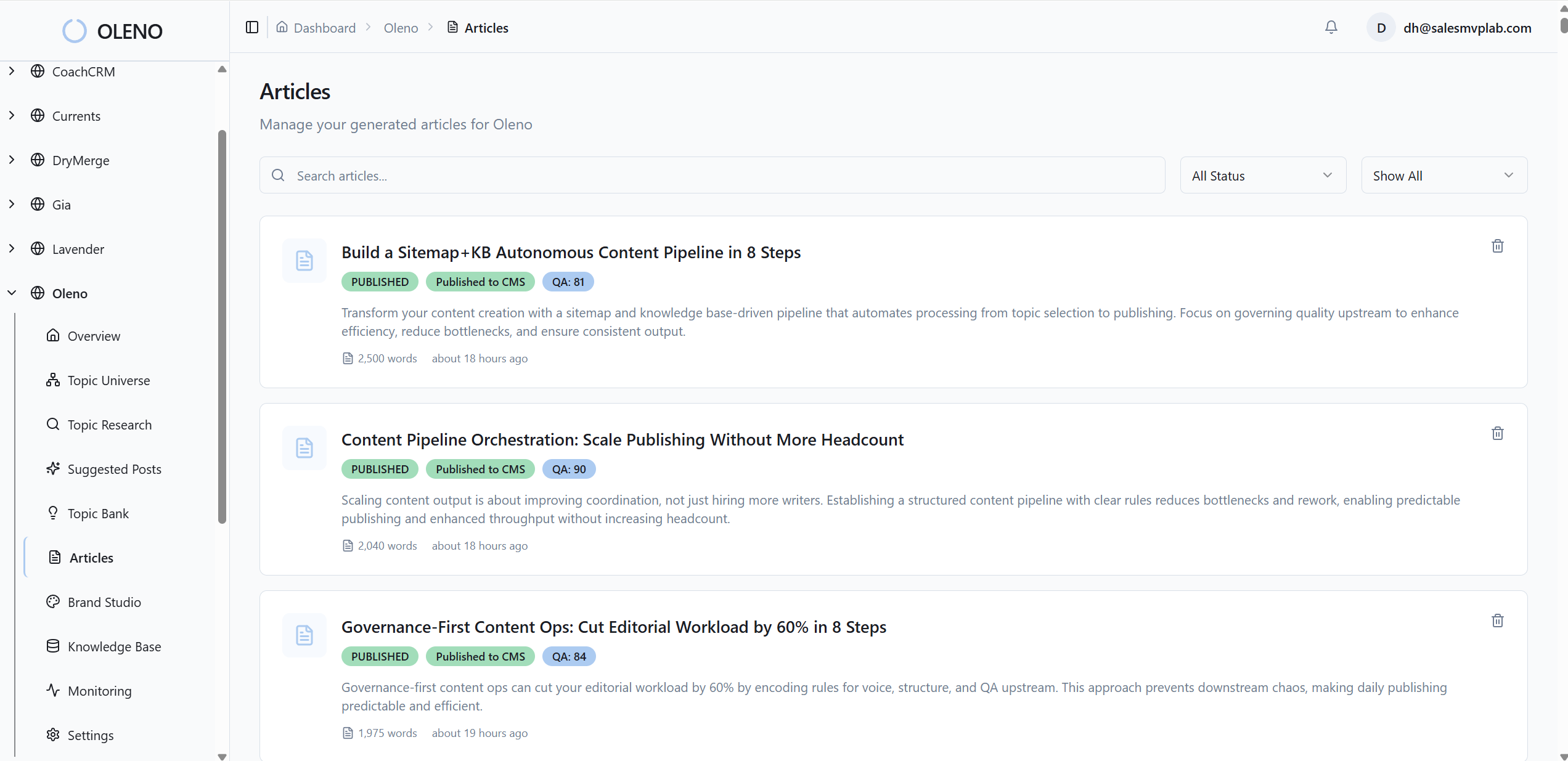
This closes the loop. Strategy gets smarter as gaps close. Visual consistency compounds brand trust. Authority builds over time, including why content now requires autonomous, and the weekly plan becomes boring in the best way.
Want to see it end to end? Request a demo.
Conclusion
If you have ever ranked with content that did not convert, you already know the lesson. Volume is not the lever. Coordination is. The fix is not more writers or faster prompts. It is a system that decides what to write next, enforces originality before drafting, structures every section for citation, generates on-brand visuals, injects verified internal links, and ships with schema attached.
You can build that pipeline yourself, piece by piece. Or you can use a system that bakes determinism where accuracy matters and keeps creativity where people shine. That is how you turn content from a project into infrastructure. And when the cadence feels predictable, you get to focus on the story again, not the clean up.
About Daniel Hebert
I'm the founder of Oleno, SalesMVP Lab, and yourLumira. Been working in B2B SaaS in both sales and marketing leadership for 13+ years. I specialize in building revenue engines from the ground up. Over the years, I've codified writing frameworks, which are now powering Oleno.
Frequently Asked Questions