Build an Orchestrated Content Pipeline to Double Output Without Quality Loss
Most teams try to fix content scale by writing faster. I did too. When I ran Steamfeed, volume gave us momentum, but only because breadth and depth moved in lockstep. Later, at PostBeyond and LevelJump, speed without structure just created rework. You think you’re doubling output. You’re halving trust.
Here’s the truth: words aren’t the bottleneck. Coordination is. If topics, briefs, structure, visuals, and publishing live in different tools and different heads, each new draft is a new failure mode. You don’t need more writers. You need a governed pipeline that carries the context so your people don’t have to.
Key Takeaways:
- Treat content as a system with defined stages, pass criteria, and deterministic checks
- Enforce Information Gain in briefs to cut duplication and rework before writing starts
- Use cluster coverage and cooldowns to stop cannibalization and over-publishing
- Push accuracy to code: internal links, schema, and field mapping handled programmatically
- Add a QA gate with visible pass/fail rules to protect brand voice and reduce edit loops
- Publish through connectors that prevent duplicates and handle retries so launches aren’t risky
Why Most Teams Double Drafts And Halve Trust
Most teams think scaling output means more drafts and more writers. It doesn’t. It often multiplies duplication, cannibalization, and brand drift because nothing enforces differentiation or structure. Systems beat heroics. Build a pipeline that requires unique value per article, or you’ll scale activity, not authority.

Most content advice focuses on writing velocity, not orchestration across the workflow. That’s the miss. Orchestration aligns strategy, structure, visuals, and publishing to reduce errors downstream. It’s the same pattern you see in robust data teams. Even outside content, guides like Nutanix’s overview of content orchestration point to governed stages and consistent outcomes.
The Volume Trap That Looks Like Progress
Doubling drafts without a pipeline feels like progress because your calendar fills, Slack lights up, and everyone is busy. But busy isn’t the goal. Authority is. Without coverage rules, briefs with unique angles, and a publishing system that won’t let bad structure through, you create more surface area for mistakes. It’s not just duplication. It’s fragmentation you can’t see until after publish.
I’ve lived this. As teams grow, context disperses. The founder’s voice fades. Product nuance gets diluted. You start shipping pieces that don’t connect back to your solution, or worse, contradict it. The result isn’t a larger library; it’s a noisier one.
Why Conventional Wisdom Misses The System Failure
Advice that “just write more” ignores choke points that appear later: inconsistent internal links, missing schema, mismatched visuals, and manual CMS cleanup. By the time you spot them, the damage is public. Treat content like software. Define stages. Add pass criteria. Make the system reject drafts that don’t clear the bar.
A structured pipeline reduces variability without killing creativity. Put creativity in the prose, not in where links land or whether schema exists. That’s what governance is for. And when the system carries these rules, new contributors don’t need your brain on every paragraph.
What Changes When Every Article Must Add Something New
Information Gain rules change behavior upstream. If a brief needs a differentiation threshold before drafting, repetition drops because you can’t proceed with “yet another” listicle. You stop measuring writers by speed and start measuring briefs by uniqueness. QC gets simpler. Edit loops shrink. Ship rates climb, without gambling your brand.
It’s not theory. The moment you mark “low-gain” briefs as blocked, managers finally see that the real bottleneck was decision quality at the start, not writer throughput at the end.
Ready to skip the theory and see a governed pipeline at work? Try Generating 3 Free Test Articles Now.
The System Problem You Do Not See In Daily Standups
The real problem isn’t a missing sentence, it’s missing structure. Fragmented workflows hide failure at the seams: topics in spreadsheets, briefs in docs, drafts in prompts, visuals bolted on later, and manual CMS work. A single, deterministic pipeline reduces hidden complexity you can’t fix in a copyedit.

You don’t scale by adding steps. You scale by defining them. Teams that run governed pipelines resemble strong data ops groups. Orchestration beats improvisation for anything repeatable. It’s why you see “rules before runs” in resources like Astronomer’s Airflow best practices.
What Traditional Approaches Miss
Traditional content ops assumes a strong writer solves everything. They don’t. Great writers can’t out-write broken systems. When visuals arrive last, links get inserted by hand, and schema is optional, you’re hoping editors catch errors. Hope isn’t a strategy. Deterministic checks are.
What you want is clear handoffs and “no wiggle” gates. If a draft doesn’t have snippet-ready openings or fails brand voice constraints, it doesn’t move. Binary rules reduce subjective debates and speed decisions: pass or fix, then proceed.
The Hidden Complexity Behind Duplication And Cannibalization
When cluster saturation and cooldowns don’t exist, similar topics slip through with slightly different angles. It feels harmless until rankings split, internal competition rises, and search engines can’t tell which version is authoritative. LLMs don’t fare better; they cite the fog, not your signal.
You fix this with a Topic Universe, saturation labels, and a 90-day cooldown. Prioritize underserved clusters. Retire exhausted ones. Your calendar shifts from “fill slots” to “build authority.” That’s the move.
Why A Deterministic Pipeline Beats One-Off Prompting
Prompts write words. Pipelines ship governed articles. When links come from a verified sitemap, schema is generated programmatically, and visuals are constrained by brand inputs, accuracy lives in code, not in late-night edits. Keep creativity in the narrative. Keep correctness deterministic.
If you’ve ever lost a day to cleaning up random internal links or broken images, you already know the cost. A small amount of orchestration prevents an outsized amount of chaos. It’s the same trade-off you see in data orchestration explained by Monte Carlo’s primer: consistent pipelines reduce downstream surprises.
The Hidden Costs Of Ad-Hoc Publishing
Ad-hoc publishing taxes the team in invisible ways: edit loops, image scavenger hunts, link fixing, schema guessing, and CMS formatting. That energy compounds in the wrong direction. A governed pipeline pays the tax once in code so you don’t pay it forever in people.
Let’s quantify a simple case. If each 1,500-word draft takes 3 hours to write, and handoffs add 4–6 hours (two edit cycles, image sourcing, link placement, CMS templating), your “3-hour post” is actually 7–9 hours. At 20 posts, that’s 80–120 hours, one to three weeks of senior time lost. Documentation from data ops circles, like Ascend’s explanation of pipeline orchestration, makes the same point: coordination reduces waste.
Rework And Missed Timelines You Never Budgeted For
Rework hides everywhere. An angle that duplicates a past piece. A section that conflicts with product positioning. A missing schema block that tanks rich results. Each looks small. Together, they push launches and pile stress on reviewers.
The antidote is a brief that enforces Information Gain and a QA gate that rejects drafts without snippet-ready openings, brand alignment, or schema coverage. Fix upstream. Publish downstream.
The Cascading Impact On Brand And Pipeline
Duplication erodes brand trust long before you see it in analytics. Sales stops sharing content that feels generic. Prospects skim and bounce. SDRs ignore assets that don’t map to objections. Momentum slows even as output rises. That’s the worst kind of busy.
A QA gate with visible pass criteria helps here. It’s not red tape. It’s clarity. When writers know what “good” means, and the system checks it, drafts ship faster and with fewer surprises.
Still wrestling manual handoffs and edits every week? Try Using an Autonomous Content Engine for Always‑On Publishing.
When Shipping Feels Like Fighting A Fire Every Day
Shipping feels like firefighting when context lives in heads, not in a system. Founders and early marketers can carry it for a while. Then the team grows, the narrative diffuses, and every publish feels risky. Codify the rules so the system remembers what you can’t.
I’ve been the solo marketer cranking 3–4 posts a week while juggling sales and product. It worked until it didn’t. As more people touched content, quality slipped because my context didn’t scale. The fix wasn’t heroics. We wrote down the rules, topics we cover, angles we avoid, how we structure openings, and made the pipeline enforce them.
The Founder-Led Crunch That Does Not Scale
Founder-led content is fast because decisions are local. But that speed masks a fragile system. When the founder steps back, the process collapses under unclear standards. You’ll see it immediately: more edits, slower approvals, less confidence. That’s the cost of memory without mechanisms.
A pipeline solves for memory. Voice constraints, banned terms, and “solution-first” narrative rules live in the system. New contributors inherit the guardrails without a three-month apprenticeship under the founder.
When Your Biggest Customer Sees Brand Drift
The worst feedback isn’t a typo. It’s a strategic mismatch raised by a top account. I’ve had a customer flag an article that contradicted our product narrative. It’s not just embarrassing, there’s real risk. Briefs that anchor to your solution language and QA gates that check voice alignment reduce this exact headache.
You won’t catch every drift. But you can make them rare and early.
Build A Deterministic Pipeline That Scales Output Safely
A safe pipeline balances creativity with rules. Put differentiation and narrative in briefs. Make structure, links, schema, and publishing deterministic. Decide once in code to prevent a hundred decisions in meetings. You’ll ship more with fewer surprises.
The plan isn’t complicated. Inventory your topics, enforce a cooldown per topic, insist on Information Gain before drafting, and add a QA gate that tests for snippet readiness, voice, structure, and schema. The workflow becomes boring in the best way: predictable.
Map Your Topic Universe With Inventory, Clustering, And Saturation
Start with inventory. Pull topics from your knowledge base and sitemap. Group them into clusters and label saturation: underserved, healthy, well-covered, saturated. Enforce a 90‑day cooldown per topic to prevent accidental re-covers. Then prioritize underserved clusters so you build breadth and depth with intent.
Document conventions, cluster names, slug formats, and decision rules, so the logic survives personnel shifts. When someone proposes a new topic, the answer lives in the map, not in a meeting.
Design Briefs With Competitive Research And Information Gain Checks
Make each brief earn its existence. Capture common coverage from top results, then list what’s missing and how your angle adds new information. Assign an Information Gain Score and set a publish threshold, say, 65+. Briefs below the line get reworked before any words are written.
Include a short list of authoritative citations you’ll use to support unique claims. The point isn’t to add links everywhere. It’s to back the parts that move beyond common knowledge.
Set QA Gates With Pass Criteria And Remediation Loops
Define a visible QA gate that checks structure, brand voice, KB accuracy, snippet readiness, visuals, links, and schema. Make the threshold explicit, an 85% pass score is a good start, and route fails into targeted refinements, not rewrite-from-scratch chaos. When pass/fail is binary, arguments disappear and velocity rises.
Remediation loops should be specific: fix missing snippet openings, normalize tone, add JSON‑LD, resolve duplicate anchor text. One loop, one fix. Then re-test.
How Oleno Operationalizes The Pipeline End To End
Oleno runs this pipeline as a closed loop. It maps your Topic Universe, enforces differentiation before writing, structures sections for snippets, injects links deterministically, generates JSON‑LD, and publishes safely. Text and visuals ship together, and duplicates are prevented by design.
The result isn’t a prettier draft. It’s fewer surprises, less rework, and a team that trusts publishing again because the scary parts are handled by the system.
Topic Universe With Cluster Saturation And Cooldowns
Oleno discovers topics from your knowledge base and sitemap, groups them into clusters, tracks coverage, and labels saturation levels. A 90‑day cooldown prevents accidental re-coverage. That steering function matters. It shifts effort to underserved areas and cuts the duplication and cannibalization that quietly drain authority.
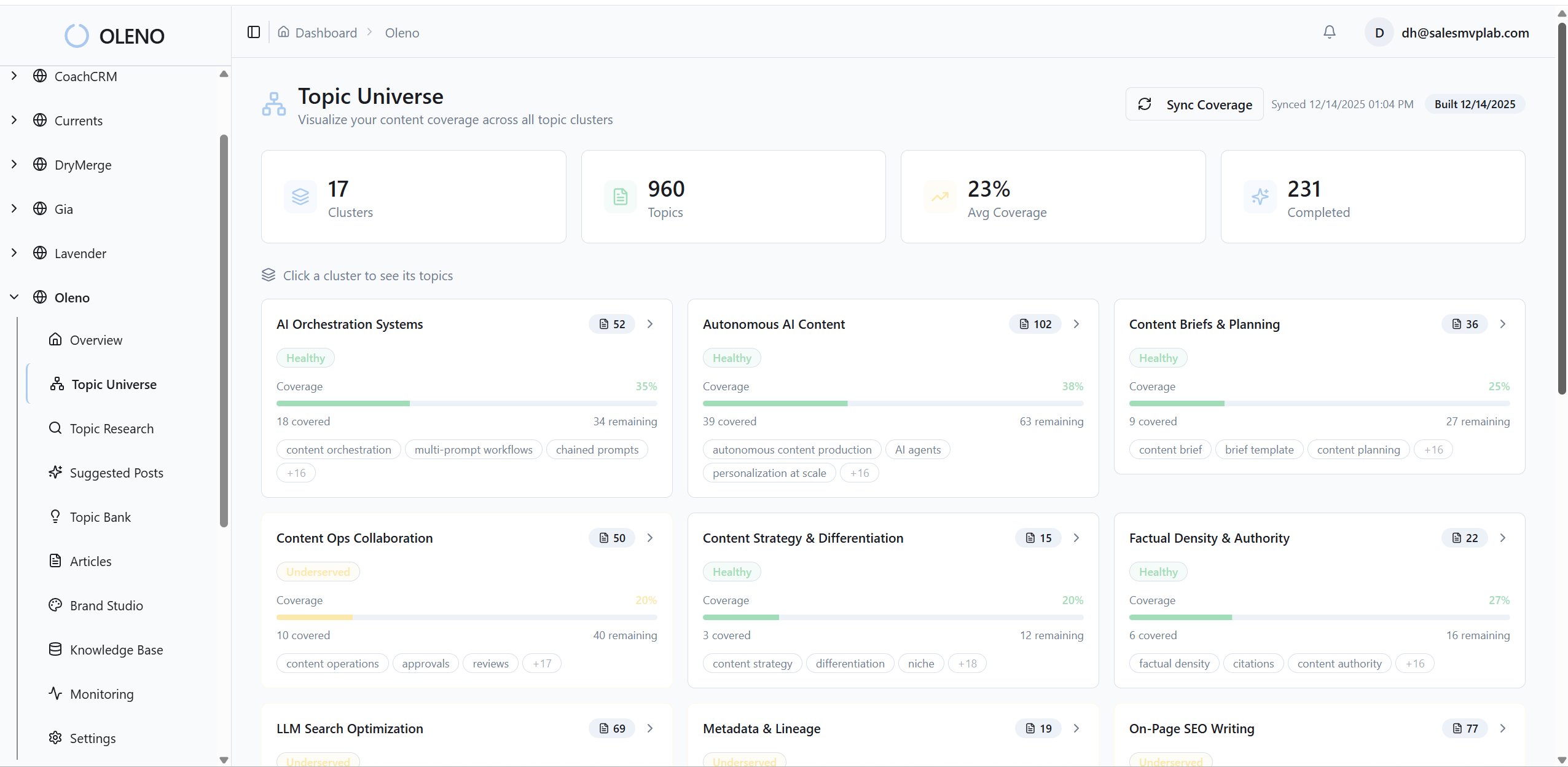
By making prioritization visible, Oleno reduces calendar thrash. You stop debating ideas and start covering gaps with intention.
Information Gain Briefs And An Enforced QA Gate
Oleno performs competitive research during brief generation and scores outlines for Information Gain. Low‑differentiation briefs are flagged before drafting. After writing, a QA gate checks structure, voice alignment, snippet‑ready openings, KB accuracy, visuals, links, and schema against explicit thresholds. Fails trigger focused refinements until standards are met.
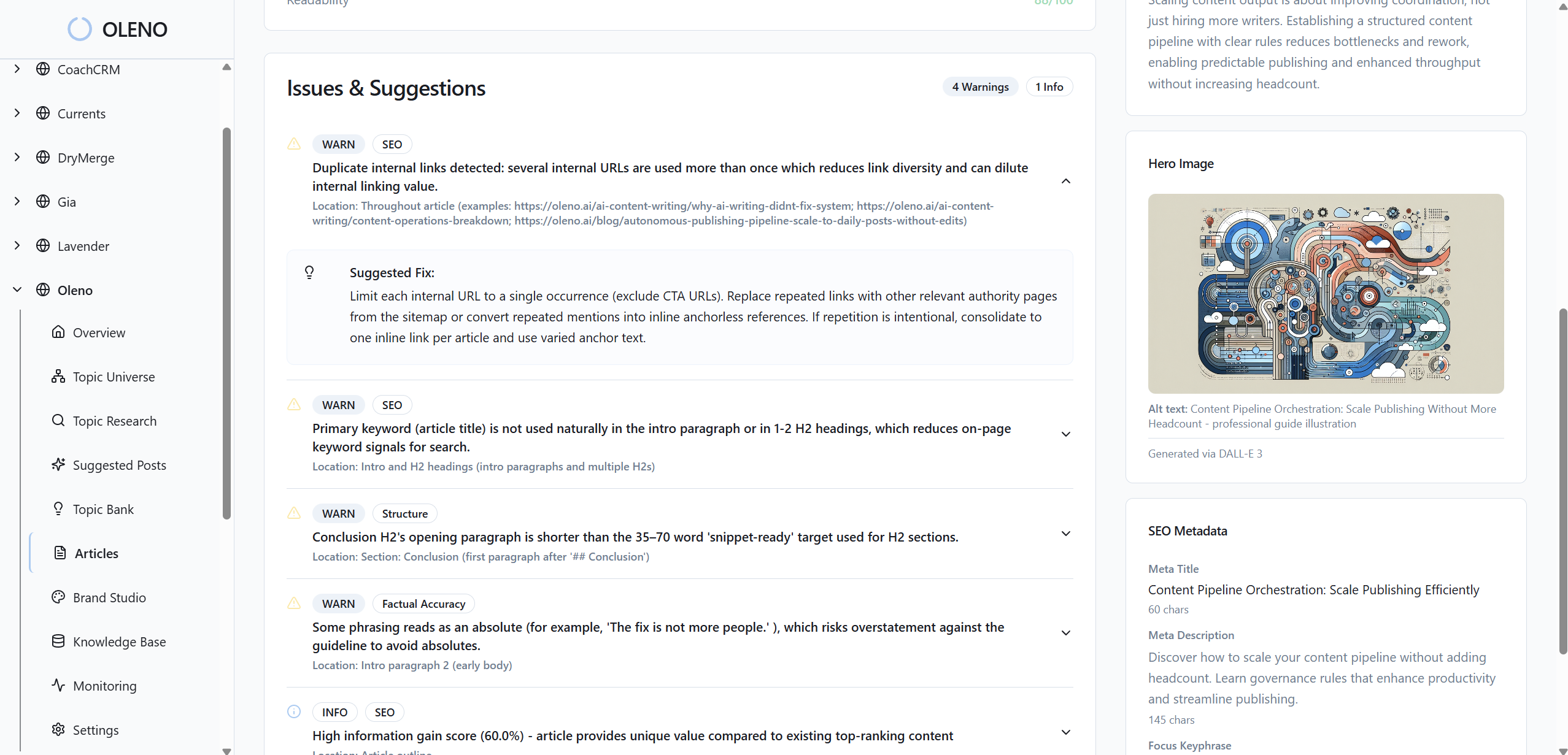
This combination, IG upfront, QA at the gate, directly addresses the rework and missed timelines we walked through earlier. Fewer edit loops. Higher first‑pass publish rates.
CMS Publishing, Schema, And Safe Delivery
Oleno converts content to CMS‑ready HTML, auto‑generates valid JSON‑LD (Article, FAQ, BreadcrumbList), maps fields to WordPress, Webflow, or HubSpot, prevents duplicate publishing, and supports draft or live modes. If a delivery hiccups, Oleno retries and sends a notification so nothing silently fails.
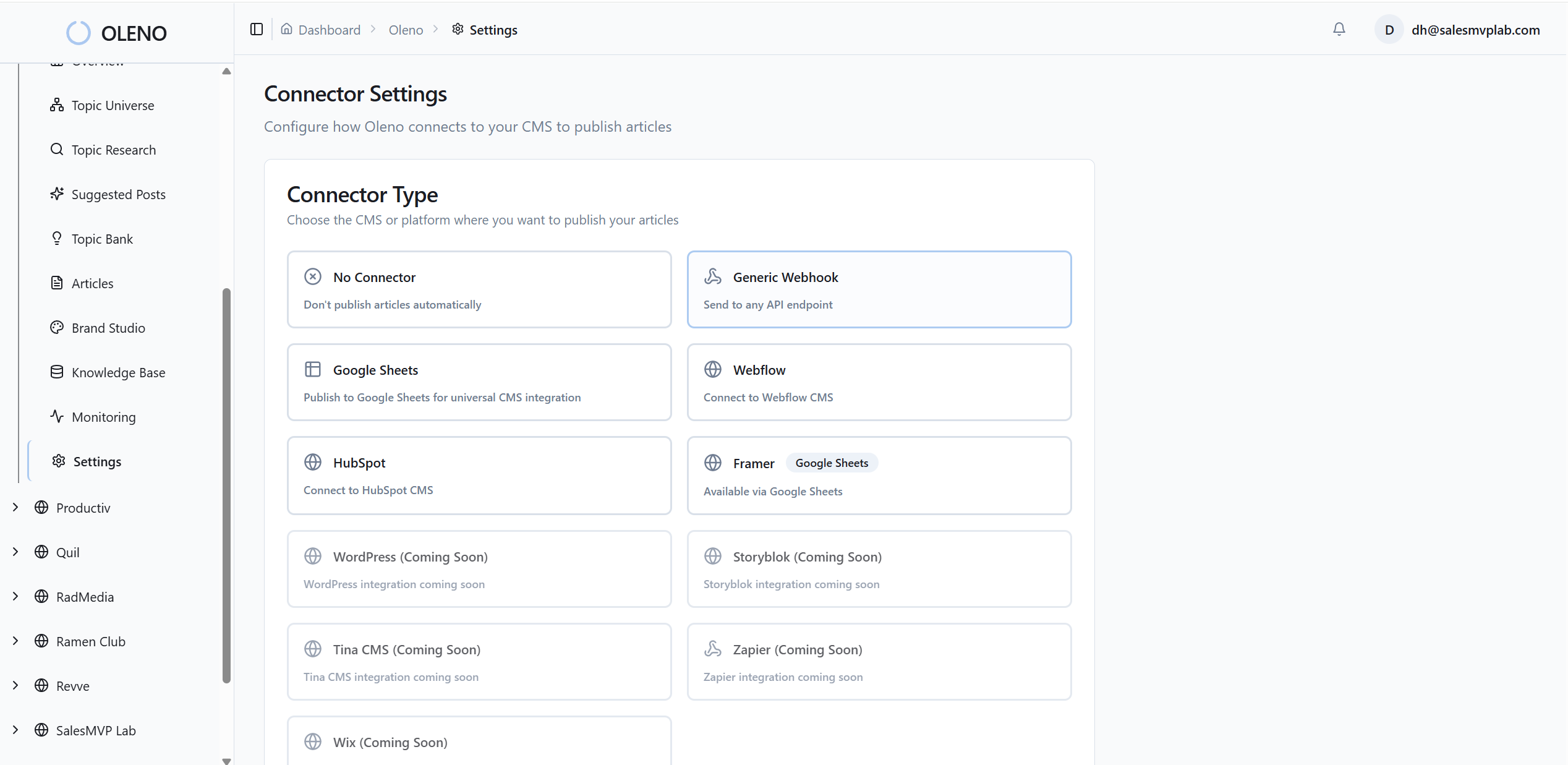
These are the “accuracy in code” pieces that teams struggle to standardize by hand, internal links from a verified sitemap with exact‑match anchors, schema generation, and safe publishing mechanics. If you want a deeper technical angle on programmatic structure, data teams have been formalizing this for years, and even academic work like USC’s orchestrated data pipelines research points to why governed delivery reduces risk.
Let Oleno handle the plumbing so your team focuses on narrative and POV. When you’re ready to see the end-to-end flow, Try Oleno For Free.
Conclusion
You don’t win by typing faster. You win by turning content into a governed system that enforces what matters, unique angles, consistent structure, brand‑true voice, and safe publishing. We’ve tried the hero route. It doesn’t scale. A deterministic pipeline does.
Start small. Map your Topic Universe, enforce Information Gain in briefs, and add a QA gate with binary pass rules. Push accuracy to code wherever possible. Do this, and doubling output won’t halve trust. It’ll compound it.
About Daniel Hebert
I'm the founder of Oleno, SalesMVP Lab, and yourLumira. Been working in B2B SaaS in both sales and marketing leadership for 13+ years. I specialize in building revenue engines from the ground up. Over the years, I've codified writing frameworks, which are now powering Oleno.
Frequently Asked Questions