Build Content Authority with Topic Coverage Maps & Info Gain

Back when we scaled Steamfeed to 120k uniques, we didn’t win because we wrote faster. We won because breadth and depth compounding over hundreds of pages made us the obvious source. Then at PostBeyond, I learned the flip side. Volume without a system creates overlap, rewrites, and editors playing traffic cop. You feel busy, not authoritative.
Here’s the messy truth most teams learn the hard way. If you don’t control topic coverage before you write, you don’t build authority; you dilute it. You get three posts competing for the same intent, all ranking “fine,” none earning citations. The fix isn’t more writers or a louder calendar. It’s a visible coverage map and a ruthless information gain gate.
Key Takeaways:
- Treat authority as coverage across clusters, not one-off post wins
- Make coverage states visible (underserved, healthy, well-covered, saturated) before drafting
- Score every brief for information gain; kill or merge low-differentiation ideas
- Enforce 90-day cooldowns and cluster caps to prevent cannibalization
- Use deterministic rules for links, schema, and visuals to remove rework
- Run a closed loop so priorities update as your library evolves
Ready to see how a system handles this end to end? Try a few runs with real topics and constraints. Try Generating 3 Free Test Articles Now.
Why Publishing Without Coverage Control Dilutes Authority
Publishing without coverage control dilutes authority because you over-represent some topics and duplicate intent across near-identical posts. Search engines and LLMs reward coherent clusters, not redundant angles that split signals. For example, three “best CRM onboarding” posts cannibalize each other while leaving comparison or objection content uncovered.

The Metric That Actually Predicts Authority
Authority accumulates when every new piece strengthens a defined cluster. Not when a single post spikes. Think of it like a balance sheet: net-new concepts, clearer definitions, and better examples add assets; repeats and vague angles create liabilities. If a draft doesn’t add new information, it weakens the network, even if it’s “good.”
This is where information gain becomes practical, not academic. Score the brief for what’s truly new versus what’s already in your library and the top-ranking pages. If the “new” column is thin, you pause. When you do this consistently, you’ll notice a shift: fewer rewrites, stronger internal links, and steadier snippet eligibility. It feels slower. It isn’t.
What Happens When You Let Topics Run The Show?
Calendars without coverage maps drift toward popular keywords and inspirational ideas. It’s human. The result is three posts chasing one intent, all competing for the same query, each fragmenting internal links. Editorial time shifts from improving arguments to fixing structure, anchors, and schema that should’ve been right from the start.
When I led sales at Proposify, I watched great content miss the mark because the narrative disconnected from the product. Rankings were up. Revenue wasn’t. The content didn’t attach to clusters that naturally pointed back to the solution. A simple question would have helped: which cluster, which gap, what net-new concept? It would have saved cycles.
Why More Writers Do Not Fix This
More writers add capacity, not clarity. Without upstream rules, coverage states, cooldowns, and uniqueness gates, headcount multiplies overlap. You publish faster, then realize you’ve created cannibalization that’s painful to unwind. The editorial queue becomes a triage bay.
Governance isn’t bureaucracy here; it’s speed protection. Caps prevent over-publishing in a hot cluster. Cooldowns force prioritization. A visible information gain floor stops redundancy at the brief. You’re not slowing down. You’re avoiding a mess. For a deeper backdrop on topical authority mechanics, this topical authority primer captures why clusters, not keywords, predict long-run wins.
Authority Is A System, Not A Series Of Posts
Authority is a system because outcomes depend on how topics are selected, differentiated, structured, and connected, every time. Posts alone don’t compound; systems do. The leverage comes from consistent rules: gate ideas by coverage state, enforce information gain, and publish with the same structure and schema, every time.

What Is A Topic Coverage Map And Why It Matters?
A coverage map inventories your sitemap, knowledge base, and target focus areas, then clusters them into coherent pillars. Each cluster gets a state, underserved, healthy, well-covered, saturated, that drives decisions. The map turns editorial debates into simple gates: write here, refresh there, pause over there.
If you’ve ever argued about “should we write another post on X,” you needed a coverage map. It reduces opinion and centers on compounding. When the state is visible inside every brief, writers arrive with context, not guesses. Approvals get faster because the why is baked in. For practical mapping ideas, see this overview of topical mapping for SEO.
How Coverage States Reduce Guesswork
States are only useful if they trigger actions. Underserved means create net-new definitional content and foundational explainers. Healthy means move up-funnel-to-mid-funnel: comparisons, objections, and adjacent FAQs. Well-covered often calls for conversion formats: case snippets, product-led walkthroughs. Saturated means freeze net-new and set a refresh cadence.
When we implemented this pattern, the biggest unlock wasn’t traffic. It was velocity with fewer rewrites. Meetings got shorter because the path was pre-decided. Editors weren’t gatekeepers; they were accelerators. Over time, clusters matured predictably instead of spiking and stalling.
When Should You Re-Cover A Topic?
Set a default cooldown, 90 days works for many teams, so you don’t reflexively revisit hot topics. Break the rule only when something changed: a product release, notable data, or a buyer-stage gap you can prove. That discipline keeps internal links clean and prevents four answers to the same question.
I’ve seen teams try to fix stagnation by re-covering too soon. It feels productive. It isn’t. The better play is to fill true gaps in the cluster, then plan refreshes that add novel evidence or angles, not new URLs. Also, keep a light eye on architecture, pillar and cluster content should ladder cleanly. This piece on building topical authority offers a sound baseline without overcomplicating it.
The Hidden Costs Of Uncoordinated Coverage
Uncoordinated coverage costs more than an underperforming post; it drains budget, time, and momentum across the whole pipeline. Overlapping drafts split intent and links. Manual linking and ad-hoc schema create fragile pages. The tax shows up as rewrites, orphan content, and missed snippets that should have been in reach.
Where Duplication Hides In Your Backlog
Duplicates rarely share a headline. They show up as near-synonyms or format masquerades, “guide,” “playbook,” and “how-to” that promise the same thing. Without a map, these sneak through because each looks “new.” The only reliable fix is upstream. Add a uniqueness check to briefs that compares proposed sections to what exists.
Set a threshold. If overlap crosses it, merge the idea into an existing page or kill the draft. This move is surprisingly freeing for writers. It removes the “prove this is different after the fact” dance and replaces it with clarity before writing starts. You’re editing the backlog, not the draft.
What Does Content Cannibalization Cost?
Let’s pretend you publish three overlapping 1,800-word posts in a quarter at $0.20 per word all-in. That’s $1,080 each, $3,240 total. If each pulls 30 percent of what a consolidated piece could have earned, you’ve burned dollars and delayed compounding internal links and schema reuse. That tax repeats quietly every quarter until someone fixes it.
There’s a second cost: opportunity. While you were splitting intent, another cluster stayed underserved. That’s a missed door for authority you’ll now open later. Over a year, this can be the difference between being cited in key answers or sitting in the “also wrote about it” pile. If you want a broader view on topical maps driving outcomes, here’s a practical take on leveraging topical maps for coverage.
Still handling this with spreadsheets and gut checks? There’s a faster way to remove the guesswork. Try Using an Autonomous Content Engine for Always-On Publishing.
The Frustration Of Rework And Missed Momentum
The emotional cost of rework is real: edits that should’ve been rules, originality feedback that arrives too late, and publish dates slipping because links or schema broke. Teams feel busy and behind, at the same time. Morale dips when “almost there” becomes the norm.
When Your Best Draft Gets Sent Back For Originality
You’ve been there. Sharp draft, confident tone, and then the note: “Adds nothing new.” It’s deflating because the work is already sunk. The fix is simple, just earlier. Score information gain in the brief, not in edit. If the score is low, either re-angle or merge into a stronger URL.
I’ve watched this single change lift teams fast. Writers stop guessing what “unique” means. Editors stop explaining it. Everyone aligns on a number backed by a comparison of claims, data, and examples. You’re not killing creativity; you’re focusing it where it moves the needle.
The 90-Day Window You Keep Missing
Clusters tend to compound in 90 to 120 days when the system is disciplined. But if you flood one cluster while ignoring others, you stall the effect, then scramble to fill gaps later. Cooldowns and cluster caps flatten the curve in a good way. Cadence becomes steady, not spiky.
This steadiness matters. It gives search engines and LLMs time to see the full set. It also keeps your team out of reactive mode. You’re not re-covering last month’s hot topic; you’re advancing the whole map. If you want a simple primer on why, this guide on the power of topical maps explains the compounding pattern clearly.
A Practical Framework To Map Coverage And Enforce Information Gain
A practical framework starts with a single source of truth for your topic universe, then layers deterministic rules for what gets written, when, and why. The cadence becomes predictable: map, score, schedule, publish, update. Examples help: a 90-day cooldown, a minimum information gain score, and visible cluster states.
Build Your Topic Universe Map
Start by exporting your sitemap and harvesting your knowledge base. Cluster pages and ideas by entity and buyer intent, awareness, comparison, decision. Normalize cluster names so writers aren’t guessing. Attach every page to a cluster and tag missing coverage where high-intent questions have no satisfying URL.
Then make it the source of truth. Store the map where briefs can pull cluster context automatically. The more you centralize this, the less “is this covered?” you’ll field in Slack. As you publish, update the map. It’s a living artifact, not a one-off audit.
Define Coverage Thresholds And Saturation Labels
Decide what makes a cluster underserved, healthy, well-covered, or saturated. Page count, recency, and format balance are a good start. Tie actions to labels. Underserved triggers net-new fundamental explainers. Healthy opens the door for objections and comparisons. Well-covered shifts to product-led formats. Saturated freezes net-new and schedules refresh.
This becomes your playbook during planning. No more opinion tennis. Just look at the state and execute the linked action. Over time, this standardizes expectations for writers and reduces last-minute changes. It also keeps internal links clean because you’re not minting new URLs unnecessarily.
Score Differentiation With An Information Gain Method
Collect the top-ranking outlines and claims for the target query and your cluster head term. Mark common ground, definitions, frameworks, examples. Draft your outline and highlight what’s truly net-new: data, angles, use cases, or lived experience. Assign an information gain score from 0 to 100 and set a floor, say 60.
If the brief can’t clear the floor, you either add new material or you don’t write it. That’s the rule. It sounds strict. It’s actually liberating. Writers know what “different” means. Editors stop hunting for novelty in revision. If you want a good conceptual intro to why this matters, this topical authority primer is a solid reference, and this overview of topical maps adds useful mapping nuance.
How Oleno Automates Coverage Mapping And Information Gain
Oleno automates coverage mapping and information gain by turning strategy into a governed pipeline: map clusters, enforce cooldowns, score briefs for uniqueness, and publish with deterministic links, schema, and visuals. The system runs daily, so your priorities adjust as coverage changes. Think “content operations as infrastructure,” not projects.
Topic Universe Keeps Coverage Balanced
Oleno includes a Topic Universe that maps your full landscape, tracks coverage and saturation in real time, and enforces cooldowns before a new brief is even written. Writers start with coverage-aware context, what’s underserved, what’s over-covered, what’s next. You avoid duplicate angles and protect velocity without editorial firefights.
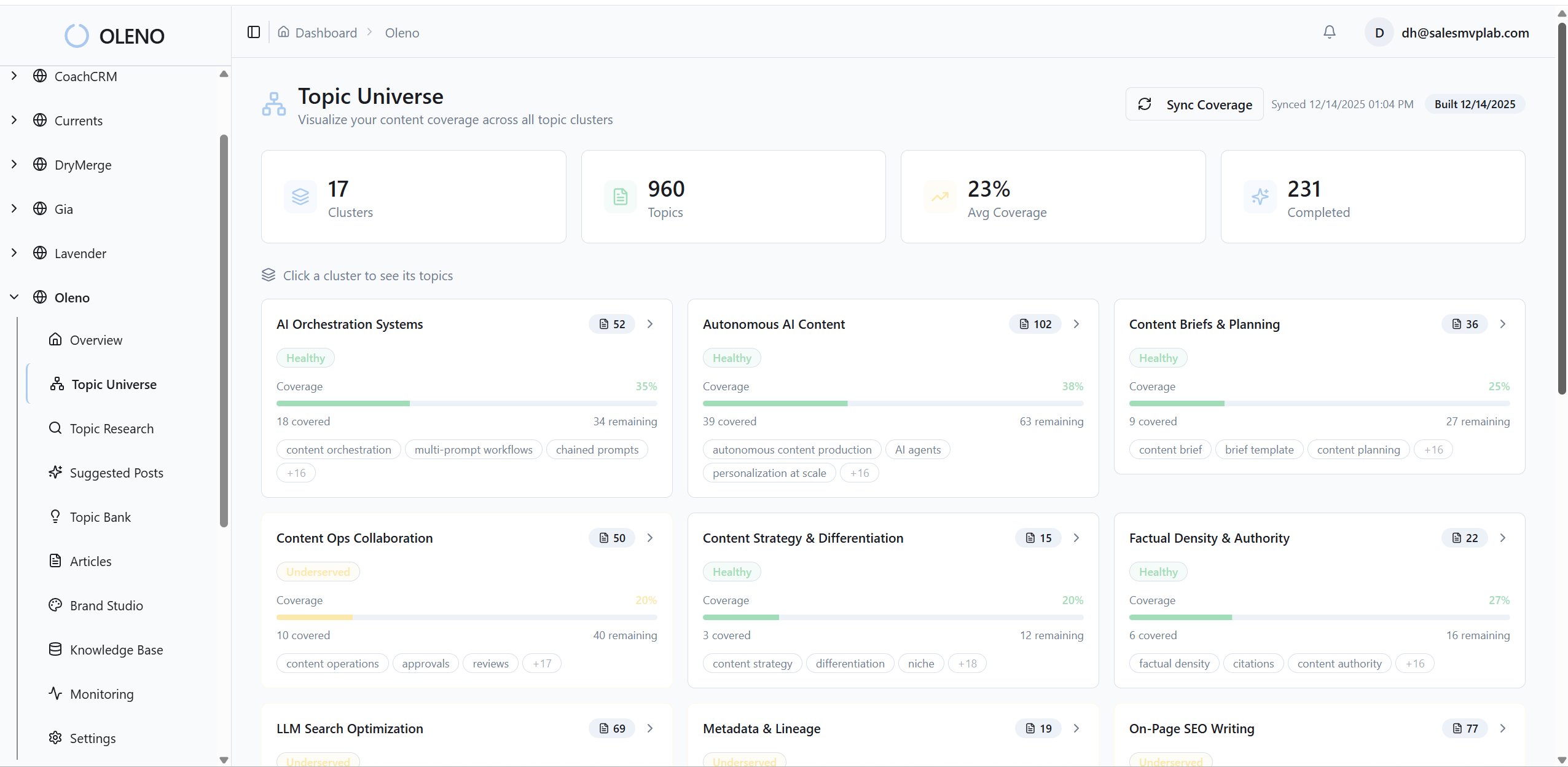
Because the state is computed, not debated, approvals accelerate. And since the map updates after each publish, tomorrow’s suggestions reflect today’s coverage. You stop guessing which cluster needs attention. The system tells you.
Information Gain Scoring Gates Redundant Briefs
Oleno calculates an Information Gain Score during brief generation by analyzing existing content and top results for overlap and gaps. Low scores trigger warnings upstream so you can re-angle or merge before anyone burns hours on a draft. High-gain briefs get rewarded in QA and move through faster.
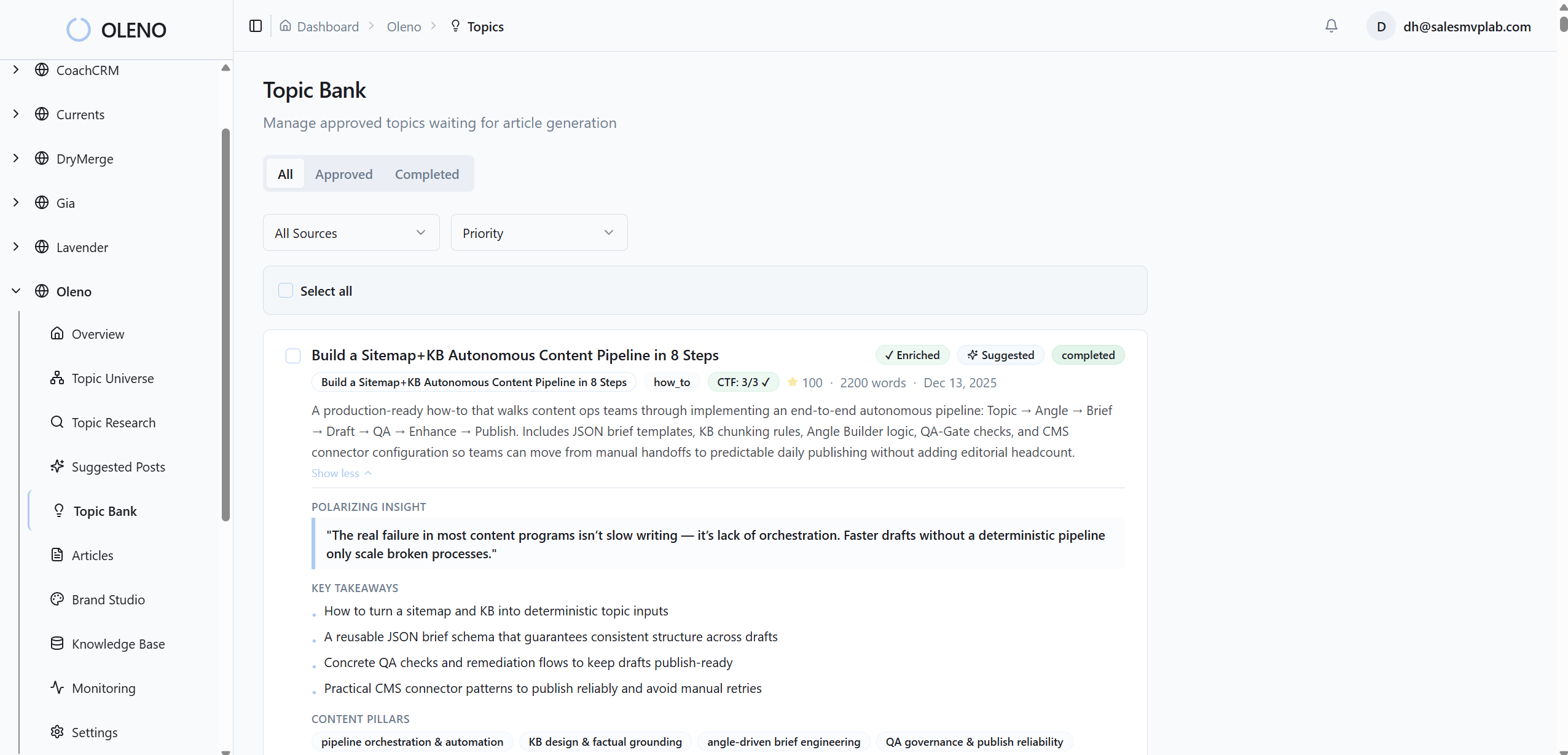
This directly addresses the costly loop of “great draft, zero novelty.” By scoring before writing, you reclaim time, reduce editorial churn, and publish articles that add something worth citing. It’s discipline as a feature.
Deterministic Execution For Links, Schema, And Visuals
Oleno handles execution details with code, not hope. Internal links are injected from a verified sitemap and anchor text matches page titles exactly. Schema is generated programmatically in JSON-LD for articles, FAQs, and breadcrumbs. Visual Studio generates brand-consistent hero and inline images and matches product screenshots to the right sections.
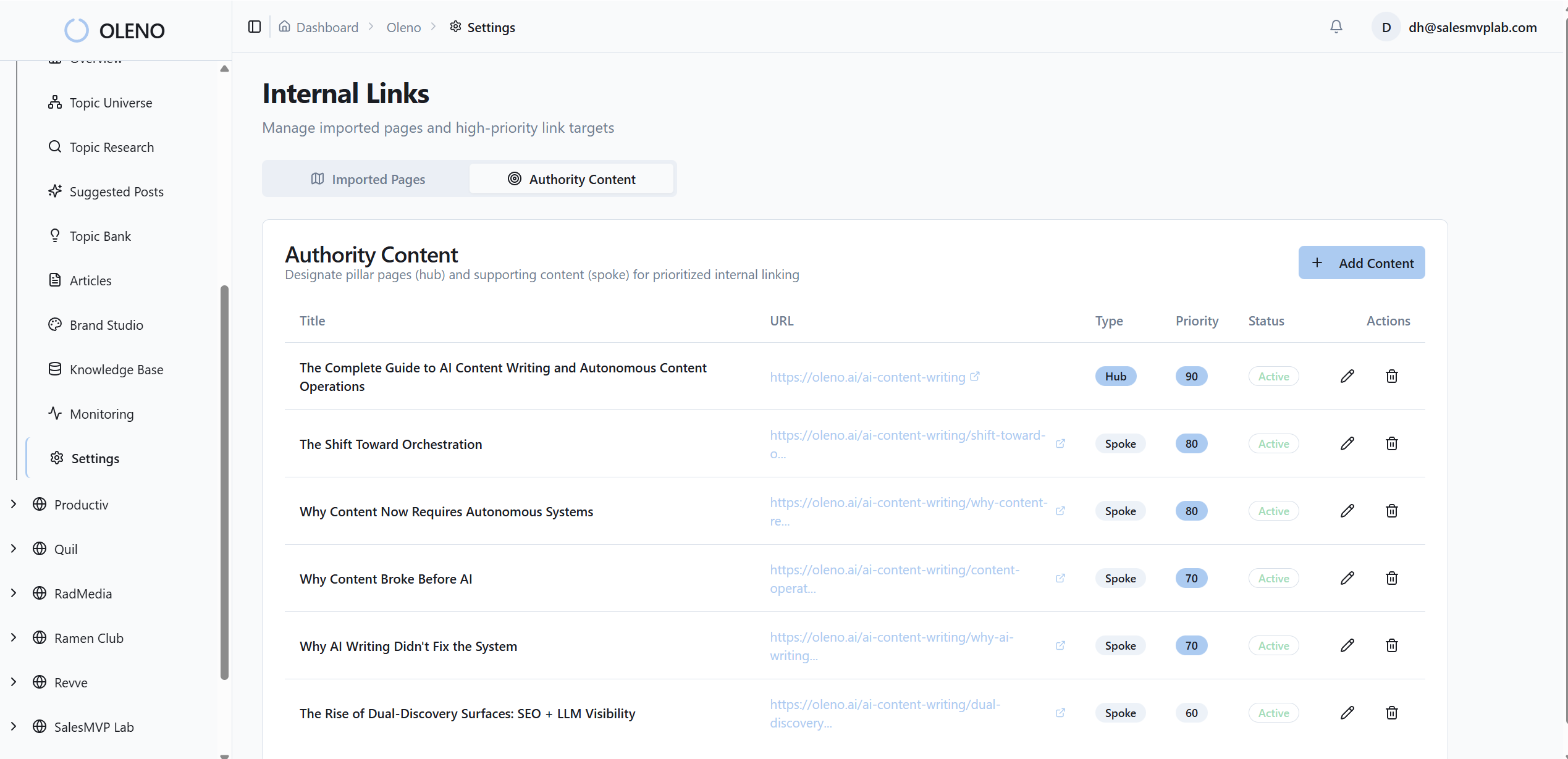
These are the steps that usually cause frustrating rework and broken snippets. When they’re deterministic, they aren’t fragile. You ship clean pages the first time, more often.
Closed-Loop Updates Keep Priorities Current
After publishing, Oleno feeds coverage data back into Topic Universe. Cluster states update, suggestions adjust, and production stays aligned with where authority is compounding. You’re not running a calendar; you’re operating a loop.
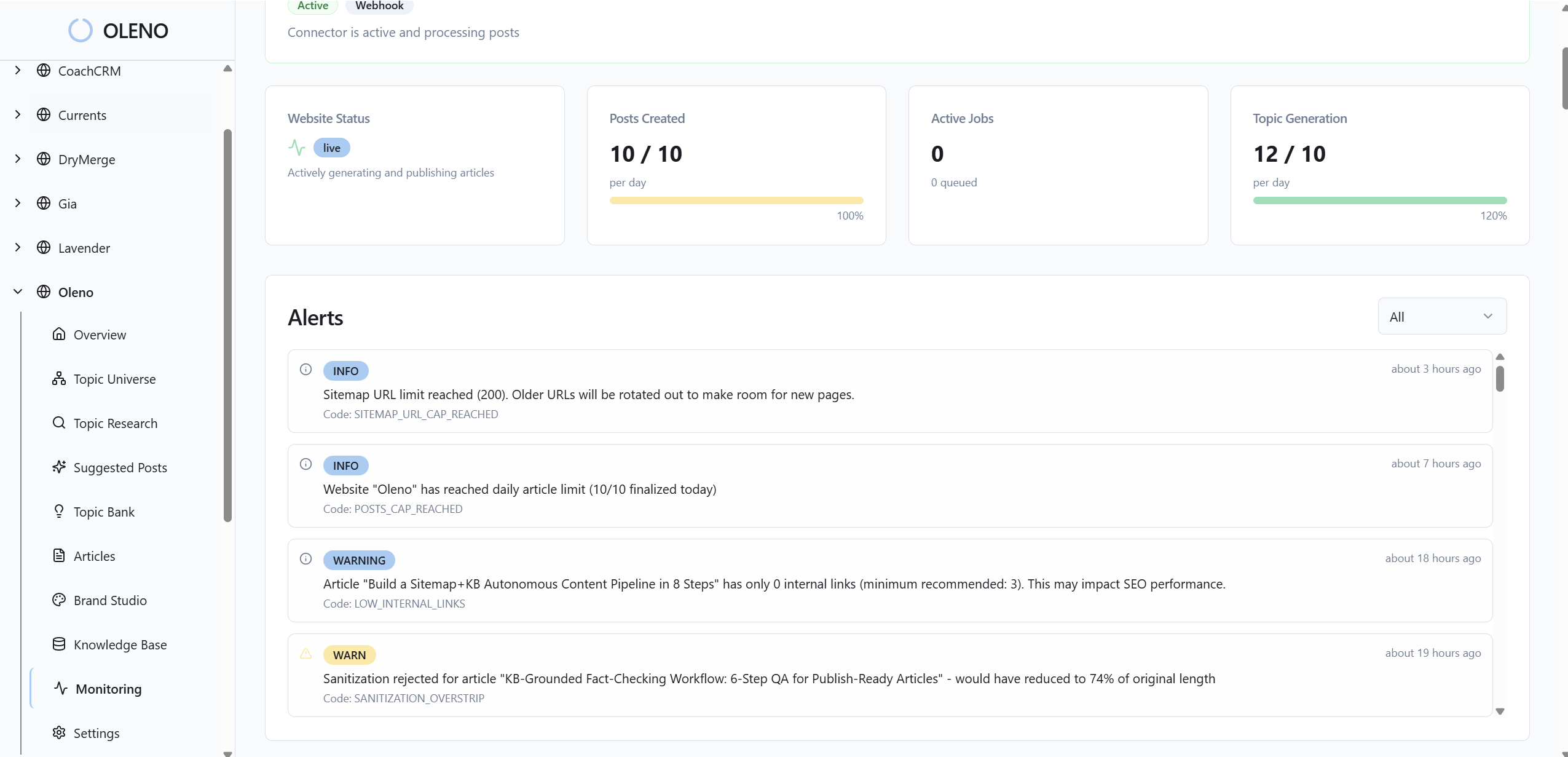
Put simply, Oleno turns the rules we’ve been talking about into an always-on system: strategy → research → writing → visuals → QA → publishing, every time. Curious what that looks like with your topics? Try Oleno for Free.
Conclusion
You don’t need more posts. You need a coverage map that tells you what to write next, an information gain gate that enforces originality, and deterministic execution that prevents rework. Do that, and authority stops being a hopeful outcome. It becomes the byproduct of a system that compounds, week after week.
About Daniel Hebert
I'm the founder of Oleno, SalesMVP Lab, and yourLumira. Been working in B2B SaaS in both sales and marketing leadership for 13+ years. I specialize in building revenue engines from the ground up. Over the years, I've codified writing frameworks, which are now powering Oleno.
Frequently Asked Questions