Build Topic Clusters That Match User Intent: Coverage-First Playbook

Most teams still treat clusters like keyword buckets. That’s why your content calendar fills up, including the rise of dual-discovery surfaces:, velocity looks good, and yet coverage is thin where it matters. You end up with five articles that say the same thing, just with different titles. Search engines see the duplication. So do LLMs.
The fix is not “write more.” It is plan by discrete user intent, then enforce it. Map the jobs people try to complete, publish one strong page per job, and stop publishing into already saturated clusters. Easier said than done.
Key Takeaways:
- Treat intent as the unit of planning, not keywords or volume
- Label and audit every URL by intent to find and merge overlap
- Use saturation and cooldowns to prevent over-publishing a cluster
- Score briefs for information gain before anyone writes a draft
- Open every H2 with a 3-sentence, snippet-ready answer
- Set deterministic internal linking rules to recover authority leakage
Keywords Aren’t Strategy, Intent Coverage Is
Intent coverage means you plan, publish, and measure against the jobs users try to complete, not against keyword volume. It creates clearer signals for crawlers and LLMs, since each page answers one job in full. Example: one “Integrate CRM X with Tool Y” guide that actually solves the task.

What is coverage-first clustering and why now?
Coverage-first clustering organizes your universe by problems, including the shift toward orchestration, comparisons, and tasks, then ensures one reliable page exists for each. It reduces cannibalization because duplicate themes are consolidated before publishing. Think of it as a library: one shelf per topic, one book per job, no confusing duplicates on the same shelf.
You likely already have scattered articles that nibble at the same idea. Keep the canonical, fold the rest into it, and redirect. Search engines prefer clarity. So do users. If you want this to run continuously, treat it as part of autonomous content operations, not a quarterly clean-up.
For broader mechanics on clusters and why intent alignment matters, see Backlinko’s Topic Clusters overview.
Define intent segments beyond tofu/mofu/bofu
Secondary labels are fine, but one primary label wins.
Label every URL with one primary intent to force clarity. Keep the list short so it guides decisions:
- explain
- compare
- evaluate
- implement
- troubleshoot
- price
- learn
Extract repeated subtopics from titles and H2s. You will spot quick wins for consolidation. This is where thin sections hide.
The Real Unit Of Work Is Discrete User Intent
Discrete intent is the smallest unit that matters, including why ai writing didn't fix, the single job someone tries to complete on your site. It cuts through volume chasing and reveals duplicates fast. Example: “Fix orphan pages” is a job. So is “Choose between Vendor A and B for mid-market teams.”

Audit pages by intent segment (and de-duplicate overlap)
Export your sitemap and tag each URL with one intent and one cluster. If two pages share the same intent inside the same cluster, pick a canonical and plan a merge. Create an overlap ledger per cluster that lists repeated subtopics. Mark weak pages for consolidation, not updates.
Define simple keeper criteria. Keep the page with the most unique sections, examples, or visuals. If nothing stands out, write a new canonical, then redirect. This is a structural fix, not an editing task. It also sets you up for clean hub and spoke linking.
How do you map overlapping topics without keyword lists?
Build from your content and knowledge base, not external volume. Pull topics from your docs, support tickets, and product FAQs, then cluster by semantic similarity and job-to-be-done. Track saturation per cluster with four labels:
- underserved
- healthy
- well-covered
- saturated
Mark saturated clusters as read-only for 60–90 days, then shift bandwidth to underserved. It reduces cannibalization and forces depth where you lack it. For structure basics that complement this approach, the Clariant Creative guide to pillar pages and clusters is useful context. For a practical mapping walkthrough, keep this nearby: search intent clusters.
Curious what this looks like in practice? Try using an autonomous content engine for always-on publishing.
The Hidden Costs Draining Your Content Budget
Duplication, weak linking, and missed snippet structure create hidden carry costs that stack up over a quarter. You feel it as slow time-to-publish, inconsistent outcomes, and rework. None of this is dramatic. It is a drip. The kind that erodes budget quietly.

Quantify information loss and duplication
Let’s pretend you ship 20 posts this quarter and 35 percent rehash existing content. That is seven low-gain pieces. If each took 6 hours across brief, draft, edit, and images, you just spent 42 hours repeating yourself. Put those 42 hours into three high-signal, net-new pages, and you’ll likely raise cluster authority faster.
Score every brief for information gain from 0 to 100. Penalize generic definitions, repeated sections, and listicles without examples. Reward proprietary data, implementation detail, and clear frameworks. Low scores trigger outline revision before anyone writes. This is where duplication dies early, not in editing. If you want the why-behind faster drafts, see AI writing limits.
What does over-publishing cost in a quarter?
Build a simple cost model. Hours per draft, edit, and publish multiplied by the number of duplicates. Add an opportunity cost for cannibalization by estimating diluted rankings across similar URLs. The math does not have to be perfect. It just has to be visible enough to change behavior.
Cap publishing in any cluster marked “saturated.” Enforce a 60–90 day cooldown. Use that time for consolidation or republishing with higher information gain. Track inputs you control: duplication rate, average info-gain score, cooldown adherence, and internal link pass rate. This trims cost without adding headcount. For a real-world lens on consolidation, review Minuttia’s topic cluster case study.
Model authority leakage from weak internal linking
Set page-level link budgets. For long-form pieces, plan 5–8 relevant internal links. Point up to the pillar and sideways to complementary intents. Place links at natural sentence boundaries to avoid clutter.
Standardize anchors to short noun phrases that match the target’s core topic. Consistency helps crawlers and LLMs understand your structure. Audit orphan pages monthly. Add 2–3 contextual links from healthy pages to pull them into clusters. If you need the tactical play, use this guide on site architecture linking. Fragmentation is a cost center, which is why this breakdown matters: content system breakdown.
Why Rework, Duplicates, And Missed Snippets Keep Happening
This pattern persists because your workflow is fragmented. Planning in spreadsheets, writing in docs, images in shared drives, publishing in the CMS. No stage enforces differentiation, so overlap sneaks through. You optimize for speed, then pay the tax in rework and cannibalization.
The real reasons teams repeat themselves
When strategy, research, writing, visuals, and publishing live in different tools, nobody owns the outcome. Writers do their best, designers add visuals later, editors clean tone and grammar, and publishing becomes a last-mile scramble. Differentiation is hoped for, not enforced.
Speed targets compound the problem. You ship more, depth gets shallow, and clusters get saturated without anyone noticing. Generic visuals erode trust. Screenshots land in the wrong sections, so readers miss context and LLMs miss structure. This is why content should run as content orchestration, not a relay race.
Where does snippet eligibility break?
Missed snippets often start with soft openings. Fix it by opening every H2 with a 3-sentence, 40–60 word direct answer. One sentence that answers the question, one that adds context, one that gives a concrete example. Keep paragraphs short, two to four sentences.
Make each section stand alone. Someone should land on that H2 and get the answer without scrolling. Add Article and FAQ schema and validate before publish. If you want a template to follow, use these rag-ready sections. For a structure primer tied to snippet logic, this analysis of topic clusters and snippets is helpful. Tie it all to dual discovery with SEO and LLM visibility.
Ready to stop paying the duplication tax? Try generating 3 free test articles now.
A Coverage-First Playbook That Compounds Authority
A coverage-first system is a way to run the work without constant meetings. It decides what to write, including why content now requires autonomous, checks for originality, writes for citation, links deterministically, and respects cooldowns. You get compounding authority because each article adds something new.
Map the Topic Universe and set priorities
Discover topics from your site, docs, and knowledge base, then cluster by similarity and job-to-be-done. Label each cluster with a saturation state, from underserved to saturated. This prevents over-publishing where you already have depth.
Build a simple priority matrix that combines intent value, saturation, and effort. Ship net-new, high-value intents in underserved clusters first. Keep a rolling 30–60 day plan tied to coverage, not volume. If saturation shifts, re-rank the backlog before you write. If you want a system-level primer, see autonomous content systems.
Force originality with information-gain briefs
Create briefs that list common coverage, missing angles, and the unique detail you will add. Assign an information gain score from 0 to 100 and set a minimum pass threshold. Low scores trigger outline revision before drafting starts. Define “what’s new” in one or two sentences for each H2. If you cannot write it, you are repeating the web.
Attach 3–5 authoritative external links during brief creation. They support depth and provide credible references. This is not about analytics. It is about raising the chance that every section is citable by search engines and assistants.
Write for citation, link with rules, and enforce cooldowns
Open every H2 with a snippet-ready paragraph, then expand in short, scannable blocks. Add schema consistently and validate pre-publish. Write sections that stand alone, so they are quote-ready.
Use deterministic internal linking rules. Plan 5–8 links per long-form page, link up to the pillar and across to adjacent intents, and place links at natural sentence boundaries. Use short, descriptive anchors, two to five words. Enforce a 60–90 day cooldown on saturated clusters, and republish only when you meaningfully raise information gain.
For another point of view on cluster mechanics, compare with the Topic Clusters playbook. For a consolidation perspective, see the topic cluster case study.
How Oleno Operationalizes Coverage-First Topic Clusters
A coverage-first system only sticks if it runs every day without manual coordination. Oleno operationalizes this with a governed pipeline that starts at strategy and ends at a published, brand-complete article. You decide priorities. The system enforces guardrails.
Strategy and discovery handled upstream
Oleno maps your Topic Universe from your site, including ai content writing, knowledge base, and focus areas, then groups topics into clusters with saturation labels and enforces 90-day cooldowns. Daily suggestions reflect real gaps, not keyword volume dashboards. Approve what matters, and the work moves forward with your brand voice and rules attached.
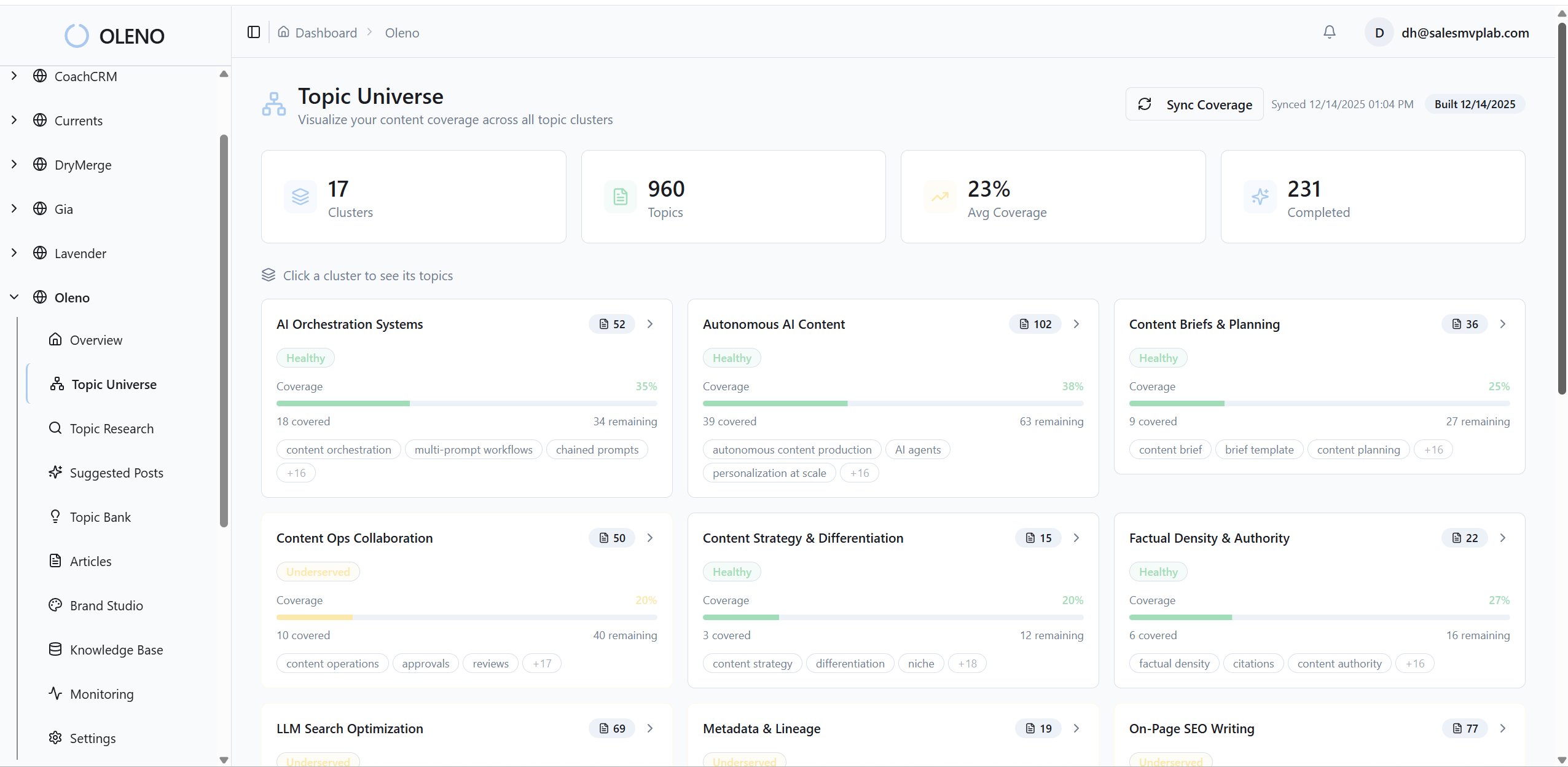
Coverage is tracked per topic and cluster, so you always know what to write next. Over-publishing gets harder because the cooldown is built in. The result is fewer duplicates and clearer authority signals across your site.
Differentiation and structure enforced before publish
During brief generation, Oleno runs competitive research and assigns an Information Gain Score. Low-gain outlines trigger revision before drafting. Drafts follow snippet-ready rules by default, including topic clusters, each H2 opening with a 40–60 word, three-sentence answer. Sections are written to stand alone, then validated in QA for structure, tone, and clarity.
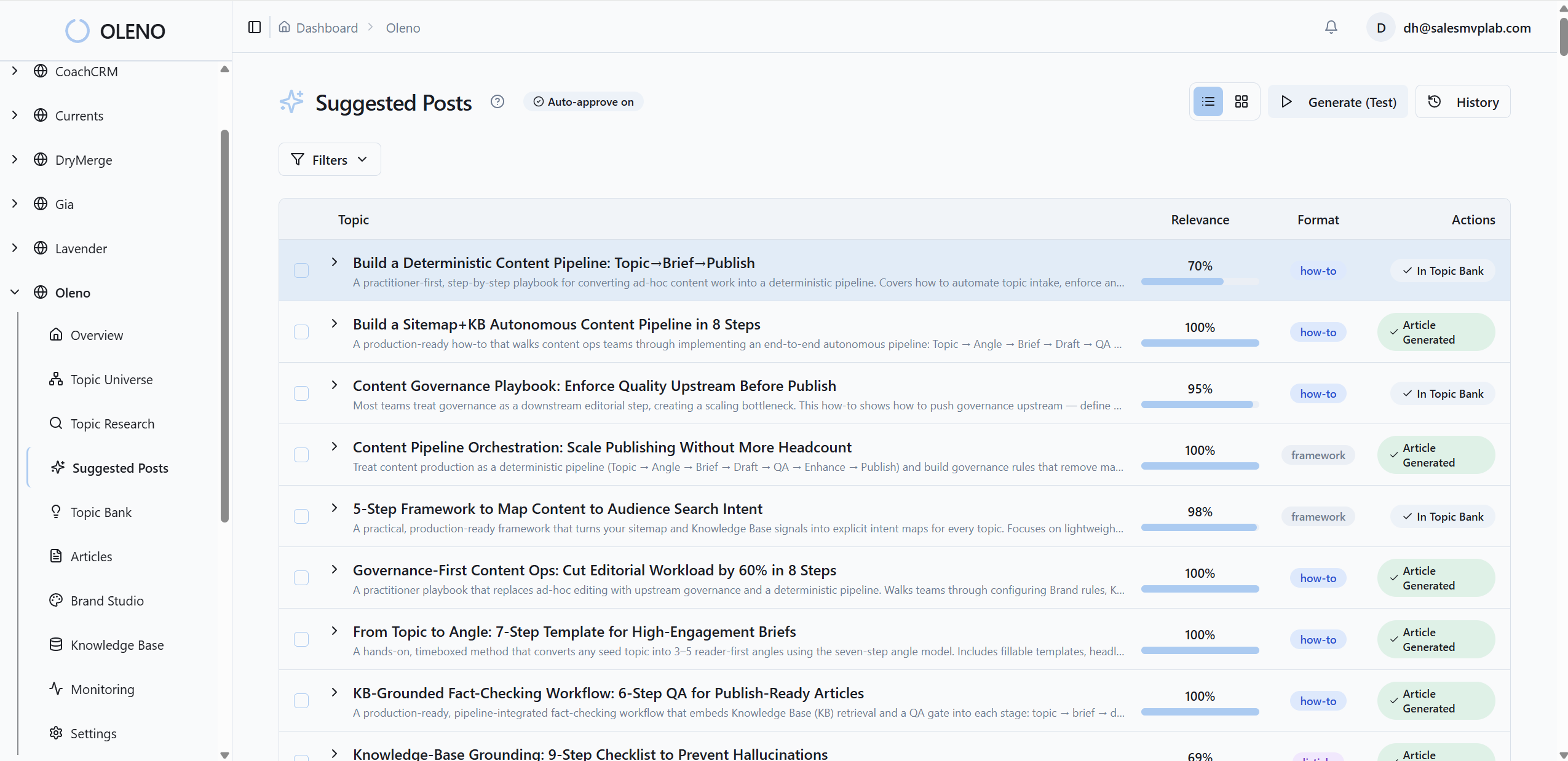
Visual Studio places brand-consistent images and relevant product screenshots in the sections where they add context. Schema is generated programmatically and attached. This reduces the frustrating rework that shows up at the end.
Links, schema, and publishing made deterministic
Oleno injects deterministic internal linking from your verified sitemap only. Expect 5–8 relevant links per article with anchor text that matches page titles, including how to create topic clusters, placed at natural sentence boundaries. Fabricated URLs are not possible. CMS-ready HTML, images, internal links, and JSON-LD schema ship together, then publish to WordPress, Webflow, HubSpot, or Sheets-based workflows with mapped fields and duplicate-prevention.
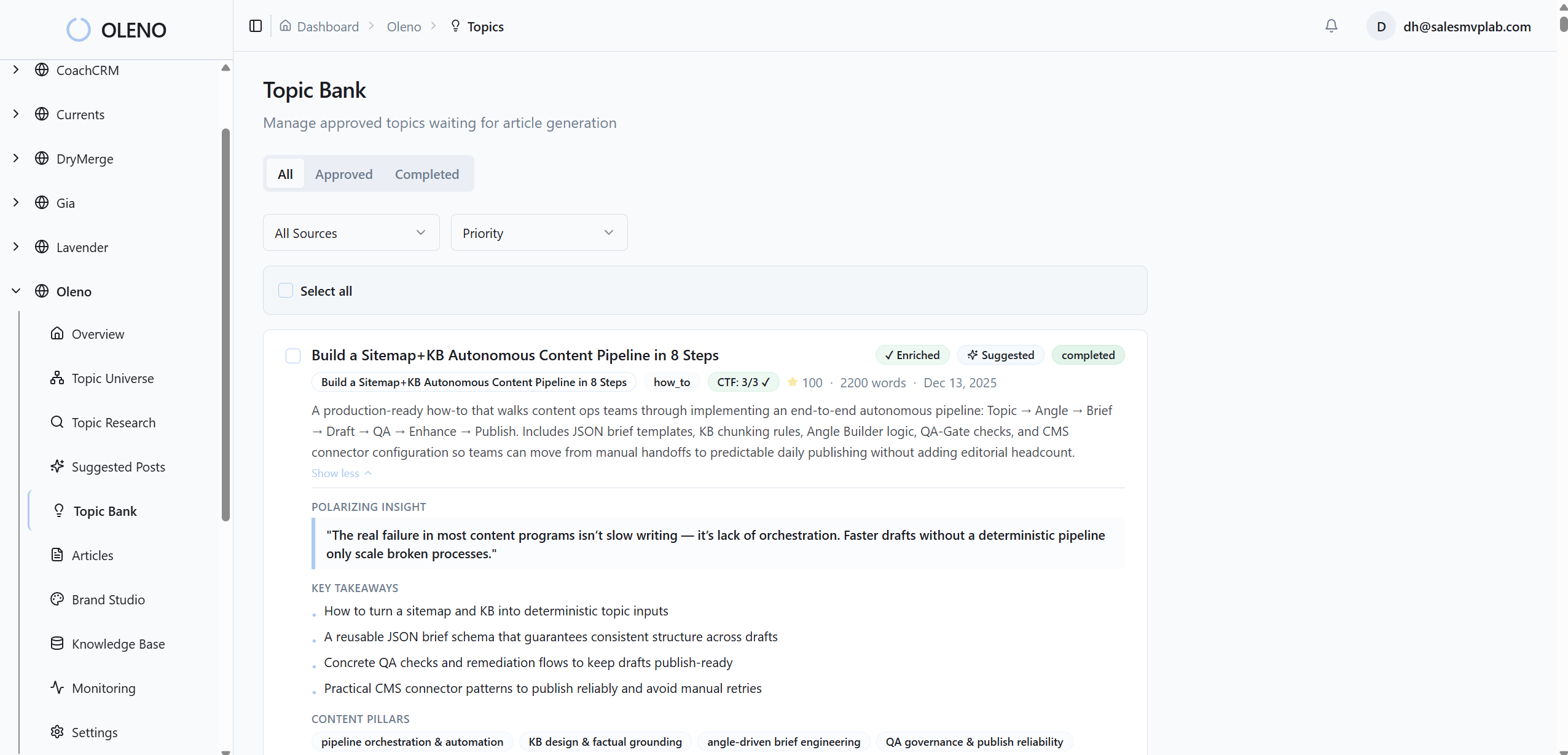
Remember the hours lost to overlap, reformatting, and broken links? Oleno reduces that hidden work by making correctness a rule, not a hope. Want to see the guardrails in action? Try Oleno for free.
Conclusion
If you want clusters that actually build authority, stop planning by keyword volume and start managing discrete user intents. Label every URL by intent, consolidate overlap, write for citation, link with rules, and enforce cooldowns. Do that consistently and coverage compounds without guesswork.
You can run this manually for a while. Or you can make it your default operating system. The moment you shift from output goals to coverage goals, the work gets saner. The results get clearer. And every new article makes the rest of your library stronger.
About Daniel Hebert
I'm the founder of Oleno, SalesMVP Lab, and yourLumira. Been working in B2B SaaS in both sales and marketing leadership for 13+ years. I specialize in building revenue engines from the ground up. Over the years, I've codified writing frameworks, which are now powering Oleno.
Frequently Asked Questions