Building a Content Operating System for B2B Marketers

Most B2B teams don't have a content production problem. They have a control problem. A content operating system gives that control back by making the right decisions repeatable before AI starts multiplying the wrong ones.
You see it when the calendar looks full, the drafts look fine, and nobody can explain which pieces connect to pipeline, product truth, or the story sales is telling. So the team adds another AI tool, then another prompt doc, then another review step, and somehow the content still feels off.
Key Takeaways:
- A content operating system standardizes decisions, not just production steps.
- AI writing alone does not solve broken content operations.
- Topic intake, narrative rules, source control, and QA matter more than raw output speed.
- Small teams scale better when they define who decides what before work starts.
- Repurposing only works when ownership and channel intent are clear.
- Leadership should measure influenced pipeline, coverage depth, and reuse efficiency, not article count.
Why Content Needs an Operating System, Not More AI
A content operating system is a decision layer for content, not a stack of writing tools. It defines the inputs, rules, roles, checks, and ownership model behind every asset. Without that layer, AI just makes the existing mess faster.

AI writing exposes the broken parts faster
Most teams already use AI. ChatGPT, Claude, Perplexity, maybe a writing assistant, maybe a scoring tool. The raw draft is rarely the bottleneck anymore. The real cost is everything around the draft: product context, positioning, source selection, outline quality, review ownership, CMS handoff, and repurposing.
I learned this the hard way. At PostBeyond, as the sole marketer, I could crank out 3-4 solid posts a week because all the context lived in my head. Then the team grew. Our writer didn't have that context, I had less time to write, and the content got slower while also getting weaker. Not because the writer was bad. Because the operating model lived in my brain.
That's why AI writing alone doesn't fix the system. Unclear inputs, loose QA, and a fuzzy ownership model mean generation speed just scales inconsistency at a faster rate. If that sounds like the thing you're trying to fix rather than the thing you want to build, it may be worth seeing how a governed workflow behaves in practice and request a demo.
The symptom is volume without control
A bad content system feels productive from the outside. Topics are moving, drafts are showing up, LinkedIn posts are being written from blog content. The calendar has colour on it, which makes leadership feel like the machine is running.
Inside the team, it feels different. The SEO person wants coverage. The PMM wants product accuracy. Demand gen wants pipeline relevance. The founder wants a stronger point of view. The content marketer is stuck reconciling all of it in the draft, which is the most expensive place to fix strategic confusion.
The job is closer to air traffic control than writing. Every asset is a plane coming in with a destination, fuel level, passenger type, and weather condition. If nobody owns the runway rules, more planes don't create more growth. They create near misses. And the team responsible for the runway is usually one person who also has to fly half the planes.
Random intake creates random content
Topic intake is where most content operations break first. A Slack message becomes a blog post. A sales objection becomes a thought leadership piece. A keyword export becomes a quarter of content. Each source has value, but none of them should become work automatically.
You can see the chaos in the questions marketers ask online: "What do you do as a Demand Generation Manager", "Demand gen leaders - do you manage SDRs?", "CEO acts as CMO", "Got a new job as SEO Lead for an enterprise level company. Any advice?" These are real market signals. They show confusion, role drift, ownership gaps, and content demand hiding inside job anxiety.
A content operating system turns those signals into a queue with rules. Not every buyer question deserves an article. Some become sales enablement. Some become social posts. Some become product pages. Some get ignored because they don't match the market you want to win. The discipline isn't in the writing — it's in the saying-no.
How to Design a Content Operating System
A useful content operating system starts with inputs, decision rules, and review ownership before it touches workflow automation. The goal is simple: make the important choices visible early, when they're cheap to change. Then AI can handle production without taking over judgment.
Start by separating inputs from ideas
Where do your topics come from right now? If the answer is "a mix of SEO, sales, leadership, and whatever we think of," you don't have a topic system. You have intake noise.
I like separating inputs into five buckets: buyer pain, search demand, product truth, sales objections, and company POV. Each proposed topic should map to at least two buckets before it becomes production work. If it only maps to search demand, it may rank but say nothing useful. If it only maps to product truth, it sounds like a release note. If it only maps to founder POV, it may be sharp but disconnected from active demand.
A practical test before approving any topic: Who is this for? What decision does it move? What must be true about our product or market for this piece to work? If the team can't answer those three in five minutes, the topic isn't ready. Park it. The cheapest place to kill a bad topic is before anyone writes a brief — once a draft exists, sunk cost takes over and weak topics get shipped to justify the work already done.
Turn topic management into the control center
Topic management is the operating control center for scaled publishing. It should show what's approved, what's blocked, why each piece exists, which persona it serves, which funnel moment it supports, and what proof it needs. A spreadsheet can do this at first. The structure matters more than the software.
Back when I ran Steamfeed, we hit traffic growth because we had both breadth and depth. 80 regular contributors. Over 300 guest contributors. Many angles on similar topics, which helped us rank across long-tail searches. We started seeing real SEO spikes at 500 pages, then 1,000, then 2,500, then 5,000, then 10,000. Most pages got under 100 views a month, but the long tail compounded. Volume worked because the topic surface had shape. It wasn't just "publish more digital marketing content."
For a SaaS team, a topic bank should track more than keywords. Add columns for persona, pain type, product connection, source requirement, repurposing path, and business priority. If you're publishing fewer than five articles per month, keep it lightweight — a Google Sheet with seven columns is enough. Once you pass five per month, a weak topic bank becomes a hidden tax because nobody remembers why half the work exists. Past 15 per month, you need a real database or the bank itself becomes the bottleneck.
A stronger content operations system makes topic prioritization visible before drafts begin. The wrong topic written well is still the wrong topic.
Decide where human judgment stays
The biggest mistake is treating automation like a moral choice. Either humans do it or AI does it. That framing is too blunt. The better question is which decisions actually change the outcome of the piece.
Human judgment should stay where taste, context, and risk live. That means research direction, angle, brief approval, outline logic, product claims, final edits, and any section carrying a strong point of view. AI can do the production work around those decisions: source synthesis, brief drafting, outline scaffolding, first drafts, repurposing variants, metadata, and CMS formatting.
A simple rule: if the decision could damage trust, keep a human in it. If the task is repetitive and bounded, automate it. Product claims damage trust. Copying approved metadata into a CMS does not. Narrative angle changes the piece. Formatting headers doesn't. The reason this matters is causal: trust failures compound across the funnel, while formatting failures get caught at proof. One creates churn risk, the other creates a five-minute fix.
Write the rules before the draft exists
A content operating system needs rules that live upstream of writing. Voice rules. Product truth rules. Source rules. Approval rules. Channel rules. Without them, the editor becomes a human patch over a broken process.
The rule set doesn't need to be fancy. For voice, define phrases you use, phrases you never use, sentence rhythm, examples of strong writing, and examples of weak writing. For product truth, define approved feature claims, current positioning, customer proof, and what must never be promised. For source control, define what sources are allowed, which claims need citations, and who can approve a claim that touches compliance or product boundaries.
One honest limitation: rules take real effort to write. A solo marketer running two articles a month will move faster just fixing drafts manually — that's true, and it's the right call at that volume. The math flips around five articles a month. Past that, the same corrections start repeating across pieces, and the cleanup time eats whatever AI was supposed to save. That's the inflection point where writing the rules pays back in weeks, not quarters.
Build QA as a production step, not a cleanup pass
Strong content systems need explicit QA, not just generation speed. QA should check factual accuracy, source support, brand voice control, structure, internal links, and whether the piece actually answers the buyer's question. If QA only happens after the draft is "basically done," it's too late.
The review should be split by risk. Product claims need product truth checks. POV sections need narrative checks. SEO sections need coverage checks. Sales enablement sections need objection handling checks. One reviewer should not be expected to catch every kind of failure, because that's how mistakes slip through when the calendar gets busy.
A simple QA system can start with five pass/fail checks:
- Product truth: every feature claim matches approved product facts.
- Source control: any factual claim has an allowed source or gets removed.
- Voice: the draft sounds like the company, not generic SaaS content.
- Intent: the piece answers the reader's actual problem.
- Business fit: the asset connects to a campaign, persona, sales motion, or coverage gap.
If a piece fails two of the five, send it back to the brief stage, not the editing stage. Editing a piece that failed on intent or business fit is just polishing the wrong asset.
Use repurposing paths, not copy-paste distribution
Repurposing fails when the team treats one source asset as a content vending machine. Blog goes in. Five LinkedIn posts come out, maybe a newsletter blurb, maybe a sales email. The problem is that each channel has a different job.
A repurposing workflow should define the channel-specific rewrite before the source asset is written. LinkedIn may need a founder POV. Sales may need a short objection-handling version. Email may need a sharper pain hook. A product page may need a cleaner explanation of what the feature does. Same source idea, different job.
My preferred rule: every long-form piece gets one primary source asset and 3-5 approved reuse paths, each with a named owner. If nobody owns a reuse path, don't list it. Ownership beats ambition here. A small team with one strong LinkedIn rewrite and one sales follow-up will usually get more value than a team that creates seven weak derivatives nobody distributes.
When the same source asset needs to become a blog, sales follow-up, and social post without losing product truth, the useful conversation is less about volume and more about who shapes each version. That's the kind of operating question we walk through when marketers book a strategy call.
Assign roles by decision, not job title
Small teams can't copy enterprise approval workflows. A solo marketer may be the strategist, writer, editor, SEO owner, and publisher. A three-person team may split content, demand gen, and PMM. Both can run a content operating system if they assign decisions clearly.
Map roles to decisions. Who approves the topic? Who owns the angle? Who confirms product claims? Who checks voice? Who decides if the asset ships? Who owns repurposing? Who reports performance? If the answer is "everyone weighs in," your approval process will slow down and still miss things.
The tricky part is leadership. A founder or CEO often wants to either validate or amplify the team's ideas while also expecting the marketer to keep quality and motivation up across the department. That can work, but only if leadership owns business outcomes, not random edits. If leadership only comments on phrasing, the team gets slower. If leadership clarifies priority, the system gets stronger. The difference between those two modes is usually the difference between content that compounds and content that just exists.
How Oleno Keeps Marketers in Control
Oleno turns the content operating system into a working production flow while keeping marketers in the editor's seat. The marketer makes the judgment calls at research direction, brief, outline, and draft edits. Oleno handles the production work between those calls.
Strategy memory replaces repeated prompting
Oleno starts with the strategy layer: Brand & Voice Memory, Positioning & Messaging Control, Product Truth Library, Customer Stories Library, and Proprietary IP & Frameworks. The system reads from the same voice, positioning, product facts, personas, and proof every time it creates a brief, outline, draft, or edit.
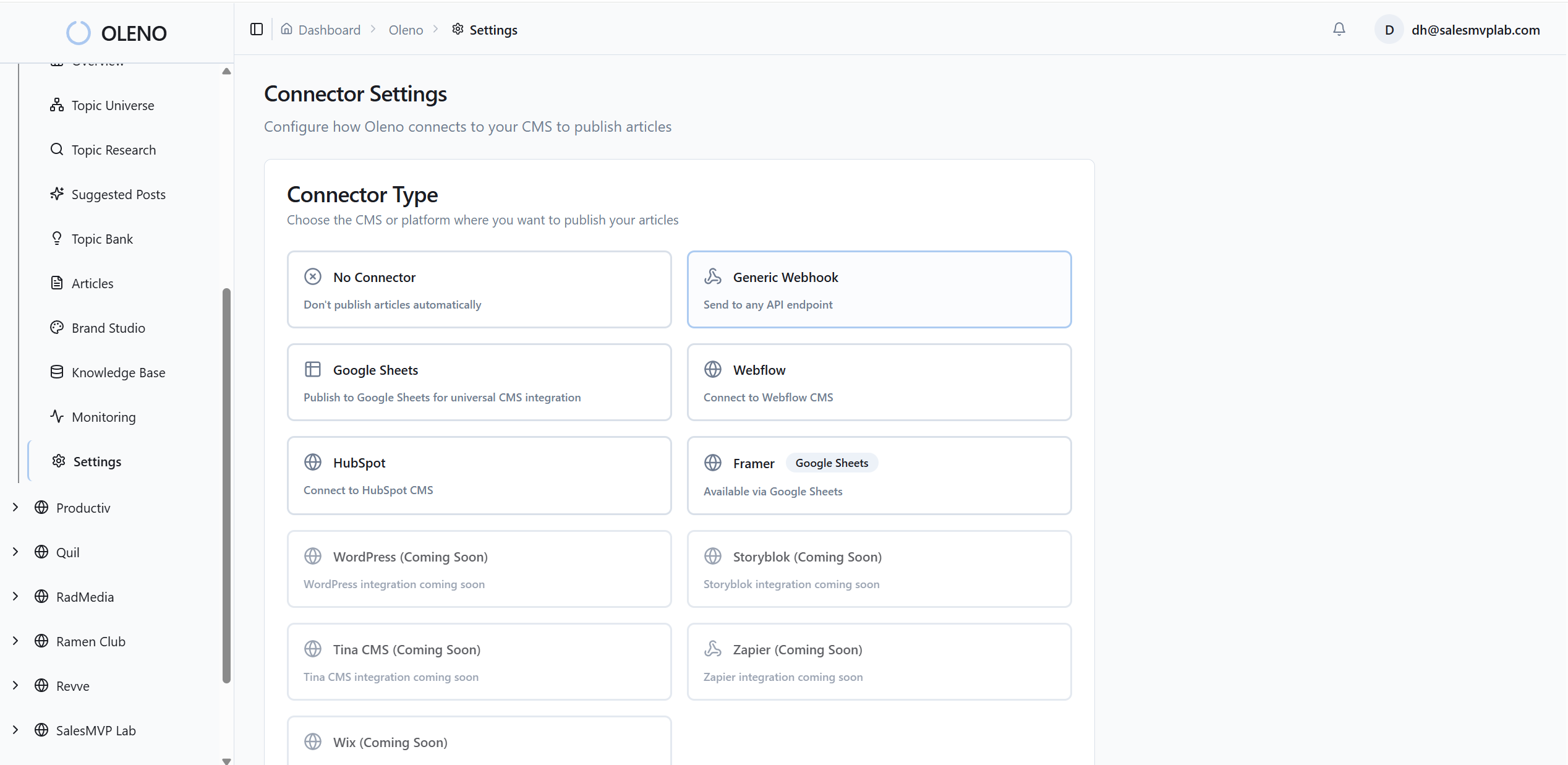
Repeated prompting is where AI content starts to drift. One Monday, the prompt says "write like our founder." The next Monday, someone forgets the product boundary. Two weeks later, the same feature is described three different ways across blog, social, and sales enablement. Not always dramatic. Just enough to make the brand feel less trustworthy.
Oleno doesn't invent positioning when it's missing. The strategy needs to exist first. That's a fair constraint, and honestly a useful one. If a team hasn't settled who they are, what they sell, and what they believe, no operating system can fix that. The tool can codify a strategy. It can't write one for you.
Four shaping points keep judgment where it belongs
Oleno's production flow has four explicit shaping points: Compose, Research, Brief, Outline, and then Draft review. The marketer sets the angle and direction before research runs. Then the marketer sees sources before writing starts. Then the marketer reviews the brief. Then the marketer reviews the outline before a full draft is generated.
That sequence matters. Catching the wrong angle at the brief stage takes minutes. Catching it after a full draft takes hours and usually turns into a rewrite. Same with outline logic. If the structure is wrong, better to fix the skeleton than edit around a bad spine.
Oleno is not for marketers who want content running in the background with no review. The pauses are the product philosophy. If you want zero per-article shaping, those pauses will feel like friction. If you care about what goes under your byline, they feel like control. Pick the right tool for the version of the problem you actually have.
QA and publishing close the loop
Oleno runs drafts through a Quality Gate before the marketer sees the piece. The check covers factual grounding, voice match, structure, link health, and SEO density. If the draft falls short of the configured threshold, a targeted repair pass runs and QA checks it again before it moves forward.
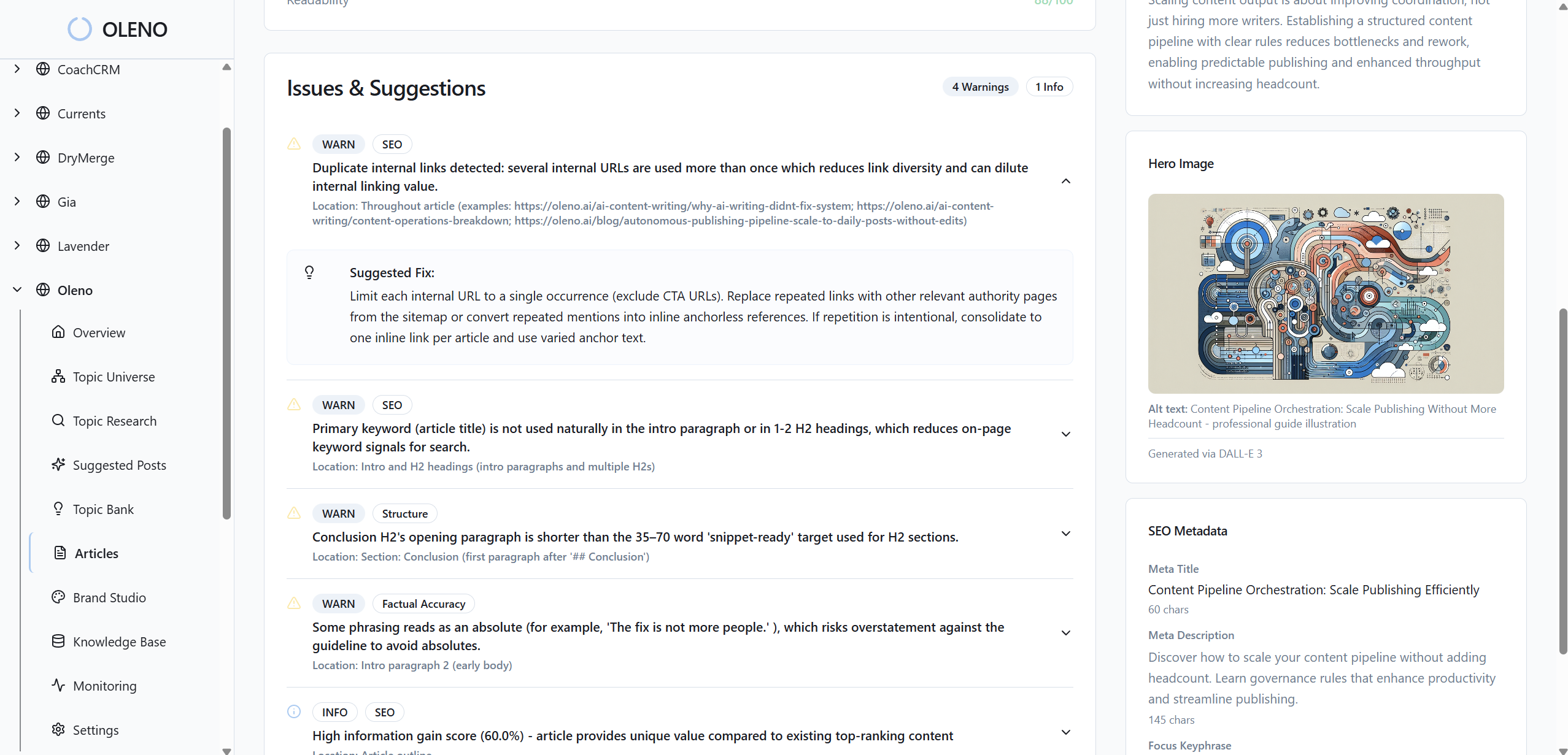
Publishing then goes into supported destinations: WordPress, Webflow, Storyblok, HubSpot, Tina, Wix, Framer, Google Sheets, Webhook, and Zapier. Oleno handles the publishing work that usually turns the marketer into the integration layer between AI output and CMS formatting. The marketer still reviews the piece. The system handles the repetitive parts around that review.
This is where the content operating system stops being a diagram. Topic decisions, source control, QA, voice, product truth, repurposing, and publishing all sit in one flow. If that's the part your team keeps rebuilding manually every week, that's the part worth fixing first.
Build the System Before You Scale the Calendar
A content operating system should make your team better at choosing, shaping, reviewing, reusing, and measuring content before it asks you to publish more. Once those decisions are clear, AI becomes useful production capacity. Before that, it mostly makes confusion look productive.
The shift is already happening. Marketing teams are becoming systems operators, not just manual producers of every asset. That doesn't make the marketer less important. It makes the marketer's judgment more important, because the system repeats whatever the marketer codifies. Good judgment compounds. So does bad judgment.
Measurement needs the same upgrade. Publish volume is easy to count, but weak as a leadership metric. Better measures: influenced pipeline, coverage depth by persona and pain, sales reuse rate, content refresh value, and how often one source asset becomes useful across channels. Leadership becomes more useful when they act as outcome owners, not output counters.
If you want to sketch your own content operating system, start with the five questions that matter: what inputs are trusted, which topics get priority, where does human judgment stay, who checks what, and how do we know the work helped the business. Get those right first. Then scale the calendar.
About Daniel Hebert
I'm the founder of Oleno, SalesMVP Lab, and yourLumira. Been working in B2B SaaS in both sales and marketing leadership for 13+ years. I specialize in building revenue engines from the ground up. Over the years, I've codified writing frameworks, which are now powering Oleno.
Frequently Asked Questions