How to Build a Content Operations System to Scale Content Marketing for SaaS

You can publish a lot and still feel stuck. I’ve done it. Years ago I ran a contributor network that hit 120k monthly visitors. Looked great on a chart. But the back half of the funnel stayed stubborn, because we weren’t running a system. We were managing posts, not building authority.
Later, as a solo marketer, I could crank out 3–4 strong pieces a week. Then the team grew. Quality drifted. Rework crept in. Writing time got traded for leadership time. Result: more meetings, more approvals, and content that ranked but didn’t connect cleanly to the product. That tension is exactly why I care about systems, and why Oleno exists.
Key Takeaways
- Treat content as a governed system, not a pile of disconnected tasks
- Map topics to product problems and hold a 70/30 “product vs. adjacent” ratio
- Turn recurring edits into upstream rules (policy-as-code)
- Quantify rework and variance to win executive buy‑in
- Enforce voice, accuracy, and originality with gates before publish
- Build a deterministic pipeline for links, schema, visuals, and publishing
- Use an autonomous engine so this is repeatable at scale
Why Volume Without A System Stalls Growth
Publishing more, without a system, fragments work across people, tools, and one‑off decisions. You get inconsistent voice, slow approvals, and content that ranks yet fails to drive pipeline. I watched this at a proposal software company that ranked broadly while missing demand‑gen because topics drifted away from the product. Classic.

Step 1: Audit Your Current Workflow And Bottlenecks
Start by seeing the mess, not fixing it. Map the path from idea to publish. Who touches what. Where work waits. Where drafts reopen. Time‑box the audit to a week and label the pain. Keep it objective and observable.
- List each stage and owner
- Note average time in stage and common reopen reasons
- Flag low‑predictability steps in red
Capture two concrete examples of “frustrating rework” and “brand cleanup” from the last month. You’ll use these as proof points when you rewrite rules. For a quick primer on where teams usually break, skim this content operations breakdown.
Step 2: Map Content To Revenue, Not Just Rankings
Tie recent posts to downstream signals, even if directional. Did the piece assist opportunities, drive demo requests, or attract product‑qualified traffic? Create two buckets, then set a sanity ratio: “directly tied to product problems” vs. “adjacent thought leadership.” A simple 70/30 target pulls your calendar back toward pipeline.
Where Is The Real Bottleneck Today?
Write faster, sure. But ask the harder question: are you missing a system that enforces differentiation, structure, and brand safety? Audit the last ten drafts that “needed one more pass.” Tag each cause: unclear brief, fact drift, voice mismatch, missing visuals, broken internal links. The pattern tells you what must move upstream and become rules.
Curious what this looks like in practice? try using an autonomous content engine for always-on publishing.
Treat Content As A System, Not A String Of Tasks
Treating content as a system means you control upstream levers that create consistency, originality, and speed. Topic coverage is intentional. Differentiation is enforced before writing. Visuals and structure match your brand by default. That’s how authority compounds without daily heroics.

Step 3: Define Your Topic Universe (Clusters, Coverage, Cooldowns)
Build a topic universe that mirrors your product pillars. Group related topics into clusters. Track coverage status per cluster, then enforce a 90‑day cooldown to stop repetitive takes. Seed from your knowledge base, sitemap, and core focus areas so the system is grounded in product reality, not a spreadsheet of random keywords.
A note on language: call statuses what they are, underserved, healthy, well‑covered, saturated. Coverage dictates what you write next. Not hunches. Not last week’s rankings.
Step 4: Turn Edits Into Rules (Governance Over Guidelines)
Any fix you make twice becomes policy‑as‑code. Convert line edits into upstream rules your system enforces automatically. You stop reminding; the rule stops slipping.
- Banned terms and phrasing constraints
- Claims that require a knowledge base citation
- Image placement rules for solution sections
- Schema patterns for consistent markup
- Internal link anchors and placement boundaries
Store rules centrally (versioned). Apply automatically. Quality becomes predictable, not personality‑driven. Remember: more content doesn’t create authority. Coordinated execution does.
What Is A Topic Universe And Why Does It Matter?
A topic universe is the map for what you should write and when. It replaces “idea lists” with a coverage model that compounds authority across clusters. It prevents over‑publishing one angle while neglecting the rest. Most important, it forces purpose before production so differentiation is built in, not bolted on.
The Hidden Costs Of Ad‑Hoc Publishing Add Up Fast
Ad‑hoc publishing looks fast, then taxes you later through rework, variance, and brand risk. Small inefficiencies compound into real budget, especially when approvals bounce and voice drifts. If you’ve reopened five drafts in a week, you’ve felt the drag. It’s a system problem, not a writer problem.

Step 5: Quantify The Rework Tax
Let’s say you ship eight posts this month. Five require two extra editorial passes at two hours each. That’s 20 hours gone. Multiply by fully loaded rates and you’ll see a cost you could move upstream into better briefs and rule enforcement.
- Track reopen reasons across a quarter
- Attach rough hours and cost to each reason
- Highlight the top two causes you can eliminate with governance
Quick math you can show on a slide:
- Rework hours = reopened_drafts × extra_passes × hours_per_pass
- Rework cost = rework_hours × fully_loaded_rate
When “voice” or “facts” dominate, the fix isn’t another editor. It’s brand constraints and knowledge‑base grounding enforced before the draft exists. If you want a sanity check on why faster drafting alone doesn’t reduce variance, read this on AI writing limits.
Step 6: Model Cadence Vs. Quality Scenarios
Build three scenarios for the quarter: Current state. “More writers.” “Governed system.” Compare publish velocity, rework hours, and percent of articles tied to product problems. You’re not chasing precision. You’re showing how a system reduces variance and protects differentiation. One slide for the exec team makes the trade‑offs clear.
You don’t need a PhD model to make this land.
What Does Inconsistency Cost Per Quarter?
Don’t ignore soft costs. Leadership time in approvals, brand risk from off‑message claims, and missed internal links that leak authority all drag performance. A conservative 10–20% quarter‑over‑quarter drag is common when variance is high. That baseline becomes your payback target when you invest in a deterministic system.
Ready to stop paying the rework tax every month? Request a demo now.
Consistency, Brand Safety, And Differentiation Are On The Line
Consistency protects brand trust and speeds approvals. Brand safety keeps risky claims out before they publish. Differentiation earns attention because every article adds something new. You get there by encoding voice, accuracy, and originality into the process, not hoping a final pass catches everything.
Step 7: Create A Voice And Narrative Guardrail
Codify tone, phrasing, banned terms, and narrative scaffolding so drafts read like you, not the internet. Tie voice patterns to moments in the article: thesis, evidence, solution.
Examples that help:
- Tone map by section (intro = bold, middle = evidence‑heavy, close = crisp CTA)
- “Say this, not that” list for common phrases
- Proof sources hierarchy (internal KB > product docs > authoritative external)
A shared definition of “our lines” replaces approval roulette with predictable quality. This is where a brand‑studio‑style ruleset shines.
Step 8: Build QA Gates That Block Risk, Not Creativity
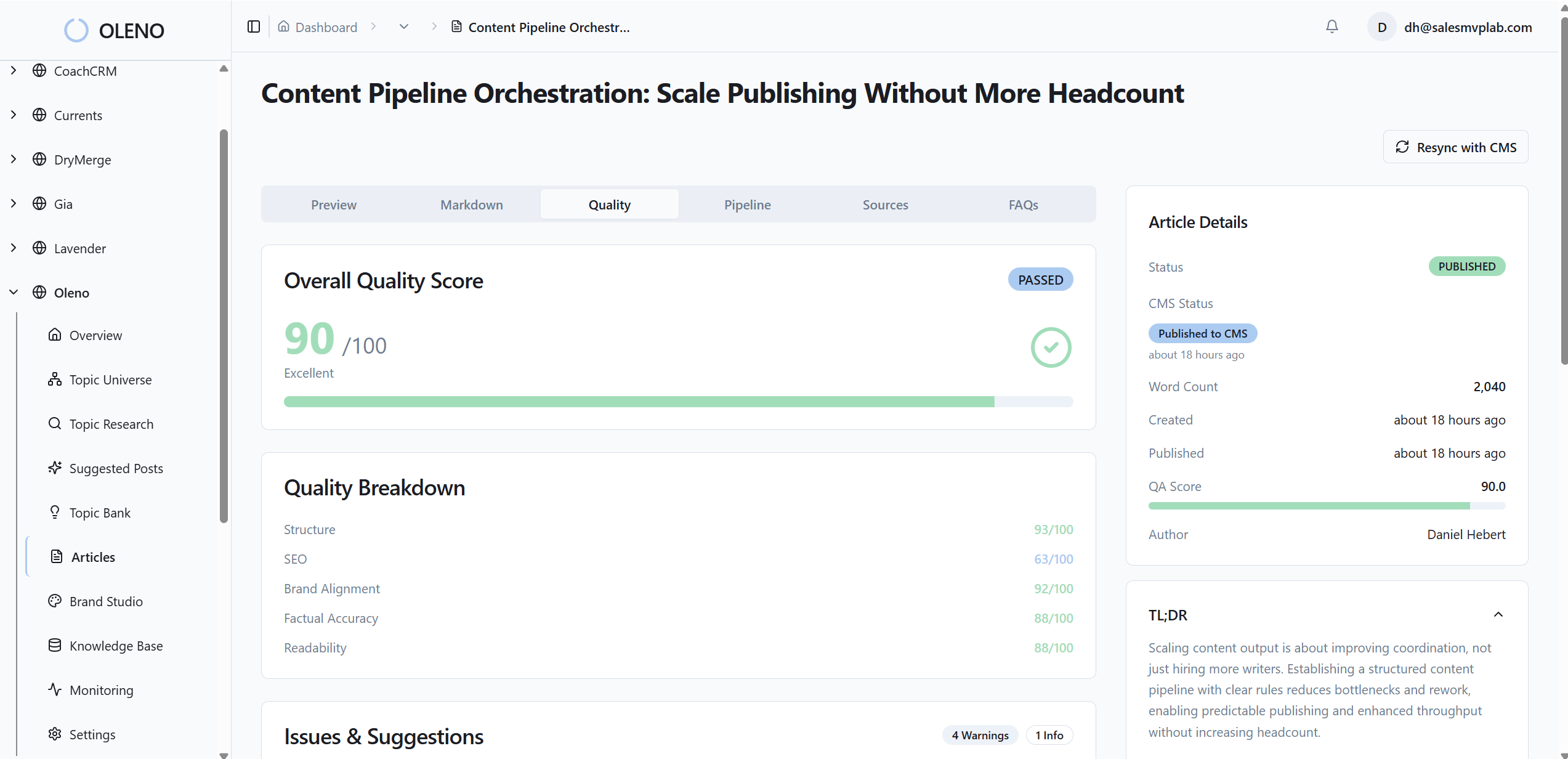
QA is a publish gate, not a performance dashboard. Check structure, voice alignment, knowledge base accuracy, snippet readiness, and internal link placement before anything goes live. Set a clear passing score, say 85, and auto‑refine low‑scoring areas. Creativity lives inside the guardrails. Risk stays outside.
How Do You Preserve Differentiation At Scale?
Enforce originality upstream. Every brief should include competitive coverage, information gaps, and an Information Gain Score (your added value vs. the SERP baseline). Flag low‑gain outlines early. You’re not copying the SERP. You’re adding what’s missing. That one habit keeps your catalog from becoming a sea of sameness, even as volume rises.
A Governed, Deterministic Content Operations Model
A governed, deterministic model standardizes the path from topic to publish so work is predictable. Each stage runs in a fixed order with clear inputs and outputs. Links and schema are programmatic. Visuals are brand‑consistent by default. This model lowers variance and compounds authority over time.
Step 9: Build The Brief‑To‑Publish Pipeline
Fix the sequence and stick to it: topic → angle → brief → draft → QA → enhancements → image → publish. At each stage, require knowledge‑base grounding and brand voice enforcement. No skipping steps when deadlines creep. Log pipeline inputs and outputs so you can retry failed work and keep a clean version history.
If you want a primer on why this system beats prompts, read about autonomous content operations and the shift toward content orchestration.
Step 10: Operationalize Internal Links And Schema
Inject internal links deterministically from a verified sitemap after text and visuals are complete. Place links at natural sentence boundaries and match anchors to page titles. Eliminate fabricated URLs entirely. Auto‑generate JSON‑LD for Article, FAQ, and Breadcrumbs, then validate and attach during publishing.
For reference on structured data basics, see Google’s introduction to structured data and the Schema.org Article type.
Step 11: Enforce Daily Suggestions With Cooldowns
Keep the pipeline fed with topic suggestions driven by coverage gaps and cluster saturation. Approve, then move directly into generation. Enforce 90‑day cooldowns so repetition doesn’t erode breadth. No keyword‑volume dashboards. No rank projections. The job here is simple: ship differentiated, publishable articles that compound authority. For the rationale, this overview of autonomous content systems is a useful anchor.
How Oleno Automates The Workflow End To End
Oleno automates the complete system, from strategy to publish, so you get consistent, on‑brand articles without handoffs. It connects your knowledge base, enforces your brand voice, generates structured briefs, produces drafts, places visuals, injects links and schema, passes a QA gate, and publishes to your CMS. Think governed pipeline, not a prompt.
Step 12: Connect Knowledge Base And Brand Studio
Remember those “one more pass” drafts caused by fact drift and voice mismatch? Oleno addresses them at the start. It processes your knowledge base and applies brand voice and writing constraints during angle creation and drafting. Claims stay grounded. Tone stays consistent. The result: fewer reopen loops before QA.
Step 13: Generate Briefs With Information Gain Scoring
Oleno creates structured briefs with competitive research and an Information Gain Score. Low‑differentiation outlines are flagged before writing, so you fix the brief instead of editing a weak draft later. Briefs also include three to five authoritative external link candidates with suggested anchors. You set minimum scores. Oleno enforces them.
Step 14: Deterministic Linking, Schema, Visuals, And QA → Publish
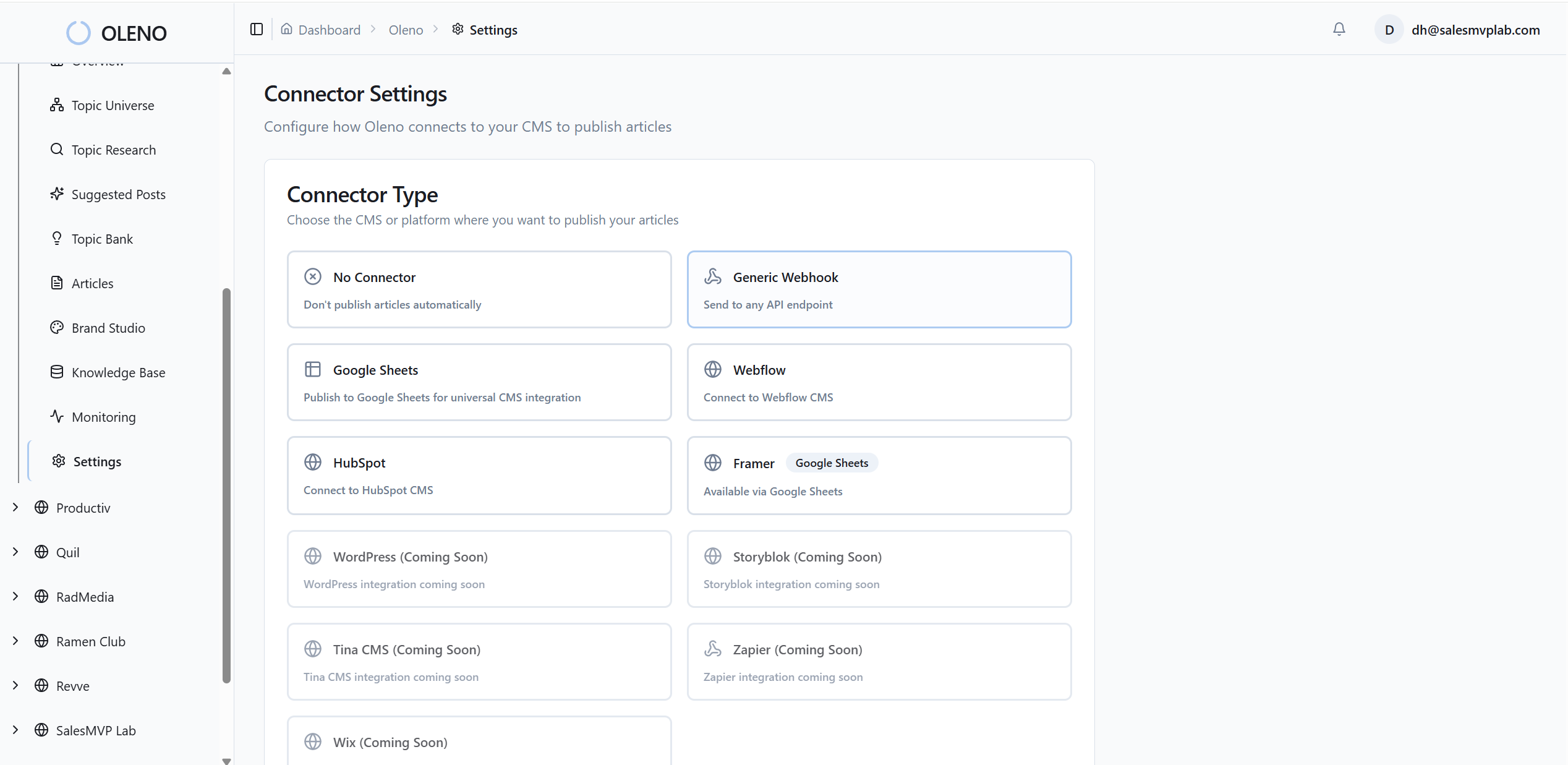
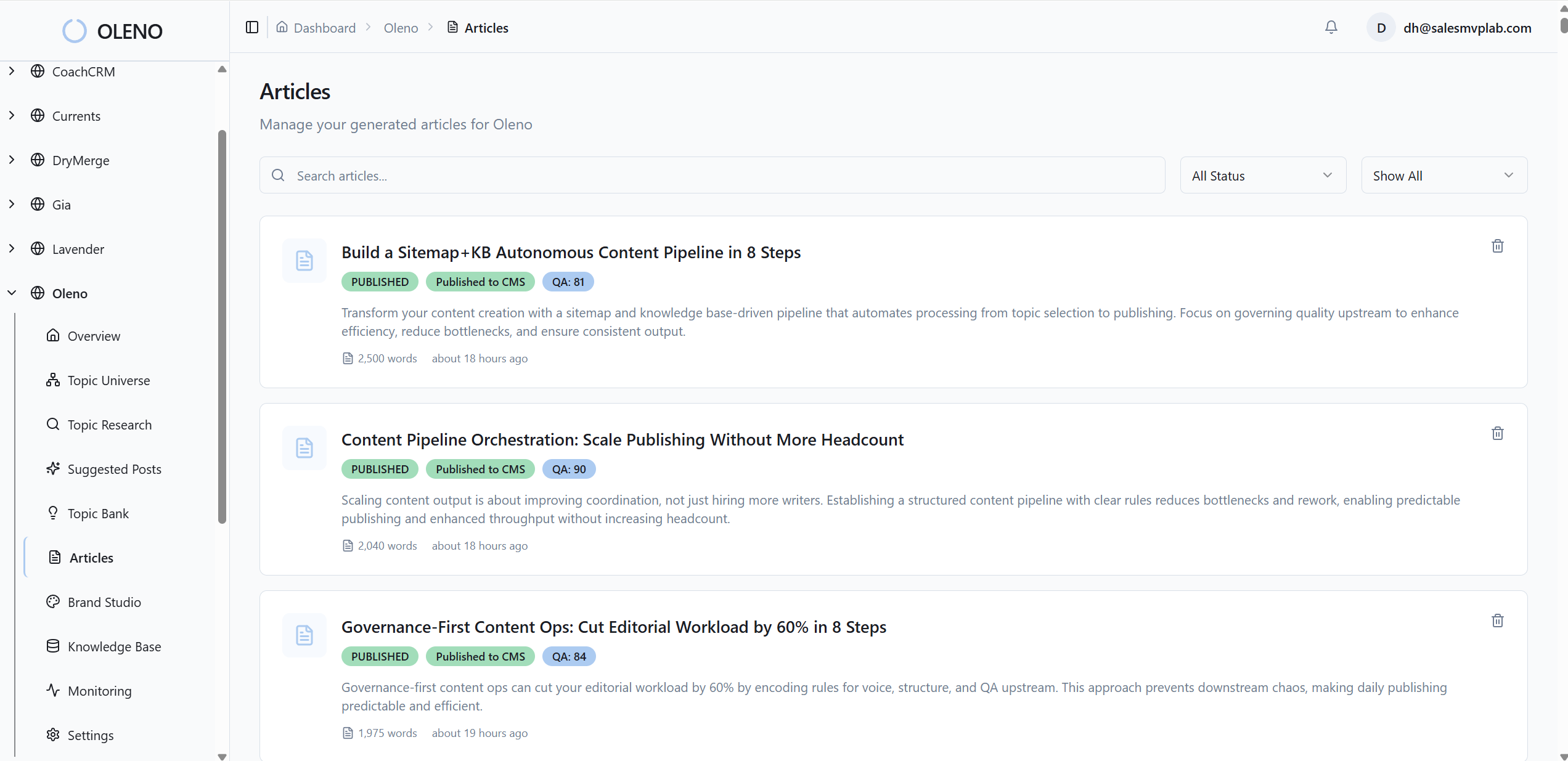
This is where Oleno’s determinism pays off. It injects 5–8 internal links using only verified URLs from your sitemap, generates Article, FAQ, and Breadcrumb JSON‑LD, and produces brand‑consistent hero and inline visuals. Solution sections get product visuals where they matter. Then a QA gate runs 80+ checks, structure, voice, information gain, snippet readiness, visual alignment. Articles publish to WordPress, Webflow, or HubSpot with mapped fields and duplicate prevention. Pipeline events are logged for reliability, not analytics.
Ready to see the governed pipeline run end to end? Request a demo.
Conclusion
You don’t need more content. You need a system that makes every article purposeful, original, and on‑brand. Map topics to your product, turn fixes into rules, quantify the rework tax, and standardize the pipeline from brief to publish. When you operate this way, cadence rises, variance falls, and authority compounds.
If you want the system handled for you, Oleno runs it as software. Knowledge‑base grounding, brand voice enforcement, topic universe, briefs with information gain, visuals, links, schema, QA, publishing. No prompt juggling. No last‑minute cleanups. Just consistent, credible content that supports your revenue story.
About Daniel Hebert
I'm the founder of Oleno, SalesMVP Lab, and yourLumira. Been working in B2B SaaS in both sales and marketing leadership for 13+ years. I specialize in building revenue engines from the ground up. Over the years, I've codified writing frameworks, which are now powering Oleno.
Frequently Asked Questions