Byword vs Outrank: Which Should You Choose?

If you’re comparing Byword vs Outrank, you’re not really comparing “AI writing quality.” You’re choosing what kind of content machine you want to run. One is built around programmatic, template-driven batches. The other leans into fast, SERP-led briefs and publish flows. Both can work, but they fail in different places when you push volume.
What You’re Really Choosing Between With Byword And Outrank
You’re choosing between programmatic batch generation (Byword) and SERP-driven speed workflows (Outrank), not just two “AI blog generators.” Byword is usually picked when you want structured, repeatable page types at scale, while Outrank is usually picked when you want quick briefs tied to what’s ranking now. The tradeoff shows up when you start publishing dozens to hundreds of pages.

| Feature | Byword | Outrank | Oleno |
|---|---|---|---|
| Pricing | ~$5/article or $99/month (reported) (Skywork Review, Babylovegrowth Comparison) | $49/month (limited-time) and $99/month regular (reported) (Outrank Overview) | from $449/mo |
| Best For | Programmatic SEO campaigns from big keyword lists (TripleDart Guide) | Fast keyword-to-brief-to-publish SEO workflows (Outrank Overview) | Teams that want end-to-end autonomous creation and publishing |
| Key Strength | Batch generation with structured templates and variables (reported) (Skywork Review) | SERP-driven briefs and on-page optimization emphasis (Outrank Overview) | Deterministic pipeline (topic → publish), KB grounding, QA-Gate checks, CMS publishing |
| Typical Limitation | Not ideal for deep expert content without editing (reported) (Babylovegrowth Comparison) | Quality can vary, edits often needed (reported) (Babylovegrowth Alternatives) | Relies on your knowledge base quality; no analytics |
| Integrations | CMS publishing and GSC tracking reported (Babylovegrowth Comparison) | Publishing connectors like WordPress/Webflow/Notion/API highlighted (Outrank Overview) | CMS connectors for automated publishing |
Key Takeaways:
- Byword tends to fit teams building large, repeatable page sets (glossaries, location pages), where templates and batching matter most.
- Outrank tends to fit teams that want SERP-aligned briefs and fast publishing loops, even if drafts need more human cleanup.
- Pricing looks similar at the entry level, but Byword’s per-article model can change quickly once you scale volume (reported).
- If your bottleneck is coordination (briefs, rewrites, publishing), an autonomous system like Oleno can remove entire handoffs, not just speed drafting.
Programmatic scale vs closed-loop workflows
Programmatic scale is about producing lots of pages that share a structure, like “{service} in {city}” or glossary entries, and keeping the machine consistent. Closed-loop workflows are about connecting research, generation, publishing, and sometimes performance feedback, so the system improves what it ships next.
I’ve lived this pain in a different form.
Back in 2012 to 2016 I ran a marketing how-to site that grew by volume and breadth. When you’re publishing at scale, you learn a weird truth. Most pages will never be heroes. They’ll get 20, 50, maybe 100 visits a month. But the long tail stacks, and that’s how you win. The catch is you can’t run that with a fragile process. Your workflow has to be boring and repeatable.
Byword leans harder into the “repeatable programmatic machine” side, with batch generation and structured modes being a theme in third-party writeups (Skywork Review, TripleDart Guide). Outrank leans into “fast SEO workflow,” with an emphasis on keyword planning, SERP analysis, and one-click publishing (Outrank Overview).
So when you’re choosing, ask yourself: are you building a library of structured pages, or are you trying to ship posts that mirror the SERP quickly?
The Hidden Time Tax Of SEO Content At Scale
The hidden cost of scaling SEO content is the time you spend coordinating research, rewrites, and publishing, not the time spent generating first drafts. Even with tools that create long-form articles quickly, teams often get stuck doing repetitive quality control and factual checks. For example, publishing 60 articles a month can quietly turn into dozens of hours of rework.

Rewrites and factual accuracy checks
Rewrites are the tax you pay when the system produces drafts that are “pretty good” but not shippable, and factual checks are the tax you pay when you don’t fully trust what got generated. Both Byword and Outrank get positioned as tools that help teams scale, but the reviews and comparisons still call out quality variance and editing needs in certain use cases (Babylovegrowth Comparison, Babylovegrowth Alternatives).
Let’s pretend you’re publishing 15 articles a week. Not crazy if you’re doing programmatic SEO.
If each article needs:
- 20 minutes of fact-checking
- 15 minutes of rewriting intros and conclusions
- 10 minutes of formatting and metadata cleanup
That’s 45 minutes per article. Times 60 articles is 45 hours a month.
That’s a full work week. Every month.
And the frustrating part is it doesn’t feel like a single big project. It feels like constant annoying cleanup, spread across the team. That’s when SEO content starts to become a coordination headache, not a writing problem.
Coordination across research, drafting, and publishing
Coordination overhead is what happens when “content” is actually a relay race, brief gets handed to writer, draft gets handed to editor, editor pings SME, someone fixes formatting, then somebody remembers to publish. Tools can speed up one leg of that race, but the race still exists.
Outrank pitches an end-to-end workflow with keyword discovery, SERP analysis, content generation, and publishing connectors (Outrank Overview). Byword is positioned around high-volume programmatic campaigns, including keyword research and publishing, and some sources mention Google Search Console integration for tracking (Babylovegrowth Comparison).
Even if those flows are smoother than a totally manual process, you still have the human question marks:
- Who decides the next topic set?
- Who verifies the claims?
- Who checks if the page is meaningfully different from the last 30 you published?
- Who hits publish, and who cleans up when the CMS format breaks?
This is where teams start to feel “busy” but not effective. Lots of motion. Not always a lot of progress.
Byword Overview
Byword is typically the better fit when you want programmatic, template-driven SEO content in batches, with a workflow that supports generating lots of similar pages quickly. It’s frequently discussed in the context of programmatic SEO and scaling production from large keyword lists. For example, guides and reviews frame it as a tool for high-volume campaigns rather than a one-post-at-a-time writing assistant (TripleDart Guide, Skywork Review).
Byword strengths
Byword’s strengths are mostly about structure and throughput, assuming you’re willing to think in templates and batches. That’s not for everyone. But if you’ve ever tried to build out 500 pages and keep them consistent, you start to appreciate “boring structure.”
Third-party writeups describe Byword as geared toward scaling SEO content, including batch generation and programmatic approaches (Skywork Review, TripleDart Guide). It’s also mentioned in roundups that position it among tools used for scaling content production (Babylovegrowth Comparison).
Practically, teams tend to like Byword when:
- they already know what page types they want, and
- they want to generate lots of them without reinventing the wheel every time.
Key strengths commonly cited include:
- Programmatic, batch generation from large keyword lists (reported) (Skywork Review)
- SEO-focused workflows and structured modes, plus metadata-related features mentioned in comparisons (reported) (Babylovegrowth Comparison)
- Publishing and tracking elements, with some sources noting Google Search Console integration (reported) (Babylovegrowth Comparison)
- Brand tone customization and file-based grounding described in third-party reviews (reported) (Skywork Review)
Byword limitations
Byword’s limitations tend to show up when you leave the “structured programmatic” lane and expect nuanced, expert writing without human involvement. The same sources that praise volume also hint that deep expert content can still require editing and oversight (Babylovegrowth Comparison).
There’s also the human factor. Programmatic tools usually demand template discipline. Someone on your team needs to care about variables, page types, and consistency rules. If you don’t have that person, you end up with a messy library of pages that all look similar, and not in a good way.
Commonly mentioned limitations include:
- A steeper learning curve because programmatic setups require more upfront structure (reported) (Skywork Review)
- Pricing that can be harder for solo users depending on volume and plan choice (reported) (Babylovegrowth Comparison)
- Not always a fit for deep, nuanced writing without a human edit pass (reported) (Babylovegrowth Comparison)
Byword pricing and value
Byword is usually described as hybrid priced, with sources reporting roughly $5 per article and/or around $99 per month, depending on plan and usage (Skywork Review, Babylovegrowth Comparison). That pricing model can be attractive if you want predictable unit economics per page, especially in programmatic campaigns.
But hybrid pricing cuts both ways. If your volume spikes or you start regenerating content often, your “cheap per page” can drift. Not always, but it’s something to model before you commit.
One practical way to evaluate value is to price in your edit hours. If you save $200 on software but spend $1,500 a month in editing time, you didn’t really save money.
How Oleno is Different: Byword can be a strong fit when you already have a programmatic template plan and want batch output, but it still often leaves teams doing coordination and cleanup. Oleno runs a fixed pipeline from topic selection through publishing, grounded in your knowledge base and enforced by QA-Gate checks. It’s less about “generate more drafts,” and more about reducing rewrites and handoffs.
Outrank Overview
Outrank is usually the better fit when you want a fast SEO workflow that starts with SERP-driven research and ends with one-click publishing. Its own materials emphasize an AI SEO content generator approach with keyword research, SERP analysis, optimization, and publishing connectors. For example, Outrank highlights generating content aligned to ranking pages, plus publishing options like WordPress and Webflow (Outrank Overview).
Outrank strengths
Outrank’s main strength is speed with SEO structure baked in. If you’ve got a marketer who’s tired of juggling five different steps, this kind of “plan to publish” workflow can feel like a relief.
Outrank describes features like keyword planning, SERP analysis, content generation, and publishing integrations (WordPress, Webflow, Notion, API) (Outrank Overview). Outrank also positions itself in SEO tool roundups aimed at smaller businesses, which typically emphasizes accessibility and getting content out the door (Outrank Small Business SEO Tools).
Strengths that come up in public materials and comparisons:
- End-to-end workflow, from keyword discovery through publishing (Outrank Overview)
- SERP-driven briefs and optimization emphasis, built around what’s ranking now (Outrank Overview)
- Multilingual positioning, including claims of broad language support in some materials (reported) (Outrank Overview)
- Collaboration allowances, with “unlimited users/collaborators” mentioned in plan descriptions (reported) (Outrank Overview)
Outrank limitations
Outrank’s limitations tend to look like what you’d expect from a SERP-first generator. You can align structure to the SERP, but you might still fight quality variance and factual sharpness, depending on topic complexity and your standards. Third-party comparisons mention variability in quality and accuracy issues that can require edits (reported) (Babylovegrowth Alternatives).
There’s also an integration nuance. Outrank highlights publishing connectors, but some comparisons don’t highlight a direct Google Search Console integration the way Byword-related roundups do (reported) (Babylovegrowth Comparison, Outrank Small Business SEO Tools).
Limitations commonly mentioned:
- Draft quality can vary, requiring human edits and rewrites (reported) (Babylovegrowth Alternatives)
- Regular (non-discount) pricing may feel higher than budget tools (reported) (Outrank Overview)
- Gaps in certain direct integrations, depending on what your team expects (reported) (Babylovegrowth Alternatives)
Outrank pricing and value
Outrank’s pricing is commonly reported as $49/month as a limited-time offer and $99/month at the regular rate, based on its public materials and reviews (Outrank Overview, Babylovegrowth Alternatives). That puts it in the same general starting range as Byword’s reported monthly plan.
Value-wise, Outrank tends to make sense when the SERP alignment and publishing speed actually reduce your cycle time. If you’re still doing heavy rewrites and manual factual checks, you’re back to paying for software plus paying in time. And time is always the expensive one.
How Oleno is Different: Outrank is built around fast SERP-driven briefs and generation, which can work well when your bar is “publish quickly and iterate.” Oleno is designed as a controlled pipeline that chooses topics, defines angles and structure before drafting, then runs QA-Gate checks for voice, structure, and knowledge grounding before publishing. That’s aimed at reducing the rewrite loop that shows up when quality varies.
Why Oleno Could Be A Better Fit For Some Teams
Oleno can be a better fit when your real bottleneck is coordination and repeatability, not drafting speed. It runs a fixed, end-to-end pipeline (topic to publish) grounded in your knowledge base, with QA-Gate checks before anything ships. For example, if your team is stuck rewriting and reformatting drafts, Oleno is built to remove those handoffs.
Before we get into the details, here’s the more comprehensive side-by-side. This is the part buyers usually screenshot and send internally.
| Feature Category | Byword | Outrank | Oleno |
|---|---|---|---|
| Primary Workflow | Programmatic batch campaigns (reported) (Skywork Review) | SERP-driven workflow and publishing (Outrank Overview) | Autonomous pipeline: topic → angle → brief → draft → QA → publish |
| Programmatic/Batch Generation | ✓ (strong) (TripleDart Guide) | ✓ (good) (Outrank Overview) | ✓ |
| SERP-Driven Briefs | Reported ✓ (Skywork Review) | ✓ (core) (Outrank Overview) | Not positioned as SERP-brief-first |
| On-Page Scoring Emphasis | Reported / mentioned in comparisons (Babylovegrowth Comparison) | ✓ (highlighted) (Outrank Overview) | QA-Gate checks include SEO formatting |
| Google Search Console Integration | Reported ✓ (Babylovegrowth Comparison) | Not highlighted in cited materials (Outrank Small Business SEO Tools) | ✗ (no analytics) |
| Internal Linking Suggestions | Reported ✓ (Babylovegrowth Comparison) | ✓ (Outrank Overview) | Not specified as a feature |
| Publishing Connectors | ✓ (CMS publishing reported) (Skywork Review) | ✓ (WordPress/Webflow/Notion/API) (Outrank Overview) | ✓ (CMS connectors) |
| Brand Voice Controls | Reported ✓ (Babylovegrowth Comparison) | Reported ✓ (Outrank Overview) | ✓ (Brand Studio) |
| Knowledge Grounding | File-based grounding reported (Skywork Review) | Brand voice preservation noted (Outrank Overview) | ✓ (Knowledge Base grounding via retrieval) |
| Quality Control | Manual review implied in caveats (reported) (Babylovegrowth Comparison) | Manual review often needed (reported) (Babylovegrowth Alternatives) | ✓ (QA-Gate, min passing score 85, auto retry) |
| Images/Media | Reported ✓ (Skywork Review) | ✓ (images/videos mentioned) (Outrank Overview) | ✓ (Image stage in pipeline) |
| Multilingual Support | ~9 languages reported (Babylovegrowth Comparison) | 150+ languages reported (Outrank Overview) | Not specified |
| Pricing Model | Hybrid (per-article + monthly) reported (Skywork Review) | Subscription reported (Outrank Overview) | Sales-led (from $449/mo) |
| Analytics/Performance Reporting | Tracking mentioned via GSC in some sources (reported) (Babylovegrowth Comparison) | Not positioned as a deep analytics product in cited sources (Outrank Overview) | ✗ (no analytics, no dashboards) |
If you want to see how an autonomous workflow feels in practice, you can Request a demo now. It’s the fastest way to sanity-check fit.
Differentiation before drafting
Differentiation before drafting means you don’t start writing until you’ve decided how the page will be meaningfully different from what already exists on your site. This matters because scale creates repetition, and repetition creates “why did we publish this?” pages. For example, if you publish 200 pages from a keyword list, you can accidentally create 40 near-duplicates.
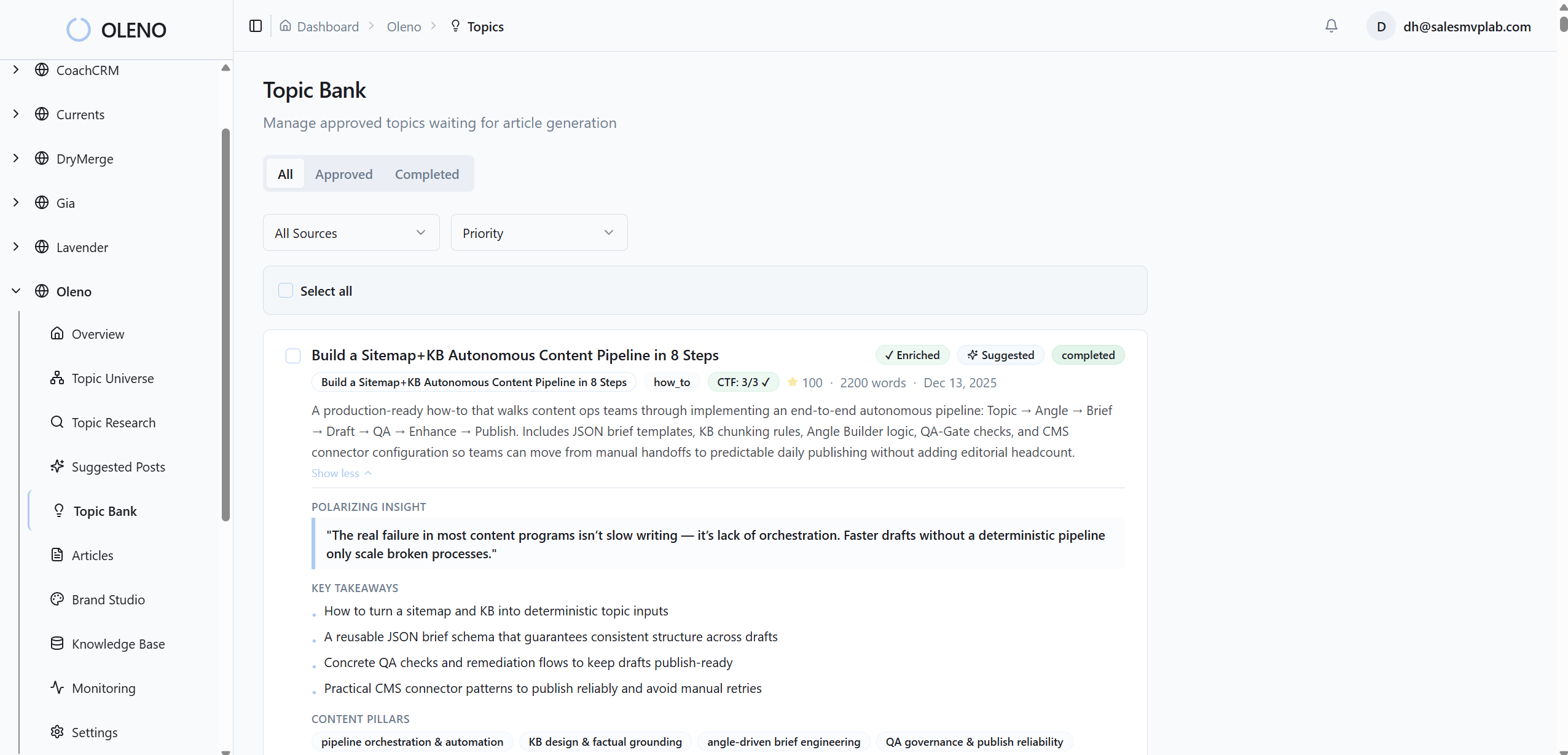
Most tools start from “generate a draft” and leave it to you to catch duplication after the fact. That’s when you get stuck in rewrite loops. You publish, you realize it’s too similar, you go back, you tweak, you re-publish. It’s slow, and it’s demoralizing.
Oleno is built to make that decision up front. It analyzes what content should exist using your sitemap and knowledge base, then defines the angle and structure before drafting. There’s also an information gain filter so topics can be blocked if they don’t add enough value. That’s a very different philosophy than “write 100 pages and clean them up later.”
On-brand, knowledge-grounded creation
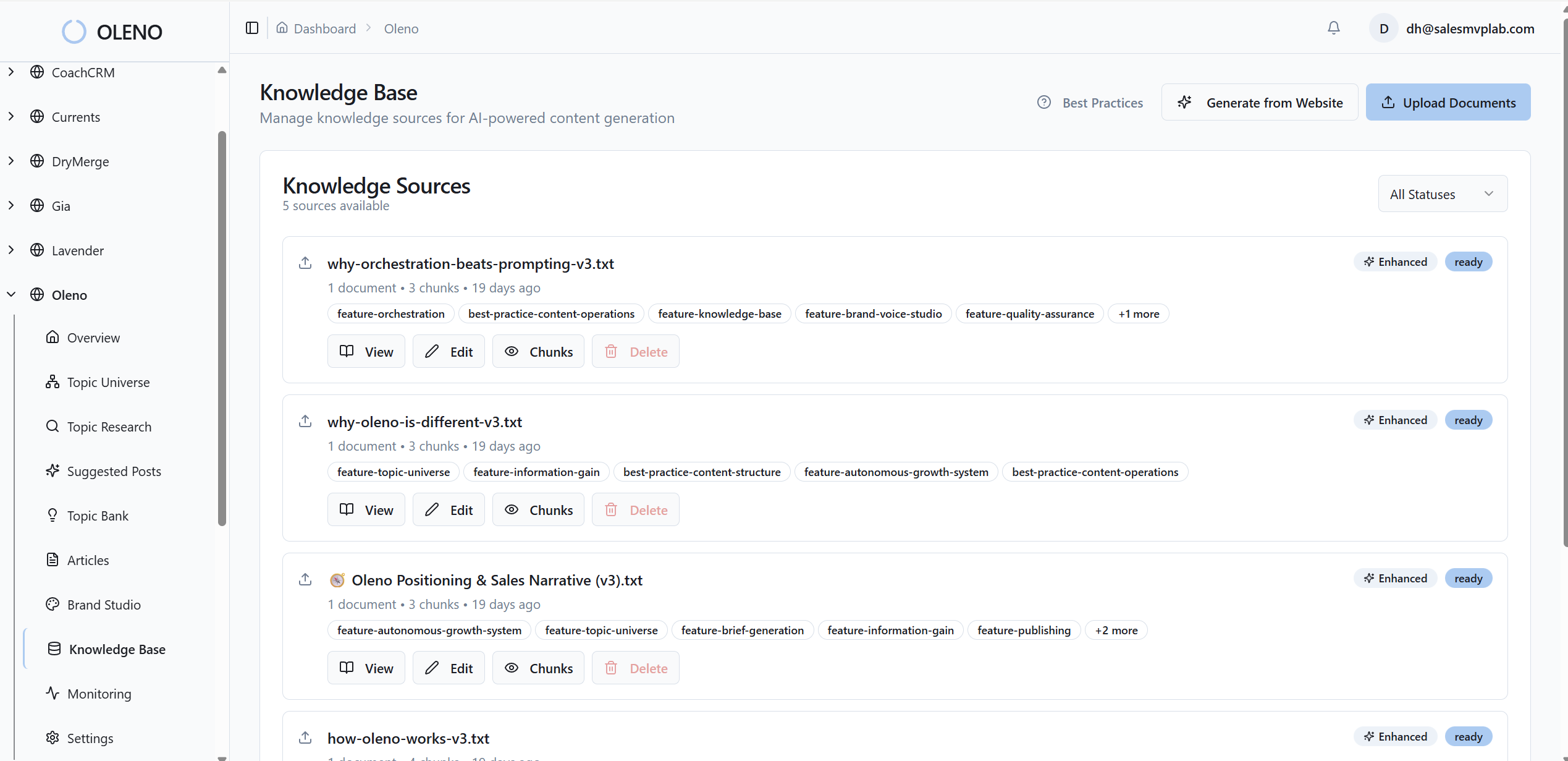
On-brand, knowledge-grounded creation means articles are written using your real internal context, not just generic web patterns, and tone is enforced consistently. This matters because the bigger you get, the harder it is to keep voice consistent across dozens of contributors, or across hundreds of AI-assisted drafts.
At PostBeyond, I was the only marketer early on. I could write fast because I had all the context in my head. As soon as you add people, or you add tools, quality starts to drift. Not because folks are bad. Because they don’t have the same mental model you do.
Oleno handles this with two persistent systems:
- A Knowledge Base used to ground claims during angle creation, drafting, and narrative checks
- Brand Studio rules that enforce tone, phrasing, structure, and even banned terms
Then QA-Gate checks the output (structure, voice alignment, KB accuracy, SEO formatting, LLM clarity, narrative order) with a minimum passing score of 85. If it fails, it improves and re-tests automatically. The point isn’t that this removes humans from content strategy. It’s that it removes the constant editorial babysitting that shows up when you scale.
Getting started with Oleno and pricing
Getting started with Oleno usually looks like configuration, not daily prompting, because it’s designed to run content creation as a system. Pricing starts at from $449/mo, and it’s subscription-based, which makes budgeting straightforward compared to per-article models once volume climbs. For example, if you’re planning daily publishing, predictable pricing matters because content volume stops being a “project” and becomes operations.
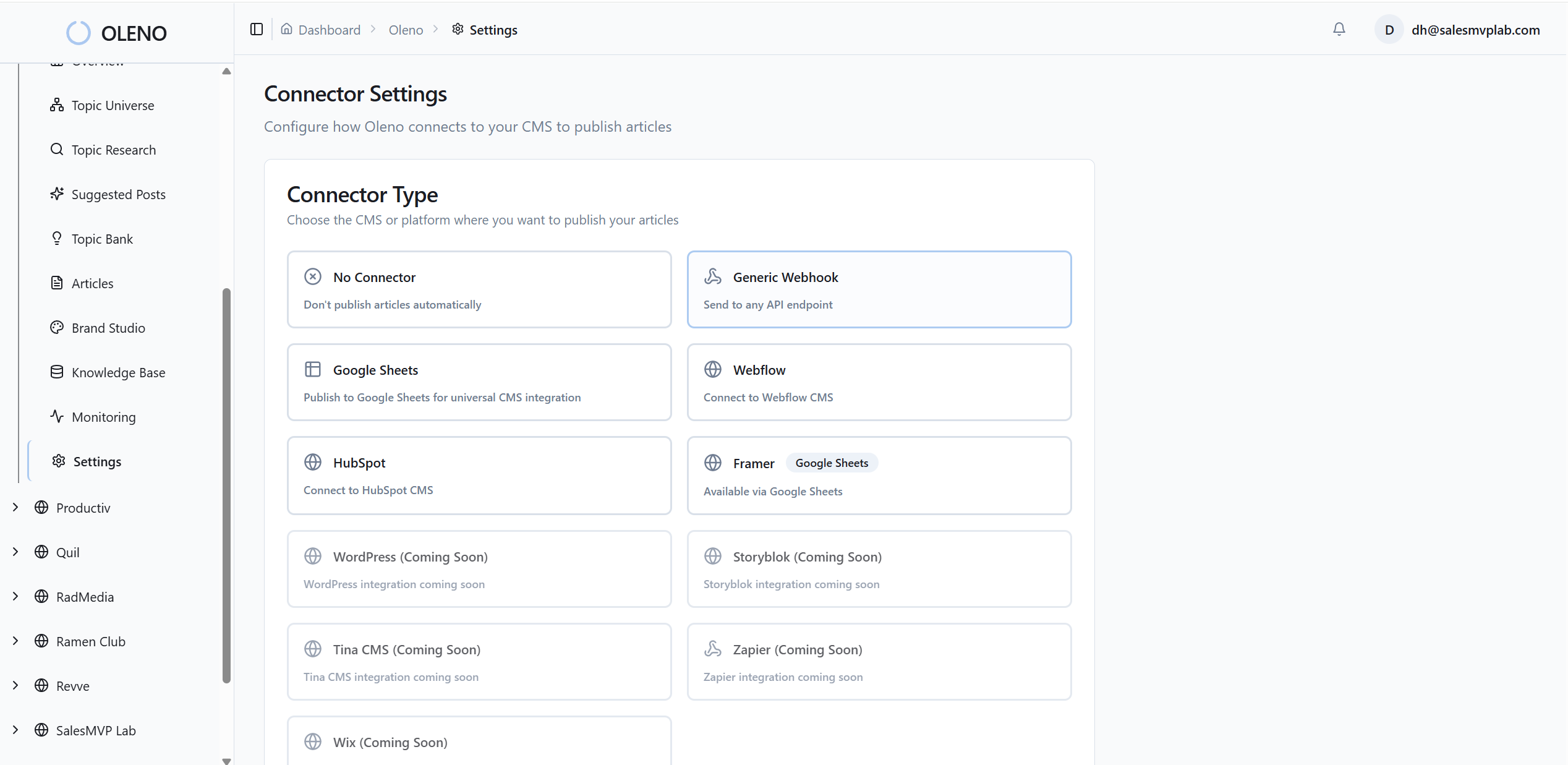
The practical onboarding steps are simple in concept:
- Connect your sitemap so it can see what exists
- Load your knowledge base so claims can be grounded
- Set voice and structural rules in Brand Studio
- Choose your publishing cadence and connect the CMS
Then the pipeline runs: Topic → Angle → Brief → Draft → QA → Enhancements → Image → Publish.
One important caveat, and I’d rather say it plainly. If your knowledge base is thin, your content will be thin. Oleno relies heavily on what you provide. It’s not doing external performance reporting either, no dashboards, no analytics. It’s focused on shipping consistent, publish-ready content, not measuring traffic.
If you’re curious whether this style of system matches how your team works, try using an autonomous content engine for always-on publishing. You’ll know pretty quickly if the output matches your standards.
Conclusion: How To Choose Between Byword, Outrank, And Oleno
Byword vs Outrank comes down to whether you’re building structured programmatic page sets (Byword) or running a SERP-led speed workflow (Outrank). Byword is a solid pick when templates and batch campaigns are the product. Outrank is a solid pick when briefs, SERP alignment, and fast publishing are the product.
But if you’re reading this and thinking, “We don’t actually struggle with drafting, we struggle with everything around drafting,” that’s the signal. That’s coordination. That’s the hidden time tax.
If you want to pressure test an autonomous approach without a big commitment, Request a demo. Generate a few articles, look at the structure, and decide if it reduces the rewrite loop for your team.
At the end of the day, the “best” tool is the one that fits your bottleneck. If your bottleneck is throughput and templates, lean Byword. If it’s SERP-led speed, lean Outrank. If it’s constant rework, handoffs, and publishing ops, Oleno is worth a serious look.
About Daniel Hebert
I'm the founder of Oleno, SalesMVP Lab, and yourLumira. Been working in B2B SaaS in both sales and marketing leadership for 13+ years. I specialize in building revenue engines from the ground up. Over the years, I've codified writing frameworks, which are now powering Oleno.
Frequently Asked Questions