Byword vs Writesonic: Which Should You Choose?

Back in 2012 to 2016 I ran a site called Steamfeed and we scaled it to 120k visitors a month off search. It wasn’t magic. It was boring volume, decent quality, and a workflow that didn’t collapse when you hit 500 pages, then 1,000, then 10,000.
That’s the lens I’m using here. Byword and Writesonic both “write.” The real question is whether they help you run a repeatable system for SEO content without creating a mess you pay for later in edits, rewrites, and coordination.
Ready to get started? request a demo.
Byword vs Writesonic: The Key Tradeoffs in 30 Seconds
Byword is often the better pick if your main goal is programmatic SEO and bulk long form publishing from keyword lists, while Writesonic tends to be better if you need lots of different marketing formats (blogs, ads, emails, social) from templates. Byword leans into batch workflows and SEO feedback loops, Writesonic leans into versatility and speed across content types. If you’re trying to publish hundreds of pages with consistent structure, Byword usually maps closer to that need.
Quick Reference Table
| Criteria | Byword | Writesonic | Oleno |
|---|---|---|---|
| Best for | Programmatic SEO and bulk long form articles (Skywork review) | Multi format, template driven marketing content (Writesonic AI Content Writer) | Governed, programmatic demand gen content at scale (first party) |
| Workflow focus | Batch keywords to templates to generate to publish, plus performance loop (Skywork review) | Pick a template and generate, with bulk options available (Bulk Generator) | Deterministic pipeline from topic to QA to publish (first party) |
| SEO capabilities | SERP inputs and Search Console tracking are part of the pitch (Skywork review) | Blog tools and on page help inside the writing flow (Blog Wizard features) | SEO Studio for consistent briefs and cadence (first party) |
| Brand governance | Tone settings and custom prompting, but governance is mostly manual (Skywork review) | Templates and presets, still manual checks for voice and claims (GetApp listing) | Brand, Marketing, Product Studios plus QA Gate (first party) |
| Publishing and integrations | Direct publishing plus SEO loop positioning (Skywork review) | WordPress and automation options are part of the ecosystem (GetApp listing) | Idempotent CMS publishing to platforms like WordPress, Webflow, HubSpot (first party) |
| Starting price | $99 per month plans and usage options (Byword pricing) | Pricing tiers listed on their pricing page (Writesonic pricing) | from $449/mo (SEO + Social) (first party) |
Who Each Tool Serves Best
Byword fits best when your calendar is basically “publish 200 pages this quarter” and you already know your keyword list is going to be the driver. It’s positioned around scaling SEO content production through bulk generation and programmatic setups (Skywork review).
Writesonic fits best when your content needs are a mix of things, like a weekly blog post, a few ad variations, some email copy, and a pile of social posts. They market themselves as a broad AI writer with blog tooling and bulk generation features (Blog Wizard features).
Key Takeaways:
- Byword is usually the cleaner fit for programmatic SEO workflows, especially if you’re generating from keyword lists and templates (Byword pricing).
- Writesonic is a better fit for teams that need lots of formats, not just long form SEO pages (Writesonic AI Content Writer).
- Both tools still expect humans to own voice, claims, and final QA, which becomes a hidden cost at higher volume.
- If your biggest risk is “we can’t let on brand and factual quality slip,” Oleno is built around governance and QA gates, not just generation (first party).
How to Decide: Use Cases, Risks, and Hidden Costs
You should decide based on what you’re scaling, not what the demo shows, because the hidden cost isn’t the subscription price, it’s the editing, coordination, and rework that shows up after week three. Byword is oriented around scaling SEO pages programmatically, while Writesonic is oriented around broad marketing creation across templates and formats. A good rule is to pick the tool that matches your operational bottleneck, not your curiosity about AI.

Programmatic SEO vs. Generalist Creation
If your use case is programmatic SEO, the workflow matters more than the writing quality on a single draft. You’re going to be generating lots of similar pages, and the win is consistency plus throughput, not “one amazing article.” That’s why Byword’s positioning around programmatic and scaling SEO content tends to resonate with agencies and SEO teams (Skywork review).
If your use case is general marketing creation, you probably need a lot of different content shapes. Landing page sections. Email variants. Social captions. And you want a tool that can sit in the middle of that with templates, presets, and bulk generation. Writesonic leans that way, especially with their template driven positioning and bulk generator feature (Bulk Generator).
Here’s the mistake I see a lot. People buy the generalist tool, then try to force it into programmatic SEO at scale. You can do it. You’ll just feel the pain in consistency, structure drift, and manual review.
Quality, Governance, and Brand Consistency
Quality problems don’t show up immediately. The first 10 drafts look fine, you ship them, everyone feels smart, and then you look up and realize your tone is drifting, your claims are inconsistent, and the product details are a little off.
Byword and Writesonic both give you controls, but the controls are mostly “inputs” not “enforcement.” Byword is described as template and bulk oriented for programmatic pages, but deep, nuanced thought leadership still tends to require heavy editing (Skywork review). Writesonic has lots of templates, but third party listings and reviews frame it as a generalist writer where you bring your own governance and review habits (GetApp listing).
If you’re in a category where you can’t afford sloppy product claims, that becomes a real risk. Not theoretical. Real.
A practical way to think about it is this:
- Voice drift is annoying.
- Claim drift is dangerous.
- Factual drift is expensive.
Total Cost of Ownership Beyond List Price
The subscription is the visible number. The total cost is what happens when you run the system every day.
I’ve lived this with content teams. When you add volume, you add coordination. More briefs. More reviews. More rewrites. And the worst part is you don’t notice the cost until your calendar is full and you’re behind anyway.
These are the “hidden cost” buckets you should actually estimate:
- Editing time per article, including rewrites and “make it sound like us” passes
- Fact checking, especially for product details and competitive comparisons
- Publishing overhead, including formatting, metadata, and preventing duplicates
- Governance overhead, meaning the time it takes to teach freelancers and agencies your voice and rules
If you want a quick sanity check, take your expected monthly output and multiply by a conservative 30 to 60 minutes of human cleanup per piece. That’s the real cost center for most teams. Even with a cheap plan.
Byword at a Glance
Byword is built for programmatic SEO teams that want to generate and publish long form pages in bulk, usually starting from keyword lists and templates. It’s positioned around scaling SEO content production with workflows that include generation and performance tracking. For agencies and SEO managers trying to ship lots of pages fast, that focus is the appeal (Skywork review).
Key Strengths (Programmatic SEO, Templates, Closed Loop SEO)
Byword’s main strength is that it’s not pretending to be a creative writing playground. It’s more like an SEO assembly line, and I mean that in a good way, assuming you actually want an assembly line.
The Skywork deep dive frames Byword around scaling SEO content, including bulk generation workflows and the idea of connecting creation to performance tracking (Skywork review). That’s aligned with how programmatic SEO teams work: keyword set, template, variable inputs, publish, watch Search Console, adjust.
What tends to work well with Byword:
- Bulk generation from keyword lists and structured templates (Skywork review)
- Pricing that supports either subscription or per article thinking, which can match agency models (Byword pricing)
- A product narrative that’s explicitly about scaling SEO content, not just “write me a blog” (Skywork review)
Key Limitations (Learning Curve, Depth of Expertise)
Byword’s constraints tend to show up when you ask it to do high nuance, high originality thought leadership without a strong human hand. That’s not an insult, it’s the trade. Programmatic systems are built for repeatable structure, not deep expertise by default.
The Skywork review also points at the realities of scaling SEO content with tools like this, which is that you still need editing and oversight to hit a quality bar that feels credible (Skywork review). In my experience, the moment you try to sound like an actual operator with a point of view, you either need great source material, or you need an editor who’s been in the weeds.
The other limitation is operational. Templates and programmatic setups are great, but they do come with a learning curve. You’re building a little system, not just generating a one off draft.
Where Byword can be a bad fit:
- Founder led thought leadership that depends on unique voice and lived experience
- Highly regulated product claims unless you have a tight review loop
- Teams that don’t want to think in templates and variables
Pricing and Value Scenarios
Byword’s pricing is commonly referenced as around $99 per month, with usage based options around per article pricing, depending on plan and volume (Byword pricing). That flexibility is useful if you want to experiment without committing to a giant monthly spend, or if your volume is spiky.
The value math usually works when:
- You’re generating enough pages that the per article cost is still lower than paying writers for first drafts
- Your editors can handle the review load without becoming the bottleneck
- You have a clear keyword strategy so you’re not paying to publish pages nobody wants
How Oleno is Different: Byword is strong at bulk generation, but it still assumes your team is the enforcement layer for voice, messaging, and safe product claims. Oleno encodes that governance up front through Brand, Marketing, and Product Studios, then uses a QA Gate to block publishing until the draft passes your standards. That’s a different operating model when you’re publishing at scale and can’t rely on everyone remembering the rules, especially when evaluating Byword vs. Writesonic.
Writesonic at a Glance
Writesonic is a template driven AI writer aimed at teams that need lots of marketing content formats, including blog posts, ads, and emails, plus bulk generation options. Their product pages emphasize blog and article creation features, along with a bulk generator for batch workflows. If your day is a mix of content types, Writesonic is often easier to slot in (Blog Wizard features).

Key Strengths (Templates, Bulk, Multi format)
Writesonic’s biggest strength is breadth. Templates are underrated when you’re trying to keep a small team moving, because it reduces the blank page problem and gets you to “something usable” fast.
On the official site, Writesonic highlights blog tooling via its blog and article features, and separately positions bulk generation as a way to produce lots of content in a batch (Blog Wizard features). That combination works for the typical SMB reality: you’re not just publishing SEO posts, you’re doing a bit of everything.
Writesonic strengths that show up in practice:
- Multi format content creation, since it’s marketed as a general AI content writer (Writesonic AI Content Writer)
- Bulk generation workflows for repeated tasks (Bulk Generator)
- A pricing ladder that starts lower than many SEO specific platforms, depending on plan and limits (Writesonic pricing)
Key Limitations (Governance, Operational Control)
The limitation is what happens when you scale. The tool can generate, but your team still has to run the operation.
GetApp’s listing frames Writesonic as an AI writing tool in the emerging tech category, which lines up with the generalist positioning and the fact that governance is mostly something you do manually with process, not something enforced by the platform (GetApp listing). That’s fine at low volume. It gets rough at high volume.
Operational control is the other piece. Writesonic has bulk generation, but it’s not inherently a “programmatic SEO operating system.” You can build a workflow around it, but you’re building that workflow yourself.
This is where teams get burned:
- Voice becomes inconsistent when multiple people use templates differently
- Product and competitive claims drift, because there’s no hard stop before publish
- Publishing becomes copy paste and formatting work, unless you invest in automation
Pricing and Value Scenarios
Writesonic publishes its pricing tiers publicly, and plans are shown on their pricing page (Writesonic pricing). In general, the entry point is positioned to be accessible for individuals and smaller teams, which is a big part of its appeal.
The value math works best when:
- You need lots of short and medium form assets, not just long form SEO
- You have a light review process and the stakes for factual accuracy are lower
- Your main constraint is time, not governance
How Oleno is Different: Writesonic is versatile, but it’s still a “generate content” tool that relies on humans for governance and final quality control. Oleno is built around governed production, with studios that encode voice and product truth, plus a QA Gate that prevents drafts from going live when they’re off. If you’ve ever had a week where content shipped and later someone said “we can’t say that,” this is the kind of control you’re buying.
Head to Head: Feature and Value Comparison for Byword vs Writesonic: Which Should You Choose?
Byword usually wins for programmatic SEO operations, while Writesonic usually wins for multi format marketing creation, and the gap is mostly about workflow depth and governance. Byword emphasizes batch generation and SEO feedback loops, Writesonic emphasizes templates plus bulk generation for speed. If you’re choosing for a B2B team, the deciding factor is how much operational control you need, not how fun the writing UI feels.
Programmatic Tooling and Bulk Operations
Programmatic SEO is basically a manufacturing problem. You need inputs, repeatable templates, and a way to avoid duplicate or inconsistent pages. Byword is explicitly positioned around scaling SEO content and programmatic workflows (Skywork review). Writesonic does offer bulk generation, but it’s framed as a general bulk content tool, not as a programmatic SEO engine (Bulk Generator).
If you’re doing 20 articles a month, both can work. If you’re doing 200, you start caring about things like:
- How easy it is to manage batches and templates across many pages
- How consistent your page structure stays across a cluster
- How much manual checking you’re doing to avoid publishing near duplicates
I’ve seen teams underestimate this. They think “bulk generation” means “bulk publishing.” It doesn’t.
Brand Voice, Fact Grounding, and QA
Neither Byword nor Writesonic is positioned as a governance first platform. Byword has tone and prompting controls and template structures, but quality control still depends on your process (Skywork review). Writesonic has templates and writing tools, but the governance side is still on you, which is typical for generalist AI writers (GetApp listing).
This matters more than people think. Not because AI is “bad,” but because scaling content exposes all the weak points in your system.
A simple checklist I’d use when evaluating either:
- Can it keep voice consistent across 50 pages without a senior editor rewriting every intro?
- Can it keep product claims consistent across “alternative” and “comparison” pages?
- Can it force a QA stop, or is QA just a suggestion?
Most teams don’t need perfection. They do need a quality floor they can trust.
Integrations, Publishing, and Analytics
Byword is often discussed with direct publishing and an SEO loop concept tied to performance tracking, which is part of why agencies like it for programmatic runs (Skywork review). Writesonic leans into broader integrations and workflows, including WordPress and automation options referenced in third party software listings (GetApp listing).
Analytics is the thing nobody budgets time for. Everyone says they’ll refresh content based on performance, and then the quarter ends.
If you’re serious about SEO, you want a loop:
- Publish consistently
- Watch what ranks and what doesn’t
- Update based on what the data says, not vibes
Byword’s positioning is closer to that loop. Writesonic is more “create content fast” and you handle the loop with your stack.
Pricing Math for Common Use Cases
Byword’s pricing page shows subscription and plan options, with a widely referenced starting point at $99 per month (Byword pricing). Writesonic’s pricing is listed on their official pricing page with multiple tiers (Writesonic pricing).
But here’s the pricing math people skip. The tool cost is rarely the biggest line item once you scale, unless you’re truly publishing at huge volume.
Do this exercise:
- Estimate monthly content volume.
- Estimate human review time per piece.
- Put a dollar value on that time.
- Add the subscription cost.
If you’re paying a content marketer or editor a real salary, that review time dominates quickly. That’s why governance and QA enforcement ends up being a financial decision, not just a quality preference.
When to Choose Oleno for Governed, Programmatic Scale
Choose Oleno when your real bottleneck is operational reliability, meaning you need a system that publishes consistently with a quality floor you can trust, not just a tool that generates drafts. Oleno is built around governance studios, grounded knowledge, and a QA Gate that blocks publishing until standards are met. In practice, that’s what prevents the “we published 50 posts and now we’re embarrassed by 20 of them” scenario.
Core Differentiators: Governance Studios and QA Gate
I’ll tell you where this came from because it explains the product. Last summer I built a little B2C app, tried to market it with SEO, and I ended up in the classic trap: prompting and copy pasting output into a CMS for hours a day. Three to four hours, every day. Total waste.
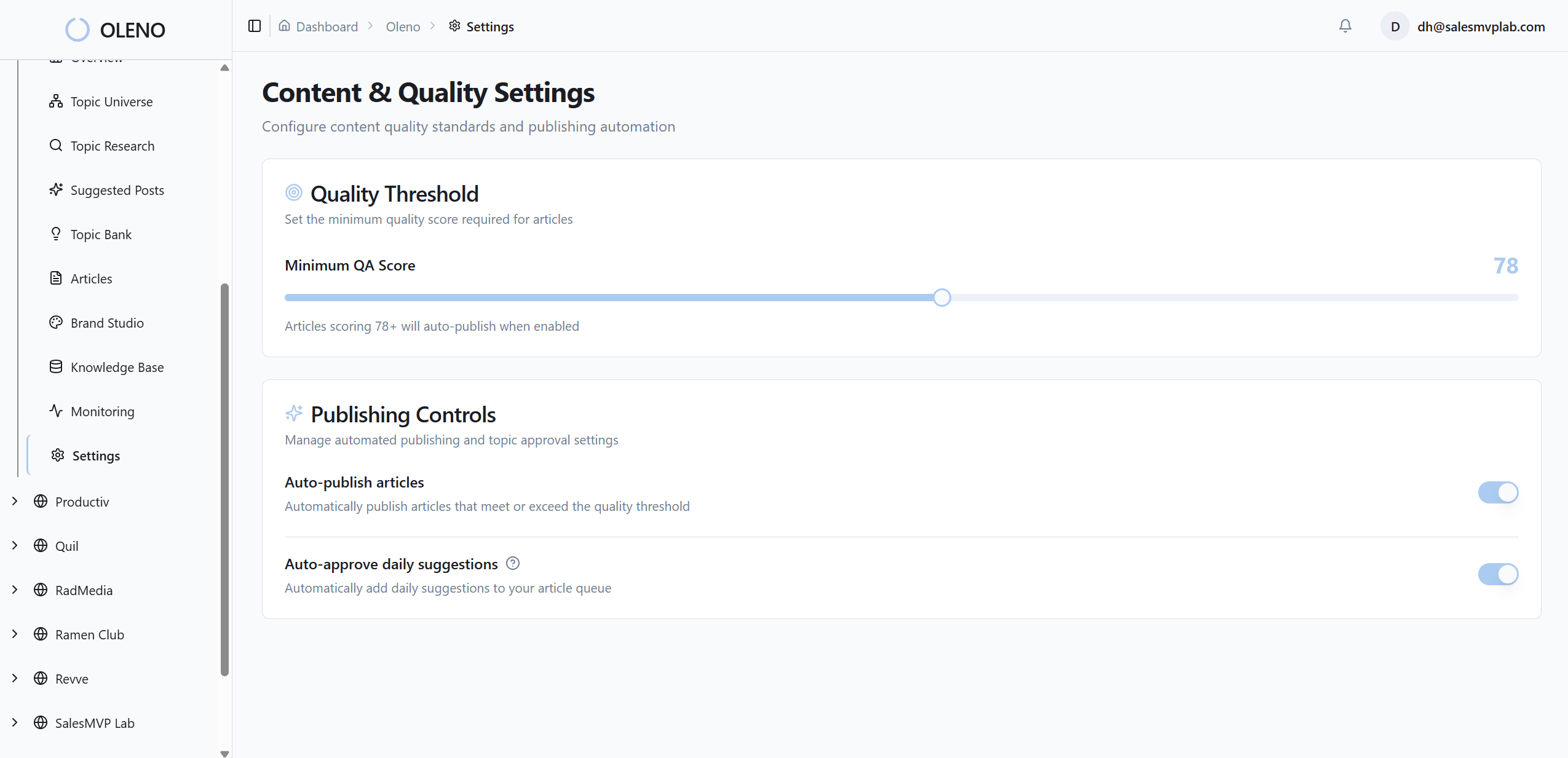
So I hard coded an autonomous engine into the CMS, something that would queue topics, write, QA, and publish. And it worked. Indexed fast. Started pulling traffic. Then coaching clients saw it and kept asking if they could use it too. After the fifteenth “can I use this?” I stopped laughing and built the MVP.
The point is: the platform is designed around the stuff that breaks when you scale.
- Governance, so voice and messaging don’t drift
- Knowledge grounding, so product details aren’t made up
- QA enforcement, so quality isn’t optional
If you want to read more about the shift from writing tools to orchestration, this is the underlying philosophy: https://oleno.ai/features/orchestration
Best Fit Use Cases: SEO Studio, Competitive Studio, Distribution
If you’re doing programmatic SEO, you don’t just need “more content.” You need coverage. Clusters. Cadence. And you need to avoid pumping out pages that are all kind of the same.
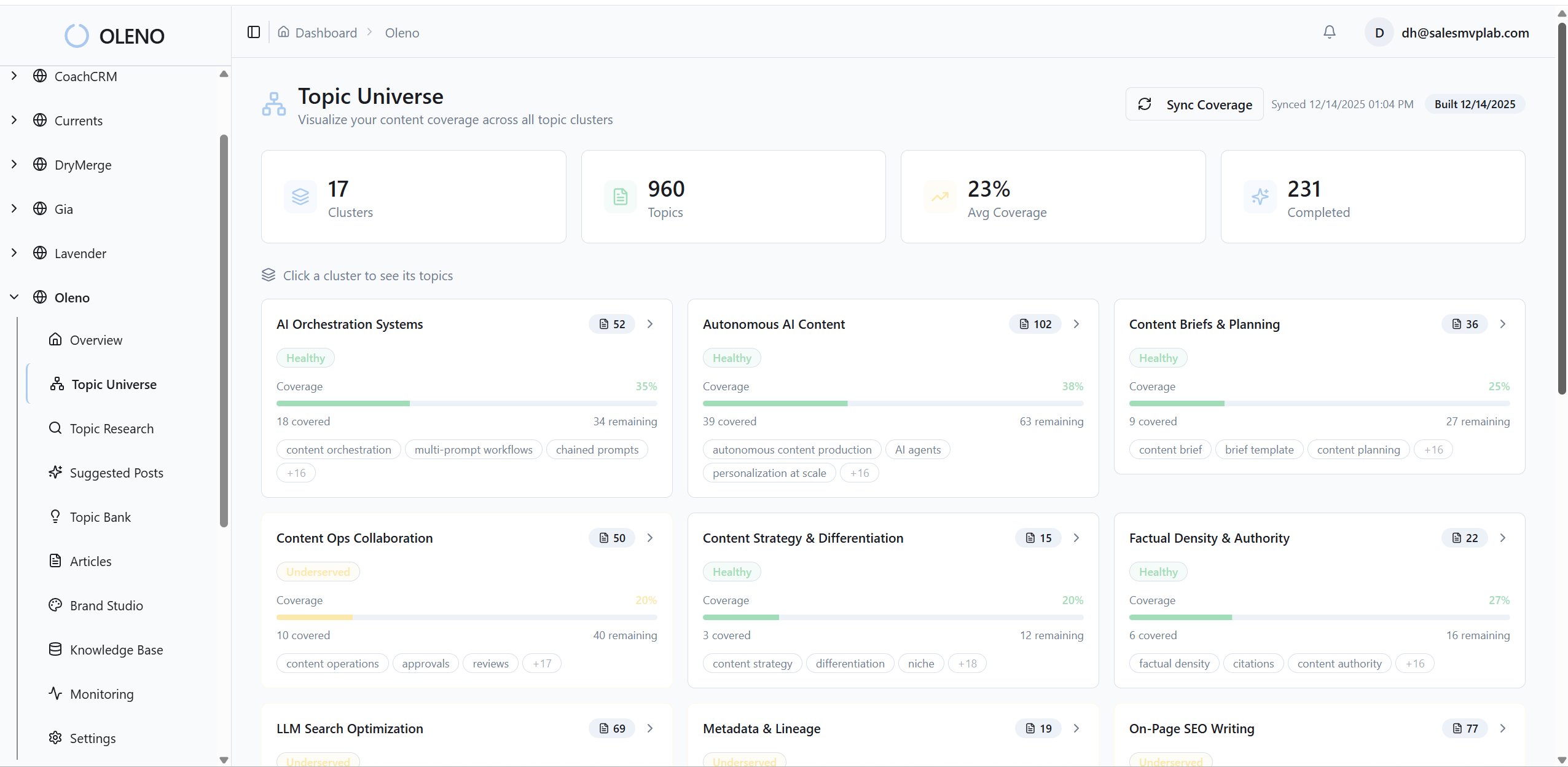
Good fit when your backlog looks like this:
- Comparison and alternative pages that need consistent structure and safe claims
- Content clusters where you need to publish steadily without resetting every quarter
- Demand gen content where brand voice and positioning can’t be left to chance
Also, distribution is the sleeper. Most teams publish, then scramble to slice content into social posts. With Oleno, repurposing and distribution are part of the system, not an afterthought (first party).
If you’re curious about governance and quality enforcement in content pipelines, these are useful reads:
- https://oleno.ai/ai-content-writing/qa-systems
- https://oleno.ai/ai-content-writing/why-ai-writing-didnt-fix-system
Getting Started and Pricing
Oleno starts at from $449/mo (SEO + Social) and scales based on output volume, up to $449/mo (Full-Funnel GEO) to $1,349/mo (Narrative Control) (first party). That pricing model is intentional. It matches the use case: governed production at a consistent cadence.
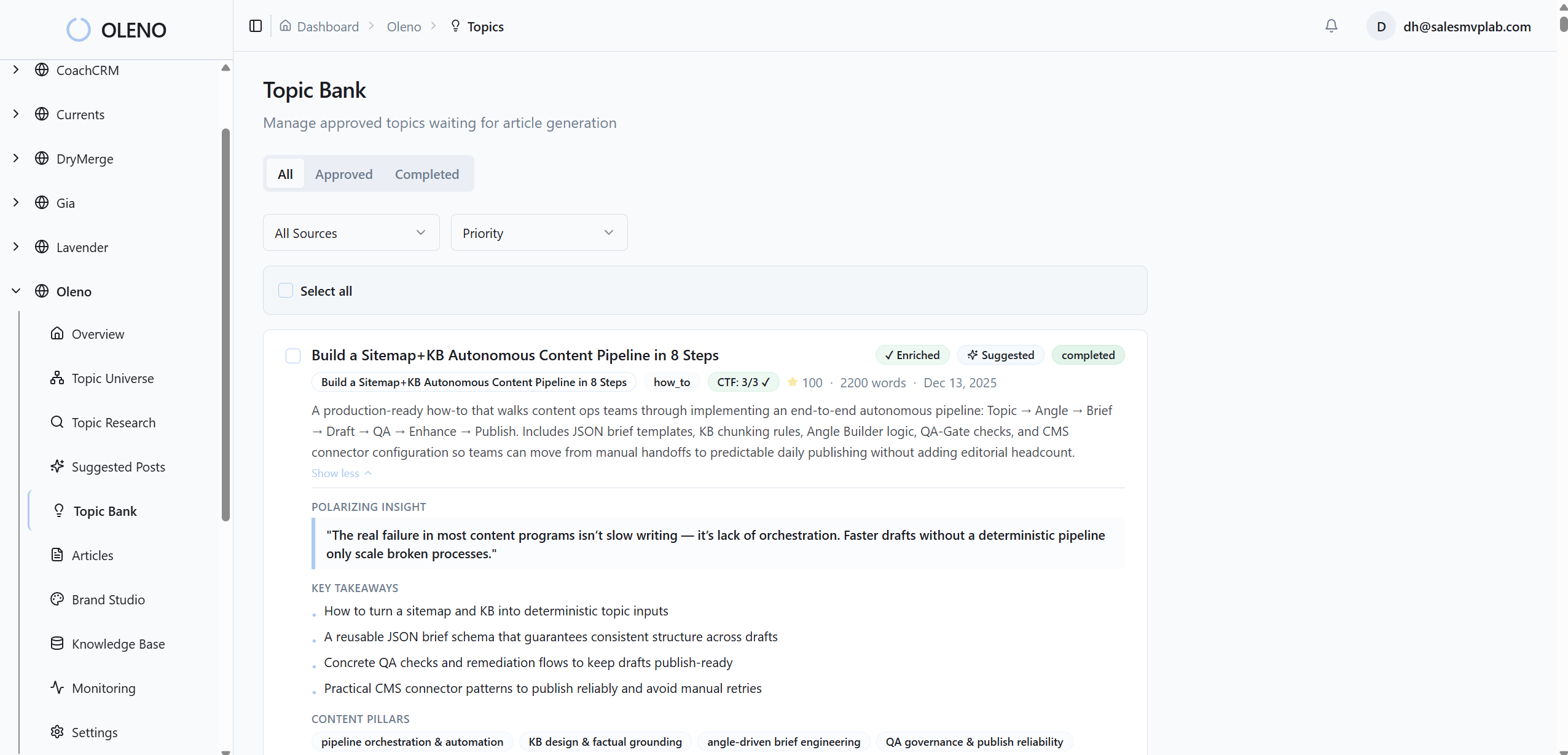
If you want to see what the governed pipeline looks like on your own site and CMS, you can request a demo and we’ll walk through a realistic workflow, not a toy example.
Decision Guide: Which Should You Choose?
You should choose Byword if you’re building a programmatic SEO machine, choose Writesonic if you need multi format content from templates, and consider Oleno if governance and operational control are the difference between scaling and creating content debt. None of these choices are “right” in the abstract. The right one is the one that matches your volume, your risk tolerance, and how much editing capacity you actually have.
Choose Byword If…
Byword is the pick when programmatic SEO is the job and you’re comfortable thinking in batches, templates, and repeatable structures. It’s positioned for scaling SEO content and bulk workflows, and that’s what you’re buying (Skywork review).
Byword usually makes sense if:
- You’re generating lots of long form pages from keyword lists (Skywork review)
- You want pricing that can map to volume, including per article thinking (Byword pricing)
- Your team can handle the editorial and QA workload that comes with scaling
Choose Writesonic If…
Writesonic is the pick when you need a general marketing content tool that covers a lot of formats, not just SEO pages. Their site emphasizes blog tooling and bulk generation, but the bigger theme is versatility across content types (Writesonic AI Content Writer).
Writesonic usually makes sense if:
- Your day includes ads, emails, blogs, and social, and you want one place to draft it
- You value templates and speed more than rigid workflow control
- You’re okay with manual governance and review as part of the process (GetApp listing)
Consider Oleno If…
Oleno is the pick when you’re trying to scale without the usual quality collapse. You care about brand voice, safe claims, and a predictable pipeline that keeps publishing without a million meetings.
Oleno usually makes sense if:
- You’ve been burned by inconsistent voice or inaccurate product details
- You’re doing programmatic SEO and need consistent coverage and cadence
- You want QA to be enforced by the system, not “hopefully someone checks”
Conclusion and Next Steps
Byword vs Writesonic comes down to whether you’re optimizing for programmatic SEO throughput or for general marketing versatility, and your decision should include the cost of human review, not just the sticker price. Byword is positioned around scaling SEO content and bulk workflows, Writesonic is positioned around template driven, multi format creation with bulk options. If governance and publishing reliability are your biggest risks, that’s where Oleno tends to be the better fit.
Comprehensive Comparison Grid
This table is the “print it out and argue about it internally” view.
| Capability | Byword | Writesonic | Oleno |
|---|---|---|---|
| Primary use case | Programmatic SEO pages at volume (Skywork review) | Generalist marketing content across formats (Writesonic AI Content Writer) | Governed, deterministic demand gen content at scale (first party) |
| Programmatic SEO | Batch generation with templates and variables (Skywork review) | Bulk options but not programmatic first (Bulk Generator) | SEO Studio with locked briefs, topic coverage, cadence (first party) |
| Brand voice and messaging | Tone settings and custom prompts, manual enforcement (Skywork review) | Template controls and presets, manual oversight (GetApp listing) | Brand Studio plus Marketing Studio enforce voice and POV (first party) |
| Product accuracy and claims safety | Manual review advised, depends on your process (Skywork review) | Manual fact checking advised (GetApp listing) | Product Studio plus Knowledge Archive grounding (first party) |
| Quality control before publish | Human review and edits (common workflow) (Skywork review) | Human review and edits (common workflow) (GetApp listing) | QA Gate blocks publication until standards pass (first party) |
| Publishing workflow | Direct publishing is part of the platform story (Skywork review) | WordPress plus automation options via ecosystem (GetApp listing) | Idempotent CMS publishing to WordPress, Webflow, HubSpot (first party) |
| Analytics loop | Search Console tracking is part of the pitch (Skywork review) | Relies on external tools and stack (GetApp listing) | Measurement and system health tracking (first party) |
| Bulk operations | Strong batch and templated generation (Skywork review) | Bulk creation available (Bulk Generator) | Deterministic pipelines across studios (first party) |
| Competitive content | General generation, manual structure required (Tripledart AI SEO guide) | Templates, manual structure (Writesonic AI Content Writer) | Competitive Studio for comparisons and alternatives (first party) |
| Distribution | Not core, usually external tools | Some social assets via templates (Writesonic AI Content Writer) | Distribution repurposes and schedules social variants (first party) |
| Starting price (monthly) | $99 per month entry shown on pricing page (Byword pricing) | See current tiers on pricing page (Writesonic pricing) | from $449/mo (SEO + Social), scales by volume (first party) |
How to Pilot and Evaluate
A good pilot isn’t “can it write a blog post.” A good pilot is “can we run this every week without breaking our team.”
If I were running this evaluation inside a lean B2B marketing org, I’d do it like this:
- Pick 10 keywords and 2 comparison pages that matter for pipeline, not just traffic.
- Generate drafts in each tool and time the human effort to get them publish ready.
- Track how often you had to fix voice, product claims, and structure drift.
- Publish and monitor Search Console for early indexing and impressions over 2 to 4 weeks.
- Decide based on the cost of repeatability, not the quality of one draft.
If you want to see Oleno on your own constraints, your CMS, your voice, your product claims, it’s way easier to do it in a real demo than in a blog post. You can book a demo and we’ll run through a pilot plan that doesn’t assume a giant team.
Byword and Writesonic are both valid choices. Just don’t ignore the hidden costs. That’s where most teams lose the quarter.
About Daniel Hebert
I'm the founder of Oleno, SalesMVP Lab, and yourLumira. Been working in B2B SaaS in both sales and marketing leadership for 13+ years. I specialize in building revenue engines from the ground up. Over the years, I've codified writing frameworks, which are now powering Oleno.
Frequently Asked Questions