Choosing the Right Content Repurposing Tools for Success

72% of teams said content mattered more this year, but that usually translates into more coordination debt, not more pipeline. If you spent this week chasing PMM context in Slack, rewriting a draft in Google Docs because it “felt off,” or waiting on one last approval before launch, you already know choosing the right content is rarely the hard part on paper and almost always the hard part in practice.
Choosing the right content isn't really about choosing topics. It's about choosing the right system for deciding what should exist, why it should exist, who it's for, and how it gets out the door without getting watered down.
Key Takeaways:
- Choosing the right content starts with funnel fit, not keyword volume
- If a piece can't be tied to a buyer stage, it usually becomes a vanity asset
- The biggest content mistake isn't weak writing, it's weak framing
- A simple 3-part filter works: buyer stage, narrative role, and proof depth
- Scaling SaaS teams don't usually need more writers first, they need less rework
- GEO raises the bar because LLMs reward consistency across hundreds of pieces, not random spikes of output
- The right content system turns strategy into repeatable execution
Why most teams choose the wrong content in the first place
Choosing the right content usually breaks long before anyone opens Ahrefs or asks ChatGPT for ideas. It breaks when the team has no shared filter for what content deserves to exist, so every request feels urgent and every asset gets judged in isolation.
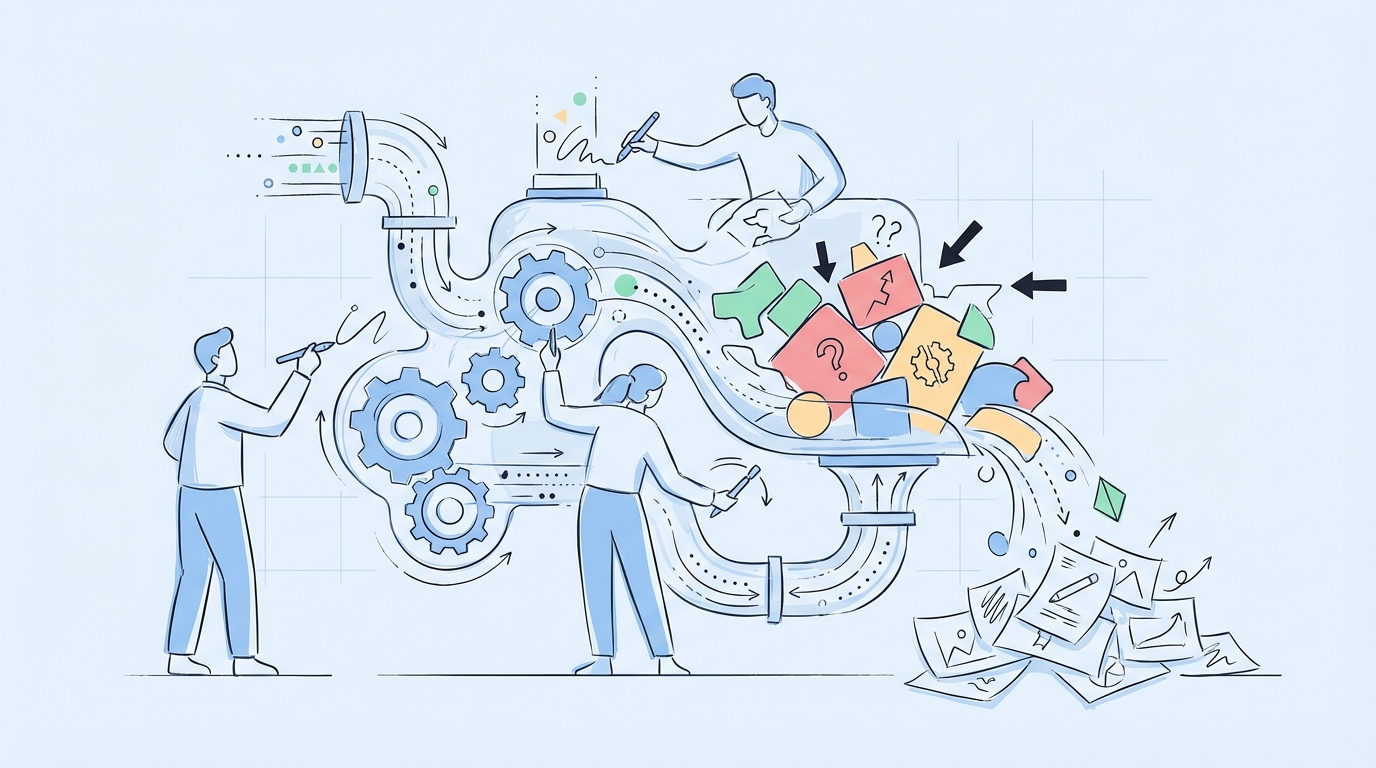
At 8:14 AM on Monday, a Demand Gen Manager at a 200-person SaaS company is triaging requests across Slack, Asana, and a half-updated Notion board. PMM needs a feature launch post. Sales wants a competitor page by Wednesday. SEO has a brief due by end of day. By Friday, the calendar looks busy, four people think their priority won, and nobody can explain how the mix supports pipeline. That's what bad content selection actually feels like. Not dramatic. Just expensive.
That's the first reframe. The problem isn't that your team is bad at ideation. The problem is that choosing the right content has no operating logic behind it.
Volume without a filter creates expensive noise
Back in 2012-2016 I ran a pretty high-volume content site. At peak, we hit 120k unique visitors a month. We started seeing traffic spikes at 500 pages, 1000 pages, 2500 pages, 5000 pages, then 10000 pages. So yes, volume matters. I believe that.
But here's the catch. Volume only works when it has both breadth and depth, and when each piece has a reason to exist. Otherwise you get what I call the Catalog Without Gravity model: lots of pages, no pull. Think of it like a SaaS dashboard with 40 widgets and no default view. Everything is technically there. Nothing helps you decide. Same with content. A bloated library without narrative structure doesn't guide buyers anywhere.
A lot of SaaS teams copy the volume part and miss the system part. They publish FAQs, launch posts, thought leadership, comparison pages, and SEO articles, but those assets don't reinforce a shared market point of view. So traffic may come in, but demand gen doesn't compound.
The wrong content often looks good on paper
This is where people get tricked. A lot of wrong content looks smart in a spreadsheet. High search volume. Low difficulty. A stakeholder request attached to revenue. A topic that sounds educational enough to feel safe.
At one SaaS company, we had a strong content team and ranked well for a lot of topics. The issue wasn't quality. The issue was alignment. We were writing around adjacent problems that were too far from the actual product story, so the content attracted attention but didn't pull readers toward a meaningful next step. Great rankings. Weak demand gen alignment.
Fair point: some top-of-funnel content should sit a bit wider from the product. That's true. If every article sounds like a sales pitch, people bounce. But if more than 40% of your quarterly output can't be mapped to a clear buyer stage or product-adjacent problem, you're probably funding a media strategy while calling it demand generation.
Most “content strategy” is really request management
This is the part a lot of teams don't say out loud. What gets called content strategy is often just polite backlog management. Sales wants battlecards. PMM wants feature education. SEO wants coverage. Leadership wants thought leadership. Demand gen wants campaign fuel.
So what happens? The loudest request wins.
That creates the Handoff Tax Loop:
- A request comes in without a clear funnel role
- A writer or freelancer fills in the missing strategy
- Reviewers disagree because they each see a different goal
- The piece gets rewritten three times
- Everyone says content is slow
I've seen this up close. When I was the sole marketer at one SaaS company, I could crank out 3-4 high quality posts per week because I had all the context in my head and a writing framework. As the team grew, output didn't get easier. It got messier. The writer had less context than I did. I had less time than I did. And suddenly more people meant slower publishing and weaker output. Sound familiar?
That's why choosing the right content starts with a tighter decision model, not a bigger backlog. So what should that model actually optimize for?
If you want to see what a governed content engine looks like in practice, you can request a demo.
The real job is matching content to market truth
Choosing the right content gets much easier when you stop treating content as channel inventory and start treating it as a market interpretation system. The right piece matches market truth, buyer timing, and your narrative angle at the same time. Miss one, and even strong writing underperforms.
A lot of AI content tools miss this completely. They are anchored in channels and tactics. SEO this. LinkedIn that. Refresh this page. Add this keyword. Useful at times, sure. But they don't have a concept of what marketing actually is.
Content should start from positioning, not channels
I remember being at a panel years ago and hearing someone list off a bunch of tactics and tools. Pull a list from here. Push it into this. Automate this. Then April Dunford jumped in and basically cut through the whole thing. Tactics without strategy are garbage. That stuck with me.
Because that's what happens with most content planning. Teams start with channel logic. “We need more SEO content.” “We need more social.” “We need more product pages.” Maybe. But what you really need is the Positioning-First Rule: if a topic can't express your view of the market in one sentence, it isn't ready for production.
Before, the brief says “write about workflow automation trends.” After, the brief says “show why B2B teams outgrow manual review before they outgrow writing capacity.” That's the difference. One is a topic. One is a market claim.
That's a useful threshold. One sentence. If you can't explain why this topic matters through your category lens, your differentiators, or your buyer problem framing, then the topic is still mushy.
Use the 3R filter: Relevance, Readiness, Reinforcement
This is the framework I'd use if I were sitting with a Demand Gen Manager trying to clean up a messy calendar. I call it the 3R filter.
Relevance asks: does this topic match a real buyer problem or use case right now? Readiness asks: is the audience actually in a stage where this asset helps them move? Reinforcement asks: does this piece strengthen the same narrative the rest of your content is pushing? Simple, but sharp.
If a topic scores yes on only one of those three, don't prioritize it. If it scores yes on two, test it only if you can publish in under 5 business days or tie it to a live campaign. If it scores yes on all three, that's usually the right content.
Consider how this works in practice. A competitor comparison page often scores high on readiness and relevance for bottom-of-funnel buyers. A category education piece often scores high on reinforcement and relevance earlier in the journey. A random broad SEO article might score on relevance if you squint, but fail on reinforcement and readiness. That's usually where content waste hides.
Some teams will say this filter is too strict. Fair. In a very early market, a little wandering is useful because you're still learning what language lands. But once a team has 5+ contributors, a real pipeline target, and quarterly pressure, loose editorial exploration turns into drift fast.
Audience depth changes what “right content” means
The same topic isn't the right content for every reader. Obvious? It should be. Yet teams still publish one-size-fits-all assets and promise themselves they'll segment the angle later. They won't.
A Demand Gen Manager usually wants campaign-ready material, faster execution, and cleaner ties to pipeline. A VP Marketing wants confidence that the content engine won't create more coordination overhead. Same broad theme. Different angle. Different stakes.
That's why I like the Audience-Use Case Match rule: if the article doesn't clearly serve one audience segment and one use case, rewrite the angle before you write the draft. Don't wait until review. That's where cycles die.
At one smaller SaaS team, we were repurposing founder insights into written content because it was faster. The thinking made sense. Founder has strong ideas, team is lean, move quickly. But without proper search structure and topic selection, the output didn't line up with intent. Good raw material. Weak fit for the job the content needed to do.
Good content earns the next question
This sounds simple, but it's a real test. The right content should create the next logical question in the buyer's head. Not confusion. Not admiration. Movement.
So if someone reads a category piece, the next question should be, “Okay, if the old way is broken, what does the new system look like?” If they read a comparison page, the next question should be, “Which option fits our buying context?” If they read a product-led workflow article, the next question should be, “Can this fit our current process?”
That's the Ladder Test. Each piece should earn the next rung. If it doesn't, you're not building a library. You're building disconnected rooms with no hallways.
Without that, you get isolated assets that might perform in a local sense but don't move demand forward. And that leads to the next practical question: how do you choose the right content quarter after quarter without turning planning into a debate club?
A practical framework for choosing the right content every quarter
Choosing the right content gets easier when you stop asking “what should we publish?” and start asking “what job does this piece do in the system?” That's the shift. Content should be selected as portfolio construction, not as a list of isolated ideas.
What works, in my view, is a quarterly model that forces tradeoffs up front. Fewer debates later. Far fewer rewrites.
Start with the funnel mix, not the topic pile
Most teams start with a giant topic pile. Keyword ideas. Customer questions. Feature requests. Competitor names. Webinar leftovers. That's normal. It's also why planning turns into chaos.
I prefer the 40-30-20-10 split for scaling SaaS teams with active demand gen:
- 40% acquisition content
- 30% category and problem education
- 20% evaluation and buyer enablement
- 10% product-led proof and launch support
Not perfect for every company. That's the honest limitation. If you're under $5M ARR and struggling for awareness, you may push acquisition to 50%. If you're in a crowded category with educated buyers, you may lift evaluation content to 30%. But choose the mix before the topics. Otherwise the quarter gets hijacked by whoever asks first.
A quarter with no declared mix usually ends up overproducing top-of-funnel fluff and underproducing conversion assets. That's not a planning issue. It's a gravity issue.
Diagnose your current state before planning more
Before you add a single new topic, run a simple diagnosis. This is the Red Flag Checklist I wish more teams used when choosing the right content.
Ask:
- Are more than 25% of drafts getting major rewrites?
- Are assets being requested without a named buyer stage?
- Are you publishing multiple pieces that say roughly the same thing?
- Are PMM, SEO, and demand gen using different language for the same problem?
- Are campaign teams waiting on content more than 7 days?
If you answer yes to three or more, you don't have a content shortage. You have a selection and coordination problem.
Before, a team says “we need more output” and adds two freelancers. After, they realize 31% of drafts are being heavily rewritten and approvals average 9 days, so they fix intake first. Same team. Very different result. Upstream decisions write downstream pain.
Score ideas with the 5-Point Fit model
Once the portfolio mix is clear, score ideas. I like a simple 5-Point Fit model because it forces a decision without pretending to be a science experiment.
Score each topic from 1-5 on:
- Buyer stage fit
- Narrative fit
- Product adjacency
- Proof availability
- Repurposing value
Anything scoring under 16 probably waits. Anything 16-20 is strong. Anything over 20 should likely make the quarter.
Proof availability is the overlooked one. A topic with no stories, no examples, no real evidence, and no internal conviction often becomes generic content fast. A topic with proof usually writes cleaner and converts better. That's not magic. It's mechanism. Evidence reduces ambiguity, ambiguity reduces rewrite cycles, and fewer rewrites means better throughput.
And repurposing value matters because one good article should feed campaign assets, sales follow-up, social distribution, and future internal links. If a piece can't travel, its return is lower.
Choose content types that match buying behavior
This is where a lot of teams get too abstract. They say they want “better content.” That's not a choice. That's a wish.
You need a content-type map. For example:
- Category articles shape how buyers define the problem
- SEO acquisition pages capture active search
- Comparison and alternative pages support evaluation
- FAQ libraries reduce friction late in the process
- Product-led workflow articles prove practical fit
If a buyer is asking “why change,” give them category education. If they're asking “what are my options,” give them comparison content. If they're asking “will this work for us,” give them workflow and buyer enablement content.
That's the If-Then Content Rule. If buyer intent is diagnostic, teach. If buyer intent is comparative, evaluate. If buyer intent is implementation-focused, prove the workflow. Wrong format, wrong moment. Even when the writing is good.
Build for compounding, not one-off wins
The best quarterly plans create clusters, not isolated hits. One category article should lead to three related SEO pieces, two comparison pages, one product proof asset, and a handful of social cutdowns. That's what compounding looks like.
Back when we scaled content volume hard, most pages did not become runaway hits. Many got under 100 views per month. But as the catalog deepened, traffic jumped in stages because the total body of work became more useful and more authoritative. A lot of people underestimate that lag. Fair enough. Compounding is boring right up until it isn't.
The right content isn't always the piece that pops this week. Sometimes it's the piece that makes the rest of the library stronger six months from now. Which raises the real operational question: what kind of system makes choosing the right content repeatable instead of heroic?
What a governed system looks like when you stop guessing
Choosing the right content gets a lot easier when strategy becomes rules and rules become execution. That's the real shift. Instead of re-explaining your market, buyer, product, and voice every single time, you define them once and let the system carry that context through execution.
This is the part where most teams feel the pain most clearly. They don't hate content. They hate the repeated explaining.
Governance removes the rewrite trap
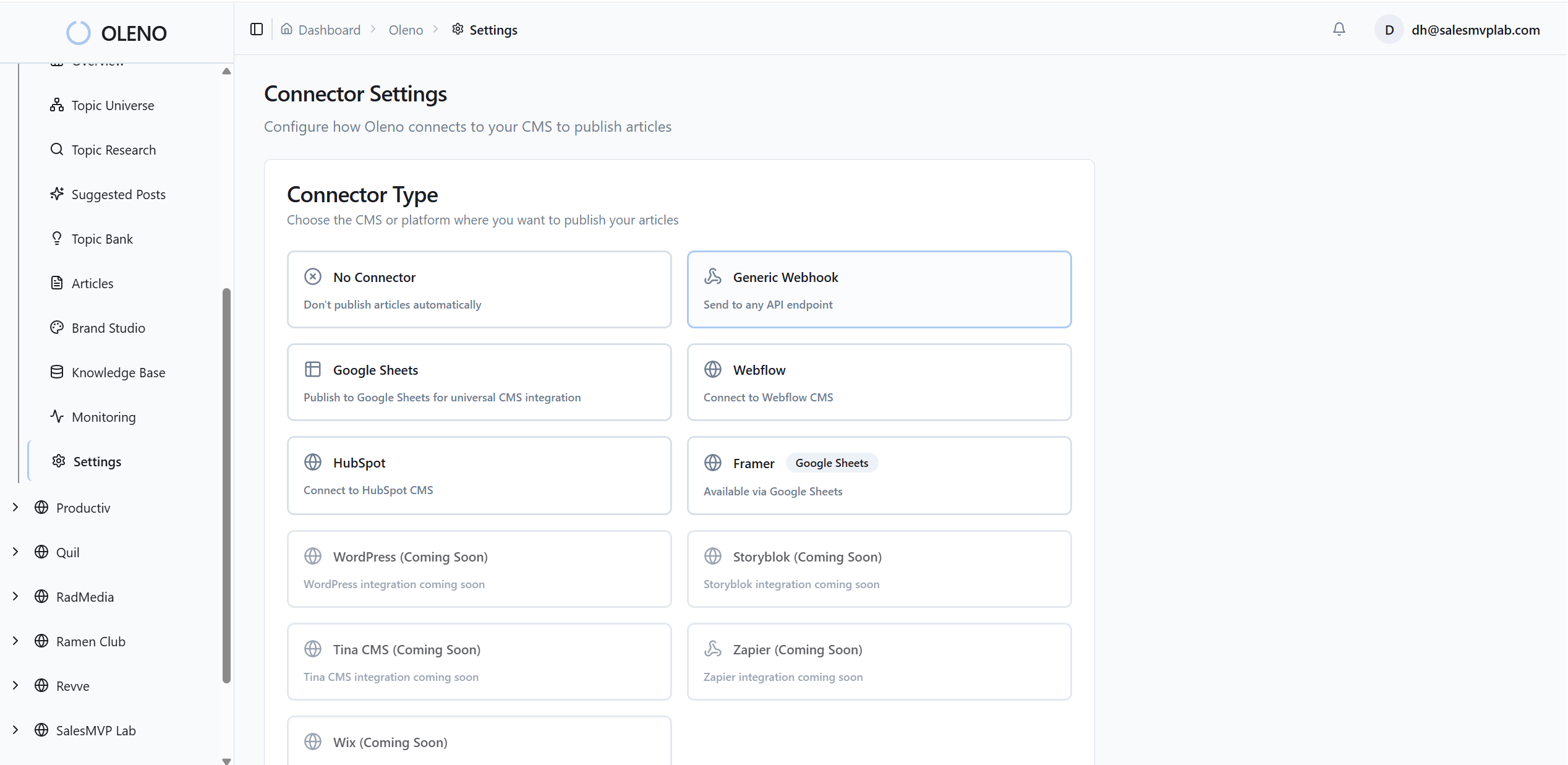
Oleno starts from governance, not raw output. Brand Studio stores how you sound. Marketing Studio stores your key messages, category framing, and market point of view. Product Studio stores approved product truth and boundaries. Audience & Persona Targeting plus Use Case Studio make sure the same topic can be shaped for the right reader and the right job.
That matters because most rewrite cycles happen for four reasons:
- the tone feels off
- the angle is too generic
- the product claims get fuzzy
- the article is aimed at nobody specific
Oleno is built to cut those failure points upstream. You're not re-briefing a writer or arguing with a blank-slate AI draft every time. You're setting the rules once, then executing within them. For a Demand Gen Manager trying to get campaign-ready content out without endless handoffs, that's a big deal.
Topic selection and production become an operating loop
Programmatic SEO Studio handles acquisition content at scale by discovering and organizing topics, then running a locked-outline pipeline so structure doesn't drift. Storyboard allocates content across audiences, personas, products, and use cases, which matters when a mid-market SaaS team has five stakeholders pulling in different directions.
Then the Orchestrator runs the pipeline on a regular cycle. Not by inventing strategy. That's important. It schedules approved topics, executes the right blueprints, and keeps cadence moving without manual babysitting.
I'd argue this is the line between a tool and a system. A tool gives you a draft. A system gives you repeatable coverage.
Teams that want a closer look at that operating model can request a demo.
Quality control stops being a heroic act
This is another place where content programs quietly fail. Quality becomes dependent on who catches what at the end. One person notices the narrative drift. Another person flags the product claim. Somebody else fixes the structure. That doesn't scale.
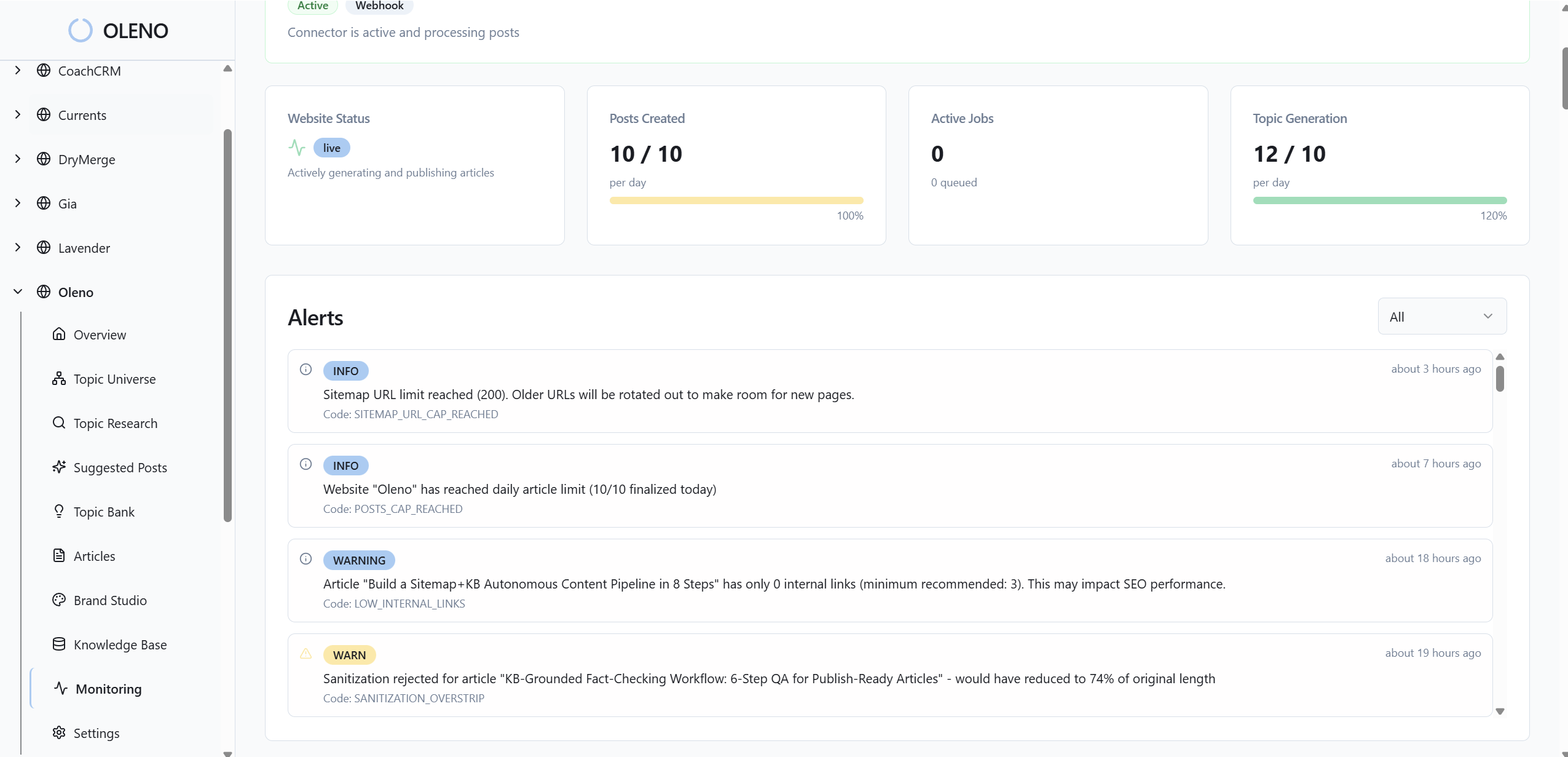
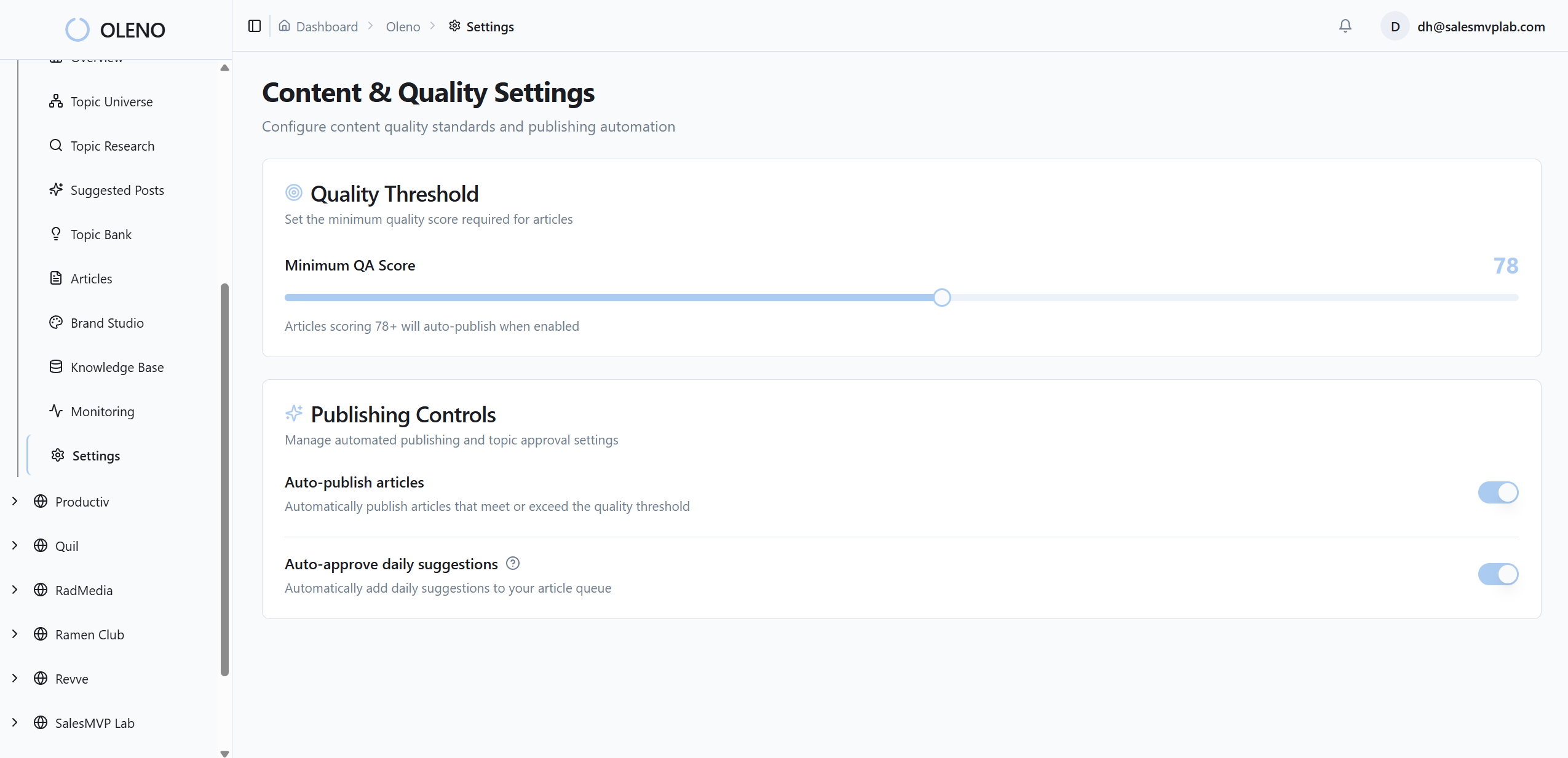
Oleno's Quality Gate evaluates articles against voice, structure, clarity, grounding, and SEO before they move forward. If the score is low, it tries to revise. If it's still low, it blocks publication. That simple rule changes behavior: nothing publishes unless it meets the bar.
And for leaders, the Executive Dashboard gives visibility into cadence, coverage gaps, quality trends, and quota use. Not attribution theater. Operational visibility. Different thing.
There's a fair counterpoint here. Some teams genuinely like heavy manual review because they want full editorial control. I get that. For high-stakes flagship content, that's valid. But if your standard operating model requires senior people to rescue every draft, you've built a content process that gets more fragile as volume rises.
Choosing the right content gets easier when the system is right
Choosing the right content is hard when every decision starts from scratch. It's much easier when your market view, buyer context, product truth, and execution rules are already in place. Then you're not guessing what to publish. You're selecting what best advances the system.
The GEO era is pushing teams back to fundamentals. Clear positioning. Tight audience definition. Real product grounding. Consistent narrative across scale. That's why random content output won't cut it anymore.
If your team is tired of content resets, rewrite loops, and disconnected assets that don't build on each other, the fix probably isn't another prompt. It's a better operating model. If you want to see how Oleno turns that into a governed execution system for scaling SaaS teams, book a demo.
About Daniel Hebert
I'm the founder of Oleno, SalesMVP Lab, and yourLumira. Been working in B2B SaaS in both sales and marketing leadership for 13+ years. I specialize in building revenue engines from the ground up. Over the years, I've codified writing frameworks, which are now powering Oleno.
Frequently Asked Questions