Codify Product Truth: Content Governance to Prevent False Claims

I’ve been on both sides of this. As a solo marketer cranking out 3–4 posts a week, and as the exec who suddenly didn’t have time to write and watched the narrative drift. The common failure isn’t creativity. It’s control. You can ship beautiful pages and still ship claims that legal never saw and product would never approve.
Back at Proposify, we ranked well for topics that didn’t line up with what we actually sold. It looked like success. It wasn’t demand. The same dynamic shows up with product claims. One overstated line about an integration, and you’re doing apologetic call-backs, emergency edits, and retroactive approvals. It’s preventable—if product truth is treated like code, with rules that machines enforce at publish time.
Key Takeaways:
- Replace manual review culture with a claims catalog and publish-time gates
- Define “claims” precisely and store canonical text, boundaries, and evidence
- Set a tiered approver matrix with SLAs and audit trails
- Tag risky fields in your CMS with claim_ids and block unapproved text
- Use policy-as-code checks to fail builds on risky language or missing proofs
- Prevent drift across channels by exposing a read-only claims API to partners and tools
Why Accuracy Fails At Publish Time
Accuracy fails at publish time because teams rely on human review instead of machine-enforced rules. Volume rises, people change, context gets lost, and unapproved phrasing slips through. If risky fields aren’t validated against a single claims source, invented features and fuzzy benefits will find daylight.
The Review Myth That Keeps Tripping Teams
Manual reviews feel safe. Until they don’t. As output scales, the net gets holes—handoffs multiply, last-minute edits sneak in, and “just this once” becomes policy by accident. Review is opinionated, inconsistent, and time-bound to whoever checked the box. The root issue isn’t people; it’s the absence of a system that enforces truth at the point of publish.
I’ve seen this exact failure mode: someone “punches up” a headline, another person adjusts a subhead, and a nuance drops. No one intended harm. The CMS ships. Support tickets start, sales asks for redlines, and legal scrambles. Teams confuse the act of reading with the act of governing. Reading spots typos. Governance blocks risk. There’s a difference.
There’s also a wider context. In a noisy environment, content governance isn’t a nice-to-have. It’s table stakes. Research on misinformation dynamics shows why structure matters when speed and scale collide. If you don’t define truth centrally and validate it automatically, drift is predictable, not surprising. See the framing in Content Governance in an Age of Disinformation.
What Is A Claim And Why Does It Need Structure?
A claim is any statement that sets buyer expectations: capabilities, performance, compliance, limits, guarantees, outcomes. If a sentence could create legal exposure or a sales promise you can’t keep, treat it as a claim. That definition sounds strict. It’s meant to be. Loose definitions create loose guardrails.
Structure is what turns “claim” into something you can test. Canonical text so everyone says the same thing. Boundaries so marketing can’t expand scope under pressure. Evidence so substantiation isn’t a scavenger hunt. Versioning so you know what was true when. Without those fields, all you have is an opinion in a doc.
Here’s the practical litmus test: could a machine verify it? If the answer is no, you don’t have governance—you have guidelines. Guidelines drift. Machines enforce. You need both, but only one catches problems at 2 a.m. without waking anyone up.
Why “Voice Rules” Are Not Enough For Product Truth
Voice rules stop tone drift. They don’t stop false promises. Most style guides tell you how to sound, not what you’re allowed to say. Product truth requires a different scaffold: an approved claims catalog, named approvers, and a publish gate that checks risky fields against that catalog in real time.
Treat voice as style and claims as liability. Mixing them is why teams feel “on brand” while quietly expanding performance statements and implied guarantees. I’ve watched marketers do this in good faith, trying to clarify or simplify. Without boundaries and evidence, “clarify” turns into “overstate.” That’s on the system, not the person.
If you’re tempted to rely on training or reminders, remember the environment. People change roles, agencies rotate, and AI tools remix text. Voice rules don’t catch legal exposure. Gates do.
Want to see what enforcement looks like when it’s baked into the workflow? When you’re ready to move beyond guidelines, Try Generating 3 Free Test Articles Now.
Treat Product Claims As Code You Can Test
Treat product claims as code by storing them in a structured catalog with evidence, owners, and versions. This lets you validate text against approved truth, enforce boundaries, and audit changes. When claims live in a repo or database, you can test them automatically before anything publishes.

Build A Claims Catalog, Not A Wiki Page
A wiki page is a parking lot for words. A claims catalog is a system of record. Give each claim an id, category, canonical text, boundaries, evidence link, owner, approver tier, effective date, expiry, and last reviewed. Keep versions immutable. Keep the latest state queryable. That’s how you make truth testable.
Where it lives matters. Put it in a database or a repo with change control. Connect it to your CMS so writers can search and insert canonical language directly. When a claim changes, you don’t email a deck—you update the source, bump the version, and every downstream use can pick up the update on the next publish.
There’s a governance lesson here too. Strong organizations prevent drift by designing the system, not by urging caution. If you want a primer on why structure beats reminders, see this overview of controls in How Corporate Governance Can Prevent Fraud and Corruption. Different domain, same principle: design for integrity.
Who Approves What, And How Fast?
Approval isn’t one size. Use tiers. Tier 1 (marketing) approves language reuse and placement. Tier 2 (product) approves capability, limits, and screenshots. Tier 3 (legal) approves regulated topics and guarantees. Each tier gets a service-level target—say 24, 48, 72 hours—and breach alerts when a request stalls.
Make accountability boring and visible. A simple queue with status, owner, and timestamps beats a heroic Slack chase. Push approvals into the claim record so the publish gate can check who signed off on which version. You want speed without gambling. Clear ownership, clear timelines, and an auditable trail enable both.
The little detail that saves you later: service aliases, not single points of failure. approvals@, claims@—let the team rotate coverage without breaking the system. It’s mundane. It’s the difference between progress and ping-pong.
The Hidden Costs Of Loose Or Overstated Claims
Loose claims create a rework tax, revenue drag, and channel drift that compounds quietly. A single overstated sentence can trigger days of follow-on work, deal delays, and trust erosion. You feel it as “busy.” It shows up as missed quarters and quiet churn.
The Rework Tax You Keep Paying
Let’s pretend one landing page overstates an integration. Sales apologizes, product triages, legal edits copy, marketing scrubs five assets. Two days burned across five people. That’s 80–100 hours gone when you include context switching and downstream fixes. Multiply by channels and the “quick fix” becomes a weekly tax.
I’ve lived that day. It rarely ends with the edit. You update the website, but the deck, the PDF, the email nurture, and the partner one-pager still carry the old line. A month later, someone forwards a screenshot from a prospect. You’re back in the fire drill. None of this work drives incremental demand. It’s all undo.
It also crowds out proactive work. The team that should be creating category explainers and product education is running cleanup. Opportunity cost hides in calendars. You don’t see the missed articles. You see “no time.”
When Risk Shows Up As Revenue Drag
Risk isn’t just fines. It’s lost trust, delayed deals, and customer doubt. In regulated spaces, investigators don’t start with punishment—they start with questions that slow everything down. Procurement redlines, security asks for another review, the buyer’s lawyer wants revised language. Commitments slip to next quarter.
Government risk research points out how controls reduce costly interventions later. The same idea applies here: a little structure now avoids heavy remediation later. If you need a gentler nudge on why early controls save dollars, scan this perspective on Modernizing Fraud Prevention and Government Risk Management.
There’s also soft risk. Sales confidence matters. When reps question marketing’s accuracy, they avoid using the latest assets. You get fragmentation and one-off pitches. That’s invisible until it isn’t.
The Channel Sprawl Problem Most Teams Miss
Claims leak. Sales decks, PDFs, partner one-pagers, website variants, AI-generated snippets. Without a verified source and machine-checkable rules, drift spreads. One-liners mutate as they’re copied. The more channels you have, the faster it happens.
You can’t train your way out of this. You can system your way out. Centralized truth plus automated checks at publish. And for channels you don’t directly control, you expose read-only APIs that give partners and tools the same approved language. Don’t negotiate every phrase by email. Give them the source.
The legal angle is sobering. Multi-channel environments generate accidental inconsistencies—exactly the scenario identified in reports like the Fraud and Scam Prevention Series. Different topic, same mechanics: complexity without controls breeds errors. Errors slow revenue.
Still stuck massaging claims by hand? There’s a better way to run this. Try Using An Autonomous Content Engine For Always-On Publishing.
The Human Side Of Claim Errors
Claim errors feel like process issues but land as people problems. Edits under pressure, unclear ownership, and late-night fixes wear teams down. You need gates not to slow people, but to protect them when speed meets risk.
The 3 Pm Edit That Becomes A 3 Am Incident
You tweak a headline for punch. A nuance drops. It ships on schedule. Support tickets spike. Sales asks for a fix. The meeting invites start. No one intended a misstatement. The system allowed it. This is why gates exist—so human shortcuts are caught by non-human guardrails.
I’ve been guilty of trying to “help” with a last-minute line. The right check isn’t “did someone read it?” It’s “did the system verify claims against the source and enforce boundaries?” If yes, the 3 pm edit is safe. If no, you’re rolling dice with sleep on the line.
A proper audit trail also changes the tone of the 3 am call. You can answer “what changed, who approved, which version” in minutes—not days. That lowers temperature immediately.
What Happens When Legal Finds It First?
Escalations rarely start with a fine. They start with Slack pings, urgent meetings, and paused campaigns. Legal’s first question is simple: who approved this language? Without an audit trail, you’re guessing. With it, you can trace the version, the approver, and the evidence—then decide whether to roll back or revise.
There’s research showing that timely, structured interventions beat ad-hoc responses when information risk is involved. If you want a compact summary, this peer-reviewed analysis of intervention strategies highlights why clarity and process matter. Again, different field, same lesson.
The goal isn’t to slow marketing. It’s to keep momentum without taking on hidden liability that boomerangs back later.
A Practitioner System To Codify Product Truth In 30 To 90 Days
You can codify product truth in 30–90 days by inventorying claims, defining approvers and SLAs, wiring your CMS to a claims catalog, and enforcing policy-as-code checks. Start small, pick the top claims used most, and make the gates visible so adoption sticks.
KB-Backed Verification: Link CMS Fields To Claim IDs And Citations
Start where the text lives. Annotate CMS templates so fields that can carry claims require claim_id metadata. When a writer selects a claim, auto-insert the canonical text and show the evidence link inline. If a field lacks a valid claim_id, warn and block publish. Lightweight, visible, and impossible to ignore.
You’ll need a simple UI: search by category, preview canonical text, view boundaries and effective dates, and one-click insert. No toggling to a wiki. The trick is surfacing context. Writers move fast; give them vetted language and proofs at the point of use, not in a separate tool they won’t open.
As the catalog matures, expose a read-only API so partners and AI assistants can pull the same approved statements. That’s how you keep guardrails intact when content creation isn’t only happening inside your CMS.
Automation Hooks: Pre-Publish Checks That Actually Block Risk
Add CI-style assertions to your content pipeline. Think regex flags for risky phrases, boundary tests like “no superlatives unless claim_id has legal_approved true,” link validation for evidence URLs, and cross-field rules (e.g., guarantees require expiry dates). If a rule fails, fail the build with a human-readable message.
Good error messages matter. Show the failing field, the rule that blocked it, and suggest the nearest approved claim to use instead. Include an override path requiring a Tier 2 or Tier 3 approver. Overrides should be rare and visible, not a backdoor normal people eventually discover.
If you’re coming from the policy and controls world, this will feel familiar. It’s policy as code for content governance. You’re not adding bureaucracy; you’re encoding the rules your team already tries to follow manually.
How Oleno Enforces Product Truth From Draft To Publish
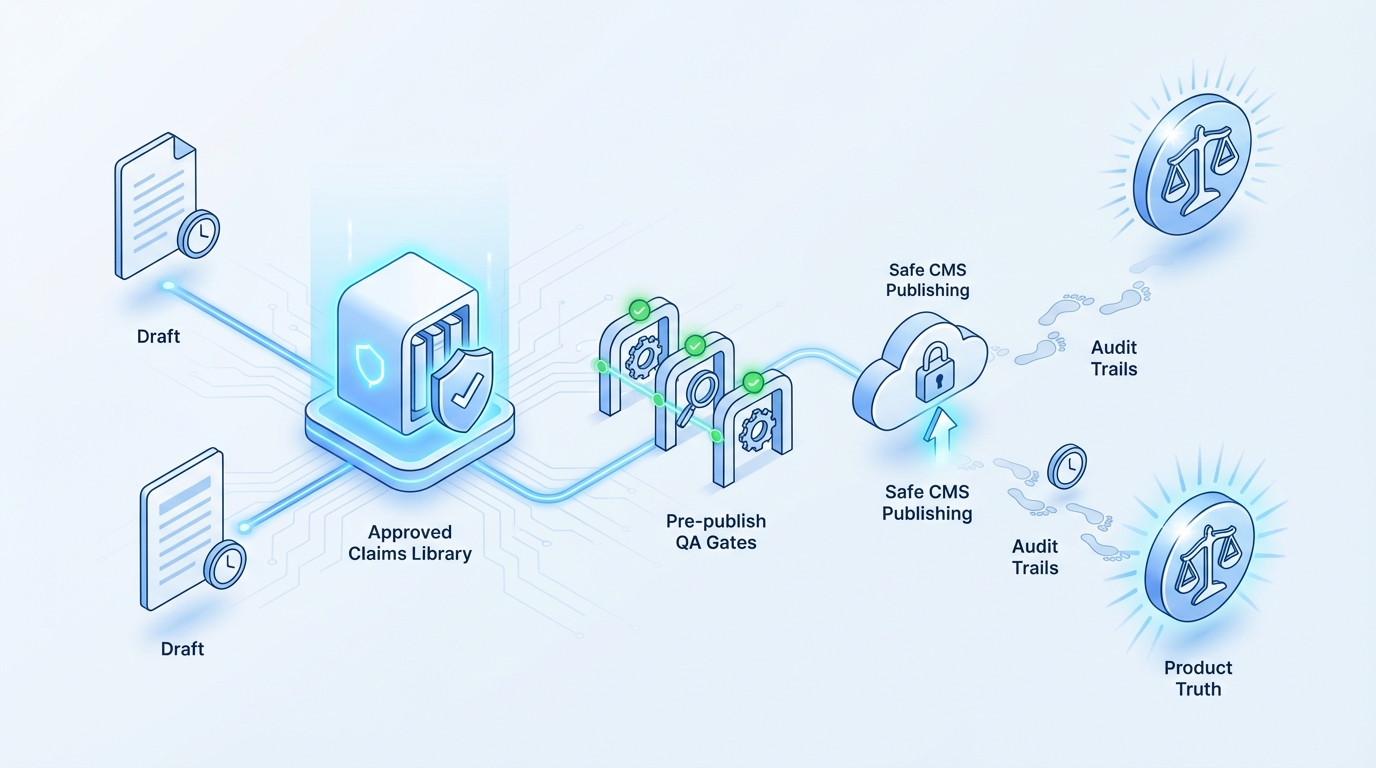
Oleno enforces product truth by combining an approved claims library, pre-publish QA gates, and safe CMS publishing with audit trails. You set the rules once; the system checks drafts against your knowledge and blocks risky copy before it goes live.
Claim Library With Approval Controls
Oleno lets you define approved product descriptions, claims, and boundaries—each tied to owners, approver tiers, and evidence. Writers reuse exact, vetted language without hunting for the latest deck. When a claim changes, you update it once and the new version flows through future drafts automatically.
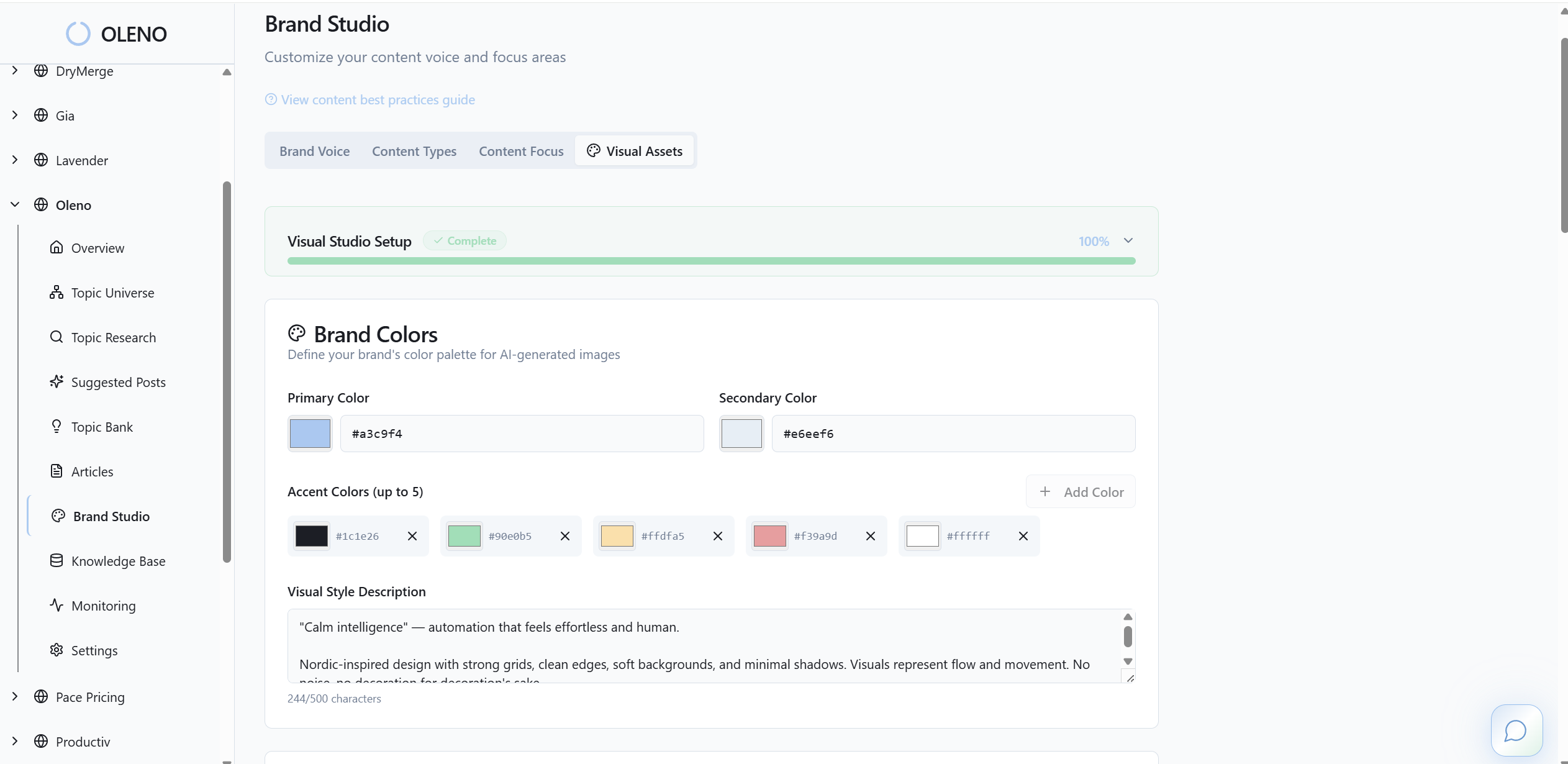
This isn’t a static page. It’s a governed catalog with versioning and clear authority. Marketing owns reuse and placement. Product owns capability and limits. Legal approves regulated topics and guarantees. Oleno encodes that separation so your team moves fast without taking on silent risk.
That structure reduces the “invented feature under deadline” problem I’ve watched play out too many times. People don’t have to guess. The system answers “what can we say?” in the editor, not in a meeting.
Pre-Publish QA Gates For Accuracy And Boundaries
Before anything publishes, Oleno runs accuracy and grounding checks against your knowledge base and claim rules. If a draft includes unapproved features, overstated benefits, or missing citations, the gate fails with actionable messages that point to the right, approved claim. No guessing. No manual spelunking.
You’ll see checks for voice and structure, too, but the emphasis here is product truth: boundaries, evidence, and version alignment. Nothing goes live unless it meets the bar you set. That reduces frustrating rework and the late-night fixes that come from soft review cultures.
And when a claim is updated, Oleno keeps you honest. If a draft references a superseded version, it flags the mismatch and suggests the current approved text. Small thing, big safety.
CMS Connectors With Idempotent, Safe Publishing
Oleno publishes directly to systems like Webflow, Storyblok, or HubSpot using idempotent operations. It enforces no-duplicate publishing, retries safely, and preserves metadata flags for claim_ids so the audit remains intact after publish. If a check fails, publish is blocked and the draft stays in staging.
Operationally, this matters. You get a verifiable record of who changed what, which claim_ids were referenced, which checks ran, and when. If a dispute pops up, you can unpublish, roll back to a prior version, or flag a claim for re-review. The path is clear and boring—in the best way.
Oleno isn’t trying to replace your strategy. It’s taking responsibility for the execution layer you don’t have time to babysit. If you want to see how this feels in your stack, Try Oleno For Free.
Conclusion
You don’t need more reviewers. You need rules machines can enforce. Define product truth once, store it where software can test it, and block risky language at the source. That’s how you reduce rework, protect trust, and keep shipping when priorities shift. Small teams can run big, consistent demand gen—without gambling on last-minute edits.
About Daniel Hebert
I'm the founder of Oleno, SalesMVP Lab, and yourLumira. Been working in B2B SaaS in both sales and marketing leadership for 13+ years. I specialize in building revenue engines from the ground up. Over the years, I've codified writing frameworks, which are now powering Oleno.
Frequently Asked Questions