Competitive Research Briefs: Score Information Gain to Prevent Duplication

You don’t build authority by publishing more briefs. You build it by publishing better ones. Ones that add something that isn’t already on page one. Here’s the thing: you can’t edit your way to quality at scale. You need rules that force differentiation before anyone writes a word.
I’ve been on both sides. Solo marketer cranking out credible posts. Sales leader watching traffic spike without pipeline. The pattern holds. When briefs repeat the market, writers do too. And then you’re rewriting after publish, trying to bolt on depth that should’ve been there from the start. That’s the quiet tax nobody budgets for.
Key Takeaways:
- Measure differentiation at the brief stage with an Information Gain rubric before drafting
- Treat duplication as structural overlap (claims, scaffolds, and angles), not copy-paste errors
- Quantify costs: repetitive posts eat time, budget, and credibility while cannibalizing clusters
- Add a QA gate that blocks low-gain briefs and enforces snippet-ready structure
- Use a lightweight workflow: capture SERP, map gaps, score novelty/depth/usefulness/product tie-in
- Automate the boring parts so your team focuses on net-new insight and product relevance
Why Publishing More Briefs Often Dilutes Authority
Publishing more briefs often dilutes authority because most briefs repeat what the SERP already says, just with different words. The fix isn’t faster drafting; it’s upstream differentiation rules. For example, brief templates that require new claims and proof push writers past rearranged headlines into real contribution.

The Metrics That Actually Matter For Differentiation
If you want briefs that generate authority, give the team one outcome: add net-new information that moves the reader forward. That means new claims, deeper explanations, or clearer how-to paths tied to your product. Not fresh phrasing. Not clever intros. Measurable novelty. Measurable depth. Measurable usefulness.
The easiest way to change behavior is to change what “good” means. Instead of approving briefs that “cover the topic,” score them on overlap versus the top results and product-context fit. Does the outline force specific evidence? Does it include a contrarian angle where the market is too safe? If not, it’s a pass, for now.
Here’s a simple anchor for teams:
- Score novelty of claims and examples, not sentence style
- Require at least one counterpoint to the prevailing SERP narrative
- Tie every how-to to a concrete product step or decision
What Counts As Duplication In Practice?
Duplication isn’t plagiarism. It’s structural sameness. If your brief mirrors the H2 scaffolds, claims, and safe frames already on page one, you’ve duplicated the market. Different adjectives won’t save it. New angles will. Proof will. Product-context decisions will.
Look for three red flags when skimming your outline. First, does the headline stack match the median SERP? Second, do the claims restate generic advice without evidence types (data, benchmarks, screenshots)? Third, does the “how” skip real implementation detail? If you’re nodding, you’re duplicating, just politely.
Signals you’re repeating the crowd:
- Same sequence of “what/why/how” sections as top five results
- No required data points, workflows, or owned POVs
- Product relevance tacked on at the end, not baked in upfront
Why Conventional SERP Skims Create Repetitive Briefs
Most teams skim the top few posts, list common H2s, then rearrange. That process guarantees sameness. The alternative is unglamorous: capture the full SERP, extract headings and snippets, and map what’s missing, thin, or contradictory. You’re not copying competitors, you’re designing to surpass them on depth and usefulness.
If you need a primer on how search engines value novel information, the concept of Information Gain is useful context. A quick explainer from Go Fish Digital on Information Gain Scores makes the point: search tends to reward pages that add new signals, not summarize old ones.
Ready to stop rearranging other people’s outlines? See how a governed brief feels in practice. Curious where this goes next? Try Oleno For Free.
The Real Bottleneck Is Differentiation At The Brief Stage
The real bottleneck is differentiation at the brief stage because outlines decide what gets written. Keyword lists and generic headings don’t protect you from sameness. A gap matrix that tags SERP claims, evidence, and product relevance does. For example, flagging thin explanations early prevents me-too drafts later.

What Traditional Approaches Miss
Keyword volume is a compass, not a map. Without a gap matrix, your outline mirrors the market’s center of gravity. That’s how you end up with calm, pleasant content that reads fine and does nothing. It’s not the writer’s fault. You gave them a derivative assignment.
Fix the assignment. Build differentiation into the brief: required new claims, required proof types, and required product-context sections. Tag each SERP source for claim coverage, evidence depth, and product mentions. The output is simple: here’s what everyone says, here’s what no one explains, here’s how we’ll add value that aligns to our solution. Now the writer has a shot.
How Does Information Gain Differ From Originality?
Originality is style. Information Gain is structure. Information Gain scores the novelty and usefulness of what you add, claims, depth, and task completion, not the voice you use. That’s why it’s enforceable. You can weight factors, set a threshold, and defend the pass/fail in review.
A useful write-up from Digitaloft on Information Gain in SEO breaks down the idea: adding new, specific information raises your odds of being referenced. In practical terms, score four things in your brief, novelty of claims, depth of explanation, usefulness to the target job, and product alignment. Weight them. Gate them.
The Hidden Complexity Behind SERP Sameness
SERPs compress to safe narratives. Over time, one framing wins, and everything converges. It’s comfortable for readers and deadly for differentiation. Teams mistake familiarity for best practice and ship more of the same. You can counter that bias with template rules that force tension and detail.
Add a few non-negotiables to your brief template: a mandatory counterpoint to the prevailing narrative, implementation detail that includes real steps and trade-offs, and at least one contrarian example that still helps the reader decide. Structure guides behavior. Do it upstream, not in edits.
The Hidden Costs Of Duplicated Content
Duplicated content is expensive because it burns hours on work that won’t rank, won’t convert well, and won’t compound authority. The costs stack quietly, writing time, editorial rework, lost opportunity, and cluster cannibalization. For example, ten derivative posts this quarter can park a month of salary with little return.
Let’s Pretend You Ship 10 Repetitive Posts This Quarter
Let’s put numbers to it. Ten posts. Eight hours each. Blended $90/hour. That’s $7,200. Add 30 percent for editorial rewrites and internal reviews you didn’t plan for, another $2,160. We’re at $9,360 for outcomes that, realistically, don’t move rankings or pipeline. It’s not just money. It’s momentum.
And there’s a hidden line item: opportunity cost. Those hours could’ve gone to one genuinely differentiated guide that wins a snippet and supports sales. The delta isn’t theoretical. It’s the difference between “another post” and an asset the team actually uses.
The Cascading Impact On Search And AI Citations
Search and AI assistants tend to cite canonical, specific information. If your article echoes the existing pages, you’ll see impressions without clicks, or clicks without links. Your lines never become the quote. Over time, that reduces your footprint in places that matter. You feel it as frustrating rework later.
If you need a broader perspective on this dynamic, this overview of Information Gain in SEO explains why additive content is more referenceable. Translation: repeating safe advice doesn’t earn citations. Teaching something specific does.
When Should You Block A Brief?
You don’t need a perfect system. You need a defensible stoplight. Block a brief when it fails your minimum Information Gain threshold, when product context is missing, or when the headings match the median SERP structure. If two of three triggers fire, it goes back to research. No debate.
Practical triggers to enforce:
- Information Gain below threshold (e.g., <70 on your rubric)
- No required product-context decision points or workflows
- Headings mirror the common SERP scaffold with minor rewording
Tired of guessing whether a brief is net-new or just new words? There’s a simpler path. Try Generating 3 Free Test Articles Now.
The Frustration Of Shipping Repeats
Shipping repeats is demoralizing because you know it’s not helping, but the calendar says publish. The fix isn’t post-mortems; it’s upstream gating. Treat publish as the last mile of a predictable system. For example, a QA gate before drafting saves you from late-night rewrites after launch.
The 3 AM Realization You Published Another Me-Too Piece
You hit publish, then spot it: your post mirrors the top three results. Headache. Now you’re choosing between unpublishing, rewriting, or pretending it didn’t happen. None are great. This is where a pre-draft stoplight earns its keep. Gate on differentiation, not vibes. Then trust the process.
I’ve been there. More than once. It’s not a writing problem. It’s an assignment problem.
A Short Story From The Trenches
When I led content as a team of one, I could ship three to four solid posts a week because I followed a tight framework. As the team grew, the gap wasn’t talent, it was context. Writers without deep product context took longer and produced pieces that sounded right but didn’t move our market. Same at another company, we ranked, but the content sat too far from the solution, so pipeline didn’t follow. The lesson stuck: if the brief doesn’t force new insight and product relevance, the draft can’t carry it later.
Why Teams Keep Repeating Themselves
Pressure to fill calendars. No standard template for “what’s new here.” No visible stoplight that says “low gain, do not write.” Editing becomes the safety net, which is the wrong stage to fix structural issues. Put a QA gate in front of writing. Give constraints that make originality easier.
A few nudges change a lot:
- Require one contrarian point per major section
- Define proof types up front (data, screenshots, customer quotes)
- Tie every how-to to a product decision or trade-off
A Production-Ready Workflow To Score Information Gain Before You Write
A production-ready workflow scores Information Gain before writing by mapping intent, harvesting the SERP, building a gap matrix, and gating briefs with a weighted rubric. The key is repeatability: same steps, same thresholds, fewer debates. For example, a 70+ pass score ensures novelty and product tie-in before drafting starts.
A Lightweight Framework You Can Run This Week
Start with intent and scope. Map business goals to query sets and audience jobs-to-be-done. Capture seed queries and modifiers (“how,” “vs,” “cost”) and document what the reader must accomplish, plus which product decisions are relevant. That becomes your north star.
Next, harvest the SERP. Pull the top 10 for core queries. Parse titles, H2s/H3s, FAQs, and any snippet copy. Normalize into a sheet. Tag each item for claim type, evidence used, depth, and product mentions. You’re looking for patterns, thin spots, and contradictions. We’re after structure, not prose.
Then, build a gap matrix and score your outline. Score on four factors, novelty, depth, usefulness to the task, product tie-in. Weight them (for example: 30/30/25/15). Set a pass threshold (say 70). If it fails, rework until it clears. Finally, turn the outline into a brief that requires new claims, proof links, and a product-context section. Add a QA gate that checks SERP overlap and your minimum score.
If you want more background on the concept, this explainer on Information Gain and content writing is a helpful companion.
How Oleno Automates Competitive Research, Information Gain Scoring, And QA
Oleno automates competitive research, Information Gain scoring, and QA by enforcing differentiation during brief generation and validating structure before publishing. It analyzes top content, flags low-gain outlines, and forces snippet-ready sections. For example, Oleno scores briefs 0–100 and blocks ones that don’t add new information.
Competitive Research And Information Gain During Briefs
Oleno analyzes the top-ranking pages during brief creation to surface common coverage, missing perspectives, and shallow explanations, before anyone drafts. Each brief gets an Information Gain Score, and low-differentiation outlines are flagged automatically. You can set a minimum score so only briefs that add new claims, deeper explanations, and clear product-context sections move forward.
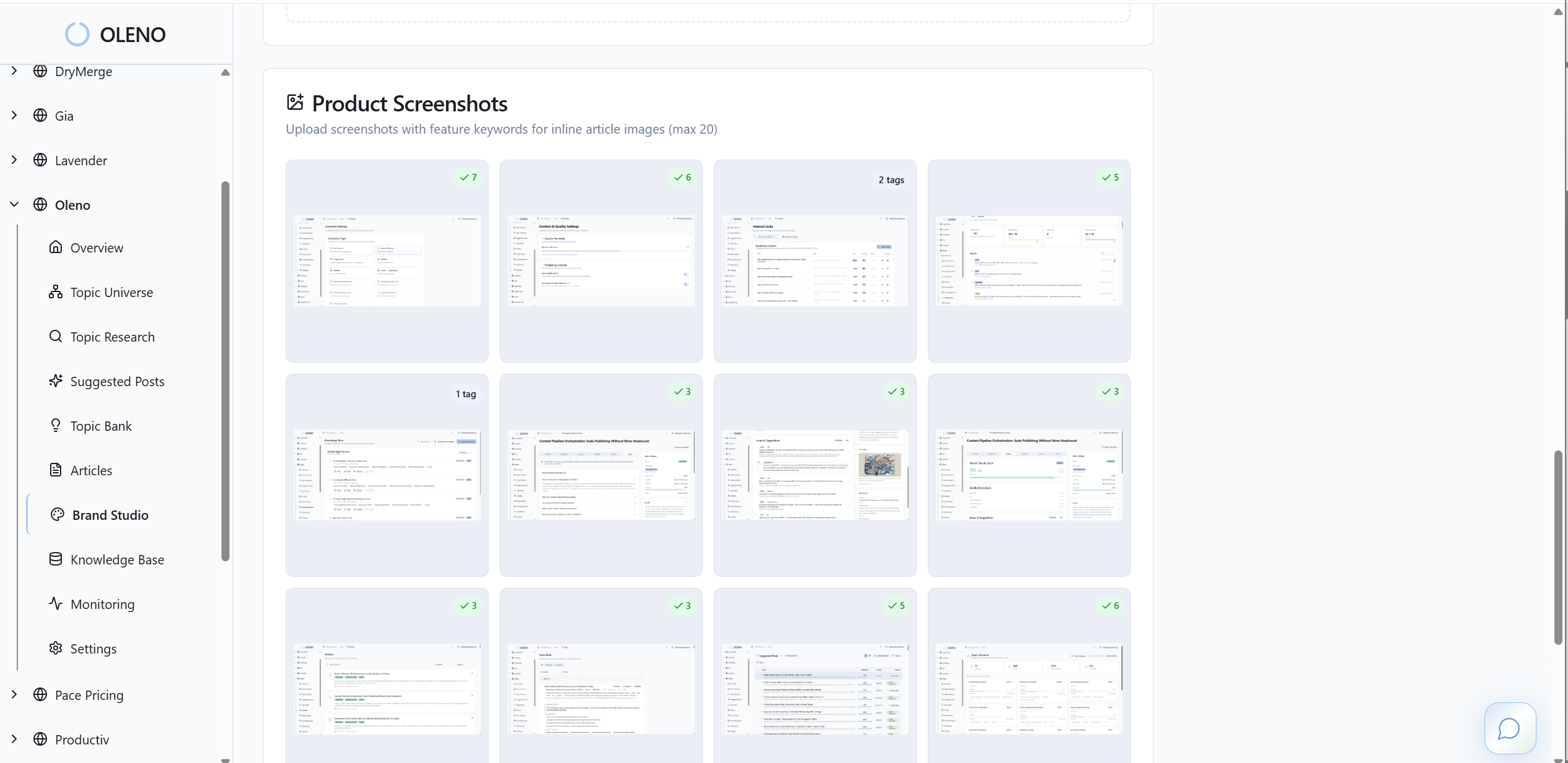
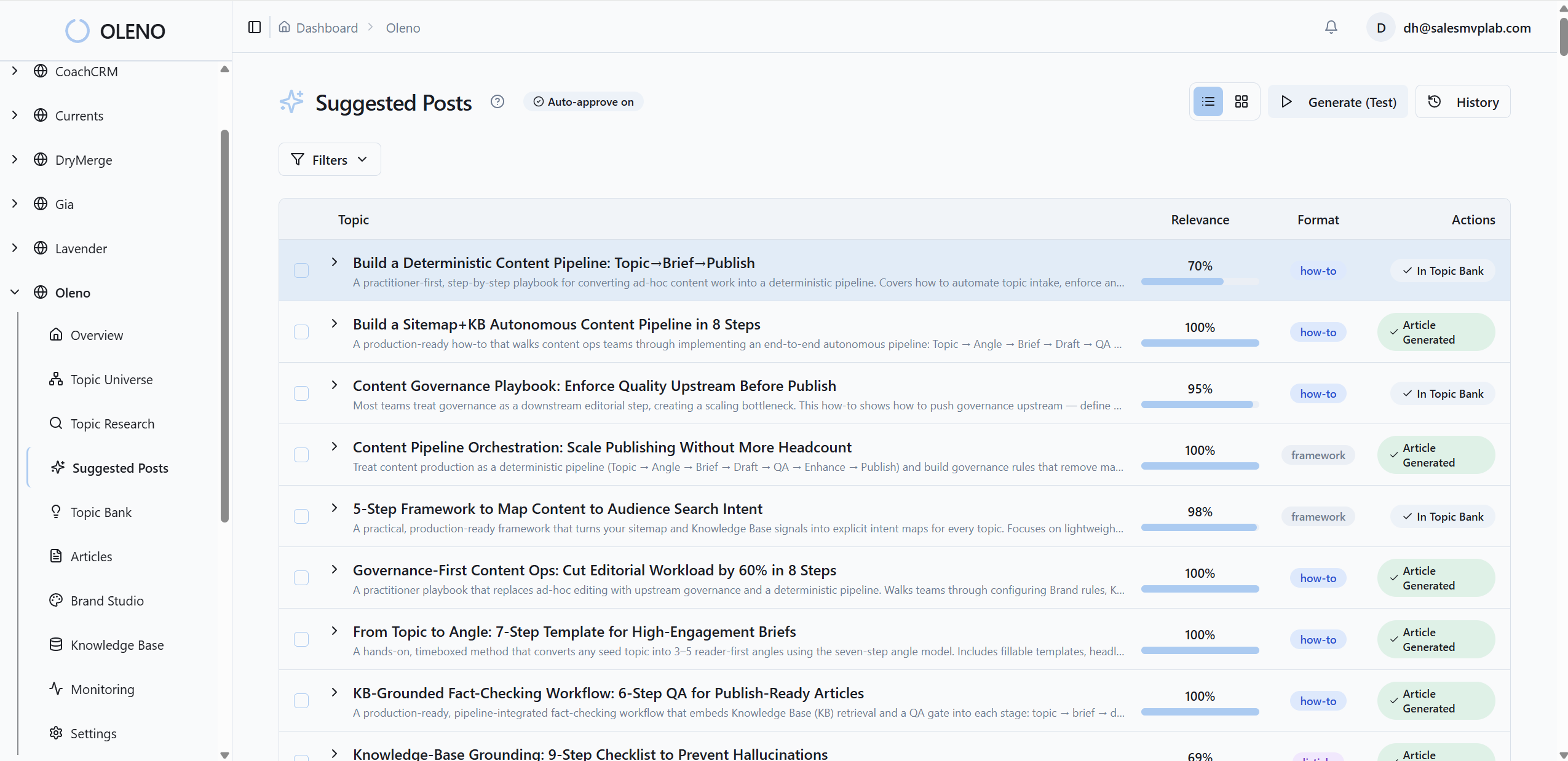
This is where the waste disappears. Instead of discovering sameness after writing, Oleno prevents it upstream. If you want a third-party angle on why this matters, here’s a concise primer on Information Gain from Inlinks.
QA Gate, Snippet-Ready Structure, And Deterministic Linking
Downstream, Oleno runs a QA gate with 80+ checks, structure, clarity, brand alignment, and those 40–60 word snippet-ready openers for every H2. Minimum pass score is enforced, and if a draft falls short, Oleno refines it automatically. This ties the differentiation promise to publish-ready quality.
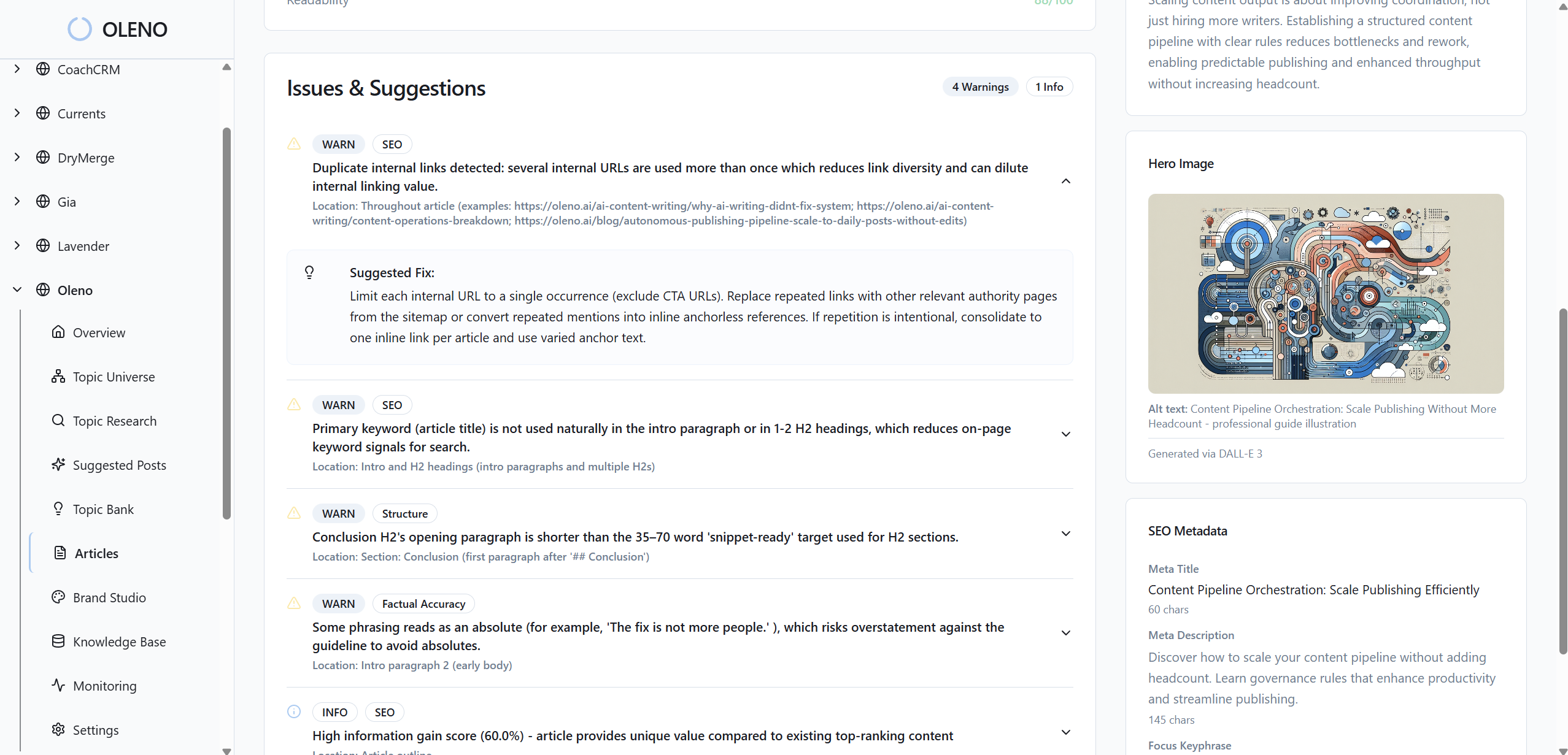
After drafting, Oleno handles accuracy-sensitive tasks deterministically. Internal links are injected from your verified sitemap with exact-match anchors, no fabricated URLs. Schema is generated programmatically. Visuals are placed by rules, not randomness. The result isn’t just a “nice draft.” It’s a complete, on-brand article that avoids the quiet tax of late rework.
If you’re ready to move from “hope it’s different” to “prove it’s different,” this is the moment. Let Oleno handle the gates and guardrails while your team focuses on the story. Try Using An Autonomous Content Engine For Always-On Publishing.
Conclusion
You don’t need more briefs. You need better ones, scored for Information Gain and tied to your product before anyone writes. The payoff isn’t abstract. Fewer rewrites. Fewer me-too posts. More assets your team actually uses. Build the gate upstream, and the rest of the system gets easier. Authority follows the teams that do this consistently.
About Daniel Hebert
I'm the founder of Oleno, SalesMVP Lab, and yourLumira. Been working in B2B SaaS in both sales and marketing leadership for 13+ years. I specialize in building revenue engines from the ground up. Over the years, I've codified writing frameworks, which are now powering Oleno.
Frequently Asked Questions