Consistency Is the New Moat in LLM Discovery

Consistency is the new moat in LLM-driven discovery, and most teams still act like volume alone will save them. If you've spent this week reviewing drafts that were technically fine but still felt off, you've already felt the real problem behind “AI content.”
Demand-gen content execution platform is a governed content operations system that turns strategy into consistent, multi-channel demand-generation output by enforcing brand, product, audience, and narrative rules across planning, creation, review, and publishing. Unlike a writing tool or traditional content ops stack, a demand-gen content execution platform exists to carry strategic context through execution so your message doesn't drift as output scales.
This category showed up because LLM discovery changed the rules. SEO used to reward coverage and tactics. LLM-driven discovery still cares about coverage, sure, but it also cares whether your brand keeps saying the same smart thing, clearly, across dozens or hundreds of assets. That's where most teams break. They run into the Strategy-Execution Trade-off, the false choice between strategic control and execution speed, and they stay stuck there far longer than they should.
Key Takeaways:
- LLMs are more likely to surface brands with repeated, coherent market signals than brands publishing scattered volume.
- The real problem isn't drafting speed. It's fragmented execution between strategy, writers, reviewers, and channels.
- The Strategy-Execution Trade-off creates two gaps: strategy never reaches output, and fast AI output stops being trustworthy.
- Every extra review cycle creates leadership drag, narrative drift, and wasted budget.
- Category leaders encode strategy into the system, not just into docs, meetings, and comments.
- A demand-gen content execution platform exists to remove the false choice between speed and control.
Why LLM Discovery Favors Consistency Over Sheer Output
LLM discovery rewards the brand that is easiest to understand and safest to cite. That's different than saying the biggest brand always wins. It doesn't. But if your company says five different things about the same problem across blog posts, product pages, comparison pages, and founder content, you're making yourself hard to trust.
LLMs Reward Clear Signals, Not the Loudest Brand
72% of B2B content never generates a lead, according to BridgeRev's review of common B2B content performance patterns. That number matters less for the traffic debate than for the signal debate. A lot of content gets published. Very little of it reinforces a sharp point of view.
That's the hidden shift. LLMs don't just parse pages. They synthesize patterns. They look for stable definitions, repeated positions, clear product truth, and audience-specific language that doesn't wobble every time a new writer, agency, or prompt gets involved. In my experience, that's why “consistency is the new” anything isn't just a branding line. It's an operating rule. If your market story changes every few weeks, you don't have authority. You have noise.
A lot of teams still think more content is the moat. I don't fully buy that anymore. More content helps, but only after coherence. Back in the Steamfeed days, we hit 120k monthly visitors because we had breadth and depth at the same time. We saw jumps at 500 pages, 1000, 2500, 5000, then 10000. But the real unlock wasn't raw page count. It was that the site kept reinforcing recognizable expertise across a massive surface area.
The Real Bottleneck Is Fragmented Execution
The bottleneck isn't content. It isn't prompts either. It's fragmented execution without a system.
You can see this in almost every scaling SaaS team. Strategy lives in the CMO's head, in a positioning doc, in a deck from the last offsite, in Slack threads, in PMM notes, and in product launch meetings. Then execution happens somewhere else. A writer gets a brief. An agency gets a call. Someone uses ChatGPT. Someone else edits in Google Docs. A demand gen lead rewrites the CTA. The founder changes two claims at the last second. Then the piece ships.
That's not one system. That's a relay race with dropped batons.
If you want a quick diagnosis, use what I call the 4-Signal Drift Test:
- Your homepage and blog describe the problem differently
- Product-led content sounds tighter than SEO content
- Founder posts feel real, but team content feels generic
- Every “final” draft still needs strategic rewrites
If you checked 2 or more, your problem isn't output. It's execution drift.
This is also why prompt-heavy workflows disappoint so quickly. Prompting treats every asset like a new event. Demand gen isn't a series of events. It's repeated market conditioning.
The Strategy-Execution Trade-off Keeps Brands Invisible
A CMO at a 200-person SaaS company usually lands in one of two bad setups by month 18 of scaling. Setup one: keep quality high with manual review, and watch output stall at 4 to 8 pieces a month. Setup two: let AI or outside writers move faster, then spend senior time fixing voice, claims, positioning, and examples. Either way, the trade-off shows up. Slow and accurate. Fast and off-brand.
That's the Strategy-Execution Trade-off. And most teams don't even name it, which is why they keep managing symptoms instead of fixing the structure.
You feel this in discovery first. The brand doesn't disappear because nobody wrote anything. It disappears because the content base isn't coherent enough to create durable authority signals. Google's guidance on helpful, people-first content keeps pushing in that same direction: clear expertise, reliable information, and consistency of purpose. LLMs push even harder there.
If you're trying to show up in AI-generated answers, being intermittently good doesn't carry much weight. Repeated clarity does. That sets up the harder question: if volume isn't the first problem, what is?
Why Most Teams Are Solving the Wrong Content Problem
Most teams are trying to fix a writing problem. What they actually have is a translation problem. Strategy gets defined in one place and executed in another, and every handoff strips context.

Prompting Makes Drafts Faster, But Demand Gen Less Reliable
Prompting is useful. Fair point. If you need a draft, a rewrite, or a rough angle fast, it can save time.
But speed at the draft layer doesn't mean reliability at the system layer. That's where people get fooled. A team sees faster output and assumes the machine is working. Then three weeks later they're buried in review comments, debating claims, tightening examples, fixing audience fit, and trying to remember which version of the positioning is current.
That is not scale. That's deferred work.
Consider a VP Marketing with 5 contributors shipping content across SEO, product marketing, and customer education. If each piece needs 35 minutes of senior review for voice, another 20 for product accuracy, and one more pass for narrative fit, 12 assets a month turns into roughly 11 senior hours of cleanup. That's before urgent launch content shows up. And that's a conservative number.
Honestly, this surprised us more than anything else when watching AI workflows spread through teams. The draft got faster. The trust got weaker.
More Writers Often Create More Context Gaps
When I started at PostBeyond, I could write 3 to 4 solid blog posts a week because I had all the context. As the team grew, output should've gone up. In theory. Instead, the new writer had less product depth and less market context than I did, so quality dropped and speed didn't improve much. At the same time, I had less time to write because I was in leadership meetings and running more of the function.
That's a very normal scaling trap. Hiring doesn't automatically close the gap. Sometimes it multiplies it.
The default assumption is “if one writer can produce X, three writers can produce 3X.” That math breaks the second strategic context is unevenly distributed. If the founder, CMO, PMM, and sales team all hold different pieces of the truth, every added contributor increases the odds of translation loss. That's why I use the 30/60 rule: if a new writer still needs more than 30 minutes of strategic briefing or more than 60 minutes of revision guidance per article after the first month, the issue is system design, not writer quality.
And yes, agencies can help. There's a valid case for them when you need temporary lift or a specific specialization. But they still inherit your context gap unless you've encoded what matters.
Content Operations Broke Before AI Put It On Display
What AI really did was expose how fragile content execution already was. The problem didn't start with ChatGPT.
Before AI, teams were already dealing with scattered briefs, subjective review loops, conflicting stakeholder opinions, and uneven understanding of who the content was for. AI just turned a slow leak into a visible one because it increased the volume of drafts entering a broken pipeline. More drafts, same bottleneck. Same executive reviewer. Same missing context.
At one SaaS company, we ranked really well on Google for a bunch of topics. Great writers. Strong design. Real traffic. But a lot of that content sat too far from the demand-gen story, so it didn't tie back to the product in a meaningful way. Good rankings, weak commercial alignment. That's a brutal lesson because it proves success in one layer doesn't carry to the next.
So the reframe is simple. You do not need another isolated writing tool. You need a system that operationalizes strategic consistency across who you're talking to, what you believe, what is true about the product, and how all of that shows up across channels. Once you see that, the next issue gets ugly fast: the cost of inconsistency isn't just editorial annoyance. It compounds.
The Hidden Cost of Inconsistency Across the Funnel
Inconsistency creates debt. Not in some abstract brand sense. In hours, budget, missed authority, and executive drag.
Every Review Cycle Becomes Leadership Tax
A 3-review workflow sounds responsible until you multiply it. One content lead spends 25 minutes marking up a draft. A PMM spends 20 minutes correcting product framing. A VP spends 15 minutes fixing the story arc and CTA. That is 60 minutes per asset. At 16 assets a month, you're burning 16 senior hours monthly on correction work. That's 192 hours a year. Almost five full workweeks.
And that assumes people review cleanly. They usually don't.
The trade-off gets worse because the most senior person often becomes the quality gate. You know this pattern. The draft is usable, but not publishable. So the CMO, founder, or PMM becomes the last-mile editor for everything strategic. Which means the system can only move as fast as that person can read and rewrite.
One experienced SEO consultant looked at Oleno's output and said it passes the slop test. That phrase stuck with me because every marketing leader knows what the opposite feels like. You don't need a rubric. You can smell slop in 30 seconds.
Narrative Drift Erodes Category Authority
What happens when one team writes “AI content automation,” another says “content ops,” another says “demand gen engine,” and your founder keeps talking about “market narrative control”? The brand starts sounding like four companies sharing a domain.
That's narrative drift. And it quietly kills authority because the market can't build a stable mental model of what you are or why you matter.
This matters more in LLM discovery than in classic search. Search can rank a page for a phrase even if the rest of your site is messy. LLMs synthesize broader patterns. If your product definition changes across pages, or your audience framing shifts from one asset to the next, you weaken citation confidence. OpenAI's guidance on search and retrieval behavior hints at the same principle from another angle: structured, consistent source material is easier to retrieve and use well.
| Dimension | The Strategy-Execution Trade-off | Demand-Gen Content Execution Platform |
|---|---|---|
| Speed vs control | Teams choose slow manual review or fast brand-deaf output | Teams keep control while increasing execution speed |
| Strategic context | Strategy lives in docs, meetings, and executive heads | Strategy is encoded into the execution system |
| Content quality | Quality depends on who wrote it and who reviewed it | Quality is governed by reusable rules and approved inputs |
| Narrative consistency | Messaging drifts across channels and contributors | Narrative gets reinforced across the full funnel |
| Executive workload | Senior leaders become bottleneck editors | Leaders set direction once and review exceptions |
| LLM visibility | Brand signals are fragmented and hard to trust | Repeated authority signals are easier to surface |
That's the real shift. You're not just publishing assets. You're training the market on what category to put you in.
Trust Compounds Faster Than Raw Output
Question lead here matters: what actually compounds in discovery?
Not pages by themselves. Trust does. And trust compounds when the market keeps hearing the same sharp definitions, the same point of view, the same product truth, and the same audience-specific language across a broad enough content base. That's why consistency is the new moat. Not because volume stopped mattering, but because volume without coherence stopped being very defensible.
Back in the contributor-network days, most pages got under 100 visits a month. That would've looked unimpressive if you judged each piece in isolation. But taken together, the catalog built topic coverage and authority. That's the Catalog Compounding Rule: once you pass roughly 500 pages of coherent, non-duplicative content, discovery often starts to step up in chunks, not inches. We saw it at 500, 1000, 2500, 5000, then 10000 pages.
Still, I'll concede something here. Small teams do not need hundreds of pages to benefit from consistency. They need enough aligned surface area for the market to recognize a pattern. Which brings us to the part that usually hurts the most.
When Your Team Is Busy but the Market Still Doesn't Get You
You feel the pain of inconsistency at 6:30 p.m., not in a strategy deck. You're reading a draft that is technically fine, maybe even pretty decent, but it still doesn't sound like your company. The claim is a bit off. The audience is too broad. The product tie-in is vague. So you start rewriting. Again.
You Become the Last-Mile Editor
At that point, you aren't leading a system. You are the system.
That's exhausting because every fix depends on the same person carrying invisible context across every asset. The writer doesn't fully have it. The AI doesn't have it. The agency definitely doesn't have it unless you've done a ton of work up front. So you sit there adjusting phrasing, correcting examples, tightening the argument, and fixing product truth because you're worried about what happens if you don't.
I don't think enough people admit how frustrating rework is when you're the one responsible for the market narrative. It isn't just the time. It's the feeling that output exists, but reliability doesn't.
Quarterly Resets Kill Confidence
Busy teams often look productive from the outside. Content calendar moving. Launches happening. Social posts going out. New drafts every week.
But inside, it feels like starting over every quarter.
Why? Because so much of the strategy is implied instead of encoded. A new campaign kicks off and everyone re-briefs the same story. A new writer joins and asks the same questions. A product update ships and old content goes stale. The category language shifts slightly and now half your library is out of sync. You don't feel momentum. You feel motion.
Short version. Motion is not control.
If that sounds familiar, good. It means the fix isn't “write better prompts.” The fix is to run content like a system.
How Category Leaders Turn Consistency Into a System
Category leaders don't treat content as isolated deliverables. They treat it as repeated market signaling. That's a different operating model.
Before the subsections, the three pillars are simple:
- Governed Strategy: Category leaders encode positioning, product truth, audience context, and voice as operating rules instead of leaving them trapped in docs and meetings.
- Orchestrated Execution: Content creation, review, and publishing run as one connected system so speed doesn't create drift and rework.
- Compounding Authority: Every asset reinforces the same market definitions, narratives, and differentiators across search, social, and LLM discovery.
If you want to see what that looks like in practice for your own team, you can request a demo.
Encode Strategy or It Won't Scale
A diagnostic question first: where does your real strategy live right now?
If the honest answer is “mostly in my head, plus some docs,” then it isn't scalable yet. Strategy only scales when it gets encoded into reusable rules that survive handoffs. I call this the Head-to-System Test. If a new contributor can't produce a strategically accurate draft within 2 rounds using only the documented inputs, your strategy is still trapped in people.
What needs to be encoded? Four things, at minimum. Voice. Audience context. Product truth. Point of view.
Not everyone agrees you need all four before scaling. Some teams prefer to move fast with just a style guide and some examples, and that's valid for a while. But once you're managing multiple contributors, multiple content types, and multiple funnel stages, partial context creates full problems. That's why governed strategy beats implied strategy every time past a certain team size.
Start With Inputs, Not Drafting
The instinct is to focus on outputs because that's what you can see. Drafts. Posts. publish dates. But reliable execution starts upstream.
Think of demand gen like manufacturing, not artistry. Not because the work is mechanical. Because quality problems almost always start in the input layer. Wrong specs in, defects out. In content, the specs are your audience, market framing, product boundaries, proof points, and definitions.
That's why prompt-based systems tend to wobble. The prompt is trying to carry too much. It becomes brief, strategy doc, style guide, PMM training, and QA checklist all at once. That's a lot to ask from a text box.
A better rule is the 5-Artifact Threshold. Before you try to scale output, make sure five things are stable: audience definition, persona goals, use-case framing, product truth, and market POV. If fewer than 4 of those are documented and reusable, don't blame the draft quality. Blame the setup.
When this is done well, humans stop spending all their time translating strategy into each asset. They spend more time deciding what should exist and what should change next. That's a much better use of senior judgment.
Repeated Signals Create Compounding Visibility
Compounding visibility comes from repeated market signals. Same category definition. Same enemy. Same audience logic. Same product truth. Repeated across different assets, angles, and channels.
This is where people get nervous. They hear “repeat” and think “boring.” But repetition with variation is how markets learn. Sales teams know this. Great messaging doesn't change every week. It gets applied to more situations with better specificity.
There's a case to be made for experimentation, of course. You should test angles. You should pressure-test framing. Early-stage companies especially need that room. But once a pattern emerges, the job changes. Then you're not searching for your story. You're reinforcing it.
And that reinforcement is what makes LLM discovery easier. Humans need repetition to remember you. Search engines need repetition to associate topics with you. LLMs need repetition to trust the shape of your expertise. Different systems. Same principle.
Midway through a market category build, this is usually the point where teams stop asking “what should we post this week?” and start asking “what repeated signals are still missing from our content base?” That's a much smarter question. If you want to pressure-test that kind of setup in your own environment, request a demo.
How Oleno Makes Consistency Operational
Oleno shows what this category looks like when the system, not the senior leader, carries the context. It doesn't ask teams to choose between strategic control and faster execution. It turns strategy into operating rules, then runs content work inside those boundaries.
Oleno Turns Strategic Context Into Working Rules
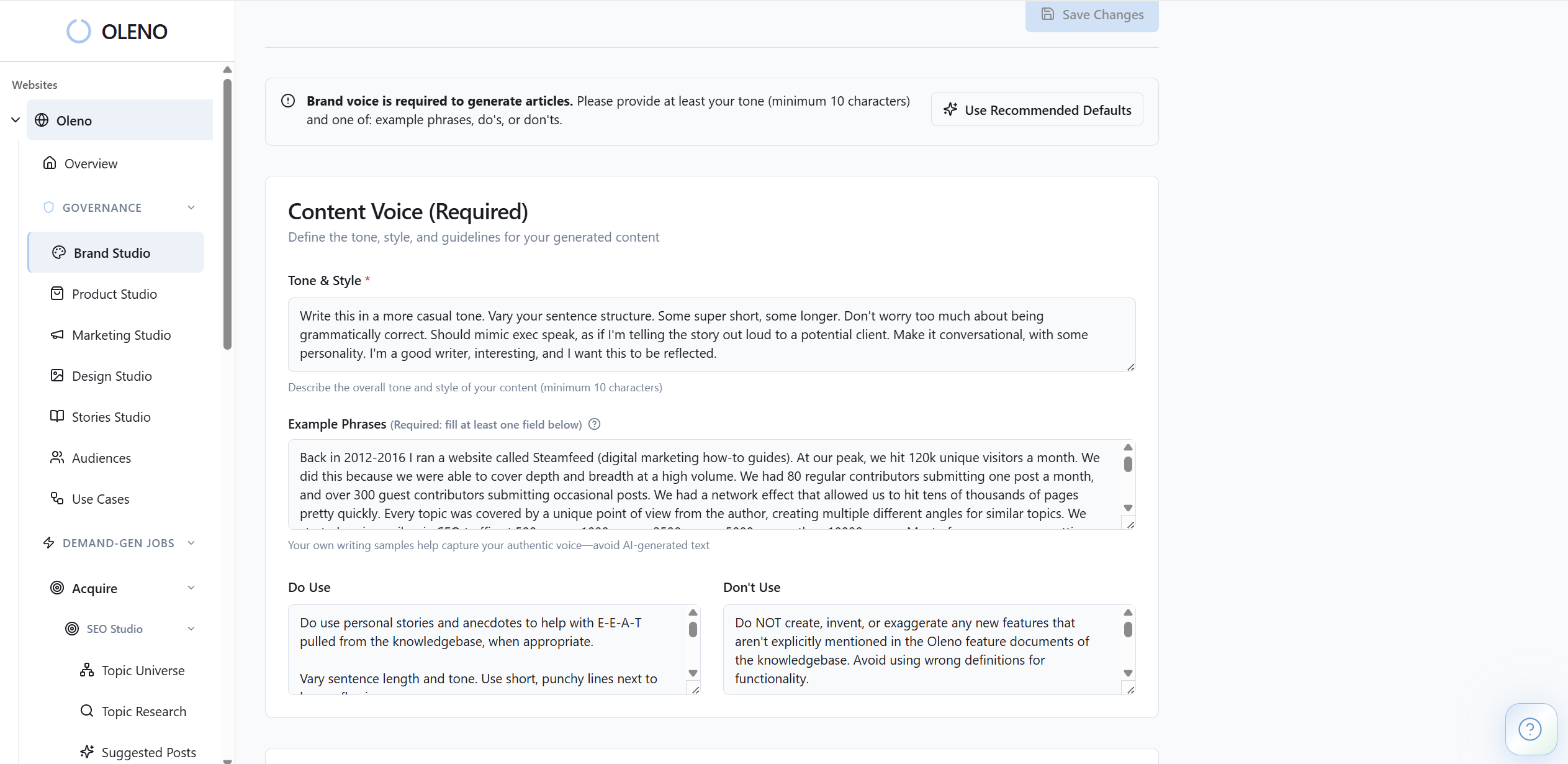
Oleno starts with the inputs most teams leave scattered. brand studio captures how the company should sound. marketing studio stores the market framing, core messages, and narrative logic. product studio keeps approved product descriptions, boundaries, and support content in one source of truth. audience & persona targeting and use case studio make sure the same topic gets framed differently depending on who it's for and what job they're trying to get done.
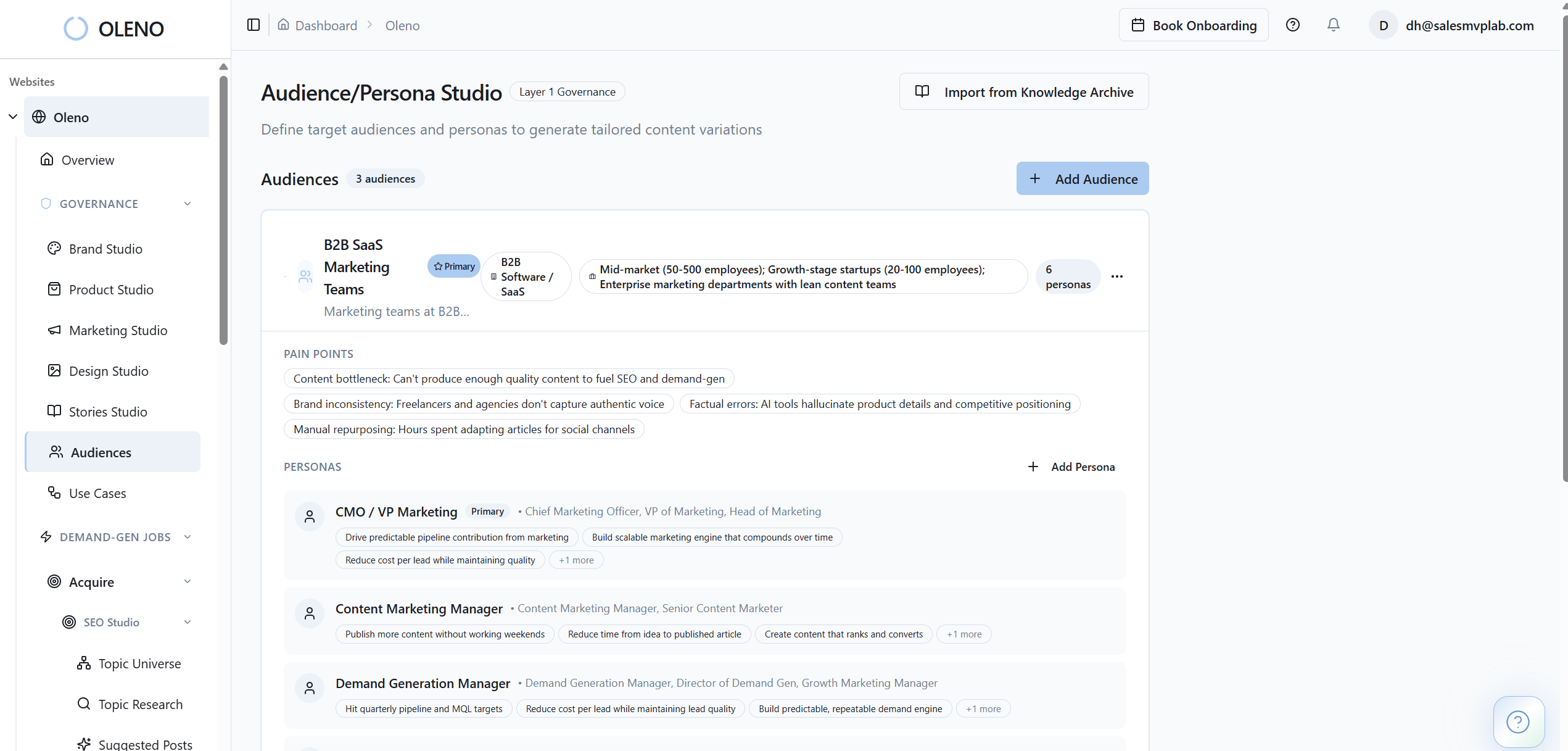
That matters because review debt usually comes from missing context, not missing words.
Instead of rewriting every draft from scratch, the team defines the important context once and reuses it across content types. ip studio adds proprietary thinking and internal frameworks, which is a big deal if you're trying to publish content that sounds like an actual operator wrote it rather than a model remixing public web language. For teams stuck in constant rebriefing, that shift alone can remove a lot of wasted motion.
Oleno Helps Teams Scale Output Without Letting the Story Drift
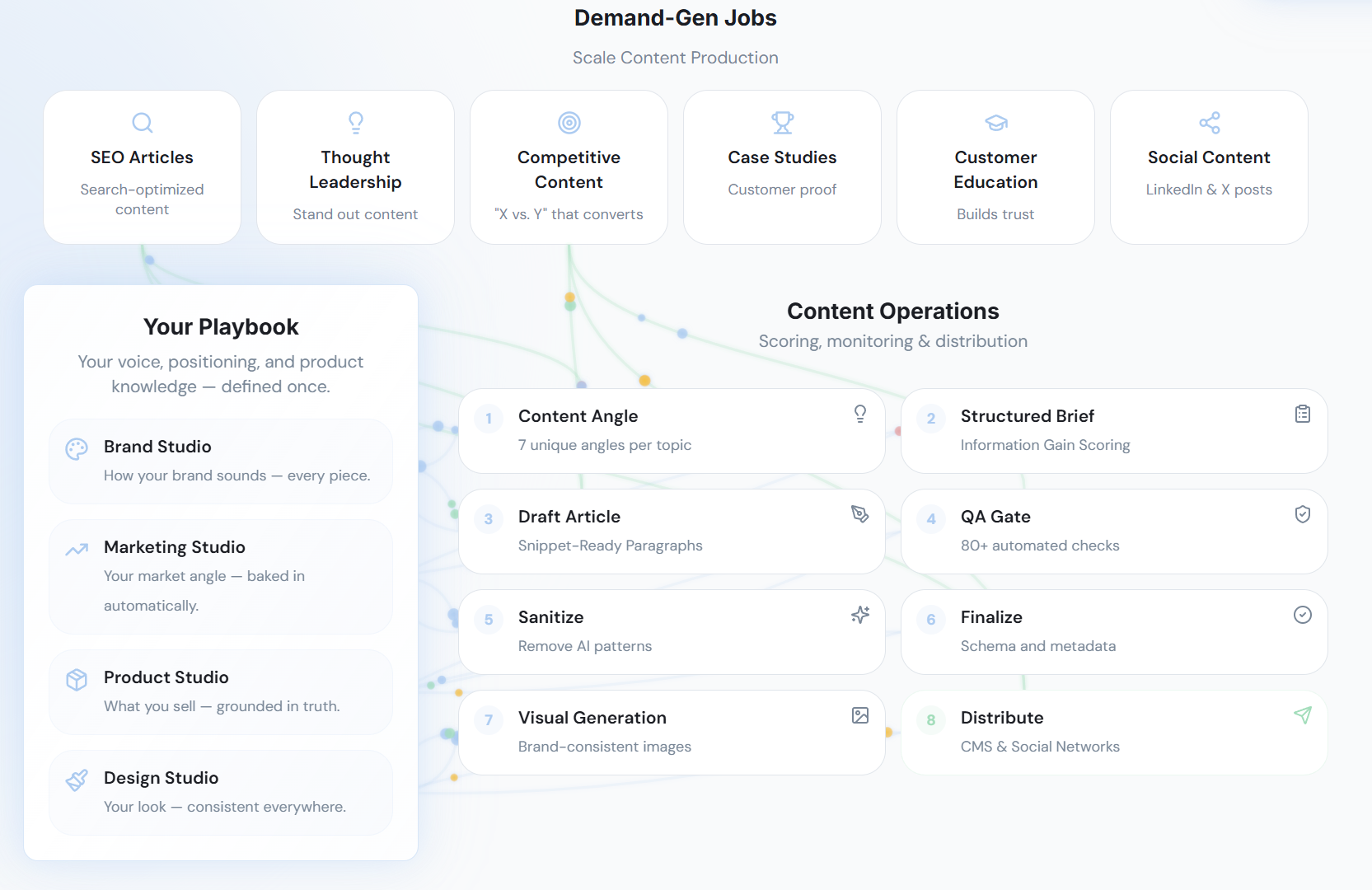
Execution still matters, obviously. Oleno uses orchestrator to pace production, run job-based pipelines, and keep work moving without a bunch of manual coordination. quality gate checks content against brand, structure, and accuracy requirements before it moves forward. cms publishing closes the gap between approved content and live content, which sounds basic until you've lost hours to copy-paste and formatting errors.
For acquisition content, programmatic seo studio expands coverage while keeping structure and voice intact. For thought leadership and market narrative, category studio and writing studio keep opinionated content aligned to the same central story. For product-led and evaluation content, product studio and buyer enablement studio help keep claims accurate and tied to real use cases.
One customer reaction captured the value better than a spreadsheet could. After seeing the output, the response was basically: this is like adding 3 people to my team. That's not magic. It's what happens when the system carries the context that used to live in one overloaded marketing leader.
If the problem you're trying to solve is the Strategy-Execution Trade-off, that's the practical test. Can the team move faster without losing the plot? If you want to see that setup in action, book a demo.
The Brands That Win AI Discovery Will Sound Like Themselves at Scale
LLM-driven discovery is exposing a hard truth. The market doesn't reward scattered effort forever. It rewards brands that can repeat a clear story, with clear definitions and clear proof, across enough surface area to become easy to trust.
That doesn't mean every team needs the same stack or the same process. It does mean the old trade-off is getting more expensive. Slow manual review won't scale. Fast but brand-deaf output won't hold trust. Consistency is the new moat because consistency is what turns strategy into something the market can actually recognize.
About Daniel Hebert
I'm the founder of Oleno, SalesMVP Lab, and yourLumira. Been working in B2B SaaS in both sales and marketing leadership for 13+ years. I specialize in building revenue engines from the ground up. Over the years, I've codified writing frameworks, which are now powering Oleno.
Frequently Asked Questions