Consistency Is the Only Moat Left in AI Search

72% of teams using generative AI say they’ve adopted it in at least one business function, but that stat hides the real problem: most of that output still doesn’t compound into market visibility or pipeline impact. If you spent time this week rewriting AI drafts, fixing messaging drift, or re-explaining your product to a writer, you felt it.
The phrase consistency is the only sounds extreme until you look at how AI search actually works. Prompts are cheap now. Drafting is cheap now. Publishing is getting cheaper by the month. What doesn’t get cheap is a clear signal repeated across dozens, then hundreds, of assets without your message drifting into mush.
Demand-generation content execution software is a governed marketing execution system that turns strategy, positioning, product truth, and audience context into repeatable, brand-consistent content operations across SEO, GEO, and demand generation. Unlike AI writing tools or SEO platforms, demand-generation content execution software is built to keep the full market story aligned over time, not just produce isolated pieces faster.
This category showed up because the GEO shift made the old way harder to hide. LLMs don’t just look at one page. They synthesize across many sources, patterns, definitions, and repeated claims. So if your content says one thing, your product pages imply another, and your thought leadership wanders off into unrelated education, you start disappearing from the answers that matter.
Key Takeaways:
- AI search rewards repeated signal more than random volume.
- Fragmented Demand Generation is the enemy, not a lack of prompts.
- If positioning, audience context, and product truth live in different places, your output will drift.
- Review cycles are usually a systems problem, not a talent problem.
- The new category is about turning marketing rules into repeatable execution.
- Small teams need a system that compounds, not more disconnected output.
- If you want to see what that looks like operationally, you can request a demo.
Why AI Search Now Rewards Repeated Signal Over Raw Output
AI search rewards consistency more than content volume because LLMs build trust from repeated, coherent signals across many assets. One strong article can help, sure. But one strong article surrounded by vague messaging, off-brand thought leadership, and half-accurate product content usually doesn’t hold up.

AI Made Publishing Cheap, So Inconsistency Became Expensive
A few years ago, the hard part was getting content published at all. Now the hard part is keeping it aligned after article 20, 50, 200. That’s the shift most teams still miss.
Prompting feels productive because you can generate words fast. We’ve all felt that little rush. Blank page gone. Draft on screen. Progress. But output is not the same thing as demand generation, and that distinction matters more now than it did in the SEO-only era. According to McKinsey’s latest state of AI research, adoption is rising fast across business functions. That means your competitors also have access to faster drafting. Speed alone won’t separate you for long.
What gets more expensive is inconsistency. Every fuzzy claim. Every article that sounds like it came from a different company. Every comparison page that says one thing while your founder says another on LinkedIn. Fragmented Demand Generation is what happens when narrative, product truth, and audience context live in different docs, different prompts, and different heads. It looks busy. It even looks modern. But the system underneath is broken.
Back in 2012 to 2016, I ran a digital marketing site that got to 120k monthly visitors. We had 80 regular contributors and 300 plus guest contributors. What made that work wasn’t just volume. It was that the site had enough depth, enough breadth, and enough repeated signal around real topics that traffic started spiking at 500 pages, then 1000, then 2500, then 5000. Volume mattered. But volume without consistency wouldn’t have compounded like that.
Visibility In LLMs Builds From Recognition, Not Isolated Wins
LLMs don’t “rank” a single page the way old-school search often felt. They synthesize. They compare. They look for patterns they can trust. That changes the job.
If your company publishes one solid category article, three thin SEO posts, a generic feature page, and two founder posts with no tie back to the actual market problem, the model doesn’t see leadership. It sees noise. That’s the uncomfortable part. A lot of content programs feel larger than they really are because they generate activity across channels without reinforcing the same core claim.
I’d call this the Repeated Signal Test. If an LLM sampled 25 pieces from your company, would it hear one company with one point of view? Or would it hear five freelancers, three tools, one PMM, and a founder all talking past each other? If the answer is the second one, that’s not a content gap. That’s a system gap.
There’s a reason this matters more now. Google’s own documentation around AI Overviews and AI-organized results points toward synthesized answers, not just blue links. And synthesized answers favor coherence. You don’t need every page to say the same thing. You do need them to rhyme.
Fragmented Demand Generation Looks Fine Until Discovery Breaks
At first, Fragmented Demand Generation doesn’t look like failure. It looks like a decent modern stack. SEO tool over here. AI writer over there. PMM docs in one folder. Product facts in another. Founder POV trapped in Slack messages, sales calls, or random Loom videos. Then a marketer tries to turn all that into weekly output.
That’s when the cracks show. Briefs get rewritten from memory. Product claims drift. The article ranks for something but doesn’t connect to pipeline. The social post sounds different from the landing page. Reviewers keep fixing the same stuff. Nobody wants to admit it, because everyone is working hard. But the work doesn’t stack.
I remember this clearly at one SaaS company. We had great writers. Great designers too. We ranked well for a bunch of topics. But the content drifted too far from the solution, so there was no clear path from traffic to actual demand. On paper, the program looked healthy. In reality, we had rankings without enough demand-gen gravity. That’s a painful place to be, because it takes a while to admit the engine is pointed in the wrong direction.
The market didn’t suddenly develop a content shortage. It developed a consistency shortage. That changes what you need to build next.
The Hidden Failure Is Broken Execution, Not Weak Writers
Most teams don’t have a writing problem. They have an execution problem where every asset becomes a fresh coordination exercise. That’s why new tools feel useful for two weeks, then create another layer of review debt.
Your Bottleneck Is Usually Coordination Cost
A lot of founders and Heads of Marketing assume the answer is better writers, more freelancers, or more prompt discipline. I get why. Those are visible levers. Hiring is visible. Prompt libraries are visible. Output counts are visible. Coordination cost is sneaky.
When I was the sole marketer at PostBeyond, I could write 3 to 4 strong blog posts per week because I had the context in my head and a structured framework in my hands. As the team grew, output didn’t automatically get easier. It got harder. The writer didn’t have all the context I had, which meant lower authority and more time spent getting to something usable. And I had less time to write because I was in meetings, managing people, doing the executive stuff. More people did not instantly equal more leverage.
That’s why I think “content bottleneck” is often the wrong diagnosis. A Head of Marketing at a 40-person SaaS company usually doesn’t wake up needing 20% better prose. They need 60% fewer context resets. Different problem. Different fix.
A simple rule helps here: if the same feedback shows up in more than 25% of review cycles, you don’t have an editor problem, you have a missing-system problem. Voice drift. Weak CTAs. Wrong audience angle. Product inaccuracies. Those shouldn’t be rediscovered manually every week.
Prompts Can’t Carry Your Entire Go-To-Market Strategy
Prompting is useful. I’m not anti-prompt. That would be silly. For exploration, brainstorming, and rough drafting, prompts are great. But prompts can’t hold your whole market position together by themselves, especially once multiple people are involved.
I remember hearing April Dunford on a panel years ago while a marketer kept rattling off tactics and tools. Grab your list here. Run this tactic there. Then do this channel move. Her response was blunt, and she was right: tactics without strategy are useless. Maybe not the exact polite version, but that was the point. And it stuck with me because it matched what I kept seeing in SaaS.
Most AI writing and SEO tools are still anchored in tactics. They optimize the channel. They don’t truly hold the marketing plan. They don’t know your market POV, your enemy framing, your differentiators, your best-fit audience, your product boundaries, your use cases, or your brand voice unless a human keeps injecting that context over and over. Which means the human is still carrying the system.
That’s why people get disappointed. Not because AI text can never work. But because the underlying GTM plan is ignored, and then humans have to argue with the draft, fix it, and eventually say, “I should’ve just written this myself.”
When Every Asset Starts From Scratch, Nothing Compounds
This is where the old categories stop being enough. It’s not another AI writing category. It’s not another SEO tool. It’s not another content ops dashboard. It’s a demand-generation execution category meant for teams who need the whole thing to hold together.
And it’s designed for a very specific kind of team: the growth-stage SaaS marketing lead who wears all the hats, has ambitious goals, and feels like every quarter resets. If that’s you, you’re not asking for more ideas. You’re asking for compounding.
Compounding only happens when the second article benefits from the first. When the feature page benefits from the category page. When the comparison page benefits from the founder story. When the social post reinforces the same point of view instead of spinning off into generic tips. If each asset begins with fresh prompts, fresh interpretation, fresh context gathering, and fresh review debates, there’s no memory in the system. There’s only labor.
That’s where old categories break down. They solve pieces. They don’t solve continuity.
The Cost Of Fragmentation Gets Worse As Output Scales
Fragmentation creates measurable costs long before a dashboard makes them obvious. You lose time in rewrites, lose clarity in the market, and eventually lose visibility because your signal gets diluted across too many disconnected assets.
More Contributors Usually Mean More Drift Before More Leverage
More contributors should increase coverage. In practice, they often increase variation before they increase leverage. That’s the hidden tax.
We saw this years ago with content teams and contributor networks. You can absolutely scale output with many voices. I’ve done it. But that only works if there’s enough structure, enough editorial clarity, and enough shared direction for the pieces to reinforce each other. Without that, every new contributor creates another surface area for drift.
A good diagnostic here is the 5-asset audit. Pull your homepage, one category article, one product page, one comparison page, and one founder post. Read them back to back. Do they define the same enemy? Do they describe the product in compatible language? Do they speak to the same audience maturity level? If not, you’re already paying the drift tax.
Fair point, some variation is healthy. You don’t want every asset sounding copy-pasted. But variation in tone is different from variation in meaning. One builds texture. The other breaks trust.
Review Cycles Are the Tax You Pay for Missing Structure
Review is where fragmented execution becomes visible. The article comes in. Then the PMM fixes product accuracy. Then the Head of Marketing adjusts the angle. Then the founder changes the positioning language. Then SEO asks for structure fixes. Then someone rewrites the CTA because it doesn’t match the actual offer.
That’s not a “high quality bar.” That’s a relay race caused by missing upstream rules.
Let’s pretend your marketer spends 90 minutes drafting a piece. Then three reviewers spend 20 minutes each fixing recurring issues. Then another 40 minutes goes into revisions and CMS cleanup. That’s 3 hours and 10 minutes for one article. Multiply that by 12 articles a month and you’re at roughly 38 hours. Basically a full work week gone to repetitive correction. Not strategy. Not customer research. Not campaign thinking. Just fixing drift.
This is the thing small teams really feel. They don’t have spare cycles. Every hour lost to frustrating rework is an hour not spent on the next campaign, customer interviews, product launch prep, or actual pipeline work.
In AI Search, Diluted Positioning Becomes A Discovery Problem
Diluted positioning used to be “just” a messaging issue. It hurt conversion rates. It confused prospects. That was bad enough. In AI search, it also becomes a discovery issue.
LLMs synthesize across many sources. If your company repeatedly sounds clear, differentiated, and consistent, you become easier to summarize. If you sound broad, generic, or self-contradictory, you become harder to surface with confidence. That’s why consistency is the only moat left in AI search for a lot of software companies. Not because everything else stops mattering. But because everything else is easier to copy.
You can copy prompts. You can copy workflows. You can copy topic ideas. It’s much harder to copy a coherent signal reinforced across a whole demand-gen system.
| Dimension | Fragmented Demand Generation | Demand-Generation Content Execution Software |
|---|---|---|
| Strategic Source Of Truth | Positioning, voice, and product facts live in separate docs and people | Strategy, audience context, and product truth live in one operating layer |
| Content Creation Model | Each asset starts with prompts, handoffs, and manual interpretation | Execution runs from persistent rules and repeatable workflows |
| Review Burden | Heavy editing catches drift after the draft is done | Rules reduce recurring errors before they spread |
| GEO Readiness | Mixed signals make citation less likely | Repeated signal makes the brand easier to summarize |
| Scaling Effect | More output increases coordination cost | More output expands coverage without as much drift |
| Demand-Gen Impact | Traffic and activity drift away from pipeline narrative | Content stays tied to positioning, use case, and audience pain |
That table isn’t theoretical. It’s the difference between busy marketing and compounding marketing.
Why This Feels Like Constant Reset Work For Small Teams
The old way feels exhausting because the system keeps asking humans to remember everything. If you’re the Head of Marketing or solo marketer, you become the living memory layer for product nuance, positioning, audience fit, voice, and quality control.
The Work Is Tiring Because You Become The Glue
You know this feeling. You open a draft and immediately start mentally comparing it to ten other things. Is the angle right? Does this match the founder’s POV? Is the feature description accurate? Is this really for a Head of Marketing, or does it sound like generic advice for anyone with a keyboard?
That fatigue has a cause. The system keeps pushing memory work onto humans.
In one founder story behind this category, a marketer was spending 3 to 4 hours a day prompting, copy-pasting, cleaning up, and manually putting things into a CMS. That’s not a minor annoyance. That’s a structural waste of time. And growth-stage SaaS teams feel it even more because there usually isn’t a deep bench to absorb it.
You start the quarter with energy. Then by week six you’re worried about backlog, worried about quality, and worried about whether all this activity is actually building anything durable.
Review Rounds Usually Reveal What the System Forgot
Every review round tells on the system. If leadership keeps correcting tone, tone was never encoded clearly enough. If PMM keeps correcting product details, product truth was never operationalized clearly enough. If SEO keeps reworking structure, the publishing process was never designed clearly enough.
We might be wrong on the exact percentage for your team, but I’d bet a lot of recurring review comments fall into four buckets:
- message drift
- wrong audience angle
- weak product tie-back
- structural inconsistency
None of those should require heroic human memory every single time.
That’s why the feeling is so frustrating. You’re not actually being paid to remember everything forever. But the current stack keeps forcing you into that role.
Quarterly Resets Are Usually A System Failure
When everything resets quarterly, it usually means the team never built durable execution memory. New campaign. New prompt set. New content calendar. New freelancer brief. New review loop. Same mistakes.
Motion everywhere. Momentum nowhere.
That’s why some teams feel like they’re always “starting a content engine” but rarely enjoying one. The engine never really existed. It was a sequence of manual pushes disguised as a strategy.
So what replaces that? Not more hustle. Not more dashboards. A different operating model.
The Teams Winning AI Search Build Signal, Not Just Assets
The better model is to govern marketing before you generate content. That means your point of view, audience context, product truth, and brand rules become persistent inputs to execution, not reminders passed around in comments and Slack threads.
- Governed Context: Strategy, positioning, voice, product truth, and audience targeting live in one persistent operating layer instead of scattered across prompts and people.
- Systemic Execution: Demand generation runs across planning, creation, review, publishing, and reinforcement as one system, not isolated tasks.
- Compounding Signal: Consistency across assets, channels, and time creates the coherent market signal that SEO and GEO increasingly reward.
That’s the category shift. And that’s what this is really for: lean B2B teams who can’t afford to rebuild context every week.
Consistency Starts Before the Draft
Most teams try to fix consistency at the editing stage. That’s too late. By then, the drift has already happened.
The better move is what I’d call the Upstream Signal Rule: if a rule matters often, define it before drafting. Voice. Market POV. Product boundaries. Audience framing. Use-case nuance. If it comes up in every review, it belongs upstream.
This is also why prompting alone runs out of road. A prompt can remind a model about a few things. It can’t reliably act as your durable source of strategic context across dozens of job types and contributors. Especially not over time.
At LevelJump, we used founder-led videos and transcripts to create content faster. That helped. But it still missed SEO structure and topic discovery, which meant strong ideas didn’t always translate into discoverable assets. That’s the connection people miss. Founder insight matters. Structure matters too. When those live separately, the output gets weaker than it should be.
If you want to explore how teams are shifting from prompt work to systems, this piece on The Shift Toward Orchestration gets into that change from another angle.
Execution Has To Connect Planning, Creation, And Reinforcement
Demand gen isn’t a content calendar plus a writer. It’s planning what should exist, producing it in the right format, checking it against the right standards, publishing it in the right place, and reinforcing it after. If one of those steps is disconnected, the whole thing gets shakier.
The teams I’ve seen do this well usually follow a 3-layer operating model:
- define the market truth
- map it to real audiences and use cases
- run production and reinforcement from those rules
That sounds obvious when you say it fast. It’s less obvious in a real company where product docs, PMM docs, brand docs, founder opinions, and SEO ideas are all floating around separately.
And this is where I’d push back on the “just publish more” crowd. More output helps if the output compounds. More output hurts if it multiplies drift. Big difference.
Midway through building this category, that’s the practical question a lot of teams ask next: what does this actually look like when the rules stop living in people’s heads? If that’s where you are, you can request a demo.
Repetition Becomes A Moat When The Signal Holds
Repetition gets a bad rap because people confuse it with redundancy. But in marketing, repetition is how markets learn. The issue isn’t repeating yourself. The issue is repeating different versions of yourself.
When your category article, product-led page, comparison piece, use-case content, and founder POV all reinforce the same underlying signal, repetition stops feeling wasteful and starts behaving like brand memory. That matters for humans. It matters for search. And it matters even more for AI systems trying to decide which brands are easiest to cite with confidence.
A decent rule here is the 70/20/10 Signal Mix. Roughly 70% of your core market message should stay stable, 20% should adapt by audience or use case, and 10% can flex by channel or campaign. If all 100% changes every time, you’re not reinforcing anything. If 100% stays frozen, you’ll sound robotic and miss context. The mix matters.
This is also why the rise of dual discovery surfaces matters so much. Search is no longer just blue links. It’s blue links plus synthesized answers plus whatever buyers hear from your founder and peers. The more those surfaces reinforce each other, the stronger the moat becomes. The rise of dual-discovery surfaces is really a consistency story in disguise.
How Oleno Turns This Category Into Daily Execution
Oleno operationalizes consistency by turning the rules behind your marketing into repeatable execution across planning, content production, QA, and publishing. Instead of asking humans to remember everything on every draft, it gives the system a durable source of context to work from.
Oleno Encodes The Rules Humans Usually Re-Explain Every Week
This is the first thing that matters. Marketers stay in control.
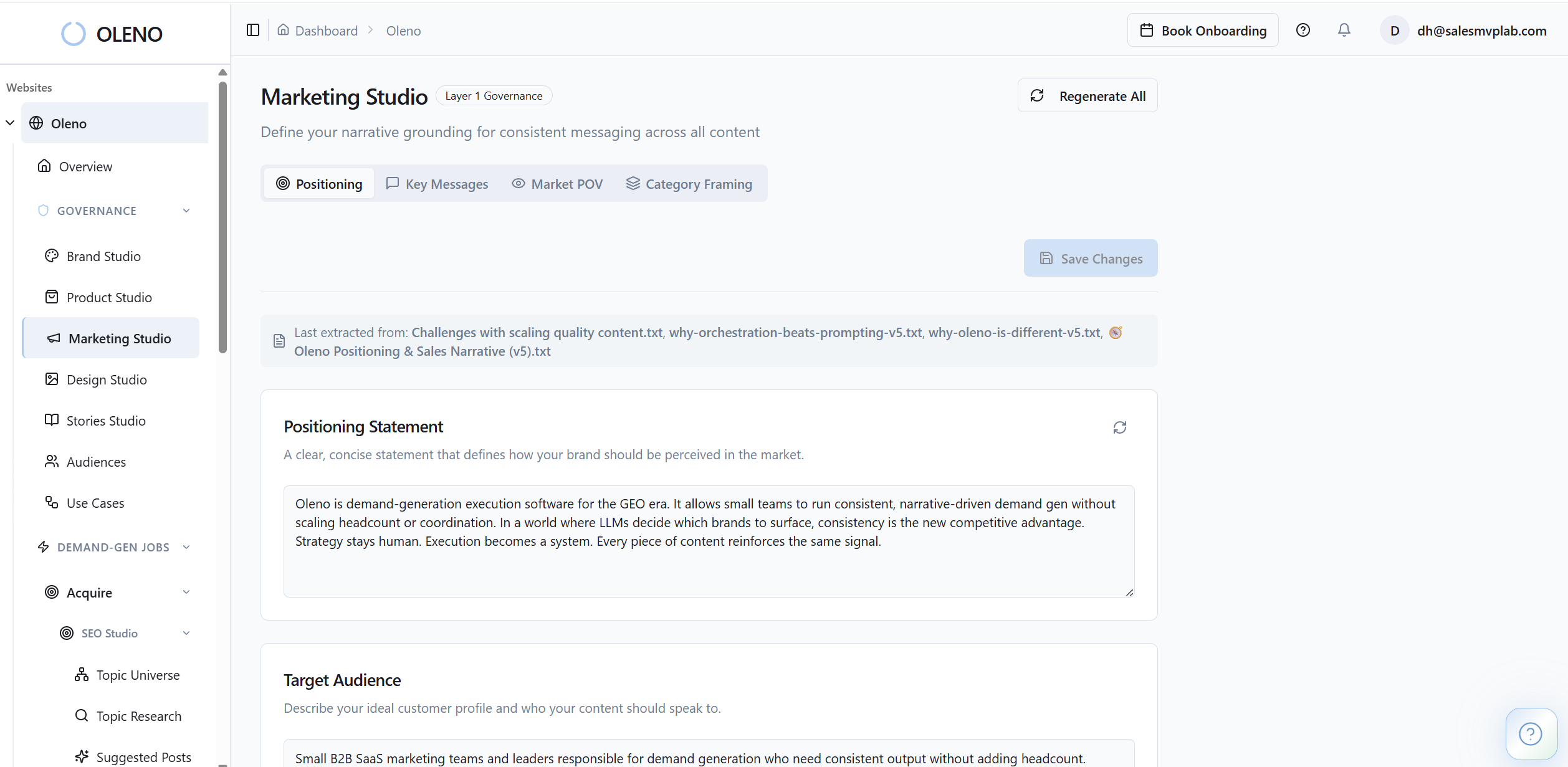
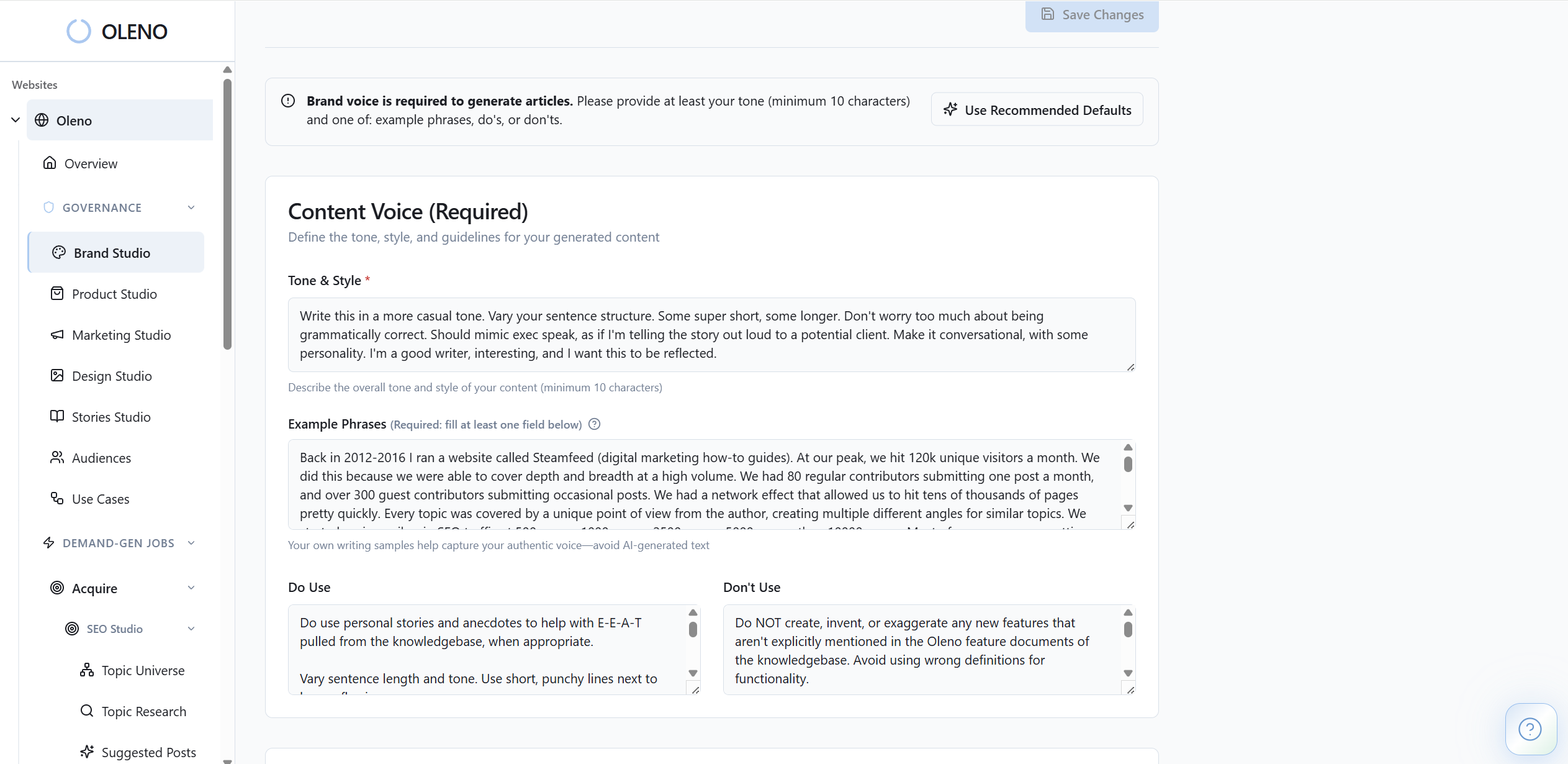
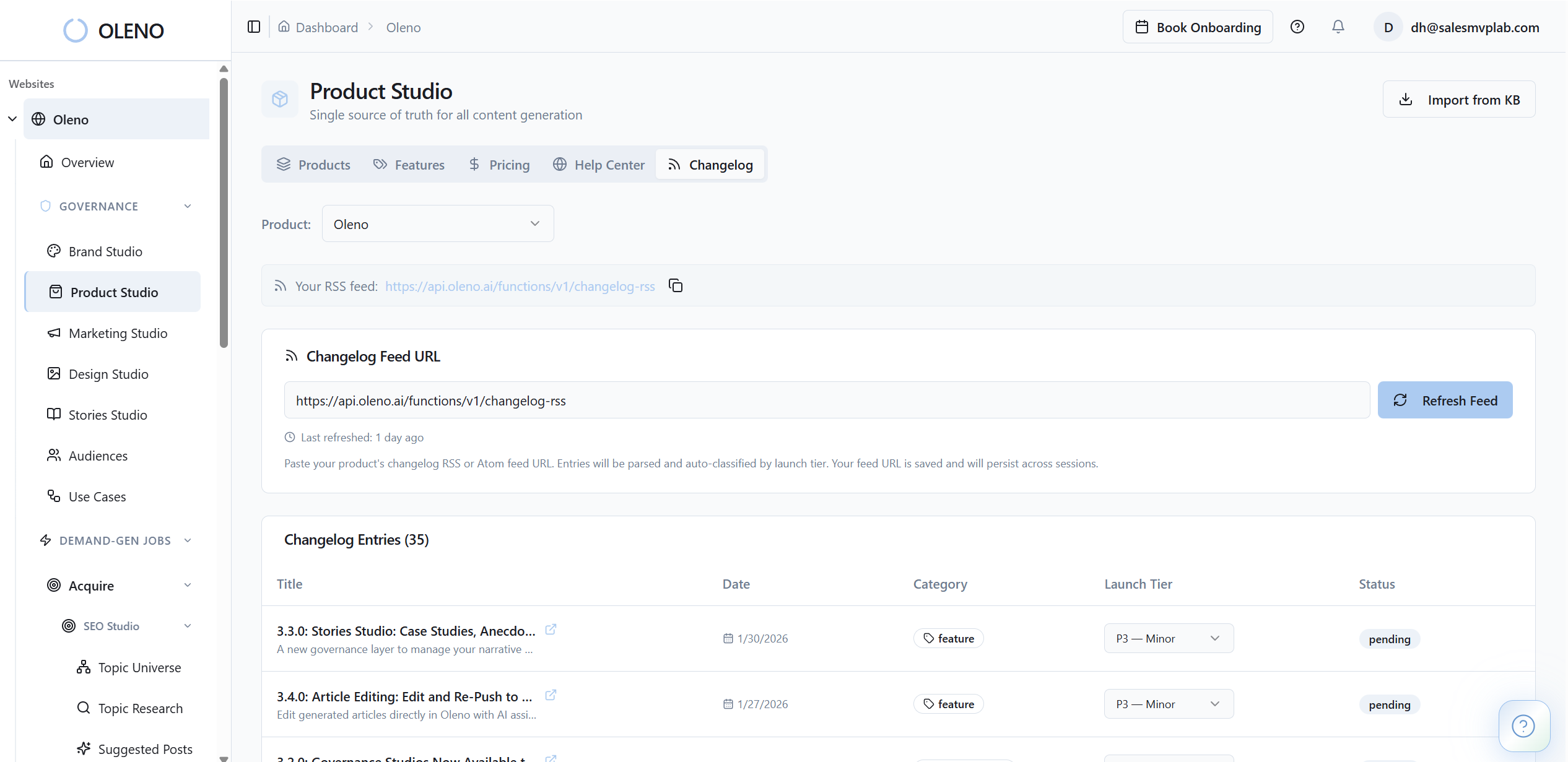
Oleno uses marketing studio to hold your category framing, key messages, and point of view so the content keeps arguing the same core position instead of drifting into neutral education. Brand studio holds the voice rules, style preferences, and structural constraints that usually get enforced late in review. Product studio holds approved product descriptions, boundaries, supported use cases, and other product truth so product-led content is grounded in what’s actually accurate.
That combination matters because it attacks three expensive failures at once: diluted positioning, recurring rewrites, and factual drift. If your recurring review burden is mostly strategic rather than grammatical, this is where the leverage shows up.
The System Connects Audience Context, Job Types, And Cadence
A lot of teams don’t need “more AI.” They need their execution to stop resetting. Oleno connects audience & persona targeting with use case studio so the same topic can be framed differently for the right buyer, role, and situation. Storyboard turns those priorities into a planned mix across audiences, products, and use cases instead of random topic selection.
From there, programmatic seo studio, category studio, buyer enablement studio, and product marketing studio handle different demand-gen job types without requiring the team to reinvent the process each time. The orchestrator then schedules and runs the pipeline against set cadence and priority rules, while quality gate checks whether content meets the standards before it moves forward.
That’s the category becoming real. Not more disconnected drafting. A system where strategy, audience fit, and content execution stay tied together.
The Payoff Is Stronger Signal, Less Rework, And More Useful Output
The payoff isn’t just “more articles.” That would be too shallow. The payoff is that more output has a better chance of sounding like the same company, describing the same market, and reinforcing the same demand-gen narrative.
For growth-stage teams, that can mean moving from scattered 4 to 8 article months toward a steadier 20 to 40 plus publish-ready article cadence in the right use cases, without adding headcount in the same proportion. For product-led content, it can mean fewer PMM rewrites because product studio gives the drafts a verified source of product truth. For thought leadership, stories studio can weave real founder and customer narrative into the work so it carries lived experience instead of generic filler. And cms publishing closes the last-mile headache by pushing finished content directly into your publishing flow.
No tool removes the need for judgment. I wouldn’t claim that. But a better system can remove a lot of the repetitive judgment tax that keeps small teams stuck. If you want to see how that looks in practice, book a demo.
The Moat Now Is The Signal You Can Repeat
AI made content production easier. It did not make coherent demand generation automatic. That’s why consistency is the only moat left in AI search for a lot of B2B teams. Not because tactics stopped mattering, but because tactics without a repeatable signal don’t hold up for long.
Fragmented Demand Generation feels normal because the market has been trained to buy pieces. Piece of SEO. Piece of AI writing. Piece of PMM support. Piece of freelance throughput. But GEO is exposing what those disconnected pieces were hiding: the real shortage is consistent execution. The teams that fix that won’t just publish more. They’ll be easier to find, easier to trust, and easier to remember.
About Daniel Hebert
I'm the founder of Oleno, SalesMVP Lab, and yourLumira. Been working in B2B SaaS in both sales and marketing leadership for 13+ years. I specialize in building revenue engines from the ground up. Over the years, I've codified writing frameworks, which are now powering Oleno.
Frequently Asked Questions